Discover how combining global SAP expertise with local presence in Spain helps companies deliver projects faster, stay compliant, and improve collaboration across teams.
Across Europe, SAP has become a core part of how companies are transforming their operations. They’re updating systems, shifting to the cloud, and reworking processes to run more efficiently.
But as soon as these initiatives expand across countries, things become more complex. What works well globally doesn’t always fit smoothly into local environments, where regulations, working styles, and communication can vary.
In Spain, this becomes especially noticeable. From manufacturing and energy to retail and the public sector, companies are actively investing in SAP S/4HANA and rethinking how their operations work in practice. But these initiatives often need to be adapted to local business realities to succeed.
In reality, success comes down to more than just the technology. It depends on how well the delivery model aligns with local realities — from regulations to decision-making processes.
This is where the gap appears. Global delivery offers scale and experience, but local execution requires a deeper understanding of how the business actually operates.
Why SAP Projects in Spain Lose Momentum Without Local Context
Even with a clear plan and the right technology in place, SAP projects in Spain can start to lose momentum once execution begins. The issue is rarely the system itself; it’s how global delivery approaches align with the way business actually works on the ground.
Spain’s regulatory landscape
SAP projects in Spain operate within a structured and highly regulated environment. These requirements aren’t something you can address later, as they need to be built into the system from the very beginning.
Teams need to account for:
- Spanish GAAP (PGC) and local financial reporting requirements
- VAT (IVA) complexity and reporting cycles
- SII (Suministro Inmediato de Información, Immediate Supply of Information) reporting, which requires near real-time data submission
- Regional e-reporting frameworks such as TicketBAI in the Basque Country
- Labor laws and sectoral collective bargaining agreements (convenios colectivos)
- GDPR requirements along with local enforcement specifics
Another important development is the Ley Crea y Crece, which introduces mandatory B2B electronic invoicing in Spain. The regulatory framework was finalized in 2026, with a phased rollout expected, starting with large companies, followed by SMEs. This is becoming a key driver for SAP-related changes, as companies need to prepare their systems for new digital reporting requirements.
The challenge isn’t just understanding the requirements, but timing. When compliance isn’t built in early, projects slow down due to rework and repeated approval cycles.
Communication and ways of working
In Spain, collaboration is shaped not just by processes, but by how teams interact. Typically, communication often shifts into Spanish, especially during key phases like workshops, testing, and training. At the same time, building trust and maintaining strong relationships play a big role in how decisions are made.
In many Spanish companies, decisions don’t happen in one step — they involve different layers, from operational teams to senior leaders, and sometimes family or executive stakeholders. It can take time to align, but the outcome is usually more stable.
Practical details also matter — from aligning with local working hours to adapting to common practices like shorter Fridays (jornada intensiva), which can affect project timing and availability.
Discussions tend to be iterative rather than purely transactional. Alignment may take longer to reach, but it usually leads to stronger engagement and more lasting results once decisions are made.
Common friction points in SAP delivery
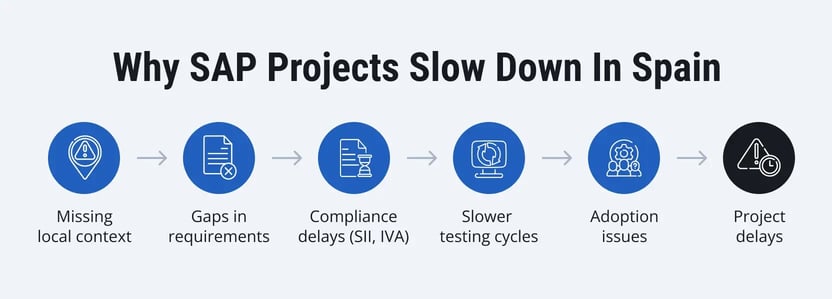
Most delays don’t come from the technical side. They appear at the points where global teams and local stakeholders need to align.
As a result, this often shows up as gaps in early requirements, delays in compliance validation — particularly around SII setup — and slower testing cycles when feedback loops are not well established. Coordination across distributed teams can also become more challenging, especially during critical phases like go-live.
Adoption is another common bottleneck. When users are not fully aligned or engaged early on, rollout tends to slow down and requires additional effort later.
In Spain, in some cases, decisions are rarely made on the spot. They usually evolve through discussion, with input from multiple stakeholders. While this can extend timelines, it also means that once alignment is reached, implementation tends to be more stable.
What changes when teams are closer to the business
Having a local presence helps smooth out these challenges and keeps projects moving at a more natural pace.
It also means understanding regional differences. Business practices and regulatory specifics can vary between regions such as Madrid, Catalonia, or the Basque Country, where frameworks like the Concierto Económico introduce additional considerations.
Shorter feedback loops mean faster issue resolution. When teams understand regulatory requirements in practice, they’re easier to navigate, and clearer communication helps keep everyone aligned.
Being close helps, but it’s not enough on its own. What really makes the difference is understanding how the business actually runs — from decision-making to teamwork — and building the project around that.

Strengthening Our Presence in Spain
As part of the ongoing development of our European delivery model, we’re strengthening our presence in Spain, bringing our teams closer to the business and aligning delivery with how projects are actually executed locally.
This approach allows us to reduce the gap between global coordination and local execution, making SAP projects more consistent and easier to manage.
|
Area |
Without local presence |
With a strengthened presence in Spain |
|
Collaboration |
Fragmented, remote-heavy |
Direct, closer interaction with stakeholders |
|
Decision-making |
Slower, extended feedback loops |
Faster, clearer decisions |
|
Project execution |
Limited on-site involvement |
On-site support during key phases |
|
Coordination |
Cross-border delays |
Smoother, more connected delivery |
|
Delivery model |
Less adaptable |
Flexible, tailored to project needs |
In Spain, where personal interaction and trust matter, this approach makes a noticeable difference. Face-to-face collaboration helps teams align faster, clear up questions more easily, and keep things moving.
We also actively engage with the local SAP ecosystem, including participating in events like SAP Sapphire Madrid, which helps us stay aligned with the latest developments and connect directly with the Spanish SAP community.
Ultimately, it’s about making delivery more practical, combining global expertise with a local presence that reflects how businesses in Spain actually operate.
What We Offer: Local Expertise in the Spanish Context
Delivering SAP projects in Spain requires more than technical expertise. It’s about understanding how companies operate day to day, how decisions are made, how teams collaborate, and what expectations shape project execution.
We combine local know-how with global SAP experience so solutions work in reality, not just technically, but within the way Spanish businesses operate day to day.
Understanding the Spanish market
Spain brings together a mix of industries — from manufacturing and energy to retail and the public sector. While their operations differ, the way projects are typically approached has a lot in common.
In the public sector, this also means working within specific regulatory frameworks, such as the National Security Framework (ENS) and budgetary accounting requirements, which need to be reflected directly in SAP system design.
In practice, this also varies by industry. In manufacturing hubs like the Basque Country and Catalonia, companies are investing in Industry 4.0, where SAP S/4HANA needs to closely integrate with production systems.
At the same time, regional specifics also come into play, including tax and reporting requirements from authorities such as the Agència Tributària de Catalunya (ATC) and the Haciendas Forales.
In retail and consumer goods, the focus is on omnichannel operations, with SAP integrated into local logistics providers such as SEUR or Correos to support fast, reliable delivery.
In Spain, a lot of collaboration comes down to relationships and trust. Decisions usually aren’t made by one person — they involve different people and take time to come together. At the same time, companies still expect structure, with clear processes that can adjust as the project moves forward.
These factors shape how SAP projects move forward — from early planning and workshops to approvals and final rollout.
Regulatory expertise
In Spain, compliance is closely tied to how systems are designed and configured. It’s not something that can be addressed later, as it needs to be considered from the start.
Our teams support clients in working with:
- Financial and tax requirements, including IVA and SII reporting
- HR regulations and labor agreements
- Industry-specific compliance standards
By building these elements into the project early on, we help avoid delays caused by rework, additional validations, or late-stage adjustments.
Alignment with business practices
Beyond regulations, successful delivery depends on how well SAP solutions reflect the way people actually work.
This involves aligning workflows with real business operations, understanding how stakeholders communicate, and fitting into the way governance and approvals are handled day to day.
Here’s how the difference typically looks:
|
Aspect |
Without local alignment |
With local alignment |
|
Communication |
Fragmented |
Direct and consistent |
|
Decision-making |
Delayed |
Gradual but aligned |
|
Workflows |
Generic |
Adapted to real operations |
|
Governance |
Rigid |
Context-aware |
Getting these elements right changes how the project unfolds. Alignment improves, decisions move faster, and the solution is more likely to be used as intended. In Spain, that balance between local understanding and SAP expertise is what makes the difference over time.
How We Work: Delivery That Fits the Spanish Market
SAP projects don’t follow a single delivery model, and in Spain, this is even more noticeable, as timelines, stakeholder involvement, and decision-making styles vary from one organization to another.
That’s why we don’t follow a fixed approach. Instead, we shape delivery around how your teams actually operate, combining global capabilities with a strong local presence.
A model that balances scale and local alignment
Our delivery model brings together nearshore scalability with local expertise in Spain. It’s not about choosing one over the other, but about making them work as a single, coordinated setup.
Nearshore teams make it easier to scale and bring in the right skills, while local experts stay close to the business, helping keep communication straightforward and stakeholders on the same page.
In reality, it means there’s no divide between teams — everyone works together, aligned on the same goals and adjusting as the project evolves.
On-site support where it matters most
In Spain, meeting face to face often makes all the difference. That’s why we’re on-site during workshops, testing, go-live, and training, the moments where quick decisions and clear communication matter most. It helps avoid long discussions and keeps things moving.
Flexible engagement that adapts to the project
Every SAP project evolves over time. Priorities shift, new stakeholders get involved, and requirements can change along the way. That’s why we make flexibility part of the setup from the start. Depending on the project, we can support different engagement models:
- Dedicated teams that work as an extension of your organization
- Project-based delivery for clearly defined scopes
- Hybrid setups that combine consulting, implementation, and ongoing support
As the project progresses, we adjust the setup, scale the team, shift the delivery model, or increase on-site involvement when needed.
In Spain, where decisions often take time and involve multiple stakeholders, this flexibility helps keep projects moving without unnecessary slowdowns.
Built to adapt, not just to follow a plan
Projects in Spain rarely follow a perfectly linear path. Alignment takes time, priorities can evolve, and decisions are often shaped through ongoing discussion.
We build our approach around how projects actually unfold. Instead of relying on a rigid structure, we stay adaptable so things don’t slow down when conditions change. In the end, it’s not just about SAP — it’s about making sure the delivery model matches your business and keeps pace with it.
Our SAP Expertise: Built Around Real Business Needs
SAP in Spain is rarely limited to one function. Finance connects with supply chain, HR impacts operations, and data flows across everything. That’s why we don’t approach SAP as a set of separate modules, as we look at how everything works together in practice.
Core areas we cover
We work across the key SAP domains that support everyday business operations:
- SAP S/4HANA transformation
- Supply Chain Management (SCM)
- Product Lifecycle Management (PLM)
- Asset Management
- Financial Management
- Spend Management
- Human Resource Management (HCM)
- Data and Analytics
- Sustainability Management
In Spain, where industries like manufacturing, energy, and retail rely on tightly connected processes, these areas are deeply interlinked. Solutions need to reflect that — not operate in silos.
Supporting the full SAP journey
We don’t step in for just one phase and step out. Our teams stay involved across the entire SAP journey to keep things consistent and avoid disconnects along the way.
That includes:
- SAP consulting
- SAP implementation and rollout
- System integration
- Migration to SAP S/4HANA
- Application management and managed services
- SAP security
- Change management
- Maintenance and support services
This end-to-end involvement is especially important in Spain, where projects often evolve over time and require ongoing alignment between teams.
Extending SAP beyond the core
For most companies, the real work starts after the core system is in place. The focus shifts to improving processes, connecting systems, and making better use of data.
We support this through:
- SAP Business Technology Platform (BTP) for extensions and integrations
- Data and analytics to improve visibility and decision-making
- SAP Business AI and SAP Joule to automate tasks such as local reporting and reconciliation
In the Spanish market, where efficiency and regulatory adaptation are ongoing priorities, this kind of flexibility helps businesses keep improving without overcomplicating their systems.
Clean Core: keeping SAP flexible without overcomplicating it
Many SAP environments become difficult to manage over time due to heavy customization. While this often solves short-term needs, it can slow down upgrades, increase costs, and limit flexibility later on.
To avoid this, we handle local business nuances through side-by-side extensions on SAP BTP, so companies can keep their specific logic without impacting the S/4HANA core or its upgrade path.
We follow a Clean Core approach:
- Use standard SAP functionality wherever possible
- Move custom logic outside the core via SAP BTP
- Keep systems ready for continuous updates and innovation
At the same time, we recognize that many processes in Spain are shaped by local requirements — from SII reporting and IVA to industry-specific practices.
Instead of removing that flexibility, we keep it just in a more sustainable way. Local extensions are moved to SAP BTP, so they stay part of the solution without making the core harder to manage.
It helps keep a balance between standard SAP and the way the business actually operates. Systems stay easier to upgrade, technical debt stays under control, and moving to S/4HANA becomes a lot more straightforward.

The Real Impact: What Changes in Practice
When global expertise and local presence work together, the difference becomes visible not in theory, but in how projects actually move forward day to day.
Things become more straightforward. Teams align faster, decisions don’t get stuck in long coordination loops, and fewer issues build up along the way.
This leads to:
- Faster progress without constant rework or delays
- Fewer compliance issues later on because requirements are built in early
- More straightforward communication, no need for endless clarification loops
- Less friction across teams, even in cross-border setups
The result is a more predictable, steady delivery process, one where global scale supports progress instead of slowing it down.
Scaling SAP Expertise Across Europe
Our presence in Spain is part of a broader effort to strengthen how we deliver SAP projects across Europe. It’s not about entering a new market, but about evolving our existing delivery model to be more connected, flexible, and closer to our clients.
Over time, we’ve expanded our footprint across the region — from the Nordics to the Baltics, and now further into Southern Europe. The idea is simple: combine global scale with local presence so projects run more smoothly in practice.
Today, this approach is supported by the scale and experience we bring:
- 20+ years of experience in SAP consulting and development
- 1,500+ SAP projects delivered across industries
- 900+ clients worldwide, including Fortune 500 companies and global enterprises
- 2,200+ professionals, including 500+ SAP-certified experts
This combination allows us to support complex, cross-border SAP initiatives while staying close to the business, which is especially important in markets like Spain, where alignment and adaptability play a key role in project success.
Conclusion
SAP transformation in Spain depends on how well the solution fits into the way businesses actually operate. Local regulations, communication styles, and decision-making processes all shape how projects move forward.
When these factors are taken into account early, projects tend to move more smoothly. Teams work more closely, fewer issues build up, and the solution fits better into everyday work.
Global expertise still matters, but on its own, it’s not enough. The difference comes from bringing global expertise and local understanding together. When delivery reflects real business conditions, projects are easier to manage and more likely to hold up over time.