Discover how LeverX supports SAP S/4HANA transformation in the Netherlands with local expertise and global delivery for smooth execution in complex environments.
Across Europe, companies are moving quickly toward SAP-driven transformation. But once projects start spanning multiple countries, things become more complex. What works well at a global level doesn’t always translate into how work actually gets done locally.
That gap becomes more obvious as organizations adopt SAP S/4HANA and start reworking finance, supply chain, and HR in parallel. On paper, it looks structured. Effectively, this becomes a massive coordination challenge—balancing an array of systems, stakeholders, and shifting priorities simultaneously. Within the Dutch market, these complexities are even more pronounced. Companies here function within highly interwoven ecosystems where logistics providers and suppliers are inextricably linked. A minor discrepancy never stays isolated; it ripples outward. This is particularly evident in operations tied to the Port of Rotterdam, Schiphol Airport, and the wider European supply chain. A generic rollout rarely survives that level of interdependency.
Why SAP Projects Slow Down Without Local Presence
Even well-planned SAP programs here tend to lose momentum during execution. Not because of the system itself, but because of how delivery models interact with real operations.
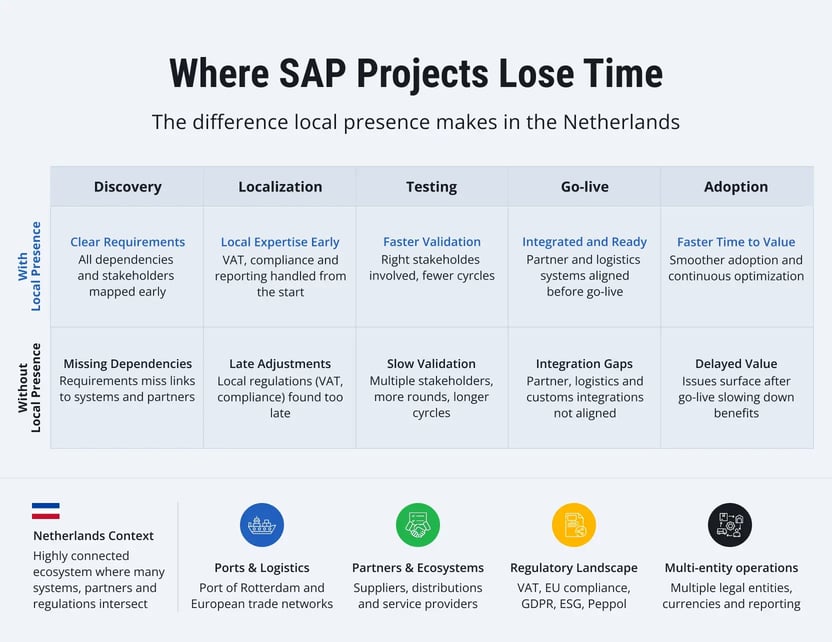
Problems don’t usually appear all at once. They build up. Early requirements might miss dependencies between internal systems and external partners. During localization, teams need to adjust for accounting logic, VAT handling, and EU-level compliance. Testing slows down when multiple stakeholders need to validate the same processes across different systems.
And then there’s the ecosystem factor. Coordination often extends beyond internal teams - logistics platforms, customs interfaces, partner systems. Each dependency adds another point where things can slip. By the time you reach go-live, even small gaps can turn into real pressure.
Individually, these issues are manageable. Together, they drag the project down.
Local presence changes that dynamic. Questions get resolved earlier. Dependencies are handled before they become blockers. Instead of reacting late, teams stay aligned as the project moves forward.
Strengthening Our Presence in the Netherlands
We’re expanding our European delivery network with a stronger focus on the Netherlands. This isn’t about entering a new market. It’s about tightening the connection between global SAP expertise and local execution.
The Netherlands sits at the center of European trade and logistics. SAP programs here rarely operate in isolation. They cut across multiple systems, partners, and regions. Without local coordination, delays tend to compound.
Having teams closer to the business helps reduce that friction. Feedback cycles are shorter. Decisions don’t get stuck in coordination loops. And during critical phases, being on-site makes a difference that remote delivery simply can’t match.
What We Offer: Local Expertise Put to Work
We do more than just understand SAP. Our team bridges the gap between world-class technical skills and a genuine understanding of how Dutch businesses actually function day to day.
Deep market insights
- We have built a solid footprint across logistics, retail, manufacturing, and the high-tech scene.
- Our people thrive in international settings where working across borders is the standard, not the exception.
- We put a heavy emphasis on real-time analytics and automation that actually makes sense.
- We know how to navigate mature digital landscapes where getting systems to talk to each other is a basic requirement.
Navigating regulatory nuances
- Our team has a total handle on Dutch VAT requirements and the specific nuances of Dutch accounting.
- We ensure the needed alignment with the Corporate Sustainability Reporting Directive (CSRD) by structuring sustainability and financial data with the help of SAP capabilities that are aligned with the Green Ledger approach.
- We keep you fully aligned with EU mandates, covering everything from GDPR privacy to ESG transparency.
- You get specialized expertise in digital invoicing and reporting via Peppol.
- We prioritize transparency from the start. This ensures your reporting stands up to even the most intense scrutiny.
- We tackle these factors on day one. It is the smartest way to avoid expensive rework or project timelines that never seem to end.
Syncing with business culture
- We prefer a communication style defined by honesty and flat hierarchies rather than unnecessary corporate complexity.
- Our team promotes a consensus-driven culture, early aligning key stakeholders so decisions hold up during execution.
- At the end of the day, we stay focused on user experience and results you can actually measure.
This balanced approach ensures our collaboration stays lean and effective. We focus on getting it right the first time to avoid that typical, redundant back and forth.

How We Work: Flexible Delivery That Matches Business Speed
Our delivery model mixes nearshore scale with local presence. Local teams handle direct interaction with stakeholders. The broader delivery network provides the capacity needed for larger programs. Everything runs as one setup, not as separate layers passing work between each other.
We adjust how we work depending on the project:
- Dedicated teams embedded into the organization
- Project-based delivery for defined scopes
- Hybrid setups that combine consulting, implementation, and support
In the Netherlands, transformation rarely happens inside a single system. Changes usually affect multiple systems and partners at once. That’s why coordination matters more than methodology.
We focus on being on-site during the phases where alignment is critical — workshops, testing, and go-live. That’s where most delays either get resolved or created.
How We Deliver SAP Across the Entire Business
SAP projects in the Netherlands rarely stay within a single function. Finance connects to supply chain, operations rely on real-time data, and decisions often depend on how well these areas work together. In practice, everything overlaps.
We approach SAP delivery with that in mind from the start - not as a fix later in the project.
Core areas of expertise
Our work spans the main SAP domains that support daily operations:
- SAP S/4HANA implementation
- Supply Chain Management (SCM)
- Product Lifecycle Management (PLM)
- Asset Management
- Financial Management
- Human Capital Management (HCM)
- Data and Analytics
- Sustainability Management
These areas are closely connected in real environments. Designing them in isolation usually creates gaps that show up later during reporting, integration, or planning.
End-to-end delivery
We stay involved across the full lifecycle, from early design through long-term use:
- Architecture and solution design
- Implementation and rollout
- Integration with existing systems
- Migration to SAP S/4HANA
- Support and optimization
- SAP consulting
Keeping everything under one structure helps avoid the usual disconnect between planning and execution. Fewer handovers, fewer surprises.
Beyond the core: integration and extension
In the Netherlands, SAP almost never operates in isolation. Systems are expected to connect across logistics platforms, partner networks, customs interfaces, and external data sources.
We extend and integrate SAP environments through:
- SAP Business Technology Platform (SAP BTP) for extensions and custom applications
- SAP Integration Suite to connect internal and external systems
- Data and analytics tools such as SAP Datasphere, SAP Analytics Cloud, and SAP HANA Cloud
- AI capabilities, including SAP Business AI and SAP Joule
The goal is to expand capabilities without overcomplicating the system. Extensions are built around the core, not inside it.
Clean Core approach
Most SAP landscapes carry years of custom code. It works until it starts slowing everything down. Changes become risky, upgrades take longer, and even small improvements require disproportionate effort.
We take a more selective approach:
- Standard functionality remains in the core
- Custom logic is moved to SAP BTP
- The system stays stable and easier to evolve
Instead of carrying everything forward, we review existing custom developments and keep only what still delivers value. The rest is simplified or redesigned using modern extension frameworks. This also creates a structured data foundation that allows SAP Business AI to generate more reliable insights.
This becomes critical when introducing tools like SAP Joule. AI depends on consistent processes and reliable data. Fragmented logic limits what these tools can actually do. A structured core removes that barrier and makes automation more effective.
We also address “shadow IT” — spreadsheets, standalone tools, and temporary fixes that became permanent. When needed, we standardize these artifacts into governed SAP processes or rebuild them in SAP BTP as custom extensions. The goal is not just a cleanup, but restoring control over how data moves across the organization.

What Our Customers Get
A stronger local presence changes how SAP projects actually run. Instead of long coordination loops, decisions happen faster. Issues are resolved closer to where they occur. Dependencies are handled before they turn into delays.
In practice:
- Timelines become more predictable.
- Regulatory alignment happens earlier.
- Communication stays direct and clear.
- Cross-system risks are easier to control.
In highly connected environments, small disruptions don’t stay small. Fixing them early keeps everything else from slipping.
Strengthening Our European Network
Our presence in the Netherlands builds on a broader European setup — from the Nordics and Baltics to the DACH region.
As SAP programs expand across countries, alignment becomes the real challenge. Without it, the same issues repeat: misunderstood requirements, delayed decisions, and extended validation cycles.
A connected delivery network helps reduce that. Teams follow the same logic, but stay close enough to local conditions to keep things practical.
This is backed by:
- 20+ years in SAP consulting and development
- 1,500+ SAP projects delivered
- 900+ clients worldwide
- 2,200+ professionals, including 500+ SAP-certified experts
At that scale, flexibility matters more than size. It allows us to adjust quickly and keep projects aligned as they grow.

.jpg)