Discover how SAP S/4HANA projects in Finland stay on track with local expertise, regulatory alignment, and practical delivery for cross-border transformation programs.
Across Europe, companies are accelerating SAP-driven transformation. But once projects span multiple countries, a consistent issue appears: global delivery models don’t always translate cleanly into local execution.
This becomes more noticeable as organizations move toward SAP S/4HANA and rebuild processes across finance, supply chain, and HR in parallel. What looks structured at the planning stage often becomes more complex in execution.
In Finland, the challenge is not due to a lack of structure, but often due to the opposite. Highly digitalized environments, standardized processes, and strict regulatory alignment leave little room for ambiguity. A generic rollout approach tends to create friction rather than efficiency.
Why SAP Projects Slow Down Without Local Presence
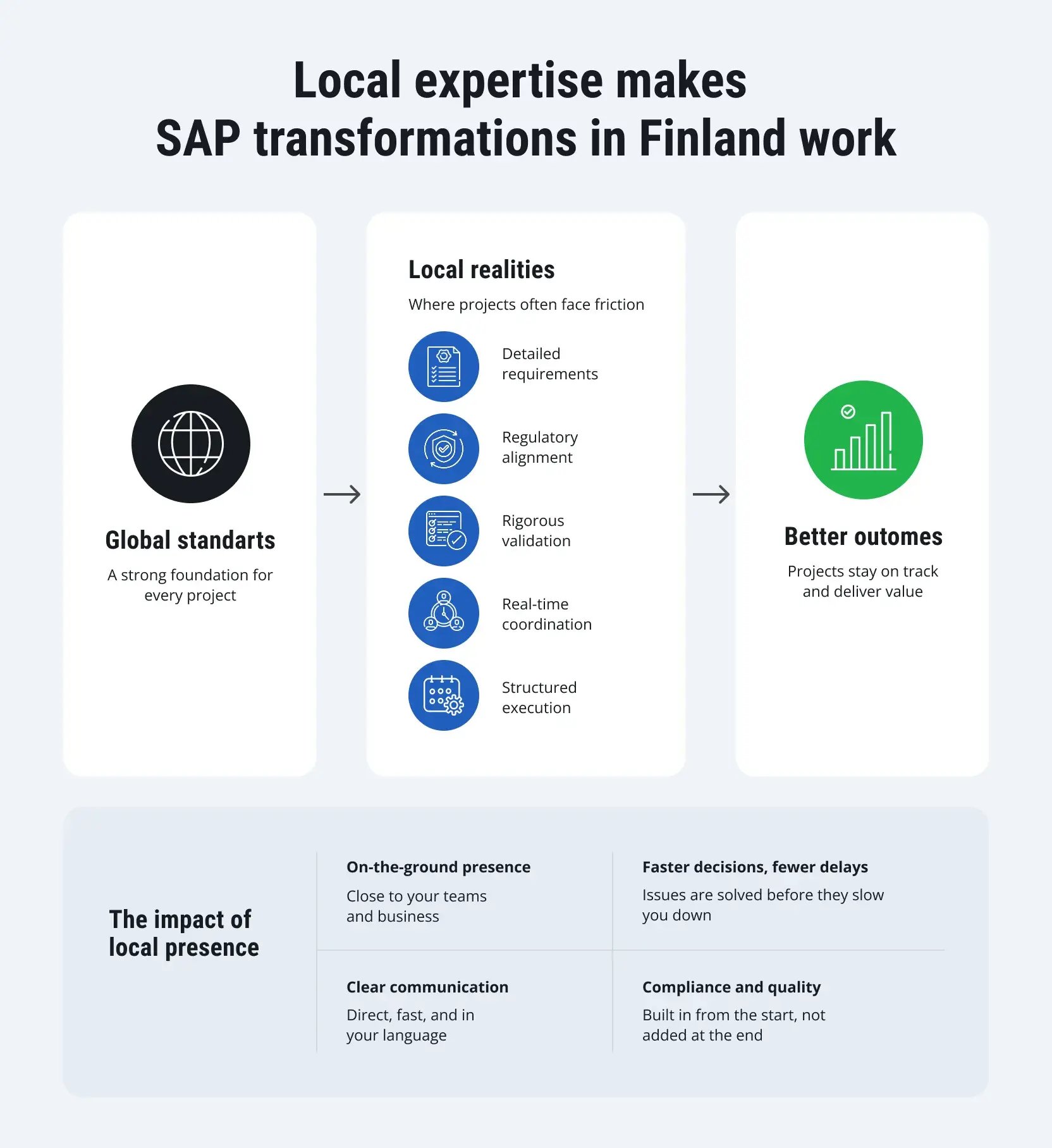
Even with strong planning, SAP programs in Finland can lose momentum once execution begins. The issue is rarely technical. It shows up in how delivery models align with local operating standards. Delays tend to build gradually.
Early requirements may look complete, but miss specific Finnish Accounting Standards (FAS) and e-invoicing nuances. During localization, adjustments are needed to meet Finnish accounting standards and EU regulatory frameworks. Testing phases can slow down when validation expectations are more detailed than initially assumed. At go-live, coordination becomes critical, especially in environments where downtime tolerance is low, and production or logistics environments often require tightly controlled change windows.
These are not major disruptions individually. But together, they extend timelines and increase pressure on later stages.
Local presence changes how this plays out. Clarifications happen earlier, validation is closer to real operating conditions, and communication becomes more direct. Instead of revisiting decisions, teams move forward with fewer interruptions.
Strengthening Our Presence in Finland
We are strengthening our European delivery network with a focused expansion into Finland. This move is less about entering a new market and more about improving how global expertise connects with regional execution. We see a growing demand for models that can manage cross-border complexity without slowing down local progress.
Finnish operations require a high degree of precision and local accountability. Having experts on-site helps bypass the coordination gaps that often happen with remote delivery models. This direct access is especially useful during critical project milestones when quick, face-to-face input is necessary to keep momentum. It also simplifies the work needed to meet specific Finnish VAT (ALV), tax regulations, and EU mandates. By working closer to the actual business teams, you can reach decisions faster and keep the implementation moving at a more predictable pace.
What We Offer: Local Expertise That Works in Practice
We combine global SAP capabilities with teams that understand how Finnish organizations operate.
Market understanding
- Deep involvement with various industries such as manufacturing, energy, forestry, and high-tech
- Significant digital readiness and a high degree of procedural consistency
- Clear expectations around efficiency, transparency, and accountability
Regulatory and ESG expertise
- Finnish Accounting Act compliance, ESG reporting (CSRD), and local tax mandates
- EU-level frameworks, including GDPR and ESG reporting requirements
- Compliance standards unique to specific industry sectors
- Early-stage alignment with these rules to prevent costly system corrections later on
Alignment with business practices
- Direct communication style with low hierarchy
- Data-driven decision-making
- Strong emphasis on reliability and predictable outcomes
This helps keep collaboration straightforward and focused.

How We Work: Flexible Delivery That Adapts to Changing Environments
Our delivery model combines nearshore scalability with local presence in Finland.
Local experts support direct interaction with business teams, while a broader delivery network provides the capacity for larger workloads. The setup is integrated, so teams operate within one structure rather than separate layers.
We adjust engagement depending on the project:
- Dedicated teams embedded into the organization
- Project-based delivery with defined scope
- Hybrid models combining consulting, implementation, and support
In Finland, many organizations prefer hybrid, selective transformation approaches that allow them to modernize core processes and scale capacity while preserving critical data and operational continuity.
On-site involvement is focused on phases where alignment matters most — workshops, testing, and go-live. This helps avoid delays caused by indirect communication.
Our SAP Expertise: End-to-End Across Key Areas
SAP projects in Finland typically involve multiple interconnected functions. Finance, supply chain, and operations are tightly linked, and separating them often creates inconsistencies.
Core areas of expertise
- SAP S/4HANA transformation
- Supply Chain Management (SCM)
- Product Lifecycle Management (PLM)
- Asset Management
- Financial Management
- Human Capital Management (HCM)
- Data and Analytics
- Sustainability Management
We design solutions with these dependencies in mind from the start.
End-to-end delivery
We support the full lifecycle:
- Architecture and solution design
- Implementation and rollout
- Integration with existing systems
- Migration to SAP S/4HANA
- Ongoing support and optimization
- SAP consulting
This reduces fragmentation between project stages.
Many Finnish organizations operate hybrid landscapes, where SAP S/4HANA runs in the cloud while certain systems remain on-premise. We ensure stable connectivity across these environments, keeping data consistent and processes aligned. This includes secure integration through SAP Integration Suite, ensuring reliable data exchange across distributed systems.
Clean Core approach
Many SAP environments rely on accumulated custom code, which complicates upgrades and slows down change.
Our approach keeps:
- Standard functionality in the core
- Custom logic in SAP Business Technology Platform (SAP BTP)
- A stable system that is easier to maintain
We avoid the trap of carrying over every old custom development. Instead, our team reviews current setups and retains only the logic that is still relevant. When the standard SAP environment falls short, we use modern extensions to bridge the gap.
A structured core also supports the use of tools like SAP Joule, which rely on consistent processes and clean data to function effectively. By moving away from fragmented custom code, a business creates a more stable foundation for automation and reporting.
Our process includes finding and removing legacy shadow IT, such as manual spreadsheets or disconnected tools. These are replaced with integrated SAP workflows whenever it makes sense for the business. This shift reduces technical debt and brings every department back into a single, managed environment.
In Finland, audit-readiness and transparency are critical. Organizations are expected to provide clear and traceable data both for external reporting and internal stakeholders. SAP Clean Core supports this by making data structures more consistent, reports easier to generate, and system behavior more predictable. It is focused on meeting compliance and reporting requirements without adding unnecessary complexity.
Beyond the SAP Core
We extend the reach of the SAP environment through the SAP Business Technology Platform and specialized tools:
- Using low-code and pro-code tools to automate manual tasks
- Leveraging SAP Datasphere, SAP Analytics Cloud, and SAP HANA Cloud for a unified view of information
- Managing complex links between different systems via the SAP Integration Suite
- Implementing AI-driven workflows through SAP Business AI (including SAP Joule)
This strategy builds on top of the standard environment while keeping the core system clean and stable. It supports a model of constant improvement where new features can be added without creating technical debt that breaks future upgrades.
What Our Clients Gain
Stronger local presence in Finland changes how projects progress.
Instead of extended coordination cycles, alignment happens earlier. Requirements are validated in context, and issues are resolved before they affect later stages.
In practice:
- Delivery timelines are more stable
- Regulatory alignment is handled earlier
- Communication remains direct and efficient
- Cross-border complexity is easier to manage
In Finland, where processes are expected to be structured and predictable, unresolved issues tend to surface later as delays rather than being absorbed early. Addressing them upfront makes a noticeable difference.
Strengthening Our European Network
Our presence in Finland builds on an existing structure across Europe, from the Nordics and Baltics to the DACH region.
As SAP programs expand across countries, the challenge is maintaining alignment between teams working in different environments. Without that, inconsistencies and delays accumulate.
A connected European network helps reduce these gaps while keeping execution close to local business conditions.
This is supported by:
- 20+ years of SAP consulting and development
- 1,500+ SAP projects delivered
- 900+ clients worldwide
- 2,200+ professionals, including 500+ SAP-certified experts
This allows us to scale delivery while maintaining consistency across regions.