Discover how SAP S/4HANA drives digital transformation in 2026 with SAP Clean Core and AI automation.
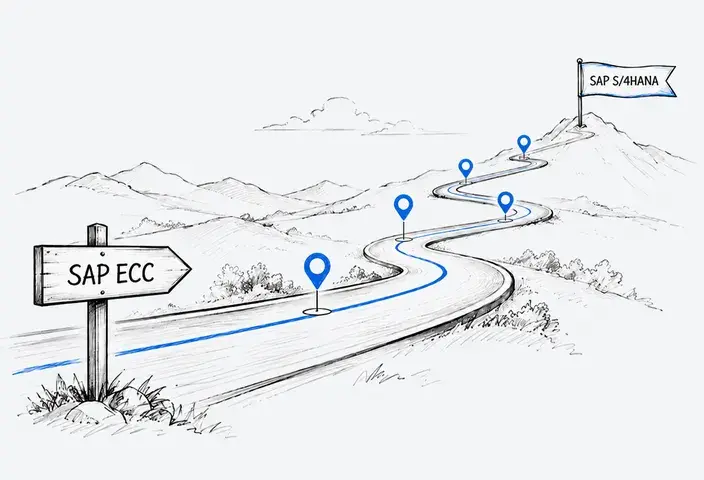
For companies still running SAP ECC, 2027–2030 is becoming a critical decision window. SAP maintenance milestones are approaching, but the challenge goes beyond choosing a migration date. Organizations need to decide what should move to SAP S/4HANA, what should change during the transition, and what ERP foundation they want to operate on afterward. These decisions matter because much of SAP’s current innovation is centered on cloud ERP, SAP Business Technology Platform (SAP BTP), SAP Business Data Cloud, SAP Business AI, and technologies that support more intelligent and increasingly autonomous business processes.
The immediate task for an SAP ECC customer is still the transition to SAP S/4HANA, but the way that transition is designed can shape the next several years of process improvement, integration modernization, data management, and AI adoption. A purely technical conversion may carry inefficient processes, unnecessary custom code, fragmented integrations, inconsistent data, and manual work into the new environment. A more deliberate transformation can establish a digital core that is easier to integrate, govern, upgrade, and extend, creating a stronger foundation for continuous improvement and AI-assisted work.
|
Key takeaways: For SAP ECC customers, 2027–2030 is primarily a window for migration planning and execution. The right deployment and migration path depends on landscape complexity, data, custom code, operating model requirements, and business priorities. At the same time, migration decisions should establish a cleaner digital core, governed data, and an integration foundation that can support continuous improvement, AI-assisted work, and selective autonomous operations after go-live. |
Why 2027–2030 Matters for SAP ECC Customers
The end of mainstream maintenance in 2027 is an important planning milestone, but it does not mean every SAP ECC system suddenly stops operating. According to SAP’s current maintenance strategy for SAP Business Suite 7, mainstream maintenance for core applications, including SAP ERP 6.0 with Enhancement Packages 6–8, continues through the end of 2027, with optional extended maintenance available through the end of 2030.
The position differs in older environments. For SAP ERP 6.0 without an Enhancement Package or with Enhancement Packages 1–5, mainstream maintenance ended in 2025, and customer-specific maintenance applies.
|
SAP ERP environment |
Maintenance position |
|
SAP ERP 6.0 EhP 6–8 |
Mainstream maintenance through 2027; optional extended maintenance through 2030; customer-specific maintenance otherwise or afterward |
|
SAP ERP 6.0 EhP 0–5 |
Mainstream maintenance ended in 2025; customer-specific maintenance applies |
|
Eligible large and complex environments |
A separate SAP ERP, private edition, transition option may provide additional time during 2031–2033 |
The 2031–2033 option should not be interpreted as a general extension of SAP ECC maintenance. In its 2025 update on SAP ERP, private edition, transition option, SAP describes it as a separate, time-bound cloud subscription for certain large and complex customers. Relevant systems must meet specific requirements and move to SAP ERP, private edition on SAP HANA, before the end of 2030.
That changes the practical planning question. Instead of asking only how long SAP ECC can remain in operation, organizations need to determine whether the remaining time is sufficient to assess the landscape, resolve data and custom-code dependencies, redesign what genuinely needs to change, test the target environment, prepare users, and execute cutover without compressing critical work into the final months of the maintenance window.
Recent research also shows why production migration should not be treated as the end of the transformation. SAPinsider’s 2026 ERP Migration and Transformation benchmark, based on a survey of 296 members of the SAPinsider community, found that 55% had deployed SAP S/4HANA or SAP S/4HANA Cloud, while only 34% said they had completed the overall transition. In practice, data cleanup, process improvement, integration modernization, organizational adoption, and other transformation objectives can continue after the production system changes.

SAP S/4HANA Migration and Transformation: What Really Changes
Once the timing question is clear, the next decision is scope: how much of the existing SAP ECC environment should actually be carried forward? ECC systems often represent years or decades of accumulated business logic, workflows, integrations, planning processes, and custom development. Some of those elements still support the business well, while others have become technical debt, redundant interfaces, outdated workarounds, or complexity that remains mainly because no one has revisited the original requirement.
Migration addresses the mechanics of moving the environment, including data, configuration, custom code, integrations, testing, and production cutover. Transformation addresses a different question: what should the target environment look like after that move? Depending on the business case, that may involve simplifying unnecessary customization, improving data quality, modernizing integration patterns, redesigning selected processes, or changing how the environment is governed and extended.
Keeping those questions separate helps control scope. Stable processes do not need to be redesigned simply because a new ERP is being introduced, and mature integrations do not need to be rebuilt for the sake of architectural novelty. At the same time, obsolete custom code, poor data, unnecessary interfaces, and inefficient workarounds should not automatically be reproduced in SAP S/4HANA simply because they existed in SAP ECC. The objective is selective transformation: preserve what still works, change what creates measurable friction, and remove enough structural complexity to make the new environment easier to operate and evolve.
Choosing Your SAP S/4HANA Migration Path
Selective transformation only works when the target state is defined before implementation choices become difficult to reverse. Organizations therefore need to align three related decisions: where SAP S/4HANA will run, which commercial transformation path fits the program, and how the existing ERP landscape will transition to the target environment. Together, these choices influence operating responsibilities, standardization, extensibility, migration flexibility, and the amount of change that can realistically be introduced during the program.
Deployment model
The target environment may involve SAP Cloud ERP, SAP Cloud ERP Private, or SAP S/4HANA on-premises. The appropriate model depends on process requirements, standardization goals, regulatory constraints, existing SAP investments, infrastructure strategy, and how much control the organization expects over its ERP environment.
This makes deployment more than a hosting decision. It can influence extensibility, upgrade responsibilities, operational ownership, standardization expectations, and the migration approaches available to the organization.

RISE with SAP and SAP GROW
RISE with SAP and SAP GROW should not be treated as competing ERP products. They represent different commercial and transformation paths around SAP’s cloud ERP portfolio, so their relevance depends on the organization’s current landscape, target ERP model, transformation complexity, and standardization requirements.
That distinction is particularly important when evaluating an existing SAP ECC environment because the commercial path should follow the intended target architecture rather than substitute for the architectural decision itself. Our comparison of GROW with SAP vs. RISE with SAP examines these differences in more detail.
System conversion, selective data transition, or new implementation
Once the target deployment model is clear, the organization can decide how to move the existing ERP environment. For SAP ERP customers, most programs fall into three broad approaches, and the choice determines how much of the current landscape is preserved versus redesigned.
A System Conversion retains much of the current configuration, processes, and historical data while converting the existing ERP environment to SAP S/4HANA. It can preserve continuity, but it also requires teams to determine which existing customizations, data, and processes still belong in the target system.
A New Implementation creates a new target environment rather than converting the existing one. This provides greater freedom to redesign processes, organizational structures, configuration, and data, but it also requires more explicit decisions about what should be recreated, replaced, or left behind.
A Selective Data Transition sits between those approaches. It allows selected data and configuration to be retained while supporting targeted restructuring, consolidation, or phased transition. If SAP Cloud ERP is the target, the transition follows a New Implementation approach, while System Conversion and traditional Selective Data Transition apply to SAP Cloud ERP Private or SAP S/4HANA on-premises scenarios.
|
Decision factor |
System Conversion |
Selective Data Transition |
New Implementation |
|
Preserve existing processes |
High |
Selective |
Low |
|
Process redesign potential |
Limited to moderate |
Moderate to high |
Highest |
|
Historical data |
Usually retained |
Selected |
Usually limited |
|
Organizational restructuring |
Limited |
Strong flexibility |
Strong flexibility |
|
Legacy custom code |
Requires remediation |
Selective |
Reassessed from the start |
|
Landscape consolidation |
Limited |
Strong use case |
Possible |
|
Typical objective |
Continuity |
Balance continuity and change |
Broad redesign |
The terms Brownfield, Greenfield, and Bluefield are also common in SAP migration discussions. Our comparison of SAP S/4HANA migration approaches explains those concepts and their decision criteria, while SAP Selective Conversion focuses specifically on selective scenarios.
The sequence matters more than the terminology. The migration method should follow the assessment rather than define the strategy before the organization understands its current landscape, dependencies, risks, and target state.
Assess Readiness and Build the Business Case
A realistic SAP S/4HANA migration plan begins with evidence about the current environment. The assessment should cover business processes, the SAP landscape, custom code, data, integrations, security, infrastructure, organizational readiness, and expected business value, but its purpose is not simply to inventory technical objects. It should expose decisions that can change scope, cost, timing, and cutover before they become delivery problems.
Teams need to determine which processes should remain, which require redesign, which systems and dependencies are in scope, which custom developments are still actively used, what data must move, what can be archived, which interfaces need to survive, and whether the organization has the people and infrastructure required to execute the program. A useful readiness assessment, therefore, produces more than a technical checklist: it establishes the likely migration scenario, major dependencies, principal risk areas, implementation assumptions, an initial sequence of work, and a realistic view of what needs to change.
Build the business case around measurable outcomes
Once the current state is understood, the organization can define what success should look like. Maintenance deadlines create urgency, but avoiding a deadline is rarely enough to justify the full transformation program. A stronger business case connects migration to measurable operational, technical, and financial outcomes, such as reduced legacy maintenance effort, a smaller custom code footprint, fewer redundant integrations, stronger master data quality, faster financial closing, better inventory visibility, improved planning, or greater automation.
Those outcomes need baselines before implementation begins. Business measures might include financial close time, order cycle time, inventory turns, and forecast accuracy, while technology measures might include custom code volume, interface failures, availability, or upgrade effort. Organizations can also track data quality, process adoption, exception volumes, automation rates, run costs, migration costs, avoided legacy costs, and realized benefits.
Establishing those measures early matters because not every benefit comes directly from changing ERP platforms. Some result from retiring the old environment, while others depend on process redesign, better data, cleaner integrations, stronger governance, or capabilities introduced after SAP S/4HANA goes live. Without a baseline, it becomes much harder to determine which changes actually produced the expected value.
SAP S/4HANA Migration and Transformation Roadmap for 2027–2030
With the target state and business case defined, the program can move from decision-making into execution. A typical sequence begins with assessment and scope definition, followed by confirmation of the target deployment model and migration approach, process and architecture design, preparation of data, custom code, integrations, and controls, solution build and migration, technical and operational validation, production cutover, and stabilization.
These are implementation stages rather than fixed calendar years. A 2027–2030 program will look different depending on the organization’s starting point, landscape size, migration method, and rollout strategy, but mapping the work against the maintenance horizon helps make dependencies visible.
|
Period |
Illustrative focus |
|
2027 |
Complete readiness assessment, confirm the target architecture and migration approach, mobilize the program, and begin implementation or priority rollout waves. For SAP ERP 6.0 EhP 6–8, mainstream maintenance ends at year-end. |
|
2028 |
Continue build, testing, cutover preparation, and migration waves. Organizations using optional extended maintenance enter the extended-maintenance period while reducing dependencies on SAP ECC. |
|
2029 |
Complete remaining major migration waves where applicable, stabilize SAP S/4HANA environments, decommission unnecessary legacy dependencies, and move deferred improvements into the post-go-live roadmap. |
|
2030 |
Complete SAP S/4HANA transitions for environments that will not use the 2031–2033 transition option. For eligible large and complex environments planning to use that option, complete the move to SAP ERP, private edition, on SAP HANA, and address the required technical prerequisites by the end of 2030. Continue addressing legacy systems and historical data requirements while shifting governance toward continuous transformation. |
This sequence is illustrative rather than prescriptive. Some organizations may finish considerably earlier, while large global transformations can span several rollout waves over multiple years. The workstreams will also overlap: data preparation may begin while target processes are still being refined, integration work may continue through build and testing, and change management should run through the program rather than appear only shortly before go-live.
For multinational organizations, rollout sequencing adds another layer because countries, subsidiaries, business units, or ERP instances may move at different times. Each wave still needs to account for shared master data, intercompany processes, integrations, reporting, and dependencies between entities running SAP ECC and those already operating on SAP S/4HANA.
This is why sequencing matters as much as the list of activities. There is little value in converting obsolete custom code before confirming that its underlying requirement still exists, just as rebuilding every legacy interface before deciding which systems belong in the target architecture only recreates complexity earlier in the program. SAP Activate provides the broader implementation framework used across many SAP programs, but the practical principle remains the same: make major target-state decisions early enough for downstream work to follow them.
Redesign Processes Before Automating Them
Once the migration scope is defined, process improvement becomes more focused. Migration creates an opportunity to change how work gets done, but it should not become an uncontrolled redesign of every business process. The useful question is where the current process creates a measurable business or technical problem, such as manual activity, unnecessary variants, duplicate work, recurring exceptions, bottlenecks, or workflows built around limitations that no longer exist.
Teams can then separate statutory or genuinely differentiating requirements from inherited habits, compare current processes with standard SAP capabilities, and decide where redesign creates enough value to justify the effort. SAP Signavio and SAP LeanIX can support process analysis, target-process design, and enterprise-architecture assessment, while SAP Cloud ALM can support implementation and operational lifecycle management. SAP’s agent-led toolchain connects these and related capabilities across transformation activities.
The principle is scope discipline rather than redesign for its own sake. Stable processes can remain stable, while workflows built around obsolete customization, manual workarounds, or fragmented information may justify more substantial change. This distinction becomes even more important when automation enters the roadmap because automating an inefficient process does not remove the underlying inefficiency; it can simply make the same process run faster.
Build an Architecture for Continuous Change
The same logic applies to architecture. The target environment needs to solve the immediate migration problem without creating another ERP landscape that becomes difficult to modify several years after go-live.
At a high level, that means combining a stable digital core for transactional processes with an integration and extensibility layer for connected applications and differentiated capabilities, a governed data foundation, AI capabilities where they create business value, and transformation-management practices that keep process, architecture, implementation, and adoption decisions aligned. The progression can be summarized as:
Digital core → integration and extensions → governed business data → AI-enabled execution
SAP BTP and integration
SAP S/4HANA rarely operates alone because business processes typically exchange information with other SAP solutions, non-SAP systems, external platforms, applications, and services. SAP BTP can support SAP integration services, extensions, application development, automation, APIs, and event-driven scenarios around the ERP core.
During a migration program, the objective should not be merely to relocate existing custom development and interfaces. The transition creates an opportunity to decouple selected capabilities from the ERP core and reduce the point-to-point integration complexity accumulated around SAP ECC. That gives teams a practical test for every significant interface: should it be retained, redesigned, replaced, consolidated, or retired? The answer should follow the target architecture rather than the fact that the interface exists in the legacy landscape.
Data architecture beyond ERP
A similar shift is happening with data. SAP S/4HANA remains a critical source of operational information, but enterprise reporting, planning, analytics, automation, and AI increasingly depend on information from multiple SAP and non-SAP systems.
SAP Business Data Cloud provides a broader foundation for governed business data, semantic context, analytics, and AI-related scenarios. Within the target architecture, the objective is to make data available with consistent meaning and governance across systems so that downstream analytics, planning, automation, and AI capabilities can work from a shared business context rather than reconcile conflicting definitions each time information is used.
Apply Clean Core and Rationalize Custom Code
Custom code is where the migration decision and the long-term maintainability of the new environment often intersect most visibly. Clean core does not mean eliminating every customization; SAP’s clean-core framework covers business processes, extensibility, data, integration, and operations. For individual developments, however, the first question is more practical: does this functionality still need to exist?
Some developments can be retired because the original requirement has disappeared, while others may now be covered by standard SAP functionality. Where a differentiating requirement remains, teams can determine whether the development should be adapted or redesigned using an appropriate upgrade-stable on-stack or side-by-side extensibility approach.
The business impact extends beyond reducing migration effort. A cleaner core can reduce future upgrade friction, simplify testing, and make it easier to adopt new SAP functionality without repeatedly destabilizing the ERP foundation. Migration is, therefore, a useful point to stop treating every existing development as an asset that must automatically be preserved.
Prepare Data for Migration and Future Intelligence
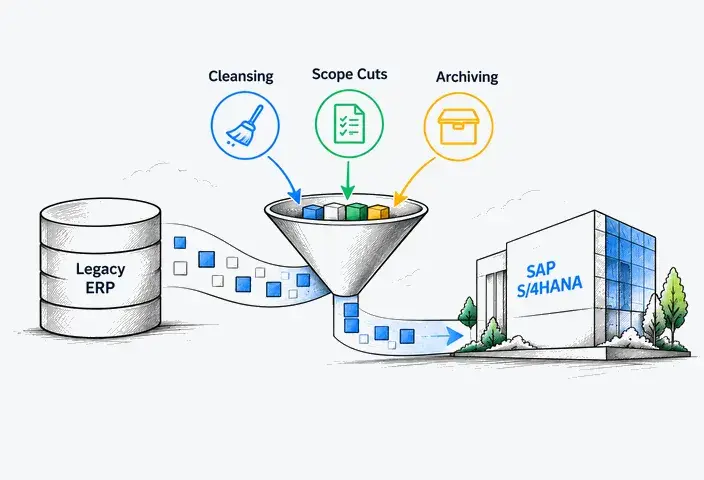
Data requires the same discipline, but the immediate SAP data migration question is narrower: what belongs in SAP S/4HANA, and what should happen to everything that does not move? Answering it requires clear ownership of master data, cleansing and harmonization rules, decisions about historical scope, retention and archiving requirements, reconciliation, validation, and governance after go-live.
The migration method affects the available choices. System Conversion generally retains more historical information, New Implementation provides greater freedom to begin with a cleaner dataset, and Selective Data Transition allows organizations to choose which history and organizational structures move into the target environment. None of those approaches removes the need to consider regulatory, audit, reporting, and operational requirements before information is excluded.
The migration plan should therefore define not only what moves into SAP S/4HANA but also what happens to the legacy environment afterward. Applications that no longer serve an operational purpose may be decommissioned, while required historical information must remain accessible for audit, regulatory, reporting, or business needs. Treating decommissioning as part of the migration lifecycle can prevent organizations from keeping entire applications running indefinitely simply because users occasionally need old records.
These decisions also affect what becomes possible later. As analytics, planning, automation, and AI expand, reliable and semantically consistent information becomes increasingly important. The practical principle is to move the data the future business needs, preserve what regulations and operations require, and establish governance to keep that information usable after migration.
Testing, Cutover, Security, and Business Continuity
All of those design decisions ultimately face one practical constraint: the business still needs to operate during the production switch. A technically functional SAP S/4HANA system is therefore not enough. Testing needs to validate the target environment end-to-end, including configuration, data, integrations, custom code, security, performance, authorizations, and complete business processes.
Mock migrations and cutover rehearsals allow teams to test timing, sequencing, dependencies, reconciliation, and downtime assumptions before the production event. The tighter the business-continuity constraint, the earlier these questions need to influence migration design rather than being left until final cutover planning.
In one LeverX SAP S/4HANA manufacturing project, the production migration had to fit within a three-day holiday window to avoid disrupting manufacturing operations and deliveries. That window is specific to the project rather than a general SAP S/4HANA migration benchmark, but it illustrates the mechanism: an operational constraint affected migration design, testing, and cutover preparation well before go-live.
Security belongs in the same readiness process as business roles, privileged access, technical users, APIs, segregation of duties, and sensitive data access, all of which need to function correctly when the target environment becomes productive. Treating security as part of end-to-end readiness helps prevent a technically successful cutover from creating avoidable operational or control issues afterward.
Make People, Adoption, and Governance Part of the Transformation
Even when the technical cutover succeeds, the operating model may change substantially. Responsibilities and approval paths can shift, exception handling may move to different roles, and reporting, system ownership, and the way employees interact with ERP processes can all evolve. That is why change management should begin during design rather than shortly before training.
Stakeholder alignment, role-impact assessment, communications, superuser networks, training, readiness measurement, digital adoption, and user feedback should evolve alongside the solution. Governance provides the structure to turn that input into decisions, rather than allowing technical and business workstreams to move independently.
Executive sponsors set strategic direction and provide escalation. The transformation office or PMO manages scope, dependencies, and delivery; process owners define how target processes, controls, and KPIs should work; enterprise architects maintain target-state standards; and data owners make migration and data-quality decisions. Security teams manage access and controls, business SMEs provide requirements and validation, IT teams own platform and operational responsibilities, and the implementation partner contributes migration and transformation expertise.
The steering structure is where those responsibilities converge around migration scope, business priorities, architectural choices, constraints, and escalation. Its role should not disappear at go-live, however. Governance needs to transition from the temporary implementation program to the teams responsible for continuously improving processes, data, architecture, and automation.
From SAP S/4HANA to the Autonomous Enterprise
Once the digital core is in place, the role of the migration changes. The question is no longer only whether SAP S/4HANA operates successfully, but also what the organization can build on that foundation.
SAP increasingly uses the term “Autonomous Enterprise” to describe an operating model in which people define objectives, constraints, and policies, while assistants and agents coordinate and execute appropriate work across business processes. In 2026, SAP positioned SAP Business AI Platform as the governed AI foundation for this direction and SAP Autonomous Suite as the application layer that brings AI agents and assistants into core business applications and processes. Joule and related AI experiences connect users with these capabilities across the enterprise, while SAP’s Autonomous Enterprise announcement provides the broader product context.
This transition is not a single technology step because different processes support different levels of automation and autonomy. Stability, risk, data quality, predictability, governance requirements, and the consequences of an incorrect action all influence how far a particular process can move.
Deterministic automation
The first level relies on predefined rules and actions. A system might route an invoice when a threshold is reached, create a task when a status changes, block a transaction when a control fails, or transfer approved information between applications.
The work is automated, but the logic remains predetermined and traceable. This model is particularly appropriate when the business rule is clear, and the expected action can be defined in advance without requiring contextual judgment.
AI-assisted work
The next level uses AI to support human decisions rather than execute the entire process independently. AI can help users interpret information, identify patterns, summarize context, generate content, or recommend actions while a person retains responsibility for the final decision.
In an SAP environment, that could mean explaining financial variances, highlighting operational exceptions, summarizing supplier information, or helping users navigate enterprise processes. The practical value comes from reducing the effort required to interpret information or complete routine knowledge work while keeping human judgment where it matters.
Governed agentic execution
Agentic execution moves beyond recommendations because AI agents can coordinate multiple workflow steps, use authorized business context, interact with applications or services, and escalate situations that require human judgment. SAP’s current direction includes Joule, Joule Assistants, Joule Agents, Joule Studio, SAP AI Agent Hub, and agentic capabilities delivered through SAP Autonomous Suite.
Our article on SAP Joule AI use cases examines agentic scenarios across business functions without turning this migration guide into a product overview. The important shift is not simply that AI can perform more steps; organizations also need to define what an agent is permitted to do, which information it can use, where approvals remain mandatory, and when responsibility returns to a person.
Selective autonomous operations
The longer-term objective is not maximum autonomy across every process. Organizations need to determine which workflows are stable, predictable, governed, and economically valuable enough to support more autonomous execution, while keeping higher-risk, regulated, or ambiguous decisions under direct human control.
An agent might therefore complete routine work within predefined limits while escalating unusual situations to people. Access rights, approval thresholds, monitoring, auditability, accountability, and intervention mechanisms become part of the operating design, not secondary controls added after implementation.
Reaching this stage depends heavily on the foundation established earlier. Poor data, unstable processes, weak integrations, and accumulated technical debt do not disappear when AI is introduced, so the quality of the migration determines how safely and effectively more advanced automation can be added afterward.
LeverX SAP S/4HANA Transformation Maturity Model
The progression toward more autonomous operations also explains why SAP S/4HANA go-live and digital maturity are not the same thing. A company can run SAP S/4HANA while still depending heavily on spreadsheets, fragmented integrations, customized processes, manual exceptions, or inconsistent data, so migration maturity and operating-model maturity need to be assessed separately.
The following LeverX framework illustrates the progression from a fragmented legacy ERP environment toward increasingly autonomous operations.
|
Level |
Operating model |
Technology characteristics |
Priority |
|
1. Legacy and fragmented |
Manual work and local workarounds dominate |
SAP ECC, accumulated custom code, fragmented integrations |
Assess and simplify |
|
2. Standardized digital core |
Core processes become more consistent |
SAP S/4HANA, reduced technical debt, stronger standards |
Establish the foundation |
|
3. Connected and data-driven |
Decisions use more consistent enterprise information |
Modern integration, governed data, cross-process visibility |
Improve coordination |
|
4. AI-assisted |
AI supports selected roles and decisions |
Embedded AI, Joule, predictive, and generative capabilities |
Improve productivity and decisions |
|
5. Governed autonomous operations |
Selected workflows execute with limited manual coordination |
Agents, orchestration, observability, controls, human escalation |
Scale appropriate autonomy |
Migration is the critical step between a legacy ERP environment and a modern digital core, but it is not the final stage, nor does every process need to reach Level 5. A high-volume internal workflow may support substantial automation, while a regulated, strategically sensitive, or ambiguous decision may continue to require direct human approval. A mature organization can therefore operate at several maturity levels simultaneously.
The purpose of the model is not to push every process toward maximum autonomy. It is to help organizations identify what foundation already exists, which constraints remain, and what type of improvement makes sense next.
What SAP S/4HANA Will Not Fix by Itself
Not every transformation problem is a technology problem. SAP S/4HANA cannot assign process ownership, clarify decision rights, create accountability, or ensure employees adopt new ways of working. It also cannot determine which KPIs matter, who owns benefit realization, how exceptions should be governed, or how improvement priorities should be funded after go-live.
A program can, therefore, be technically successful while the operating model around it remains weak. If process owners lack decision-making authority, responsibilities remain ambiguous, users are not prepared for role changes, or governance disappears when the implementation program closes, the organization may struggle to capture the expected value from the transformation.
Technical go-live should not become the sole measure of success. The target operating model, ownership structure, adoption model, governance cadence, and benefit-tracking process all need to continue beyond the production switch. The objective is not to solve every organizational issue before migration, but to identify weaknesses that could limit the value of SAP S/4HANA and address them deliberately rather than assuming the new platform will resolve them.
How Long Does SAP S/4HANA Transformation Take and What Drives Cost?
Once the scope becomes concrete, questions about timeline and cost become easier to frame, but they still cannot be answered with a single number. Timelines can vary widely depending on landscape size, migration approach, data volume and quality, custom-code footprint, integration complexity, rollout model, downtime constraints, and business scope. A Brownfield conversion of one relatively stable ERP instance is fundamentally different from a global transformation that consolidates multiple systems, restructures data, redesigns processes, and replaces a large integration landscape.
Cost varies for the same reason. Major drivers can include software subscriptions or licenses, infrastructure, assessments, implementation services, custom-code remediation, data migration, integration work, testing, security, process redesign, change management, internal resources, cutover, hypercare, and post-go-live optimization.
This makes scope discipline a financial issue as much as a delivery issue. Retiring one obsolete interface, unused custom development, or unnecessary historical dataset can reduce migration effort while also removing something the organization would otherwise need to maintain, test, secure, and upgrade for years afterward.
Post-Go-Live: From Stabilization to Continuous Transformation
Go-live changes the production system, but it does not complete every transformation objective. The immediate priority is stability: teams need to resolve production issues, monitor critical processes and interfaces, confirm data reconciliation, support users, and verify that the new environment operates as intended. Once SAP S/4HANA is stable, the organization can return to improvements that did not need to sit on the migration critical path.
Those improvements may include further process redesign, integration modernization, clean-core work, data-platform enhancements, analytics, automation, and AI adoption. This is also the point when the original business case becomes useful again, as actual processes, technologies, adoption, and financial KPIs can be compared with the baselines and target outcomes established before implementation.
A LeverX transformation for a Baltic heat energy provider illustrates the distinction between migration and the broader transformation lifecycle. The SAP ECC-to-SAP S/4HANA migration took 11 months, followed by four months of post-go-live optimization and support. Those figures describe a single project rather than an industry benchmark, but they show why production migration and transformation completion do not necessarily occur simultaneously.
Over time, the temporary migration backlog should give way to a continuous-improvement backlog. This keeps deferred enhancements separate from the migration critical path while ensuring they are not lost once the implementation program closes.
What Organizations Should Prioritize From 2027 to 2030
The practical priority for 2027–2030 depends on where the organization enters the period. A company still defining its migration strategy has a very different agenda from one that has already stabilized SAP S/4HANA and is preparing to introduce more advanced automation.
|
Current position |
Primary 2027–2030 priority |
|
Still on SAP ECC with no defined migration |
Complete readiness assessment and define the SAP S/4HANA path |
|
Migration approach selected |
Confirm scope, architecture, governance, resources, and implementation sequence |
|
Migration underway |
Protect data quality, scope, testing, cutover readiness, and business ownership |
|
Recently went live on SAP S/4HANA |
Stabilize the digital core and resolve residual migration issues |
|
Mature SAP S/4HANA environment |
Improve integration, data, clean-core alignment, and automation |
|
Strong digital foundation established |
Introduce governed AI and agentic workflows where business value is clear |
For organizations still running SAP ECC, migration readiness and execution remain the immediate priorities. Organizations already operating SAP S/4HANA can instead use the same period to strengthen data, integrations, clean-core alignment, automation, and AI readiness. The roadmap should therefore reflect actual maturity rather than assume that every company starts from the same position or pursues the same destination at the same speed.
FAQ
From SAP ECC Migration to the Autonomous Enterprise
For organizations still running SAP ECC, the immediate 2027–2030 priority is to define and execute the appropriate transition to SAP S/4HANA. The more consequential outcome, however, is the foundation that remains after migration: process scope, data quality, integration architecture, custom code, clean-core principles, governance, testing, and adoption determine how easily the environment can continue to evolve.
Organizations do not need to design every future AI scenario before beginning migration. They do need to avoid decisions that unnecessarily reproduce legacy limitations or make future improvements harder.
The practical objective for 2027–2030 is therefore twofold: complete the transition to a sustainable SAP S/4HANA foundation and use that foundation to establish a credible path toward increasingly intelligent and autonomous operations.
Build Your SAP S/4HANA Roadmap
The first step is to understand the actual starting point: the SAP landscape, business processes, data, integrations, custom code, migration constraints, organizational readiness, and longer-term transformation priorities. That assessment provides the basis for choosing a migration path and separating work that belongs on the migration critical path from improvements that can follow after stabilization.
From there, LeverX can help define the appropriate SAP S/4HANA migration path and build a roadmap that addresses near-term transition requirements without closing off future opportunities for improvement and innovation.