Learn how combining global SAP expertise with local presence in France helps companies deliver faster, reduce risks, and improve cross-border project execution.
Across Europe, companies are accelerating their digital transformation efforts using SAP. But when projects cross national borders, one challenge quickly becomes apparent: successful implementation requires both global expertise and a strong local presence.
In France, this shift is becoming especially visible as companies invest more heavily in SAP S/4HANA, cloud, and intelligent enterprise solutions. Instead of simply upgrading systems, they’re reworking their end-to-end processes — across finance, supply chain, asset management, and HR.
While the strategic direction is clear, execution can become more complex at the local level.
Why SAP Projects Slow Down Without Local Presence
Even the most carefully planned initiatives can run into friction — from regulatory requirements and language differences to the need for in-person collaboration. These real-world factors often add layers of complexity and slow execution, regardless of how well the strategy is defined. In France, these are not exceptions, but a consistent part of project delivery.
Regulatory complexity isn’t optional
France has a well-defined and highly regulated business environment. SAP projects must align with:
- Labor laws and HR compliance requirements, including DSN (Déclaration Sociale Nominative) reporting
- Local accounting and tax regulations
- Data protection standards, including RGPD (France’s implementation of GDPR), as well as industry-specific rules
Even small gaps in localization can lead to rework, longer approval cycles, or compliance issues, especially in finance and HR projects.
Language impacts more than communication
While project documentation may be in English, real collaboration often happens in French.
This becomes critical during:
- Workshops and requirement discussions
- User acceptance testing (UAT)
- End-user training and change management
Without local language support, teams risk misunderstandings, slower decisions, and reduced user adoption.
Where projects typically lose time
The biggest slowdowns don’t happen at the technical level; they happen at the interaction points between global teams and local stakeholders.
|
Project phase |
Where challenges arise |
Impact without local presence |
|
Discovery and blueprinting |
Understanding local processes and business context |
Misaligned requirements, rework |
|
Localization and compliance |
Adapting SAP to French regulations |
Delays in approvals, compliance risks |
|
UAT |
Communication with business users and validation in French-speaking environments |
Slower testing cycles, misinterpretation of requirements, and missed issues |
|
Go-live |
On-site coordination and issue resolution |
Increased downtime risk |
|
Change management and training |
User engagement and adoption |
Low adoption, resistance to change |
Having experts on the ground helps bridge the gap between global delivery models and local realities. It enables:
- Faster, clearer communication with stakeholders
- Better alignment with regulatory and business requirements
- Real-time collaboration during critical project phases
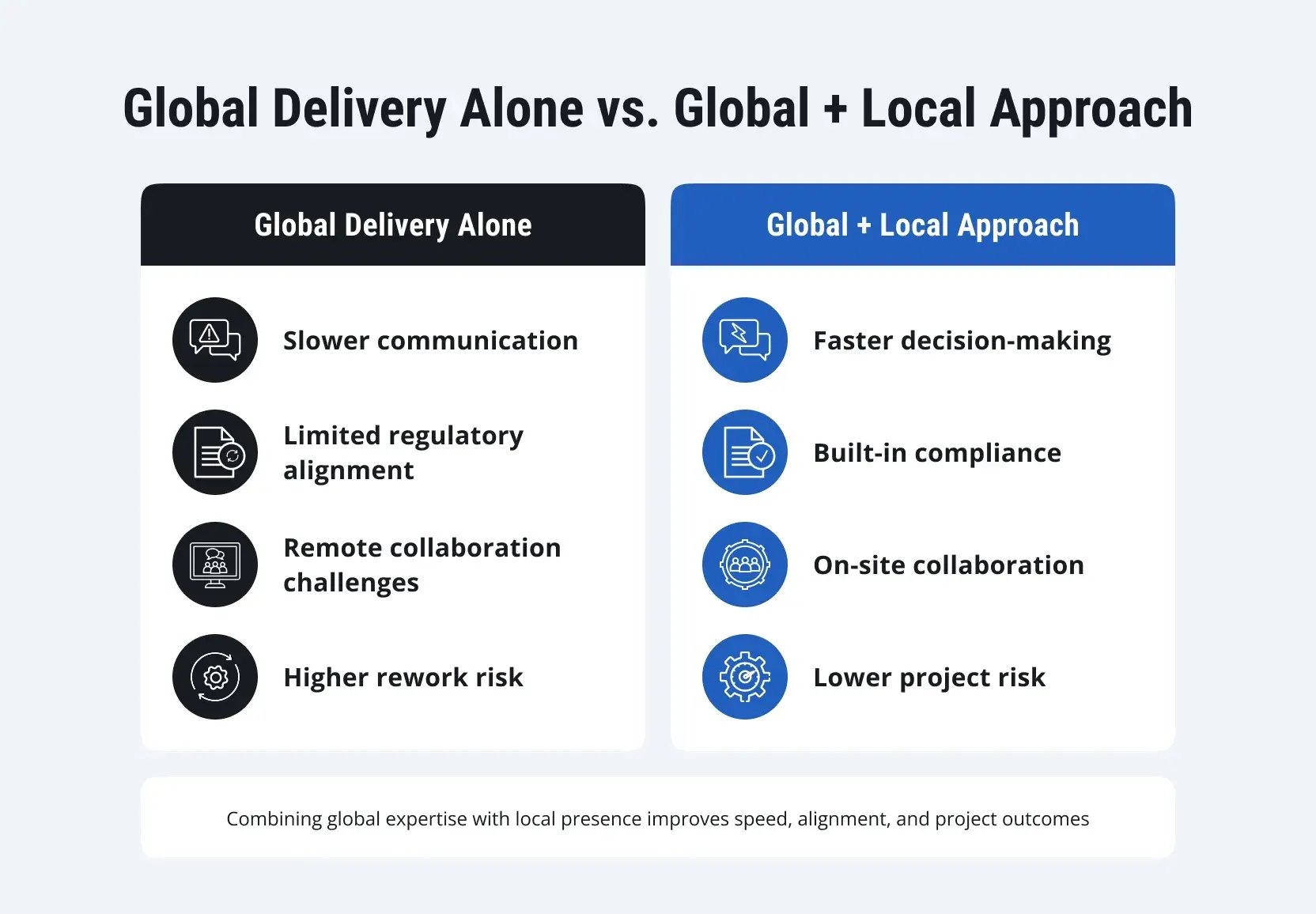
Ultimately, local presence reduces friction, and that’s often what determines whether a project stays on track or falls behind.
Strengthening Our Local Presence in France
To better support our clients, we’re expanding our presence in Southern Europe, including France. We’re seeing a clear shift across projects; companies don’t just need global SAP expertise anymore, they need teams that are close to their business, both geographically and in how they operate.
By strengthening our presence in France, we aim to:
- Work closer to our clients’ teams, enabling faster communication and decision-making
- Improve alignment with local regulations and business practices
- Provide on-site support during critical project phases
- Reduce delays caused by cross-border coordination
- Increase flexibility in how projects are delivered
This approach allows us to better connect global delivery models with local execution, improving speed and reducing project risk. By expanding our presence in France, we are further strengthening our European delivery network to support clients more effectively across regions.
What We Offer: Local Expertise That Delivers Real Value
We bring together local teams who understand the French business environment and regulatory landscape with LeverX’s global SAP expertise.
Deep understanding of the French market
Our teams don’t just know the market — they understand how things really work on the ground. This includes:
- Industry-specific dynamics across manufacturing, energy, retail, and services
- Local decision-making structures and stakeholder expectations
- The pace and style of project execution are typical for French organizations
As a result, SAP solutions better meet the daily needs of businesses. We use industry-specific acceleration tools and proven approaches to speed up processes and ensure that solutions are built with real-world business processes in mind.
Strong regulatory and compliance expertise
We embed regulatory requirements directly into the solution design, ensuring alignment with French standards such as:
- Labor laws and HR compliance, including DSN
- Financial reporting requirements, including FEC (Fichier des Écritures Comptables)
- Data protection standards, including RGPD, as well as industry-specific regulations
This approach helps minimize compliance risks, reduce rework, and keep projects moving smoothly through validation and approval stages, particularly in finance and HR.
Alignment with local business practices
Beyond regulations, successful delivery depends on understanding how teams actually work. Our local presence helps us adapt to:
- Established workflows and operational practices
- Communication styles and stakeholder engagement
- Expectations around documentation, approvals, and governance
In practice, it means smoother collaboration, faster decisions, and solutions that people actually use.
-min-Jul-12-2022-09-46-40-14-AM.jpg)
How We Work: Flexible Delivery Built Around Your Needs
We keep delivery efficient with nearshore teams and step in on-site when it matters most. Since every SAP project is different, we adapt our approach to your scope, timeline, and internal setup.
The right balance of global and local
Our delivery approach is designed to give you both scalability and proximity:
- Nearshore teams ensure cost efficiency, speed, and access to a broad talent pool.
- Local experts provide on-site support when close collaboration is critical.
- A French-speaking Project Manager or Solution Architect acts as a local anchor, ensuring clear communication and alignment with business stakeholders.
- Integrated teams work as one unit, regardless of location.
This allows us to scale resources up or down quickly while staying closely aligned with your business.
On-site when it matters most
Certain phases of SAP projects require direct interaction, and that’s where local presence makes a difference. We provide on-site support for:
- Discovery workshops and requirement gathering
- User acceptance testing (UAT)
- Go-live and hypercare
- Change management and training
This helps ensure faster feedback, clearer communication, and fewer misunderstandings.
Flexible engagement models
We adapt not only to the place of work, but also to the way it is performed:
- Dedicated teams fully aligned with your organization
- Project-based delivery for defined scopes
- Hybrid models combining advisory, implementation, and support
From complete SAP implementation to support in special situations, we tailor our approach to your needs.
Built for real-world execution
We stay flexible, so shifts in priorities don’t slow things down. We can quickly adjust the team, delivery approach, and on-site involvement. This keeps the project efficient and in sync with your teams.
Our SAP Expertise: End-to-End Across Key Business Areas
LeverX works with SAP across all key business functions, focusing on how everything connects and works together in practice. As a long-term SAP partner, we stay up to date with SAP’s roadmap and updates, so our clients can take advantage of the latest solutions and best practices as they become available.
Core areas of expertise
Our experience covers key SAP domains, including:
- SAP S/4HANA transformation
- Supply Chain Management (SCM)
- Product Lifecycle Management (PLM)
- Asset Management
- Financial Management
- Spend Management
- Human Resource Management (HCM)
- Data and Analytics
- Sustainability Management
We don’t treat these as separate areas. In practice, they’re closely connected, and we make sure SAP solutions reflect how your business actually operates across functions.
End-to-end SAP services
We support the full SAP lifecycle — from early planning to long-term support. This includes:
- SAP consulting
- SAP implementation and rollout
- System integration across your IT landscape
- Migration to SAP S/4HANA
- Application management and managed services
- SAP security and landscape optimization
- Change management
- Maintenance and support services
By covering the full scope, we help keep projects consistent and avoid gaps between strategy and execution.
Beyond core SAP
We also help extend SAP capabilities using SAP Business Technology Platform (BTP) and related solutions:
- Application development and process automation
- Data and analytics (SAP Datasphere, SAP Analytics Cloud, SAP HANA Cloud)
- Integration with SAP Integration Suite
- AI-driven scenarios with SAP AI services, including SAP Business AI and SAP Joule
This allows us to extend SAP capabilities while keeping the core system clean and stable, supporting continuous improvement without compromising upgradeability.
Clean Core approach
Many SAP landscapes — especially legacy ECC systems — are heavily customized with Z-code. While this can solve short-term needs, it often makes future upgrades slower, more complex, and more expensive.
Our approach is based on a Clean Core strategy. We keep the SAP core as close to standard as possible and move custom logic to SAP BTP when needed. This means:
- Using standard SAP functionality wherever possible
- Extending and customizing processes through BTP instead of modifying the core
- Keeping the system ready for regular updates and new SAP releases
This approach helps reduce technical debt, simplify the upgrade to SAP S/4HANA, and ensure long-term flexibility. It also allows customers to more quickly implement new SAP capabilities without reworking existing configurations.

What Our Clients Gain From Our Expanded Presence
With stronger local capabilities in France, our clients benefit from a more practical and efficient approach to SAP delivery.
In practice, this means:
- Faster project delivery with local teams supporting critical phases
- Better alignment with country-specific regulations from the start
- More efficient communication with local stakeholders
- Reduced risks in cross-border SAP implementations
With local experts involved, issues are resolved faster, approvals move more smoothly, and collaboration becomes more straightforward.
For companies running cross-border SAP initiatives, this makes a real difference, helping avoid misalignment and keep projects on track across multiple locations.
Strengthening our European network
This expansion strengthens our presence across Europe — from the Nordics and Baltics to Southern Europe. It’s not about entering new markets, but about building a more connected and responsive delivery network that supports clients wherever they operate.
Today, LeverX brings:
- 20+ years of experience in SAP consulting and development
- 1,500+ SAP projects delivered across industries
- 900+ clients worldwide, including Fortune 500 companies and global enterprises
- 2,200+ professionals, including 500+ SAP-certified experts
This scale allows us to deliver complex SAP projects globally while staying close to local business needs.
Conclusion
As SAP projects grow more complex and cross borders, it gets harder to turn strategy into real execution. What works globally doesn’t always work the same way locally.
That’s why proximity matters. When your team is close to the business — speaking the same language and working in the same context — it’s much easier to handle complexity, respond quickly, and keep everything on track from start to finish.
By strengthening our presence in France, we’re making SAP delivery more connected, more responsive, and ultimately more effective for companies operating across Europe.