Discover how SAP enables enterprise project management with financial transparency, portfolio governance, and scalable cloud delivery.
Across most industries, the way work is organized has changed. Companies no longer run a small number of clearly separated projects. Instead, they manage dozens or hundreds of initiatives at the same time, such as product development, IT modernization, engineering changes, market rollouts, and internal transformation. In many organizations, this has effectively created a project-based or hybrid operating model. Projects are now one of the main tools for executing strategy, not just a delivery function.
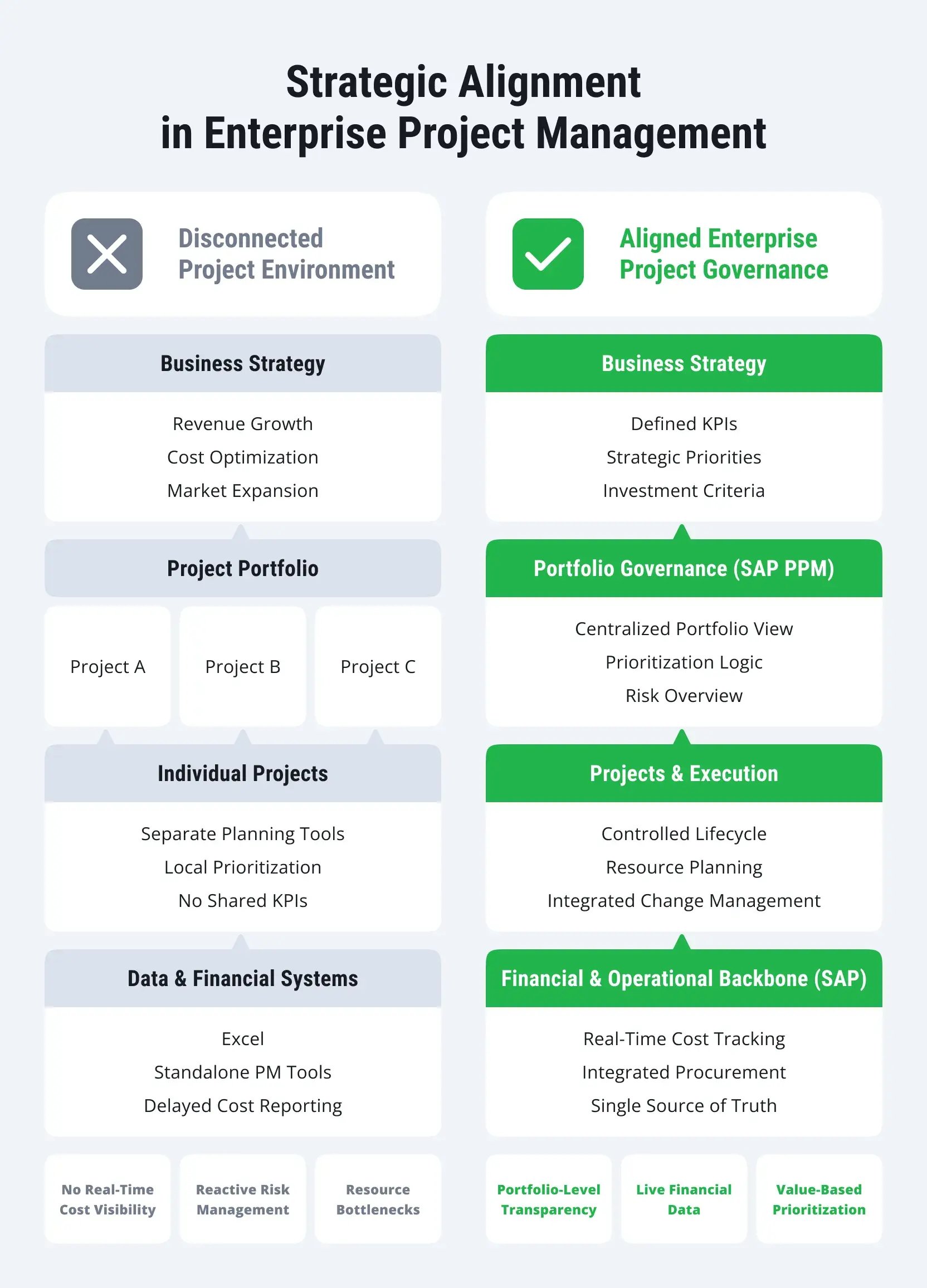
What has not always changed at the same pace is how these projects are managed. As delivery becomes more complex and more cross-functional, teams still rely on Excel files or standalone project tools. This approach breaks down quickly in practice. When cost data lags, your financial goals lose touch with reality. Management then ends up missing the big picture because they don't have one consistent view of the entire portfolio. As a result, it becomes more difficult to understand which projects actually contribute to your goals, control the general spending, and prioritize initiatives.
Conflicting Priorities: When Project Management and Business Strategy Are From Different Planets
When project management is not connected to business planning, problems rarely appear overnight. They tend to build up gradually. Projects continue to move forward, teams stay busy, and reports are still produced. Yet at some point, the results no longer match expectations, even though a lot of effort is being invested.
In practice, this misalignment usually becomes visible through a number of recurring scenarios.
1. Budget overruns erode profitability
Cost overruns don’t usually come from one dramatic failure. More often, they grow out of small gaps in visibility. Planning is done manually while real costs are captured later in financial systems. When the issues become visible, the project has already moved too far, and it’s hard to correct the course smoothly.
When the numbers don't add up, confidence vanishes. It’s a tough spot for any company when profits are shrinking, and nobody can tell if the next forecast will actually hold true. The real kicker? You might hit every project deadline on the calendar, but still see zero impact on the bottom line. Over time, it starts to feel like you’re just dealing with resource drain without seeing any real return for the effort.
2. Delays slow time-to-market
When information is scattered, projects can stall. If your team muddles through various tools and documents just to find an update instead of using a unified source of truth, they are hardly working.
The fallout is painful: products hit the shelves late, and you’re forced to tell customers that you can't meet your promises. In a competitive landscape, those lost weeks are expensive. While you’re stuck in coordination mode, your rivals are already shipping and scaling.
3. Risks and resource utilization stay hidden
Without a portfolio-level view, risk management becomes reactive. Teams focus on their own delivery, while broader constraints remain invisible until they cause disruption.
Resource planning follows the same pattern. Skills and capacity are assigned locally, without a clear picture of how resources are used across the organization. The result is familiar: key initiatives wait for critical specialists, while lower-priority work continues simply because it was started earlier. Over time, delivery risk increases not necessarily because teams perform poorly, but because decisions are made without enough context.
4. Project failures damage brand and customer trust
When misalignment persists, the effects eventually reach outside the organization. Missed deadlines, inconsistent quality, and unclear ownership reduce customer confidence. Any single issue might be manageable, but repeated delivery problems change how the business is perceived.
Customers stop trusting commitments. Loyalty declines. Repeat engagements become harder to secure. At this point, project management is no longer an internal efficiency issue; it becomes a factor that directly influences brand value and long-term relationships.
Beyond the To-Do List: The Shift To Enterprise Project Governance
For years, companies viewed project management as a get-it-done function. Success was measured by checklists, deadlines, and individual tasks. That’s fine for a small, standalone task, but it’s a recipe for chaos when your projects start hitting the bottom line or driving major strategy. When the stakes get this high, you can’t just manage projects in a vacuum anymore; you have to govern them as a living, breathing part of the whole business.
The breaking point of traditional methods
The problem with old-school project tools is that they weren't built for the big picture. They’re great for checking off milestones, but terrible at talking to the rest of the company. In most setups, your money data is in one silo, your people are in another, and your supply chain dependencies are essentially invisible to the project lead.
Reporting in this world is slow and manual. You’re basically looking at a snapshot of the past. By the time a report reaches a manager’s desk, the reality on the ground has already shifted. As you scale up, this lack of transparency makes it impossible to know which projects actually deserve your attention and which are just low-value initiatives.
Getting the full picture
When projects are linked together, you need a view that goes deeper than just a status bar. It’s about seeing the why and how simultaneously, meaning that you understand how a massive portfolio breaks down into small, daily activities. Without this context, you’re just guessing.
Real visibility means pulling your budget, your team’s bandwidth, and your project risks into one single dashboard. When this data is live, you can actually get ahead of problems. Instead of doing damage control after a bad report, you can pivot in real-time based on what’s happening right now.
Project management as a strategic asset
At a certain point, a company realizes that project management isn't just about delivery, but about a core business strength. A project’s success is more about whether it actually moved the needle on your long-term goals. Financial targets and strategic KPIs become the foundation of the plan, not just an afterthought.
This shift changes how you spend your money. You start investing based on where the most value is, not just where you’ve always spent it. It gives leadership the control they’ve been missing, ensuring that every hour worked and every dollar spent is actually building a more sustainable future.
.jpg)
How SAP Actually Handles Project Management
SAP doesn’t look at project management as just another app you install and forget. Instead, they’ve woven it into the very fabric of the business. This is a massive distinction: in the real world, projects don’t live in a bubble; they eat up budgets, consume parts from the warehouse, and require real people from HR. To manage them well, you need a platform that connects all those dots without forcing you to copy and paste data between systems.
What makes this possible in modern SAP landscapes is what is increasingly referred to as the Digital Thread. In simple terms, it’s a continuous flow of connected data across systems and business functions. Instead of moving information manually between tools, the Digital Thread links design, planning, finance, procurement, and execution into one structure. By integrating SAP PPM, SAP S/4HANA, and SAP PLM, organizations create that thread from the first product concept in R&D to final delivery and financial settlement.
Governance and strategy with SAP PPM
Think of SAP Portfolio and Project Management (SAP PPM) as your project command center. It’s where you stop looking at tasks and start looking at investments. It gives you a central place to store your data, but more importantly, it helps you apply a consistent set of rules to your entire portfolio. It’s the tool that helps you spot two projects competing for the same budget before it becomes a problem, ensuring that every initiative actually matches your high-level business goals.
SAP S/4HANA as the financial backbone
While SAP PPM handles the big-picture strategy, SAP S/4HANA is where the heavy lifting happens. It acts as the financial engine. Because your project costs are tied directly to the general ledger and procurement team, you get a view of your margins in near real time. You’re no longer waiting for a month-end report to find out you overspent. Working with a single source of truth means that the exact state of your business is reflected at this very second.
Bridging the gap with SAP PLM
For companies that actually build physical products, digital twins, or service-oriented lifecycles, SAP Product Lifecycle Management (SAP PLM) isn’t just a layer of control. It stands as the product discovery and engineering foundation on the project landscape, where engineering specifications, Bills of Materials (BOMs), and R&D requirements become structured objects that define the project. When a design changes, it’s all reflected in timelines, procurement needs, and cost structures, keeping the entire lifecycle in sync.

Real-time insight and the cloud
Transparency is only useful if the right people can see the right data. SAP’s analytics tools, particularly SAP Analytics Cloud (SAC), take the mountain of information generated by your projects and turn it into dashboards that actually make sense. Whether you’re a CFO looking at total spend or a Lead Engineer looking at design cycles, you get the view you need.
By moving these capabilities to the cloud, SAP makes collaboration easy. It doesn’t matter if your team is in a different time zone; everyone is looking at the same live data. Plus, with predictive tools, you’re getting a forecast for your projects, allowing you to plan for obstacles before you hit them.
Core Strengths of SAP-Driven Project Management
When you pull SAP components into a single environment, project management stops being a game of manual tracking. It becomes a command center for the entire business. You are no longer looking at isolated schedules because financials and operations stay in a tight automated loop. In a mature environment, these four pillars usually define the success of the rollout.
Tight control over the project lifecycle
A structured lifecycle is more than a roadmap. It is the foundation of the business. Projects move through rigid gates starting with the initial justification and ending with formal closure. Every step is logged and tied to a budget or a specific business goal. This creates a clear digital trail. It does not mean you lose flexibility, but it ensures that the choices made on day one stay visible throughout the execution. When you finally close a project, the financial reconciliation actually means something because the data was handled correctly from the start.
Live financials and precision cost control
The real differentiator here is the direct link to the ledger. In SAP, budgets are not static numbers in a spreadsheet; they are live entities connected to actual spending. As the project moves, your forecasts update based on real-time data instead of hopeful guesses. This turns variance analysis into a proactive tool. Instead of waiting for a final report to find out the project lost money, management can see the margins while the work is still live. This makes corrective action possible before the budget is gone.
Smart resource and capacity planning
In big organizations, the bottleneck is rarely the technology. It is very often the people. SAP allows for a high-level view of how capacity is spread across the entire portfolio instead of just a single project. This allows for skill-based allocation. You stop assigning people just because they are available and start matching expertise to the actual requirements. You can monitor utilization in real-time to prevent the burnout of your top specialists while making sure nobody is sitting idle.
Detecting risks before they become fires
Risk management should never be a side conversation. When risks are documented directly in the project framework, they become measurable. You assign owners and track mitigation efforts to move away from informal check-ins. By using scenario modeling, teams can look ahead to see what happens if the scope creeps or if a key resource is pulled. You can assess the fallout before it happens. This shifts the team from reactive firefighting to strategic planning. That is usually where the real value is hidden.
Cloud-Based PM: Moving Toward Resilience
For many organizations, the debate over cloud adoption is effectively over. Moving project management to the cloud is more than a trend but a survival tactic driven by the need for scale and speed. When project landscapes get messy, local hardware starts to feel like a leash. You need systems that actually handle distributed teams and erratic workloads without piling on more admin work.
The real win here? You stop “babysitting” local servers. Performance scales as you grow, and updates just happen. This removes the technical friction that usually kills a project when you try to expand into new regions or spin up a fresh initiative on short notice.
Why the cloud is the new baseline
It really comes down to how we work now. Your team isn't sitting in one room; they’re spread across four time zones. Having one source of truth without version-control nightmares now becomes the bare minimum.
Then there’s the scale factor. Project data grows fast. Cloud deployment lets you bump up capacity instantly, skipping those long, painful hardware procurement cycles. Plus, having live financial data at your fingertips means you’re actually making decisions based on today’s reality, not last month’s reports.
The SAP Cloud reality
In the SAP world, this isn't a one-size-fits-all situation.
- S/4HANA Cloud: This is the go-to for a "clean core" strategy. It’s standardized, it updates itself, and it cuts down on the mess of custom code.
- The hybrid state: Let’s be honest. Most big organizations aren't 100% cloud yet. They have legacy systems or regulatory rules that keep some data on-premises. The key is making sure the cloud and on-premises data centers actually talk to each other. SAP’s architecture is built for this coexistence, allowing data to flow back and forth without you having to build everything twice.
Shifting the collaboration dial
Cloud setups change how we talk to each other. Internal teams get what they need without waiting for a manual spreadsheet consolidation. You can even plug partners directly into the workflow via controlled access, which kills the need for those endless status update emails.
Sometimes, you even give the customer a window into the progress. That level of transparency is a double-edged sword, but it forces clear ownership and stops arguments on long-term contracts.
SAP EPM Success: Beyond the Software
If there is one thing experience teaches us, it’s that technology alone won't fix project performance. The real difference between a system that drives growth and one that just generates more paperwork lies in the implementation strategy. Here is how to actually make it stick.
Don't just track—align
Before anyone starts configuring workflows, you have to nail down the "why." It sounds basic, but many portfolios grow into bloated lists of tasks that have zero connection to the company's actual goals.
- The reality: When you define strategic alignment upfront, the noise disappears.
- The benefit: Projects aren't just judged by who is shouting the loudest or which deadline is closest. Instead, you evaluate them based on real impact, like cost optimization or revenue growth. It turns governance from a debatable prioritization task into a logic-based process.
Standardize now, scale later
SAP is deep. You could customize it forever, but you shouldn't. Sticking to fit-to-standard processes is the only way to keep the system maintainable long-term. Every piece of custom code you add is just another hurdle for future upgrades. The goal is a scalable architecture that lets you add a new business unit or a new country next year without having to rebuild the foundation.
Why the "Big Bang" usually fails
Trying to transform everything at once is a recipe for disaster. A phased approach is far more practical because it lets you stabilize the reporting and fix the inevitable data bugs before moving to the next stage. The glue that holds these phases together is governance. If roles and decision paths aren't crystal clear from the jump, people will just default back to their old, inconsistent habits. A well-designed system is useless if no one agrees on who actually owns the data.
Focus on value, not just deadlines
Being on time and under budget is the bare minimum. Truly mature organizations look at the bigger picture. Did the project actually move the needle on business performance? Once you start measuring financial impact and risk reduction instead of just delivery dates, the project management office stops being a cost center and starts being a strategic asset.
Building PM Maturity With LeverX
Developing a serious, enterprise-grade project management capability takes more than just a new software license. It’s a process that starts by taking a hard look at where you actually are. It’s necessary to identify the specific spots where governance is weak or where financial data is a black hole. LeverX doesn't just hand you a best practice template; we dig into these gaps to figure out what the next practical steps look like for your specific setup.
SAP PPM and SAP S/4HANA connection
The real work happens where SAP PPM and SAP S/4HANA meet. You can’t have your project plans living in one world while your financial data lives in another.
- The integration: We sync project structures and operational flows so they actually talk to one another.
- The payoff: This kills the need for manual data reconciliation. Your forecasting and cost controls finally stay consistent because they’re pulling from the same source of truth.
Beyond the go-live
Every industry has its own rhythm. Engineering, manufacturing, services, the pharmaceutical industry, and the food and beverage industry don't follow the same project logic, so your system shouldn't either. We adapt the architecture to match those specific dynamics. We don't just walk away once the system is live, though.
Business needs to shift. Markets change. Because of that, your PM framework can’t be static. We stick around to help with the ongoing tweaks and optimizations required to keep the system useful as your organization evolves. It’s about building a framework that’s flexible enough to grow with you, rather than a rigid tool that people eventually stop using.
The Bottom Line: Project Management as a Growth Driver
At this point, it’s clear that project management has outgrown its task coordination roots. In the real world, projects are the primary way companies actually execute change, whether that’s a product launch, an operational overhaul, or a move into a new market. Because these initiatives are the business, the way you govern them is a direct predictor of your long-term competitiveness.
You can't lead a company on guesswork. If your data is fragmented, your decisions on budgets and priorities will be, too. True clarity only comes when your project structures, financial data, and operational reality are linked. This isn't just about better reporting; it's about seeing exactly which initiatives are creating measurable value and which ones are just burning capital.
This is specifically where an integrated SAP foundation changes the math. By housing portfolio management, lifecycle tracking, and financial analytics in one ecosystem, you can scale up without the usual visibility blackout that happens as organizations grow.
Ultimately, enterprise project management shouldn't be viewed as just a delivery discipline or a set of administrative hurdles. It’s a strategic asset. When done right, it provides the transparency and control necessary to turn project execution into a reliable engine for sustainable growth.