Explore how SAP S/4HANA transformation works in Sweden and how LeverX helps align teams, reduce rework, and deliver projects in complex, highly structured environments.
Across Europe, companies are pushing ahead with SAP-driven transformation. But the moment a project stretches across countries, execution becomes more complex. What looks clean in a global plan often turns into something harder to manage locally.
You can see it especially when organizations move to SAP S/4HANA and try to redesign finance, supply chain, and HR all at once. On paper, it’s a clear structure. In reality, it’s a coordination problem — too many systems, too many dependencies, and too many decisions happening in parallel.
Sweden adds its own twist to this. Many companies here tend to take more time to validate their decisions, align and document them before moving forward. That approach can help minimize mistakes, but it also means that if something is unclear early on, the whole project can slow down while teams work it out properly.
In sectors such as manufacturing, energy, and the public sector, this becomes even more evident. Systems are tightly connected, and requirements are rarely flexible. If the setup doesn’t match how the organization actually operates, it won’t hold for long.

Common Points Where SAP Projects Slow Down
Even strong SAP programs in Sweden can lose pace once execution begins. It’s rarely about the technology itself. More often, it’s related to how delivery fits into how teams actually work.
At the start, everything can look fine: requirements are gathered, plans are approved. But some details stay vague, especially where different teams or systems intersect. Later, during localization or testing, those gaps can come back.
And then there’s the way decisions are made. It’s usually not one person signing off but a group. That leads to better outcomes, but it also means that unclear assumptions resurface. That’s where time gets lost. Not in one big delay, but in small corrections that keep adding up.
Having people on the ground helps here. Questions get answered earlier. Assumptions are checked before they turn into issues. The project moves forward without constantly doubling back.
Strengthening Our Presence in Sweden
We are currently building up our European delivery team with a specific focus on Sweden. The goal is to apply global SAP knowledge in a way that actually fits the local market. Sweden has a very mature digital culture. Companies here expect their systems to be reliable and sustainable. There is generally less interest in temporary fixes that eventually cause more trouble.
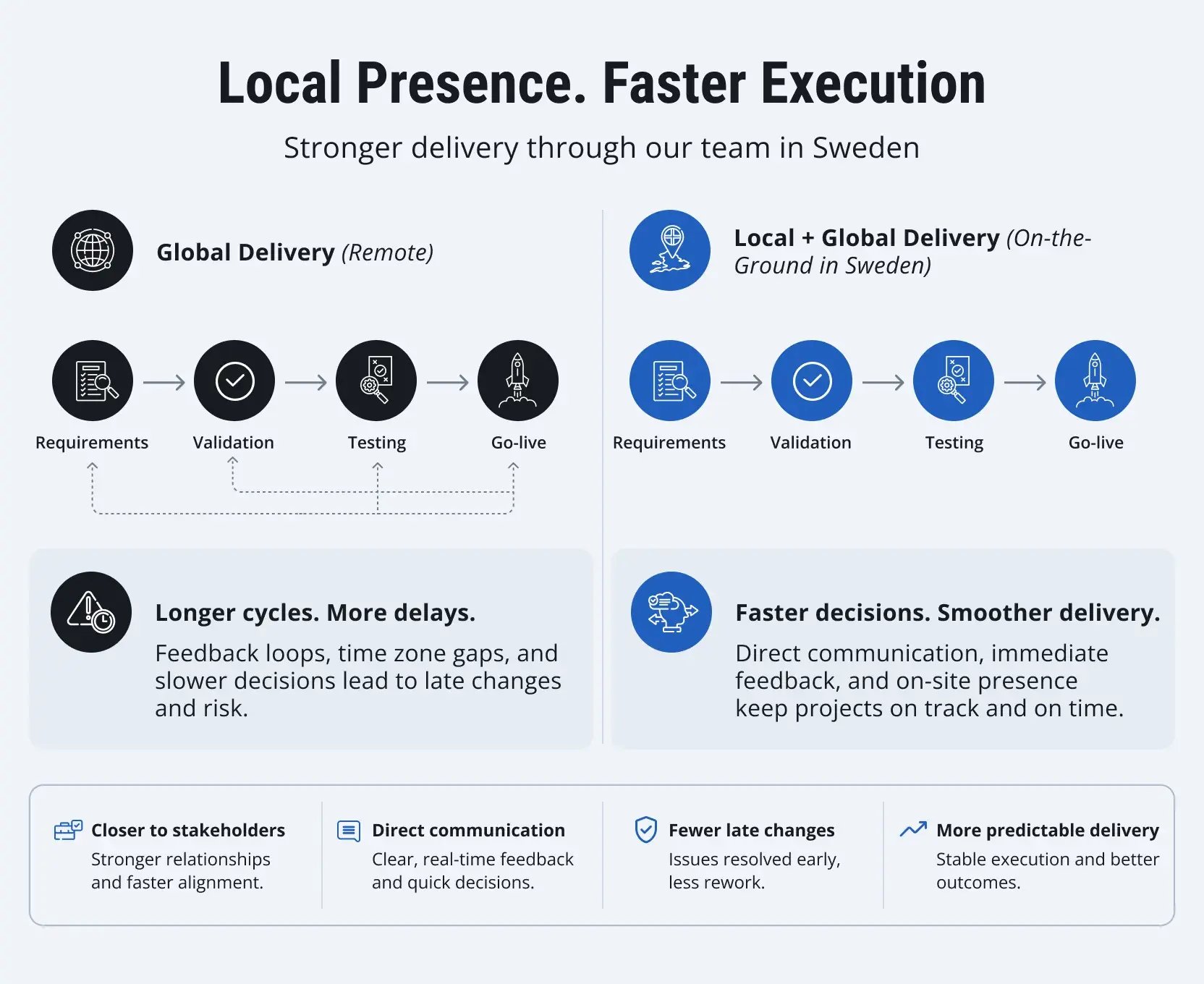
Being on the ground changes the workflow. Discussions happen much faster. Feedback is more direct. During the stressful parts of a project, such as testing or the actual go-live, having a team on-site avoids the delays of remote communication. Issues get handled immediately with the people involved. It keeps things from getting stuck in long email threads or approval loops. This leads to a more stable project with fewer late-stage changes and a more predictable delivery.
What This Looks Like in Practice
We bring global SAP experience together with teams who understand how Swedish organizations operate day to day.
Involvement in the industry and market context
- Active presence in manufacturing, automotive, energy, and the public sector
- Advanced level of system integration and digital maturity
- Frequent use of shared service models and centralized data structures
- Close alignment between business strategy and IT execution
- Experience in managing local tax shifts, such as temporary VAT changes, including complex scenarios where rates differ for the same product — like dine-in versus takeaway — which takes a very specific setup in SAP S/4HANA
Focus on regulatory rules and sustainability
- Alignment with Swedish accounting standards (including K2 and K3) as well as EU standards
- A real priority of environmental, social, and governance (ESG) and sustainability reporting
- Help with Corporate Sustainability Reporting Directive (CSRD)
- Structuring data so that your finances and sustainability goals are tracked together, using SAP tools that fit the Green Ledger approach
- Familiarity with local compliance requirements such as Peppol-based e-invoicing and standard file formats like SAF-T and SIE
- Experience with public sector reporting requirements and audit transparency expectations
Working with local expectations
- Decisions are typically validated across multiple stakeholders before execution
- Significant impact of structured governance and consensus-based approval processes
- High expectations around documentation, traceability, and audit readiness
- Preference for predictable, well-tested solutions over rapid but less controlled changes
- Alignment with Swedish requirements for digital resilience and operational continuity, including guidance from authorities such as MSB
- Secure hosting and data management to support data sovereignty expectations, particularly for critical infrastructure environments
- Experience in creating SAP S/4HANA environments that comply with evolving EU regulations such as the NIS2 Directive
Sometimes it might look slower and more complicated at the beginning, but this approach reduces rework once execution starts.
How We Approach Delivery
Our delivery model mixes nearshore scale with local presence. It’s not a strict formula. Local teams stay close to business stakeholders; the wider delivery network supports the workload behind the scenes. It works as one setup, not separate layers handing things off to each other.
We usually work in a few different ways:
- Dedicated teams that integrate into the organization
- Project-based setups with a defined scope
- Hybrid models that combine consulting, implementation, and long-term support
In Sweden, transformation is rarely about speed alone. Companies want to modernize, but not at the cost of stability. That changes how projects are paced.
We focus on being present during the moments that matter most — workshops, testing, and go-live. That’s where alignment either holds or breaks.
How SAP Fits Into the Bigger Picture
SAP projects here don’t stay neatly inside one function: finance affects the supply chain. Operations depend on accurate data. Everything is connected in practice, even if it looks separate on paper.
Core areas we cover
- SAP S/4HANA implementation
- Supply Chain Management (SCM)
- Asset Management
- Product Lifecycle Management (PLM)
- Financial Management
- Human Capital Management (HCM)
- Sustainability Management
- Data and Analytics
Staying involved beyond go-live
We don’t stop at implementation, staying involved across the lifecycle:
- Architecture and solution design
- Integration with existing systems
- Migration to SAP S/4HANA
- Change management
- Ongoing support and optimization
- Security services
- SAP consulting
Keeping this under one structure avoids the usual disconnect between planning and execution.
Beyond the core
In Sweden, SAP rarely operates on its own. It has to connect with other systems - especially in manufacturing, infrastructure, and public services.
We extend and integrate through:
- SAP Business Technology Platform (SAP BTP)
- SAP Integration Suite
- SAP Datasphere, SAP HANA Cloud, and SAP Analytics Cloud
- AI tools like SAP Business AI and SAP Joule
Here, our approach is to extend what you need without overloading the core.
Keeping the system clean
Most SAP environments carry years of custom code. It works, but over time, it becomes harder to manage, since changes take longer and risks increase.
We take a more selective approach:
- Keep standard functionality in the core
- Move custom logic to SAP BTP
- Keep the system stable and easier to evolve
We look at what still makes sense and remove what doesn’t. That creates a cleaner structure and a better foundation for tools like SAP Joule, which depend on consistent data.
To support this, we also consolidate and harmonize data through solutions like SAP Datasphere. This helps establish a unified data foundation, so AI tools operate on consistent information while staying aligned with EU and Swedish data privacy requirements.
We also deal with so-called “shadow IT”, including spreadsheets, standalone tools, and quick fixes that are now permanent. Where possible, these are replaced with integrated SAP processes or reproduced as custom extensions on the basis of SAP BTP.

What Changes for Clients
A stronger local presence not only improves communication but also changes how the whole project runs. Instead of long feedback loops, decisions happen earlier. Issues are resolved closer to where they appear. Teams spend less time revisiting things.
In practice, that means:
- More predictable timelines
- Earlier alignment with regulatory and sustainability requirements
- Clearer communication
- Lower risk in complex programs
In environments where quality matters, that difference is noticeable.
Part of a Larger European Setup
Our work in Sweden is part of a broader European network across the Nordics, Baltics, and DACH region.
As projects stretch across countries, keeping teams aligned becomes the main challenge. Without that, the same problems repeat - delays, miscommunication, rework.
A connected delivery model helps avoid that. Teams follow the same logic but stay close to local realities.
This is supported by:
- 20+ years in SAP consulting and development
- 1,500+ SAP projects delivered
- 900+ clients worldwide
- 2,200+ professionals, including 500+ SAP-certified experts
Scale is useless without the ability to adjust on the fly. We focus on staying flexible enough to handle the inevitable shifts that come with growing projects.