

Explore how SAP SCM enables global supply chain visibility, resilience, and cost efficiency for large enterprises operating across multiple regions.
Managing a global supply chain today isn’t really about fine-tuning anymore, but about keeping up. What used to follow a clear rhythm — plan, produce, deliver — now changes all the time. Demand can shift overnight, suppliers come and go, logistics costs rise and fall, and disruptions aren’t rare events anymore — they’re just part of the day-to-day reality.
For companies operating across multiple regions, the challenge isn’t just efficiency anymore. It’s visibility, coordination, and the ability to respond quickly without losing control over costs and performance.
Many enterprises still rely on fragmented systems and regional processes that don’t fully connect. As a result, teams spend more time reacting to issues than preventing them, and decision-making becomes slower and less reliable.
SAP Supply Chain Management (SAP SCM) addresses this problem by bringing supply chain processes into a single, connected environment. It gives businesses a clearer picture of what’s happening across regions and helps them plan and act with more confidence.
SAP no longer views SCM as a standalone function. It’s part of a wider digital supply chain environment built on SAP S/4HANA. As a result, supply chain processes are tied directly to finance and operations, so everything works off the same data.
In this article, we’ll look at the key advantages of SAP SCM for global enterprises and how it supports more consistent, scalable supply chain operations.
Why Global Supply Chains Need a New Operating Model
Many global companies aren’t struggling because they lack tools — they’re struggling because their supply chains were designed for a different reality.
What used to work with regional systems and periodic planning now requires constant coordination across markets, partners, and teams. Supply chains need to keep up.
What’s making supply chains harder to manage
- Geopolitics. Trade rules change, conflicts happen, and routes that worked yesterday suddenly don’t.
- Working across regions. Each country comes with its own regulations, suppliers, and logistics setup, and they don’t always fit together.
- Unpredictable demand. Customer behavior shifts quickly — and not always in the same way across markets — so forecasts don’t hold like they used to.
- Sustainability requirements. Businesses are expected to track emissions and work with responsible suppliers, without slowing things down.
- Service standards. Faster delivery, real-time updates, and consistent service are no longer a bonus — they’re just expected.
Where traditional models fall short
Many organizations still rely on fragmented systems and disconnected processes. This creates a number of limitations:
|
Challenge |
Business impact |
|
Lack of visibility across regions |
Slower decision-making and missed opportunities |
|
Siloed data and systems |
Inconsistent planning and execution |
|
Reactive operations |
Higher costs and lower service levels |
|
Lack of coordination |
Inefficiencies across procurement, production, and logistics |
.jpg)
From Fragmented Operations to a Unified Global Network
In many companies, supply chains didn’t become complex overnight — they grew that way over time.
One region rolled out its own ERP. Another added a separate logistics tool. Reporting was established locally. Step by step, systems and processes evolved independently. For a while, it worked. But at scale, it started to slow things down.
Where things break
The problem isn’t just that systems are different; it’s that they don’t really connect.
- Different ERP setups across regions mean data doesn’t move easily, so teams rely on local views instead of a global one.
- Logistics is often managed in separate tools, with limited visibility outside each function.
- Data doesn’t fully match: definitions, metrics, and reports vary from one region to another.
As a result, even basic questions — what’s in stock, what’s delayed, and what’s at risk — take time to answer, and answers don’t always match.
What changes when systems start working together
At this stage, companies start looking at how their systems interact. It’s less about replacing tools and more about making them work together more cohesively.
With SAP SCM, processes that used to sit in separate tools start to connect:
- You can see what’s happening across procurement, production, and logistics without pulling data from multiple sources.
- Core processes follow the same logic across regions, so teams don’t reinvent them locally.
- People work from the same data, which makes coordination easier and reduces back-and-forth.
How it comes together
Behind this is a shared foundation, often built on SAP Business Technology Platform (SAP BTP). It connects systems, aligns data, and gives companies a way to scale without adding more fragmentation. When everything is connected, the supply chain doesn’t necessarily get simpler, but it becomes easier to manage. Teams spend less time reconciling data and more time actually making decisions.
Real-Time Visibility Across Global Supply Chains
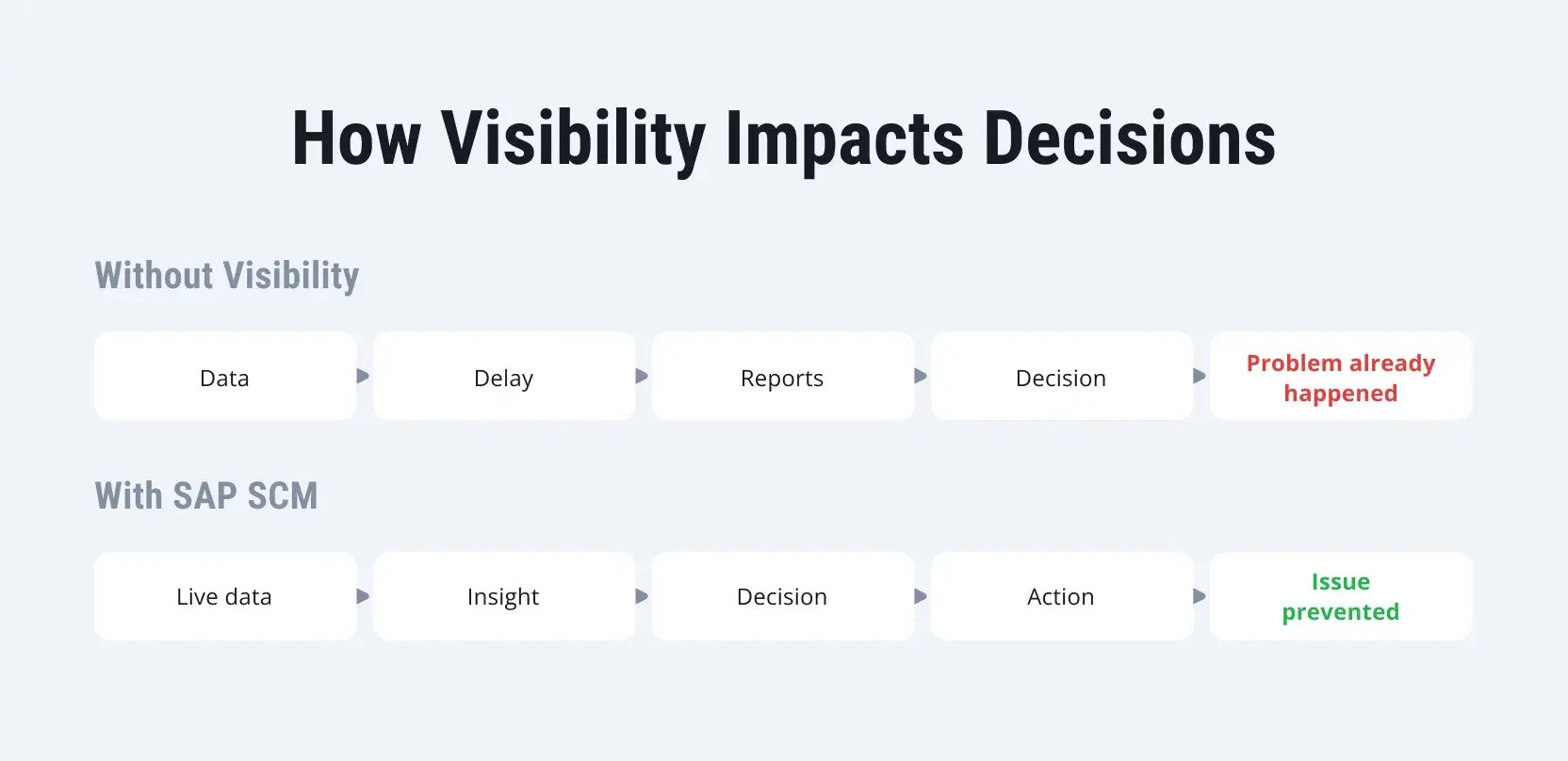
One of the hardest parts of managing a global supply chain isn’t execution — it’s understanding what’s happening in time to act on it. In many companies, data is scattered. Each region has its own reports, its own tools, its own way of measuring performance. By the time everything is pulled together, the situation has already changed.
Where visibility usually breaks down
At a global level, the issue shows up in small but constant friction:
- Leaders don’t see the full picture without talking with multiple teams.
- Metrics don’t fully match from one region to another.
- Inventory looks different, depending on which system you check.
- Problems become visible only after they’ve already caused delays.
The problem isn’t missing information — it’s that it’s difficult to trust or use existing data when decisions need to be made fast.
What changes when visibility improves
When systems are connected and data is aligned, things start to move differently.
You don’t have to wait for reports from each region to understand what’s happening. You can see where performance is off, where inventory is building up, or where delays are starting to form.
That’s where data-driven decision-making with SAP becomes practical, not theoretical.
- If demand spikes in one market, you see it early and can adjust supply.
- If something slows down in logistics, it shows up before it turns into a bigger issue.
- If performance drops somewhere, it’s visible without digging through reports.
What sits behind it
This only works if the data is consistent and actually connected. With SAP Datasphere and S/4HANA embedded analytics, companies bring data from different systems into one place and work from the same numbers across regions. When that happens, decisions don’t get faster because people rush — they get faster because they don’t have to guess.
.webp)
Advanced Planning and Predictive Capabilities
Planning used to rely heavily on historical data and best-guess estimates. That hasn’t gone away, but it doesn’t fully work anymore.
When demand shifts quickly and disruptions happen without warning, planning has to be more flexible. It’s less about getting a forecast “right” and more about being ready to adjust when things change.
Moving beyond static planning
In many companies, planning still follows a fixed cycle — data is collected, forecasts are created, and plans are set for the next period. The problem is that reality rarely follows that plan.
What companies need instead is a way to continuously adjust based on what’s actually happening.
- Forecasts need to reflect real demand, not just historical patterns.
- Plans should be easy to update when conditions change.
- Teams should be able to test different scenarios before making decisions.
What changes with a predictive approach
With tools like SAP IBP capabilities, planning becomes more dynamic. Instead of relying on a single version of the plan, companies can:
- Refine demand forecasts as new data comes in.
- Run different scenarios to see how changes in supply or demand might play out.
- Simulate disruptions and understand their impact before they happen.
- Adjust plans faster without rebuilding everything from scratch.
Planning shifts to something that is ongoing rather than periodic.
The role of AI in planning
AI adds another layer to this process, not by replacing planning, but by making it more responsive.
With AI in supply chain management, companies can spot patterns earlier, identify risks faster, and make adjustments with more confidence.
For example:
- A sudden change in demand can trigger automatic updates in planning.
- Supply risks can be flagged before they affect operations.
- Recommendations can be generated based on real-time data.
Companies no longer have to react after the fact. They can see changes coming and respond early, before those changes impact operations.
Operational Efficiency and Cost Optimization
At scale, inefficiencies don’t stay hidden, as they show up in costs. Extra inventory, slow processes, delays in delivery — it all adds up. And in global supply chains, even small issues can have a noticeable impact on margins.
Where things usually go wrong
Most of the time, it’s not one big problem. It’s a combination of things that don’t work as well as they should:
- Too much inventory, just to stay on the safe side
- Transportation that isn’t fully optimized
- Manual steps that slow teams down
- Delays that stretch lead times without anyone noticing immediately
Individually, these don’t seem critical. Together, they affect both cost and performance.
What improves when things are connected
Once systems and processes start working together, it becomes easier to see where time and money are being lost and to fix them.
- Inventory levels become easier to manage without overstocking.
- Transportation planning gets more consistent across regions.
- Routine tasks are automated instead of being handled manually.
- Lead times become more predictable.
For example, better warehouse optimization with SAP EWM reduces unnecessary handling and improves accuracy. At the same time, supply chain automation removes repetitive work and speeds up day-to-day operations.
What this means in practice
The impact is pretty straightforward:
- Less money tied up in inventory
- Lower logistics and operational costs
- Faster order processing
- More stable performance across regions
Over time, this directly affects margins and frees up working capital, without adding more complexity to the system.
Building Resilient and Risk-Aware Global Operations
Resilience in supply chains isn’t just about reacting when something goes wrong. It’s about being prepared before it happens.
For global companies, disruptions are no longer rare. Suppliers change, routes get delayed, and regulations shift. The question is, how quickly can you respond when it does?
Where risks typically originate
Most risks don’t appear out of nowhere. They don’t come from one place — they build up across the supply chain:
- Supplier dependency: Relying too heavily on a single vendor or region increases exposure.
- Limited visibility: It’s hard to react if issues aren’t visible early.
- Lack of coordination: Teams may respond differently across regions, slowing down recovery.
- Regulatory pressure: Compliance requirements vary and change, especially across markets.
What changes with a more risk-aware setup
When systems are connected and data is consistent, companies can manage risks more proactively.
- It becomes easier to diversify suppliers and understand where dependencies exist.
- Teams can look at possible disruptions ahead of time and understand what might happen.
- Risk alerts help surface issues early, before they escalate.
- Compliance monitoring becomes part of daily operations, not a separate effort.
For example, companies in highly regulated industries are already focusing on resilient supply chains in pharma, where visibility and control are critical. At the same time, teams can use digital twins to check “what happens if something goes wrong,” before it actually does.
What changes in everyday work
This doesn’t remove risk completely, but it changes how companies deal with it. Issues are easier to spot early. Responses are more aligned across regions. Instead of scrambling to respond, teams have a plan. And over time, resilience stops being reactive and just becomes part of the process.
Scalability for Multi-Region Enterprise Growth
Growth sounds straightforward on paper. In reality, it usually means adding more systems, more processes, and more complexity.
As companies expand, things get more complicated. Each new region brings its own rules and processes, and acquisitions come with different systems. Ultimately, it all turns into a jumble that’s difficult to keep aligned.
Where complexity starts to show
The issue is that things stop working the same way everywhere. One region follows global standards, another does things locally. Data doesn’t line up, and reporting takes longer because everything has to be pulled together manually. What worked before just doesn’t hold up as the business grows.
What helps keep things aligned
To scale without losing control, companies need a balance between global consistency and local flexibility.
- Core processes stay aligned across regions.
- Local teams can still meet regulatory and operational requirements.
- Data is structured in a way that supports both global and regional reporting.
This is where SAP SCM fits in. It helps standardize how processes run across regions, while still allowing for local differences where they’re needed.
It also becomes easier to introduce changes, whether that’s entering a new market, integrating an acquired company, or adjusting operating models.
For example, choosing the right SAP S/4HANA deployment options plays a big role in how flexible and scalable the overall landscape can be.
And more broadly, this kind of setup is part of a larger shift toward enterprise digital transformation with SAP, where systems are designed to grow with the business instead of holding it back.
What changes as the company grows
Growth becomes easier to manage. New regions don’t feel like separate systems. Acquisitions don’t require rebuilding everything from scratch. And teams spend less time trying to align processes and more time actually running the business.
Instead of adding complexity with every step, the system absorbs it and keeps things consistent.
Integration With SAP S/4HANA and the Digital Core
On their own, supply chain tools can only go so far. The real value shows up when everything is connected — especially to the core system — where financials, operations, and reporting come together. For many companies, that core is SAP S/4HANA.
Why this connection matters
When systems aren’t well-connected, supply chain decisions end up happening separately. Planning, execution, and financials often sit in different systems. By the time everything connects, it’s already behind, and that adds delays and extra effort.
When supply chain processes are connected to the digital core, things start to line up:
- Supply chain decisions reflect actual financial data.
- Production planning stays aligned with real demand and capacity.
- Asset and maintenance data feed directly into operational planning.
- Everyone works with the same data, not different versions of it.
What changes when systems work together
Instead of moving data between systems and reconciling it later, everything runs on a shared foundation. Finance sees the impact of supply chain decisions earlier. Operations teams work with up-to-date data. Reporting becomes faster because the numbers already match.
This kind of setup is usually part of a broader transformation, starting with a clear SAP S/4HANA migration strategy.
For companies moving to the cloud, RISE with SAP helps bring core systems and supply chain processes together in one place.
What does this mean in everyday work?
Teams spend less time correcting data and more time using it. Decisions are made faster because the numbers already match. And instead of systems working separately, everything moves in the same direction.

Measurable Business Outcomes for Global Enterprises
For global enterprises, the focus is on results. Forecast accuracy, inventory levels, delivery speed, and consistency across regions are what really demonstrate whether the changes are working.
Where the impact becomes visible
Once supply chain processes are connected and aligned, the results usually show up in a few key areas.
- Forecast accuracy improves. Planning is based on current data and broader inputs, not just historical trends.
- Working capital goes down. Inventory levels become easier to control without overstocking.
- Order fulfillment speeds up. Fewer delays between planning, production, and delivery.
- OTIF (on-time, in-full) performance improves. Orders are delivered more consistently.
- Cross-region alignment gets stronger. Teams work with the same data and follow the same logic.
These are the metrics leadership teams actually track, and where the value of SAP SCM becomes tangible.
How does this connect to financial performance?
These operational improvements translate directly into financial outcomes. Better forecast accuracy reduces unnecessary inventory. Faster fulfillment improves revenue flow. More consistent execution lowers operational costs. Instead of optimizing individual processes, companies start improving overall performance.
This is where supply chain transformation connects with broader SAP financial management impact, linking operational decisions to measurable business results.
What changes at the executive level
The biggest change is simply seeing what’s going on. Instead of waiting for reports, teams can see how decisions affect costs, service levels, and working capital as things happen. That makes it easier to adjust and keep everything on track.
Strategic Considerations Before Implementing SAP SCM
Before making changes, it helps to look at how your supply chain actually works today. Most of the time, the issue isn’t the technology — it’s how work is organized and how teams coordinate across regions. You need to get the flow right before trying to automate it.
Where to start
A good starting point is understanding the current level of maturity.
- How aligned are processes across regions?
- Where are the biggest gaps in visibility or coordination?
- Which areas create the most delays or inefficiencies?
Without this baseline, it’s hard to define what needs to change and what should stay as is.
Taking a phased approach
Big transformations almost never go according to plan. It’s usually much better to take it one step at a time, starting where you’ll see the biggest win and growing from there. This approach lets you manage risks more easily, pivot when you need to, and — most importantly — keep the rest of the business running without any massive headaches.
Balancing governance and flexibility
As systems become more connected, governance plays a bigger role. Global standards keep processes aligned, but they need to work alongside local requirements. The key is balancing both.
Preparing teams for change
A system can be set up perfectly, but it won’t deliver much if people don’t use it the right way. That’s why change management plays a critical role. Teams need to understand what’s changing, why it matters, and how it affects their day-to-day work. A structured approach to organizational change management helps make that transition smoother and reduces resistance along the way.
Looking beyond implementation
The real value shows up over time — when the system actually supports how the business runs. If it’s set up right, it can adapt as the company grows, expands into new markets, or changes the way it operates.
This is often part of a broader transformation journey, supported by a clear SAP S/4HANA transformation roadmap that connects supply chain improvements with long-term business goals.
What this means in the long run
Companies that approach this strategically don’t just improve operations — they build an advantage. They can scale faster, respond more quickly to change, and keep global operations aligned without adding unnecessary complexity.
Conclusion
Global supply chains aren’t getting simpler, and they’re not going back to how they used to work. The difference now is how companies choose to deal with that complexity.
Those that continue to rely on disconnected systems and reactive processes will keep dealing with the same issues — just at a larger scale. Those that invest in connected, data-driven operations gain something more important than efficiency: the ability to adapt without losing control. That’s ultimately what defines a strong global supply chain today.




.webp)