

Discover how SAP Data & Analytics empowers smarter decisions across industries. Practical use cases, tools, and expert insights from LeverX implementation experience.
Logistics has already done the hard part. Most enterprises digitized core processes, automated execution, and standardized planning rules across ERP and transportation systems. That model improved speed and consistency, but it was designed for a world where conditions change slowly.
Supply chains now behave differently. Demand shifts week to week, sometimes day to day. Capacity tightens unexpectedly. Disruptions ripple across regions quickly. Networks grow more complex as companies add nodes, partners, and constraints. In this environment, rule-based logistics starts to fail for a simple reason: automation follows predefined logic, even when the situation has already changed.
Automation executes rules. Intelligence evaluates context and chooses the best decision for the current conditions.
That difference is driving the next stage of logistics maturity. Companies are moving from rule-based planning to system-driven optimization, where decisions are recalculated continuously using real-time signals and machine learning. The goal is practical autonomy: faster planning cycles, fewer manual overrides, and operations that adapt without waiting for humans to catch up.
This article breaks down how AI-driven logistics works in practice, from predictive analytics to dynamic planning across transportation, warehouses, and inventory. It also shows how SAP-based platforms support this shift. At LeverX, we help enterprises make the transition without ripping out their core systems by layering intelligence on top of SAP Transportation Management (SAP TM), SAP Integrated Business Planning for Supply Chain (SAP IBP), SAP Extended Warehouse Management (SAP EWM), and SAP Business Technology Platform (SAP BTP) and turning operational data into decisions that scale.
Why Traditional Logistics Decision-Making Methods Don’t Work
Logistics planning used to be manageable because the environment changed slowly and the number of variables stayed within human reach. Today, supply chains behave like dynamic systems. Data updates constantly, constraints shift during the day, and decisions in one part of the network trigger consequences elsewhere. Under these conditions, manual planning and static rules stop being reliable.
|
What changes in modern logistics |
Why traditional decision-making can’t keep up |
What it causes |
|
Data volume explodes (SKUs, events, IoT, forecasts) |
Humans and rule sets can’t process high-frequency signals |
Decisions based on partial data, more exceptions |
|
Demand volatility increases |
Planning cadences (weekly/monthly) lag behind reality |
Expediting, stockouts, unstable service levels |
|
Networks get more complex (nodes, partners, constraints) |
Local optimization creates downstream failures |
OTIF drops, bottlenecks move, and higher costs |
|
Conditions change in real time |
Static rules assume stable inputs |
Late rerouting, missed windows, SLA breaches |
|
More dependencies across functions |
Planning remains siloed (transport vs. warehouse vs. inventory) |
Inventory imbalance, warehouse congestion, transport cost spikes |
The pattern is consistent. The issue is not effort or competence; it is that traditional methods were built for periodic planning and stable inputs. Modern logistics runs on continuous signals and fast-moving constraints, so decision-making has to evolve accordingly.
The Rise of AI-Driven Logistics
In traditional logistics, the problem is often discovered when the shipment is already late. AI changes that dynamic. It picks up warning signs earlier, projects the impact, and helps the network adjust before the delay becomes real.
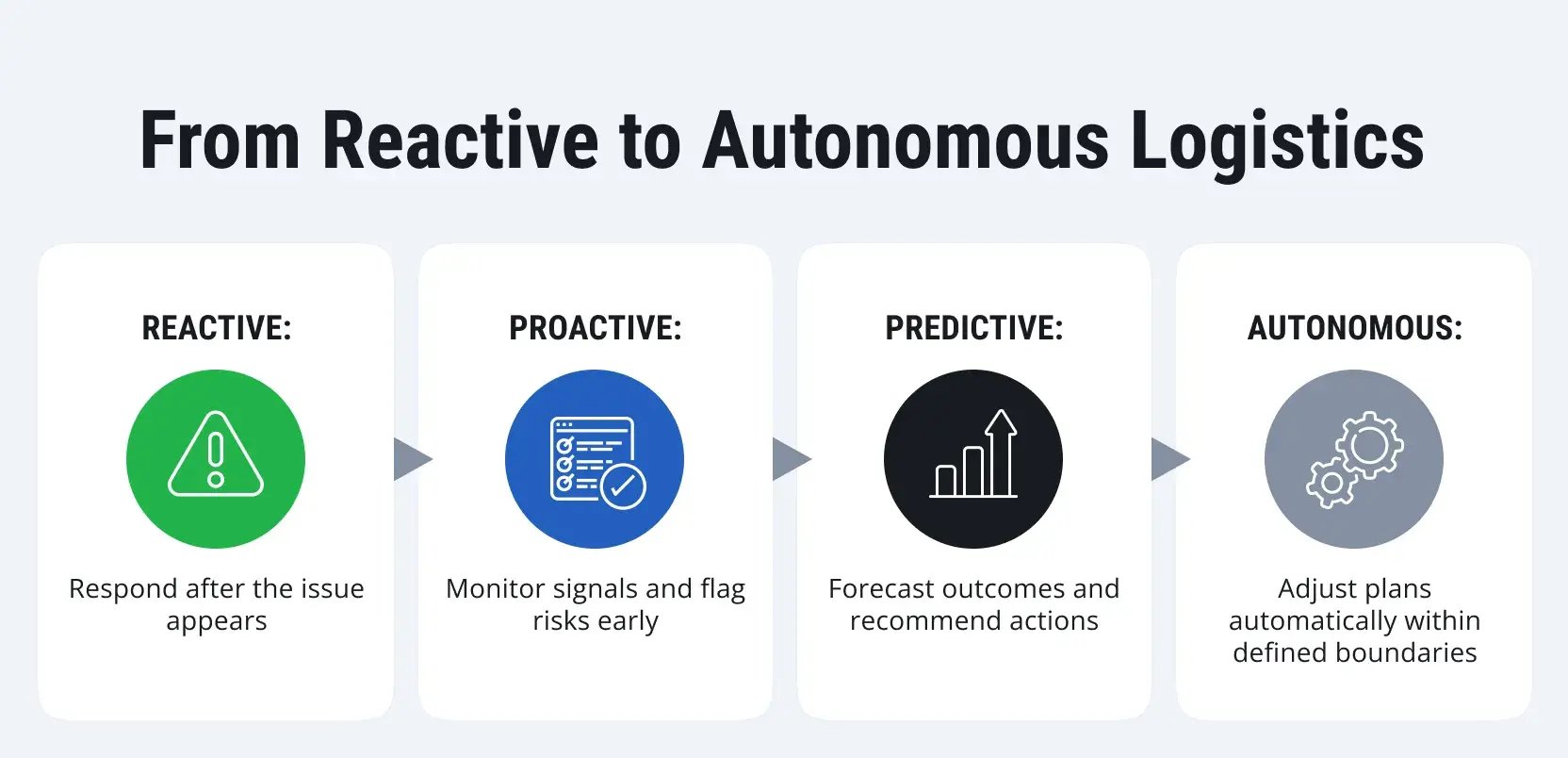
From reactive to autonomous decision-making
Traditional logistics operates in a reactive mode: a delay occurs, a planner intervenes, and a workaround is applied. AI introduces a different progression:
SAP EWM vs. Microsoft Dynamics 365 SCM — Choosing the Right Tool for the Job
Each step reduces reliance on manual intervention and shortens the time between receiving a signal and making a decision.
Machine learning sees what planners cannot
Modern planning depends on variables that interact in messy ways. When demand signals, lane performance, inventory positions, and real-world conditions shift together, spreadsheet logic and manual analysis miss cross-effects. Models built on historical and real-time data help expose those cross-effects and quantify tradeoffs before decisions are locked in.
It’s most useful in networks where dependencies stretch across lanes, nodes, and time, so cause and effect are not immediate or localized.
Predictive AI models in planning, not just analytics
Neural networks play an increasing role in core planning processes. In demand forecasting, they capture non-linear patterns that traditional models miss. In transportation planning, they evaluate route options under changing constraints. In inventory planning, they balance service levels and cost across multiple locations at once.
What matters is not the algorithm itself, but the ability to evaluate complex scenarios continuously rather than rely on static assumptions.
Real-time risk and anomaly detection
AI-driven logistics systems monitor operations as they happen. They detect deviations from expected behavior, flag emerging risks, and surface issues before they escalate. This includes early signals of transport delays, abnormal demand spikes, capacity shortfalls, or inventory imbalances.
Instead of relying on threshold-based alerts, these systems learn what “normal” looks like and adapt as conditions evolve.
Decisions recalculated at machine speed
One of the most practical advantages of AI is speed. Modern systems can re-evaluate thousands of planning scenarios per second as new data arrives. Routes are adjusted, priorities are re-ranked, and allocations are updated continuously. Planning stops being a scheduled activity and becomes a live process.
Better outcomes, fewer manual corrections
AI does not remove humans from logistics, but it changes their role. Planners shift from constant exception handling to supervision and decision control. Human error drops because decisions are consistent, data-driven, and continuously validated against outcomes. Planning accuracy improves because systems learn from every execution cycle, not just from periodic reviews.
This is the foundation of intelligent logistics: decisions that adapt as fast as the network itself.
Predictive Analytics for Supply Chain and Transportation
Predictive analytics is often the first place teams feel the difference. Instead of finding out about problems when they are already expensive, you get a heads-up while there is still room to act.
Demand forecasting that keeps up with reality
Classic forecasting leans on history. It works when demand behaves the way it used to. Predictive models take in more signals, such as recent sales patterns, promotions, seasonality shifts, and external drivers, and then adjust forecasts as conditions change. That helps planning stay aligned with what customers are doing now, not what they did last quarter.
Delay risk becomes visible early
Most late deliveries have warning signs. Congestion builds. Weather shifts. Terminals back up. Customs timing changes. Predictive analytics pulls those signals together and estimates delay risk before a shipment misses its window. That gives teams options: reroute, change priorities, adjust dock schedules, or reset expectations with customers.
ETA that customers and operations can trust
An ETA only matters if it updates with the real world. When you combine live tracking with historical performance by lane, carrier, and region, ETA predictions get tighter over time. Warehouses can plan labor and dock assignments more accurately, and customer service stops guessing.
Maintenance that happens before breakdowns
Fleet and equipment downtime has a habit of showing up at the worst time. Predictive maintenance uses operating data and sensor signals to spot early indicators of wear, then schedules service before a failure takes an asset offline. Maintenance becomes condition-based instead of calendar-based, so you reduce breakdowns without over-maintaining equipment.
A different operating rhythm: fewer emergencies
When demand shifts, delay risks, and equipment issues are visible ahead of time, the team’s day changes. Less firefighting. Fewer last-minute expedites. Fewer “we’ll fix it in transit” decisions that drive cost. You move from reacting to preventing.
Where SAP fits: SAP IBP and SAP BTP
Predictive insights need to land inside the tools where planning happens. SAP IBP uses predictive inputs to improve demand forecasting and inventory optimization. SAP BTP services for predictive scenarios provide a practical way to build and run predictive models close to enterprise data, without turning every use case into a long custom development project.
Intelligent Route Optimization and Dynamic Planning
Routing used to be a planning exercise done in advance. Once routes were released, the assumption was that execution would follow the plan with only minor adjustments. That assumption no longer holds. Conditions change too fast, and static routes age quickly.
Routes that adapt as conditions change
Modern routing doesn’t happen once and then stop. It keeps checking conditions as the day moves on. When traffic builds, weather turns, or capacity shifts, the plan updates in real time. The point is not to change routes nonstop, but to adjust when the original route stops being the best option. Early tweaks often prevent late-day problems.
What intelligent routing actually accounts for
Effective route optimization goes far beyond distance and cost. Decisions factor in multiple, often competing constraints, such as:
- Current and forecasted traffic conditions
- Weather impact on transit time and safety
- Road quality and access limitations
- Warehouse and terminal congestion
- Customer delivery windows and SLA commitments
The system evaluates tradeoffs across these variables instead of optimizing one metric at the expense of others.
From static plans to self-optimizing networks
When routing decisions update continuously, the network starts optimizing itself. Routes are not planned in isolation but adjusted based on what is happening across the entire supply chain. A delay in one lane can trigger earlier changes elsewhere, reducing knock-on effects instead of spreading them.
Dynamic use of people and assets
Routing does not stop at vehicles. Intelligent planning also reallocates drivers, equipment, and cargo as conditions change. Loads are reassigned, priorities shift, and capacity is used where it delivers the most value at that moment. This flexibility is hard to achieve with manual planning, especially at scale.
Results that show up in performance metrics
The impact is measurable. More reliable routing improves OTIF performance by reducing late deliveries caused by avoidable delays. Transportation costs come down as last-minute rerouting, expediting, and empty miles decrease. Over time, the network becomes more predictable, even as conditions remain volatile.
Intelligent route optimization turns transportation planning from a one-time decision into an ongoing process that keeps pace with the real world.
AI in Warehouse and Inventory Decision-Making
Transportation gets most of the attention, but warehouses decide whether the supply chain feels smooth or chaotic. Putaway, slotting, picking, replenishment — all of it looks tactical on paper. In practice, these choices determine speed, labor efficiency, inventory health, and how many “urgent” shipments end up hitting the road.
Slotting that reflects what customers are ordering now
Slotting tends to be revisited too rarely. Item velocity changes, order profiles shift, and yesterday’s layout starts working against you. AI-driven slotting uses actual movement data to recommend better placement. Fast movers stay closer to pick faces. Items that are often ordered together end up nearer to each other. The outcome is less travel, fewer aisle backups, and better throughput without adding headcount.
Order flow forecasting for staffing and wave planning
Most warehouse stress comes from surprises. Peaks arrive, the floor gets congested, and the plan turns into improvisation. Predictive order flow analysis helps forecast volume and mix earlier, so teams can adjust labor, dock schedules, and waves before the shift begins, not after it starts going sideways.
Picking strategy selection based on conditions
No single picking method wins every day. What works for high-volume, similar orders fails when the mix changes. Intelligent systems can recommend an approach based on the current workload and constraints, including:
- Zone picking for high-volume and controlled travel
- Batch picking when many orders share common SKUs
- Cluster picking when small orders can be grouped efficiently
- Wave picking when releases need to align with carrier cutoffs
This is less about fancy logic and more about choosing the method that fits the moment.
Inventory optimization without the usual extremes
Inventory problems usually show up as opposites: stockouts in the wrong location, excess inventory in the right one, or both at the same time. AI-supported optimization helps set smarter reorder points and safety stock levels by factoring in demand variability, lead times, and service targets. The goal is stable availability without turning the warehouse into storage.
One network, not separate islands
Warehouse choices affect transportation. Transportation constraints affect warehouse priorities. When those decisions live in different tools and teams, you get local optimization and network-level pain. The value of intelligence shows up when demand planning, warehouse execution, and transportation planning share the same signals and operate on aligned priorities.
Where SAP EWM fits
None of this matters if it cannot be executed. With SAP EWM, these recommendations can be tied to real warehouse processes, slotting, wave planning, replenishment logic, and task management, with the governance and control enterprises need.
When warehouses shift from fixed templates to business-driven operations, inventory becomes more balanced, and fulfillment becomes more predictable.
Autonomous Decision-Making: The Future of Logistics
Autonomy in logistics is not about turning the lights off and letting the supply chain “run itself.” It is about taking routine, fast-moving decisions off people’s desks, so teams can focus on control, strategy, and exceptions that truly need human judgment. The system handles the repeatable calls at the speed operations require, and within the rules the business defines.
Procurement that reacts to reality, not a calendar
Supplier decisions still happen on schedules in many organizations. The market does not. Autonomous procurement examines current market conditions, including pricing, availability, lead times, quality, and risk signals, and recommends or executes the best choice within established guardrails. When conditions shift, terms can be adjusted sooner, not after the next quarterly review.
What it includes:
- Automated supplier selection based on performance and capacity
- Real-time renegotiation of pricing or delivery terms when risk rises or capacity drops
Transportation that starts coordinating itself
Autonomy is also moving into transportation. Platooning aims to improve fuel efficiency and utilization by coordinating trucks digitally. Self-driving trucking is still developing, but the direction is obvious: more predictable long-haul capacity and less exposure to driver shortages in specific lanes. Even before full autonomy, smarter dispatching and dynamic re-planning reduce the number of manual interventions required to keep freight moving.
“Machine customers” and automated ordering
In some supply chains, the buyer is already software. Systems place replenishment orders automatically when demand signals and inventory levels cross defined thresholds. These orders follow policy, service targets, and budget limits, then route to suppliers without someone rebuilding the plan by hand.
Operational decisions made in seconds
The real value of autonomy shows up in day-to-day execution. Priorities change, disruptions appear, and decisions need to happen quickly. Algorithms can:
- Reprioritize shipments when constraints change
- Reallocate inventory across locations to protect service levels
- Adjust routing and capacity assignments on the fly
Planners stay in control through policies and escalation rules, but they are no longer the bottleneck for every adjustment.
The direction: self-operating logistics networks
As autonomy expands across procurement, planning, warehousing, and transportation, logistics starts to behave like a connected system instead of separate teams passing work downstream. Decisions travel through the network automatically, and plans update continuously as conditions change. People still set objectives and manage exceptions, but the supply chain runs with fewer handoffs and far less firefighting.
The Role of Platforms Like SAP BTP, SAP TM, SAP IBP, and SAP BN4L
AI only delivers results in logistics when it’s tied to execution. That’s where SAP’s ecosystem helps. Instead of treating intelligence as a standalone tool, SAP connects planning, transportation, warehousing, and collaboration in a way that lets insights turn into actions.
What each SAP platform brings to AI-driven logistics
|
SAP platform |
What it does in logistics |
Where intelligence shows up |
|
SAP TM |
Transportation planning and execution |
Dynamic planning, route optimization, carrier selection, cost, and SLA tradeoffs |
|
SAP IBP |
Demand and supply planning across the network |
Forecasting, scenario modeling, inventory optimization, and what-if simulations |
|
SAP BTP |
Data and extension layer for SAP landscapes |
ML development, analytics, integration, automation, real-time processing |
|
Multi-party collaboration across carriers and partners |
Real-time data exchange, visibility, and exception handling across stakeholders |
End-to-end integration: how the platforms work together
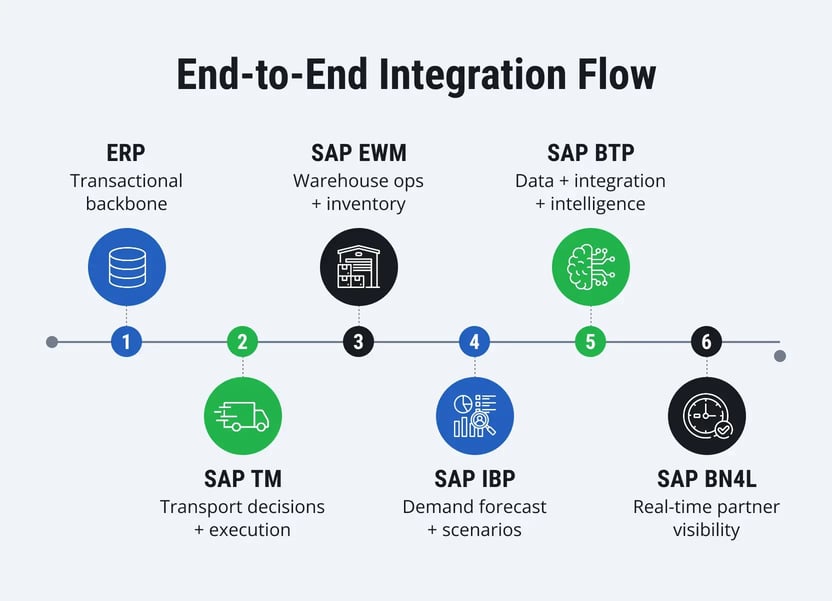
A typical intelligent logistics flow links operational execution, planning, and external collaboration:
- ERP provides the transactional backbone
- SAP TM manages transportation decisions and execution
- SAP EWM handles warehouse operations and inventory movement
- SAP IBP forecasts demand and runs scenarios for supply planning
- SAP BTP unifies data and enables ML-driven decisions and integrations
- SAP BN4L connects external partners with real-time logistics visibility
One intelligence layer across the network
When these platforms work together, companies stop optimizing in silos. They build a shared layer of supply chain intelligence where demand, transportation, warehousing, and partner visibility are aligned. Decisions become faster, more consistent, and easier to govern because they run on a single data foundation and a connected execution model.
In the end, companies need fewer disconnected apps and more coordinated decision-making across the supply chain.
Business Benefits: What Companies Achieve With AI
Below is a practical, business-first view of what AI brings to logistics when it’s implemented as part of planning and execution (not as a standalone experiment). Format: benefit + what it means in real operations.
Higher planning accuracy and faster decision-making
Planning stops being a slow, periodic activity. Forecasts and operational decisions update as conditions change, using live signals across demand, inventory, and transportation. Teams spend less time debating and more time acting on the most likely scenario. Faster decisions reduce late-stage changes that trigger premium freight, missed delivery windows, and warehouse congestion.
Reduced transportation and inventory costs
When routing stays flexible, you drive fewer unnecessary miles, fill trucks more effectively, and avoid late changes that usually cost the most. Better inventory decisions also help reduce overstock without creating gaps on the shelf.
Improved service levels and OTIF performance
Better prediction and faster replanning lead to more consistent delivery performance. OTIF improves when delays are detected early, inventory is positioned correctly, and transportation plans are adjusted before commitments are broken.
Service issues rarely stem from a major failure. They build up through small misses that compound across the network.
Increased resilience to disruptions
When you catch the warning signs early, disruption stays a problem to manage, not a crisis to survive. Plans can be adjusted before delays spread, demand swings hit service levels, or equipment failures take assets offline.
Scalable, data-driven logistics operations
Growth stops being a headcount problem. You can add SKUs, locations, and constraints without constantly expanding the planning team just to keep the wheels turning. Decision-making also becomes more consistent because the same rules and priorities apply across the network, not a different approach in every region based on who is on shift or which workaround became normal.
How LeverX Implements AI-Powered Logistics
AI in logistics only works when it’s grounded in real operations. At LeverX, we focus on building solutions that fit into existing SAP landscapes, work with live supply chain data, and scale beyond a single pilot. The goal is practical: faster decisions, fewer disruptions, and measurable improvements in cost and service.
Designing enterprise data platforms on SAP BTP
Most logistics organizations already have the data they need; it’s just spread across systems. We use SAP BTP to bring key signals together from SAP and non-SAP sources, connect planning with execution, and set up a foundation where intelligence can run reliably. That includes integration, data modeling, governance, and the right security controls for enterprise environments.
Implementing intelligence modules where they matter
Instead of trying to AI everything, we start with high-impact decision points and build modules that plug into real workflows.
Typical focus areas include:
- Forecasting: improving demand forecasts and planning inputs using current signals and historical behavior
- Optimization: route planning, resource allocation, and network-level tradeoffs across cost and service constraints
- Anomaly detection: early identification of deviations such as delay risk, unusual demand spikes, inventory imbalance, or execution patterns that signal disruption
Each module is designed to support decisions, not generate noise.
Moving from proof of concept to scalable rollout
Pilots are easy to launch and easy to abandon. The hard part is making outcomes repeatable across regions, product groups, and operational teams. LeverX helps clients move from PoC to production by focusing on what usually breaks initiatives at scale: data quality, system integration, process ownership, and change management.
How pilots become production-grade solutions
A realistic rollout path typically follows a sequence like this:
- Use case selection based on measurable business impact and available data
- Data readiness work to ensure inputs are reliable and consistent
- Model and logic design aligned with business constraints and KPIs
- Integration into SAP workflows (planning and execution)
- Controlled deployment with monitoring, human oversight, and fallback rules
- Scaling and standardization across sites with governance and performance tracking
The result is an AI-powered logistics approach that doesn’t live in a sandbox. It runs inside the systems teams already depend on, supports operational decision-making, and scales with the supply chain.
Conclusion
Logistics has reached the limit of what automation can deliver. Rule-based execution still matters, but it can’t keep up with supply chains that shift daily, run across complex networks, and operate under constant uncertainty. The companies pulling ahead are not the ones adding more people or more manual controls. They’re building the ability to sense change early, adjust plans faster, and keep decisions consistent across the entire network.
This isn’t a passing trend. Autonomous logistics is quickly becoming the default. Predictive analytics, real-time planning, and better warehouse execution are already changing how teams operate, especially when the right platforms connect data to execution. Over time, systems take on more routine decisions, and teams spend more time on oversight, policy, and the hard calls.
Competitive advantage will belong to organizations that invest in intelligence now. Not as a lab project, and not as a standalone tool, but as a capability embedded into planning and execution. AI will be the foundation for supply chains that stay resilient under disruption, adapt quickly to shifting demand, and make better decisions with less effort.
The logistics networks of the future won’t wait for a planner to catch up. They will make decisions independently, at machine speed, and the most prepared companies will be the ones that shape that future rather than react to it.


-min-Jul-12-2022-09-29-22-35-AM.jpg)
-min-Jul-12-2022-12-30-31-79-PM.jpg)