A practical look at how PLM helps food manufacturers in the U.S. manage compliance, traceability, and product development under growing regulatory and market pressure.
The U.S. food and beverage sector is hitting a wall in 2026. It’s a perfect storm of regulatory mandates, operational friction, and a consumer base that changes its mind weekly. Manufacturers are no longer just making products; they’re fighting to stay upright in an environment where safety rules are tightening, traceability is the new law, and the sheer volume of formulation data is becoming unmanageable.
The FDA started this domino effect. By rewriting the definition of "healthy" in late 2024, they invalidated years of marketing strategy overnight. Then came the FSMA updates, mandatory visibility requirements for the entire supply chain. While the July 2028 extension offers some breathing room, the ultimatum is clear: modernize your data validation now or lose your seat at the table.
But compliance is only half the headache. Consumer loyalty is dead. People now demand a digital paper trail for every ingredient, from sourcing ethics to carbon footprints. As recipes get more complex to meet these "clean label" demands, the internal struggle to maintain consistency while rushing to market is creating massive structural friction.
The old ways of handling R&D and data silos are officially obsolete. To understand where the industry is heading, we have to look past the compliance checklists and analyze the deeper shifts currently gutting traditional business models.
Key Challenges in Food Product Lifecycle Management
Regulatory documentation control
Regulatory requirements are becoming more detailed and broader at the same time. For manufacturers, this means keeping documentation consistently up to date across different markets — from ingredient approvals to nutritional data and compliance records, without gaps or delays.
Allergen and labeling compliance
Changes in regulation, from redefining what counts as “healthy” to limiting specific additives, mean that ingredient data and product claims have to be checked more frequently. There is no clear endpoint to this process.
At the same time, transparency is expected by default. Allergen details, sourcing, nutritional value — all of it needs to be accurate and accessible. Keeping everything aligned across product variations is where the complexity shows up.
Recipe and formulation management
Food products have become more complex in how they are formulated. Multiple ingredients, competing priorities — nutrition, cost, compliance — all need to be balanced within a single product. There is rarely a fixed solution.
On top of that, dietary trends keep evolving. Plant-based alternatives, allergen-free lines, and specialized diets — all of this pushes teams toward ongoing reformulation and testing.
Version control and change management
Product changes are constant — regulations evolve, costs fluctuate, and trends shift. Keeping track of versions becomes critical in this environment. Without a clear record of formulation updates, labeling changes, and approvals, teams risk using outdated data. The result is slower development and, at times, costly issues in production or compliance.
Maintaining continuous product development
The market increasingly expects regular product updates. Seasonal offerings, like pumpkin spice in autumn, and short-term releases such as the Grimace Shake are now part of the cycle. In parallel, consumers look for more variety even within established products, which continues to drive the expansion of product variations.
Rising ingredient costs
More than 80% of companies in the industry report rising material and ingredient costs. It is already affecting margins in a noticeable way. There is no easy response. Reducing costs too aggressively impacts quality. Ignoring the issue affects pricing and, over time, customer loyalty.
Managing private label and co-manufacturing
Private label expansion and outsourced production change how product data is managed. Complexity increases as more external partners become involved. Each partner brings its own processes and systems, which makes it harder to keep formulations, specifications, and compliance requirements aligned.
Reducing food waste and improving sustainability
Sustainability is no longer a side topic. Consumer expectations have made it central. One of the most effective levers is reducing waste and spoilage across the supply chain. The difficulty lies in execution. Expiration dates, production efficiency, and material usage — all of these need to be tracked with a high level of accuracy.
The push for eco-friendly packaging
The move toward sustainable packaging is picking up pace. Plastic waste is a major trigger. There is no single driver behind it. Regulations are tightening, customers expect change, and cost still matters. For manufacturers, this creates a difficult balance. Packaging has to be redesigned, but product stability, compliance, and cost efficiency cannot be compromised. Complexity increases as a result.
Taken together, these challenges show that the underlying model has changed. Product lifecycle management in food is no longer fragmented. Everything is connected — formulations, compliance, suppliers, costs, and sustainability. Changes in one area quickly affect the others.
Operating in this setup requires a different approach. Companies need a single environment where product data and processes are aligned. PLM systems are often used for this purpose, as they help structure development, maintain compliance, and reduce the impact of growing complexity.
FDA & FSMA Without the Headache: How PLM Brings Structure to Compliance
In the U.S. market, regulation directly shapes product development and documentation. The pressure is increasing rather than stabilizing. Requirements under the FDA and FSMA are still expanding. This affects how manufacturers handle product data, structure processes, and assign accountability throughout the lifecycle.
FSMA has, in many ways, redefined the industry’s approach by shifting it toward a preventive model. Companies are expected not only to identify and mitigate risks at an early stage but also to maintain robust sanitation and testing procedures, alongside properly structured employee training. Inspection practices have evolved as well. Increased frequency means that gaps in documentation or process control are more likely to surface, often at earlier stages.
The level of detail required for traceability has increased, driven in part by the FDA’s final rule for products on the Food Traceability List (FTL). This includes maintaining records of critical tracking events across the entire supply chain — from origin and transport to storage and distribution. Such records are expected to be consistent and accessible without delay when inspections or recalls occur. Incomplete or inaccurate data can lead to regulatory action, product withdrawals, and damage to reputation.
Regulatory expectations around labeling continue to expand. FALCPA requires explicit declaration of the top nine allergens, which ties labeling accuracy directly to how formulation changes are managed. When products are updated frequently, inconsistencies — even minor ones — can introduce compliance risks.
Fragmented approaches do not hold up well under regulatory complexity. Data spread across spreadsheets, separate systems, and teams leads to inconsistencies. Traceability becomes harder to maintain. Audit readiness is affected.
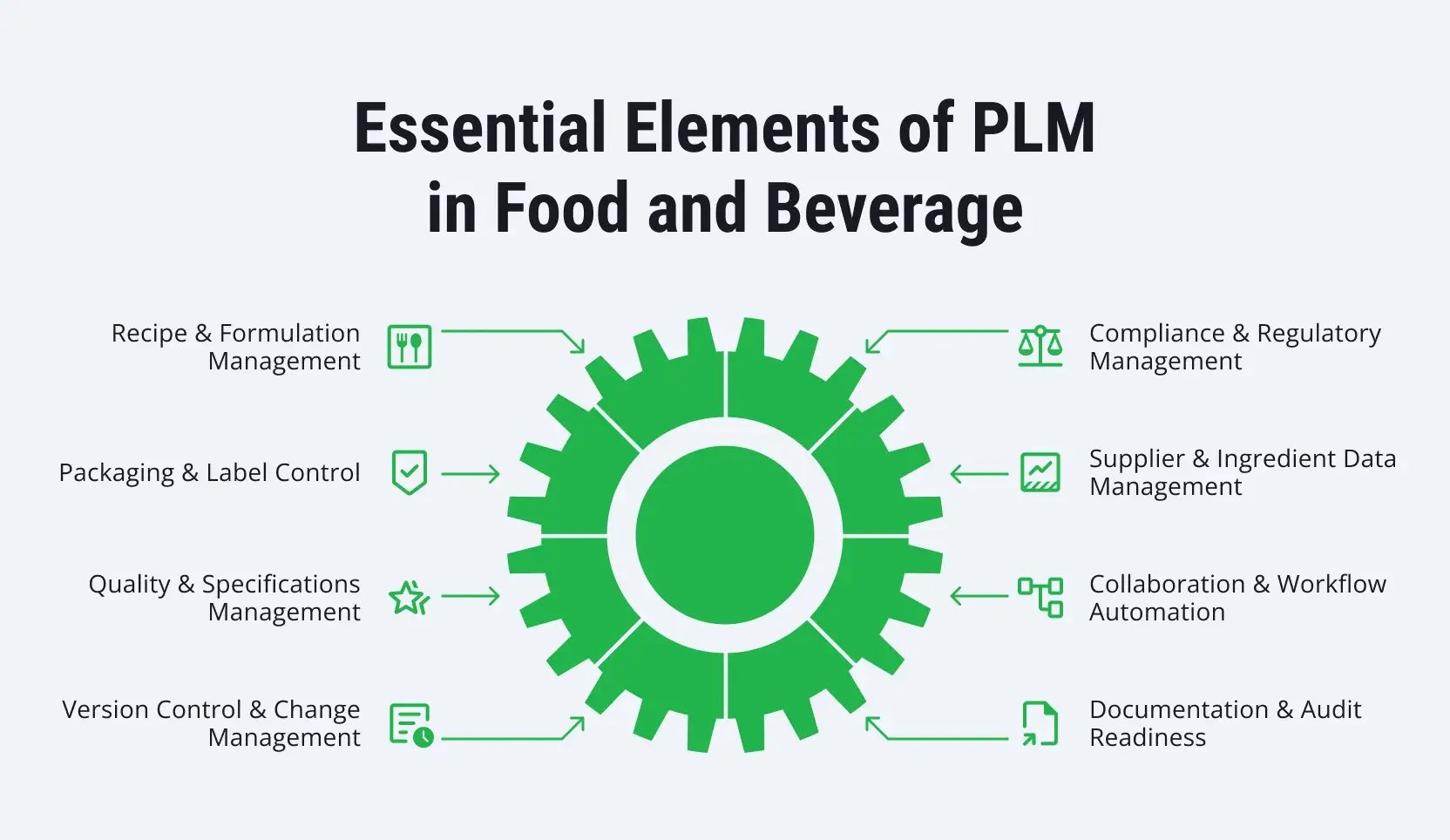
PLM systems change how this is handled. Product information is centralized — formulations, specifications, documentation, compliance data — within one controlled environment. Teams work with the same version of data, which helps reduce errors and keeps processes aligned.
Beyond centralization, PLM supports the core processes required for compliance. It streamlines document control, ensures proper version management, and enables full traceability across the product lifecycle. With built-in workflows and project management capabilities — the top use case cited by 43% of manufacturers — teams can standardize how products are developed, reviewed, and approved. This simplifies compliance and accelerates decision-making.
The impact is tangible. Manufacturers using PLM report improved product quality (41%) and better data management (37%) — both critical for meeting FDA and FSMA requirements while keeping pace with market demands.
Faster Innovation and Time-to-Market Is Another Key Benefit of PLM
Regulatory compliance defines the limits within which manufacturers operate. Competitiveness, however, depends on how quickly they can move within those limits. With shorter product lifecycles, ongoing demand for new variations, and rising cost pressure, slow development processes become a constraint. PLM provides an advantage here by enabling faster innovation without compromising control.
Closing the gap between R&D and manufacturing
R&D and manufacturing do not always operate in sync. Formulations that look stable in the lab can behave differently in production, which leads to rework and delays. PLM changes how this is handled. Formulation data, process parameters, and manufacturing requirements are linked early. Recipes are developed with production in mind, which makes scaling more reliable and reduces late adjustments.
Centralized product data for faster iterations
Delays are also often caused by fragmented data. When information is spread across multiple systems, retrieving validated formulations or comparing versions becomes time-consuming. PLM addresses this by centralizing product data within a structured repository. This makes it easier to access reliable formulations, track changes between versions, and reuse existing knowledge.

Stronger launch planning and readiness
Launch readiness often depends on how well different data points are aligned. PLM helps structure this by linking product data with supply chain inputs, packaging requirements, and documentation. This makes it easier to ensure that all components of the product are consistent before release.
Product assortment management
Product variations are often unavoidable. Market differences, regulatory requirements, and consumer preferences — all contribute. PLM helps organize this process. Variants can be created without repeating the same work, while documentation and approval history are maintained for each one.
Real-time visibility for faster decisions
Decision-making depends on visibility. Without current data, even routine choices take longer. PLM addresses this by making development status, approvals, and risks visible in real time. Version control and validation add another layer of reliability. Rework becomes less frequent, and products moving toward launch are based on consistent information.
From Concept to Shelf: Traceability You Can Prove
Traceability under FSMA has become more specific, especially with the FDA’s Food Traceability List (FTL). The requirement is not only to document critical tracking events but to do so in enough detail to be usable. Sourcing, transformation, transportation, storage — all of these need to be recorded in a way that supports a fast response if something goes wrong.
This is already expected from companies handling FTL-listed products. Fresh produce, seafood, dairy, eggs, and nut-based products — all fall into scope. Systems need to capture Key Data Elements (KDEs) across Critical Tracking Events (CTEs), from growing and receiving through to transformation and shipping. What this looks like in practice: at least two years of records and the ability to provide them to the FDA quickly in a structured electronic format.
Traceability influences both compliance and business outcomes. When it is insufficient, batch identification takes longer. Recalls can expand, costs increase, and reputational risks follow. A more structured traceability setup changes how issues are handled. Identification is faster, and response actions are more accurate.
Its importance becomes more visible at scale. The benefits do not grow evenly — they become more pronounced with higher supply chain complexity, greater product value, and stronger regulatory pressure.
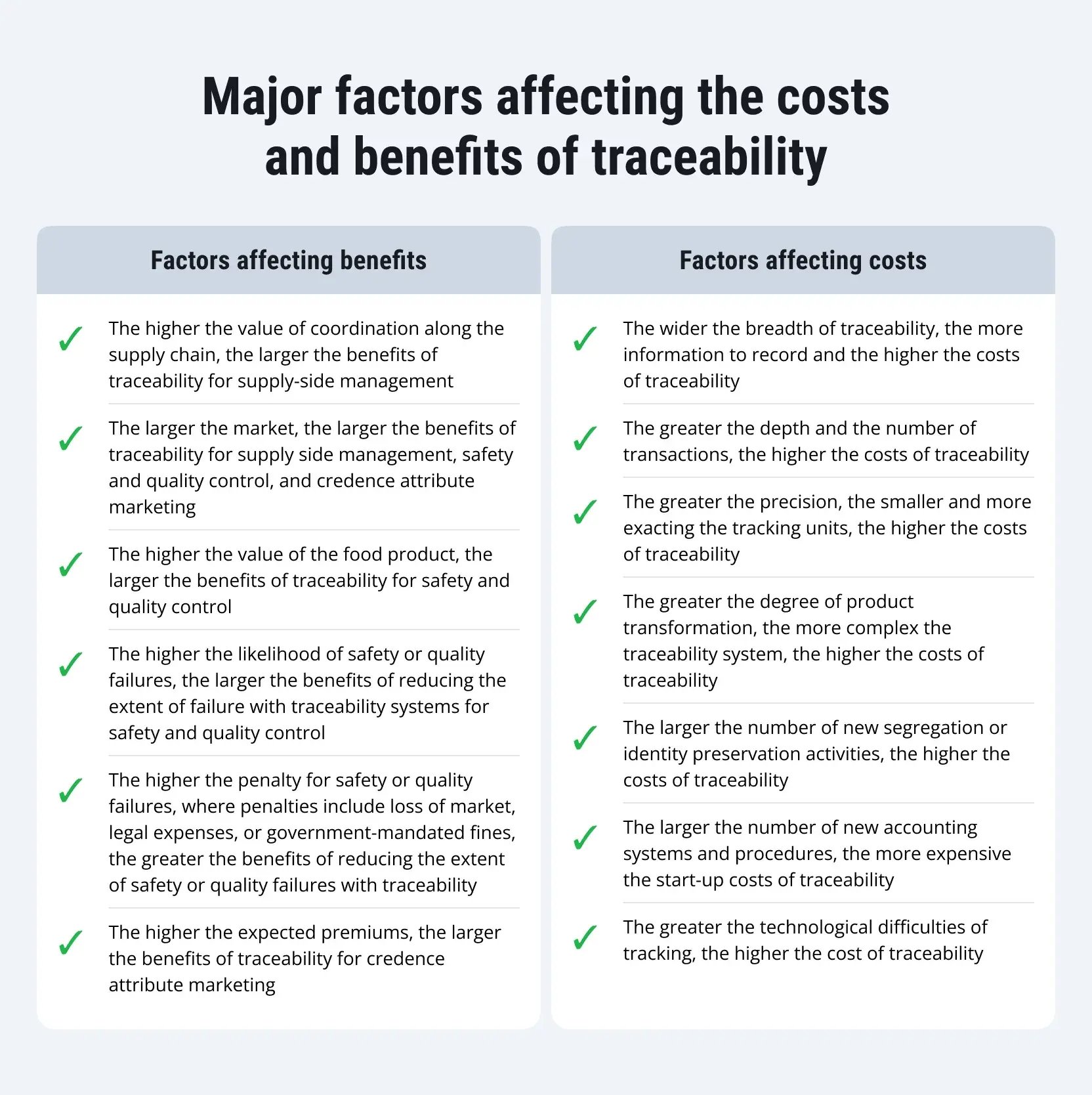
At the same time, the operational burden grows just as quickly. The broader the traceability scope and the higher the level of detail required, the more data must be captured, validated, and maintained across systems. This creates a structural challenge: the exact conditions that make traceability essential also make it difficult to implement using traditional tools.
In many organizations, product data is distributed across multiple systems. ERP platforms, supplier databases, spreadsheets, and local documentation each contain part of the picture, but they are rarely synchronized. As a result, reconstructing a product’s history requires manual effort, and the data itself may be incomplete or inconsistent, which becomes a critical issue when records must be delivered within hours, not days.
PLM systems address this fragmentation by linking all product-related data within a single environment. From the earliest stages of product development, formulations are connected to raw material specifications, supplier information, and compliance data. Every change is recorded, version-controlled, and traceable over time.
This approach ensures that:
- Each ingredient is linked to its source and specifications.
- Formulation changes are documented with full history and approvals.
- Compliance data and test results remain attached to the product record.
- Product variants maintain traceable connections to base formulations.
- Documentation evolves together with the product rather than separately.
Because all data points are connected, traceability becomes an inherent part of the product lifecycle, aligned with both operational needs and regulatory expectations.
Why Traditional Systems Fall Short and Where PLM Fits In
Most food manufacturers use a mix of systems to manage different parts of the product lifecycle — from R&D and quality control to production and supply chain operations. Each system solves a specific task, but none provides a complete, end-to-end view of the product.
The table below illustrates how these systems compare and where PLM brings additional value.
|
System |
Primary focus |
Strengths |
Limitations in PLM |
|
- Production - Procurement - Inventory |
- Strong transactional control - Supply chain visibility |
- Limited support for formulations - Weak version control, not designed for R&D |
|
|
Laboratory Information Management System (LIMS) |
- Laboratory testing - Quality control |
- Accurate testing - Compliance support |
Isolated from product development and manufacturing decisions |
|
Electronic Lab Notebook (ELN) |
Research and development documentation |
Flexible experiment tracking |
- No lifecycle control - Poor integration with downstream processes |
|
Product Data Management (PDM) |
Product data and document management. |
- Version control - Centralized storage |
- Limited workflow management - Lack of cross-functional integration |
|
Quality Management System (QMS) |
- Quality processes - Compliance |
- Audit readiness - Quality tracking |
Reactive focus, not embedded in product development |
|
Supplier and logistics management |
- Supplier coordination - Sourcing optimization |
No visibility into product structure |
|
|
Spreadsheets (e.g., Excel, Google Sheets) |
Ad hoc data management |
- Flexibility - Quick setup |
- No traceability - No version control - High risk of errors |
|
Product Lifecycle Management (PLM) |
End-to-end product lifecycle management |
- Centralized product data - Version control - Workflow automation - Full traceability |
Requires integration with existing systems |
What sets PLM apart is not that it replaces these systems, but that it connects them. It creates a structured layer where product data, changes, and processes are managed consistently across the entire lifecycle.

Turning PLM Complexity into a Managed, Scalable System with SAP and LeverX
In theory, product lifecycle management seems straightforward. In practice, it rarely is. Data volumes grow, stakeholder groups expand, changes continue, and regulatory expectations increase. Coordination becomes a challenge rather than a given.
SAP PLM supports a more connected approach. It aligns processes across all lifecycle stages, from initial concept through to end-of-life management.
- Idea — requirement management remains structured, allowing teams to evaluate concepts and focus on initiatives with real potential.
- Design — product data is centralized, while formulation management and version control support collaboration across R&D, engineering, and quality.
- Manufacturing — design decisions are carried through to production via aligned BOMs, routing, and integration with ERP and MES.
- Service — insights from real-world usage feed back into the lifecycle, supporting ongoing improvements and maintenance planning.
- Disposal — materials and substances are tracked to meet environmental and sustainability requirements.
Managing product data across lifecycle stages often leads to fragmentation. SAP PLM addresses this by bringing data, documentation, and processes into a single environment, where they can be maintained consistently.
The solution itself is not limited to one module. It functions as a broader ecosystem that supports different areas of the lifecycle.
SAP Recipe Development (SAP RD) is used to manage formulation and compliance.
Regulatory tracking and hazardous substance control are handled through SAP Product Compliance.
For engineering, companies rely on SAP Engineering Control Center (SAP ECTR) to integrate CAD data, while SAP Enterprise Product Development (SAP EPD) supports collaboration across teams.
Cost simulation is covered by SAP Product Lifecycle Costing (SAP PLC). Sustainability and environmental metrics are addressed through SAP Responsible Design and Production (SAP RDP) and Product Footprint Management (SAP PFM).
Together, these tools extend PLM from a data management layer into a comprehensive platform for product innovation, compliance, and lifecycle optimization.
LeverX: From platform to working solution
With over 20 years of SAP expertise, LeverX supports companies at every stage of their PLM journey — from initial strategy to long-term optimization.
Our services cover the full lifecycle of PLM adoption:
Strategic PLM consulting
Defining a roadmap, aligning PLM capabilities with business goals, and establishing governance models.
SAP PLM implementation
End-to-end setup tailored to industry-specific requirements, including food and beverage.
System integration
Connecting PLM with ERP, LIMS, QMS, supply chain systems, CAD tools, and external data sources.
Application management (AMS)
Ongoing support, optimization, and performance improvement.
Security and compliance
Protecting product data and ensuring alignment with regulatory standards.
LeverX extends SAP PLM with a set of accelerators — workflow automation (IPS), data management tools, and BOM optimization solutions. These are used to reduce implementation time and improve how processes run daily.
SAP defines the technological layer. LeverX works on top of it, making sure the system is integrated and aligned with real business workflows.
In the U.S. food industry, this combination becomes particularly relevant. Compliance, traceability, and speed all need to be addressed at once. A more connected lifecycle setup helps replace fragmented processes with a controlled, end-to-end approach.
SAP PLM in Practice: LeverX Project Examples
The following examples show how LeverX helps companies move from these constraints to a structured, high-performing PLM landscape.
25–35% efficiency increase through cross-facility collaboration optimization
A construction machinery producer working across several locations faced a common issue. Product data and documentation were not stored in one place. Each facility maintained its own set of information. Over time, this affected collaboration and introduced inefficiencies, especially when teams worked with outdated data.
SAP PLM was used to reorganize this setup. Product information and documents were centralized, CAD data was integrated, and SAP Engineering Control Center (ECTR) helped align engineering practices across locations.
The effect became visible quickly. Teams gained access to the same data, regardless of location. Coordination improved, friction decreased, and efficiency increased by 25–35%. The new setup also supported further steps, including visualization tools and workflow automation.
40% revenue growth supported by R&D and engineering modernization
A U.S.-based consumer goods company faced growing limitations in its R&D and engineering processes due to an outdated CAD integration setup. The system supported only a narrow subset of engineering data, was difficult to use, and lacked the functionality required for efficient lifecycle management. As a result, teams struggled to maintain consistency across product development and manufacturing, which directly affected scalability and product quality.
LeverX redesigned the client’s PLM environment by creating a unified workspace for engineering, R&D, and quality processes. By implementing SAP Engineering Control Center (ECTR), the team connected CAD data (SOLIDWORKS) with core business data in SAP, eliminating fragmentation between design and execution. Additional capabilities, such as 3D visualization through SAP Visual Enterprise and flexible workflow management via LeverX’s Integrated Process Solution (IPS), enabled more efficient collaboration and structured change management.
The impact was immediate and measurable. The project was delivered fully remotely within six months, during the peak of the COVID-19 pandemic. As demand surged and the client’s revenue grew by 40%, the new PLM environment allowed the company to scale engineering and manufacturing operations without disruption, supporting both increased production and international expansion.

.jpg)