A change to a medical device can affect far more than the product specification. It can require updates to the approved manufacturing process, inspection criteria, production records, component traceability, inventory, and service documentation.
If those records sit in disconnected systems, even a controlled engineering change can create gaps in execution and documentation.
This connection has gained additional weight in the US since the FDA’s Quality Management System Regulation (QMSR) took effect on February 2, 2026, incorporating ISO 13485:2016 into 21 CFR Part 820. SAP can connect processes across product lifecycle management, ERP, manufacturing, quality, warehouse operations, and service, with the exact architecture depending on the manufacturer’s products, plants, systems, and regulatory requirements.
In this guide, we examine the SAP manufacturing solutions and processes relevant to medical device manufacturing, from product lifecycle and engineering changes through production, quality, traceability, supplier management, planning, and post-market support.
What SAP Solutions Are Relevant to Medical Device Manufacturing?
SAP offers a range of applications that can support different parts of the medical device manufacturing lifecycle. A manufacturer does not necessarily need all of them. The relevant landscape depends on the products, manufacturing model, plant network, supplier structure, existing applications, and the company’s overall SAP strategy.
At its heart, SAP S/4HANA can manage enterprise processes like procurement, materials, production, inventory, sales and finance. Other SAP solutions extend the landscape to specialised operational areas:
- SAP S/4HANA: Provides the ERP foundation for materials, procurement, production, inventory, sales, finance, and related master data. Its manufacturing capabilities can connect production planning and manufacturing processes with the broader enterprise.
- SAP Quality Management: Supports inspection planning and execution, quality results, defects, quality notifications, and follow-up actions. It can connect quality checks with materials, batches, suppliers, production, and inventory.
- SAP Product Lifecycle Management and SAP Integrated Product Development: Support product and engineering information, product development, change processes, and integration with enterprise processes. SAP also supports integration with external PLM platforms, which matters when a manufacturer already relies on systems such as Siemens Teamcenter, PTC Windchill, or Dassault Systèmes 3DEXPERIENCE.
- SAP Digital Manufacturing: Provides manufacturing operations management and shop-floor execution capabilities. It can connect production execution with SAP S/4HANA and support the collection of production and process data.
- SAP Extended Warehouse Management (EWM): Handles detailed warehouse processes such as receiving, picking, staging, packing, and inventory movements. EWM can also integrate with SAP Quality Management for warehouse inspections and with production supply processes.
- SAP Integrated Business Planning (IBP): Supports demand, inventory, supply, and response planning when manufacturers need planning capabilities beyond the core ERP processes.
- SAP Business Network and SAP Ariba: Extend procurement and supplier processes to external partners. They can be relevant when supplier quality, component availability, purchase orders, and collaboration with contract manufacturers require coordinated processes.
- SAP Asset Management: Supports maintenance of production equipment, including maintenance planning, work orders, technical objects, and asset history. This becomes relevant when equipment condition and maintenance records affect manufacturing operations.
- SAP Business Technology Platform (BTP): Provides integration, extension, automation, and application-development capabilities around the SAP landscape. It can connect SAP applications with existing PLM, MES, QMS, laboratory, regulatory, or other specialized systems without forcing every function into SAP.
- SAP Business Data Cloud and analytics capabilities: Bring data from SAP and other sources together for reporting and analysis across areas such as production, quality, supply chain, inventory, and finance.
- SAP service capabilities, including SAP Field Service Management where applicable: Can support field service processes for installed devices, technicians, service orders, spare parts, and equipment information after shipment.
These components can also coexist with specialized systems. A medical device manufacturer may continue using a dedicated PLM, MES, QMS, laboratory, regulatory, or other industry-specific application while connecting it to SAP. BTP and standard integration capabilities can support these connections without requiring every process to move into SAP.
The architecture which emerges depends on the role of each system. Critical to the success of the project are decisions about who owns a given record in an application, where a business process resides, how data flows between systems, and what information must remain connected across the product lifecycle. These areas are discussed in more detail in the following sections starting with product lifecycle management and engineering change.

Product Lifecycle and Engineering Change
A medical device moves into production only after its product definition reaches an approved state. That definition can include the product structure, engineering BOM, specifications, documents, revisions, and other information required to manufacture the device. SAP PLM and related product development capabilities provide a framework for managing this information and connecting it with downstream manufacturing processes.
SAP for medical device product lifecycle management
The product lifecycle typically moves from design and review through approval and manufacturing release. The critical point comes at the handoff to manufacturing: production needs a controlled product definition that corresponds to the approved engineering data.
SAP supports different product structures for engineering and manufacturing. An engineering BOM can represent the product from the design perspective, while a manufacturing BOM can organize the components and structure required for production. SAP change records can also group related objects such as BOMs, routings, materials, documents, and specifications within one controlled change process.
Product documentation and approval status also form part of this lifecycle. The specific objects and workflows depend on the SAP products and manufacturing processes in use. In a broader PLM landscape, SAP can also exchange product information with external engineering and PLM systems rather than requiring every engineering function to reside in SAP.
Engineering change management for medical devices
Medical device designs can change because of component substitutions, design corrections, supplier changes, manufacturing requirements, or other business and engineering decisions. Each change needs a defined scope, approval, and effective date or other effectivity rule.
SAP Engineering Change Management uses change numbers and change records to document changes to objects such as BOMs and routings. Effectivity controls when a particular change becomes applicable. SAP also supports workflow and status management for change processes, allowing organizations to define review and release steps before changes take effect.
For a medical device, the impact can extend beyond the engineering BOM. A component change may require corresponding updates to the manufacturing BOM, routing, purchasing requirements, specifications, or other affected objects. SAP's change record capabilities support impact analysis across related engineering and manufacturing objects.
The resulting process can follow a controlled chain:
Engineering change → product structure update → manufacturing data update → affected business objects reviewed → change approved → defined effectivity applied
This approach gives engineering and manufacturing teams a common change reference. It also reduces the risk of different systems carrying different versions of the product definition. The specific integration pattern depends on the manufacturer's PLM, ERP, MES, and other systems, which we will address later in the article.
Production and Shop-Floor Execution
Once an approved product definition reaches manufacturing, SAP connects the production plan with the materials, operations, resources, and execution records required to build the device. The exact division of responsibilities depends on the manufacturing environment.
SAP S/4HANA can manage the manufacturing order and core production transactions, while SAP Digital Manufacturing can provide a more detailed execution layer for shop-floor activities.
SAP for medical device production
In SAP S/4HANA, a manufacturing order brings together the material requirements, BOM components, routing operations, quantities, dates, and other data needed to execute production. Production confirmations record quantities, work performed, and operation status, while goods movements can post component consumption and finished-goods receipt.
For serialized products, SAP can assign serial numbers to production order items and carry those assignments through the production process. SAP also provides product genealogy capabilities for serialized materials, allowing users to examine the components, production data, quality issues, and documents associated with a manufactured product.
This gives manufacturers a production flow that can connect the released product definition with the manufacturing order, material consumption, operations, confirmations, and finished device. The level of detail captured during execution depends on the plant’s processes and the systems used at the shop floor.
SAP Digital Manufacturing for medical devices
SAP Digital Manufacturing adds a dedicated manufacturing execution layer between enterprise planning and the operator. It can provide production operators with work instructions, collect process data at specific operations, and manage execution through shop-floor control objects. Work instructions can include text, images, diagrams, URLs, and 3D content. Data collection groups can capture defined parameters during manufacturing.
A typical architecture connects SAP S/4HANA with SAP Digital Manufacturing, with Digital Manufacturing handling detailed execution activities at the plant. Routings and production information can be transferred into Digital Manufacturing, where they can be supplemented with work instructions and data collection requirements for specific operations.
This architecture can suit medical device plants that need more detailed operator guidance and process data than the core ERP layer provides. It does not mean every plant should replace an existing MES or other validated manufacturing application with Digital Manufacturing. The appropriate execution layer depends on the site's processes, validation requirements, automation, existing systems, and required level of shop-floor control.
For high-mix manufacturing, detailed work instructions and operation-specific data collection can help manage differences between products and variants. High-volume environments may place greater emphasis on automated data capture, equipment integration, and consistent execution across production resources. In both cases, the architecture needs a clear boundary between enterprise production management and shop-floor execution.
How SAP Connects Quality, Traceability, and Recall Readiness
Quality and traceability rely on the same underlying production and material records. A component can move from supplier receipt through inspection and production into a finished device, while batches, serial numbers, inspection results, and business documents preserve the relationships between those events. SAP provides several mechanisms for recording and analyzing these relationships.
SAP Quality Management for medical devices
SAP Quality Management can support inspections at different points in the material flow. A goods receipt can trigger an inspection lot for incoming material, while production processes can generate inspection lots for in-process or finished-product inspection. Users can record inspection results and defects and complete an inspection with a usage decision. Depending on the configured process, stock can remain in inspection or blocked status until the relevant quality decision is made.
For a medical device manufacturer, this can connect quality decisions with the material and business document involved. Quality notifications can also be associated with objects such as batches, serial numbers, inspection lots, deliveries, and production orders. This provides a common reference for investigating a defect or quality event.
The resulting relationship can span the material flow:
Component receipt → incoming inspection → release or restriction → production → in-process checks → final inspection → finished-product disposition
The exact inspection points, characteristics, sampling rules, and release controls depend on the manufacturer's quality process and configuration.
Device and component traceability
Traceability requires more than assigning a serial number to a finished device. The manufacturer needs relationships between the device, its components, production records, quality data, and downstream transactions.
SAP batch management can provide where-used analysis that follows a batch through production and distribution. The analysis can work in both directions, showing where a batch was used and where it originated. Relevant records can include production orders, vendor batches, material documents, and deliveries.
For serialized devices, serial numbers provide an additional level of identification. Depending on the configured processes, manufacturers can associate serial numbers with production and logistics transactions and use them in quality processes. SAP can also combine batch and serial-number information where both are relevant to the product.
A practical traceability chain can look like this:
Supplier component → supplier batch or serial number → purchase order and goods receipt → inspection → production order → finished-device serial number → delivery → customer
The available depth depends on what data the manufacturer actually captures and how systems outside SAP are integrated. SAP Global Batch Traceability can also incorporate relevant data from non-SAP systems, which matters when production, PLM, MES, or other applications contribute to the genealogy.
SAP for supplier and component traceability
The inbound side of genealogy starts with the component. A manufacturer needs a reliable relationship between the supplier, purchased material, supplier batch or serial number, receipt transaction, inspection result, and subsequent consumption in production.
SAP can maintain these relationships through material, batch, supplier, purchasing, inventory, quality, and production records. Batch where-used functions can then trace how a received batch moved through production and into subsequent materials or deliveries.
This becomes particularly useful when a supplier identifies a problem with a component batch. Instead of starting with finished-device records, the investigation can begin with the affected supplier batch and move forward through the production orders and finished products that used it.
Recall and containment readiness
A quality event can require two complementary searches. Backward traceability identifies where an affected component came from. Forward traceability identifies which production orders, finished devices, inventory, and shipments may have been affected.
SAP's batch traceability capabilities can support these investigations through relationships among tracked batches and business documents such as purchase orders, production orders, deliveries, and material documents.
For example, an investigation could follow:
Affected component batch → production orders → finished-device batches or serial numbers → available inventory → deliveries and customers
That information can help teams identify potentially affected stock, support containment decisions, investigate complaints, and provide service teams with relevant product history. SAP provides data, traceability, and workflow capabilities that can support these processes. It does not independently determine whether a regulatory recall is required or define the manufacturer's regulatory obligations.

Learn how LeverX helped a leading healthcare technology company migrate from legacy systems to SAP Product Lifecycle Management (SAP PLM).
This helped the client digitize engineering and quality workflows to support strict FDA compliance.
How SAP Connects Suppliers, Contract Manufacturing, and Planning
Medical device supply chains often depend on external companies for critical components, processing, subassemblies, or complete products. That makes supplier performance and external production part of the manufacturing planning problem. SAP can connect procurement, supplier collaboration, quality processes, subcontracting, and supply planning so that material availability and supplier constraints can be reflected in production decisions.
Supplier quality and procurement
For regulated manufacturing, supplier management extends beyond placing purchase orders. The procurement process may need to account for supplier qualification, technical delivery requirements, quality agreements, certificates, inspections, and supplier performance.
SAP S/4HANA Quality Management integrates with procurement processes and supports functions such as supplier evaluation, supplier blocking, supplier release, technical delivery terms, quality assurance agreements, certificate processing, source inspections, and goods receipt inspections.
SAP Business Network can extend collaboration beyond the enterprise. Suppliers can receive purchase orders, send confirmations and ship notices, and participate in quality-related processes. Quality collaboration can include inspection requests, inspection results, certificates of analysis, and quality notifications.
This creates a connection between procurement and quality data. A supplier issue recorded during inspection can feed supplier evaluation and follow-up activities instead of remaining isolated from the purchasing relationship.
SAP for contract manufacturing
SAP S/4HANA supports subcontracting procurement when a supplier manufactures a product using components provided by the buyer. The subcontracting purchase order can specify the required components, while SAP manages the provision of those components and the receipt of the finished material.
This model can apply when a medical device manufacturer sends components to an external manufacturer for an assembly or processing step. The components remain tracked as stock provided to the vendor while they are at the subcontractor, with consumption recorded as part of the subcontracting process.
SAP Business Network can also support collaboration with contract manufacturers. A subcontracting purchase order can include the component information required for production, followed by order confirmation, component shipment, shipment of the manufactured goods, receipt, and invoicing.
For medical device operations, the architecture needs clear ownership of production records and material information across the internal plant and external manufacturer. The exact model depends on whether the external party produces a component, performs a specialized process, or manufactures the finished device.
SAP for medical device supply chain planning
Supplier lead times and component availability directly affect production plans. SAP Integrated Business Planning (IBP) supports demand planning, supply planning, inventory planning, response and supply planning, and what-if simulations.
For a medical device manufacturer, planners can use these capabilities to examine how a component shortage, supplier constraint, demand change, or inventory policy affects the supply plan. The planning question can then move from “Will we have enough components?” to “Which production requirements and customer commitments are affected if supply changes?”
A simplified planning relationship looks like this:
Supplier constraint → available supply → production plan → inventory position → customer commitments
The quality and supplier information from procurement processes can also provide context for planning decisions. For example, a material may exist physically while remaining unavailable for production because it is under quality inspection or another restriction. Planning needs to work with the supply quantities and statuses that actually apply to the manufacturing process.
This makes supplier management, contract manufacturing, and planning interconnected parts of the operating model. The next sections can then follow the material after procurement and production into inventory, packaging, distribution, and service, without repeating the supplier processes covered here.
How SAP Supports Inventory, Distribution, and Service After Production
After production, medical device operations still depend on accurate product identity, stock status, packaging information, and shipment records. SAP can carry this information through warehouse operations, packaging, distribution, and service, with the exact process depending on the device, distribution model, and systems in use.
SAP for inventory and warehouse operations
Medical device inventory can include raw materials, components, finished devices, sterile products, service parts, and stock held for inspection or other restricted statuses. SAP S/4HANA supports batch and serial number management, inventory status, and controlled stock movements. In warehouse-managed environments, SAP EWM can add bin-level inventory, warehouse tasks, handling units, and more detailed execution.
Handling units link packaging materials with their contents and retain relevant product information such as batch data. EWM can also manage serialized products and record the storage location associated with a serial number.
For a medical device manufacturer, the warehouse process therefore needs to preserve the identity and status of stock while it moves between storage, inspection, staging, picking, and shipping. EWM becomes particularly relevant when warehouses require detailed execution, high transaction volumes, complex storage structures, or tighter control over picking and packing activities.
SAP for medical device packaging and labeling
Packaging connects the approved product definition with the physical device prepared for shipment. SAP can manage packaging materials, packaging configurations, handling units, and relevant batch or serial information. The resulting records can support the relationship between a device, its packaging, and the outbound delivery.
For products subject to FDA UDI requirements, the device label and package generally need a UDI in both human-readable and machine-readable form, with specified device information submitted to GUDID. The UDI itself contains a device identifier and may include production identifiers such as a lot or batch number, serial number, or expiration date.
SAP can provide product, batch, serial, packaging, and logistics data used by labeling and packaging processes. Actual UDI generation, label design, issuing-agency requirements, GUDID submission, and applicable exceptions require the appropriate regulatory and labeling processes around the SAP environment.
A typical data relationship can run from product definition to device identification, packaging, labeling, and shipment. Keeping those references consistent helps prevent discrepancies between the device prepared for distribution and the information recorded in business and logistics systems.
SAP for medical device distribution and logistics
Distribution begins with customer demand and continues through availability checking, outbound delivery, warehouse fulfillment, transportation, and receipt. SAP S/4HANA can manage sales and delivery processes, while EWM can handle detailed warehouse execution and SAP Transportation Management can support transportation planning and execution.
For larger distribution operations, an architecture can connect S/4HANA → EWM → TM → carrier. EWM can manage picking, packing, staging, and loading, while TM can plan transportation activities and exchange shipment information with the warehouse. SAP also supports batch and serial information in transportation documents, allowing product identification data to move into logistics processes.
Proof of delivery can then provide a downstream confirmation of the shipment and any reported quantity differences. This gives distribution teams a connected record from customer order through warehouse fulfillment and transportation to delivery confirmation.
SAP for service and installed device management
For devices that remain in use at customer sites, the operational record continues after shipment. SAP installed base capabilities can represent customer-site products and their components, including equipment, materials, serial numbers, and related documents. Service processes can use this structure as a reference for service activities.
A service event can reference the installed device, record work performed and materials consumed, and maintain the service history. Serial numbers can also identify the specific device or service part involved. SAP Field Service and Asset Management can add technician planning and dispatch capabilities where field service operations require them.
The resulting service relationship can connect:
- Installed device and customer location
- Service request or maintenance event
- Technician activity and service findings
- Spare parts and consumed materials
- Completed service history.
For medical device manufacturers, this information can support maintenance, warranty handling, service planning, and investigation of device-related issues. Complaint handling and regulatory reporting may require additional processes and systems depending on the manufacturer's obligations and operating model.
Understanding US Regulatory and Validation Requirements for SAP
For US medical device manufacturers, an SAP implementation may become part of the systems used to operate and document the quality system. The regulatory question then extends beyond whether SAP can perform a business process. The manufacturer needs to demonstrate that relevant processes, records, access controls, changes, and system functions operate as intended within its quality framework.
US regulatory and quality context
The FDA’s Quality Management System Regulation (QMSR) took effect on February 2, 2026. It amended 21 CFR Part 820 and incorporated ISO 13485:2016 by reference, creating a closer alignment between the FDA quality framework and the international medical device quality standard. The QMSR applies to finished device manufacturers that commercially distribute medical devices in the US.
For SAP-supported processes, the relevant controls can cover areas such as:
- Controlled quality and production records
- Documented changes and approvals
- Material and device traceability
- Supplier and purchasing controls
- Access to regulated data
- Records that support audits and inspections.
The applicable requirements vary by device, process, and record. For electronic records and signatures that fall within its scope, 21 CFR Part 11 establishes requirements concerning electronic records, signatures, and related controls. FDA guidance also describes considerations such as validation, audit trails, record retention, and system access.
SAP can provide functionality that supports these processes, including workflow, authorization controls, change management, quality records, and audit-related information. The manufacturer remains responsible for defining its procedures, determining which records and processes fall within applicable requirements, and maintaining evidence that the controls work as intended.
SAP and computer system validation / GxP-type controls
Validation should follow the intended use and risk of the system. A medical device manufacturer may use SAP for finance or ordinary commercial processes alongside functions that directly support production or the quality system. The validation effort should focus on the functions whose failure could affect product quality, safety, regulated records, or the effectiveness of the quality system.
FDA's February 2026 Computer Software Assurance guidance recommends a risk-based approach for software used in medical device production and quality management systems. It addresses activities such as identifying risks, determining where additional rigor applies, and selecting appropriate testing methods and objective evidence.
For an SAP implementation, this can affect requirements, configuration, testing, access management, change control, and documentation. A manufacturer may need documented evidence that critical workflows, calculations, interfaces, authorizations, and electronic records perform according to their approved intended use. Changes introduced through upgrades, configuration changes, custom development, or integrations may also require assessment and appropriate regression testing.
The term GxP needs similar care. Medical device manufacturers operate under a device-specific regulatory framework, including the QMSR, rather than automatically following pharmaceutical GMP requirements. Some organizations may use GxP terminology internally or operate across multiple regulated product categories, but the applicable controls should come from the manufacturer's actual regulatory obligations and quality system.
SAP software alone does not establish FDA compliance or satisfy validation requirements. The manufacturer needs a controlled implementation, documented procedures, risk-based testing, appropriate access and change controls, and objective evidence supporting the system's intended use.
How to Build a Connected SAP Architecture for Medical Devices
Medical device manufacturers rarely run every product, manufacturing, warehouse, and service process in one application. The architecture may include PLM, ERP, MES, warehouse systems, supplier platforms, service applications, and external regulatory or labeling tools. The key architectural question concerns where each piece of information belongs and how changes move between systems.
SAP data management for medical devices
A connected architecture starts with consistent master data. SAP S/4HANA can hold core business and manufacturing data such as materials, suppliers, customers, BOMs, routings, batches, and serial numbers. Product development or PLM systems may remain the system of record for engineering information, while specialized applications can own other data domains.
Data governance needs to define ownership, identifiers, lifecycle states, and synchronization rules. For example, a material number, device model, supplier record, or serial number should have a clear source and consistent representation across connected systems. The same principle applies when data moves between SAP and external MES, PLM, warehouse, or service applications.
Migration adds another layer of control. Legacy material masters, BOMs, batches, serial numbers, and historical records need mapping and validation before they enter the target system. The migration approach should also distinguish data required for ongoing operations from historical information retained for reporting, service, quality, or regulatory purposes.
For larger transformations, the migration strategy should follow the manufacturer's data ownership model rather than treating every legacy record as equivalent.
SAP integration architecture for medical device manufacturing
Integration should preserve business relationships as information moves between applications. A typical landscape can connect product development with SAP S/4HANA, while S/4HANA coordinates procurement, production, quality, inventory, and finance. Digital Manufacturing or another MES can handle detailed shop-floor execution, with EWM supporting warehouse processes and service applications managing post-sale activities.
Suppliers and contract manufacturers may exchange orders, confirmations, shipment information, quality data, and other records through SAP Business Network or other integration channels. Customers and distributors add another external boundary. SAP BTP and SAP Integration Suite can provide integration and API capabilities across these systems. SAP describes API-based, event-driven, and central integration patterns as complementary options within its clean-core integration approach.
The important design decision concerns system ownership. A PLM system may own engineering structures, S/4HANA may own the commercial and manufacturing transaction, and an MES may own detailed shop-floor execution data. Interfaces should then transfer only the information required by the receiving process, using governed APIs, events, or other supported interfaces.
This separation also helps control changes. When an interface changes, the organization can identify which processes depend on it, test the affected flows, and maintain evidence of the change where regulated processes require it.
Clean Core and SAP BTP for medical devices
Clean core provides a framework for keeping SAP S/4HANA maintainable while extending the overall solution where standard functionality does not cover a specific requirement. SAP supports both on-stack extensibility and side-by-side extensions on SAP BTP. Side-by-side extensions run separately from S/4HANA and can use released APIs or business events to interact with the core.
For a medical device manufacturer, BTP can support use cases such as supplier integrations, workflow extensions, custom applications, process automation, analytics, and AI services. The choice depends on how tightly the requirement needs to interact with the ERP process. SAP's current clean-core guidance favors released interfaces and appropriate extension models rather than direct dependencies on internal SAP objects.
A practical principle for the architecture is:
Standard S/4HANA + governed extensions + controlled integrations
That approach keeps regulatory and operational processes visible within the core ERP while allowing specialized capabilities to remain outside it. BTP should have a defined architectural role rather than becoming a second place to reproduce S/4HANA business logic.
Recommended SAP architecture for medical device manufacturing
There is no single SAP stack that fits every medical device manufacturer. Product complexity, manufacturing model, existing PLM or MES systems, warehouse requirements, service operations, and regulatory processes all affect the target architecture.
A reference model can place SAP S/4HANA at the center of core enterprise processes, with product development and PLM connected upstream and specialized execution and service capabilities connected around it.
EWM can handle detailed warehouse execution, while Digital Manufacturing or an existing MES can manage shop-floor activities.
BTP and integration services connect SAP with suppliers, contract manufacturers, customers, and external applications.
Analytics and SAP Business Data Cloud can provide a data layer for cross-process analysis. SAP's broader architecture guidance places SAP applications and processes alongside BTP, Business Data Cloud, and external data and application sources.
The resulting reference architecture can be represented as: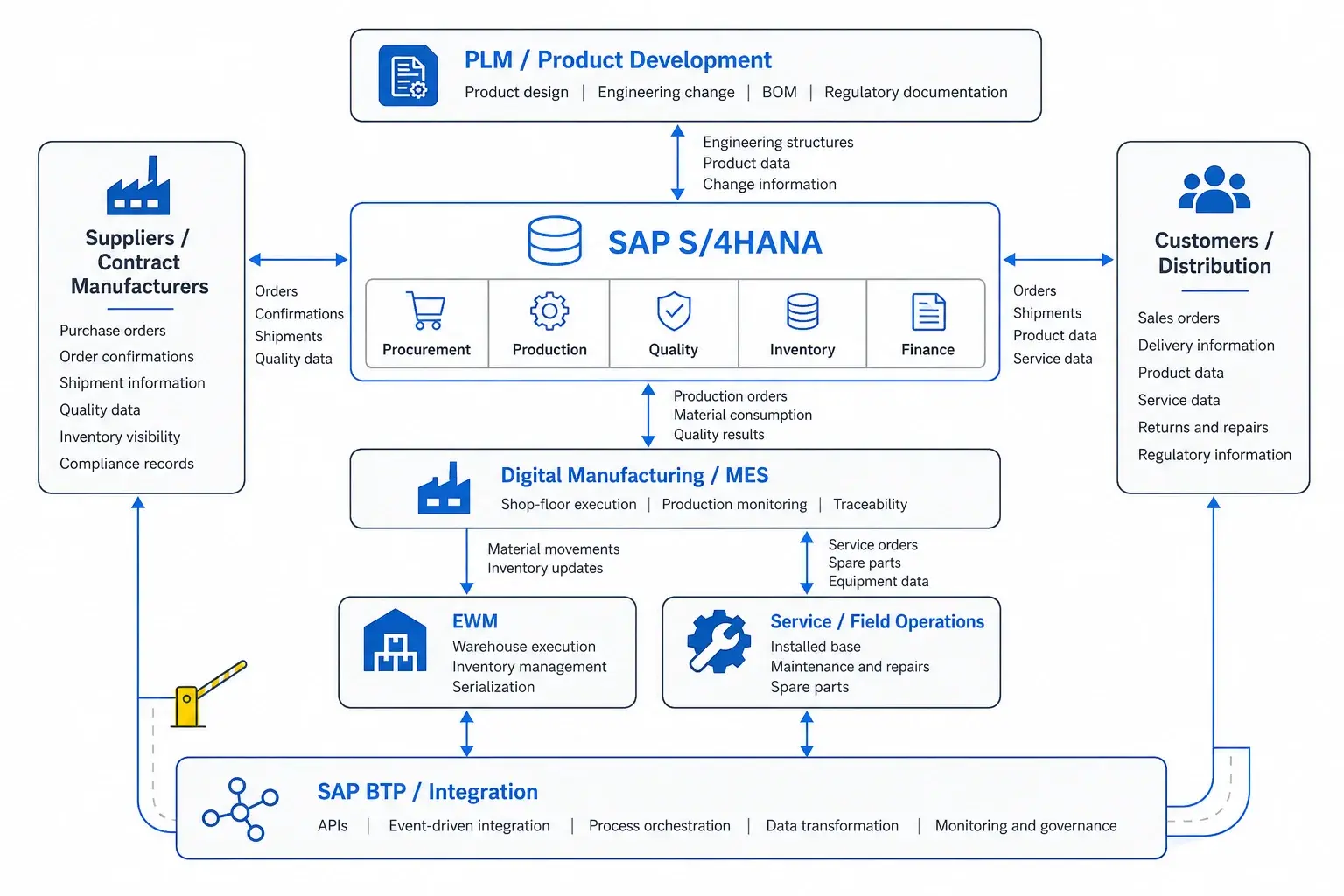
This should serve as a reference architecture rather than a mandatory SAP stack. Some manufacturers may retain an existing PLM, MES, QMS, labeling, or service platform and integrate it with S/4HANA. Others may consolidate more capabilities within SAP. The architecture should follow clear ownership of data and processes, controlled interfaces, and the manufacturer's validated operating model.
How to Approach an SAP Transformation Across Medical Device Operations
The hardest part of an SAP transformation for a medical device manufacturer often sits between processes and sites. Product data may follow one structure in engineering, production records another, and supplier or quality information may remain in separate applications. Acquisitions and contract manufacturers add further variation. A successful program needs to address these differences before they become configuration and integration problems.
Common SAP challenges in medical device manufacturing
Several recurring issues can make an SAP transformation harder to control:
- Weak traceability: Component, batch, serial, and device genealogy may be distributed across ERP, MES, warehouse, and other systems.
- Poor master data: Plants may use different material structures, units, BOMs, or naming conventions for similar products and components.
- Engineering and manufacturing disconnect: Approved engineering changes may require manual translation into manufacturing data or multiple downstream systems.
- Supplier quality gaps: Supplier qualifications, inspection results, certificates, and purchasing information may sit in separate processes.
- Manual recall analysis: Teams may need spreadsheets or manual queries to identify affected devices, components, inventory, or shipments.
- Excessive customization: Legacy processes can lead to custom SAP developments that reproduce old ways of working and increase the future maintenance burden.
- Validation and change-control complexity: Changes to SAP configuration, integrations, and custom applications can require coordinated assessment, testing, and documentation when the systems support regulated processes.
- Fragmented contract manufacturing: External production can create gaps in visibility when component ownership, production status, quality records, and finished-device information cross organizational boundaries.
These problems are connected. For example, inconsistent master data can make integration unreliable, while unclear system ownership can make traceability and change control harder to maintain. The transformation should address the underlying process and data model rather than treating each symptom as a separate SAP project.
SAP transformation roadmap for US medical device manufacturers
A practical transformation starts with the operating model and then maps technology to it. A manufacturer can structure the program around seven broad phases:
- Assess maps the current product, engineering, production, quality, supplier, inventory, service, and system landscape. The goal is to identify dependencies, manual controls, duplicated data, and gaps that could affect the target architecture.
- Define establishes the target processes, system ownership, data governance, integration boundaries, and quality controls. For US manufacturers, the design also needs to account for the applicable quality and regulatory framework. The FDA's QMSR has been effective since February 2, 2026, so regulated processes should be assessed against the requirements applicable to the manufacturer's devices and operations.
- Simplify removes obsolete processes, redundant applications, unnecessary interfaces, and customizations that no longer serve a clear business requirement. This phase also provides an opportunity to standardize master data and process variants before deployment.
- Implement configures the SAP capabilities, integrations, data structures, and extensions defined in the target design. Testing should start during implementation rather than being left until the end of the program.
- Validate combines functional, integration, end-to-end, and risk-based validation activities appropriate to the intended use of the systems. Regulated processes require documented evidence that relevant functions operate as designed within the manufacturer's quality system.
- Deploy moves the solution into production through a controlled rollout. The deployment unit can be a site, product line, business unit, or another logical group, depending on the operating model.
- Optimize uses operational and quality data to identify process issues, improve planning and execution, and adjust the solution as business requirements change.
The sequence can overlap in practice. Data migration, testing, validation planning, change management, and training should begin well before the first production deployment.
SAP for multi-site medical device manufacturing
A multi-site program adds a second design question: what should every plant share, and where should local requirements remain? A common SAP template can establish shared processes for areas such as finance, procurement, production, quality, master data, and reporting. Individual plants may then require controlled variations for manufacturing methods, equipment, local logistics, product portfolios, or other operational requirements.
The template should define more than SAP configuration. It should also establish common master-data rules, integration patterns, security roles, testing standards, documentation, and change governance. SAP's rollout tooling has long supported template-based deployment models for distributing common process content across multiple sites.
A typical rollout can begin with a reference site, followed by deployment waves for plants with similar processes. Acquired businesses and sites with different legacy ERPs may need additional migration and harmonization work before they can adopt the template.
For a US medical device group, the target model can therefore combine global standards with controlled local variation. Each rollout should preserve the common data and process model while documenting deviations that have a genuine operational, regulatory, or market-specific reason.
Which KPIs Matter for Medical Device Manufacturing?
A medical device SAP environment can connect operational data with quality, supply chain, production, and service metrics. The useful KPI set depends on the manufacturer's processes and improvement priorities. The following measures provide a practical reference without assuming universal targets.
|
Area |
Example KPI |
What it can show |
|
Quality |
First-pass yield |
Share of units completing a process without rework or rejection |
|
Quality |
Nonconformance rate |
Frequency of identified product or process nonconformances |
|
Quality |
CAPA cycle time |
Time from CAPA initiation to closure |
|
Traceability |
Traceability completeness |
Extent to which required component, batch, serial, and device relationships can be reconstructed |
|
Production |
Schedule adherence |
Degree to which production follows the planned schedule |
|
Production |
Scrap and rework rate |
Material or production volume requiring disposal or additional work |
|
Supplier |
Supplier defect rate |
Quality issues attributable to received supplier materials |
|
Supplier |
Supplier on-time delivery |
Delivery performance against agreed dates |
|
Inventory |
Inventory accuracy |
Agreement between recorded and physically available inventory |
|
Logistics |
On-time delivery |
Shipments delivered within the committed timeframe |
|
Service |
Mean time to repair |
Average time required to restore a device or asset after a service event |
|
Engineering |
Engineering change cycle time |
Time required to review, approve, and implement an engineering change |
These measures become more useful when teams can connect them to the underlying transaction or quality record. For example, a supplier defect metric can be analyzed against material, supplier, inspection, and production data, while engineering change cycle time can be examined alongside affected products, approval stages, and implementation dates.
Where Should the SAP Architecture Start?
For medical device manufacturers, the SAP design should follow the product lifecycle and the controls around it. Engineering data, manufacturing, quality, suppliers, inventory, distribution, and service need clear process ownership and reliable connections between the systems that support them.
LeverX works across this SAP landscape, including S/4HANA, manufacturing, Quality Management, PLM and Enterprise Product Development, Digital Manufacturing, EWM, Asset Management and Service, BTP, integration, and data management. Our experience also includes SAP migration and workflow projects for medical device manufacturers, including PLM, engineering change control, quality workflows, data migration, and controlled electronic documentation.
The right starting point depends on the current ERP and application landscape, product portfolio, manufacturing model, data quality, and target operating model. An assessment can identify which processes should move into SAP, which systems should remain specialized, where integration needs attention, and which data or validation constraints could affect the transformation.
Book an assessment session with LeverX to define the right SAP architecture and transformation priorities for your medical device manufacturing environment.
FAQ
Can SAP manage serialised medical devices?
Yes. SAP supports serial number management across relevant production, inventory, delivery, and service processes. A serial number can identify an individual device and connect it with transactions such as production, goods movements, deliveries, and service activities.
For medical devices, serialization can work alongside batch management. A manufacturer can use the serial number to identify an individual device and a batch or lot number to identify a group of products or components. The level of information available for each device depends on the data captured and the processes configured across SAP and connected systems.
Does SAP support FDA requirements for medical device manufacturers?
SAP can support processes and records that form part of a manufacturer's regulated operations, including quality management, traceability, controlled changes, inventory, production, and electronic records. The relevant FDA requirements depend on the device, process, and records involved.
For US medical device manufacturers, the FDA's Quality Management System Regulation (QMSR) took effect on February 2, 2026, incorporating ISO 13485:2016 by reference into 21 CFR Part 820. SAP can provide system functions used within a quality system, while the manufacturer remains responsible for its procedures, controls, validation activities, and regulatory obligations.
Does SAP implementation make a medical device company FDA compliant?
No. SAP provides software functionality. Compliance is a function of how the manufacturer designs, implements, validates, operates and controls the system within its quality framework.
For regulated processes the manufacturer needs appropriate requirements, risk assessment, configuration, testing, control of access, change management, documentation and evidence that the system works according to its intended use. The controls that are applicable depend on the processes and records that the system supports.
How can SAP support 21 CFR Part 11 requirements?
If electronic records or electronic signatures are within scope of 21 CFR Part 11, SAP can provide system controls to help the control environment as required by the regulation. Depending on the implementation, these can include user control of access, electronic signatures, authorisation management and controlled workflows, audit-related records, etc.
Part 11 applies to electronic records that are created, modified, maintained, archived, retrieved, or transmitted under FDA record requirements. The FDA also expects organisations to consider validation, audit trails, record retention and control of access within the appropriate system and process.
The specific Part 11 controls cannot be determined from the SAP product alone. The manufacturer needs to establish which records and signatures fall within scope and configure, validate, and operate the relevant functions accordingly.
Can SAP support UDI-related processes?
Yes, SAP can support data and business processes that contribute to UDI management, labeling, packaging, and distribution. Product, device, batch, serial, packaging, and logistics information can provide source data for related processes.
FDA UDI requirements generally require device labellers to place a UDI on applicable device labels and packages and submit specified device information to the FDA's Global Unique Device Identification Database (GUDID). A UDI can contain a device identifier and, where applicable, production identifiers such as a lot or batch number, serial number, or expiration date.
SAP can therefore form part of the data and process landscape around UDI. UDI generation, labeling rules, issuing-agency requirements, GUDID submission, and applicable exceptions require dedicated regulatory and labeling processes. SAP should not be treated as the sole system responsible for UDI compliance.
Disclaimer: This article is intended for general informational purposes only and does not constitute legal, regulatory, or compliance advice. SAP capabilities and product availability may vary depending on the solution, configuration, implementation, and applicable requirements. References to FDA regulations, ISO 13485, 21 CFR Part 11, and other regulatory frameworks are provided for general context and should not be interpreted as a guarantee of compliance. Medical device manufacturers are responsible for assessing their applicable regulatory obligations and ensuring that their systems, processes, and records meet relevant requirements. Consult qualified regulatory, quality, and legal professionals for guidance specific to your organization.