Where should SAP fit in a semiconductor manufacturing environment that already depends on MES, equipment-control systems, inspection platforms, and other specialized technologies?
The answer starts with the processes around the fab. Semiconductor manufacturers need to coordinate high-value materials and suppliers, plan production across long and sensitive cycles, track lots and wafers, manage quality and yield data, and maintain equipment that directly affects production capacity. SAP can connect these enterprise processes with specialized manufacturing systems through an integrated application landscape.
In this guide, we examine the SAP manufacturing solutions and integrations relevant to semiconductor manufacturing, covering supply chain, procurement and planning, manufacturing and MES integration, traceability, yield and quality, equipment and asset management, and related processes.
Why Semiconductor Manufacturing Requires a Different ERP Approach
Semiconductor manufacturing usually separates enterprise planning, production execution, and equipment control across several systems. SAP can manage materials, production orders, procurement, inventory, and financial postings. MES and equipment systems handle detailed production execution and machine data from the fab.
ERP, MES, and equipment serve different purposes
Semiconductor production can involve long routings, repeated processing steps, and frequent changes during execution. SAP S/4HANA can maintain materials, BOMs, routings, work centers, and production orders. SAP Digital Manufacturing supports production execution and work-in-process management.
SAP provides standard integration between SAP S/4HANA or SAP ERP and SAP Digital Manufacturing. Supported scenarios cover the exchange of master data and production orders, along with production confirmations and related manufacturing data.
The setup depends on the existing fab landscape. Some manufacturers may use SAP Digital Manufacturing for production execution. Others may keep an existing semiconductor MES and integrate it with S/4HANA. In either setup, each system needs clear ownership of the data it creates and maintains.
Why this separation matters in a fab
Fab equipment can generate far more detailed data than ERP processes require. SAP S/4HANA may send a production order to the manufacturing system and receive the resulting production confirmation. Yield and scrap quantities can form part of that exchange.
Machine-level data can stay closer to production. SAP Digital Manufacturing supports equipment connectivity through the Production Connector, including interfaces such as OPC UA and MQTT.
This division also influences data ownership. SAP can store enterprise master data and business transactions, and manufacturing systems can store detailed work-in-process and execution records. Equipment signals may remain in shop-floor systems until they are used by another process.
These boundaries are used to help define the SAP architecture and required integrations between ERP, manufacturing and equipment systems for semiconductor manufacturers.
What SAP Solutions Are Relevant to Semiconductor Manufacturing?
SAP products map to business domains, and each domain needs a different mix of them in a semiconductor company. The core sits in SAP S/4HANA. Specialized applications for planning, supplier collaboration, shop-floor execution, and data extend it.
The S/4HANA core
SAP S/4HANA contains the processes that all semiconductor companies run.
Finance is responsible for WIP valuation, Product costing and Asset accounting. Purchasing and inventory management includes the purchase of materials, the receipt of goods and batch managed stock. Production planning includes MRP and production orders. Plant maintenance (now available as SAP S/4HANA Asset Management) addresses tool maintenance orders, spare parts and equipment history. SAP Quality Management in S/4HANA provides support for inspection plans, quality notifications and batch records for incoming materials.
SAP Extended Warehouse Management (EWM) and SAP Transportation Management (TM) can be embedded in S/4HANA or deployed separately for larger volumes of warehouse and transportation functions.
Applications around the core
Six applications extend that core in semiconductor landscapes:
- SAP Integrated Business Planning (IBP) supports demand, supply, and inventory planning across plants. It can also allocate constrained supply based on customer demand and planning priorities.
- SAP Business Network and SAP Ariba support sourcing, procurement, and supplier collaboration, including the exchange of orders, forecasts, and confirmations.
- SAP Digital Manufacturing manages production execution on the shop floor, including data collection and work instructions. It can receive production orders from SAP S/4HANA and return production results.
- SAP Business Technology Platform (BTP) provides integration and extension capabilities around the SAP landscape. It can connect SAP applications with MES, equipment, test systems, and other applications.
- SAP Business Data Cloud brings SAP and external data into a common data and analytics environment. Semiconductor manufacturers can use it with data from sources such as MES and test platforms.
Of these SAP Digital Manufacturing needs to be scoped out most carefully. Most front-end wafer fabs have a dedicated semiconductor MES because the lot dispatching and tool-level control require functions specific to that. SAP Digital Manufacturing is better suited for assembly, packaging and test lines or for auxiliary operations such as mask and materials handling, where the process steps are similar to discrete manufacturing.
How the mix may change by company type
An integrated device manufacturer (IDM) uses the vast majority of the portfolio, because it has fabs, back-end operations and customer delivery. A fab mostly on S/4HANA with its MES and equipment systems next to it leans most heavily on SAP Asset Management and quality functions.
A foundry manufactures products from customer designs. Its SAP landscape emphasizes order management by customer, capacity allocation in SAP IBP, and billing by wafer or mask set.
A fabless company owns no production assets. It still manages wafer supply from foundries and assembly and test services from outsourced semiconductor assembly and test (OSAT) providers, so S/4HANA subcontracting, SAP IBP, and SAP Business Network carry most of its load. SAP Asset Management and SAP Digital Manufacturing play little or no role.
An OSAT works at the back end, often with customer-owned wafers and high unit volumes. It combines subcontracting processes, SAP Digital Manufacturing for line execution, SAP EWM for material flow, and SAP TM for outbound shipments.
A semiconductor equipment maker sells tools that fabs depend on. Its sources of income include long term service contracts and its landscape is based on S/4HANA with variant configuration, project management and service and spare parts processes.

How SAP Supports Supply Chain, Procurement, and Planning
SAP for semiconductor supply chain planning
Customers revise forecasts often, while wafer starts and material orders fix quantities weeks or months ahead. Automotive, data center, and consumer device demand follow separate cycles. A forecast change at the customer reaches the fab only after it moves through the die bank, assembly, and test.
Capacity limits sit at three stages: front-end tools, packaging lines, and testers. A shortfall at any one stage caps shipments regardless of wafer supply.
Many companies hold sorted wafers or unpackaged die between the fab and assembly. This stock lets planners shift the product mix within the back-end cycle time, which runs shorter than a new wafer start cycle. The buffer size depends on demand variability and back-end lead time.
SAP Integrated Business Planning (IBP) addresses this with four functions.
- Demand planning builds statistical forecasts by product family and customer segment and merges them with sales input.
- Supply planning runs a constrained plan across fab, assembly, and test capacity. Inventory optimization calculates safety stock for each stage from demand and lead time variability.
- Scenario planning simulates changes in a separate plan version and leaves the operational plan untouched.
- Binning needs explicit modeling because one wafer start produces several products.
Planners usually represent it with yield and split assumptions for each product family, maintained from test history.
Take a hypothetical 20 percent forecast increase for a microcontroller next quarter. IBP compares the added demand with capacity at each stage and shows a shortfall in test. It then calculates the additional substrates and bond wire the volume requires. Planners compare three scenarios: add a test shift, move volume to an outsourced test provider, or confirm partial quantities. The selected scenario sets the customer commitments, and the resulting planned orders and purchase requisitions pass to S/4HANA for execution.
Semiconductor procurement and supplier management
Semiconductor procurement requires controls at both supplier and source level. Approval of a supplier does not by itself determine which source S/4HANA will select for a purchasing requirement.
SAP Ariba Supplier Lifecycle and Performance can manage supplier registration, qualification, and evaluation processes. S/4HANA uses procurement master data and source-determination rules for operational purchasing. Source lists can define the sources permitted or relevant for a material and plant, while quota arrangements distribute requirements across specified sources over a defined period.
The behavior of quota arrangements is sometimes misunderstood. A quota can define the intended share assigned to each source, but SAP does not necessarily divide each individual purchase requisition according to those percentages. During source determination, the system can assign the complete requirement to one source while using the quota arrangement to maintain the required allocation over time.
The purchasing structure also varies by material type:
- Chemicals and process gases: recurring supply can be managed through scheduling agreements where appropriate. Consignment is another option when ownership remains with the supplier until the material is withdrawn for use.
- Silicon wafers and substrates: longer-term agreements can carry delivery schedules and forecast requirements. Supplier collaboration may include the exchange of releases and confirmations through SAP Business Network.
- Packaging materials and electronic components: scheduling agreements can support repeated deliveries against expected production demand.
- Spare parts: reorder settings can reflect consumption and replenishment time. Purchasing info records can maintain supplier-specific procurement conditions and data.
- Capital equipment: purchase orders can use asset- or project-related account assignments. Costs that qualify for capitalization can be collected through asset-under-construction processes before settlement to the final asset.
Incoming quality inspection adds another control point. If the relevant Quality Management settings are active, receipt of a supplier material can create an inspection lot in S/4HANA. The material can remain in quality inspection stock while results are recorded and evaluated. The subsequent usage decision determines how that stock is handled.
The supplier-facing document flow can extend beyond the purchase order. SAP Business Network supports the exchange of procurement documents such as orders, confirmations, and ship notices between buyers and suppliers. Supplier Lifecycle and Performance can also maintain evaluation programs and published performance scores based on the indicators configured by the buying organization.
SAP for semiconductor supply chain resilience
US manufacturers source some inputs and services abroad. Several process materials come from a small number of suppliers, and a large share of packaging and test capacity sits outside the US. A new domestic fab can start producing wafers before nearby suppliers and back-end providers reach matching capacity. Each added source then requires its own qualification.
A resilience process starts with a supplier event, for example a single-source photoresist supplier placing customers on allocation. A where-used analysis across S/4HANA bills of materials lists every product that consumes the material. Source lists and quotas show whether a qualified alternative exists and what share it can take. SAP IBP then recalculates the plan with reduced material availability and tests each alternate.
The result shows days of cover by material, and shelf life caps how much stock a planner can build in advance. Customer allocation rules then apply contractual commitments and priorities, and affected customers receive new delivery dates.
The analysis reaches only the suppliers recorded in the system. S/4HANA holds tier-1 suppliers, while raw material sources such as high-purity quartz sit two or three tiers further down. SAP Business Network and SAP Ariba Supplier Risk can add supplier-reported and third-party risk data. Sub-tier mapping still depends on supplier cooperation, so the picture stays incomplete.

Where SAP Planning Ends and Fab Execution Begins
Planning in SAP and execution in the MES meet at the production order, so most design decisions in this area start with what one order represents.
Can MRP plan a fab? SAP for semiconductor manufacturing planning
MRP Live in S/4HANA explodes demand through bills of materials and schedules with the planned lead times stored in the material master. It does not check tool capacity unless planners add capacity leveling.
In a fab, queue time at a bottleneck tool group rises and falls with WIP, so the actual lead time of a lot shifts while the master data value stays fixed. Many teams refresh lead times per product and technology from MES cycle-time history each planning cycle, which keeps substrates and photomasks on a realistic schedule.
The table shows how planning tasks divide between SAP and the fab systems.
|
Planning task |
In SAP |
Outside SAP |
|
Material requirements |
MRP Live sizes wafer starts and component orders against planned yield, stored as an operation scrap percentage in the routing |
MES cycle-time history that updates lead times |
|
Capacity |
Work centers represent tool groups; capacity comes from tool count, shift calendars, and maintenance windows; capacity requirements planning shows the load per group |
Lot sequencing at each tool, batch tools such as furnaces, and setup-dependent changeovers in the MES dispatch logic or dedicated scheduling tools |
|
Routings |
Aggregated routing at the level of process modules and the die bank |
Full step sequence in the MES |
|
Confirmations |
Posted at milestones such as the end of a module, with quantity, scrap, and reason code; they trigger backflush and activity posting |
Step-level tracking in the MES |
|
Gases and chemicals |
Standard quantity per wafer, with variances posted at period end |
Facility-level consumption data |
|
Rework and engineering lots |
Rework order or additional confirmations; a separate order type settles engineering lot cost to a development project |
Rework loop on the floor in the MES |
S/4HANA PP/DS can schedule finitely on selected resources, which suits back-end lines with short routings. When confirmed yield stays below plan for several periods, planners correct the routing master data.
Which system owns the lot? SAP digital manufacturing and semiconductor MES integration
In a typical setup, S/4HANA sends production orders to the manufacturing system responsible for execution. The MES tracks production on the shop floor and exchanges data with equipment and automation systems.
A semiconductor MES can track wafers, lots, and carriers as they move through the fab. Depending on the product and configuration, it can also manage lot holds, splits and merges, recipes, and dispatching. Dispatch rules may use factors such as tool availability, queue conditions, and setup requirements.
SAP Digital Manufacturing uses shop floor controls (SFCs) to represent units or quantities moving through production. Production orders from S/4HANA can provide the basis for SFC creation. During execution, SAP Digital Manufacturing can provide work instructions, collect production data, record nonconformances, and return confirmations to S/4HANA.
Manufacturers can also use different execution systems across production stages. A semiconductor MES may run wafer fabrication, while SAP Digital Manufacturing supports assembly or test processes. Both can exchange the required production data with S/4HANA.
The interface begins with the order structure. One design creates an order per lot. Another creates an order per wafer-start batch and reports several lots against it. Per-lot orders give direct cost collection and batch assignment for each lot but multiply the number of orders. Batch-level orders keep SAP volumes lower and leave a lot of detail in the MES. The choice sets cost granularity and the depth of genealogy that SAP can hold, so it needs a decision before interface design.
Seven kinds of data cross the boundary:
- Production orders: released from S/4HANA with product, quantity, dates, and routing version; the MES creates the lot or SFC.
- Materials: component reservations and batch assignments flow down, and actual consumption by batch flows back.
- Process instructions: the MES owns recipes and work instructions, and SAP holds the version references that tie an order to a process revision.
- Production confirmations: yield, scrap with reason codes, and time at each milestone, which update inventory and WIP in S/4HANA.
- Quality data: the MES and inspection platforms keep measurement detail, and summary results reach SAP Quality Management for usage decisions.
- Genealogy: lot-to-batch relationships and parent-child links after splits and merges, passed to SAP at the depth the order design allows.
- Equipment status: downtime and state-change events that SAP converts into maintenance notifications.
Integration usually runs through SAP Integration Suite on SAP BTP or an existing fab middleware, using asynchronous messages with queues. The fab keeps running during an ERP upgrade or outage, and the MES holds confirmations until SAP accepts them.
Each message carries a unique ID, so a resend after a timeout cannot post a confirmation twice. Product, routing version, and lot or batch ID need shared keys agreed before interface development starts, because a mismatch there produces orders the MES cannot match.
What sits between MES and fab equipment?
Fab equipment produces detailed machine and process data. PLCs, sensors, automation systems, and historians collect and process much of this data close to the production equipment. The MES uses the information needed to track and control manufacturing execution.
The responsibilities can be divided as follows:
|
Layer |
Typical responsibility |
|
SAP S/4HANA |
Production orders, materials, inventory, costing, quality-related business processes, and financial postings |
|
MES / SAP Digital Manufacturing |
Production execution, work-in-process tracking, operator instructions, production data collection, and confirmations |
|
Equipment and automation |
Machine control, equipment signals, process parameters, alarms, and other equipment-level data |
SAP Digital Manufacturing can connect to shop-floor systems through the SAP Digital Manufacturing for edge computing Production Connector. SAP documents interfaces including OPC UA, OPC DA, OPC HDA, MQTT, and IP21. The connector can read values from connected systems and write data back through supported interfaces.
A simplified flow looks like this:
SAP S/4HANA → MES / SAP Digital Manufacturing → equipment and automation systems
PLCs and equipment-control systems continue to handle machine-level control. The MES manages production execution using the data it receives from the shop floor. S/4HANA receives the production information needed for processes such as inventory movements, production confirmations, costing, and financial postings.
SAP BTP and SAP Integration Suite may also connect applications around this flow. Their role depends on which systems need to exchange data and which interfaces those systems support.
From Material Batch to Shipped Die: Traceability, Yield, and Quality in SAP
Genealogy, yield data, and quality results describe the same wafers from three sides, and SAP ties each of them to material batches, cost, and customer deliveries.
Which lots are affected? Wafer, lot, and material traceability in SAP
SAP traces at batch level. Batch management links each supplier batch of photoresist, gas, or substrate to the production orders that consumed it and to the output batch those orders produced. A batch-where-used list runs in both directions, from a finished-goods batch back to supplier batches and from a supplier batch forward to customer deliveries.
The MES keeps the process-level genealogy: wafer and slot IDs, the tool and chamber used at each step, the recipe version, and timestamps. Wafer maps and die-level test results sit in the test systems, and some products carry a die ID programmed during wafer sort or test.
The table shows where each link of the chain is recorded.
|
Chain step |
Recorded in SAP |
Recorded in MES or specialized systems |
|
Raw material |
Supplier batch, certificate values, goods receipt |
Material lot IDs at the point of use on the tool |
|
Wafer start and lot |
Production order and output batch |
Lot, carrier, and wafer IDs, including splits and merges |
|
Process steps and equipment |
Milestone confirmations |
Step history, tool, chamber, recipe version, timestamps |
|
Inspection |
Lot-level results and usage decisions in SAP Quality Management |
Metrology and defect inspection data per wafer |
|
Packaging and test |
Orders or SFCs and the output batch per assembly lot |
Wafer map, die-to-package link, test results per unit |
|
Finished product |
Batch assigned to delivery and customer |
Unit serial or die ID, where applied |
Consider a particle excursion traced to one deposition chamber. The MES lists the lots processed in that chamber during the affected window. Those lot IDs map to SAP batches, and a where-used list shows which finished-goods batches contain them, how much stock remains in each warehouse, and which customer deliveries have shipped.
SAP can block the remaining stock and produce the customer notification list. The mapping resolution follows the order structure chosen earlier: per-lot orders map one lot to one batch, while batch-level orders return all lots of a batch as a group.
What a five-point yield drop does to product margin
Yield analysis correlates defect inspection data, parametric test results, and wafer maps by tool, chamber, and step. The measurement volume per wafer is large, so this work runs in the MES analytics layer or in dedicated yield management systems.
SAP receives yield as confirmed quantities and scrap per order and puts a value on the loss. Scrap confirmed against an order raises the cost per good output, and the gap between planned and actual yield appears as a production variance at settlement. With actual costing in the Material Ledger, that variance can reach inventory value and cost of goods sold for each product.
A hypothetical example shows the size of the effect. A processed wafer costs $5,000 and carries 600 gross die, and each good die sells for $11.50, with back-end cost excluded. At the planned 85 percent yield, a wafer gives 510 good die at $9.80 each, a margin of about 14.8 percent. At 80 percent, it gives 480 good die at $10.42 each, and the margin falls to about 9.4 percent. A five-point yield drop removes about 5.4 points of margin.
Who releases a suspect lot? SAP Quality Management for semiconductor manufacturing
SAP Quality Management supports inspections that determine whether a batch can proceed. Inspection plans define characteristics, specifications, and sampling procedures for incoming, in-process, or final inspection. Dynamic modification can tighten or reduce inspection scope based on inspection history and configured rules.
Detailed process control and equipment data usually remain in the MES or specialized quality systems. SAP can receive the results needed for batch-level inspection and the usage decision.
A fab hold may begin in the MES, where production execution stops the affected lot. SAP QM can record the related defect through a quality notification and manage follow-up tasks. If the material also needs an inventory restriction, it can be posted to blocked stock or another appropriate stock type.
The disposition determines the next process:
- Scrap: post the rejected quantity as scrap.
- Rework: route the material through additional processing or a rework order.
- Accept: release the inspected quantity through the usage decision when acceptance criteria have been met.
- Return to supplier: process the supplier issue and return through the relevant quality and purchasing transactions.
For outbound shipments, SAP QM can create quality certificates using inspection results and batch-related characteristic data when the customer requires them.
What Happens to Output When a Tool Goes Down: Equipment and Asset Management in SAP
A fab asset record serves two teams: maintenance, which needs the tool's history and parts, and finance, which needs its cost, depreciation, and downtime. SAP holds both views in one equipment record.
Semiconductor equipment and asset management: Which assets belong in SAP?
Process equipment can include lithography, deposition, etch, metrology, and furnace systems. Facility equipment may cover pumps, chillers, gas delivery, abatement, and cleanroom air handling. Shared utilities also require maintenance records because one failure can affect several production tools.
SAP Asset Management can organize this equipment through functional locations, for example by site, fab, bay, tool group, and individual tool. Major components such as chambers, robots, or RF generators can have their own equipment records when their maintenance and replacement history needs separate tracking. Serialized parts provide another option for components tracked individually.
Maintenance plans can follow time or equipment usage. Calendar-based cycles fit equipment serviced at fixed intervals. Counter-based plans can use readings such as operating hours, wafer counts, or pump runtime. When those readings reach the configured maintenance cycle, SAP can generate a maintenance call and, depending on the plan settings, a maintenance order.
The order can specify the required work, planned labor, and spare parts. Counter readings from MES or equipment systems require an integration path into the relevant SAP measuring points or counters.
The table follows one tool failure through the chain of records.
|
Step |
Record in SAP |
Owner and effect |
|
Tool alarm or downtime event |
Maintenance notification created from the MES event |
Equipment engineer reviews and classifies the failure |
|
Repair task |
Maintenance order with operations and a component list |
Maintenance planner schedules it against the tool's qualification status |
|
Spare part |
Reservation against stock, or a purchase requisition if stock is short |
Warehouse picks the part; cleanroom handling rules apply before it enters the fab |
|
Technician |
Time confirmation on the order |
Qualified technician, with certifications recorded in the work center or personnel data |
|
Capacity effect |
Downtime and cost on the order; tool availability update for the work center |
Planning reduces available capacity for the tool group |
The last row closes the loop with planning. A work center that loses a tool for 48 hours shows lower capacity in the next planning run, so the wafer-start plan reflects the repair. The repair also does not end at the work order. After a chamber replacement or a major repair, the tool usually requires requalification runs before it returns to production, and those runs consume test wafers and engineer time. Planners add them to the order as operations, so the planned downtime includes the full period until the tool returns to production.
Shutdown planning groups work for the same reason. Planned maintenance windows on a bottleneck tool group are scheduled together with a parts kit staged in advance, so the technicians do not wait for material once the tool is open. The parts kit comes from reservations on the work orders. Capital spares, such as a spare robot or RF generator, are usually repairable parts. SAP tracks them as serialized stock that moves between the warehouse, the fab, and the vendor repair loop.
Predictive maintenance for semiconductor equipment: Can sensor data predict a tool failure?
Process tools produce sensor traces during every wafer run: chamber pressure, gas flow, RF power, temperature, and vibration on pumps. Fault detection systems on the equipment or in the MES analytics layer already compare these traces with reference limits. Predictive maintenance extends that approach by combining four data sources:
- Sensor traces: high-frequency tool data collected through equipment interfaces such as SECS/GEM or EDA.
- Equipment history: past failures, part replacements, and repair times from SAP maintenance records.
- Maintenance data: the planned intervals and counters that define the current schedule.
- Operating conditions: the product mix, recipe, and process load the tool ran under.
Sensor data usually stays in an equipment analytics or data platform, where predictive models can identify signs of failure. SAP can receive the resulting alert, health score, or measurement and link it to the relevant equipment. Maintenance teams can then reschedule work, reserve parts, or adjust the maintenance plan. SAP S/4HANA supports condition- and counter-based maintenance through measuring points and counters.
Useful predictions depend on four conditions:
- Reliable data: sensor readings need the correct equipment and operating context.
- Consistent failure records: structured failure codes provide better training data than free-text descriptions alone.
- Enough warning: the prediction needs to arrive before the maintenance window closes.
- A defined response: planners need a process for scheduling work and securing the required parts.
Failure predictions can also inform spare-parts planning. Teams can compare predicted demand with actual failures and parts consumption, then adjust stock parameters when the evidence supports a change.
Inventory, Warehousing and Logistics
Semiconductor materials can change status several times before reaching the customer. Raw materials enter inventory, wafers and components move through production, finished devices enter storage, and some materials may remain in inspection or quarantine. SAP can connect these inventory records with warehouse execution and transportation processes so that material status and location remain visible across the physical flow.
How does SAP manage semiconductor inventory?
S/4HANA inventory management can track materials across different stages and stock categories. For semiconductor manufacturers, relevant inventory can include:
- Raw materials, wafers, components, and packaging materials;
- Work in process and production-related stock;
- Spare parts for manufacturing equipment;
- Finished semiconductor products;
- Inspection, blocked, and quarantined stock.
Lot and batch information can support material traceability, while stock status determines whether material can be consumed, moved, or shipped. Shelf-life information can also matter for materials with defined expiration requirements. High-value materials require accurate quantities, locations, and movement records because inventory discrepancies can have a direct financial impact.
Inventory data also needs to support planning and financial processes. Production planning depends on available and usable material quantities, while finance relies on inventory movements and valuation data. A material sitting in a warehouse may have a different operational status from material available for production or customer delivery.
What does EWM add to semiconductor warehouse operations?
SAP Extended Warehouse Management (EWM) provides more detailed control over warehouse execution than core inventory management. It can manage warehouse tasks, storage-bin movements, staging, replenishment, and handling-unit processes while maintaining links to the relevant inventory documents.
For semiconductor operations, EWM can support warehouse processes around high-value materials, production staging, spare parts, and finished products. The exact warehouse design depends on the material, handling requirements, and site processes. EWM can also manage batch-related warehouse processes where batch characteristics and stock status affect material selection.
A typical material flow can connect S/4HANA with EWM and then with production staging:
S/4HANA inventory → EWM warehouse execution → staging → production or distribution
This separation gives inventory management and warehouse operations different responsibilities while keeping material movements synchronized.
How does SAP coordinate semiconductor logistics and distribution?
After finished products leave the warehouse, transportation planning becomes the next layer of the process. SAP Transportation Management (TM) can support transportation planning, carrier selection, freight management, and transportation execution. Delivery requirements from S/4HANA can feed transportation planning, while execution data can provide visibility into the shipment.
For semiconductor products and components, logistics planning may need to account for shipment value, delivery commitments, packaging requirements, export documentation, and carrier constraints. International shipments can also involve multiple parties and regulatory documentation that need coordination with the commercial delivery process.
The resulting flow connects the material record with its physical movement:
Inventory → warehouse execution → delivery → transportation → customer
This gives semiconductor manufacturers a consistent view of where material sits, when it becomes available, and how it moves to the next destination.
Packaging, Testing, and Subcontract Manufacturing in SAP
Packaging and test run in company plants or at outsourced assembly and test (OSAT) providers, and SAP records both cases with the same production and cost logic.
Semiconductor packaging and testing
Wafers arrive from the die bank after wafer sort. The back end dices them, attaches die to a substrate or leadframe, connects it with wire bonds or flip-chip bumps, encapsulates the package, and runs final tests, often with burn-in for automotive and other high-reliability products. Each step uses different materials, such as substrates, bond wire, and mold compound, and the output quantity depends on assembly yield and final test yield.
In an in-house back end, a production order in S/4HANA covers the assembly lot. Operations map to the major stages, and SAP Digital Manufacturing or a back-end MES controls the line and reports confirmations. Test floors usually run on tester software and a test data system, which holds the results per unit. SAP receives the good quantity per test bin, the rejects, and the assembly lot number. Because bin results define sellable grades, the finished-goods batch carries a grade characteristic that sales and delivery use for allocation.
How SAP tracks wafers sitting at an outsourced assembly site
With an OSAT, the company keeps ownership of the wafers and most materials while the provider performs the work. S/4HANA handles this through a subcontracting purchase order. The order names the finished product, the service, and the components to be provided. The company posts a transfer of wafers and other components to the OSAT as stock at the subcontractor, which stays on the company's books and carries its value. When the OSAT returns packaged and tested devices, the goods receipt consumes the components and adds the subcontracting fee to the product cost.
Visibility comes from the stock record and the provider's status data. Stock at the subcontractor appears by material, batch, and quantity, so planners see which wafers are outside the company. Three kinds of information come back from the OSAT:
- Lot status: current step and expected completion date, sent by EDI or a supplier portal such as SAP Business Network.
- Yield and scrap: the quantity lost at assembly and final test, which determines the components to be consumed.
- Test data: bin results and quality records for each assembly lot, linked to the batch of origin.
- Consumption reports: actual material use, which the company reconciles against the planned bill of materials.
Differences between planned and reported consumption are the main source of discrepancies in this process. A company that posts consumption from the provider's report, then reconciles it to physical counts at an agreed interval, finds yield losses and stock errors earlier than one that waits for the invoice. Wafer ownership also affects inventory valuation, insurance, and export documents when the OSAT sits outside the US, so finance and trade compliance need the stock location in the record.
A fabless company uses the same structure for foundry wafers and for assembly and test, with S/4HANA supplying the purchase orders and SAP IBP supplying the forecast to the provider. The batch link from the finished device back to the wafer lot keeps the genealogy chain from the earlier traceability discussion intact across the company boundary, though the process data stays with the provider unless the contract requires delivery.
New Fabs, CHIPS Context and Multi-Site Operations
New semiconductor facilities create an opportunity to establish the enterprise architecture before legacy processes and disconnected systems become difficult to change. For U.S. manufacturers, that work can sit within large capital projects influenced by public incentives, new supplier networks, and plans for additional production sites.
What does the CHIPS context mean for SAP planning?
The CHIPS and Science Act supports U.S. semiconductor manufacturing through incentives for investments in facilities and equipment. Current CHIPS Program Office materials also require award recipients to meet reporting and other obligations defined by their specific award terms.
SAP can support the business processes used to collect, reconcile, and report project and operational data relevant to those activities. For example, financial systems can track project costs, procurement commitments, assets, and operating results across a new facility. The exact data requirements depend on the applicable award and its terms.
An SAP implementation does not establish CHIPS eligibility or demonstrate compliance with program requirements. Legal, financial, and program-specific obligations remain subject to the applicable statute, funding opportunity, and award documentation.
How should SAP support a new semiconductor fab?
A greenfield fab gives manufacturers the chance to design business processes and system interfaces around the future operating model. The enterprise layer may need to cover:
- Project and capital expenditure management during construction
- Procurement and supplier management for equipment, materials, and services
- Asset management as equipment moves into commissioning and production
- Finance, inventory, quality, and manufacturing processes once operations begin.
The transition from construction to production creates a critical handoff. Equipment purchased through a capital project becomes an operational asset. Suppliers and materials move from project procurement into recurring supply processes. Production master data, inventory structures, maintenance processes, and financial controls need to work together when the fab starts operating.
A practical lifecycle can follow:
Fab project → procurement → construction → equipment installation → commissioning → production
Designing these connections early reduces the amount of operational data that teams later need to reconstruct across separate systems.
How do semiconductor companies scale SAP across multiple sites?
A successful first fab can become the template for subsequent facilities, but each site may still require local adaptations. A multi-site SAP model needs clear boundaries between processes that should remain consistent and those that depend on local regulations, facilities, suppliers, or operating models.
A rollout can standardize areas such as master-data structures, financial processes, integration patterns, security, reporting, and core supply-chain processes. Local teams may then configure site-specific requirements without creating separate architectures for every facility.
For semiconductor networks spanning fabs, packaging and test facilities, distribution centers, acquired businesses, and shared suppliers, rollout governance becomes as important as the individual implementation. Common templates, controlled local extensions, defined integration standards, and staged deployment waves can help maintain consistency as the network expands.
SAP for Semiconductor Cost and Sustainability Management
Semiconductor manufacturing costs depend on what the fab consumes and how effectively it converts those inputs into saleable output. Material consumption, production activities, equipment use, maintenance, overhead, scrap, and yield all affect the cost of manufactured products. SAP can connect these costs with plants, products, production activities, and inventory valuation.
Where do semiconductor manufacturing costs come from?
SAP product costing can incorporate material costs, production activities, and overhead. Actual cost data can then include material withdrawals, activity confirmations, and overhead allocations. The material ledger can also record material movements, invoices, and order settlements for inventory valuation and actual cost analysis.
For a semiconductor manufacturer, this creates a more detailed view of manufacturing economics. A change in yield can alter the cost assigned to usable output because more material, machine time, energy, or processing capacity may be required for the same quantity of saleable devices.
Cost analysis can cover factors such as:
- Material consumption and supplier costs
- Equipment and production activity costs
- Energy, maintenance, and facility costs
- Scrap, rework, and yield losses.
The resulting data can support comparisons across products, plants, production periods, and other cost objects. That becomes particularly useful when manufacturers evaluate the economics of different production volumes, process changes, or site configurations.
How can SAP connect resource use with sustainability data?
Energy, water, chemicals, and waste create both operational and environmental data requirements. Sustainability calculations need defined boundaries, source data, and appropriate emission factors. SAP Sustainability Footprint Management can use business and operational data, including energy consumption, purchased products, waste, and other activities, to calculate organizational and product footprints.
For semiconductor manufacturing, relevant data can come from several systems. Utility meters may provide energy and water consumption, manufacturing systems can provide production quantities, procurement systems can provide purchased-material data, and waste systems can provide waste quantities and treatment information.
SAP can then associate these inputs with plants, products, and business activities. Product footprint calculations can allocate Scope 1, Scope 2, and selected Scope 3 emissions to manufactured products when the required data and methodology have been defined.
The result supports analysis of both financial cost and environmental impact, while keeping the two calculations methodologically separate. Sustainability reporting still depends on data quality, appropriate emission factors, allocation rules, organizational boundaries, and the reporting methodology selected by the company.
A Practical SAP Architecture for Semiconductor Manufacturing
A semiconductor SAP architecture needs clear ownership of data and clear boundaries between enterprise applications, manufacturing execution, equipment systems, and analytics. Without those boundaries, the same material, lot, equipment, or production data can develop different versions across systems.
Who owns semiconductor manufacturing data?
The data model should define which system creates, maintains, and consumes each major data object. Relevant domains include:
- Materials, products, BOMs, routings, and production versions
- Suppliers, customers, plants, storage locations, and work centers
- Equipment and maintenance records
- Wafer, lot, quality, and production data
- Process and recipe data where the manufacturing environment requires it.
SAP S/4HANA can serve as the enterprise source for materials, procurement, inventory, finance, and relevant production master data. SAP Digital Manufacturing can receive master data such as materials, BOMs, recipes, and production orders for execution. SAP documents integration mechanisms for transferring these objects between S/4HANA and Digital Manufacturing.
Master-data governance then controls how changes enter and propagate through the landscape. SAP Master Data Governance can govern material and business-partner data and support replication to connected systems.
For semiconductor companies, governance should also define ownership outside SAP. Detailed equipment parameters, recipes, sensor readings, and machine-level process data may remain in MES, equipment-control, historian, or other specialized systems when those systems provide the required capabilities.
How should SAP connect with MES and fab systems?
The integration layer needs to handle different data patterns. Master data and production orders may move from S/4HANA into manufacturing execution. Confirmations, production results, and other execution data can return to SAP. Equipment and OT systems can provide operational data to manufacturing applications or analytics platforms.
SAP Integration Suite on SAP BTP provides capabilities for application integration, API management, and event-based integration across SAP and third-party systems.
A reference flow can look like this:
S/4HANA
Procurement · Finance · Inventory · Enterprise planning
↓
MES / SAP Digital Manufacturing
Production execution · WIP · manufacturing data
↓
Fab equipment and OT
Machines · automation · sensors · control systems
Other systems connect across these layers:
- IBP for supply and demand planning
- EWM / TM for warehouse and transportation processes
- Quality and Asset Management for their respective business processes
- Suppliers / OSATs / Customers through defined business integrations
- BTP / Integration / Data services for connectivity, APIs, events, extensions, and data processing
The integration design should avoid sending every available machine signal into S/4HANA. Enterprise systems need business-relevant data, while high-frequency equipment and process data can remain closer to the manufacturing layer or flow into appropriate data platforms.
What should a semiconductor SAP architecture look like?
A practical architecture should assign each layer a specific responsibility:
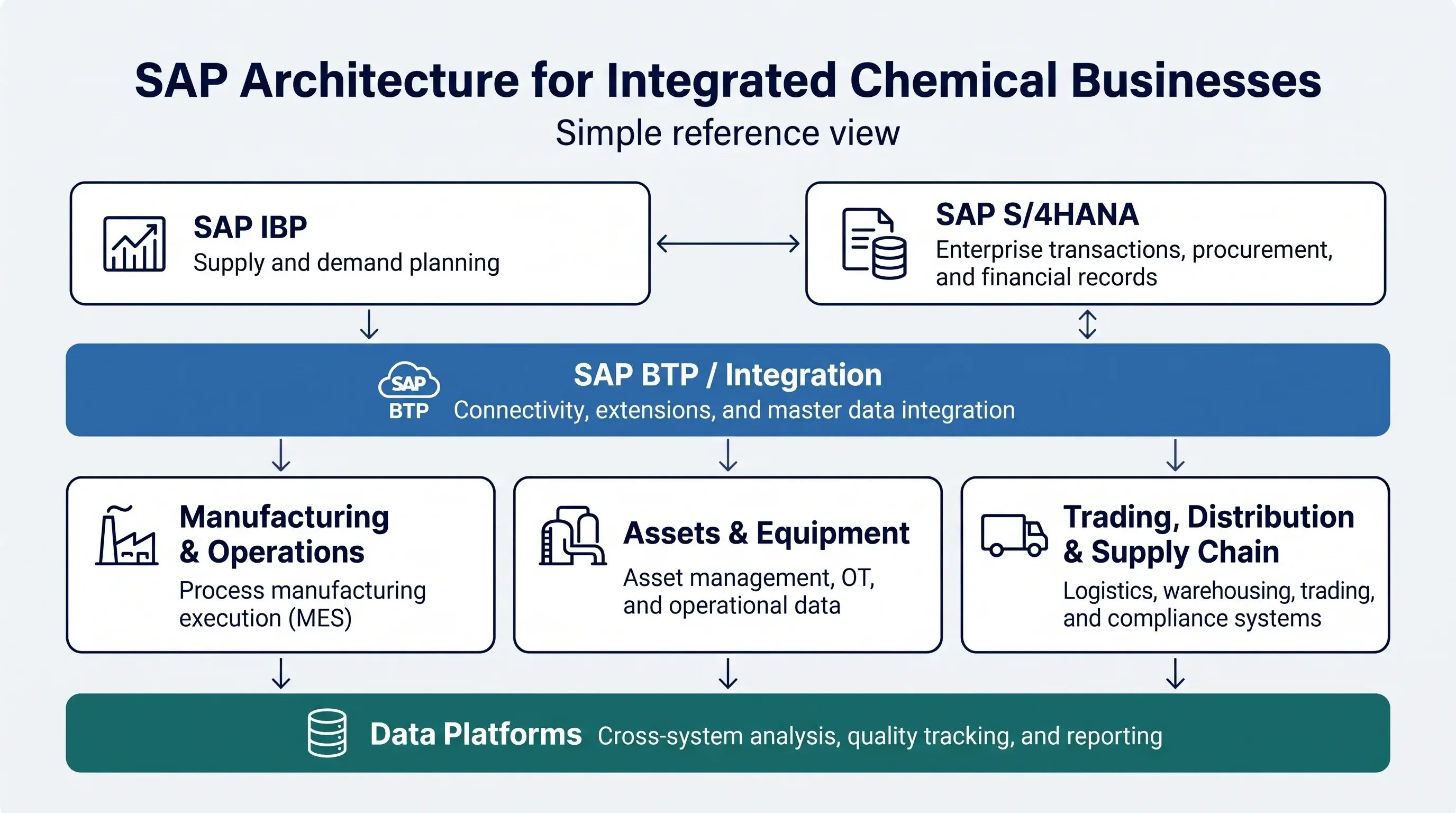
IBP can operate alongside the transactional landscape for longer-term supply and demand planning.
This architecture serves as a reference rather than a fixed implementation pattern. A semiconductor manufacturer may retain specialized MES, automation, equipment-control, quality, or data systems where they provide capabilities that SAP does not need to replace. The integration layer then connects those systems around shared business objects, controlled interfaces, and defined data ownership.
Learn which factors to evaluate when comparing SAP integration partners in the USA.
Where SAP Transformations Fail, and How to Structure the Roadmap
SAP transformation in semiconductor manufacturing is difficult when enterprise processes, manufacturing execution, equipment data, and site-specific practices have developed independently. The greatest risks are often at the interfaces between systems and organisational responsibilities.
Where do SAP transformations become difficult in semiconductor manufacturing?
Several issues tend to reinforce each other. Weak master data can complicate integration. Fragmented production and equipment data can make traceability harder to reconcile. Site-specific customizations can then make subsequent rollouts more expensive.
Common challenges include:
- ERP and MES boundaries: unclear ownership can leave production orders, confirmations, WIP, and execution data split across systems without a consistent process model.
- Lot and wafer genealogy: material movements, production results, quality records, and equipment data may use different identifiers or levels of detail.
- Equipment data fragmentation: maintenance records may sit in SAP while condition and process data remain in equipment systems, historians, or MES.
- Master-data inconsistency: materials, suppliers, equipment, BOMs, routings, and locations can follow different structures across plants.
- Excessive customization: copying legacy processes into the new environment can preserve unnecessary complexity and make upgrades or site rollouts harder.
- External supply-chain visibility: subcontractors, OSAT providers, and suppliers can create information gaps around material status, consumption, capacity, and delivery.
- Yield-to-cost disconnects: production losses can remain in manufacturing analytics without a clear connection to material consumption, processing costs, and product economics.
- Greenfield integration: new fabs require project, procurement, asset, manufacturing, warehouse, quality, and finance processes to converge as the facility moves into production.
These problems rarely require one technical fix. They require decisions about process ownership, master data, interfaces, system scope, and the sequence in which capabilities should be introduced.
What should a semiconductor SAP transformation roadmap cover?
A practical roadmap should establish the operating model before large-scale configuration begins. The sequence can vary by company, but seven phases provide a useful structure:
- Assess: document sites, processes, systems, equipment, data, integrations, and external partners. Identify the interfaces where operational or financial information currently breaks down.
- Define the target architecture: assign responsibilities across S/4HANA, MES or Digital Manufacturing, equipment and OT systems, EWM, TM, planning applications, and the integration and data layer. Define ownership for the main data objects.
- Standardize: establish common structures for materials, suppliers, equipment, financial processes, quality processes, and maintenance. Separate genuine site requirements from inherited local practices.
- Integrate: build and validate interfaces between SAP, manufacturing systems, equipment, warehouses, logistics providers, suppliers, and subcontractors. Prioritize business-critical data flows before lower-value integrations.
- Test: validate complete scenarios rather than individual interfaces. Testing should cover production execution, material movements, lot genealogy, quality events, equipment-related disruptions, subcontracting, inventory, and financial postings.
- Deploy: roll out by fab, plant, business unit, or process according to operational dependencies and readiness. A phased deployment can reduce the number of simultaneous changes affecting production.
- Optimize: use production, maintenance, supply-chain, inventory, quality, and cost data to identify measurable improvement opportunities. Optimization should follow stable processes and reliable data rather than compensate for unresolved architecture or master-data problems.
For a multi-site semiconductor company, the roadmap should also establish which capabilities belong in a common template and which require controlled local variation. That decision directly affects the cost and speed of future site rollouts.
Measuring a Fab Landscape: KPIs for SAP in Semiconductor Manufacturing
KPI that two systems calculate differently produces two numbers for the same wafer. Yield shows how this happens. The MES can report line yield, wafer sort gives die yield, the tester gives final test yield, and SAP adds a confirmed-quantity yield for each production order.
The table pairs each KPI with the system that normally holds the source data and the definition to settle first.
|
Area |
KPI |
Main data source |
Definition to settle first |
|
Production |
Yield |
MES, test systems, SAP order confirmations |
Stage measured (line, die, final test) and good die against gross die |
|
Production |
Cycle time |
MES lot timestamps, SAP milestone confirmations |
Start and stop events, tracked per product and technology |
|
Production |
Throughput |
MES moves, SAP confirmed quantities |
Wafers or die, per tool group or per fab |
|
Production |
Schedule adherence |
SAP production orders, SAP IBP plan |
Tolerance window around the planned date, at lot or order level |
|
Equipment |
Availability |
MES and equipment states, SAP downtime records |
Whether planned maintenance and requalification count as downtime |
|
Equipment |
Unplanned downtime |
SAP maintenance notifications and orders with failure codes |
One failure code catalog shared by the MES and SAP |
|
Maintenance |
MTTR |
SAP maintenance order timestamps |
Clock stops at repair completion or at return to production |
|
Quality |
Defect rate |
Inspection and metrology data, SAP quality notifications |
Unit of measure: per wafer, per lot, or per million units |
|
Quality |
Lot and wafer traceability completeness |
SAP batch records, MES genealogy |
Share of finished batches linked to supplier batches and wafer lots, plus time to complete a mock recall |
|
Supply chain |
Supplier on-time delivery |
SAP purchase order confirmations and goods receipts |
Requested or confirmed date, and the tolerance window |
|
Inventory |
Inventory accuracy |
SAP EWM cycle counts, S/4HANA stock |
Count level (bin or handling unit) and quantity or value basis |
|
Logistics |
On-time delivery |
SAP deliveries, SAP TM carrier events |
Customer requested or confirmed date, measured at dispatch or at the dock |
|
Finance |
Cost per unit or wafer |
S/4HANA product costing, Material Ledger |
Per wafer start, good wafer, or good die |
|
Sustainability |
Energy and resource use per unit |
Utility meters, facility systems, SAP sustainability data |
Allocation of shared utility use to products |
Targets come from the company's own baseline and from the business case for the program. This guide cites no industry benchmarks, because yield, cycle time, and downtime vary with technology node, product mix, and fab age.
The Right SAP Architecture Needs the Right Implementation Partner
Each section of this guide returned to the same decision: which system owns which record. SAP holds the order, the batch, the asset, and the cost. The MES holds the lot, and the equipment controllers hold the recipe and the tool state. Programs that settle these assignments before configuration begins spend their effort on interfaces and data quality, and the rework after go-live stays small.
LeverX recommends treating SAP for semiconductor manufacturing as a connected enterprise architecture. S/4HANA links with the MES, equipment systems, quality platforms, asset management, supply chain planning, and logistics, and every link has a named owner and a defined data flow. The MES keeps lot dispatching and tool control, while SAP carries planning, procurement, inventory, maintenance, and finance.
LeverX brings SAP implementation and integration expertise across these areas, with experience connecting ERP environments to manufacturing, warehouse, logistics, and external systems. Its manufacturing practice covers S/4HANA, Digital Manufacturing, asset management, quality, EWM, supply chain planning, BTP, and SAP integrations.
For a semiconductor manufacturer, the starting point should be the existing landscape and the processes that need to change. Our assessment can identify system boundaries, data gaps, integration dependencies, and the SAP capabilities that fit the target operating model.
FAQ
What is SAP for semiconductor manufacturing?
SAP for semiconductor manufacturing refers to the use of SAP software for the business processes around a fab or back-end site. S/4HANA manages planning, procurement, inventory, product costing, asset accounting and maintenance. SAP IBP, SAP EWM, SAP TM, SAP Quality Management and SAP Digital Manufacturing provide planning, warehouse, transportation, quality and shop-floor capabilities where needed to a site. The MES and equipment systems will continue to handle lot dispatching, recipe control, and tool communication.
Can SAP integrate with fab equipment and automation?
SAP does not connect to process tools directly in most fabs. Equipment controllers communicate with the MES through standards such as SECS/GEM, and the MES passes selected events and data to SAP. Typical examples are downtime events that create maintenance notifications, counter readings (RF hours or wafer counts) that release maintenance orders, and confirmed quantities that update inventory and WIP.
Integration usually runs through SAP Integration Suite or the fab's existing middleware. Back-end lines running SAP Digital Manufacturing can collect machine data closer to the shop floor, but the interface design depends on the equipment vendors and the automation layer already in place.
Does SAP replace semiconductor MES?
In a front-end wafer fab, SAP does not replace a semiconductor MES. Lot tracking at the wafer and carrier level, hold and release, recipe management, and dispatch decisions based on live tool state need functions that ERP transactions do not provide. SAP Digital Manufacturing can run execution in assembly, packaging, and test lines, where the process resembles discrete manufacturing. Whether it fits a given site depends on the process complexity and on the MES already installed. A mixed landscape with both is common.
Can SAP support yield and production-cost analysis?
SAP supports the cost side of yield. Confirmed quantities and scrap per production order raise the cost per good unit, and the gap between planned and actual yield appears as a variance at order settlement. With actual costing in the Material Ledger, the variance can flow into inventory value and cost of goods sold per product.
Root-cause yield analysis, which correlates defect inspection data, parametric test results, and wafer maps by tool and step, runs in the MES analytics layer or in dedicated yield management systems. SAP Business Data Cloud can combine both data sets for margin reporting by product.
Does SAP support CHIPS Act-related requirements?
SAP implementation does not establish eligibility or compliance with the CHIPS and Science Act. Eligibility and reporting obligations come from the award agreement and from official guidance by the Department of Commerce and the IRS. SAP can supply records that support those obligations: project costs by WBS element, capitalized costs by asset class, and spend by supplier.
Teams that know the reporting categories at design time can build them into the project and asset structures. Legal, tax, and finance teams should confirm current requirements against official sources.
Disclaimer: This article is for informational purposes only and does not constitute technical, legal, tax, or regulatory advice. SAP capabilities, licensing, and integration options depend on the specific manufacturing environment and product configuration. References to the U.S. CHIPS and Science Act are for context only; applicable requirements should be verified against official guidance and individual award terms. Results may vary depending on the implementation and business context.