This article explores how SAP supports U.S. aerospace manufacturers by connecting engineering, production, quality, traceability, supply chain, and MRO within an integrated operating model while addressing industry-specific and regulatory requirements.
U.S. aerospace manufacturers need to keep engineering, production, quality, supplier, and maintenance information aligned across product lifecycles that can span decades. The challenge is not simply the number of processes involved. It is the number of relationships that must remain intact. An engineering change may affect material already ordered, work released to production, supplier requirements, inspection criteria, inventory, and delivered products.
The U.S. operating environment adds another layer. Depending on the company and program, manufacturers may operate under FAA production approvals, aerospace customer requirements, defense contracts, export controls, cybersecurity requirements, or combinations of these frameworks.
SAP can provide the enterprise foundation connecting the underlying operating model:
Engineering → Planning & Procurement → Production → Delivery → MRO, where service data is available in or integrated with the connected landscape
Quality and traceability can span these processes where the relevant lifecycle information is available across connected systems. The goal is not to place every aerospace process in a single application. It is to establish clear ownership of processes and data and connect engineering, manufacturing, quality, supply chain, and enterprise systems around the information the business needs.
The exact landscape depends on the manufacturer’s products, plants, production model, existing applications, customers, and regulatory or contractual environment. Companies evaluating the ERP foundation behind these processes can use SAP S/4HANA consulting to assess the current environment and define an appropriate transformation path.
Why Aerospace Manufacturing Requires a Different ERP Approach
Aerospace manufacturers use many familiar discrete-manufacturing processes: procurement, material planning, production orders, inventory management, inspections, and delivery. What changes is the level of control around the product.
A manufacturer may need to determine which revision was applied when a component was produced, which supplier provided the material, which batch or serial number entered the assembly, which inspections were completed, and which product configuration was delivered.
That creates a stronger need for configuration and revision control, engineering change management, serial and batch traceability, material genealogy, nonconformance management, approved supplier processes, detailed production and quality records, and long-term product history.
For U.S. manufacturers, the same operating environment may span commercial aviation, defense, space, and multi-tier supplier programs. Different programs can introduce different customer, contractual, cybersecurity, export-control, production-approval, and information-handling requirements, even within the same organization.
The difficulty increases when PLM, ERP, MES, quality, warehouse, and supplier systems maintain different parts of that history independently. The objective of the ERP architecture is therefore not to replace every specialist system. It is to preserve the business relationships between engineering definitions and operational records as the product moves through manufacturing.
What SAP Solutions Are Relevant to Aerospace Manufacturing?
SAP S/4HANA can provide the enterprise foundation for finance, procurement, materials management, production, inventory, quality, and maintenance. Other SAP solutions can extend that foundation where the operating model requires them.
|
Business area |
Relevant SAP capability |
|
Enterprise resource planning |
|
|
Complex production engineering |
SAP S/4HANA Manufacturing for Production Engineering and Operations (PEO) |
|
Product development and PLM |
|
|
Manufacturing operations |
|
|
Quality |
|
|
Warehouse operations |
|
|
Supply chain planning |
|
|
Procurement and supplier collaboration |
|
|
Transportation |
|
|
Export control and global trade compliance |
SAP Global Trade Services (GTS), edition for SAP HANA |
|
Aviation MRO |
Component Maintenance Cockpit (CMC) |
|
MRO subcontracting |
MRO Subcontracting in SAP S/4HANA |
|
Integration and extensions |
SAP Business Technology Platform (BTP) and SAP Integration Suite |
|
Maintenance |
Not every aerospace manufacturer needs this complete portfolio. A component supplier with one plant may require a relatively focused architecture, while a large manufacturer working across multiple plants, engineering environments, suppliers, and aftermarket operations may need a broader landscape.
The selection should follow business requirements and system ownership rather than a predetermined software list.
SAP for Aerospace Engineering and Product Lifecycle Management
Engineering information determines what manufacturing ultimately builds. Product structures, BOMs, drawings, specifications, revisions, configuration data, approved materials, and supporting documents can influence procurement, production, quality, and delivery.
Aerospace manufacturers often retain specialist CAD and PLM environments for detailed engineering. SAP Integrated Product Development can help connect approved product information with downstream operational processes.
A typical handover may look like:
Engineering definition → Product structure → Manufacturing requirements → Procurement → Production
Manufacturing then receives the structures, materials, revisions, and requirements needed to plan and execute work in accordance with an approved definition.
The important architectural question is not whether every engineering object belongs in SAP. It is the system that owns each object, and the approved information needs to reach ERP and manufacturing.
Engineering Change Management
Aerospace products can evolve while procurement and production are already underway. A revised specification may affect existing inventory, open purchase orders, production orders, manufacturing instructions, supplier requirements, and inspection criteria.
A controlled change process needs to establish when the new revision becomes effective, which open work is affected, whether existing inventory can still be used, which suppliers need updated requirements, whether production instructions or inspections must change, and how approved exceptions will be handled.
The process may follow:
Engineering Change → BOM / Specification Update → Production Impact → Supplier Impact → Quality Documentation
The objective is controlled propagation of an approved change rather than separate updates in PLM, ERP, manufacturing, procurement, and quality systems.
For highly engineered products, PEO can provide the production engineering layer needed to translate approved changes into detailed manufacturing execution.
SAP for Aerospace Production Planning and Manufacturing
Aerospace production often combines low volumes with high complexity, expensive materials, long lead times, serialized products, subcontracting, and extensive quality requirements. SAP S/4HANA can support processes such as MRP, production planning, BOMs, routings, work centers, production orders, material staging, confirmations, inventory movements, and subcontracting.
The value comes from the connections between those processes.
If a material becomes unavailable, planners need to understand which orders depend on it. If quality blocks a component, its availability should reflect that status. If engineering changes a product definition, manufacturing needs the approved change before executing the affected work. That coordination reduces the need for planners and production teams to manually reconstruct the current situation across several systems.
PEO, SAP Digital Manufacturing, and the Aerospace Shop Floor
SAP S/4HANA Manufacturing for Production Engineering and Operations (PEO) and SAP Digital Manufacturing address related manufacturing requirements, but they have different roles.
PEO is designed for highly engineered and complex products. It supports version-controlled manufacturing structures, manufacturing BOMs, detailed shop-floor routings, operator instructions, serialized production, and engineering-change impact analysis.
PEO is available with SAP S/4HANA and SAP Cloud ERP Private. It can also operate side by side with an existing SAP ERP or separate SAP S/4HANA system through SAP Digital Supply Chain Management, edition for SAP S/4HANA.
SAP Digital Manufacturing addresses broader manufacturing operations management. It can connect enterprise processes with shop-floor execution, resources, machines, production data, and performance monitoring.
An established MES can also remain in place when it continues to meet plant requirements. The architecture should therefore define ownership of production engineering, detailed execution, machine connectivity, and shop-floor data rather than assume one product must replace every existing manufacturing system.
Aerospace Traceability and Material Genealogy
Traceability becomes most valuable when something goes wrong. If a supplier identifies a problem with a material batch, teams may need to find which receipts came from it, which production orders consumed it, which serialized components contain it, what inspections were completed, and where the resulting products were delivered.
A representative genealogy is:
Supplier → Material → Batch/Lot or Serial Number → Production Order → Work Step → Inspection → Finished Assembly → Delivery
Where fielded product and service records are available in SAP or integrated from operator or MRO systems, this history may extend to installation and maintenance. The traceability model should be defined around the questions the business needs to answer. That includes identifying which events create genealogy records, which identifiers must persist across systems, and how missing or conflicting records are handled.
For a serialized component, quantity on hand is only one part of the record. The manufacturer may also need the supplier source, production history, inspections, configuration, and disposition associated with that individual unit.
SAP Quality Management for Aerospace
Quality activity occurs throughout manufacturing, from receiving through production and final release. SAP Quality Management within SAP S/4HANA can support incoming, in-process, and final inspections, results recording, defects, quality notifications, nonconformance processes, and supplier-related quality activities.
A typical flow is:
Supplier Material → Inspection → Nonconformance → Supplier Action → Production Decision
The important point is that quality status should affect operations. Material awaiting inspection should not be treated like material already released. A failed inspection may require supplier action, inventory restrictions, production replanning, or further engineering review. This gives quality data operational meaning instead of leaving it in an isolated quality record.
Aerospace Supplier and Procurement Management
Aerospace manufacturers can depend on multi-tier suppliers, long-lead components, external processing, and subcontract manufacturing. Procurement, therefore, needs more than price and delivery information. Relevant supplier records may include approval or qualification status, product and specification requirements, applicable revisions, required inspections, supplier quality history, program or contract attributes, data-sharing restrictions, and corrective actions.
For FAA production approval holders, supplier control is part of the broader production-quality environment. Customer and defense contracts can add further program-specific requirements.
U.S. manufacturers may also need to evaluate domestic, regional, and alternative sources alongside established global suppliers. Reshoring or dual-sourcing decisions can affect qualification, lead times, capacity, material availability, cost, and quality requirements, so sourcing changes need to remain connected with planning and manufacturing rather than being treated as procurement decisions alone.
SAP S/4HANA procurement, SAP Ariba, SAP Business Network, and SAP Quality Management can help connect supplier activity with actual manufacturing demand and quality status.
SAP for Aerospace Inventory and Warehouse Management
Aerospace warehouses can contain expensive components, serialized parts, long-lead materials, inspection stock, quarantined items, and inventory subject to specific handling requirements.
SAP Extended Warehouse Management can support receiving, putaway, picking, staging, internal movements, inventory control, and production supply. Depending on the landscape, SAP EWM can be embedded in SAP S/4HANA or deployed as a decentralized system. The right model depends on warehouse scale, operational complexity, performance requirements, automation, and integration needs.
For aerospace operations, one important requirement is the connection between physical material and its status. Material blocked after a nonconformance, awaiting inspection, or released for production should remain clearly distinguishable as it moves through the warehouse.
Aerospace Supply Chain Planning
Long lead times and constrained components make early visibility particularly important in aerospace. SAP S/4HANA planning and SAP Integrated Business Planning can connect demand, supply, inventory, and capacity information.
A representative process is:
Demand → Supply Plan → Procurement → Production → Inventory → Delivery
Planners can use this information to evaluate which production orders depend on delayed components, where shortages may emerge, which capacity constraints matter, and where limited inventory should be allocated.
This section concerns operational planning. Broader structural decisions, such as dual sourcing, reshoring, and regional supply networks, are addressed separately in the supply chain resilience section.
SAP for Aerospace Quality and Regulatory Traceability
Regulatory and contractual requirements should be translated into specific process, record, and control requirements rather than treated as a generic “compliance” feature.
FAA production approvals
The FAA recognizes Production Certificates, Parts Manufacturer Approvals, and Technical Standard Order Authorizations as forms of production approval. For Production Certificates, the FAA evaluates the applicant’s organization, facilities, quality system, and ability to manufacture products that conform to approved design data under applicable Part 21 requirements.
For an SAP environment, relevant areas can include approved product and manufacturing data, supplier records, inspection results, nonconforming material, serial and batch traceability, engineering changes, and production history.
SAP can support the processes and records involved. It does not itself provide an FAA production approval or guarantee regulatory compliance.
9100-series quality requirements
IAQG 9100 establishes quality management system requirements for aviation, space, and defense organizations and can be applied throughout the aerospace supply chain.
SAP-supported quality, supplier, documentation, traceability, and change processes can form part of the organization’s operating environment, supporting those requirements. Certification remains an organizational responsibility.
This distinction is important: SAP functionality can support control, but the organization still needs to define the applicable requirements, process ownership, evidence, and governance.
SAP for Aerospace and Defense: ITAR and Security Considerations
Aerospace and defense programs can involve controlled technical, operational, contractual, or customer information. Export-control obligations may arise under ITAR or the EAR, depending on the jurisdiction and classification of the item, software, technical data, or technology.
The EAR, for example, treats certain releases of controlled technology to foreign persons as exports, including some releases that occur within the United States.
For an enterprise architecture, export-control and contract requirements can affect user and administrator access, engineering integrations, supplier collaboration, support arrangements, data transfers, nonproduction environments, attachments and interface payloads, logging, and monitoring.
CMMC and defense contracts
Defense contractors may also face CMMC and related contractual cybersecurity requirements when applicable information systems process Federal Contract Information or Controlled Unclassified Information.
As of September 2026, CMMC Phase II requirements remain suspended. The U.S. Department of Defense CIO states that the Phase II transition, originally scheduled for Nov. 10, 2026, was suspended on July 13, 2026, while Phase I self-assessment requirements remain in place.
For an SAP program, the architectural question is which SAP and connected systems fall within the relevant information boundary. The answer depends on the actual solicitation, contract, subcontract, information types, and system landscape. It should be determined with qualified legal, contracting, cybersecurity, and export-control specialists.
SAP Integration for Aerospace Manufacturing
Aerospace manufacturers rarely operate SAP in isolation. The broader landscape can include PLM, CAD, MES, warehouse automation, supplier systems, MRO platforms, quality applications, equipment, customer systems, and data platforms.
A representative architecture may look like this:
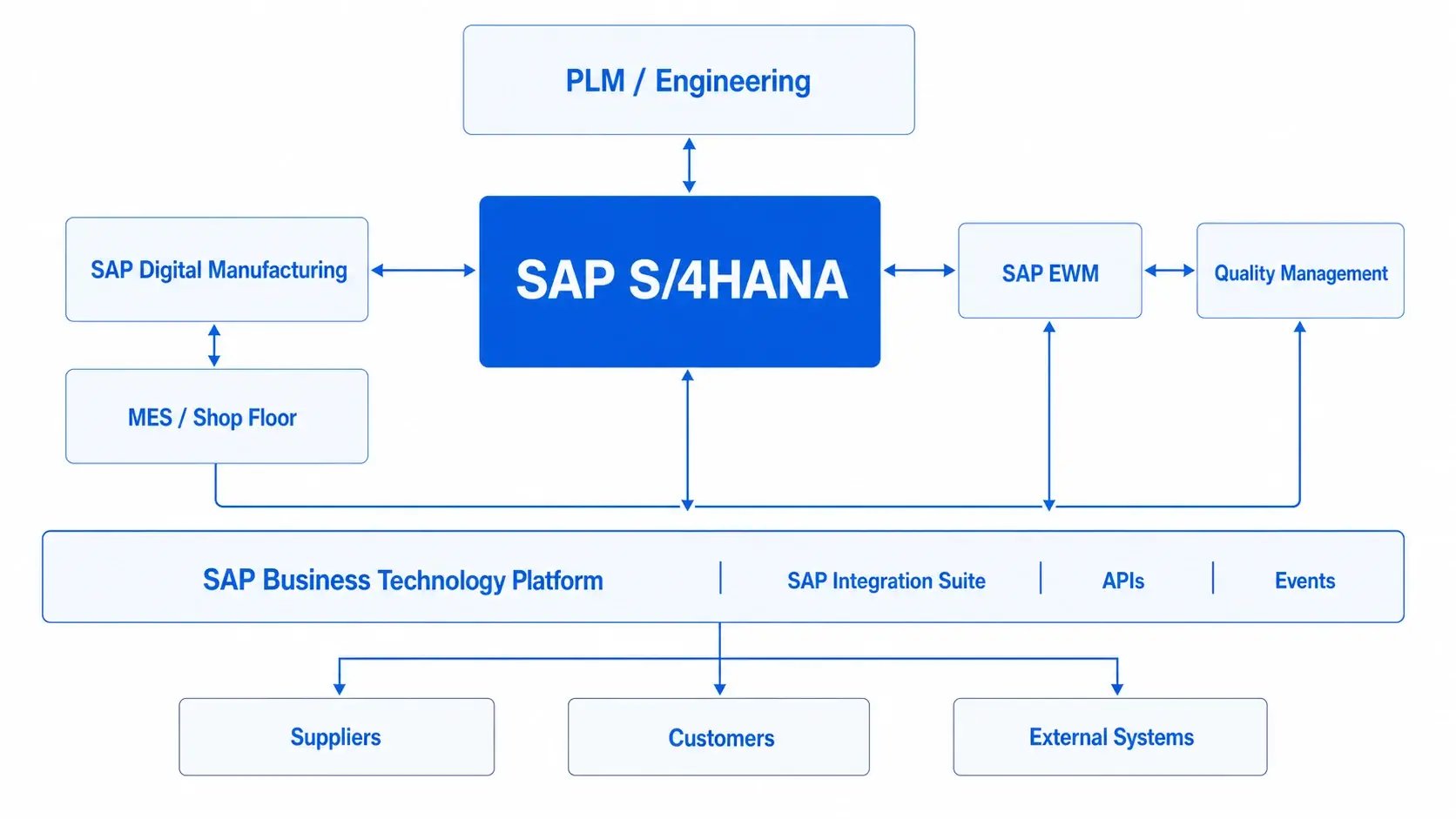
The diagram is representative, not prescriptive. One organization may use SAP Digital Manufacturing for shop-floor operations. Another may retain an established MES. EWM may be embedded or decentralized. PLM may be SAP or non-SAP.
The first architecture decision is therefore system ownership: which system is authoritative for each process and critical data object. After ownership is clear, teams can define the interfaces, integration frequency, API or event requirements, error handling, and reconciliation rules.
SAP Business Technology Platform can provide a broader platform for integration and extensions. Within SAP BTP, SAP Integration Suite can support SAP and non-SAP connectivity, APIs, and event-driven integration.

SAP Data Management for Aerospace Manufacturing
Integration cannot compensate for unreliable source data.
Aerospace SAP programs often need governance across material masters, product structures, BOMs, routings, serial numbers, batches, suppliers, customers, equipment, quality characteristics, and engineering revisions.
For each critical domain, the organization should establish an authoritative source, naming and validation rules, ownership, change approvals, retention requirements, and reconciliation procedures.
Migration decisions are equally important. Historical information does not automatically need to move into the new transactional environment. Some records may be migrated, some archived, and others retained in accessible legacy repositories.
The decision should reflect operational needs, traceability, reporting, regulatory and contractual requirements, and the quality of the source data. LeverX SAP data migration services cover migration strategy, data cleansing, transformation, validation, reconciliation, and transition to new SAP environments.
SAP for Aerospace MRO and Aftermarket
Aerospace product lifecycles can continue long after manufacturing through maintenance, repair, overhaul, spare parts, and service activity. SAP Enterprise Asset Management, together with inventory, procurement, serialization, and related SAP S/4HANA processes, can support this environment.
Where maintenance information is captured in SAP or integrated from operator or MRO systems, the information path may continue as:
Manufacturing history → Installed component → Maintenance → Repair or replacement
Connecting the available manufacturing and service records can help teams investigate components, plan parts, and understand previous work.
This continuity should not be assumed automatically. Operators, airlines, OEMs, and independent MRO providers may own different portions of the lifecycle record. The architecture, therefore, needs to establish what downstream information is actually available, who owns it, and how it can be exchanged.
Aerospace Business Scenarios
The following scenarios show how the individual process areas work together.
Scenario 1: new aircraft component
Engineering → BOM → Procurement → Production → Inspection → Delivery
Engineering establishes the approved product definition. Procurement sources the required materials. Production executes the manufacturing plan, while quality records the required inspections.
The value comes from maintaining consistent product and operational information across these handoffs.
Scenario 2: supplier quality issue
Supplier Batch → Incoming Inspection → Nonconformance → Production Impact → Corrective Action
When a supplier identifies a material problem, teams need to determine what was received, where it is located, whether production consumed it, and what containment or corrective action is required. The scenario depends on procurement, inventory, quality, production, and genealogy records being connected.
Scenario 3: engineering change
Revision Change → BOM → Production → Supplier → Quality Documentation
An approved revision may affect existing inventory, work in progress, supplier requirements, and inspections. The value comes from identifying the impact before teams continue work using outdated requirements.
Scenario 4: component traceability
Serialized Component → Production History → Delivered Product → Maintenance, where downstream records are available or integrated
A component’s identity can connect its manufacturing and inspection history with delivery information. Installation and maintenance records become part of the picture only where the relevant downstream data is available to or integrated with the connected landscape.
Benefits of SAP for Aerospace Manufacturing
A well-designed SAP landscape can improve aerospace operations without requiring every process to move into one platform. Potential outcomes include stronger traceability between materials, suppliers, production, inspections, and delivered products; more consistent ownership of product, material, supplier, and manufacturing data; and better production visibility around shortages, quality holds, order status, and work in progress.
Connected processes can also improve supplier coordination, reduce the manual work required for genealogy and quality investigations, make engineering changes easier to manage across affected processes, improve visibility into inventory status, reduce reconciliation between disconnected data sources, and provide more consistent operational information for reporting and decision-making.
These are potential outcomes rather than guaranteed ROI results. Their value should be measured against the organization’s own baseline.
Common SAP Transformation Challenges in Aerospace
Legacy system fragmentation
Engineering, ERP, MES, warehouse, and quality environments may have evolved independently. The target design needs clear ownership before interfaces are replaced or consolidated.
Poor master data
Different sites may use inconsistent materials, product structures, suppliers, units of measure, or classifications. Migration without standardization simply transfers the inconsistency.
Customization
Projects sometimes recreate legacy workflows inside SAP rather than deciding whether those workflows are still necessary. Each extension should have a clear business reason and lifecycle owner.
Traceability gaps
Historical genealogy may already be incomplete. A new system cannot reliably recreate evidence that was never captured, so unresolved gaps require explicit governance.
Supplier integration
Suppliers have different technologies, data quality, and connectivity capabilities. The operating model needs controlled alternatives for suppliers that cannot use the preferred collaboration channel.
Long product lifecycles
Product and manufacturing history may remain important after source systems are retired. Retention and archive access, therefore, belong in the transformation scope.
User adoption
Engineers, planners, quality teams, warehouse users, and production employees may need to change established workflows. Process ownership, realistic testing, training, and post-go-live support influence whether those changes actually work.
SAP Aerospace Transformation Roadmap
Aerospace transformation should begin with the operating model rather than the SAP product catalog.
Phase 1: assess
Map engineering, ERP, manufacturing, quality, warehouse, supply chain, suppliers, integrations, and data, along with the regulatory and contractual dependencies that apply to the planned scope. For U.S. programs, this assessment should explicitly identify relevant FAA production-approval considerations, defense-contract requirements, export-control restrictions, cybersecurity obligations, and controlled-information boundaries where applicable.
The assessment should identify where information becomes inconsistent, where traceability breaks, and where teams rely on manual reconciliation.
Phase 2: define target operating model
Determine which processes should be standardized and which remain plant-, program-, or product-specific. Define process ownership, data ownership, and responsibilities between SAP and specialist applications.
Phase 3: design architecture
Define the roles of SAP S/4HANA, PLM, PEO, SAP Digital Manufacturing, EWM, SAP BTP, existing MES platforms, supplier systems, MRO applications, and other relevant components. Establish integration, security, and controlled-data boundaries before interfaces are built.
Phase 4: clean and govern data
Standardize and validate critical product, material, supplier, BOM, routing, serial-number, and quality information. Decide which historical data will be migrated, remediated, archived, or retained in legacy repositories.
Phase 5: implement/integrate
Configure the required SAP processes, build integrations and controlled extensions, and prepare workflows, roles, reporting, and operational procedures.
Phase 6: test and validate
Test end-to-end aerospace scenarios rather than isolated transactions. Testing should include engineering changes, supplier quality issues, serialized traceability, warehouse movements, integrations, security requirements, cutover conditions, and exception handling.
Phase 7: deploy and optimize
Deploy by an appropriate plant, product, process, or program scope. After stabilization, measure business outcomes, correct remaining issues, and extend the solution based on demonstrated priorities.

How SAP Can Support U.S. Aerospace Supply Chain Resilience
Supply chain resilience is broader than day-to-day material planning. A manufacturer expanding U.S. production, evaluating reshoring, introducing dual sourcing, or developing more regional supply networks needs to understand how sourcing decisions affect capacity, inventory, production, and delivery.
A representative process is:
Supplier → Procurement → Planning → Production → Warehouse → Delivery
Connected SAP processes can help planners and procurement teams assess long-lead shortages, supplier performance, alternative sources, inventory buffers, production capacity, material availability, regional supply options, and the likely effect on delivery commitments. Where transportation complexity is material, SAP Transportation Management can extend this view into transportation planning and execution.
The purpose is not to create a separate “resilience system.” Resilience is an operating outcome created when supplier, planning, procurement, inventory, warehouse, transportation, and production information can be evaluated together before a disruption becomes a production stoppage.
Clean Core and SAP BTP for Aerospace
Aerospace manufacturers often have specialized requirements that standard ERP processes do not fully address. That does not mean every requirement should become custom code in SAP S/4HANA.
A practical model is:
Standard SAP core + Controlled extensions + Governed data + Integrated specialist systems
Clean Core decisions should determine where additional logic belongs. A requirement may fit standard SAP functionality, an approved in-app extension, a side-by-side application on SAP BTP, or an existing specialist engineering or manufacturing platform. SAP BTP can support side-by-side extensions, workflow, automation, applications, and integration services without forcing every specialized requirement into the ERP core.
The objective is controlled extensibility: enough flexibility to support real aerospace requirements without creating an environment that becomes increasingly difficult to test, maintain, and upgrade.
.webp)
How to Measure SAP Success in Aerospace Manufacturing
SAP program success should be measured through business outcomes rather than go-live completion alone.
|
Area |
Example KPI |
|
Production |
Production schedule adherence |
|
Quality |
First-pass yield |
|
Quality |
Nonconformance rate |
|
Traceability |
Traceability completeness |
|
Inventory |
Inventory accuracy |
|
Supply Chain |
Supplier on-time delivery |
|
Procurement |
Purchase-order cycle time |
|
Engineering |
Engineering-change cycle time |
|
Warehouse |
Picking/staging accuracy |
|
Finance |
Manufacturing cost visibility |
Targets should be defined against the organization’s baseline and business case. The useful question is not whether the new system is live. It is whether the operating problem the program was intended to solve has measurably improved.
How LeverX Supports SAP Aerospace Manufacturing Initiatives
LeverX supports aerospace manufacturing initiatives across SAP S/4HANA, PEO, SAP Integrated Product Development, SAP Digital Manufacturing, SAP Quality Management, SAP EWM, SAP IBP, SAP Ariba, SAP Business Network, SAP Transportation Management, SAP Enterprise Asset Management, SAP BTP, and SAP Integration Suite.
Depending on scope, LeverX can support solution and architecture design, SAP implementation and transformation, engineering and manufacturing integration, PEO and shop-floor scenarios, warehouse and supply chain processes, data migration and governance, SAP and non-SAP integration, testing and deployment, and post-go-live optimization and support.
For U.S. aerospace programs, solution design can also account for regulatory, contractual, cybersecurity, quality, export-control, and controlled-data requirements where they materially affect the SAP landscape.

Connect engineering, production, quality, supply chain, warehouse, and traceability through an SAP architecture designed around complex aerospace operations.
Conclusion
Aerospace manufacturers need more than an ERP replacement. They need reliable relationships between engineering definitions, manufacturing structures, suppliers, materials, quality records, serialized components, inventory, warehouse operations, and delivery. SAP can provide the enterprise foundation, while specialist engineering, manufacturing, and service systems remain where they provide the strongest value.
For U.S. aerospace manufacturers, that architecture also needs to reflect the regulatory, contractual, cybersecurity, export-control, supplier, and controlled-data requirements that apply to the specific programs the organization supports.
The target model can be summarized as:
Engineering + ERP + Production + Quality + Traceability + Supply Chain = Integrated Aerospace Operating Model
The strongest architecture begins with business processes and data ownership, then applies SAP capabilities where they solve a defined operational problem.
FAQ
What is SAP for aerospace manufacturing?
SAP for aerospace manufacturing is the use of SAP solutions and connected specialist systems to support engineering, production, quality, procurement, inventory, supply chain, traceability, and related aerospace processes.
How can SAP support aerospace manufacturing?
SAP can connect engineering information with planning, procurement, manufacturing, quality, warehouse, supply chain, and maintenance processes while supporting controlled exception handling across them.
How does SAP improve aerospace traceability?
SAP can connect supplier, material, batch, serial number, production, inspection, and delivery records. The traceability model should define in advance which genealogy relationships the business needs to preserve.
Can SAP manage serialized aerospace components?
Yes. SAP can manage serial-number-related production, inventory, quality, and logistics records, but the architecture should clearly define which system owns each serial identity.
How does SAP support aerospace engineering change management?
SAP can help propagate approved changes into affected manufacturing, procurement, inventory, and quality processes while supporting control over effectivity and work already in progress.
Can SAP integrate PLM and manufacturing?
Yes. SAP and non-SAP PLM systems can integrate with ERP and manufacturing applications, provided ownership, release events, identifiers, and synchronization rules are clearly defined.
How can SAP support aerospace quality management?
SAP Quality Management can support inspections, results, defects, notifications, nonconformance processes, and supplier-related quality activities.
Does SAP support aerospace supply chain planning?
Yes. SAP S/4HANA and SAP IBP can support demand, supply, inventory, capacity, and response planning using the organization’s planning assumptions and operational data.
Can SAP EWM support aerospace warehouses?
Yes. SAP EWM can support complex receiving, storage, serialized inventory, staging, production supply, and warehouse execution processes.
How can SAP support aerospace MRO?
SAP Enterprise Asset Management can support maintenance, asset, inventory, procurement, and service-related processes where the necessary fielded product and service information is available or integrated.
Does SAP support ITAR-related requirements?
SAP technologies can contribute to access, identity, integration, logging, and data-governance controls, but ITAR applicability and compliance depend on the organization’s actual data, users, authorizations, and operating environment.
Can SAP support US aerospace and defense manufacturers?
Yes. SAP can support core manufacturing and enterprise processes, while the architecture is adapted to each organization’s products, programs, contracts, controlled information, and system boundaries.
What SAP solutions are relevant to aerospace manufacturing?
Principal solutions include SAP S/4HANA, PEO, SAP Integrated Product Development, SAP Digital Manufacturing, SAP EWM, SAP IBP, SAP Ariba, SAP Business Network, and SAP BTP. A capability-ownership matrix can help determine which ones the target architecture actually needs.
How long does an SAP aerospace implementation take?
There is no standard duration. The schedule should be estimated by scope and rollout wave based on plants, integrations, data, testing, validation, and organizational readiness.
How much does SAP for aerospace manufacturing cost?
Cost depends on software, implementation, integrations, migration, testing, security, internal resources, support, and rollout scope. A reliable estimate requires a defined target architecture and a current-landscape assessment.
Disclaimer: This article is provided for general informational and planning purposes only. SAP products, features, licensing, pricing, and recommended implementation approaches may change over time. Any cost or timeline references are general planning considerations and do not constitute SAP or LeverX quotes, guarantees, or fixed project estimates.
Actual implementation scope, costs, and timelines depend on the organization’s technology landscape, manufacturing model, number of plants, engineering systems, integrations, data quality, security requirements, deployment model, internal resources, regulatory environment, contracts, and other project-specific factors.
FAA, ITAR, EAR, CMMC, DFARS, 9100-series, export-control, cybersecurity, quality, certification, and other regulatory or contractual requirements should be evaluated with appropriately qualified legal, regulatory, cybersecurity, quality, and contracting professionals. Requirements can vary by product, approval, customer, solicitation, contract, subcontract, and data involved. The use of SAP products or capabilities does not by itself guarantee regulatory compliance, certification, authorization, approval, or fulfillment of contractual obligations.