

The US renewable energy market increasingly combines generation technologies with large-scale energy storage. EIA reported that developers planned 43.4 GW of utility-scale solar and 24 GW of battery storage additions in 2026, alongside 11.8 GW of planned wind capacity.
For companies developing and operating these assets, enterprise systems have to cover more than accounting and procurement. They need to support capital projects, contractors, equipment, maintenance, spare parts, field activities, asset performance, and the financial transition from construction to long-term operations. SAP provides capabilities across these areas, including project management, supply chain, finance, maintenance, and asset management.
In this guide, we examine how SAP supports the renewable energy lifecycle in the USA, including project management, relevant SAP technologies, solar, wind and battery storage operations, asset management, maintenance, supply chain, and finance.
Why Renewable Energy Requires an Integrated Enterprise Architecture
Renewable energy companies manage processes that cross organizational and system boundaries. A project may begin in development, move through procurement and construction, and become a long-lived operating asset. Once the facility enters operation, maintenance, field service, spare-parts, financial, and performance processes continue for years.
The challenge comes from keeping the information connected across these stages. Project systems may hold construction data, ERP manages financial and procurement transactions, asset management tracks equipment and maintenance, while SCADA and other operational systems collect real-time plant data. Contractors and field teams may use additional systems to execute work.
Where disconnected systems create problems
Consider a wind turbine that generates an alarm in the operational system. The alarm itself does not create a maintenance record, reserve a spare part, assign a technician, or post the resulting cost to the correct asset. Those actions require business processes around the operational event.
An integrated architecture can connect the relevant records and transactions:
- Operational event: SCADA or another plant system detects an abnormal condition.
- Maintenance process: The condition creates or supports a maintenance notification and work order in the enterprise system.
- Field execution: A technician receives the work assignment, records the work performed, and reports labor or service details.
- Materials: Required spare parts can be planned, reserved, issued, and replenished through supply chain processes.
- Asset and financial records: The completed work updates maintenance history and creates the relevant financial postings.
The exact integration pattern depends on the operational technology and the SAP landscape. Real-time control remains within the specialized operational environment. SAP handles the related enterprise processes and records.
Why the connection matters across the asset lifecycle
The same principle applies before and after commissioning. Project costs, procurement records, equipment information, and construction data can affect how an asset is managed after handover. During operations, maintenance costs, material consumption, service activity, and asset performance contribute to financial and portfolio reporting.
An integrated enterprise architecture gives these processes a common transactional and informational context. That makes it easier to trace an asset from project delivery through operation and maintenance while keeping operational and financial records aligned.
What SAP Solutions Are Relevant to Renewable Energy?
Renewable energy companies rarely need the entire SAP portfolio. The relevant combination depends on the company’s role, asset base, operating model, and existing IT landscape.
For an owner-operator, the core may center on SAP S/4HANA and enterprise asset management, with additional capabilities for field service, asset performance, supply chain, data, and integration. An EPC contractor may place more emphasis on project management, procurement, construction costs, and subcontractor processes. A developer with limited operating activities may have a different scope from a company managing hundreds of operating sites.
Which SAP capabilities support the core business processes?
SAP S/4HANA can provide the ERP foundation for finance, procurement, inventory, project-related processes, and other core transactions. Enterprise asset management connects physical assets with maintenance planning and execution, work history, materials, and related costs. SAP describes EAM as covering the lifecycle of physical assets and integrating asset, maintenance, spare-parts, and workforce information.
Other SAP capabilities can extend this foundation where the operating model requires them:
- SAP Project System and project capabilities support project planning, budgeting, cost control, and execution processes.
- SAP Asset Performance Management uses asset and maintenance data together with sensor and other operational data to support risk assessment, asset health analysis, and predictive maintenance scenarios.
- SAP Extended Warehouse Management (EWM) can support warehouse processes for equipment, components, and maintenance materials where warehouse complexity justifies a dedicated solution.
- SAP Transportation Management (TM) can support transportation planning and execution for equipment, components, and other materials.
- SAP Field Service Management supports planning and execution of field work, including technician scheduling, mobile execution, equipment information, and service confirmations.
- SAP Integrated Business Planning (IBP) can support supply and demand planning where the company has complex material flows and planning requirements.
- SAP Business Technology Platform (BTP) provides integration, extension, application development, and automation capabilities around the core SAP landscape.
- SAP Business Data Cloud and analytics capabilities can bring together business and operational data for reporting and analysis.
- SAP sustainability solutions can support environmental data management and sustainability-related processes where those requirements form part of the company's operating model. SAP's utilities portfolio includes sustainability alongside asset, supply chain, finance, and other capabilities.
How should the SAP landscape differ by company type?
The starting point should come from the business model rather than from a predefined list of SAP products. A renewable energy developer may need strong project, procurement, financial, and asset-handover processes. An owner-operator needs deeper capabilities for maintenance, asset performance, spare parts, field work, and long-term asset accounting. An EPC provider has different requirements around project execution, procurement, contractors, and construction costs.
The architecture also depends on the existing landscape. A company may already have a CMMS, field service platform, warehouse system, data platform, or operational technology environment. SAP can integrate with specialized systems rather than requiring every process to move into SAP. For asset-intensive operations, the practical question is which system should own each process and master data object, and how information should move between them.
This approach keeps the SAP landscape proportional to the company's actual operating model. A 20-site owner-operator and a global EPC contractor can both use SAP while requiring very different architectures.
Managing Renewable Energy Projects
Renewable energy projects accumulate costs and commitments long before a facility generates its first megawatt-hour. Development work, engineering, equipment purchases, construction services, and contractor invoices all contribute to the project's capital cost. SAP can connect these financial and procurement transactions to the project structure, then carry the relevant information into asset accounting and operations after commissioning.
How does SAP support renewable energy project management?
A project structure gives the company a consistent way to organize costs by project, work package, activity, or other defined dimensions. Project budgets can be compared with commitments and actual costs as work progresses. Purchase orders and supplier invoices contribute to the project's financial position, while contractor costs can be tracked against the relevant project activities.
For a large solar, wind, or battery project, this provides visibility into the cost of developing and constructing the facility before those costs become part of the operating asset. SAP S/4HANA includes project financial management capabilities for planning, budgeting, actual costs, commitments, and project-related procurement.
The scope can cover activities such as site development, engineering, construction, commissioning, and other capital expenditures. Permitting itself may remain in a specialized system or external process, while associated costs and project information can be recorded within the SAP project structure.
How does project procurement affect cost control?
Procurement decisions directly affect project cost and schedule. Renewable projects can involve long-lead equipment, construction services, engineering contractors, transportation, and specialized suppliers. Purchase orders and contracts create financial commitments before the company receives an invoice.
Connecting procurement with project structures allows committed costs to appear alongside budgets and actuals. Delivery information can also be linked to purchasing processes, giving project teams a clearer view of whether ordered equipment and services are progressing as planned.
Supplier performance can be assessed using purchasing and delivery data, while invoice and goods-receipt processes provide the financial records required for project accounting. The exact process depends on the company's procurement model and the systems used by its EPC contractors and suppliers.
What happens when construction becomes an operating asset?
The accounting and operational treatment changes at commissioning. During construction, the company tracks expenditures against the capital project. After an asset is placed into service, the relevant costs can be capitalized and assigned to the resulting fixed assets, subject to the company's accounting policies.
This handoff matters because the asset record becomes the basis for subsequent depreciation, maintenance, work history, and other operational processes. For a wind farm, for example, individual turbines and related equipment may require their own asset structures. A solar project may include inverters, transformers, trackers, and other maintainable equipment. Battery projects can require detailed structures for battery systems, power-conversion equipment, and supporting infrastructure.
SAP can connect project accounting, procurement, fixed-asset accounting, and enterprise asset management across this transition. The result is a traceable relationship between project expenditure, purchased equipment, constructed assets, and subsequent maintenance costs, while operational systems remain responsible for specialized plant monitoring and control.
SAP by Technology: Solar, Wind, and Battery Storage
The SAP landscape can differ significantly by renewable energy technology. Solar portfolios involve large numbers of standardized components across many sites. Wind assets have fewer units but more complex mechanical and electrical equipment. Battery energy storage systems add modular equipment, degradation, and replacement considerations.
SAP can support the enterprise processes around these assets, including maintenance, procurement, inventory, field service, project accounting, and financial management. Specialized operational systems remain responsible for equipment monitoring and control.
Solar: managing distributed assets and inverter maintenance
Solar portfolios can contain thousands of panels, inverters, trackers, transformers, and other components distributed across multiple sites. Consistent asset master data helps operators maintain a clear structure for equipment, locations, maintenance plans, work orders, materials, and service history.
A monitoring system may detect an abnormal inverter condition. That event can feed an integrated maintenance process in SAP, where the company creates a notification or work order, assigns the required resources, and records the completed work.
The process can connect several enterprise records:
- Condition event: A monitoring or operational system identifies a potential equipment issue
- Maintenance: SAP creates or supports the maintenance notification and work order
- Field execution: A technician or contractor performs and records the work
- Materials: Required spare parts are reserved, issued, and replenished through inventory processes
- Asset history: The completed work and associated costs remain linked to the relevant equipment.
SAP can also support project accounting and procurement during solar-farm development and construction. After commissioning, the same enterprise landscape can support asset management and maintenance.
Wind: linking turbine maintenance to asset history
Wind operations have a different maintenance profile. A turbine can contain blades, a gearbox where applicable, generator, drivetrain, tower, and electrical equipment. Remote locations can also make technician dispatch and spare-parts logistics more complex.
SAP asset management can organize these components into an asset hierarchy and associate maintenance plans, work orders, materials, contractors, and service history with the relevant equipment. Operational data can provide input for maintenance decisions, while SAP manages the resulting enterprise workflow.
For a large turbine fleet, this creates a consistent record of maintenance activity across sites and individual assets. Operators can track recurring work, component replacements, contractor activity, material consumption, and maintenance costs without separating these records from the assets they concern.
SAP does not control the turbine itself. Turbine control and real-time operational monitoring remain within specialized operational systems.
Battery storage: managing equipment across its lifecycle
Battery energy storage systems combine battery equipment with power conversion systems, thermal management, transformers, switchgear, and other supporting infrastructure. These components can have different maintenance requirements, service intervals, and replacement cycles.
SAP can connect the enterprise processes surrounding these assets:
- Asset management: Maintain equipment structures, locations, and lifecycle records
- Maintenance: Plan inspections, corrective work, component replacement, and service activities
- Inventory: Manage replacement components and maintenance materials
- Procurement: Purchase equipment, services, and replacement parts
- Project and financial management: Track project costs during development and capital expenditures after commissioning.
Battery degradation also makes lifecycle information relevant to maintenance and replacement planning. The battery-management and protection systems remain responsible for technical measurements, monitoring, and control. Relevant data can flow into SAP processes where it supports maintenance decisions, asset records, or financial analysis.
This distinction matters across solar, wind, and battery storage: SAP manages the enterprise processes around the physical asset, while specialized operational technology manages the equipment itself.
Asset Management and Maintenance
For renewable energy operators, maintenance starts with a reliable representation of the physical asset base. Each site needs a consistent structure for equipment, components, locations, maintenance history, and costs. SAP Asset Management provides the technical asset and maintenance processes that connect this information with planning and execution.
How does SAP Asset Management structure renewable energy assets?
A renewable energy portfolio can contain hundreds or thousands of technical objects spread across geographically separated facilities. A common hierarchy allows maintenance teams to relate individual equipment to the site and larger operating structure.
A typical model can follow:
Portfolio → Site → Substation → Turbine / Inverter → Component
The exact hierarchy depends on the technology and the operator's maintenance model. SAP uses functional locations and equipment to maintain technical asset structures and lifecycle information. Maintenance plans, task lists, measuring points, technical documentation, and related records can then be associated with these objects.
For renewable energy companies, this structure provides a consistent context for:
- Asset master data and technical characteristics
- Functional locations and equipment
- Maintenance plans and inspection activities
- Work orders and notifications
- Spare parts and material consumption
- Maintenance history and associated costs.
The hierarchy also affects reporting. An operator can analyze maintenance activity at the component or equipment level and aggregate information to a turbine, site, or portfolio level.
When should renewable assets receive maintenance?
Maintenance strategies generally fall into three categories: preventive, corrective, and condition-based or predictive maintenance.
Preventive maintenance follows a predefined schedule. The trigger can come from calendar intervals, operating hours, production cycles, or other measurable conditions. SAP supports maintenance plans and scheduling for recurring inspections and servicing.
Predictive and condition-based approaches use information about the actual condition or behavior of an asset. Relevant inputs can include sensor data, operational measurements, maintenance history, and other asset information. SAP Asset Performance Management can analyze IoT and maintenance data, monitor asset behavior, assess risk, and generate maintenance recommendations or notifications based on configured rules and analytics.
Predictive maintenance requires more than a large volume of sensor data. The data must represent the equipment accurately, models or rules need appropriate thresholds and context, and the maintenance organization needs a process for acting on the resulting recommendations.
How does SAP support renewable energy O&M?
Once a maintenance need has been identified, the value of the system comes from connecting the decision with execution. A typical process can move through:
Condition or inspection → maintenance notification → work order → planning → technician and parts → repair → confirmation → asset history
SAP maintenance processes support planning and execution of inspections, repairs, and other maintenance work. Technicians can receive work orders, record field information, and report time and material consumption through SAP mobile asset-management capabilities.
This creates a record of what happened to the asset and why. Over time, that history can support maintenance planning, reliability analysis, spare-parts planning, and cost analysis.
Useful measures for renewable energy operations can include equipment availability, downtime, mean time to repair, maintenance cost, preventive maintenance compliance and work order completion. These metrics are more useful when the maintenance records have the same asset structure as the equipment they describe.
Connecting SAP with Field and Operational Technology
Renewable energy operations depend on specialized systems that generate and process equipment data. SCADA platforms, inverter and turbine systems, IoT platforms, weather systems, and remote-monitoring applications can provide information about equipment status, alarms, operating conditions, and production.
SAP can use relevant information from these systems to initiate and support enterprise processes. The integration layer connects the operational environment with SAP without moving plant control into the ERP system.
How does SAP integrate with SCADA and other OT systems?
A practical architecture separates the responsibilities of the operational and enterprise layers:
OT and SCADA → Integration and data layer → SAP
SCADA and other OT systems remain responsible for real-time monitoring and control. The integration layer can transform, filter, and route selected information before it reaches SAP. SAP can then use that information within maintenance, asset management, supply chain, and financial processes.
Depending on the architecture, exchanged information can include:
- Equipment status and condition data
- Alarms and events that require maintenance attention
- Production and operating statistics
- Asset identifiers and technical information
- Operational KPIs
- Maintenance-relevant measurements.
SAP Business Technology Platform can provide integration and extension capabilities where required. The specific architecture depends on the existing SCADA, IoT, middleware, data platform, and SAP landscape. High-frequency sensor streams generally require different handling from business transactions such as maintenance notifications or work orders.
For example, a turbine monitoring platform may detect a condition that requires inspection. An integration process can pass the relevant event and asset identifier to SAP, where it can contribute to a maintenance notification or work-order process. The operational platform continues monitoring the turbine while SAP manages the associated enterprise workflow.
How does SAP Field Service Management connect technicians to assets?
The enterprise process reaches the physical site through field service when maintenance requires on-site work. This can be particularly relevant for renewable portfolios where technicians travel between geographically distributed facilities.
SAP Field Service Management supports scheduling, dispatching, mobile execution, and service documentation. When integrated with SAP asset and maintenance processes, a technician can receive the relevant work assignment, access equipment information, record work performed, and report materials or time used.
The resulting process can connect:
Asset → Work order → Technician → Parts → Service completion → Cost and asset history
Mobile access also allows technicians to capture information at the site, such as service notes, measurements, or photos, depending on the configured application and workflow.
Field Service Management does not need to form part of every renewable energy SAP landscape. Companies with a small internal field team or an existing service platform may use different tools. The relevant architectural question concerns how field work, asset records, materials, and maintenance costs remain connected across the systems the company already operates.
Supply Chain, Spare Parts, and Resilience
Renewable energy supply chains have to support two different needs: delivering major equipment to projects and keeping operating sites supplied with replacement parts. A delayed transformer can affect construction schedules, while an unavailable gearbox component can extend turbine downtime. The supply chain strategy needs to account for both project requirements and ongoing maintenance.
How does SAP support the renewable energy supply chain?
The material profile varies by technology. Solar projects may require modules, inverters, trackers, transformers and cabling. Wind projects include turbines, blades, gearboxes, generators and electrical equipment. Battery storage projects involve the installation of battery modules, power-conversion equipment, cooling systems and other electrical components.
SAP can connect procurement and inventory processes with project and maintenance requirements. The resulting flow can span:
Demand → Procurement → Supplier → Transportation → Warehouse → Site
For large projects, purchase orders and supplier commitments can be tied to project requirements and planned delivery dates. During operations, maintenance requirements can generate demand for spare parts and replenish stock at the locations where technicians need it.
SAP Extended Warehouse Management can support more complex warehouse operations, while SAP S/4HANA provides core inventory and procurement processes. SAP Integrated Business Planning can add supply and inventory planning across multiple locations when the scale and complexity justify it. Its planning capabilities include multi-location supply planning, inventory optimization, scenario simulation, and supplier collaboration.
Managing spare parts across sites and warehouses
Spare-parts strategy has a direct relationship with maintenance performance. A company operating remote wind or solar sites may need critical components available closer to the equipment, even when demand for those parts remains low.
The inventory model can combine central and regional stock with field inventory or technician vehicle stock. Criticality, lead time, failure frequency, replacement cost, and site location can all influence stocking decisions.
SAP can provide the records and processes for:
- Critical spare identification and inventory levels
- Stock across warehouses and service locations
- Reservations and material issues for maintenance orders
- Replenishment and purchasing
- Obsolete or slow-moving inventory
- Material availability for planned maintenance.
The right stock level depends on the consequence of a shortage. Holding every possible replacement component at every site would create unnecessary inventory. Holding too little stock can increase downtime when a failure occurs. SAP IBP supports inventory target planning across supply-chain networks and can account for supply variability and lead times when setting inventory targets.
Planning for supply disruptions and long lead times
A company’s ability to quickly assess the impact of a disruption and adjust its plans is the key to supply-chain resilience. For renewable energy companies, a delayed transformer, inverter, gearbox component or battery-system component can impact a project schedule or increase asset downtime. Supplier concentration, long lead times, remote sites and weather-related transport constraints can also intensify that exposure.
SAP can support this planning through:
- Alternative sourcing: evaluate different suppliers or sourcing locations when the primary supply is constrained.
- Inventory positioning: determine where critical components should be stocked across the network.
- Scenario planning: model the effects of supply shortages, capacity constraints, or delivery changes before changing the operating plan.
- Priority management: assess which project, maintenance, or site requirements should receive limited materials first.
SAP Integrated Business Planning supports supply planning across multiple locations, supplier collaboration, inventory optimization, and what-if scenarios for changes in supply, capacity, and inventory.
For example, if a critical component becomes unavailable, planners can compare options such as reallocating existing stock, using an alternative supplier, moving inventory between locations, or rescheduling maintenance. The system provides the planning data and scenarios; the appropriate response depends on supplier contracts, logistics constraints, asset criticality, and operational priorities.
See how LeverX built a unified energy data foundation.
Learn how LeverX helped a North American energy company consolidate data from thousands of assets with SAP Business Data Cloud.
Financial, Portfolio, and M&A Management
Renewable energy assets generate financial consequences long after a project enters operation. Capital costs become fixed assets, depreciation continues over the useful life, maintenance adds operating costs, and asset performance affects the economics of individual sites and the portfolio as a whole. Acquisitions add another layer when the buyer needs to bring assets, financial data, and operating processes into a common structure.
What does SAP asset accounting cover?
A renewable energy project can accumulate significant costs before a solar farm, wind facility, or battery installation becomes an operating asset. SAP can connect project and financial processes so that eligible costs move from construction or project structures into fixed-asset accounting when the asset is placed in service. SAP Asset Accounting supports acquisition values, depreciation, transfers, retirements, and net book value reporting.
The financial record can then be considered alongside maintenance and operating costs. Maintenance orders can carry costs that are settled to defined receivers, allowing finance teams to analyze expenditure associated with assets and cost objects.
A simplified financial lifecycle looks like:
Project CAPEX → Asset capitalization → Depreciation → Maintenance and OPEX → Lifecycle cost
This creates a basis for evaluating an asset beyond its original purchase or construction cost. Depending on the company's accounting model, analysis can include acquisition cost, accumulated depreciation, maintenance expenditure, operating costs, and other financial measures associated with the asset.
When does portfolio-level visibility matter?
Managing one renewable energy site allows teams to work with relatively limited data. A portfolio of solar, wind, and storage assets creates a different reporting problem. Finance, operations, and asset managers may need to compare sites with different technologies, operating histories, locations, and ownership structures.
A common enterprise hierarchy can connect the levels:
Company → Portfolio → Region → Site → Asset → Component
Analytics can then bring together information such as:
- Asset availability and production
- Maintenance activity and cost
- Project status and capital expenditure
- Inventory and spare-parts consumption
- Contractor performance.
The purpose is to give portfolio managers a consistent view without removing the operational detail maintained at site and asset level. SAP S/4HANA can provide financial and operational data, while SAP analytics and integrated data platforms can combine information from SAP and external systems where the source data remains outside SAP.
What changes after a renewable energy acquisition?
Acquisitions often bring assets into the same portfolio before they bring systems and data into the same operating model. An acquired company may use another ERP, different equipment identifiers, separate maintenance software, inconsistent supplier records, and different financial structures.
The integration work needs to establish common definitions before consolidated reporting can become reliable. Typical areas include:
- Asset and equipment master data
- Functional locations and asset hierarchies
- Materials and supplier records
- Maintenance processes and coding
- Financial and organizational structures
- Historical data required for reporting and asset history.
SAP can provide the target structure for these processes and support data migration and integration from acquired systems. Group Reporting can also consolidate financial information across organizational units and incorporate data from sources outside SAP S/4HANA.
For a renewable energy portfolio, the practical goal is a common operating and reporting model while preserving the information needed to manage each acquired asset. The exact migration scope depends on the acquisition structure, data quality, existing SAP landscape, and the level of standardization the company wants across the combined portfolio.
Renewable Energy Data and Integration Architecture
The renewable energy field contains thousands of assets, multiple equipment manufacturers, several operating systems, and data from projects that entered the portfolio at different times. That's why SAP architecture needs a consistent way to identify those assets and exchange the information required by finance, procurement, maintenance, field service, and analytics.
What data needs a common structure?
Asset data becomes difficult to manage when the same physical equipment has different identifiers or structures across systems. A turbine, inverter, transformer, or battery unit may appear in an ERP, maintenance application, monitoring platform, and supplier system under different names.
A common data model should establish relationships between assets, locations, components, materials, suppliers, projects, and maintenance records. Relevant data can include:
- Asset and equipment identifiers
- Functional locations and component structures
- Serial numbers and materials
- Maintenance history and work orders
- Suppliers, contractors, and service records
- Project, contract, and location data.
This structure should survive changes in the portfolio. Newly constructed sites can use the same conventions as existing assets, while acquired portfolios can be mapped to the common model during integration. That makes the lifecycle easier to trace:
Acquire → Standardize → Operate → Maintain → Analyze
SAP master-data capabilities can support the governance of common business objects, while external systems can remain the source for specialized technical or operational data where appropriate.
Where should SAP, OT, and external systems connect?
A renewable energy architecture needs clear boundaries between business applications and operational systems. SAP S/4HANA can provide the enterprise core for finance, procurement, projects, inventory, and related processes. Asset management connects those processes with the physical asset structure and maintenance execution.
SCADA, IoT platforms, equipment controllers, and other OT systems remain responsible for technical monitoring and control. Selected operational data can cross into the enterprise landscape when it has a business use, such as triggering maintenance processes, updating asset information, or supporting performance analysis.
SAP Integration Suite on SAP BTP can provide the integration layer between SAP and non-SAP applications. It supports application integration, APIs, and event-driven scenarios across hybrid landscapes.
A conceptual architecture can be represented as:
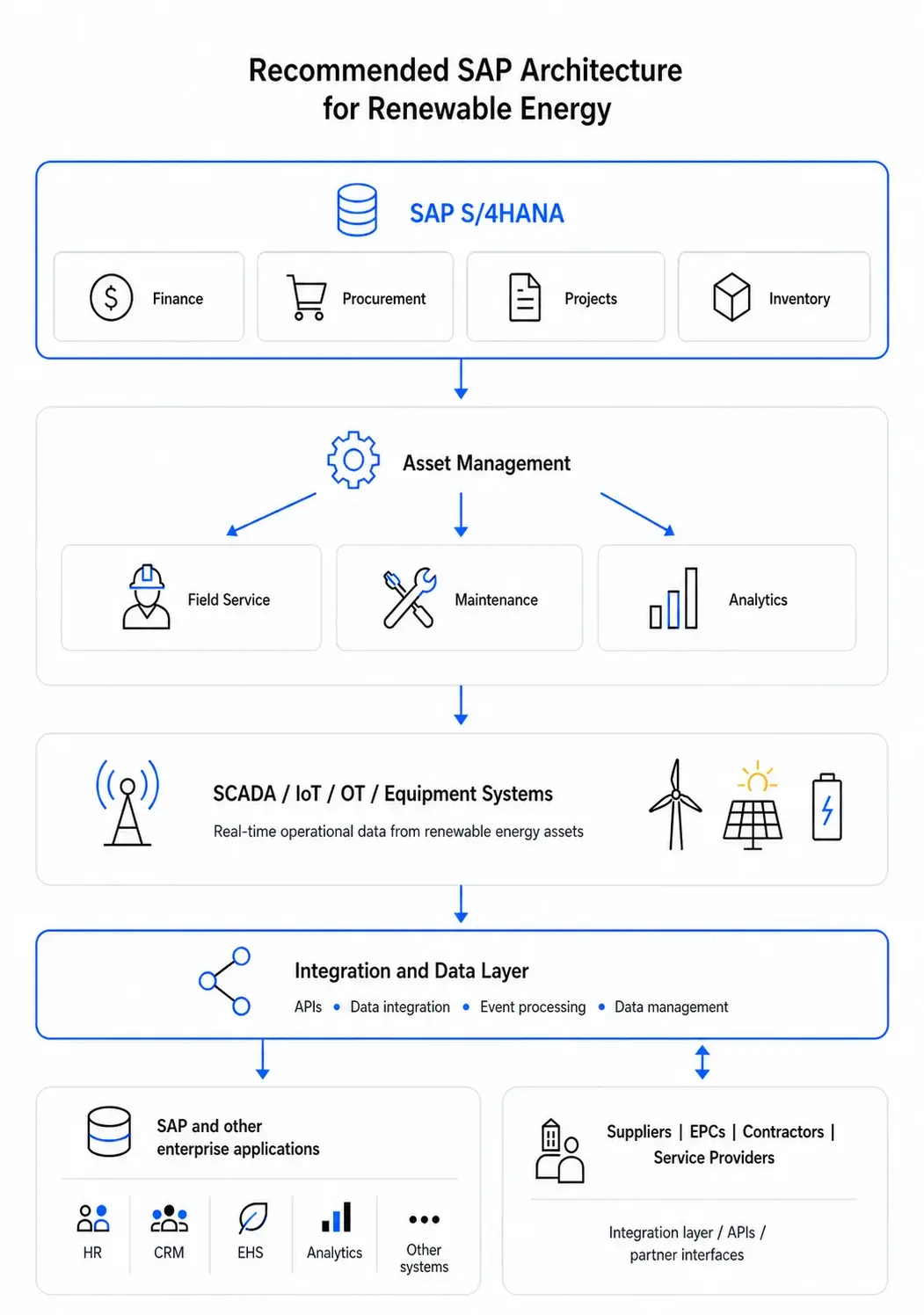
The integration layer should carry the data required by each process rather than replicate every available operational signal into SAP. API-based and event-driven integration can help separate systems while still allowing relevant business events and data to move between them.
What should a renewable energy SAP architecture include?
There is no single SAP architecture that fits every renewable energy company. An owner-operator with a large distributed portfolio may need a different landscape from an EPC, developer, or smaller asset owner. Existing SCADA platforms, field-service tools, data platforms, warehouse operations, and acquired systems also affect the design.
A practical reference model can use these layers:
- Enterprise core: SAP S/4HANA for finance, procurement, projects, inventory, and related business processes.
- Asset and service layer: asset management, maintenance, field service, and supporting operational processes.
- Integration and data layer: SAP BTP capabilities, including SAP Integration Suite, APIs, events, and data services where required.
- Operational layer: SCADA, IoT, equipment systems, and other specialized OT applications.
- External ecosystem: suppliers, EPCs, contractors, service providers, and other business partners.
The architecture must also specify which system owns which data object, which system performs each process, and which events or data cross system boundaries. Those decisions matter more than another application on the landscape. The design that emerges should be specific to the company’s asset base, operating model, existing technology, integration requirements, and data governance maturity.
Sustainability and Renewable Energy Data
Renewable energy generation data serves a different purpose from corporate sustainability reporting. Production, availability, and downtime describe asset operations. Sustainability reporting can require data on emissions, materials, suppliers, equipment lifecycle, and project activities.
What sustainability data matters to renewable energy companies?
A renewable energy company can generate environmental impacts through equipment manufacturing, transportation, construction, maintenance, replacement, and end-of-life processing.
Relevant data can include:
- Equipment and material information
- Project and operational activities
- Supplier and purchased-goods data
- Energy consumption and emissions
- Maintenance, replacement, and end-of-life records.
The required calculations depend on reporting boundaries, methodologies, emission factors, and the applicable reporting framework. Operational records provide source data for these calculations; they do not automatically produce a corporate carbon footprint.
Where does SAP fit?
SAP sustainability capabilities can link sustainability metrics to financial, procurement, material, supplier, and operational data. SAP Sustainability Footprint Management can be used for corporate and product carbon-footprint calculations. SAP Sustainability Control Tower can be used for sustainability data management and reporting.
The quality of the data underlying the results directly matters. Missing supplier information, inconsistent material classifications, incomplete activity data or unsuitable emission factors can cause distortions in calculations. Companies also need clear boundaries for reporting and consistent calculation methods.
KPIs for Renewable Energy Operations
Renewable energy companies track performance across assets, maintenance, field service, supply chain, projects, and finance. Combining these measures gives managers a broader view of site and portfolio performance.
Which KPIs matter for renewable energy operations?
|
Area |
KPI |
What it measures |
|
Assets |
Availability |
Time an asset remains available for operation |
|
Operations |
Downtime |
Time an asset or site cannot operate as intended |
|
Maintenance |
MTTR |
Average time to restore an asset after failure |
|
Maintenance |
Preventive maintenance compliance |
Scheduled preventive work completed within the required period |
|
Inventory |
Critical-spares availability |
Availability of designated critical parts when needed |
|
Procurement |
Supplier on-time delivery |
Deliveries received by the agreed date |
|
Projects |
Project cost variance |
Difference between planned and actual cost |
|
Projects |
Schedule variance |
Difference between planned and actual timing |
|
Finance |
Asset lifecycle cost |
Costs associated with an asset over its defined lifecycle |
|
Portfolio |
Site performance |
Operating or production performance against the selected baseline |
|
Field Service |
Work-order completion time |
Time from work-order release or assignment to completion |
How can SAP support these KPIs?
The underlying data can come from different processes and systems. Maintenance metrics use work orders and confirmations, procurement metrics use purchasing and receipt records, and financial measures use project and asset accounting data. Operational metrics may require data from SCADA or other connected systems.
SAP can combine these records for cross-functional analysis. Each KPI still needs a defined calculation method. For example, availability depends on how planned maintenance and other excluded periods enter the calculation.
Common Challenges and the Transformation Roadmap
SAP projects in renewable energy can become difficult when the technology has to accommodate inconsistent asset structures, multiple operating systems, and processes that vary between sites. A clear transformation approach starts with these operational differences rather than with a predefined SAP configuration.
What tends to complicate SAP for renewable energy companies?
The most common issues appear where data or processes cross organizational and system boundaries:
- Fragmented asset data: sites use different equipment structures, identifiers, and maintenance records.
- SCADA and ERP disconnect: operational events remain separate from maintenance and business processes.
- Spare-parts gaps: planners lack consistent visibility into critical components across warehouses and sites.
- Project-to-asset gaps: construction and procurement data require manual work before entering the operational asset structure.
- Acquisition complexity: acquired portfolios bring different ERPs, maintenance systems, suppliers, and data models.
- Manual field service: technicians work with disconnected scheduling, asset, inventory, or work-order information.
- Fragile integrations: interfaces between SAP, OT, and third-party systems become difficult to maintain.
- Excessive customization: site-specific changes increase upgrade effort and make standardization harder.
What should the transformation roadmap cover?
A practical roadmap can move from landscape assessment to controlled rollout:
- Assess: map the portfolio, assets, projects, maintenance, field operations, supply chain, finance, and integrations.
- Standardize: define common asset structures, master data, maintenance practices, and procurement processes.
- Integrate: connect SAP with SCADA, IoT, field service, suppliers, and other required systems.
- Implement: deploy SAP capabilities according to business priorities and the target architecture.
- Validate: test asset, maintenance, procurement, field-service, and financial processes across representative sites.
- Roll out: extend the model to additional sites and acquired portfolios.
- Optimize: use operational and financial data to refine maintenance, inventory, and asset-management decisions.
For US renewable energy companies, rollout scope can vary significantly by portfolio structure, acquisition history, existing ERP landscape, and the degree of process standardization already in place.
A Practical Approach to SAP for Renewable Energy
A renewable energy SAP landscape should mirror the asset lifecycle, from project development and procurement through commissioning, operations, maintenance, and eventual retirement. Enterprise processes should be connected to asset, field-service, supply-chain, and operational data. Specialized energy systems continue to be responsible for their technical functions.
How LeverX can help
Relevant capabilities can be SAP S/4HANA, SAP Asset Management, SAP Asset Performance Management, SAP Field Service Management, SAP EWM, SAP BTP, integration services, supply-chain planning, data-management capabilities, depending on the operating model. The right mix depends on the company's assets, processes, existing systems and integration requirements.
LeverX can support this work from architecture assessment and process analysis through SAP implementation, integration, data migration, and rollout. Its US SAP consulting practice covers S/4HANA strategy, Clean Core architecture, integration, data, and supply-chain transformation.
A focused assessment can help determine which processes require redesign, where SAP should become the system of record, which specialized systems should remain in place, and how the target architecture should support future site additions or acquisitions.
Contact LeverX to schedule an assessment and discuss how we can align your SAP landscape with your business goals.
FAQ
What does SAP mean for renewable energy companies?
SAP’s enterprise applications connect financial, project, procurement, asset, maintenance, supply chain and field-service processes. The actual SAP landscape is dictated by the company’s assets, operating model and existing systems.
How does SAP support predictive maintenance?
SAP Asset Performance Management can combine asset data, maintenance history, and IoT data to assess asset health and identify potential failures. It can also generate maintenance recommendations or backlogs that connect with maintenance execution in SAP.
Can SAP support battery energy storage operations?
Yes. SAP can manage the enterprise processes around battery storage assets, including projects, procurement, inventory, maintenance, financial records, and asset history. Battery-management and protection systems remain responsible for technical monitoring and control.
How can SAP support renewable energy M&A?
SAP can offer a common set of tools for the integration of acquired portfolios, including asset and master-data governance, uniform maintenance processes, financial structures, and consolidated reporting. The scope of migration depends on the target operating model, acquired systems and data quality.
Which SAP solutions are relevant for solar and wind companies?
Depending on the operating model, relevant capabilities can include SAP S/4HANA, SAP Asset Management, SAP Asset Performance Management, SAP Field Service Management, SAP EWM, SAP BTP, integration services, supply-chain planning, and data management. The required combination varies by portfolio size, asset type, and existing technology landscape.