Food and beverage manufacturers operate with constraints that a standard ERP model does not always capture well. Ingredients expire, recipes change, and actual yields differ from planned quantities. Materials may require inspection before production can use them, while finished products often have a limited window for storage, distribution, and sale.
Traceability connects these challenges. One supplier lot may feed several production batches, which can then become multiple finished products shipped to different customers or distribution centers. When a quality problem appears, teams need to reconstruct those relationships quickly enough to understand what is affected and what can continue moving through the supply chain.
For U.S. manufacturers, the operating environment adds another layer. Companies may run plants and distribution centers across several states, import ingredients, serve retailers with strict delivery requirements, and work under different federal food-safety frameworks depending on the product. A well-designed SAP foundation can help connect these processes across the enterprise, while SAP S/4HANA consulting can support decisions around architecture, process design, implementation, and modernization.
An integrated SAP environment can connect this end-to-end process:
Supplier → Ingredients → Formulation → Production → Quality → Batch Traceability → Warehouse → Distribution → Customer
The objective is to give every function reliable information about the same process. With the right architecture, manufacturers can plan production, control quality, trace materials, manage usable inventory, and serve customers without relying on repeated manual reconciliation between systems and teams.
Why Food and Beverage Manufacturing Requires a Specialized ERP Approach
Food and beverage production differs from many discrete manufacturing environments because companies manage formulas, batches, shelf life, and variable outputs rather than only fixed assemblies.
A recipe may define target quantities, but actual yield can change from one production run to another. The same process may produce a primary product, co-products, by-products, and waste. Finished goods can also appear in several package sizes or configurations while sharing the same underlying formula.
Shelf life creates another constraint. Two batches of the same product may have different expiration dates, quality statuses, or remaining shelf lives. Operationally, they are not always interchangeable even when the material number is identical.
That difference connects functions that companies often manage separately. Procurement needs visibility into upcoming ingredient requirements. Production needs approved materials. Quality decisions determine whether inventory can be consumed. Warehouse teams depend on accurate batch and expiration data. Distribution teams need to know whether the selected products will still meet customer requirements upon arrival.
When each function relies on a different application, spreadsheet, or local process, teams spend more time reconciling information before they can act. A connected SAP environment can reduce that effort by carrying consistent data and decisions across the manufacturing lifecycle.
What SAP Solutions Are Relevant to U.S. Food and Beverage Manufacturers?
SAP S/4HANA can provide the ERP core for procurement, process manufacturing, batch management, quality, inventory, costing, sales, and finance. Other SAP solutions can extend that foundation when the operating model requires more advanced product development, planning, shop-floor execution, warehousing, transportation, supplier collaboration, integration, or analytics.
|
SAP capability |
Business role |
|
SAP S/4HANA |
Connect procurement, process manufacturing, batch management, quality, inventory, costing, sales, and finance |
|
SAP Integrated Product Development |
Manage product development, specifications, recipes, formulation, and controlled product changes |
|
SAP Digital Manufacturing |
Support manufacturing operations management, shop-floor execution, production data, and visibility |
|
SAP Extended Warehouse Management (SAP EWM) |
Support advanced warehouse execution and batch- and shelf-life-aware warehouse processes |
|
SAP Transportation Management (SAP TM) |
Plan and execute transportation and manage freight processes |
|
SAP Integrated Business Planning (SAP IBP) |
Coordinate demand, supply, inventory, and scenario planning |
|
SAP Ariba and SAP Business Network |
Support sourcing, procurement, and supplier collaboration |
|
SAP Business Technology Platform (SAP BTP) |
Integrate systems, extend applications, and automate processes |
|
SAP Business Data Cloud |
Bring enterprise data together for analytics and planning |
The required landscape depends on how the company operates. A single-plant processor with relatively straightforward warehousing may need far fewer components than a manufacturer running several plants, automated distribution centers, an MES, and a national transportation network.
Deployment decisions matter as well. Warehouse architecture and licensing depend on the selected SAP S/4HANA edition and required capabilities. SAP TM deployment and licensing similarly depend on the target landscape and business scope.
SAP for Food and Beverage Production Planning
Day-to-day production planning translates near-term demand into a manufacturing plan that the plant can execute.
A typical sequence looks like this:
Demand → Ingredient Requirements → Available Capacity → Production Schedule → Batch Execution
Before deciding what should run tomorrow, planners need to know whether the required ingredients and packaging are available, which lines can manufacture the product, and whether sufficient capacity exists. Depending on the operation, they may also need to consider minimum or economical batch sizes, sanitation and allergen-related changeovers, quality restrictions, and the risk of creating excessive short-dated inventory.
This is where operational planning differs from forecasting. A production schedule becomes useful only when it reflects current materials, capacity, inventory, open orders, and restrictions.
SAP S/4HANA can connect these requirements with procurement, inventory, and production execution. As a result, planners can work with the same operational information used by purchasing, production, and inventory teams, rather than rebuilding the picture manually before releasing a plan.
Planning across several plants, suppliers, and distribution centers operates on a broader horizon. That network-level perspective is addressed later through SAP IBP.
Recipe, Formula, and Product Management
A formula-driven product requires more than a conventional bill of materials. Manufacturers may need to control ingredients, quantities, specifications, target yields, processing instructions, and approved versions as parts of the same manufacturing definition.
The practical problem appears when that definition changes. If production still works from an outdated spreadsheet or local document, the plant may manufacture the wrong version even though an approved formula already exists elsewhere.
The intended flow is:
Formula → Approved Product Definition → Manufacturing Data → Quality Requirements → Production
A change to an ingredient quantity, supplier specification, or processing parameter can affect production, quality, costing, and downstream product information. Formula management, therefore, requires controlled versioning and change processes rather than simply serving as a repository for recipes.
Formulation capabilities within SAP Integrated Product Development can support manufacturers that need detailed control over ingredients, recipes, formulas, specifications, and product versions.
This stage establishes the definition of manufacturing itself. The broader R&D lifecycle and the packaging structures built around that definition are addressed separately below.
Batch Management and Lot Traceability
Effective traceability should help a manufacturer answer two questions quickly:
Where did this material come from?
Where did it go?
A typical genealogy looks like this:
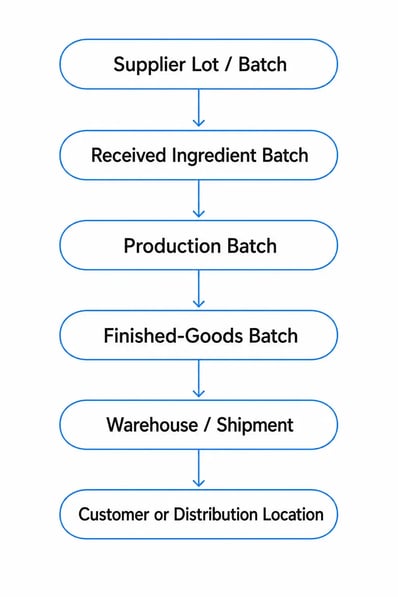
Batch records can connect supplier references, production dates, expiration dates, characteristics, quality status, and inventory status.
Consider a supplier that reports a problem with one ingredient lot. The manufacturer may need to identify every production batch that consumed it, the finished products created from those batches, and the customers or distribution centers that received them.
The same logic works in reverse. If a finished-product test fails, investigators may need to trace the batch back through production conditions, inspection records, ingredients, and suppliers. Reliable genealogy, therefore, supports more than recall readiness. It can shorten investigations and give quality, operations, logistics, and customer-service teams a shared record of what happened to the material.
Shelf Life and Expiration Management
Food and beverage inventory cannot always be treated as interchangeable units of the same material. Two batches may have different expiration dates, quality statuses, or remaining shelf lives. One may be suitable for a nearby customer, while another does not meet the minimum remaining shelf-life requirement for a longer distribution route.
A typical fulfillment flow is:
Production → Quality Release → Shelf-Life Check → FEFO-Oriented Picking → Shipment
FEFO means “First Expiry First Out.” The approach prioritizes inventory by the earliest applicable expiration date rather than by the order in which stock is received.
Shelf-life data can influence production planning, allocation, order fulfillment, warehouse selection, returns, and disposal. The issue is therefore broader than knowing how many units are on hand. Teams need to understand how much stock remains commercially and operationally usable for a specific order, customer, or location.
SAP Quality Management for Food and Beverage
Quality information becomes operationally useful when a quality decision immediately changes what other teams are allowed to do. An incoming ingredient, for example, may move through this process:
Ingredient Received → Inspection → Approved or Restricted → Production Use
SAP Quality Management capabilities can support incoming, in-process, and final inspections, along with results recording, defect management, quality notifications, and usage decisions.
The important connection is material status. If an ingredient fails inspection or a finished batch is placed on hold, production and warehouse teams need to see that restriction in the processes where the material would otherwise be consumed or shipped.
Quality information can also contribute to supplier-performance analysis. Repeated inspection failures or nonconformances are more useful when teams can connect them to the supplier, affected material, and production impact, rather than evaluating each quality record separately.
Food Safety, Compliance, and Recall Management
For U.S. manufacturers, food-safety requirements depend on the product, facility, and activity involved. For FDA-regulated facilities, the FSMA Preventive Controls for Human Food rule generally requires covered facilities to maintain and implement a written food-safety plan that includes a hazard analysis and risk-based preventive controls, subject to the applicable provisions and exemptions.
The regulatory framework differs for products under USDA FSIS jurisdiction, including covered meat and poultry products, processed egg products, and fish of the order Siluriformes, including catfish. USDA's Food Safety and Inspection Service regulates these categories, while the FDA regulates most other foods, including some meat and poultry products that fall outside FSIS jurisdiction.
Alcoholic beverage manufacturers may also be subject to Alcohol and Tobacco Tax and Trade Bureau requirements in areas such as producer qualification, formulation, labeling, and label approval, depending on the beverage and production process.
Traceability can also have a specific regulatory dimension. The FSMA Food Traceability Rule establishes additional recordkeeping requirements for foods on the Food Traceability List and organizes required information around Critical Tracking Events, Key Data Elements, and traceability lot codes.
The original compliance date was Jan. 20, 2026. The FDA has proposed extending it to July 20, 2028, while Congress has separately directed that appropriated funds not be used to administer or enforce the rule before July 20, 2028. Manufacturers should continue to monitor FDA rulemaking because the proposed compliance-date extension and the restrictions on administration and enforcement are separate actions.
SAP can support the controlled data, quality records, genealogy, inventory information, and delivery records that teams use when investigating an issue or preparing recall information. The system does not determine which regulations apply or make an organization compliant automatically.
SAP for Ingredient Procurement and Supplier Management
Production reliability starts before materials reach the plant. Available line capacity has little value if a critical ingredient arrives late, fails inspection, or does not meet the required specification. A connected procurement process can follow:
Supplier → Purchase Order → Receipt → Supplier Batch → Inspection → Approved Inventory
SAP S/4HANA can manage core procurement processes, while SAP Ariba and SAP Business Network can extend sourcing and supplier collaboration where required. For companies importing ingredients into the United States, supplier management may also support obligations under the FDA's Foreign Supplier Verification Programs rule. Covered importers must perform risk-based activities to verify that foreign suppliers produce food in accordance with applicable U.S. safety requirements.
SAP does not perform that assessment on the importer's behalf. It can, however, help organize supplier, ingredient, approval, inspection, and supporting record data within the company's verification process.
SAP for Inventory Management in Food and Beverage
Inventory management provides an enterprise-wide view of what the company owns, where that inventory is located, how it is valued, and whether operations can actually use it.
For food and beverage manufacturers, the distinction between inventory categories matters. Raw ingredients, packaging materials, work-in-process, finished goods, co-products, by-products, quarantined batches, and blocked stock can all contribute to the total inventory figure, but they do not have the same operational value.
The difference becomes especially important across multiple plants. A critical ingredient may be unavailable at one site while excess stock exists elsewhere. Conversely, enterprise totals may suggest sufficient inventory even though much of it is blocked, reserved, expired, or unsuitable for the planned production run.
Enterprise inventory visibility can help teams detect stock-outs earlier, avoid unnecessary purchases, identify spoilage and obsolete inventory, and make better working-capital decisions. Shelf-life logic determines whether a particular batch remains usable. SAP EWM addresses more advanced physical warehouse execution. Inventory management connects these processes through the broader view of quantity, status, location, and value.
SAP EWM for Food and Beverage Warehouses
Advanced warehouse management becomes more important as batch restrictions, expiration dates, automation, and transaction volumes make basic warehouse processes harder to control.
SAP Extended Warehouse Management (SAP EWM) can support advanced inbound and outbound execution, warehouse tasks, handling units, staging, and inventory status. In food and beverage operations, these activities often need to work directly with batch and shelf-life information.
The exact warehouse architecture depends on the SAP S/4HANA edition. SAP Cloud ERP provides Warehouse Management within the system and can integrate with a separate SAP EWM system when additional capabilities are required. SAP Cloud ERP Private and on-premises landscapes can use embedded EWM or decentralized EWM based on SAP S/4HANA.
This distinction matters in facilities that handle chilled, frozen, and ambient products simultaneously or run high-volume distribution operations. Warehouse teams need to move inventory quickly while still controlling which batches are eligible for each order.
Seasonal peaks make that coordination harder. Ahead of periods such as Thanksgiving or July Fourth, a distribution center may need to process sharp increases in inbound receipts, picking, staging, and outbound shipments within the same operating window. SAP EWM can use waves, warehouse orders, queues, resource management, and labor planning capabilities to organize and prioritize the workload.
These capabilities do not create additional physical capacity. They can, however, help managers understand expected workload, structure work packages, and use available people and equipment more effectively during peak periods.
Cross-docking can reduce unnecessary warehouse movements when incoming products are already needed to meet outbound demand. Depending on the configured process, SAP EWM can support planned or opportunistic cross-docking, so that eligible goods move from receiving to goods issue without following a conventional putaway-and-later-picking cycle.
For high-velocity or time-sensitive products, the result can be less warehouse dwell time and handling when inbound and outbound flows are sufficiently synchronized. SAP EWM can also support shelf-life-sensitive stock-removal strategies, including FEFO-oriented processes where appropriate.

SAP TM for Food and Beverage Distribution
Food and beverage distribution often involves frequent shipments, narrow delivery windows, and products whose commercial value declines as their shelf life shortens. SAP Transportation Management (SAP TM) can support transportation planning, carrier processes, routes, shipment execution, and freight-related activities.
The process connects directly with warehouse execution:
Customer Order → Warehouse → Loading → Transportation → Customer
For U.S. manufacturers, geography can materially change the fulfillment decision. The same product may arrive with a very different remaining shelf life depending on which plant or distribution center ships the order.
Weather events and regional transportation disruptions add another variable. Transportation planning, therefore, needs to reflect what inventory is actually available, where it is located, and whether it can reach the customer within the required service and shelf-life window.
SAP IBP for Food and Beverage Supply Chains
Operational production planning answers questions such as what should run tomorrow. Supply chain planning works at a broader level: how should the network respond over the coming weeks and months?
SAP Integrated Business Planning can support demand planning, supply planning, inventory planning, and scenario analysis across plants, suppliers, and distribution locations.
Consider a beverage producer preparing for peak summer demand. A higher forecast does not automatically mean every plant should increase production. Planners need to determine whether ingredient supply, packaging availability, plant capacity, and inventory positioning can support that demand across the network.
Scenario planning becomes especially useful when conditions change. If a hurricane delays imported ingredients or constrains a regional distribution center, teams can compare alternative sourcing, production, and inventory scenarios before revising the operating plan.
The value here comes from network-level coordination rather than individual production-order scheduling.
SAP and Product Lifecycle Management
Product lifecycle management connects innovation with the controlled information operations eventually needed to manufacture a product at scale. The process can move from:
New Product → Specification → Formula → Approval → Manufacturing Handoff
SAP Product Lifecycle Management can support the broader lifecycle, while SAP Integrated Product Development can support collaboration around product definitions, requirements, changes, and approvals, and includes capabilities for Specification Management and Formulation.
For food and beverage manufacturers, the controlled handoff matters because R&D may create and test several iterations before a product is ready for production. The plant needs the approved version together with the correct specifications and quality requirements.
The same discipline applies after launch. When a formula or specification changes, teams need to know when the revised version becomes effective and which production runs should use it.
SAP for Packaging and Label Management
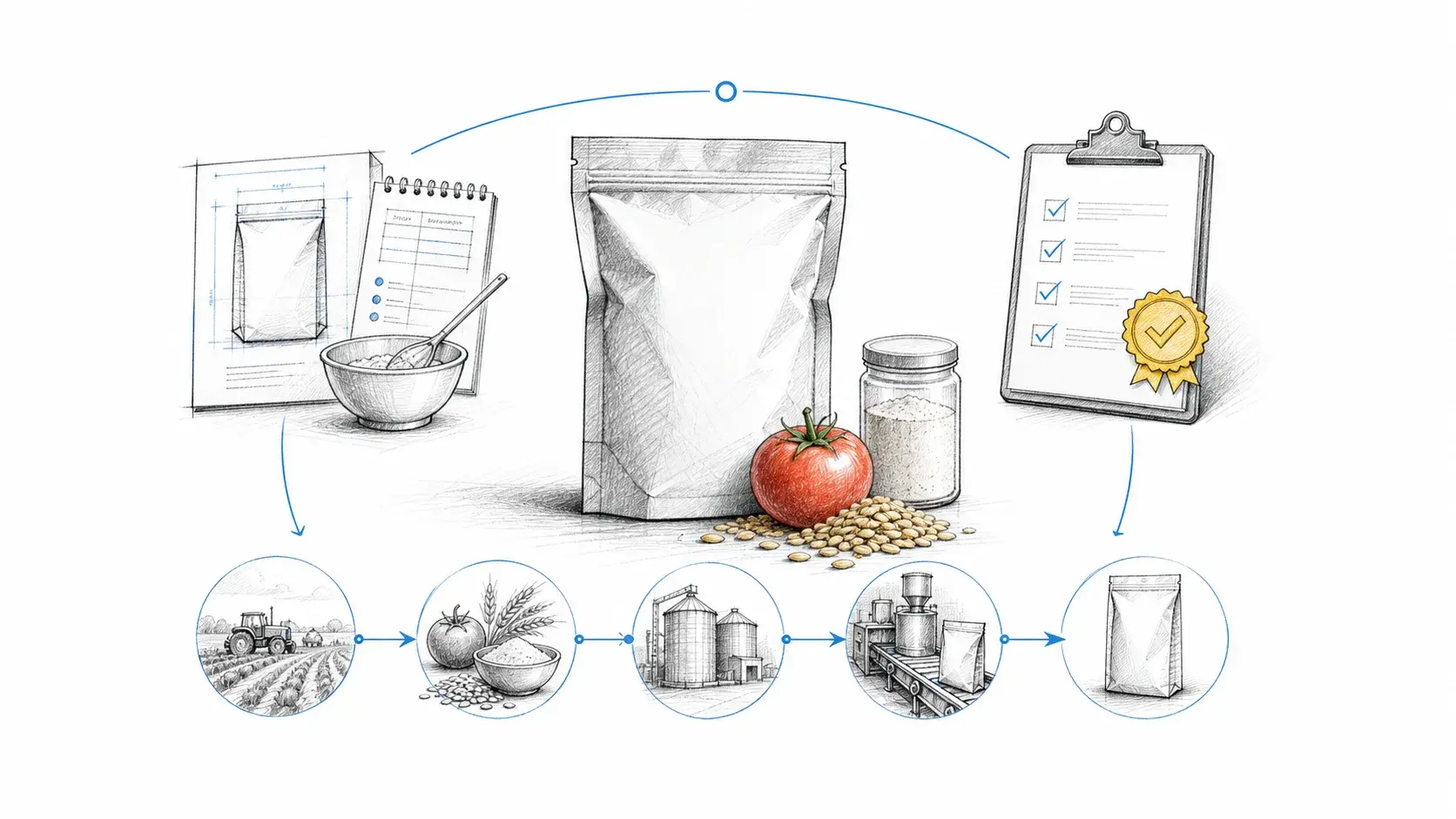
One formula can lead to many sellable products. A beverage, for example, may be filled into bottles, cans, or kegs. Those units can then be grouped into cartons, cases, multipacks, and pallets. Each packaging level introduces material requirements and can affect production, warehouse handling, transportation, and product identification. Packaging data, therefore, needs to stay aligned with the product version being manufactured.
Labels introduce another dependency. Product identifiers, batch information, expiration data, ingredient information, and applicable regulatory declarations may need to correspond to the correct formula and packaging version.
Changes in allergens make this connection especially important. For FDA-regulated packaged foods, a change involving one of the nine major food allergens, including sesame, may affect label declarations. A controlled change process may therefore need to account for existing label and packaging inventory, open production orders, work in process, finished inventory, affected SKUs, and effective dates.
SAP can support the underlying product data and change processes. Determining the required label content remains the manufacturer's regulatory responsibility.
SAP for Co-Products, By-Products, and Yield Variability
Process manufacturing does not always convert one input into one predictable output. A dairy process, for example, may produce cheese as the primary product, whey as a co-product or by-product, and additional material losses or waste.
A simplified flow is:
Production Batch → Primary Product + Co-Product + By-Product + Waste
Actual yield can also vary from one batch to another, even when planned input quantities remain similar. SAP process-manufacturing capabilities can represent multiple outputs and record actual material consumption, so inventory reflects what the operation physically produced rather than only what the standard recipe predicted.
That accuracy matters operationally first. Production teams need a reliable record of what was consumed and what was produced. The financial impact of those differences appears next in product cost and margin analysis.
SAP for Cost Management in Food and Beverage
Yield variability becomes a financial issue when it changes the cost of each unit produced. Ingredient and commodity prices create another source of volatility. A product may use the same recipe as last month and still generate a different margin because raw material prices, actual consumption, or production yield have changed.
The relationship can be viewed as:
Ingredient Cost → Production Cost → Finished-Product Cost → Margin
Connecting procurement, manufacturing, and finance can help teams compare standard and actual costs and analyze purchase-price variance, production variance, and yield variance. Instead of seeing only that the margin declined, teams can investigate the mechanism behind the change. The cause may be a supplier price increase, excess material consumption, lower yield, or another production factor.
This visibility becomes particularly important for high-volume products, where even relatively small changes in ingredient cost or yield can have a material financial impact when multiplied across large production volumes.
SAP Integration Architecture for Food and Beverage
Food and beverage manufacturers rarely operate SAP in isolation. Plants may already use MES applications, laboratory systems, labeling platforms, warehouse automation, carrier systems, supplier platforms, and production equipment. The architectural challenge is to connect those systems without creating an expanding network of point-to-point interfaces that becomes progressively harder to maintain.
SAP Digital Manufacturing can support manufacturing operations management, shop-floor execution, and production visibility. A third-party MES can also remain in place as long as it continues to meet plant requirements.
The important design decision is system ownership. The architecture should define which application plans production, which executes it, where machine or laboratory data originates, and where production confirmations are recorded in the enterprise record.
SAP Business Technology Platform (SAP BTP) can provide the platform foundation for integrations, extensions, and automation. Within that environment, SAP integration services can use SAP Integration Suite, APIs, and events to connect SAP with plant and enterprise systems.
SAP Integration Suite is a service within SAP BTP, not an alternative platform. Keeping that distinction clear helps teams define the architecture at the right level and assign responsibilities to the appropriate services.
Data Management for Food and Beverage
Integration cannot compensate for inconsistent data. Critical food and beverage data may include ingredients, materials, formulas, batches, suppliers, customers, packaging definitions, storage locations, shelf-life rules, and quality characteristics.
Multi-plant organizations often see the problem clearly. Two facilities may use different codes or descriptions for the same ingredient. Connecting those plants technically does not resolve the mismatch. Instead, integration can spread inconsistent definitions into more downstream processes.
Data governance, therefore, requires explicit ownership. Teams need to establish who creates, approves, changes, and retires critical master data objects, and which definitions should be standardized across the enterprise.
SAP data migration should include cleansing, mapping, validation, and reconciliation alongside the technical transfer of records. Historical data also needs an explicit strategy. Not every legacy record has to move into the new environment, but required traceability information and relevant business history still need to remain accessible.
SAP for Multi-Plant U.S. Food and Beverage Manufacturers
For multi-plant manufacturers, SAP transformation becomes a rollout and operating-model challenge as much as a technology project. A company may acquire facilities running different legacy ERPs, manufacturing applications, material-numbering systems, and local processes. Moving those sites toward a common SAP environment requires more than installing the same software at each location.
A corporate template can standardize finance, procurement, master data, quality, and traceability while still allowing plant-specific configuration where production technology or legitimate local requirements differ. The model can be represented as:
Corporate SAP Template → Plant 1 | Plant 2 | Plant 3
Sequencing matters as much as standardization. One plant may establish the first version of the template, while later sites reuse and refine it. During the transition, temporary integrations may also be necessary while legacy and SAP environments coexist.
Legacy identifier crosswalks, historical genealogy, cutover transactions, and local-system retirement should therefore be part of the rollout design rather than problems left until after go-live.
SAP and Supply Chain Resilience for Food and Beverage
Supply chain resilience matters when the original operating plan is no longer possible. Food and beverage manufacturers may face ingredient shortages, supplier failures, weather events, transportation disruptions, seasonal volatility, and commodity-price changes. When one of these events occurs, the practical question is how quickly teams can understand the available alternatives and their consequences.
If a supplier cannot deliver a critical ingredient, procurement can identify alternatives, planning can evaluate available supply, and production can determine which plants can still manufacture the product.
Consider a hypothetical U.S. citrus producer during hurricane season. A hurricane affecting Florida could interrupt harvesting, warehouse operations, or highway access just as citrus shipments are scheduled for a beverage plant in another state.
Looking at each disruption separately would provide only part of the picture. Planners would need to identify which Florida inventory and supplier shipments remain available, compare alternative supply scenarios, assess capacity at another production location, and revise transportation plans to accommodate the usable supply.
The response might involve redirecting available citrus to a plant in Georgia, shifting part of the production schedule between facilities, and reallocating finished-goods inventory to protect deliveries in affected markets.
Moving production between plants, however, requires more than spare line capacity. The alternative facility also needs the correct ingredients, packaging, approved product data, warehouse capacity, labor, and access to the required distribution network.
This is why resilience depends on connected information across sourcing, inventory, production, and transportation. An integrated environment gives teams the context they need before making changes to sourcing, production, inventory, or distribution plans.
Common SAP Challenges in Food and Beverage Manufacturing
Even when SAP supports the required process, manufacturers may still struggle with traceability, quality, planning, or inventory control if the underlying data and operating model are inconsistent. In practice, these issues are rarely solved through configuration alone. They usually require clearer process ownership, stronger data governance, better integration, and end-to-end testing.
Poor batch traceability
Batch traceability weakens when genealogy breaks somewhere between suppliers, production, warehouses, and shipments. Once that happens, investigating a quality issue takes longer because teams cannot immediately determine which materials, batches, or customers may be affected.
Manufacturers can reduce this risk by defining mandatory batch-capture points at goods receipt, production, warehouse movements, and shipment. Systems that generate relevant genealogy data should also be integrated into the traceability process. End-to-end testing should then verify both forward and backward tracing before the process goes live.
Inconsistent product and master data
A multi-plant SAP environment depends on consistent definitions of materials, formulas, packaging, and other critical master data. If plants maintain different versions of the same objects, integration can spread those differences across the landscape rather than correct them.
A governance model should therefore define who owns each critical object, how changes are approved, and which standards apply across sites. Cleansing and harmonizing the data before migration or a multi-plant rollout reduces downstream reconciliation and makes common processes easier to maintain.
Manual quality processes
A quality decision has limited value if the teams handling the material cannot see it. When inspection results or batch restrictions remain in spreadsheets, emails, or separate systems, production and warehouse users may continue processing inventory that should already be blocked.
Connecting inspection results and usage decisions to material and batch status makes those restrictions visible directly in downstream production, inventory, and warehouse processes. This reduces dependence on manual notification and helps ensure that quality decisions affect execution as soon as they are recorded.
Weak shelf-life management
Shelf life affects more than inventory storage. It can influence production sequencing, warehouse allocation, customer fulfillment, and ultimately product waste. Companies can define shelf-life rules, minimum remaining shelf-life requirements, and FEFO-oriented warehouse strategies so that the system considers product age in inventory decisions. Monitoring stock that is approaching expiration also gives planners and warehouse teams time to reallocate or consume inventory before it becomes unusable.
Fragmented planning
Procurement, production, inventory, and demand decisions are closely connected, but separate planning processes can obscure those dependencies. A supplier delay, for example, may affect production capacity, inventory availability, and customer commitments at the same time.
A common planning model can connect demand and supply assumptions with current inventory, supplier availability, and production capacity. Planners can then evaluate the network-wide consequences of a constraint instead of optimizing one function while creating problems elsewhere.
Legacy ERP fragmentation
Fragmentation often becomes most visible after acquisitions or multi-site expansion. Plants may follow similar business processes while relying on different ERP systems, identifiers, data structures, and local applications.
A phased SAP rollout can establish a common corporate template without requiring every site to migrate at once. During the transition, temporary integrations and identifier crosswalks can keep legacy and migrated plants connected. Historical genealogy and other required records should also remain accessible so traceability and operational continuity are not lost during migration.
Excessive customization
Legacy ERP environments often contain custom logic created to solve requirements that have since changed or disappeared. Moving all that logic into a new SAP environment can reproduce historical complexity rather than simplify operations.
Fit-to-standard analysis should therefore challenge inherited customizations before they are carried forward. Custom logic should remain only where it supports a valid business requirement that standard functionality cannot address appropriately. When extensions are necessary, a governed architecture can help preserve that flexibility while limiting unnecessary changes to the ERP core.
These challenges point to the same broader issue: an SAP implementation cannot compensate for unclear ownership, inconsistent data, or disconnected processes on its own. The target operating model should define reliable data, clear system and integration boundaries, accountable process owners, and end-to-end testing from the start. That is what allows the SAP landscape to resolve existing gaps instead of simply reproducing them in a newer system.
Recommended SAP Architecture for Food and Beverage
A target landscape should connect the ERP core with specialized capabilities without assuming that every manufacturer needs the same combination of products.
A representative logical architecture is:
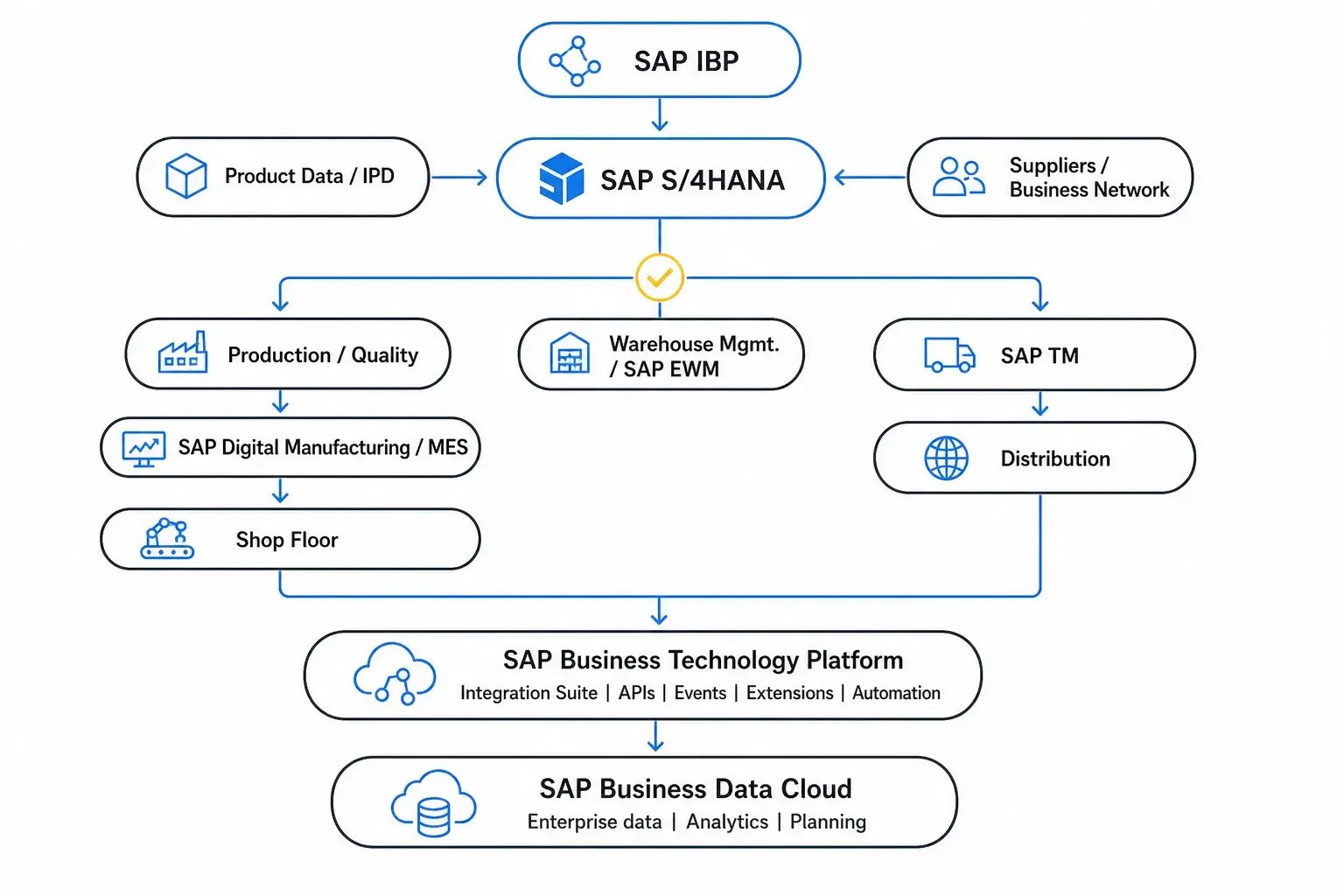
The diagram is conceptual. Warehouse Management / SAP EWM deployment depends on the selected SAP S/4HANA edition, while the exact combination of components should reflect business requirements, existing systems, operational complexity, and licensing.
SAP Business Data Cloud can complement this landscape by bringing enterprise data together for analytics and planning. The architecture should ultimately support one connected operating model. Each product has a specific role, but the business impact depends on how information and decisions move between them.
How To Build an SAP Roadmap for U.S. Food and Beverage Manufacturers
A practical SAP implementation roadmap should begin with the business problems the company needs to solve and the dependencies between them.
Phase 1 — assess
Map plants, production models, quality processes, warehouses, procurement, planning, data, and integrations. Identify where manual work, inconsistent information, or disconnected systems create the greatest operational or business risk.
At the same stage, determine which regulatory frameworks apply to the relevant products and facilities, including FDA, USDA FSIS, FSVP, Food Traceability Rule, and TTB requirements where applicable.
Phase 2 — define the target operating model
Decide which processes and data definitions should become common across the organization and where plant-specific differences need to remain. This phase should also establish ownership for critical systems, processes, and data. Without that ownership, technical integration alone will not produce a consistent operating model.
Phase 3 — prioritize
Focus first on areas where better data, process control, or integration can remove an important business constraint. Depending on the organization, that may mean traceability, production, quality, inventory, planning, or another process that currently causes significant operational friction.
Phase 4 — build
Configure the selected SAP capabilities, prepare and validate data, and implement the required integrations to complete end-to-end processes. The objective is to create operating flows that span functions rather than deploy individual capabilities that still rely on manual handoffs.
Phase 5 — test end-to-end
Test realistic operating scenarios rather than isolated system functions. Relevant scenarios may include ingredient receipt, quality holds, production, formula changes, shelf-life-based fulfillment, interface failures, and simulated traceability investigations.
These tests show whether information and decisions actually move correctly across systems and teams before go-live.
Phase 6 — deploy
Roll out by plant, region, or business unit according to operational readiness and business priorities. For multi-site programs, deployment sequencing should reflect template maturity, local complexity, training, integration dependencies, and each site's ability to absorb operational change.
Phase 7 — optimize
Use actual operational data after go-live to refine planning parameters, inventory policies, quality processes, warehouse execution, and supply chain decisions. Many assumptions made during implementation can only be fully tested once the system begins operating under real demand, inventory, production, and quality data. Optimization turns those observations into process improvements rather than leaving the initial configuration unchanged.
KPIs for SAP in Food and Beverage Manufacturing
A transformation needs baseline metrics if the company wants to distinguish successful technology deployment from measurable operational improvement.
|
Area |
Example KPI |
|
Production |
Schedule adherence |
|
Production |
Yield variance |
|
Quality |
First-pass yield |
|
Quality |
Nonconformance rate |
|
Traceability |
Traceability or recall-response time |
|
Inventory |
Inventory accuracy |
|
Inventory |
Expired inventory |
|
Warehouse |
FEFO adherence |
|
Procurement |
Supplier on-time delivery |
|
Supply chain |
Forecast accuracy |
|
Logistics |
On-time delivery |
|
Finance |
Product margin |
The relevant measures depend on the project scope. A warehouse transformation should not be evaluated against exactly the same indicators as a formulation-management initiative.
A more useful approach is to select KPIs that directly address the problem the project is intended to improve and to establish the baseline before implementation. This creates a clearer link between SAP changes and actual business outcomes.
LeverX Recommendation
Food and beverage processes are highly interdependent, so SAP design needs to account for how a decision in one area changes what happens next.
Formulation determines what procurement needs to source. Procurement determines which ingredients become available for production. Quality decides whether inventory can be consumed or shipped. Batch records create the genealogy required for traceability. Shelf life influences fulfillment. Warehouse and transportation execution affect customer service. Production performance and ingredient costs ultimately affect margin.
For U.S. manufacturers, the operating model also needs to reflect regulatory scope, supplier networks, plant footprints, and distribution requirements.
The resulting SAP landscape does not need to contain every available solution. It needs reliable data, clear system ownership, and enough integration to connect the processes whose decisions depend on one another.
FAQ
What is SAP for food and beverage manufacturing?
It is an SAP architecture configured around food-specific processes and controls. A useful scoping rule is to prioritize processes in which missing or delayed data could halt production, compromise traceability, or render inventory unusable.
How can SAP support food and beverage production?
Manufacturers should define how production exceptions such as excess consumption, yield loss, rework, or incomplete confirmations are recorded and resolved. This prevents deviations from disappearing between shop-floor execution and ERP records.
Can SAP manage recipes and formulas?
Yes. Manufacturers should also define what happens when a formula changes while production is already planned or underway, including which orders retain the previous version and when the new version becomes effective.
How does SAP support batch and lot traceability?
Traceability design should cover split-and-merge scenarios, not just linear batch flows. Testing should confirm that genealogy remains intact when one lot feeds several batches, or several inputs are combined into one output.
Can SAP manage expiration dates and shelf life?
Yes. Minimum remaining shelf life should be evaluated against the expected delivery point, not only the warehouse picking date, so transportation time does not make otherwise eligible stock unacceptable on arrival.
How does SAP support food quality management?
Quality design should define who can release, restrict, retest, or reclassify a batch and how those decisions are synchronized across production and warehousing. Clear disposition authority reduces conflicting inventory statuses.
Can SAP support food recalls?
Yes. Manufacturers should predefine the recall data package they need to produce, including affected lots, on-hand inventory, shipments, customers, locations, and relevant timestamps, and identify the authoritative source for each element.
How does SAP EWM support food and beverage warehouses?
Before implementation, companies should decide where to enforce batch-selection and shelf-life rules. Duplicating similar logic across SAP S/4HANA and SAP EWM can lead to conflicting stock-selection decisions.
Can SAP IBP support food and beverage demand planning?
Yes. Companies should define how often the approved planning view moves from SAP IBP into operational execution and which changes require replanning rather than immediate production adjustments.
How does SAP help manage ingredient costs?
Cost analysis is more useful when purchase-price effects, actual ingredient consumption, and yield losses remain distinguishable. Combining them into one variance makes it harder to identify the operational cause of a margin change.
Can SAP support co-products and by-products?
Yes. Each secondary output should have a defined business treatment before configuration, including whether it will be sold, reused, stored, further processed, or discarded, because that decision affects inventory and costing.
How does SAP support multi-plant food manufacturing?
Multi-plant programs benefit from a formal process for approving exceptions to the corporate template. Without a formal exception-governance process, legitimate local differences can gradually turn into unnecessary plant-specific variants.
Can SAP integrate with MES and production systems?
Yes. Interface design should also define retry, reconciliation, and failure-handling rules for production confirmations and batch events so temporary connectivity problems do not create duplicate or missing transactions.
Does SAP make a food manufacturer FDA- or FSMA-compliant?
No. For requirements supported by SAP, companies should map each required record to its system of record, responsible owner, retention rule, and evidence of approval or timestamping so compliance teams can consistently retrieve the required information.
Disclaimer: This article provides general information and does not constitute professional, legal, financial, technical, or implementation advice. SAP products, services, pricing, and capabilities may change over time, while project costs, timelines, and technical requirements vary by organization and scope. Readers should assess their specific requirements and consult qualified professionals before making implementation or investment decisions.