Smart manufacturing with SAP connects planning, shop-floor execution, quality, maintenance, logistics, and analytics across automotive plants.
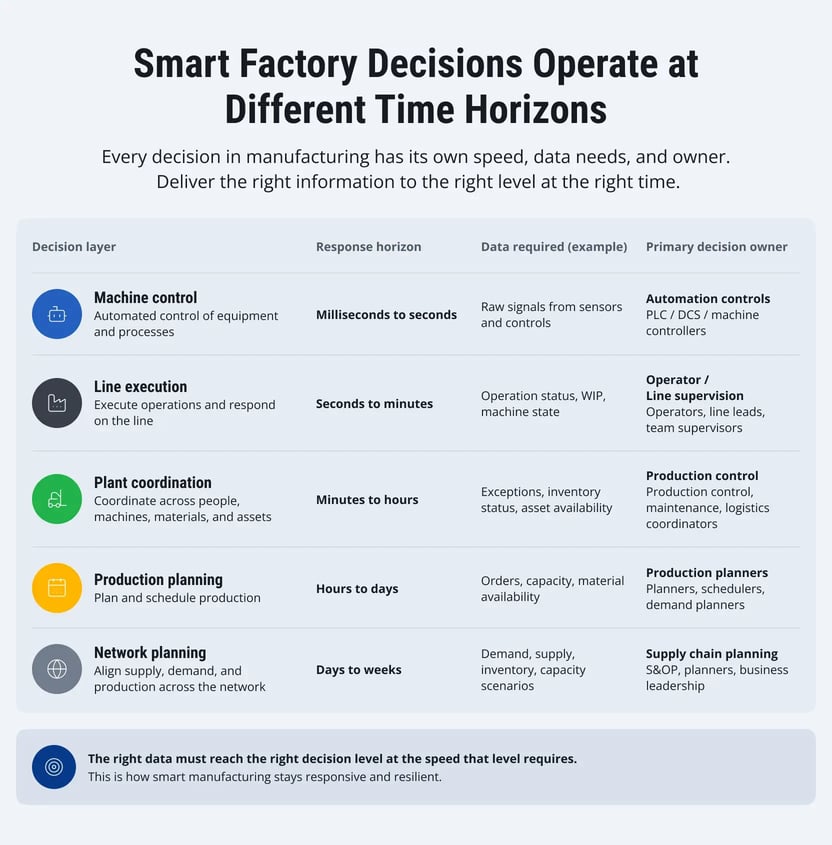
Assembling vehicles requires immediate data sharing between the groups forecasting sales, the active machinery on the floor, maintenance crews, and warehouse staff. Connecting these departments to current production data gives shift supervisors a clearer view of how disruptions affect the production plan. When a material delivery is late, a robot fails, or a weld inspection is rejected, supervisors can reassess production sequences, resource assignments, and short-term schedules based on execution feedback. Where planning and automation processes are configured to support it, the system can also propose or execute schedule adjustments.
Depending on the plant landscape, SAP Digital Manufacturing can connect with SAP S/4HANA or supported SAP ERP environments, existing MES platforms, and other shop-floor systems. SAP EWM can be added when warehouse execution and production supply need closer coordination. Production Connector exchanges data between SAP Digital Manufacturing and machines or equipment on the factory floor. Asset management, analytics, and AI tools can support specific maintenance, monitoring, or operational tasks. Existing MES platforms and local machine controls can remain where they still meet functional, integration, performance, security, resilience, and supportability requirements.
Why Smart Manufacturing Transforms the Automotive Industry
Building cars requires exact timing on the factory floor. The shift toward electric models forces assembly lines to integrate heavy battery packs, high-voltage wiring harnesses, and strict safety testing protocols alongside legacy tasks. Plant managers frequently schedule traditional gas engines, hybrid platforms, and fully electric vehicles to run consecutively under a single roof.
Accelerated design cycles force engineering departments to send structural updates to the manufacturing line at a much faster pace. Customer requests for specific interior trims, advanced radar assistance packages, unique battery ranges, and regional safety features dictate exact parts staging. Every individual variation requires floor personnel to reference different assembly manuals, adjust conveyor pacing, and execute distinct visual checks before a chassis moves to the next station.
Labor shortages make this complexity harder to absorb through experience alone. Digital work instructions, guided workflows, automated data collection, and role-specific operator interfaces can help standardize execution when experienced specialists are unavailable on every shift.
At the same time, an automotive factory depends heavily on synchronized logistics. A production order may be executable in the MES while the required component remains in the wrong warehouse zone or arrives at the line out of sequence. Smart manufacturing programs increasingly extend beyond machines and work centers into warehouse staging, replenishment, and production supply.
For automotive manufacturers, Industry 4.0 increasingly centers on coordination across planning, execution, equipment, quality, and intralogistics. A highly automated line still has limited flexibility when these processes operate with different data or respond to production changes at different speeds.
SAP's automotive portfolio reflects this broader scope, covering manufacturing execution, production planning and scheduling, manufacturing analytics, and asset performance alongside other supply chain processes.
The Biggest Challenges in Automotive Manufacturing
The technology inside an automotive plant often comes from different generations. A new assembly line may use modern machine interfaces and automated data collection, while another area still relies on an older MES, custom middleware, local databases, or manual confirmation. This creates several practical problems.
Planning and execution drift apart
Production planning works with expected capacity, material availability, routing data, and demand. The shop floor works with the conditions that actually exist at that moment. A machine stops. A supplier's delivery arrives late. Rework consumes capacity. One model takes longer at a workstation than expected. Without timely execution feedback, the production schedule can lag actual shop-floor conditions.
Production data remains fragmented
Cycle times may sit in one system, quality results in another, machine events in a historian, labor information in a separate application, and production orders in ERP. Plant managers can still calculate KPIs from this landscape, although the process frequently involves reconciliation and delayed reporting. More importantly, finding the reason behind a KPI change becomes difficult. A drop in output could originate from equipment availability, material shortages, quality holds, staffing, or an unrealistic schedule.
Unplanned downtime disrupts more than one workstation
A failed asset can affect sequencing, labor allocation, material consumption, warehouse movements, and downstream operations. Maintenance teams need equipment information and operating context early enough to decide whether intervention can wait for a planned stop or requires immediate action.
Variant complexity increases execution risk
Automotive production depends on delivering the correct operation, component, parameter, and inspection at the correct point in the vehicle sequence. A disconnected process creates opportunities for the wrong part to reach the line, an inspection to be missed, or an operator to use outdated work instructions. Traceability also becomes harder once information has to be reconstructed across several systems after production.
Material flow can become the hidden constraint
Many automotive assembly operations rely heavily on just-in-time (JIT) and just-in-sequence (JIS) supply. Production cannot maintain takt simply because the required stock exists somewhere in the facility. Components have to reach the appropriate production supply area when the line needs them. That makes warehouse and manufacturing integration part of the smart factory architecture.
How SAP Connects Planning, Execution, and Shop-Floor Operations
SAP can connect enterprise planning with manufacturing operations without requiring every plant-level function to move into one application. At the enterprise level, SAP S/4HANA supports automotive production planning through manufacturing master data, material requirements, work centers, production orders, inventory, and related business transactions. SAP S/4HANA Manufacturing for planning and scheduling adds constrained production planning and detailed scheduling capabilities, helping manufacturers align production plans with available materials, capacity, and execution feedback.
SAP Digital Manufacturing operates closer to production execution. The platform supports manufacturing operations management, including execution, resource orchestration, shop-floor monitoring, manufacturing analytics, and equipment connectivity. It can receive production-related master and transactional data from SAP S/4HANA and return execution information such as yield and scrap confirmations.
Quality management forms part of the same production loop. SAP S/4HANA Quality Management supports inspections during production, inspection result recording, and defect and nonconformance processing. In an automotive environment, these processes help connect quality results with the relevant production context and provide a structured path for handling defects, rework, and follow-up actions. The architecture may distribute these activities across SAP S/4HANA, SAP Digital Manufacturing, an existing MES, and specialized plant systems, depending on the manufacturing process and system landscape.
SAP Digital Manufacturing also supports integration with SAP EWM and multiple ERP deployment scenarios. Exact interfaces and prerequisites vary by landscape and release, so integration design should be checked against the systems running at each plant.
Where SAP fits in the factory architecture
Automotive plants already contain PLCs, robots, sensors, test benches, SCADA systems, industrial networks, machine historians, and sometimes several MES platforms. A sensible SAP architecture works with that environment.
Machine and equipment signals can enter the manufacturing layer through supported connectivity mechanisms, including the Production Connector for SAP Digital Manufacturing. SAP Digital Manufacturing then adds business context such as the production order, material, resource, operation, and work-in-process status. SAP S/4HANA handles the enterprise processes surrounding execution, while warehouse, maintenance, data, and analytics solutions support their respective operational domains.
The distinction matters when defining scope. Connecting a machine signal provides data. Connecting that signal to a specific order, operation, asset, material, and quality process makes the data useful for manufacturing decisions.
SAP Solutions Supporting Smart Factories
The SAP portfolio covers different parts of the manufacturing process. The architecture should reflect the plant's existing systems, production model, integration requirements, and transformation roadmap.
|
SAP offering |
Role in automotive smart manufacturing |
|
This core system handles daily production scheduling, active manufacturing orders, and physical inventory counts. The software also processes failed quality inspections, schedules machine repairs, executes purchasing requests, and records the resulting financial data |
|
|
SAP S/4HANA Manufacturing for planning and scheduling |
Supports finite production planning and detailed scheduling based on resource capacity, material availability, order priorities, and sequencing constraints. The module calculates realistic production timelines by evaluating available raw materials, strict assembly sequences, and hard physical capacity limits on the floor |
|
Supports production execution, operator guidance, resource orchestration, shop-floor monitoring, and manufacturing analytics. Configured shop-floor connectivity can bring equipment data into SAP Digital Manufacturing and link it to the production context for monitoring and analysis |
|
|
Coordinates inventory and warehouse execution, including production staging and material movements required to supply manufacturing operations |
|
|
Uses asset, maintenance, and condition information to support reliability analysis and condition-based, predictive, and prescriptive maintenance approaches |
|
|
Provides data integration, semantic modeling, and governed access to SAP and third-party data. SAP positions SAP Datasphere within SAP Business Data Cloud |
|
|
Supports analytical reporting and performance analysis. SAP Analytics Cloud technology also underpins operational analytics within SAP Digital Manufacturing for insights |
|
|
Adds AI capabilities within SAP applications for selected manufacturing tasks, depending on product release and licensed scope |
|
|
Provides services for integration, extension, data, and application development where manufacturing processes span SAP and non-SAP systems |
In legacy documentation, SAP Digital Manufacturing often appears as SAP Digital Manufacturing Cloud, though the company has since updated the official product name. Meanwhile, SAP Datasphere continues to be a core portfolio offering, now integrated into the SAP Business Data Cloud suite.
Building a Connected and Intelligent Factory
A connected factory relies on integrated systems that exchange defined production, logistics, quality, and equipment data through established interfaces. During chassis welding or final trim installation, SAP S/4HANA can provide production orders and master data, SAP Digital Manufacturing can track execution and work-in-process status, and SAP EWM can coordinate component staging and line-side supply. MES, automation, and equipment-monitoring systems can continue to handle plant-specific execution and machine-level processes where required.
With these systems connected, production teams can assess how a conveyor fault, material delay, or quality issue affects execution, component availability, and downstream operations. The goal is to give supervisors a consistent operational context across systems so they can respond without manually reconciling disconnected records.
IoT and manufacturing automation
Industrial IoT becomes useful when equipment data enters a defined manufacturing process. SAP Digital Manufacturing can connect to shop-floor systems through the Production Connector, providing a connectivity layer between manufacturing applications and machines or equipment. Production data can then be associated with the resources, operations, and orders that give those signals operational meaning.
Connectivity can also support manufacturing automation. Configured processes can respond to changes in machine values, exchange information with equipment, and transfer shop-floor data into SAP Digital Manufacturing without relying on manual entry. Automotive manufacturers should define which machine signals matter to production execution, quality, or maintenance before expanding connectivity across the plant.
Real-time production monitoring
SAP Digital Manufacturing supports live monitoring and operational analytics at levels such as plant, line, work center, and resource. Its manufacturing analytics capabilities also support Overall Equipment Effectiveness (OEE), including availability, performance, and quality components.
For an automotive plant, the useful question goes beyond the current OEE value. Teams need to identify what produced the loss. Was availability affected by repeated microstops? Did performance fall because a workstation could not maintain its standard rate? Did scrap or rework reduce the quality component? Were the causes concentrated on one line, resource, shift, or product family? Reason-code structures and loss analysis can help teams investigate these questions instead of treating OEE as a dashboard number alone.
Predictive and condition-based maintenance
Sensor data can provide early indications of equipment deterioration, but effective predictive maintenance in automotive manufacturing depends on the ability to turn those signals into maintenance decisions and actions. Teams need asset hierarchies, failure modes, maintenance history, thresholds, and a defined process for responding to detected conditions. SAP Asset Performance Management supports risk and reliability analysis, maintenance strategy optimization, and asset condition monitoring. It can also work with enterprise asset management processes, so identified issues lead to maintenance activities.
For automotive manufacturers, the highest-value candidates often include equipment whose failure can constrain an entire line or create a difficult recovery sequence. The business case should start with those assets instead of applying predictive maintenance indiscriminately across every motor and sensor in the plant.
AI in manufacturing operations
AI is increasingly appearing in specific manufacturing workflows. SAP Digital Manufacturing includes AI-assisted production engineering capabilities for generating script tasks and analyzing failed production processes, including root-cause and solution suggestions.
Broader manufacturing AI scenarios, such as anomaly detection, quality analysis, predictive maintenance, and operator assistance, may involve other SAP services, partner solutions, or plant-specific models. Automotive manufacturers should prioritize use cases with reliable source data, a defined operational decision, validation criteria, and a clear escalation path. Availability depends on release, region, licensing, and system landscape.
Digital twins and production context
Digital twin architectures in automotive manufacturing can represent different entities, including a product configuration, a physical asset, or a production resource. The data required for each representation may come from several systems.
In an SAP-centered landscape, SAP S/4HANA can provide business and asset master data, while SAP Digital Manufacturing contributes execution context such as orders, operations, resources, and production status. Engineering models, 3D data, simulation capabilities, or specialized twin functions may remain in PLM or third-party platforms.
The architecture should define which physical or logical entity each twin represents, which system owns each data element, and which operational decisions depend on that representation. This prevents digital-twin initiatives from collecting large volumes of data without a defined manufacturing use case.
Connecting Production With Warehouse and Line-Side Logistics
Manufacturing software cannot compensate for components that fail to reach the line. This becomes particularly visible in automotive operations using sequenced supply. Production schedules determine what the plant expects to build, but intralogistics has to convert those requirements into warehouse tasks, staging activities, and line-side replenishment.
SAP EWM can support production supply processes, while SAP Digital Manufacturing supports integration scenarios with EWM. The specific design depends on the SAP releases, embedded or decentralized warehouse architecture, and manufacturing processes in scope.
This connection allows a smart manufacturing program to address a broader set of exceptions. A line supervisor can see that production has slowed, while logistics teams can determine whether a material shortage contributes to the problem. Warehouse execution can respond to actual production requirements instead of operating from a separate set of assumptions. For automotive plants with JIT or JIS requirements, that coordination can matter as much as machine automation.
Our Expertise in Smart Manufacturing Transformation
At LeverX, we help automotive manufacturers modernize production around the processes that have the greatest impact on plant performance. Our work spans SAP-based production planning, manufacturing execution integration, warehouse and line-side logistics, and the modernization of established shop-floor environments.
In an SAP S/4HANA transformation for a large automotive company, operating multiple assembly sites, we carried out an SAP S/4HANA transformation that replaced manual planning and paper-based production reporting with integrated SAP processes while retaining the company's GM GEPICS MES. We connected the MES with SAP S/4HANA for production data exchange, used SAP PP/DS for planning, and supported warehouse and assembly-line supply with SAP EWM. The project reduced production cycle time by 4%, increased on-time delivery by 5%, and cut profit losses associated with component shortages by 10%.
We are also applying this experience in an SAP S/4HANA manufacturing logistics implementation for a leading automaker. The current scope connects warehouse and line-side logistics through SAP EWM, RF-supported loading and unloading, route determination, tour creation, and Fiori-based tour monitoring. The project remains in implementation, with additional route-train working modes and exception-handling capabilities planned as the solution expands.
This experience shapes how we approach smart manufacturing programs. We assess where production performance is being constrained, define the right role for SAP and existing plant systems, and build the integration around real execution requirements. Depending on the plant, that may mean improving planning, connecting an established MES, strengthening production supply, eliminating manual reporting, or introducing a new manufacturing execution layer.
Business Benefits of Smart Manufacturing With SAP
Smart manufacturing investments should eventually appear in production metrics. Broad claims about "digital transformation" provide little guidance when a plant manager has to justify the program.
A useful business case ties each capability to an operational measure.
|
Area |
What can improve |
Metrics to track |
|
Production performance |
Faster detection and analysis of production losses |
OEE, throughput, cycle time, production rate |
|
Equipment reliability |
Earlier identification of asset problems and more targeted maintenance |
Unplanned downtime, MTBF, MTTR, maintenance cost |
|
Quality |
Earlier recording and investigation of defects and stronger traceability |
First-pass yield, scrap, rework, defect rate |
|
Planning |
Better alignment between planned production and actual execution |
Schedule adherence, capacity utilization, and planning exceptions |
|
Production flexibility |
Faster response to changes in volume, sequence, product variants, and production requirements |
Changeover time, sequence adherence, response time to production changes |
|
Operating costs |
Less avoidable downtime, scrap, rework, manual reporting, and emergency material handling |
Manufacturing cost per unit, maintenance cost, scrap cost, overtime, expedite cost |
|
Material flow |
More synchronized warehouse staging and line supply |
Line-side shortages, staging lead time, and inventory accuracy |
|
Labor |
Clearer operator instructions and less manual reporting |
Labor productivity, training time, and manual data-entry effort |
|
Traceability |
Stronger links between production records, materials, operations, and quality results |
Traceability coverage, investigation time, containment time |
|
Management visibility |
Faster access to consistent plant and network performance data |
Reporting latency, exception response time, and cross-plant KPI consistency |
These metrics need to be tied to specific operational changes. Lower manufacturing cost, for example, may come from reduced downtime, scrap, rework, overtime, or emergency material movements. SAP Digital Manufacturing can calculate OEE and expose production losses, but the software alone does not improve the metric. Results depend on how production, maintenance, quality, engineering, and logistics teams act on the information.
Well-integrated systems can improve the speed, consistency, and availability of operational data. Business performance changes when teams use that data to address the underlying causes of production loss.
How to Approach a Smart Manufacturing Program
Automotive companies rarely need to digitize every plant and every production process at once. A more workable roadmap starts with a specific operational problem and traces the systems and data involved in it.
A manufacturer experiencing frequent line interruptions from missing components, for example, should examine planning accuracy, inventory visibility, warehouse staging, production sequencing, and exception handling together. A company struggling with quality escapes may need stronger execution traceability, automated data collection, inspection integration, and structured nonconformance processes. Chronic equipment-related downtime points toward a different combination of machine connectivity, maintenance data, asset performance management, and production analytics.
System architects must track exactly which software generates specific records. SAP S/4HANA might handle raw material counts and assembly sequences, while a localized MES tracks live production progress. Dedicated automation networks monitor machine temperatures, physical test rigs record quality metrics, and EAM software logs repair schedules. Replicating manufacturing data across multiple systems can create inconsistencies when systems of record, data ownership, and synchronization rules are not clearly defined.
Physical differences between assembly sites dictate the exact software deployment strategy. Car builders frequently manage a disorganized mix of outdated machinery, newly acquired factories, and isolated programs installed by past regional managers over decades. To resolve this, IT groups establish a central baseline architecture to enforce standard reporting rules and basic data connections. They still leave room for specific facilities to maintain necessary localized tool configurations based on their unique floor layouts.
Finally, smart manufacturing requires operational ownership. IT can integrate systems and maintain the architecture. Production, quality, maintenance, logistics, and engineering teams still need to define how an exception gets handled once the system detects it.
Smart Manufacturing as an Operating Model
Smart manufacturing can become a strategic advantage when an automotive manufacturer can respond to production changes without losing coordination across planning, execution, quality, logistics, and maintenance. Shared operational context helps teams adjust schedules, resolve exceptions, protect quality, and keep material flow aligned with what the plant is actually building.
For automotive manufacturers, SAP provides much of the digital foundation for that model. SAP S/4HANA connects production to enterprise planning and business processes. SAP Digital Manufacturing brings execution, shop-floor control, and manufacturing data into the landscape. SAP EWM coordinates material flow. Asset management applications support equipment reliability. SAP Datasphere and SAP Analytics Cloud extend data and analytical capabilities, while SAP Business AI adds targeted automation and decision support.
The actual financial return depends on how effectively technology, data, processes, and operational teams work together across the manufacturing environment. IT directors might start the upgrade by linking a legacy Manufacturing Execution System directly to SAP S/4HANA. Other facilities might deploy SAP EWM to organize their forklift staging areas, or introduce SAP Digital Manufacturing to replace or modernize a legacy MES or manufacturing execution layer. Regardless of the exact starting point, every technical approach works toward reducing the time gap between corporate production forecasts and the physical assembly capabilities of the plant.
Automotive assembly facilities rely heavily on this rapid data exchange because a single delayed microchip shipment, a jammed welding robot, or a sudden chassis sequence swap stalls the entire conveyor line almost instantly. Integrating these distinct databases gives shift supervisors a flexible technical framework to handle upcoming electric vehicle launches, heavy machinery upgrades, and future floor layout expansions.