Explore SAP Digital Manufacturing use cases in automotive, integration across the IT/OT landscape, migration considerations, and key implementation decisions.
Automotive production leaves little room for disconnected decisions. A single plant may build multiple vehicle variants on the same line, work to tightly controlled takt times, coordinate complex production sequences, and meet strict quality requirements. At the same time, production depends on materials arriving when needed, equipment remaining available, and every operation being completed in the right order.
When one part of that system slips, the effects can spread quickly. A missing component can delay assembly. A quality hold can interrupt downstream operations. An equipment issue can affect line balance, while a sequencing change may require production, logistics, and operators to adjust almost immediately.
This makes basic order tracking insufficient for many automotive companies. Manufacturers need order progress data that reflects what's happening on the production line and can be used alongside information on planning, materials, quality, maintenance, and other operational data while production is still ongoing.
SAP Digital Manufacturing (SAP DM) is a cloud-based manufacturing operations management (MOM) platform with manufacturing execution system (MES) capabilities, deployed on SAP Business Technology Platform (SAP BTP). It provides the manufacturing execution layer that connects shop-floor activity with enterprise processes and helps create a more consistent flow of production information across the plant.
Why Automotive Manufacturers Are Rethinking Traditional MES
For automotive manufacturers, the question is no longer simply whether a plant has a manufacturing execution system. The more important issue is whether that system can keep pace with the way production now changes, connects, and operates across the wider manufacturing environment.
A mature MES can still support complex production effectively. The pressure is greater in older or heavily customized landscapes, where years of local modifications, isolated interfaces, and plant-specific logic can make even relatively small process changes difficult to implement consistently.
Production complexity has increased
Automotive production has always required precise coordination, but the number of variables manufacturers manage has grown.
Factories can produce multiple variants of vehicles or components on the same line, each with its own bill of materials (BOM), production routings, process parameters, and quality checks. Product manufacturing lifecycles are shortening, engineering changes are more frequent, and many manufacturers now must support production programs for battery-electric, hybrid, and internal-combustion powertrains within the same extensive production network.
The execution layer, therefore, has to absorb change without turning every new requirement into another local workaround. If execution logic becomes increasingly dependent on local workarounds, even routine product or process changes can require more effort to implement, test, and support. The challenge is keeping the execution layer adaptable as product complexity grows.
Production decisions depend on data outside the MES
A production order may be technically ready to run, but that does not mean the plant should execute it next. The required material may still be in staging, a component may be under a quality hold, a critical resource may be unavailable, or an engineering change may alter the instructions for the next unit.
The same applies during execution. A supervisor deciding whether to continue, resequence work, move an order to another resource, or hold production needs more than order status. Material availability, quality disposition, equipment status, labor constraints, and schedule changes can all affect the decision.
The execution layer, therefore, needs access to the information required for these decisions at the point where production is being managed.
Fragmented plant systems limit visibility
Automotive plants will continue to rely on specialized systems. Programmable logic controllers (PLCs), machine controllers, supervisory control and data acquisition (SCADA) platforms, ERP, warehouse applications, quality systems, maintenance solutions, and MES all serve different purposes.
The difficulty comes when the context for one production event is split across several of them. A PLC may contain the process value, SAP DM the operation and unit being processed, ERP the production order, and a quality system the resulting defect record. Individually, each record can be correct while still providing only part of the story.
When those records cannot be related easily, teams spend more time reconstructing what happened, which product or operation was affected, and what conditions surrounded the event. The problem is therefore not the number of plant systems, but the loss of manufacturing context between them.
What Is SAP Digital Manufacturing?
SAP DM brings manufacturing execution together with operational analytics, resource orchestration, production process design, and connectivity within one cloud-based manufacturing operations environment.
Its role goes beyond tracking whether a production order has started or finished. SAP DM provides the manufacturing context needed to manage work on the shop floor, collect execution data, coordinate resources, monitor performance, and exchange relevant information with enterprise and plant systems.
Where SAP DM sits between ERP and the shop floor
SAP DM serves as the link between enterprise applications and systems that manage physical production. At the enterprise level, applications such as SAP S/4HANA manage business processes, master data, production orders, materials, and associated planning operations. At the other end of the architecture, PLCs, machine tools, robots, SCADA systems, and other industrial technologies execute or control physical operations.
SAP DM connects these layers by adding manufacturing context to what happens on the shop floor.
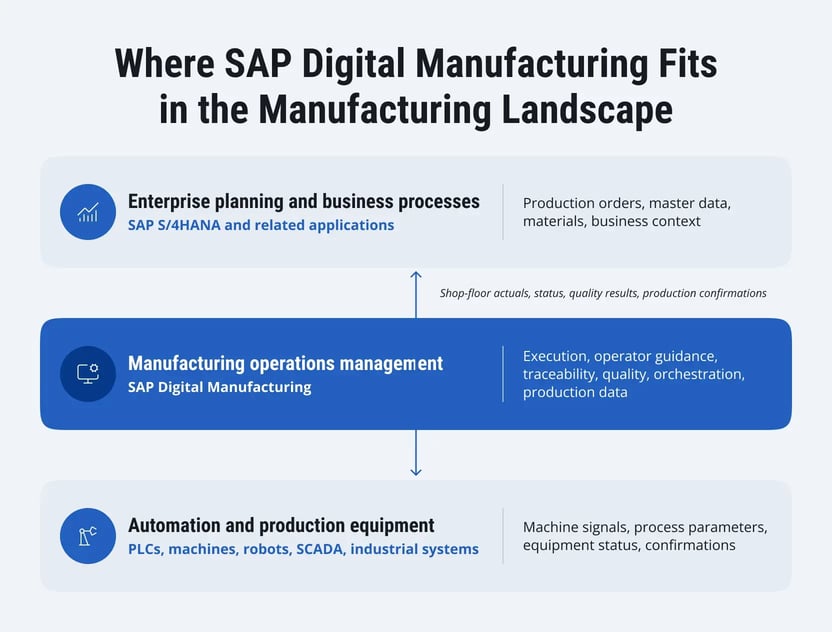
For example, an ERP system may contain a production order for a specific vehicle component. SAP DM receives the order and relevant manufacturing data and manages its detailed execution on the shop floor, captures what actually happens during execution, and makes the resulting production information available to the wider landscape.
Core SAP DM capabilities
SAP DM covers several areas of manufacturing operations rather than focusing on a single execution function.
Its capabilities include:
- Production execution: Manage and track manufacturing orders, operations, quantities, confirmations, and execution status.
- Operator guidance: Provide workers with digital instructions and information relevant to the current product and operation.
- Manufacturing data collection: Capture production, process, and equipment data that is relevant to manufacturing execution and needs a manufacturing context.
- Genealogy and traceability: Connect products and assemblies with the components, materials, and production steps involved in making them.
- Quality-related execution: Incorporate inspections, checks, data collection, and exception handling into production workflows.
- Resource orchestration: Coordinate and dispatch work across available resources based on production requirements and current conditions.
- Production monitoring: Give supervisors visibility into orders, operations, resource utilization, and exceptions.
- Manufacturing analytics: Analyze production performance using operational data from the shop floor.
- Overall Equipment Effectiveness (OEE) and loss analysis: Examine availability, performance, quality losses, and the causes behind them.
- Production Process Designer and manufacturing automation: Model production processes and automate selected interactions between manufacturing systems and equipment.
- Shop-floor connectivity: Exchange information with machines, automation systems, and other industrial applications.
SAP groups these capabilities across execution, insights, resource orchestration, and production process design.
SAP DM vs. a traditional MES
SAP DM covers the core manufacturing execution functions commonly associated with MES while also supporting broader manufacturing operations management capabilities such as analytics, resource orchestration, and production process design.
A traditional MES may already provide sophisticated order execution, traceability, quality control, equipment integration, and production monitoring. The difference should therefore not be framed as traditional MES versus modern functionality.
Compared with many traditional MES deployments, SAP Digital Manufacturing places more emphasis on cloud delivery, integration with the wider SAP landscape, manufacturing analytics, and orchestration across production processes.
What SAP Digital Manufacturing Changes on the Automotive Shop Floor
The capabilities of SAP DM become more meaningful when viewed through day-to-day production. On an automotive line, the difference is visible in how work is released, how operators know what to do next, and how supervisors respond when production starts to drift from plan.
Production orders become executable shop-floor workflows
A production order in SAP S/4HANA defines what needs to be produced. SAP DM takes the relevant execution information and turns it into work that can be carried out and tracked on the shop floor.
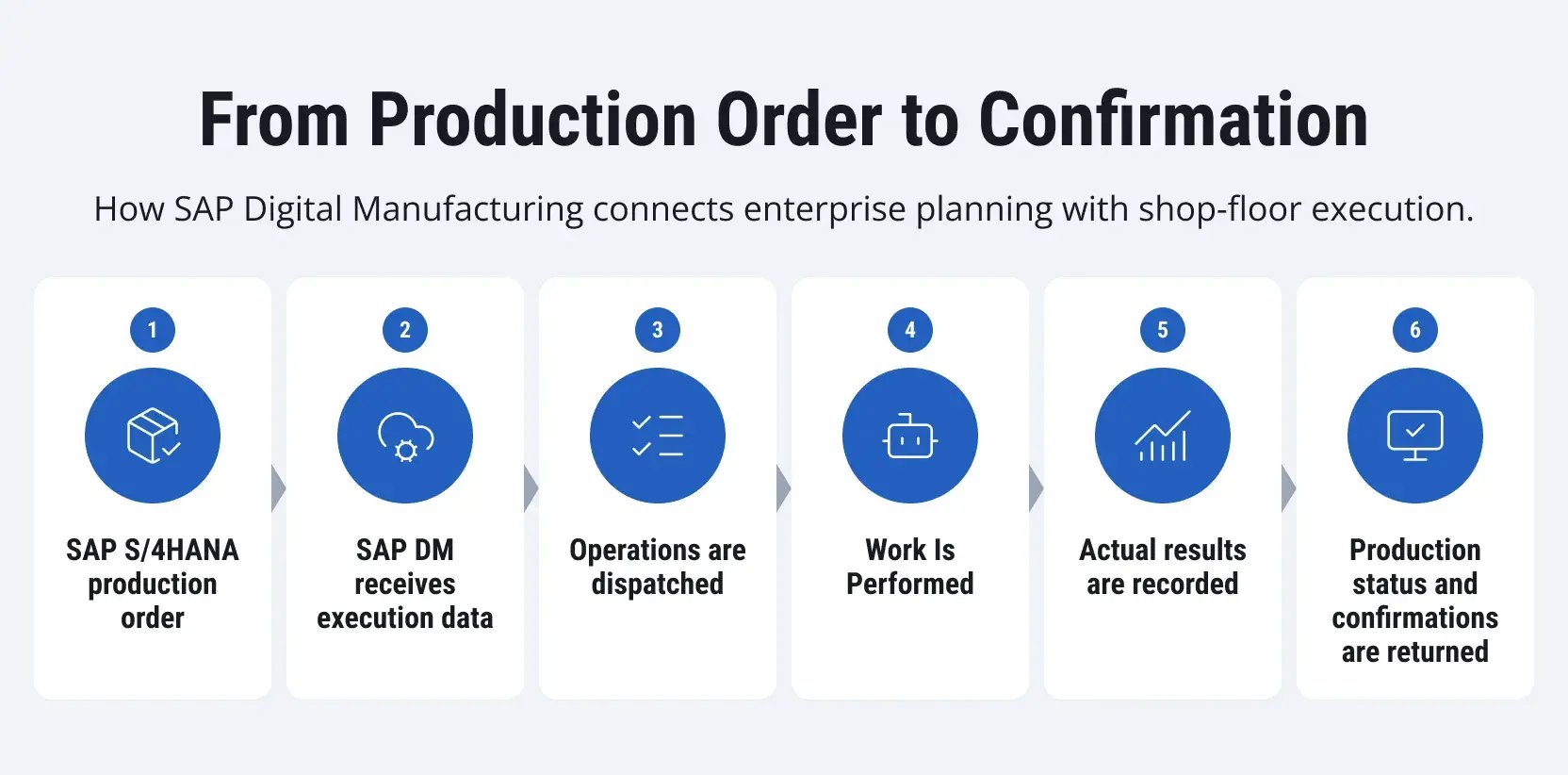
During execution, the system can capture quantities produced, operation status, labor activity, scrap, rework, and machine or process data associated with the work being performed.
This is especially important in automotive manufacturing, as the actual execution path of production operations doesn't always match the original plan. A part may require rework, an operation may take longer than expected, or equipment may become unavailable. Recording these events as part of the execution workflow allows subsequent processes to gain a more accurate understanding of what actually happened on the line.
Operators work from controlled digital instructions
Operators need clear, current information at the point where the work is performed. SAP DM can present digital work instructions, drawings, visual references, safety information, and other guidance associated with the production activity being executed.
For automotive assembly, that information might include an assembly sequence, fastening procedure, inspection instruction, or component-installation guidance. Instead of relying on printed documents or locally stored files, operators can work from instructions managed as part of the execution process.
The value here is consistency at the workstation. Operators receive the information needed for the current task in the context of the work being performed, reducing dependence on manual document selection and outdated local instructions.
Supervisors gain a current view of production status
Supervisors need a different level of visibility. Their concern is not how one operation should be performed, but whether the line as a whole is progressing as expected and where intervention may be required.
SAP DM can provide a current view of:
- Orders in execution
- Delayed or waiting operations
- Resource availability
- Production queues
- Progress against the schedule
- Exceptions and disruptions
- Labor and resource allocation
Resource Orchestration extends this further by supporting the scheduling, dispatching, monitoring, and allocation of production work based on available resources and current operating conditions.
The practical benefit is faster prioritization. Instead of piecing together status from individual machines, operator updates, or separate applications, supervisors can see where work is accumulating, which resources are constrained, and which production activities may need to be reassigned or rescheduled.
Key SAP Digital Manufacturing Use Cases in Automotive Production
Automotive manufacturers can use SAP DM across very different production environments, from component manufacturing and battery assembly to final vehicle assembly. The most relevant use cases are those where execution depends on knowing exactly what is being built, which materials and parameters were involved, and whether the process followed the expected path.
Vehicle and component traceability
When a quality issue appears, finding the defect is only part of the job. The manufacturer also needs to determine where the affected material was used and how far the issue may have spread.
SAP DM can connect production records across multiple levels, including:
- Vehicle or product serial identifiers
- Assemblies and subassemblies
- Components
- Material batches
- Production operations
- Inspection results
- Collected process parameters
Consider a supplier batch later found to contain defective components. The quality team needs to identify which assemblies or vehicles received material from that batch, where they were produced, and what happened during the relevant operations. Production genealogy provides the relationships needed to narrow that search instead of treating every unit produced during the same period as equally suspect.
The same records can support root-cause analysis. If defects appear only on units processed by a particular resource, during a certain shift, or under a specific set of process conditions, the investigation can move beyond the component itself.
For automotive manufacturers, this can improve containment decisions, help define the scope of recalls or corrective actions, and provide production evidence for customer and regulatory requirements.
Variant-specific execution on mixed-model lines
Mixed-model production creates a different challenge: the execution system has to distinguish what should happen to each unit as different configurations move through the same production resources.
Two vehicles following one another through the same line may require different components, operations, process parameters, or quality requirements. Similar variation appears in battery packs, powertrain components, seats, electronic modules, and other configurable products.
SAP DM executes the relevant production requirements using the order, BOM, routing, or operation, and configuration-related data provided or maintained for the production scenario. That context determines which materials, production steps, data collection requirements, and quality criteria apply to the unit being processed.
The key capability is, therefore, not simply presenting different instructions. It is maintaining the correct execution context as different products and variants move through a shared manufacturing environment.
Error-proofed assembly and process validation
Execution control also needs to verify that critical production steps were completed correctly, not simply that an operator or system marked them as finished.
A fastening operation is a useful example. The process may require a specific tool, acceptable torque and angle ranges, and successful completion before the unit can proceed. The resulting values can be captured and associated with the relevant product, operation, and production record.
The same validation principle can apply to:
- Correct component verification before installation
- Required measurements or process parameters
- Tool or fixture checks
- Completion of mandatory inspection points
- Wiring and connector checks
- Battery-module assembly results
- Confirmation that required operations were completed successfully
When a required condition is not met, the execution process can prevent normal progression, trigger an exception, or route the unit for additional inspection or rework. The purpose of error proofing is therefore to validate execution results and required conditions, not simply to tell the operator what to do.
In-process quality control
Finding a defect after production is complete can make containment expensive. By then, additional units may have passed through the same operation, and the original process conditions may be harder to reconstruct.
SAP DM can incorporate quality checks directly into production execution. Depending on the process, the collected result might be a dimensional measurement, torque value, weld parameter, test-station reading, visual inspection result, or simple pass/fail decision.
When a result falls outside the expected criteria, the production flow can respond accordingly. The affected unit might be held, sent for additional inspection, routed to rework, or escalated for further review.
This does not make SAP DM a replacement for every quality management application in the landscape. Enterprise quality processes may still reside in SAP S/4HANA or another quality management system. SAP DM's role is particularly relevant at the point of execution, where the inspection result can remain connected to the product, operation, resource, and production context in which it was generated.
Rework and exception handling
Automotive production rarely follows the ideal routing every time. A component can fail inspection, an operation can remain incomplete, a machine can stop mid-cycle, or a unit can require repair before it continues downstream. These exceptions need their own controlled execution path.
Instead of handling rework through handwritten notes, spreadsheets, or informal instructions, manufacturers can keep the additional activity within the production record. The system can document why the unit left the standard flow, which corrective operations were required, what work was performed, and whether subsequent checks were passed.
That history matters later. A unit that underwent repair or additional inspection should remain distinguishable from one that passed through the standard process without interruption.
It also gives manufacturing and quality teams better data for spotting recurring problems. If the same operation repeatedly generates rework for one product variant, component, or resource, the pattern becomes something the plant can investigate rather than a collection of isolated exceptions.
OEE and production loss analysis
OEE combines three factors:
- Availability: Was the resource available when production expected it to run?
- Performance: Did it operate at the expected production rate?
- Quality: How much of the output met quality requirements?
The resulting percentage can show that performance has deteriorated, but the number alone does not explain what needs to change. This requires looking at the losses behind it.
A production line may lose availability because of equipment failures or repeated microstops. Performance can decline because a process is running below its designed speed. Quality losses may come from scrap or recurring defects. Changeovers, material shortages, and other production events can add further context to what happened during the shift.
SAP DM supports OEE analysis together with the classification and analysis of availability, performance, and quality losses. This allows teams to move from a high-level KPI toward the resources and loss categories contributing most to the result.
For an automotive plant, that distinction is important. A declining OEE trend can point to very different actions depending on whether the underlying problem is an unreliable machine, excessive stops, slower cycle times, or quality losses.
Production process automation
Some manufacturing workflows require coordination between SAP DM, operators, enterprise applications, and shop-floor systems. SAP Digital Manufacturing's Production Process Designer can be used to model this logic and orchestrate the services and process steps involved.
A production process can respond to events, call services, and trigger the next step in the workflow. In an automotive environment, that might mean requesting information from another system, continuing a process after an operator completes a task, or reacting to an equipment event.
Machine-level interactions are handled through the appropriate shop-floor connectivity layer. Production Connector can execute automation sequences, read and write equipment values, and exchange data with SAP DM. In edge-enabled scenarios, automation sequences can also run on the Production Connector on the edge.
This separation keeps the manufacturing process logic connected with physical execution without positioning Production Process Designer itself as the machine-control layer. Teams can manage orchestration at the manufacturing process level while PLCs, controllers, and other automation systems remain responsible for physical control.
Connecting Production With Planning, Quality, Logistics, and Maintenance
Once production is underway, actual execution results can change what surrounding processes need to do next. Lower-than-planned output may affect the next schedule. Material consumption can change replenishment needs. A failed inspection may stop a unit from moving forward, while an equipment issue can change which work the plant is able to execute.
SAP DM provides the manufacturing context behind these events: what was produced, which operation was performed, what materials and resources were involved, and what results were recorded. That information becomes more useful when it reaches the business and operational processes that need to respond.
Production planning and execution
Plans are created before production meets actual shop-floor conditions. During execution, SAP DM captures quantities, yield, scrap, rework, operation status, and other results that show how closely production is following the plan.
If a line produces fewer units than expected because of a prolonged stop, planners need the actual output before deciding what should run next. The same applies when rework consumes additional capacity or an operation takes longer than planned.
The important flow is therefore from planned requirements into execution and from actual production results back into planning and scheduling decisions.
Material staging and warehouse operations
Production cannot execute an operation simply because the order is ready. The right components also have to reach the right production supply area at the right time.
This creates a direct dependency between shop-floor execution and warehouse operations. In an automotive plant, the requirement may involve anything from fasteners and electronic modules to seats, battery components, or variant-specific assemblies. The warehouse needs to know what production requires, while production needs visibility into whether those materials are available and being staged.
When SAP DM works with SAP Extended Warehouse Management (SAP EWM), the two systems can coordinate this flow without blurring their responsibilities. SAP DM provides the production context and can initiate staging requirements, while SAP EWM manages the warehouse activities required to pick and move the material to the production supply area. SAP supports both order-specific and cross-order staging scenarios in this integration.
The relationship continues once material reaches the line. Consumption has to be reflected as production progresses, shortages may require additional staging or replenishment, and completed products eventually move back into logistics processes. SAP EWM remains responsible for warehouse execution, while SAP DM remains focused on manufacturing execution.
For automotive operations, that separation matters. Line-side inventory should be sufficient to keep production moving, but continuously pushing excess material toward the line creates congestion and unnecessary inventory. Linking production demand with warehouse execution helps material movement follow what the plant is actually preparing to build.
Maintenance and equipment availability
Production plans depend on resource availability. If a critical machine, cell, or line becomes unavailable, the effect can extend from maintenance activity into capacity, sequencing, and production priorities.
SAP S/4HANA Asset Management supports maintenance processes such as maintenance requests, planning, orders, and execution. SAP Asset Performance Management (SAP APM) can complement this layer with asset-health monitoring, reliability and risk analysis, maintenance-strategy optimization, and predictive or prescriptive approaches.
SAP DM contributes to the manufacturing execution context. Where the integration architecture makes the relevant information available across these systems, teams can evaluate equipment condition and maintenance requirements alongside production activity and operational priorities. SAP DM itself does not replace the maintenance-management or asset-performance layers.
Quality processes
Quality decisions depend on more than the inspection result itself. A failed measurement is more useful when it can be related to the product, operation, material, resource, and process conditions under which it occurred.
Execution data from SAP DM can provide that context for containment, defect investigation, rework, and corrective-action processes. Quality decisions can then feed back into production by holding a unit, requiring additional inspection, or changing its execution path.

Integrating SAP Digital Manufacturing With the Automotive IT/OT Landscape
The process flows above translate into a technical architecture spanning enterprise applications, cloud manufacturing services, integration components, local connectivity, and industrial control systems.
The exact design varies by plant and deployment model. The key architectural questions are which system owns each type of data or control, how information crosses application and IT/OT boundaries, and which interactions require cloud, edge, or local execution.
|
Architecture area |
Typical SAP components or systems |
Primary responsibility |
Typical interaction with SAP DM |
|
Enterprise applications |
SAP S/4HANA or SAP ERP |
Production planning, master data, orders, confirmations, and related business processes |
Provides master and order-related data and receives production results such as yield, scrap, and confirmations |
|
Warehouse execution |
SAP EWM |
Material staging, production supply, inventory movements, and warehouse execution |
Coordinates material movement to and from production based on manufacturing requirements |
|
Quality management |
SAP S/4HANA Quality Management or other quality systems |
Enterprise quality processes, defect management, notifications, and corrective actions |
Exchanges production-relevant quality information with SAP DM and uses execution data in broader quality processes |
|
Asset management |
SAP APM, SAP S/4HANA Asset Management, and other asset systems |
Asset condition, maintenance, and equipment-performance context |
Provides equipment and maintenance information that can be evaluated alongside production activity |
|
Enterprise integration and connectivity |
SAP Integration Suite (including Cloud Integration), SAP Cloud Connector, other SAP BTP services, and APIs as required |
Application integration and secure connectivity between SAP DM and enterprise or third-party systems |
Supports message exchange, transformation, routing, and secure connectivity across application and network boundaries; the exact components depend on the connected systems and deployment model |
|
Shop-floor connectivity |
Production Connector for SAP Digital Manufacturing |
Connectivity between SAP DM and locally installed manufacturing systems and equipment |
Transfers relevant machine signals, process values, events, and commands between SAP DM and the shop floor |
|
Industrial systems and automation |
PLCs, CNC and robot controllers, SCADA systems, machines, torque systems, test equipment, and other line-side technologies |
Physical control, automation, and generation of production data |
Executes or controls physical operations and exchanges relevant states, measurements, and results with SAP DM through the shop-floor connectivity layer |
Connecting SAP DM with shop-floor systems
An automotive plant may include PLCs, CNC machines, robot controllers, torque systems, test benches, SCADA, historians, IIoT platforms, and proprietary line applications. These systems continue to perform their specialized roles.
Production Connector provides the connectivity layer between SAP DM and locally installed shop-floor systems. Depending on the scenario, it can exchange equipment values, states, events, and other execution-related information using the interfaces and protocols supported by the plant architecture.
The ownership boundary should remain clear. A PLC or controller performs the physical control logic. Production Connector handles the communication with the manufacturing layer. SAP DM provides the execution context that relates the resulting data to the product, order, operation, and production process.
Extending SAP DM with APIs and SAP BTP
Manufacturing landscapes also include custom and non-SAP applications. SAP DM provides APIs that can be used to connect these systems, while SAP BTP can support additional integration, application development, and extension scenarios where needed.
The integration design should follow the actual manufacturing requirement rather than force every interaction through the same technology.
From Manufacturing Data to Continuous Improvement
Automotive factories generate large volumes of production data, but volume alone is not enough to improve productivity. Data becomes useful when teams can link individual events and measurements to the product, process, resources, and business context behind them.
Establishing a common manufacturing data context
A machine value by itself says very little. A temperature reading, cycle time, or torque result becomes more useful when the plant can associate it with the resource that produced it, the operation being performed, the product or order involved, and the expected operating range.
SAP Digital Manufacturing structures execution data around this manufacturing context. For analytics, SAP DM for insights also organizes production information into Manufacturing Data Objects (MDOs), which can be used to analyze relationships across manufacturing data without building every analytical data model from scratch.
This makes it easier to move from seeing an abnormal value to understanding where it occurred and what production it may have affected.
Detecting repeatable production patterns
A single production deviation may be an isolated event. Continuous improvement starts when teams can determine whether the same problem is recurring and under what conditions.
Production data can be compared across resources, operations, shifts, products, variants, and process conditions to identify patterns that would be difficult to see from individual incidents. A recurring stop on one resource, repeated rework for a particular variant, or rising cycle time during a specific operation can point to an issue worth investigating.
The goal is to move from noticing that performance changed to identifying where the pattern occurs and which production context is associated with it.
Turning analysis into measurable improvement
Finding a pattern is only the beginning. Teams then need to determine what can be changed in the production process. Depending on the cause, that might involve adjusting an operating parameter, changing a work instruction, addressing an equipment issue, modifying material handling, or redesigning part of the execution workflow.
After a change is made, teams need to see whether it actually helped. They can compare the relevant metrics before and after the change and watch whether the original problem becomes less frequent or less severe over time.
That turns analysis into an ongoing improvement process. Teams spot a recurring issue, look at the conditions surrounding it, make a targeted change, and then check the result. SAP DM provides the execution data needed for that analysis, while engineering and operations teams decide what to change and whether the outcome is good enough to keep.
Comparing performance across lines and plants
For automotive manufacturers operating multiple lines or facilities, the same data can support comparison across shifts, resources, product families, and plants.
Cross-plant comparison is meaningful only when the metrics being compared are calculated consistently. Two plants can both report OEE, for example, but the figures may tell different stories if planned downtime, production losses, or utilization are classified differently.
Once metric definitions are agreed upon, teams can use differences between plants, lines, shifts, or product families as a starting point for investigation. A performance gap alone doesn't explain the cause, but it can point to areas where deeper analysis is warranted.
Where AI Fits Into SAP Digital Manufacturing
AI becomes more useful in manufacturing when it can work with production context rather than isolated machine readings. SAP DM provides that context by connecting operational data with resources, orders, products, processes, and production events.
AI-assisted analysis and decision support
SAP is adding AI capabilities to areas where teams need to interpret information or resolve issues faster. For example, where available, AI-Assisted Production Engineering can analyze failed production processes using error logs and suggest possible root causes and solutions. SAP also positions AI-guided KPIs and analytics as part of the SAP DM offering.
Availability of individual AI capabilities can depend on the SAP Digital Manufacturing subscription, data center, and current release, so manufacturers should confirm support for their environment before including them in the solution design.
The practical role of AI is to help users get from a production issue to relevant information and a possible next action faster. Final decisions still depend on the process, operating conditions, and engineering judgment.
Predictive use cases need a broader data foundation
More advanced scenarios, such as predictive maintenance or quality prediction, usually require data beyond the MES. Depending on the use case, that may include equipment sensor history, maintenance records, process parameters, quality outcomes, and relevant master data.
SAP DM can contribute production data and execution context to these scenarios, but it is only one part of the architecture. The predictive model, asset intelligence, or AI service may sit elsewhere in the SAP landscape or in a third-party platform.
A Practical Automotive Production Scenario
Consider a mixed-model assembly line where a torque-controlled fastening operation has to be executed for different vehicle variants. The scenario shows how enterprise data, manufacturing execution, shop-floor connectivity, and physical automation can work together.
- SAP S/4HANA provides the production order and relevant manufacturing data to SAP DM. This can include the order, material, and routing information required for execution.
- SAP DM manages the manufacturing context for the unit at the workstation. Based on the production data available for that scenario, it identifies the operation to be performed and the applicable execution requirements.
- Production Connector provides the connectivity between SAP DM and the shop-floor system. Relevant execution data or parameters can be exchanged with the torque controller through the configured plant-connectivity architecture.
- The torque controller performs the physical fastening cycle. The controller remains responsible for machine-level execution and returns the resulting torque, angle, status, or other relevant values through the connectivity layer.
- SAP DM records the result in the context of the unit and operation. If the result meets the defined criteria, the production process can continue. If it does not, SAP DM can trigger the configured exception path, such as additional inspection or rework.
- Quality and maintenance processes remain in their respective system layers. Where required by the solution design, execution results or exceptions can be made available to SAP S/4HANA Quality Management, maintenance applications, or other connected systems for follow-up.
- Relevant production confirmations return to SAP S/4HANA. Enterprise processes can then work with the actual execution status and results rather than only the original production plan.
This scenario illustrates the separation of responsibilities within the architecture: SAP S/4HANA manages the enterprise's production processes, SAP DM manages the execution of production operations and context, the Production Connector provides communication with the production floor, and the controller or automation system remains responsible for the physical operations.
What Manufacturers Should Decide Before Implementing SAP DM
An SAP DM implementation should start with production requirements, not a list of product capabilities. Before designing the solution, manufacturers need to decide where SAP DM will add value, what should remain in existing plant systems, and how much consistency they want across sites.
Which production processes belong in SAP DM
Not every shop-floor process needs to move into SAP DM. The first step is to identify where production lacks control, visibility, or reliable information exchange.
Useful questions include:
- Which processes depend heavily on manual workarounds?
- Where does production information break down between systems?
- Which decisions require current shop-floor data?
- Which processes vary unnecessarily between plants?
- Which existing systems already perform their role well?
This helps define a realistic SAP DM scope and avoids replacing plant applications simply because a new platform is being introduced.
What should be standardized across plants
For multi-plant manufacturers, SAP DM creates an opportunity to establish common manufacturing practices. Data models, operation definitions, reason codes, KPI definitions, interface patterns, operator roles, and exception handling are good candidates for standardization. Physical constraints, equipment, and layouts are more likely to remain site-specific. The goal is to standardize enough to improve comparability, support, and maintainability without forcing different plants into identical operating models.
What should run in SAP DM cloud, at the edge, or in local OT systems
Automotive plants need to decide where manufacturing functions should run based on production continuity, connectivity, latency, and control requirements.
SAP DM is cloud-based. SAP Digital Manufacturing for edge computing can run a defined set of SAP DM functions closer to the shop floor and synchronize production-critical data between the cloud and the edge. This can help production continue during temporary interruptions in cloud connectivity rather than making the edge a full local replacement for SAP DM cloud.
PLCs, controllers, and other local OT systems remain responsible for physical and real-time machine control. The architecture should therefore place each function where it belongs: enterprise manufacturing processes in SAP DM cloud, supported continuity-sensitive functions at the edge where required, and physical control in local automation systems.
Migrating From SAP ME to SAP Digital Manufacturing
For existing SAP Manufacturing Execution (SAP ME) customers, migration to SAP DM is an opportunity to modernize the production environment rather than reproduce the existing system one-for-one. In automotive manufacturing, that transition also has to account for production continuity, sequencing requirements, line-side integrations, mixed-model execution, and the limited cutover windows available at high-utilization plants.
Treat migration as process modernization
Years of SAP ME use can leave behind custom screens, extensions, interfaces, and workflows built for requirements that have since changed.
Each one should be evaluated before migration. Some functionality may still be essential, some can be redesigned using SAP DM capabilities, and some may no longer be needed. In automotive plants, particular attention should go to processes tied closely to takt-sensitive execution, variant handling, quality gates, equipment interfaces, and production sequencing.
The assessment should cover:
- SAP ME customizations and extensions
- Operator workflows and user experience
- Interfaces with ERP and plant systems
- Line-side equipment and automation dependencies
- Variant and sequencing logic
- Manufacturing and historical data requirements
- KPI and reporting logic
- Manual workarounds that have developed around the system
Recreating everything one-for-one can carry unnecessary complexity into the new environment.
Coexistence can support a phased transition
Migration does not always have to happen as a single cutover. A manufacturer may move plants, lines, or capabilities gradually, operate different platforms at different sites during the transition, or maintain a temporary hybrid landscape.
SAP currently supports an integration scenario between SAP ME and Resource Orchestration in SAP DM. Production supervisors can schedule and dispatch work in Resource Orchestration while execution continues in SAP ME. However, SAP has deprecated Data Engineering, the component used to replicate SAP ME data to SAP DM, and plans to remove it in release 2704. Manufacturers considering this coexistence approach should therefore confirm the supported architecture and migration path against the latest SAP documentation before making it part of a long-term transition plan.
For automotive networks, phased coexistence can be useful when plants cannot tolerate extended production interruptions or when high-risk integrations need to be moved separately. A rollout may begin with a less constrained line or plant before moving to facilities with complex sequencing, dense automation, or round-the-clock production.
Migration questions to answer early
Before defining the transition plan, manufacturers should determine:
- Which SAP ME capabilities are actually being used?
- Which customizations still solve a current business requirement?
- Which interfaces, machines, and line-side systems depend on SAP ME?
- Which sequencing and mixed-model execution rules must be preserved?
- What historical manufacturing data must remain accessible?
- Which processes can move to SAP DM functionality?
- How will production continue during cutover?
- How will variant, exception, and equipment-integration scenarios be tested before go-live?
- Should the rollout proceed by plant, line, process, or capability?
For automotive manufacturers, the transition plan should account for more than technical migration efforts. It also needs to reflect production calendars, planned shutdown windows, model launches, line utilization, and the operational risk of disrupting tightly sequenced manufacturing.
Business Impact of SAP Digital Manufacturing in Automotive
The value of SAP DM is more readily apparent in operational results than in individual functions. For automakers, the primary benefits include tighter control over work execution, improved production context, and faster access to information in the event of deviations from plan.
|
Business impact |
What changes in practice |
|
More controlled production execution |
Orders, instructions, process requirements, and confirmations stay connected throughout execution, reducing reliance on manual coordination. |
|
Stronger traceability |
Manufacturers can reconstruct the production history of a vehicle, assembly, or component and relate it to materials, operations, resources, and process results. |
|
Faster response to exceptions |
Supervisors can see disruptions and their production context sooner, making it easier to prioritize rework, resource changes, or other corrective actions. |
|
Better quality control during production |
Quality and process data can be captured as work is performed rather than only after production is complete. |
|
More useful performance data |
Production KPIs can be analyzed in the context of orders, products, resources, operations, and losses instead of as isolated machine statistics. |
|
Better visibility across the manufacturing network |
Shared production information gives central and plant teams a clearer view of execution performance, exceptions, and production results across multiple facilities. |
For global OEMs and Tier 1 and Tier 2 suppliers, the broader benefit is a more consistent connection between what is planned at the enterprise level and what actually happens across individual plants.
LeverX Expertise in SAP Digital Manufacturing for Automotive
SAP DM projects bring together manufacturing engineering, SAP architecture, plant automation, production IT, and data. Success depends on making those areas work as one production environment rather than treating the project as an isolated MES implementation.
LeverX supports manufacturers from the initial assessment through implementation, integration, rollout, and ongoing optimization.
Manufacturing and MES assessment
We start by examining how production operates today: the existing MES landscape, SAP ME footprint, manual workflows, plant-specific processes, integration dependencies, and recurring operational issues.
The assessment helps determine which processes should move to SAP DM, which should be redesigned, and which existing systems should remain in place. It also identifies integration dependencies, operational constraints, and the areas where the current MES landscape creates the greatest execution or support burden.
SAP Digital Manufacturing implementation
LeverX designs and implements SAP DM around the production processes the plant needs to execute. In automotive environments, the scope may include mixed-model execution, operator guidance, genealogy and traceability, in-process quality scenarios, Resource Orchestration, manufacturing analytics, and exception workflows for rework or production disruptions.
The design also has to account for takt-sensitive operations and the dependencies between SAP DM and line-side systems so that digital execution supports the pace of the physical production process.
ERP, logistics, and shop-floor integration
SAP DM has to operate within the wider manufacturing landscape. LeverX connects it with SAP S/4HANA, SAP EWM, asset-management applications, existing MES solutions, and plant-level technologies such as PLCs, SCADA, torque systems, test equipment, and other line-side applications.
For automotive plants, integration design should also consider sequencing, material staging, variant-specific execution, and the timing requirements of equipment interactions. Clear system responsibilities help ERP, MES, warehouse, and automation layers exchange information without duplicating each other's roles.
SAP ME modernization and migration
Once the target SAP DM scope and architecture are defined, LeverX translates them into a practical SAP ME transition and cutover plan. This includes mapping migration dependencies, defining interface switchover points, planning access to required historical production data, establishing readiness and rollback criteria, and coordinating validation across SAP applications and line-side systems.
For automotive plants, cutover planning also has to fit available shutdown windows and production schedules. Critical sequencing, mixed-model execution, equipment interactions, and exception paths should be validated before the production line moves to the new execution environment.
Rollout and ongoing optimization
Automotive manufacturers often roll SAP DM out across plants with different production calendars, automation landscapes, model programs, and levels of technical readiness. LeverX can sequence deployment around those constraints, using lessons from earlier sites to reduce risk and improve subsequent rollouts.
After deployment, production stabilization, KPI analysis, user feedback, and operational data provide the basis for further improvements as products, lines, and manufacturing requirements change.
Conclusion
Automotive plants already generate massive amounts of production data. The biggest challenge is converting this data into actionable information while there's still time to influence production, whether that means responding to quality issues, adjusting production lines, or understanding why actual production volumes deviate from plan.
SAP Digital Manufacturing provides the execution layer between enterprise processes and the shop floor, giving production orders, operator activity, equipment data, and production results a shared manufacturing context. That connection allows information from the line to become part of wider planning, quality, logistics, maintenance, and performance decisions.
The value of digital manufacturing, therefore, goes beyond replacing an older MES with a cloud platform. It comes from creating a production environment that can recognize what is happening, understand what it affects, and respond before the issue becomes a larger production problem.