Most oil and gas companies invest in digital technologies, yet many initiatives stay at the pilot stage. This article explores what changes when SAP becomes part of their landscape.
Automotive manufacturing depends on timeliness. Parts must arrive at the right place in the right order, robots must operate at line speed, and equipment in stamping, the body shop, paint, and final assembly must remain available. When critical equipment fails, the problem is rarely isolated to a single area.
Preventive maintenance can reduce this risk, but equipment can begin deteriorating between inspections. Predictive maintenance uses operating and condition data to identify patterns that may indicate developing degradation. Increased vibration, unusual temperature patterns, or changes in operating mode can give maintenance crews time to investigate while they can still decide when to shut down the equipment.
For automotive manufacturers using SAP, those signals can become part of a broader maintenance process rather than remain isolated in machine monitoring systems. The following sections look at how predictive maintenance works in automotive manufacturing, where it makes sense to use it, and how SAP can support the path from equipment data to planned maintenance work.
Why Unplanned Downtime Is So Expensive in Automotive Manufacturing
The repair bill is only one part of what an equipment failure can cost. In automotive production, the larger impact often comes from the time and capacity lost around the failed asset. A press, robot, conveyor, or machining center may be one step in a tightly sequenced process, so an interruption can quickly affect how work moves through the rest of the line.
The exact impact depends on where the failure occurs and how much buffer exists around that operation. A single stop can lead to several problems at once:
- Work-in-process accumulating upstream
- Downstream stations running short of parts
- Material arriving out of sequence
- Operators waiting or being reassigned
- Expedited purchasing or shipping for spare parts
- Overtime or additional shifts once production resumes
Lost production time can also be difficult to recover. Plants operate against planned takt times, shift patterns, and available capacity. Catching up may require schedule changes, overtime, or additional shifts. If the affected operation is already capacity-constrained, the disruption can also put output targets or planned delivery dates for vehicles and components at risk.
Downtime is reflected in manufacturing performance as well. Because equipment availability is one component of Overall Equipment Effectiveness (OEE), unplanned stops can lower OEE even when production speed and quality remain unchanged. Repeated interruptions can also reduce the usable capacity of an otherwise capable line.
This is why the cost of failure rarely stops with the failed machine itself. Maintenance decisions have to be considered in the wider production context, including the manufacturing, logistics, and planning processes that depend on equipment availability.
For companies managing complex automotive operations, SAP solutions for automotive manufacturers can help connect these processes across the plant.
Where Predictive Maintenance Fits in the Maintenance Strategy
Automotive plants usually mix several maintenance approaches. A low-cost component that has little effect on production may simply be repaired when it fails. A press, robot, or other critical machine is a different case. When its failure can interrupt production, closer monitoring and earlier intervention are easier to justify.
The main difference lies in what triggers the work.
|
Maintenance approach |
What triggers maintenance |
Main advantage |
Main limitation |
Best fit |
|
Reactive |
Equipment failure |
Simple to manage for low-criticality assets |
Provides limited control over the timing of failure and intervention |
Noncritical, inexpensive equipment |
|
Preventive |
Time, cycles, mileage, or operating hours |
Makes maintenance easier to schedule |
Components may be serviced too early, while failures can still occur between intervals |
Assets with established service intervals |
|
Condition-based |
A monitored condition reaches a defined threshold |
Links maintenance to the actual state of the asset |
Requires reliable condition data and meaningful thresholds |
Assets with measurable indicators of wear or degradation |
|
Predictive |
Analytics indicate a developing failure, rising failure probability, or declining remaining useful life |
Gives teams more lead time to plan an intervention |
Depends on sufficient data, integration, and ongoing model validation |
Assets with significant failure impact and detectable degradation patterns |
Preventive maintenance asks whether an asset has reached a scheduled service point. Condition-based maintenance looks at whether its current state has crossed an acceptable limit. Predictive maintenance goes a step further by estimating how that condition may develop and whether intervention will be needed before a failure occurs.
The practical question is which assets justify the additional monitoring and analytics required for predictive maintenance.

How Predictive Maintenance Works in an Automotive Plant
Predictive maintenance can draw on several types of evidence. Some use cases rely mainly on condition data, such as vibration, temperature, current, or pressure, to detect changes in equipment behavior. Other approaches rely more heavily on maintenance history, known failure modes, operating hours, workload, and reliability data to estimate how asset condition or failure risk may develop.
Consider a robotic welding cell. The process might look like this.
1. Equipment generates operating data
A welding robot produces a continuous stream of information while it works. Depending on the equipment and the failure modes being monitored, relevant signals could include:
- Motor current
- Vibration
- Temperature
- Torque
- Movement speed
- Cycle time
- Error codes
- Weld quality data
Those readings become more useful when they are viewed alongside operating hours, maintenance records, component replacements, past faults, and production conditions. A temperature reading by itself may mean little. A steady temperature increase under comparable operating conditions can tell a different story.
2. Data is checked for changes in equipment behavior
Several analytical methods can contribute to the maintenance process, but they do not all serve the same purpose. A fixed threshold can flag a motor once its temperature exceeds an acceptable limit, which is a form of condition-based monitoring. Trend analysis can show that vibration has been rising over several weeks, while anomaly detection can identify behavior that differs from the equipment’s normal pattern.
More advanced analytical models can combine multiple variables and historical patterns to identify signs that equipment condition is changing. The method should follow the use case. A clear temperature limit does not require a predictive model when a simpler monitoring rule is sufficient.
3. Analytics help determine whether the change presents a real risk
An unusual reading or detected change does not necessarily mean a machine is about to fail. The next step is to assess what that change may mean for the future condition of the asset.
Depending on the asset, available data, and analytical method, teams may be able to identify:
- Developing degradation
- Recurring failure patterns
- Increasing probability of failure
- Estimated remaining useful life
- Abnormal behavior that requires inspection
In the welding-cell example, a combination of rising vibration and changes in motor current may indicate that the bearing condition is deteriorating even if the robot is still meeting its cycle time. The result is not a guaranteed failure date. It is information that helps maintenance teams judge whether the asset needs further inspection or intervention.
4. Maintenance teams decide what to do with the warning
A prediction becomes useful only when someone can act on it. If a potential problem is detected, the team still has several decisions to make:
- How serious is the risk?
- How long can the equipment reasonably continue operating?
- Does the asset need an immediate inspection?
- Can the work wait for the next planned production stop?
- Are the technician, tools, and spare parts available?
- How should the intervention be coordinated with production?
Suppose the welding robot shows signs of bearing degradation but can continue operating for several shifts. That warning may give the plant an opportunity to inspect the robot during a scheduled break and have the required part ready. If the data instead points to rapid deterioration, waiting may no longer be the sensible option.
Predictive maintenance supports that decision. It does not make it automatically.
5. What happens during maintenance becomes part of the asset history
The process does not end when the technician completes the work. Inspection findings, confirmed faults, replaced components, downtime, labor, and repair costs become part of the asset history.
Comparing those outcomes with the earlier warning closes the feedback loop. Over time, this gives teams evidence they can use to refine monitoring logic and improve future maintenance decisions.

What Makes Predictive Maintenance Reliable
Predictive maintenance depends on more than the analytical model behind it. If maintenance records are inconsistent, sensor signals are poorly chosen, or the wrong assets are selected for monitoring, even a technically advanced system can produce results that are difficult to use.
For automotive manufacturers, reliability starts with a narrower question: where can an earlier warning actually change the maintenance outcome?
Start with the right assets
Asset selection has a major influence on whether predictive maintenance delivers useful results. The strongest candidates are usually assets where failure would have a meaningful operational impact and where deterioration can be detected before the equipment stops.
When deciding where to start, manufacturers can look at:
- Production criticality
- Failure frequency and impact
- Repair cost and replacement-part lead time
- Safety implications
- Availability of measurable signs of wear or degradation
A frequently failing component is not automatically a good candidate. If there is no detectable change before failure, there may be little to predict. The same is true for inexpensive assets that can be replaced quickly without disrupting production.
Build a maintenance history you can trust
Historical records help teams understand recurring failures, including which faults technicians found and what changed before and after each repair. Work orders, fault codes, inspection results, replaced parts, operating hours, downtime reasons, and past interventions can all feed into that picture.
The quality of those records matters more than their volume. If the same problem is described differently by different teams, recurring failure patterns become harder to recognize. A bearing issue, for example, may be logged as vibration in one work order and simply as equipment stopped in another.
For some manufacturers, improving maintenance data quality becomes part of the predictive maintenance project itself.
Collect signals that relate to the failure you want to predict
More sensor data does not automatically make a prediction better. The useful signals are the ones that reflect how a specific failure develops.
Bearing wear may appear in vibration or temperature. A hydraulic issue may be easier to see in pressure behavior. On another asset, changes in current, torque, or cycle time may provide an earlier indication.
This is where maintenance engineering knowledge becomes essential. Teams need to understand what can fail, how that failure develops, and which measurements are likely to reveal it. Otherwise, collecting more signals can simply create more noise to sort through.
Connect equipment data with the operating context
A machine reading can be misleading when it is viewed on its own. Suppose motor current increases on a production asset. That may indicate deterioration, but it may also be explained by a heavier production load, a different product variant, a change in operating mode, or recent maintenance work.
Combining equipment data with asset records, production conditions, maintenance history, downtime, and quality information gives teams more context for interpreting what they see. This is also where the connection between operational technology (OT) systems on the shop floor and enterprise IT systems becomes important.
Validate predictions against real outcomes
A model can perform well during testing and still become less useful under real operating conditions. Teams, therefore, need to compare their warnings with inspection findings, actual failures, and changes in equipment behavior over time.
Validation should also account for changes in equipment, production conditions, or failure patterns that may reduce model accuracy. The goal is to confirm that the monitoring approach continues to provide information that maintenance teams can act on.
How SAP Supports the Predictive Maintenance Loop
Predictive maintenance only creates value when a warning can be turned into a maintenance decision and then into actual work. This is where the SAP landscape becomes important. Different applications cover different parts of the process, from assessing asset health to planning the intervention and understanding how that work will affect production.
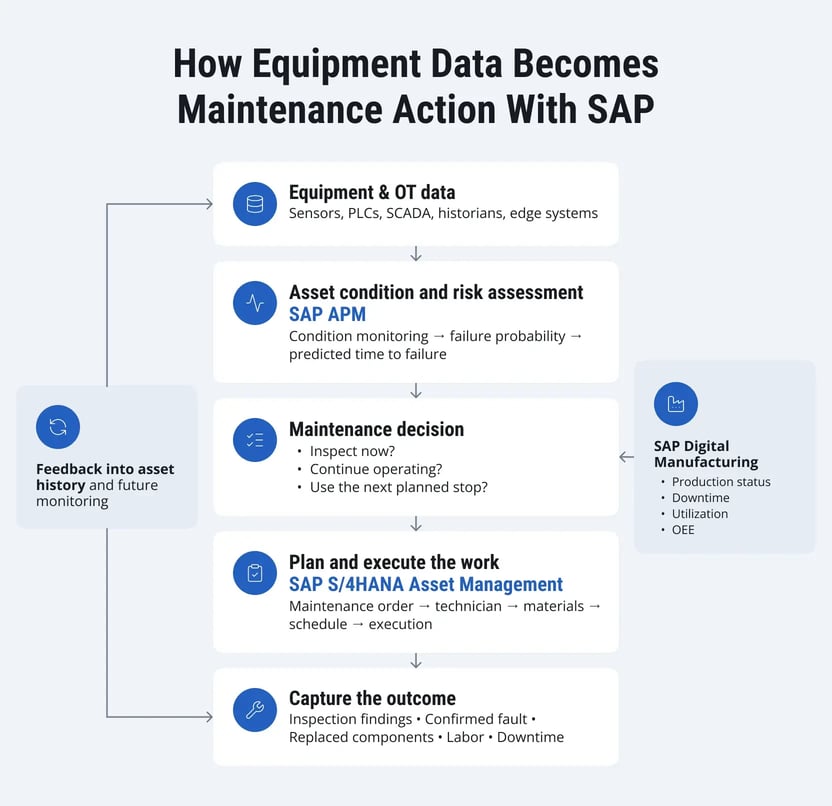
In an SAP-centered predictive maintenance setup, equipment and OT systems provide condition data from the shop floor. SAP Asset Performance Management (SAP APM) can help reliability teams assess asset health and determine where attention is needed, while SAP S/4HANA Asset Management supports the planning and execution of maintenance work. Depending on the manufacturing landscape, SAP Digital Manufacturing (SAP DM) can add production context such as downtime, utilization, and OEE. Together, the relevant applications connect asset condition with maintenance and production decisions.
The exact architecture will differ from plant to plant. Automotive manufacturers may already have historians, supervisory control and data acquisition (SCADA) systems, IoT platforms, edge devices, or other OT infrastructure in place. Those systems do not necessarily have to be replaced. The objective is to make relevant equipment data available to the applications and processes that use it.
SAP Asset Performance Management turns asset data into maintenance decisions
SAP APM can play a central role in predictive maintenance scenarios by helping reliability and maintenance teams assess asset health, risk, and criticality and determine which equipment needs closer attention.
The solution supports condition monitoring as well as risk and reliability analysis. Depending on the use case, teams can use rule-based monitoring to track asset conditions and Failure Curve Analytics to assess failure probability and estimate when a technical object may fail. These capabilities help reliability teams understand how asset condition is developing and whether a potential issue requires closer attention.
The results still require interpretation. A high failure probability, for example, does not automatically mean that a machine should be stopped immediately. Teams also need to consider asset criticality, the expected rate of deterioration, production requirements, available resources, and the consequences of delaying the work.
Information about asset criticality, failure modes, and reliability can help teams determine which maintenance approach is appropriate for a given asset and failure mode.
The important point is that SAP APM does not stop at identifying unusual equipment behavior. It helps reliability teams put that information into context and determine whether further action is justified.
SAP S/4HANA Asset Management turns the decision into work
Once a maintenance need has been identified, the next question is operational: what needs to happen, when, and with which resources?
SAP S/4HANA Asset Management supports that part of the process. A maintenance issue can be documented against the relevant technical object, and maintenance orders can then be used to plan and execute the work.
The order pulls together the practical details for the job: what needs to be done, which work center handles it, what materials are needed, the dates, and the expected cost. As the work gets done, technicians confirm what was actually completed and log the real effort and materials that went into it.
For an automotive plant, this is where an early warning actually starts to pay off. If a component shows signs of wear, the team can check whether the work fits into an existing production stop, whether the right technician is available, and whether a spare part needs to be pulled and ready ahead of time.
That handoff matters. Predictive analytics may indicate that a problem is developing, but S/4HANA Asset Management provides the structure for organizing the response.
Once the work is completed, maintenance findings and confirmations become part of the asset history. Comparing those outcomes with earlier warnings gives teams additional information for refining monitoring rules and future maintenance decisions.
SAP Digital Manufacturing adds production context
Maintenance planning often needs to account for what is happening on the production floor. When SAP Digital Manufacturing is part of the landscape, it can provide additional context about current and historical manufacturing performance. This can include equipment utilization, downtime, production status, speed losses, and OEE.
That context helps maintenance and production teams look at the same situation from different angles. A reliability engineer may see a developing equipment issue, while production teams can see whether the asset is currently running at full load, whether its performance has already started to decline, or whether an upcoming interruption offers a better window for maintenance.
SAP DM is therefore not the predictive engine in this architecture. Its role is to add shop-floor context so that maintenance decisions can be made with a clearer view of their production impact.
IoT and OT integration bring equipment data into the SAP process
Automotive plants rarely start with a blank technology landscape. Machine data may already be collected through programmable logic controllers (PLCs), SCADA platforms, equipment controllers, historians, edge systems, or third-party IoT platforms.
Those existing systems can remain part of the predictive maintenance architecture. For new SAP APM implementations, SAP recommends the Embedded IoT architecture for bringing time-series equipment data into the solution. Existing historians, SCADA platforms, IoT systems, and edge solutions can still remain part of the landscape, with relevant data integrated according to the plant’s architecture and use case.
This is especially important in automotive manufacturing, where a single site may contain equipment from different vendors and generations. Some machines provide detailed condition data natively. Others may require additional sensors or an edge gateway before useful information can be collected.
The integration design determines how relevant equipment data moves from these source systems into the SAP landscape. Depending on the architecture, this may involve direct interfaces, edge components, integration services, or existing industrial data platforms. The goal is to make the required time-series and contextual data available without unnecessarily duplicating or replacing systems that already perform a useful role.
Predictive Maintenance Use Cases in Automotive Manufacturing
Predictive maintenance is most useful where equipment condition can be observed before a failure starts to affect production. The exact signals and thresholds vary by machine design, operating conditions, and failure mode, but several automotive production areas lend themselves well to this approach.
|
Automotive asset |
Typical signals |
Potential indication |
Possible maintenance response |
|
Robotic welding cells |
Motor current, vibration, temperature, cycle time |
Bearing wear, servo degradation, and abnormal mechanical load |
Inspect or replace the affected component during a planned line stop |
|
Stamping presses |
Vibration, hydraulic pressure, temperature, force |
Bearing deterioration, hydraulic issues, and tooling wear |
Schedule inspection or component replacement before the press availability is affected |
|
Paint-shop equipment |
Pressure, airflow, temperature, and pump behavior |
Pump degradation, filter restriction, unstable process conditions |
Service the affected equipment before throughput or coating consistency begins to suffer |
|
Conveyor systems |
Motor current, vibration, belt speed, temperature |
Drive, bearing, alignment, or motor problems |
Repair the affected section before material movement becomes unreliable |
|
Computer numerical control (CNC) machines |
Spindle vibration, temperature, load, and tool data |
Spindle wear, tool degradation, and abnormal cutting conditions |
Coordinate maintenance or tool replacement with the production schedule |
|
Final assembly equipment |
Torque, motor load, cycle time, error codes |
Tool wear, actuator problems, and abnormal equipment behavior |
Correct the issue before it leads to repeated stoppages or process deviations |
The maintenance response will not be the same in every case. A change in vibration on a stamping press may justify an inspection during the next planned stop, while a rapidly worsening hydraulic condition may require earlier intervention. The value lies in having enough warning to choose the response rather than reacting after the equipment has already stopped.
This is especially important in automotive manufacturing because many assets sit inside tightly coordinated production flows. Keeping one robot, press, conveyor, or machining center available can help preserve the continuity of the operations that depend on it. Predictive maintenance gives teams another way to protect that continuity without treating every abnormal signal as an emergency.
From Pilot to Plant-Scale Predictive Maintenance
A pilot should validate more than model accuracy. Scaling it across a production area or multiple plants is a different challenge. At that point, the focus shifts from the model itself to repeatability, ownership, integration, and day-to-day use.
A good rollout does not simply connect more machines. It creates a practical way to introduce new use cases without rebuilding the process from scratch each time.
1. Set a clear target for the pilot
The first deployment should answer a specific business question. For example, can the plant detect a recurring spindle issue early enough to avoid emergency work? Can a press family be monitored in a way that gives maintenance more time to prepare for intervention?
That target becomes the basis for deciding whether the pilot is ready to move forward. Without it, teams may end up with an interesting technical result but no clear reason to expand it.
2. Design a reusable rollout pattern from the start
A pilot should solve the immediate use case while also creating a foundation that can be reused for similar assets or production areas. Otherwise, each new deployment risks becoming another one-off integration project.
Teams should identify which elements can be standardized early, such as:
- Data mappings and interfaces
- Asset and signal structures
- Alert routing and escalation rules
- Maintenance workflow templates
- Roles and decision points
- Reporting conventions and KPIs
The objective is not to make every plant or asset identical. Equipment, operating conditions, and production constraints will still vary. The reusable part is the underlying approach, so the next deployment can build on an established pattern instead of starting from scratch.
3. Define who owns the next step
Predictive maintenance touches several functions, and unclear ownership can quickly become a problem.
A reliability engineer may review the alert, a maintenance planner may decide what work is needed, production may have to release the equipment, and OT or IT teams may be responsible for the data connection. Those roles should be agreed upon before the use case moves beyond a pilot.
The same applies to escalation. Teams need to know which warnings require immediate attention, which can wait for review, and who has the authority to make that call.
4. Make sure the workflow works in practice
A pilot should prove more than technical accuracy. It should also show that the warning can move through the maintenance process without creating unnecessary manual work.
Can the right person see the alert? Is the information clear enough to act on? Can maintenance planning pick it up without re-entering the same data elsewhere? Can production make room for the intervention?
These questions often determine whether the solution becomes part of normal operations or remains something people check only when they have time.
5. Scale by asset family or production area
Once a use case has shown that it can provide useful warnings and support a practical maintenance response, the next step is to extend it where the same logic can be reused.
For example, a monitoring approach proven for one family of welding robots can be applied to similar robots in other body shop areas before the organization moves to a different class of equipment or production area. This allows teams to reuse data mappings, integration patterns, monitoring logic, and maintenance workflows while accounting for differences in equipment and operating conditions.
Expansion should follow demonstrated value rather than the number of machines that could technically be connected.
6. Build ownership beyond the project team
Once predictive maintenance becomes part of normal operations, it needs long-term ownership. Someone has to decide when a monitoring rule should change, how a new asset is added, who reviews performance, how integration issues are handled, and when a use case is no longer delivering enough value to continue supporting.
That usually requires coordination across maintenance, reliability, production, OT, and IT. Without that operating model, even a technically successful rollout can become difficult to sustain.
Measuring Predictive Maintenance Performance
A predictive maintenance program should be measured from two angles. First, is maintenance and production performance actually improving? Second, are the predictions useful enough to support those improvements?
Looking only at downtime or OEE gives an incomplete picture. A plant may see better availability for reasons unrelated to predictive maintenance, while a technically accurate model may still provide little value if its warnings arrive too late to act on.
Measure the operational impact
These KPIs show whether the maintenance process around the predictions is producing better results.
|
KPI |
What it shows |
|
Unplanned downtime |
How much production time is being lost to unexpected equipment stops |
|
Asset availability |
How much of the scheduled production time an asset remains available |
|
OEE |
How availability changes affect overall production performance alongside speed and quality |
|
Mean Time Between Failures (MTBF) |
Whether the equipment is operating longer between failures |
|
Mean Time to Repair (MTTR) |
How quickly equipment is returned to service after a failure |
|
Planned vs. unplanned maintenance |
Whether a larger share of maintenance work can be scheduled rather than handled as an emergency |
|
Emergency work orders |
Whether the unexpected maintenance demand is decreasing |
|
Maintenance cost per asset or production unit |
Whether reliability improvements are being achieved at an acceptable cost |
SAP Digital Manufacturing can contribute production-side measures such as OEE, downtime, and speed losses, while maintenance KPIs can be drawn from the relevant asset management and maintenance systems.
No single metric should be read in isolation. A higher MTBF may look positive, for example, but not if it comes with sharply higher maintenance costs or excessive component replacement. OEE can improve because of changes in production speed, quality, scheduling, or other plant initiatives, not necessarily because predictive maintenance alone is working.
Measure whether the predictions are useful
The second group of measures looks at the quality and timing of the warnings themselves.
|
Metric |
What to look for |
|
Prediction lead time |
Whether the warning arrives early enough to inspect the asset, obtain parts, and schedule the work |
|
False-positive rate |
How often alerts indicate a problem that is not subsequently confirmed by inspection or observed asset behavior |
|
Missed failures |
How often relevant failures occur without a useful warning |
|
Actionable alert rate |
How many warnings lead to a justified maintenance decision rather than being ignored or dismissed |
|
Model drift indicators |
Whether changes in equipment or operating conditions are reducing prediction accuracy over time |
These measures help reveal a problem that operational KPIs alone can hide. A model may identify deterioration correctly, but give maintenance only an hour of warning when the required part takes two days to obtain. Technically, the prediction was right. Operationally, it arrived too late.
Performance should also be compared against a meaningful baseline. Asset utilization, production volume, planned shutdowns, product mix, and maintenance practices can all change over time. Without that context, it is easy to credit predictive maintenance for improvements that came from somewhere else.
The strongest programs, therefore, track both sides of the equation: how well the prediction performs and whether it changes what happens on the plant floor.
LeverX Expertise in Predictive Maintenance for Automotive Manufacturing
Predictive maintenance projects tend to cross several boundaries at once. Maintenance teams understand how equipment fails. Production knows when that equipment can be taken offline. OT teams manage machine connectivity, while IT is responsible for the SAP landscape, integrations, data, and security. Bringing those pieces together is often more challenging than implementing any single technology.
LeverX approaches predictive maintenance from that broader manufacturing perspective. Our work can start with an existing maintenance environment, a defined predictive use case, or an early-stage idea that still needs to be tested against available asset data and business priorities.
Depending on the starting point, LeverX can support:
- Readiness and process assessment: We review asset structures, maintenance processes, available equipment data, integration points, and candidate use cases before making technology decisions.
- Implementation, scaling, and rollout support: Our experts configure the SAP applications required for the use case, which may include SAP APM, SAP S/4HANA Asset Management, and SAP DM, align them with the relevant maintenance and production processes, and take validated scenarios into production. We can then extend the approach across additional assets, production areas, or sites where it has proven effective.
- IoT and OT integration: LeverX connects SAP with plant equipment, historians, shop-floor systems, IoT platforms, and other sources without assuming that the existing OT landscape needs to be replaced.
- SAP Business Technology Platform (SAP BTP) and integration architecture: Our team designs the services, interfaces, extensions, and data flows needed to connect equipment information with SAP applications and surrounding systems.
- Analytics and AI: We develop or integrate analytical capabilities where the use case calls for more advanced prediction, while keeping the model tied to a defined maintenance decision.
- Ongoing optimization and support: We adjust integrations, processes, monitoring logic, and SAP applications as equipment and operational requirements change.
Our automotive SAP practice adds another important layer: understanding how maintenance decisions fit into a production environment where asset availability, material flow, quality, and line schedules are closely connected.
The objective is to build a predictive maintenance process that works beyond the analytics layer. Equipment information has to reach the right SAP process, maintenance teams need a practical way to respond, and the resulting work has to fit the realities of automotive production.
Conclusion
Equipment failures will always be part of automotive manufacturing. What manufacturers can change is how much warning they have before a failure affects production and how prepared the organization is to respond. Predictive maintenance creates that earlier decision point by connecting changes in asset condition with maintenance priorities and production constraints.
SAP helps turn that warning into a workable process. SAP APM provides insight into asset health and failure risk, while the wider SAP landscape connects those insights with maintenance planning, production information, and execution. The real value lies in having enough time to inspect the equipment, prepare the work, and intervene at a point that makes sense for both maintenance and production.