SAP connects engineering, planning, manufacturing, logistics, quality, finance, and after-sales processes across automotive OEM operations.
An automotive OEM has to preserve the connection between thousands of decisions made across product development, sourcing, production, and service. A change to an electronic control unit may affect the engineering bill of materials, supplier releases, plant instructions, testing requirements, vehicle configuration, product cost, and future repairs. When each department updates its own system or spreadsheet, the organization can lose that connection before the revised vehicle reaches the line.
Transitioning to electric platforms forces automakers to coordinate a host of new variables, from high-voltage components and battery technology to updated testing protocols. IEA data shows that in 2025, plug-in hybrids and battery-electric cars represented a quarter of global new-car sales and about 10% domestically in the U.S. Because of this market shift, OEMs must oversee these emerging supply networks without abandoning their internal-combustion lines. Managing software versions complicates this further, because each deployment must correspond directly to the vehicle’s specific hardware setup and service background.
An integrated digital landscape with governed data can give these decisions a shared operational context. SAP solutions for automotive OEMs can connect product data, material plans, supplier commitments, production orders, warehouse tasks, freight movements, quality records, costs, and service information. Automotive ERP software records the central transactions, while product development, manufacturing, logistics, and partner applications add the details needed to execute them. The practical value comes from the handoffs between those processes.
The Role of OEMs in the Automotive Industry
Automotive OEMs define the vehicle program and approve the final configuration. They coordinate the work needed to launch each model and keep it serviceable after delivery. Suppliers may develop batteries, seats, braking systems, electronic assemblies, or complete modules. The OEM remains responsible for combining those parts into a vehicle that meets technical and regulatory requirements in every market where it will be sold.
The work begins long before a production order reaches the plant. Engineering teams convert product structures into manufacturing bills of materials, routings, and production versions. Plant preparation also covers work-center data, inspection plans, tooling, packaging instructions, and rules for line-side supply. Procurement establishes approved sources and scheduling agreements. Finance tracks target costs and capital spending, while service teams prepare spare-parts structures and repair documentation before customer deliveries begin.
Changes continue after launch and throughout series production. An OEM may approve a substitute supplier, correct a quality issue, revise a component to reduce cost, adapt the model for another region, or release new software. Every change needs effective rules that identify the plants, production orders, components, and individual vehicles involved. Poor control at this stage can leave a plant building one configuration while service and warranty teams refer to another.
Electrified powertrains add battery traceability, high-voltage safety controls, and additional test procedures. Cell and pack records need links to supplier lots, assembly operations, and test results. Power electronics, thermal systems, and charging hardware also introduce different sourcing and inspection requirements. When battery-electric, hybrid, and combustion-engine models share a production network, planners must balance material availability and line capacity while maintaining the required model sequence.
Software follows a separate lifecycle from the physical vehicle. Source code repositories, continuous integration pipelines, cybersecurity testing, and over-the-air release tools usually remain within specialist engineering environments. Enterprise systems still require the approved software version, hardware dependencies, release status, cost impact, and service applicability. Clear ownership and lifecycle rules reduce the risk of teams working from conflicting records. The same vehicle program may also require different suppliers, prices, localized content, and compliance records by market, often with less time between design release and start of production.
Business Challenges Facing Automotive OEMs
Automotive manufacturing problems rarely stay inside one function. A supplier delay becomes a planning issue, then a warehouse issue, then a production and financial issue. The table below shows where the most common dependencies arise.
|
Challenge |
Why it becomes difficult |
Typical operational effect |
|
Vehicle variants and engineering changes |
Multiple drivetrains, trims, markets, and software versions require controlled effectivity across product structures and plants |
Obsolete inventory, wrong-build risk, rework, and launch delays |
|
Multi-tier supplier coordination |
Capacity, inventory, quality, and shipment data may stop at the first supplier tier or arrive through disconnected channels |
Material shortages, premium freight, larger safety-stock buffers, and line stoppages |
|
Demand and capacity volatility |
Product mix may change faster than tooling, labor, supplier capacity, or transportation contracts |
Unstable schedules, missed orders, excess inventory, and margin pressure |
|
Just-in-time (JIT) and just-in-sequence (JIS) supply |
Sequence data, packaging, truck arrivals, warehouse staging, and line delivery must remain synchronized |
Sequence errors, dock congestion, and line-side shortages |
|
Product quality and genealogy |
Supplier lots, serial numbers, process parameters, inspection results, and vehicle identities must be linked reliably |
Slow root-cause analysis, excessive containment, and higher warranty costs |
|
Equipment availability |
Closely linked production stages leave little room for unplanned downtime |
Lost throughput, failure to meet takt time, overtime, and recovery costs |
|
Software and hardware configuration |
Software versions depend on specific electronic components and approved vehicle configurations |
Incompatible releases, incomplete service histories, and compliance risk |
|
Sustainability and material traceability |
Emissions, recycled content, and material origin data come from several companies and systems |
Manual reporting, weak audit trails, and delayed responses to customers or regulators |
|
Regional competition and compliance |
Trade rules, local-content requirements, customer demand, and product regulations vary by market |
Sourcing changes, additional product variants, margin pressure, and launch delays |
|
Legacy applications and inconsistent data |
Global OEMs often run several ERP, PLM, MES, EDI, warehouse, and plant systems |
Duplicate records, manual reconciliation, and slow response to change |
Consider a shortage of one electronic component. Procurement receives a partial supplier commitment. Planners must decide which models and plants receive the available stock. Production sequencing changes. Warehouses revise staging priorities. Transportation teams may need an expedited shipment. Finance evaluates the cost of premium freight against the margin and delivery risk of the affected vehicles. A standalone spreadsheet may document the allocation decision without propagating it consistently to downstream processes.
JIT and JIS operations expose the same weakness at higher speeds across the automotive supply chain. A component may already be on the factory site and still fail to reach the line because the handling-unit label, unloading point, or sequence reference does not match the production requirement. Reliable execution depends on shared identifiers, monitored interfaces, and clear ownership of exceptions.
Quality investigations also depend on connected records. When a part fails, the OEM needs to find the supplier lot, vehicles containing the part, assembly conditions, inspection results, rework history, shipment status, and warranty exposure. Missing genealogy expands the investigation and can force the company to contain far more vehicles than the defect actually affects.
How SAP Supports Automotive OEM Operations
SAP for the automotive industry can provide a common business layer around engineering, planning, execution, and financial processes. Each application keeps a defined role, while integration preserves the context of a change, order, or event as it moves through the organization. SAP positions its automotive portfolio across research and engineering, manufacturing, supply chain management, sales, service, and mobility processes.
Connecting engineering changes with production
SAP’s product lifecycle management portfolio, including SAP Integrated Product Development, supports requirements, enterprise product structures, product data integration, configuration management, testing, and controlled handover to downstream processes. Approved information can move into the SAP S/4HANA-based ERP core, where plants use it in material masters, manufacturing bills of materials, routings, production versions, procurement records, quality plans, and product costing.
Most OEMs already have established CAD, PLM, simulation, and software-engineering platforms. A sound architecture gives those specialist systems clear ownership and transfers released structures, revisions, effectivity dates, configuration rules, and approval status into the processes affected by the change.
A controlled engineering release should answer practical questions before production adopts it. Which plants and suppliers use the affected component? Can the current inventory still be consumed? Do open scheduling agreements need an update? Does the inspection plan change? Which sequenced vehicles retain the previous revision? What happens to service parts and repair instructions? Workflow and integration should carry those decisions with the released change.
Linking demand, capacity, and supplier commitments
SAP Integrated Business Planning for Supply Chain supports demand, inventory, response, and supply planning, sales and operations planning, and scenario analysis. OEM planners can test the effect of demand changes, material shortages, and capacity limits before an approved plan moves into operational execution.
SAP Business Network Supply Chain Collaboration extends selected planning and procurement processes to suppliers and contract manufacturers. OEMs can share forecasts, receive supplier commitments, exchange orders and shipping information, view inventory, and collaborate on quality issues. Capacity data and alerts on component commitments help planners identify a gap before the shortage reaches the plant.
Supplier governance remains necessary after network integration. Units of measure, location identifiers, planning horizons, tolerances, message formats, and response deadlines need agreed definitions. Suppliers may connect through EDI, APIs, or network portals based on transaction volume, technical maturity, process criticality, and the OEM’s onboarding model. These channels should feed the same planning process and exception rules.
Coordinating production and shop-floor execution
The SAP S/4HANA-based core manages manufacturing master data, material requirements, production orders, goods movements, quality transactions, costs, and financial postings across OEM manufacturing operations. Deployment and functional scope depend on the selected edition and release. SAP Cloud ERP Private, for example, documents support for core production planning, SAP Production Planning and Detailed Scheduling, production engineering and operations, quality management, and several manufacturing models, including just-in-time processes.
SAP Digital Manufacturing adds manufacturing operations management for dispatching work, guiding operators, collecting production data, tracking labor, managing skills, handling quality and rework processes, and monitoring plant performance. Its integration with planning, inventory, maintenance, and logistics helps operations teams act on a revised schedule with the relevant material and resource context.
An OEM may keep an existing MES for certain plants or production technologies. The architecture should state where production orders originate, where detailed dispatching occurs, how equipment and quality data are collected, which confirmations return to ERP, and who resolves failed messages. This prevents two systems from claiming authority over the same order status.
The same discipline applies to machine data. A torque result connected to a specific vehicle and assembly operation may require long-term retention. A high-frequency vibration stream can remain in an operational data platform, with only an anomaly, health score, or maintenance request passed into enterprise applications. Sending every sensor value to ERP creates volume without improving business decisions.
Synchronizing warehouses, transportation, and line supply
SAP Extended Warehouse Management supports receiving, storage, handling units, kitting, production staging, internal movements, packing, shipping, and mobile warehouse work. SAP documents integration with production, inbound, and outbound transportation and yard processes. For an OEM, that connection helps coordinate supplier deliveries, supermarkets, route trains, production supply areas, and returns of empty containers.
SAP Transportation Management supports transportation demand, routing, planning, carrier processes, freight execution, costing, and settlement. It can cover inbound components, interplant flows, finished vehicles, and service parts.
In SAP S/4HANA and SAP Cloud ERP Private environments where the required integration is supported, SAP Business Network Global Track and Trace can bring carrier and visibility-provider events into shipment and order tracking. SAP TM supplies the transportation context, while actual location updates come from external event sources. The available integration should be checked for the specific ERP deployment and release.
Sequence-sensitive production requires more than an optimized route. Packaging hierarchies, handling-unit labels, unloading points, dock slots, line-side locations, and exception scans determine whether the right component reaches the correct station on time. Warehouse and transportation designs should use the same material, location, and sequence references as production.
Connecting maintenance with production priorities
SAP S/4HANA Asset Management supports maintenance planning, scheduling, work orders, spare parts, and asset history. SAP Asset Performance Management adds risk assessment, equipment-behavior analysis, and predictive maintenance capabilities based on sensor and maintenance data. Reliability teams can compare a failure risk with the available production window, technician capacity, and spare parts position before scheduling work.
That connection matters in highly interdependent lines. Replacing a component too early consumes maintenance budget and production time. Waiting too long can stop several downstream stations. A useful maintenance workflow gives the planner access to condition, risk, schedule, labor, material, and cost data within the same decision.
Production and maintenance activity also reaches finance. Material consumption, labor, scrap, rework, equipment time, freight, inventory, and warranty costs affect vehicle and program economics. Consistent postings allow controllers to analyze actual cost and production variance without rebuilding operational data at period end.
Carrying product data into after-sales service
Depending on the selected landscape and scope, OEMs can manage registered products and warranty coverage in SAP Service Cloud Version 2 and process warranty claims in SAP S/4HANA. SAP S/4HANA Supply Chain for extended service parts planning can support aftermarket parts demand, inventory, and supply planning.
Vehicle delivery does not end the information lifecycle. After-sales teams need the as-built configuration, installed software, component genealogy, warranty conditions, and compatible service parts. Those records help determine which vehicles require a repair, which replacement part fits, and whether a claim falls within warranty coverage.
Field failures should travel back to quality and engineering. When warranty data includes the exact vehicle, component, software version, and production history, teams can compare failures across suppliers, plants, and configurations. That feedback helps narrow corrective action and gives future engineering changes a stronger evidence base.
SAP Solutions for Automotive OEMs: Roles at a Glance
Product data, production orders, shipment events, and warranty records pass through several systems in an automotive OEM landscape. Before teams build the interfaces, they need to decide which system owns each record and when that ownership changes. The answer may differ for the engineering view, manufacturing view, and as-built record.
|
Capability area |
Systems and SAP solutions |
Typical role in the OEM landscape |
|
Digital core |
SAP Cloud ERP, SAP Cloud ERP Private, or SAP S/4HANA on premises |
Records purchase orders, production orders, inventory movements, quality decisions, maintenance work, sales transactions, and financial postings |
|
Product development, planning, and supplier collaboration |
SAP Integrated Product Development, SAP IBP for Supply Chain, and SAP Business Network Supply Chain Collaboration |
Carries approved product data into planning, develops demand and supply scenarios, and exchanges commitments and exceptions with suppliers |
|
Plant and logistics execution |
SAP Digital Manufacturing or an existing manufacturing execution system, SAP EWM, SAP Transportation Management, SAP Business Network Global Track and Trace, SAP S/4HANA Asset Management, and SAP Asset Performance Management |
Coordinates production, warehouse, transportation, and maintenance work and returns confirmations, delays, and logistics events for replanning |
|
Integration, extensions, and data |
SAP BTP, SAP Integration Suite, and SAP Datasphere in SAP Business Data Cloud |
Connects SAP and third-party systems, supports approved extensions, and makes validated business data available for reporting and analytics |
|
After-sales service |
SAP Service Cloud Version 2, warranty claim management in SAP S/4HANA, and SAP S/4HANA Supply Chain for extended service parts planning |
Maintains registered-product data, processes warranty claims, and plans aftermarket parts demand, inventory, and supply |
|
AI and decision support |
Helps users investigate exceptions, retrieve relevant business context, and act on recommendations within supported SAP processes |
|
|
Sustainability and carbon accounting |
SAP Sustainability Footprint Management and SAP Green Ledger |
Calculates product and corporate footprints and allocates carbon data to financial dimensions when the solutions are integrated |
The table provides a reference for solution design. An OEM may need only part of this portfolio. The final combination depends on its ERP deployment, existing plant systems, required processes, integration boundaries, and licensed capabilities.
Digital Transformation Strategies for Automotive OEMs
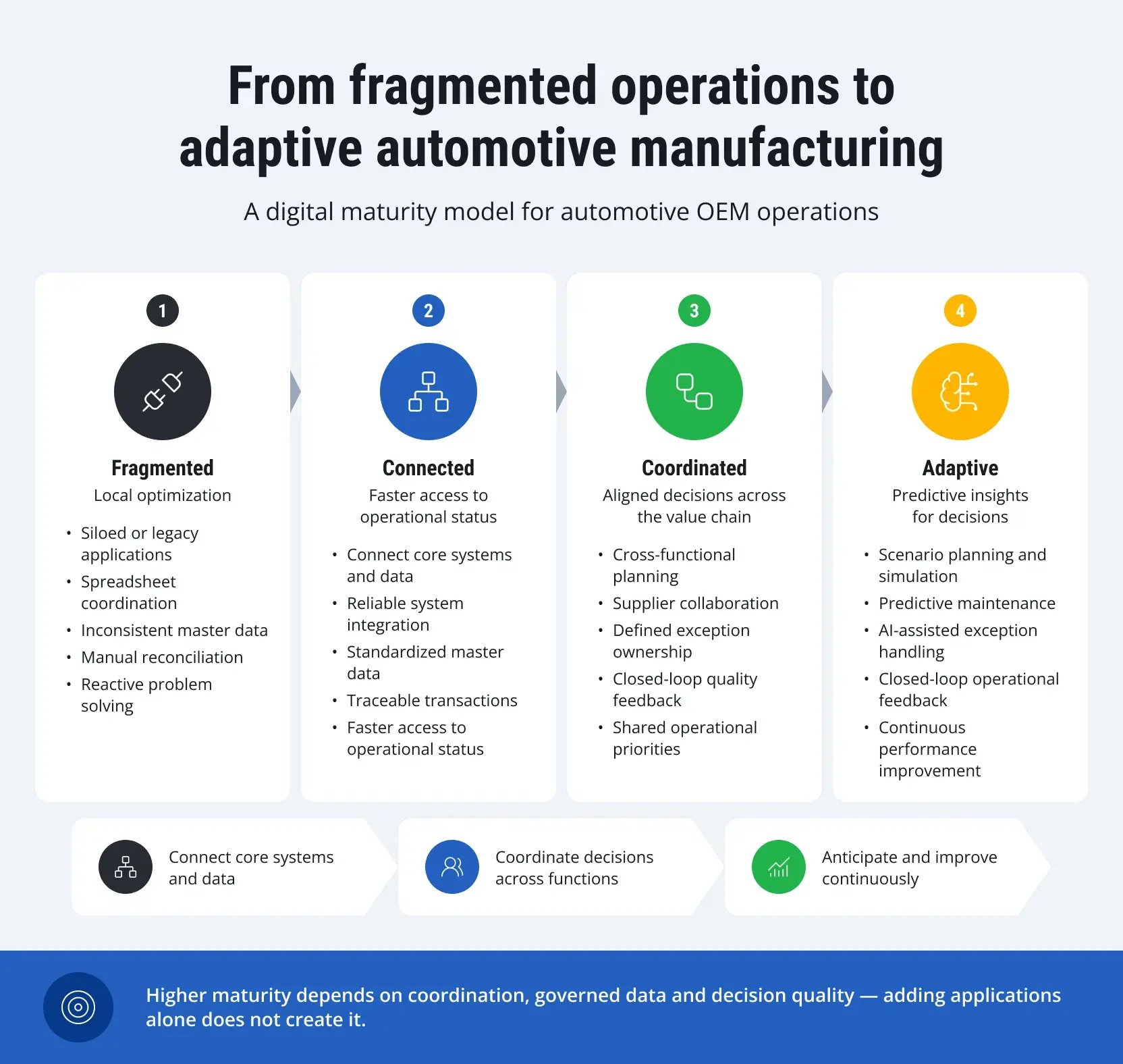
For most large OEMs, redesigning every process and system in one program creates unacceptable delivery and operational risk. The program needs a sequence that produces operational evidence early and protects the wider architecture from another wave of local fixes.
1. Start with costly decisions and broken handoffs
Select a small set of decisions where poor information already carries a visible cost. Common examples include replanning after a supplier shortfall, releasing an engineering change, containing a defect, approving premium freight, or scheduling maintenance before a predicted failure.
For each decision, record the trigger, required data, owner, current response time, available actions, cost exposure, and success measure. This work gives the integration team a concrete scope. A product list alone leaves those operating questions unanswered.
2. Define systems of record and data ownership
Define the authoritative system for each business object, business view, and lifecycle state, together with the rules for approval, replication, and correction. The list usually includes engineering structures, manufacturing bills of materials, materials, suppliers, locations, production versions, vehicle identities, quality results, assets, and shipment events.
IT can implement validation and workflow. Business teams still have to decide whether two supplier part numbers represent the same approved component, when a revision becomes effective, and which plant owns a correction. Automation amplifies weak master data just as efficiently as it amplifies good data. Prioritize data according to operational risk. An obsolete address in an inactive record can wait. An incorrect packaging quantity used for line supply cannot.
3. Build the digital thread around effectivity
Many digital-thread programs focus on transferring product structures. Automotive execution also needs the logic that says when and where a structure applies. A practical pilot can follow one product family from engineering release through sourcing, planning, production, genealogy, and service. The pilot will expose the places where effectivity lives outside the formal system: a spreadsheet that maps software to hardware, a local rule for consuming old inventory, or a manual step that changes work instructions after the BOM release. Resolve those gaps before scaling the template. The result provides a repeatable process. An architecture diagram alone cannot do that.
4. Design a connected factory around exceptions
Connected factories need timely production, quality, labor, warehouse, and maintenance information. Move machine data into enterprise applications when it supports an operational decision, traceability requirement, compliance obligation, or defined analytical use case. High-frequency raw signals can remain in the appropriate operational data platform unless broader retention is justified.
Classify plant events by business consequence. A rejected quality result may block a vehicle and open a nonconformance. A performance trend may create a maintenance recommendation. A minor sensor fluctuation may remain in the operational platform. This classification keeps interfaces manageable and helps supervisors focus on events that require a decision. It also clarifies offline procedures, message replay, and reconciliation after an outage.
5. Match integration latency to the decision
Machine safety functions must remain in validated safety-related control systems, with response times defined through hazard and risk analysis. Enterprise applications can receive the resulting event for traceability, maintenance, and operational follow-up. Non-safety line-stop risks may require second-level or minute-level integration, depending on the process.
Treating every connection as real-time raises infrastructure and support costs without an equal operational gain. Architecture teams should define latency, failure handling, duplicate prevention and monitoring for each business event. Plant employees also need a fallback process that works during a network or application outage.
6. Use digital twins for a specific decision
A digital twin may represent a vehicle configuration, production asset, warehouse flow, or transportation process. SAP Integrated Product Development can combine engineering models and business data for product digital twins. For other scenarios, the architecture should identify the application that owns the operational model and the process that consumes its results.
Product teams may use a digital twin to assess an engineering change. Reliability engineers may compare equipment condition with maintenance history to evaluate failure risk. Logistics teams may simulate space, resource, or flow constraints. Each model should support a defined decision, analysis, or operational action, with an accountable owner, update logic, and success measure. Without that connection, the model risks becoming an underused visualization layer.
7. Apply AI with operational controls
Useful AI scenarios start with a decision and a reliable dataset. Supply-risk models need supplier, demand, and lead-time history. Visual inspection needs labeled defects, confidence thresholds, and a route for human reinspection. Predictive maintenance needs enough failure and condition data to separate a useful warning from noise.
Generative assistance should show the source record, respect authorizations, and log any changes made to business data. Production and quality teams also need an override process. An algorithm may recommend a schedule change or line stop; the organization still has to define who approves it and what happens when the recommendation conflicts with safety, quality, or customer priorities.
Measure each use case against an existing baseline. Useful metrics include time to resolve an exception, false-positive rate, planner touch time, avoided downtime, and scrap prevented. Broad claims about faster decisions provide little evidence after go-live.
8. Protect the core and scale through a plant template
Use standard processes where they meet the requirements. A Clean Core strategy selects the least disruptive extension option that meets the requirement. Depending on the use case and deployment model, this may involve key-user extensibility, on-stack development with ABAP Cloud, or side-by-side extensions on SAP BTP using released APIs and events. Custom sequence logic, label formats, scanning flows, and equipment integrations may remain necessary, but each object should have an owner, business reason, dependency list, test coverage, and retirement plan.
A global plant template should define core processes, master data, integrations, controls, KPIs, and support procedures. Local teams can document justified differences caused by legal requirements, labor agreements, plant equipment, supplier formats, or physical layout.
Rollout plans also need practical details: scanners, printers, RF coverage, labels, open orders, cutover inventory, shift-based training, offline work, and support during production hours. Conference-room testing should be followed by shift-based operational testing under realistic warehouse, plant, and network conditions.
9. Extend governance beyond the OEM
Cross-company visibility requires agreements on data ownership, access rights, confidentiality, identifiers, correction procedures, and response obligations. The issue becomes harder beyond the first supplier tier, where smaller companies may have limited integration capacity and valid concerns about exposing customers, capacity, or proprietary process data.
SAP Industry Network for Automotive provides Catena-X-ready packages for automotive collaboration, traceability, and sustainability use cases. The technology supports interoperable data exchange; commercial trust and data-use policy still require explicit governance between participants.
Our Experience in SAP Automotive Transformation
At LeverX, we work with vehicle manufacturers and automotive suppliers on SAP programs covering production planning, manufacturing logistics, warehouse execution, finance, product data, integration, and analytics. We begin by tracing the operational handoffs that create the most risk, such as a revised sequence, line-side shortage, engineering change, or failed message between plant and enterprise systems.
For a leading vehicle developer and manufacturer, we worked on an SAP S/4HANA for Manufacturing Logistics implementation designed to coordinate material movement between the warehouse and production line according to the production sequence. The scope covered routes, route groups, stops, loading lanes, tours, radio frequency (RF) loading and unloading, SAP EWM integration, and SAP Fiori applications for tour monitoring. Because implementation was still in progress, the published case includes no finalized performance improvements.
In another SAP EWM project for a global automotive manufacturer, we configured and extended inbound, outbound, and packaging processes. The work included mobile RF transactions, custom ABAP programs, Business Add-In (BAdI) implementations, and integration with the wider SAP landscape to support production synchronization.
On the supplier side of the OEM network, a broader SAP S/4HANA transformation for a large automotive parts manufacturer connected production planning, procurement, SAP EWM, finance, sales, master data, and an existing manufacturing execution system (MES). After go-live, the client reported a 4% reduction in production cycle time, a 3% decrease in warehouse inventory days, a 10% reduction in losses associated with component shortages, and a 5% increase in on-time deliveries. These results reflect the client’s baseline, scope, and operating conditions.
Across these engagements, we repeatedly encountered several practical priorities: observe the real plant process, define ownership of business data, assign clear integration responsibilities, and test exception paths. Architecture workshops become far more useful after the team has followed a shortage, handling unit, or production change through the actual operation. More examples are available in our automotive case study portfolio.
Business Benefits of SAP for Automotive OEMs
A credible business case links each technology capability to an operating mechanism and a KPI. Targets should come from the OEM’s own volumes, costs, and service levels.
|
Business area |
How value can be created |
KPIs to track |
|
Engineering and launch |
Controlled handover of approved changes into sourcing, manufacturing, quality, and service |
Engineering change cycle time, engineering releases accepted without correction, late-change count, and launch-readiness milestone completion |
|
Planning |
Coordinated demand, material, capacity, inventory, and financial scenarios |
Forecast value added, schedule stability, constrained demand value or volume, and planning cycle time |
|
Supplier collaboration |
Earlier access to commitments, capacity gaps, shipment status, and quality issues |
Supplier on-time in-full (OTIF), commitment accuracy, advanced shipping notice (ASN) accuracy, shortage count, and expedited freight spend |
|
Manufacturing |
Better dispatching, material readiness, and response to plant exceptions |
Schedule adherence, throughput, cycle time, overall equipment effectiveness (OEE), and changeover time |
|
Quality and traceability |
Faster identification of affected vehicles, components, and process conditions |
First-pass yield, scrap rate, rework rate, defects per million (PPM), containment time, and genealogy completeness |
|
Warehouse and transportation |
Better staging, inventory control, dock coordination, and freight planning |
Inventory days, dock-to-stock time, line-side shortage incidents, pick accuracy, and freight cost per vehicle |
|
Asset management |
Maintenance decisions based on condition, risk, schedule, labor, and parts |
Unplanned downtime, mean time between failures (MTBF), maintenance schedule compliance, emergency maintenance share, and spare-parts availability |
|
Finance |
More consistent product cost, inventory value, and period-end data |
Production cost variance, working capital, financial close cycle time, and margin by vehicle or program |
|
After-sales service |
Better use of vehicle configuration, service parts, and warranty records |
Warranty claim cycle time, warranty cost per vehicle, parts fill rate, and first-time fix rate |
|
Sustainability |
More complete supplier, material, and emissions records |
Footprint data completeness, supplier response rate, calculation cycle time, and audit exceptions |
Benefits should also be reviewed across functions. Lower inventory can increase shortage risk when supplier commitments remain unreliable. Higher equipment utilization can reduce maintenance windows. Faster engineering changes can create obsolete stock. Shared definitions, cross-functional ownership, and jointly reviewed targets can expose those trade-offs before cost or risk shifts from one department to another.
The measurement plan should be ready before implementation. Define the baseline, data source, calculation owner, and reporting frequency for every promised result. Without that discipline, genuine improvements may remain difficult to verify, while attractive dashboards say little about actual business impact.
Conclusion: Establishing a Connected Operating Model for Automotive OEMs
To succeed, automakers must ensure that engineering, finance, external suppliers, and plant operations are all making decisions based on the same data. SAP enables this connected approach by linking the core ERP with product development, manufacturing execution, and logistics operations. The ecosystem also layers in essential tools like asset management, secure data governance, and applied business AI. However, any system transformation must start with a tangible business problem — whether that is a disconnected process that halts assembly, drives up expenses, or compromises part traceability. From there, the OEM can establish trusted data, define system responsibilities, connect the required applications, and measure changes under real operating conditions. That foundation gives OEMs more control over new vehicle programs, software releases, supplier disruptions, and mixed production networks without relying on another layer of manual reconciliation.