See how SAP S/4HANA connects demand, materials, capacity, production, and supplier data to support more reliable automotive production planning.
A vehicle assembly plant might secure enough total capacity for the month yet still fail to meet tomorrow's shift target. A single delayed seat assembly, an overloaded paint shop, or a sudden sequence change on the main line disrupts schedules that appeared completely feasible just forty-eight hours prior.
Planners coordinate thousands of physical components across distinct manufacturing stages. They balance incoming supplier shipments and fixed floor constraints against an actively shifting mix of customer orders. Vehicle configuration introduces massive variation into this daily workflow. Distinct engine blocks, battery packs, regional electronic packages, and custom paint colors demand unique material setups and assembly tasks, even as completely different cars move down the exact same conveyor belt.
SAP S/4HANA embeds scheduling directly into the active transaction data. Current demand, inventory, and planned receipts, configured work-center capacity, and open procurement requirements can be considered within connected planning processes in SAP S/4HANA. Data from external planning, manufacturing, and supplier systems can also feed these processes when the required integrations are in place. This continuous data exchange eliminates the reliance on detached spreadsheets and delayed batch uploads.
Depending on the planning and execution scope, manufacturers may complement SAP S/4HANA with SAP Production Planning and Detailed Scheduling (SAP PP/DS) for detailed production planning and scheduling, SAP Integrated Business Planning for Supply Chain (SAP IBP) for broader demand and supply planning, SAP Digital Manufacturing for shop-floor execution and resource orchestration, SAP Extended Warehouse Management (SAP EWM) for warehouse execution and production staging, and SAP Business Network for Supply Chain for supplier collaboration.
The actual technical scope depends heavily on the specific SAP S/4HANA edition, exact release version, the factory's operating model, and active software licenses. IT and operations departments document these precise parameters prior to drafting a final system architecture.
Why Production Planning Is Critical in Automotive Manufacturing
Automotive plants run under tight dependencies. Final assembly depends on components arriving in the correct quantity and, in many cases, at a precise time or in a prescribed sequence. Upstream processes such as stamping, body construction, painting, and subassembly production have their own capacities, cycle times, and constraints.
A forecast revision can affect purchased components weeks before the corresponding vehicles enter production. A short-term sequence change may require a faster response from internal logistics, warehouse teams, and suppliers. A capacity problem at one work center can alter the feasible schedule for several product variants.
The planning problem has also become harder as automotive portfolios have diversified. Many manufacturers now manage conventional powertrains, hybrid models, and electric vehicles within overlapping supply networks. Components with long replenishment times can sit alongside parts sourced through frequent JIT deliveries. Electronics and battery-related supplies introduce further dependencies that planners must consider when deciding what can actually be produced.
Planning accuracy directly affects how reliably manufacturers can use constrained capacity, protect production sequences, control inventory, and respond to changes in vehicle demand. Plants that identify material or capacity conflicts earlier have more options to adjust the plan before those constraints affect output or delivery schedules.
JIT and JIS leave little tolerance for planning errors
Automotive manufacturing makes extensive use of just-in-time and just-in-sequence processes. Under JIT, components arrive close to the point when production needs them, limiting line-side inventory. JIS adds a sequencing requirement: configured components may need to reach the assembly line in the same order as the vehicles that require them.
For manufacturers replenishing their own production, SAP S/4HANA supports JIT Supply to Production scenarios in which production requirements trigger replenishment from an internal warehouse or an external supplier. JIT calls can specify the required material, quantity, date and time, destination production supply area, and other information needed to coordinate supply with production. Sequenced JIT/JIS processes can also link component replenishment to the vehicle production sequence. The available process scope depends on the SAP S/4HANA edition, release, and surrounding logistics architecture.
A sequence change can quickly affect several functions. If production moves a vehicle while the warehouse or supplier continues working against an earlier sequence, the plant may have enough components overall but lack the required component at the line when it is needed. Production planning, supplier communication, and intralogistics need to work from aligned requirements and sequence information.
Common Production Planning Challenges in the Automotive Industry
Most automotive planning problems start long before a production order reaches the line. The visible disruption may occur in assembly, while the underlying cause can sit in demand planning, master data, procurement, capacity assumptions, or supplier collaboration.
Material shortages
One unavailable component can block a much more valuable finished vehicle. Planners need to understand upcoming shortages early enough to respond through expediting, alternative sourcing, approved substitute components, production resequencing, or changes to the build plan.
A simple inventory balance rarely provides enough information. The planner also needs dates, confirmed receipts, dependent requirements, and the relationship between material availability and scheduled production.
Demand and order mix changes
Forecasts can become outdated when model demand, option take rates, regional requirements, or launch assumptions change faster than planning cycles. Aggregate demand may remain stable while the mix changes significantly. Production planning software has to translate these changes into updated material and capacity requirements at the product and variant level.
Production bottlenecks
Different parts of an automotive plant operate under different constraints. Paint capacity may depend on color sequencing and changeovers. Assembly resources may face shifts or labor restrictions. Specialized equipment can limit the output of particular variants.
MRP can determine required supply, but a material-feasible plan does not automatically become a capacity-feasible schedule. Resource loads, shifts, setup requirements, and sequencing constraints can still make the proposed production plan difficult or impossible to execute as scheduled.
Scheduling conflicts
Production orders compete for equipment, people, tools, and time. Changes made to solve one problem can produce another downstream. A planner may move an order because one component will arrive late, only to place it into a period when the required work center already carries an excessive load. Effective scheduling requires planners to examine these dependencies together.
Inventory imbalance
Automotive plants can experience shortages and excess inventory at the same time. Safety stock added indiscriminately may protect some operations while increasing working capital and storage requirements elsewhere. Low inventory targets can create the opposite problem if replenishment times, supplier reliability, or production variability are poorly represented in planning data. Inventory decisions work best when they reflect actual demand, lead times, production schedules, and supply constraints.
Limited visibility between planning and execution
A production plan starts losing value when actual shop-floor conditions diverge from it without timely feedback. Machine downtime, slower cycle times, quality holds, labor constraints, and execution delays can change the feasible plan during a shift. When this information stays outside planning processes, planners continue making decisions from assumptions that no longer describe the plant.
How Automotive Production Planning Works in SAP S/4HANA
Within the broader SAP S/4HANA manufacturing environment, production planning connects demand with procurement, manufacturing, inventory, and related logistics processes. Production Planning (PP) capabilities in SAP S/4HANA cover material requirements planning, production master data, planned orders, manufacturing orders, capacity-related processes, and integration with production execution. The specific functions available vary across SAP S/4HANA deployment models and releases.
Demand creates the planning requirement
Production planning can start from planned independent requirements, sales requirements, or other demand signals, depending on the manufacturing strategy. For repetitive manufacturing, SAP documentation describes planned independent requirements and sales orders as core inputs. When available inventory cannot cover the requirement, MRP can generate planned orders that contribute to the production plan.
In automotive environments, requirements may also originate from scheduling agreements, customer schedules, and other industry-specific processes. The important point for planners concerns traceability. Demand should feed the material and production plan without repeated manual conversion between systems.
MRP determines what needs to be supplied
Material requirements planning compares demand with available and expected supply. Using master data and planning parameters, MRP evaluates what the plant needs and when. Depending on procurement settings and the planning situation, SAP S/4HANA can create procurement proposals such as planned orders or purchase requisitions. Planned orders can later be converted into manufacturing orders or procurement documents as appropriate.
For an automotive manufacturer, this calculation can span finished vehicles, major assemblies, and large component structures. BOM accuracy, lead times, lot-sizing settings, procurement types, and production versions directly influence the quality of the resulting plan. Fast calculation alone cannot compensate for incorrect planning data.
Production versions connect materials with manufacturing alternatives
Manufacturers frequently have several ways to produce the same or similar materials. A production version defines which BOM and routing or recipe are used to manufacture a material within its validity conditions. In repetitive manufacturing, it can also identify the relevant production line.
In repetitive manufacturing scenarios, MRP can use relevant settings to assign planned orders to production versions and production lines. This becomes valuable when plants need to distribute volume across alternative lines or production methods. Planners can see the effect of demand on the manufacturing structure instead of considering material requirements in isolation.
Planned supply becomes executable production
Planned orders represent proposed supply. Once planners have validated the relevant conditions, these proposals can move toward execution. For discrete manufacturing, planned orders can be converted into production orders. Production order processing then covers release, confirmations, component consumption, goods receipts, and status updates. Because these processes share the SAP S/4HANA business context, actual production activity can update inventory and operational data used by subsequent decisions.
Capacity requires a separate check
MRP identifies uncovered requirements and creates procurement proposals based on current supply, demand, and planning parameters. Capacity planning then evaluates whether work centers and other production resources have enough available time to support the resulting workload.
SAP S/4HANA provides capacity evaluation capabilities that help planners identify work center utilization and bottlenecks. Capacity can also be adjusted through working-time and shift-related settings where appropriate.
Automotive manufacturers with dense sequencing requirements or heavily constrained resources may require more detailed, constraint-based planning. Where PP/DS is available and in scope, it can extend this process with resource-level planning, finite scheduling, and optimization.
Advanced Production Planning and Detailed Scheduling With SAP PP/DS
Production Planning and Detailed Scheduling (PP/DS) supports more granular planning where material availability, resource constraints, sequence, and timing have to be considered together. In SAP S/4HANA and SAP Cloud ERP Private, PP/DS supports detailed resource planning and finite scheduling of planned orders, production orders, and process orders. For decentralized scenarios, SAP also provides SAP S/4HANA Manufacturing for planning and scheduling (PP/DS) as part of SAP Digital Supply Chain Management, edition for SAP S/4HANA. SAP Cloud ERP has a different production planning scope, so the PP/DS capabilities discussed in this section should not be assumed to apply to the public edition.
Finite scheduling
Finite scheduling takes resource availability into account when assigning operations. Once the available capacity has been consumed, additional work cannot simply occupy the same time slot. For automotive plants, this can help planners manage constrained lines and resources where an overloaded schedule would have little operational value.
Sequencing
The order of production matters in many vehicle manufacturing processes. Changeovers, product characteristics, and production restrictions can make one sequence significantly more practical than another. Detailed scheduling allows planners to consider these relationships when arranging work on resources.
Planning high-variant repetitive production
SAP provides specific PP/DS capabilities for configurable products with high order volumes. The Rapid Planning Matrix supports planning scenarios for products with many variants and large numbers of sales orders. SAP explicitly identifies make-to-order repetitive manufacturing in automotive as a relevant use case.
This capability should be described with some caution during solution design. The documented automotive scenario has prerequisites around the manufacturing model and master data, including iPPE in the relevant process. It does not represent a generic requirement for every automotive SAP S/4HANA implementation.
Production Planning Within the SAP Manufacturing Ecosystem
SAP S/4HANA can provide the transactional and operational planning foundation, while other SAP solutions address different levels of the manufacturing and supply chain process.
|
SAP solution or capability |
Role in automotive production planning |
|
SAP S/4HANA |
Connects demand, MRP, procurement, manufacturing orders, inventory, production master data, and capacity-related processes |
|
SAP PP/DS |
Supports detailed production planning, finite scheduling, sequencing, and constraint-sensitive planning in SAP S/4HANA and SAP Cloud ERP Private; decentralized deployment is also available |
|
SAP IBP |
Supports demand, supply, response, inventory, and scenario planning across broader planning horizons |
|
SAP Digital Manufacturing |
Connects planning with shop-floor execution, operation dispatching, resource orchestration, and production feedback |
|
SAP EWM |
Manages warehouse execution and material staging to production supply areas |
|
SAP Business Network for Supply Chain |
Supports collaboration with suppliers around forecasts, commitments, and supply information |
|
SAP Analytics Cloud |
Can extend analytics, reporting, and planning-oriented management views where required |
|
SAP Business AI |
Adds AI-assisted capabilities to supported SAP processes, with availability depending on product, edition, and release |
SAP IBP connects tactical and operational planning
Automotive production rarely begins with a plant-level schedule. Manufacturers first need a view of demand and supply across products, locations, and longer planning periods. SAP IBP supports this broader planning layer. Supply planning results can then feed more detailed production planning in SAP S/4HANA PP/DS.
SAP documents synchronized production planning scenarios in which time-series supply planning results from SAP IBP become input constraints for PP/DS planning. Order-based integration can also connect an SAP IBP rough-cut supply plan with detailed planning and scheduling in PP/DS.
This division gives each planning horizon an appropriate level of detail. Broader supply planning typically works at a less granular level, while near-term plant scheduling may require order- and resource-level detail.
SAP Digital Manufacturing brings shop-floor conditions into the picture
Once production starts, planners need information about what actually happens on the floor. SAP Digital Manufacturing supports manufacturing execution and related operational processes. Resource Orchestration allows production teams to monitor, schedule, and dispatch operations to shop-floor resources and see their assigned workloads.
This execution layer helps production teams respond when actual shop-floor conditions diverge from the plan. Supervisors can work with orders and resources at a level that differs from mid-term supply planning or PP/DS planning. SAP Digital Manufacturing also supports automatic dispatching scenarios with finite and infinite scheduling options under the documented Resource Orchestration functionality.
SAP EWM coordinates material staging with production demand
A production order cannot move simply because the required component exists somewhere in warehouse stock. The material has to reach the right production supply area at the right time. SAP EWM supports staging materials from warehouse storage to production supply areas and records consumption in connection with manufacturing processes. For automotive plants with high component volumes and limited line-side storage, this connection between production requirements and intralogistics can have a direct effect on schedule reliability.
SAP Business Network for Supply Chain extends planning toward suppliers
Internal planning quality depends partly on information coming from outside the enterprise. Through supply chain collaboration capabilities in SAP Business Network for Supply Chain, suppliers can work with forecast information and provide commitments based on their capacity and inventory. For automotive companies managing large supplier networks, these commitments provide a stronger planning input than an assumption that every requested quantity will arrive on the requested date.
SAP Analytics Cloud supports planning and performance analysis
With the relevant data connections and business content, SAP Analytics Cloud can extend PP/DS analysis with views of orders, operations, pegging relationships, and resource capacity. Available KPIs include measures such as delayed orders, capacity utilization, processing time, setup time, and wait time. Manufacturers can use these views to investigate recurring planning deviations and resource constraints.
SAP Business AI can support specific planning and production decisions
AI should be connected to defined business processes rather than described as a generic scheduling engine. As of SAP S/4HANA Cloud Public Edition 2608, the Production Planning and Operations Agent can check component availability and alternatives, evaluate work center capacity, propose rescheduling, and support production order release after planner confirmation. This provides a practical example of AI-assisted production work: automating repetitive checks and presenting possible responses when an order cannot proceed as planned. Organizations should verify availability for their specific SAP edition and release before making AI capabilities part of the target process design.
Best Practices for Modern Automotive Production Planning
Improving automotive production planning usually requires more than implementing another planning algorithm. Data quality, planning horizons, supplier integration, and execution feedback determine whether a technically feasible planning model works in daily operations.
Align planning horizons
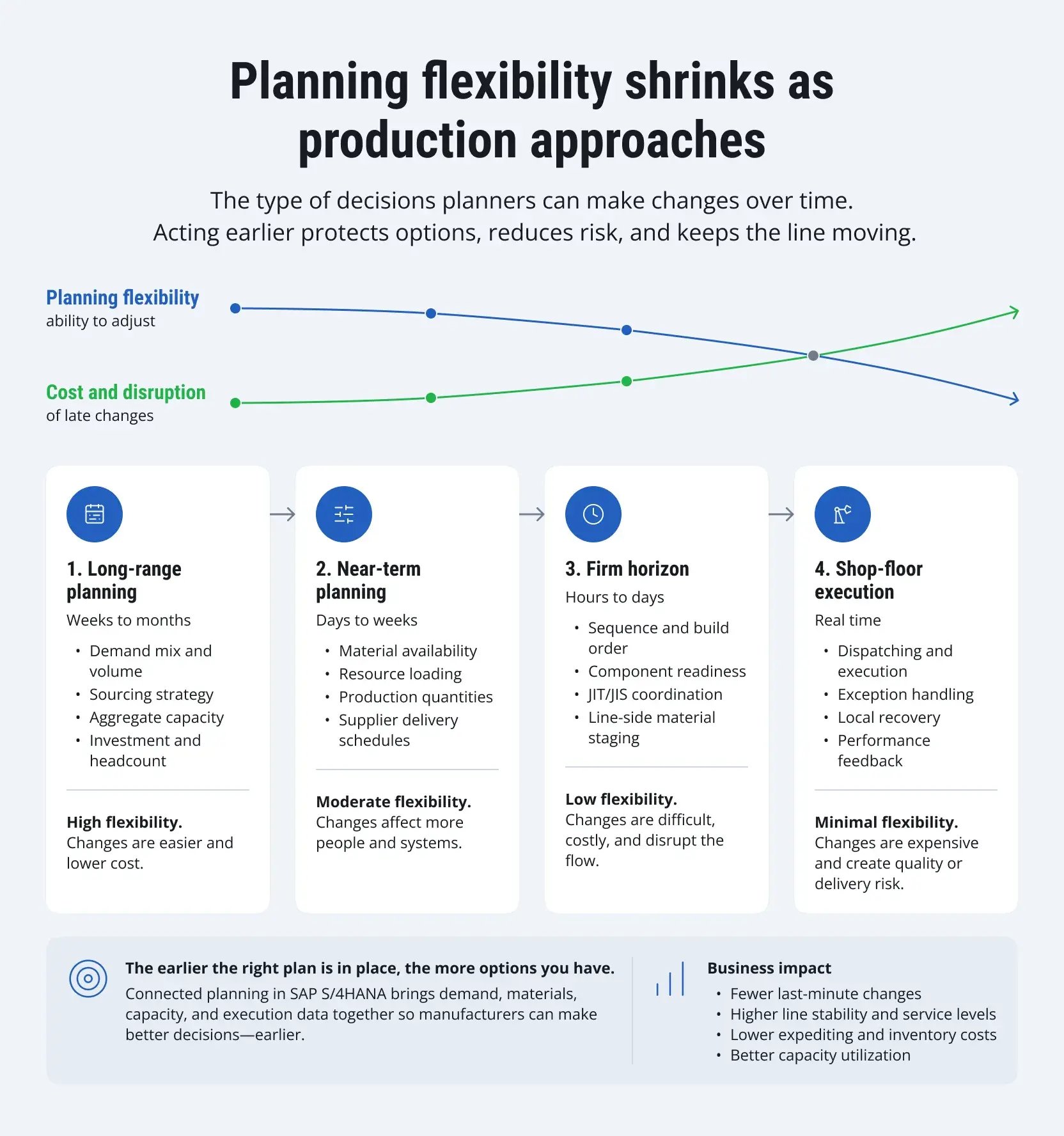
Use current demand and order-mix signals to update material, supply, and capacity requirements at the appropriate planning horizon. Define which decisions belong to strategic, tactical, and operational planning, which data each horizon requires, and how changes move between them. Clear handoffs help supply-plan changes reach detailed production scheduling without triggering unnecessary replanning elsewhere.
Replanning the entire network every time a shop-floor operation slips by 20 minutes creates noise. A persistent capacity shortage, however, should be reflected in upstream planning early enough for teams to assess its effect on supply and production commitments.
Treat production master data as planning data
BOMs, routings, production versions, work centers, capacities, lead times, and calendars shape planning results. When these records no longer match plant reality, the system can produce internally consistent plans that remain operationally impossible.
Automotive manufacturers should establish ownership and change controls for critical planning master data. Engineering changes also need timely synchronization with production planning, particularly when new vehicle variants or component revisions enter production.
Use finite planning where constraints justify it
Finite scheduling adds value around real bottlenecks. Applying maximum planning complexity to every resource can create unnecessary maintenance and processing effort. Start with resources that materially affect throughput or schedule feasibility. These may include a constrained assembly line, paint operations, specialized test equipment, or a production stage with expensive setup changes. PP/DS configuration should reflect genuine operating constraints rather than every theoretical restriction a plant could model.
Connect supplier commitments to planning decisions
Supplier collaboration becomes particularly important when the production plan depends on long-lead or constrained components. Define how planners respond when supplier commitments expose a quantity or timing risk. Depending on the scenario, the response may involve procurement escalation, supplier follow-up, approved alternative components, sequence changes, or revised production quantities. Assign decision ownership and escalation thresholds so that shortages reach the relevant planning, procurement, and manufacturing teams early enough to act.
Feed execution data back quickly
Execution deviations should remain visible even when parts of the production schedule are intentionally frozen. Plants need thresholds for deciding when a deviation can be absorbed locally and when it requires replanning. A small delay may be absorbed locally. A resource outage lasting several hours may require schedule changes across multiple orders. Connecting SAP S/4HANA with shop-floor systems such as SAP Digital Manufacturing helps planners and production teams work with more current operational information.
Integrate production planning with intralogistics
Material availability in the ERP system and material readiness at the line describe different conditions. For JIT-oriented plants, staging rules, production supply areas, warehouse capacity, and internal movements deserve attention during planning and design. A production order scheduled for 10:00 cannot be executed as planned if its components do not reach the workstation until 10:45. Integration with SAP EWM can connect warehouse execution more closely with manufacturing requirements.
Plan for exceptions
Production planners should focus their attention on conditions that require judgment. Useful exception management highlights shortages, overloaded resources, delayed orders, missing confirmations, and other situations that threaten the production plan. If every order receives the same level of attention, planners end up manually reviewing large volumes of orders that require no intervention. Dashboards and alerts should reflect the decisions planners actually make, with thresholds tied to business impact.
Review planning performance continuously
Production planning parameters should evolve with actual manufacturing performance. Teams can compare planned and actual lead times, capacity utilization, schedule adherence, shortage patterns, and execution delays to identify recurring deviations. These findings can then inform changes to planning parameters, master data, capacity assumptions, and exception thresholds.
Business Benefits of SAP S/4HANA for Automotive Production Planning
A connected SAP production planning environment can improve performance in several areas, although results depend on process design, master data quality, integration, and adoption. Manufacturers should define baseline metrics before implementation and measure changes after stabilization.
|
Business objective |
How integrated planning can contribute |
Useful KPIs |
|
More reliable schedules |
Aligns demand, materials, capacity, and production requirements |
Schedule adherence, production plan attainment, and order delays |
|
Fewer material-related disruptions |
Provides earlier visibility into requirements and expected supply |
Component shortages, shortage-related downtime, and expedited orders |
|
Better capacity use |
Highlights overloaded work centers and supports detailed scheduling where needed |
Capacity utilization, bottleneck hours, queue time |
|
Lower inventory exposure |
Connects replenishment more closely with actual production requirements |
Inventory days, excess stock, days of supply |
|
Faster response to change |
Updates planning decisions using current demand, supply, and execution information |
Replanning lead time, response time to shortages, frozen-zone changes |
|
Improved production flow |
Coordinates orders, materials, and resources around executable plans |
Cycle time, throughput, work in process |
|
Stronger supplier coordination |
Connects forecasts and supply commitments with planning processes |
Supplier confirmation rate, delivery reliability, and shortage frequency |
These outcomes should be treated as measurable improvement areas rather than guaranteed implementation results.
LeverX’s Proven Expertise in SAP Manufacturing Transformation
At LeverX, we have worked with automotive manufacturers on the processes that directly affect whether a production plan can be executed: detailed planning, component supply, JIT/JIS operations, production sequencing, MES integration, warehouse staging, and manufacturing logistics.
For one large automotive manufacturer, we implemented SAP S/4HANA across production, supply chain, and logistics processes. The planning scope included SAP PP/DS and SAP MM, covering both long-term demand forecasts and day-to-day production requirements. We also supported JIT and JIS production models and integrated the existing GM GEPICS MES with SAP S/4HANA. This gave planners access to current shop-floor data when production conditions changed and helped connect vehicle configuration with sequencing and component requirements.
Our automotive work also extends into the logistics processes that keep the production sequence running. In an SAP S/4HANA for a manufacturing logistics project, we helped a leading vehicle manufacturer coordinate material movements between the warehouse and production line according to the production schedule. The solution covered route determination, tours, loading lanes, production supply areas, and RF-supported loading and unloading integrated with SAP EWM.
We have addressed the same connection between production and warehouse execution in an SAP EWM project for a global automotive manufacturer. Our team implemented and extended inbound, outbound, staging, packaging, and mobile RF processes and integrated SAP EWM with the wider SAP landscape to support production synchronization.
This experience gives us a practical view of automotive production planning. We look at the production schedule together with the processes that determine whether it will hold up on the shop floor: material availability, supplier and warehouse execution, sequencing, resource constraints, and feedback from production. That perspective helps us design SAP manufacturing landscapes around the way a plant actually operates.

Conclusion: Building a More Reliable Automotive Production Plan
Keeping an automotive assembly plant running on schedule requires plant managers to continuously adjust parts inventory, machine capacity, and line sequencing against fluctuating customer demand. SAP S/4HANA anchors this daily workflow by linking those physical variables directly to core business transactions. When factories require stricter controls, IT teams integrate PP/DS, SAP IBP, SAP Digital Manufacturing, SAP EWM, and the SAP Business Network for Supply Chain to handle minute-by-minute machine scheduling, broader supply forecasts, active pallet movements, and direct shop-floor routing.
LeverX maps out and installs these connected software architectures for vehicle manufacturers. Technical specialists configure the SAP modules based strictly on a facility's physical floor limits, current legacy databases, and specific data integration needs.

-min-Jul-12-2022-09-46-40-14-AM.jpg)