Learn how different SAP S/4HANA migration approaches affect ERP transformation strategy and long-term system architecture.
An SAP S/4HANA project usually stays at the center of a company's IT roadmap for years. The initial strategy determines how the business will operate for the next decade. Because budgets are high and timelines are long, getting the direction right from day one is essential.
Confusion over terminology often stalls these projects before they begin. Migration, conversion, and transition show up in almost every proposal, yet they are frequently used interchangeably. In reality, they represent completely different technical approaches.
Using the wrong terms can lead to serious errors in project scope. An organization might underestimate its timeline or fail to prepare its data correctly. Finding out about technical limitations in the middle of a project creates massive risk. Clear definitions help protect the budget and ensure the system performs as expected long-term.

Why SAP Terminology Can Be Confusing
SAP planning often stalls because the vocabulary is used inconsistently. Consulting firms, official documentation, and internal IT teams use different words for the same thing. This might make it hard to align everyone on what is actually happening.
Many people treat the word “migration” as a specific method. In reality, migration is just an umbrella term for moving from an old ERP to SAP S/4HANA. It does not explain how the move happens.
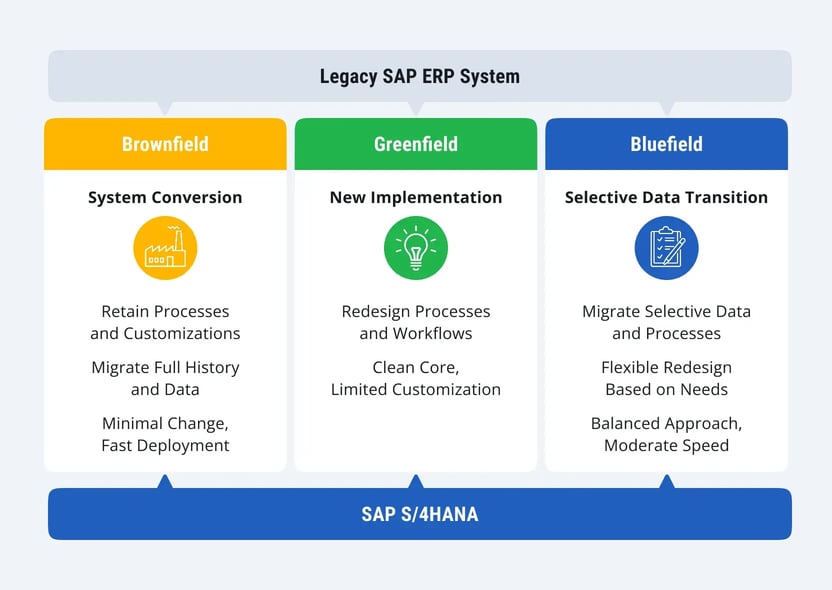
SAP defines the following specific methods for exiting legacy systems:
- Migration: This is a general term for the move to SAP S/4HANA.
- Conversion: This usually means a system conversion or a Brownfield approach.
- Transition: This often refers to a new implementation or a Greenfield approach.
- Selective data transition: Lets you move specific data and processes instead of the whole system.
Each path, or migration approach, has unique requirements for process design and data management. You can read more about the approaches in our migration scenario guideline. When determining which works best for your business, you take the first step towards ensuring a clean core architecture.
Vague wording in your request for proposal creates immediate risk. Failing to define the transition scenario in the RFP can lead to misaligned vendor responses and bids for completely different technical setups. You end up with project quotes that are impossible to compare because the costs, timelines, and work scopes do not match.
Defining these terms early keeps your stakeholders aligned before you sign a contract. It is the only way to prevent expensive course corrections or technical surprises once the project is already moving.
Choosing the Right SAP S/4HANA Path: A Decision Framework
Selecting the right transformation approach depends on a few strategic choices. Most companies start by looking at their current ERP setup to see if it is worth keeping. Systems with too much custom code or broken processes usually need a complete redesign.
Other organizations prioritize speed. If your current processes work well, keeping things consistent might be more important than a total overhaul.
Critical questions for your strategy
- Technical debt: How much custom code is sitting in your current SAP system?
- Process gaps: Do you need to fix major workflows across different departments?
- Historical data: Do you really need decades of records inside the new live system?
- Innovation readiness: Do you need advanced analytics or AI automation immediately?
Picking the right path now avoids a technical architecture that blocks your growth later. It ensures the system fits your immediate needs, while leaving room for long-term digital goals.
SAP S/4HANA path selection matrix
|
Criteria |
System conversion (Brownfield) |
New implementation (Greenfield) |
Selective data transition |
|
Data strategy |
Keep all historical data |
Start fresh with master data |
Selective historical data |
|
Process model |
Existing processes retained |
Best-practice redesign |
Selective process optimization |
|
Technical debt |
Preserved |
Eliminated |
Reduced |
|
AI readiness |
Moderate, requires the Clean Core retrofitting and data cleansing to be effective |
High, relies on standardized processes and clean master data |
Optimized, |
|
Timeline* |
6–10 months |
12–18 months |
9–18 months |
*These estimates reflect standard, single-country projects. Your actual schedule will depend on technical factors like total database size, the number of legal entities, and the volume of custom code (Z-objects) requiring remediation. You should also account for the current talent market: expert SAP S/4HANA consultants are becoming harder to secure as the 2027 SAP ECC maintenance deadline approaches.
The cloud deployment model determines the migration path. SAP Cloud ERP (SAP S/4HANA Cloud Public Edition) requires a new implementation, while the shift to SAP Cloud ERP Private through RISE with SAP means that you can migrate existing systems using the system conversion approach. This allows companies to move their current ERP environment to the cloud while preserving historical data and existing configurations, instead of rebuilding everything from scratch.
.webp)
Typical Mistakes
Most SAP S/4HANA projects fail because the strategy was selected for the wrong reasons. Approaches often look easy in a slide deck. The real complexity only shows up during the actual system analysis. Identifying these pitfalls early prevents expensive fixes later.
Choosing Brownfield for speed only
System conversion is tempting. It seems to be the fastest path to SAP S/4HANA. That timeline advantage often vanishes once you start dealing with legacy complexity. Large SAP ECC systems usually have years of custom code and undocumented changes. Each one of those pieces must be adapted to the new architecture. If you underestimate this work, the project stalls and your time savings disappear.
Ignoring custom code fixes
Many teams underestimate how much of their daily work depends on old custom programs. These were built for the SAP ECC data model. SAP S/4HANA replaces legacy index tables, like BSIS and BSIK, with the Universal Journal (ACDOCA). Custom code still calling the retired tables will fail, triggering runtime errors that halt the transaction. Without an early analysis, you might only find these bugs during testing. Fixing them that late can create massive delays and spikes in consulting fees.
Moving data that nobody uses
Historical data is a sensitive topic. Some companies try to move decades of records just to keep everything together. This increases the complexity of the move. It also makes testing cycles much longer. Most of that data is never touched in daily operations. A smarter plan is to keep the new SAP S/4HANA environment lean. Move old records into a separate archive where you can still reach them for audits.
Ignoring master data quality
Migration tools can move your data, but they cannot fix it. Duplicate vendors and inconsistent product records accumulate over time. If you carry those inconsistencies into SAP S/4HANA, your reporting will be wrong. Your automation will fail. Preparing your data before the move is essential for system stability. In SAP S/4HANA projects, this typically includes master data cleansing and the implementation of mandatory Customer Vendor Integration (CVI). This aligns customer and vendor records with the business partner model required by the new system.
AI Readiness as the 2026 Multiplier
The motivation for moving to SAP S/4HANA has changed. It is no longer just about hitting the SAP ECC support deadlines. Many companies now view SAP S/4HANA as the mandatory foundation for AI-driven business.
Tools like SAP Joule and predictive analytics require reliable data to function. These systems monitor transactions and automate workflows. For them to be effective, you need clean master data and a simplified system architecture. In practice, Greenfield implementation is usually an approach that enables these capabilities more quickly. It means that you start with standardized processes and clean data models. As for Brownfield conversions, they often require additional cleanup and optimization before AI features become effective.
This makes your migration strategy a business choice rather than a technical one. Systems weighed down by custom code or inconsistent data struggle to support advanced automation. AI might technically run in those environments, but the results are usually inconsistent or limited.
Companies that use the SAP S/4HANA move to reset their architecture find it much easier to deploy intelligent tools later. Focusing on data quality and standard processes creates a better base for AI.
Leadership teams now look at this transition through a different lens. The goal is not just to implement SAP S/4HANA quickly. It is about ensuring the system can handle AI-enabled decisions and autonomous processes. Shifting to SAP S/4HANA is really about preparing your platform for the next generation of technology.
FAQ
Moving From Planning to Execution
Knowing the definitions is just the start. The hard part is turning those terms into a roadmap that works for your specific systems. You have to weigh business priorities against what your current technology can actually handle.
Most teams start by auditing their current ERP setup. You need to know the state of your data and how much custom code is buried in the system. This shows which path is actually realistic and what you need to fix before the move begins.

See how LeverX experts help plan these transformations.
We can help you pick the right strategy before you commit to the full project.