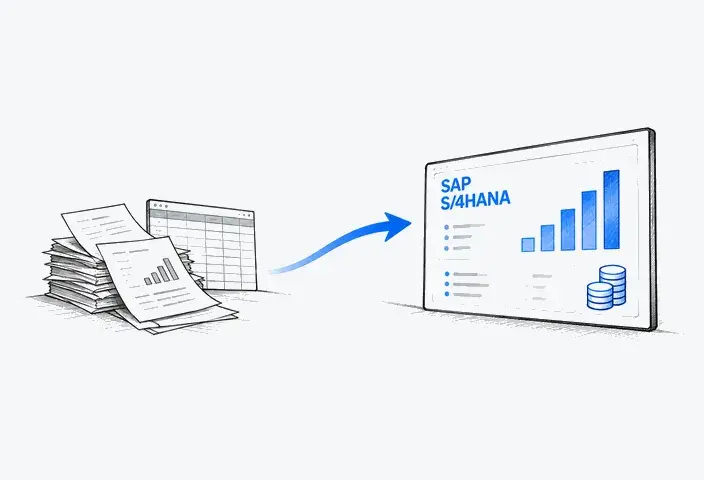
RISE with SAP is a transformation approach for moving to SAP S/4HANA Cloud with a clean core, industry focus, and long-term flexibility. This guide explains how it works across industries and how to choose the right approach.
In 2026, modernization is no longer really a question. The question is how to do it without putting everyday operations at risk. Markets keep shifting, reporting requirements keep growing, and customers notice when service is slow, inconsistent, or full of avoidable errors.
With that kind of pressure, it is no surprise that many companies look to SAP S/4HANA. The catch is that switching ERP platforms does not change behavior on its own. If teams treat the project as a lift-and-shift, the same complexity and one-off exceptions tend to follow, along with the customizations that were already slowing everything down.
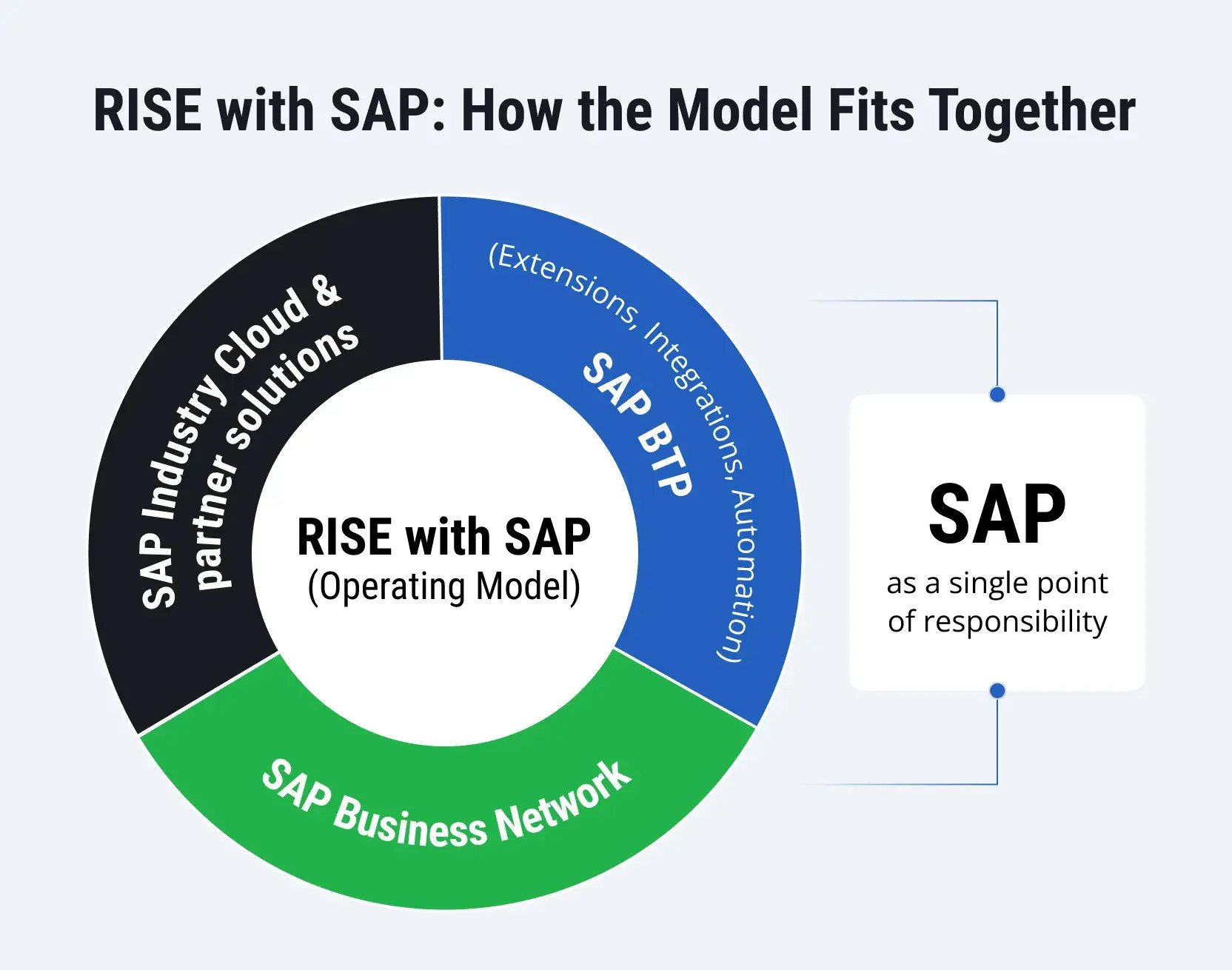
RISE with SAP is positioned for a broader shift. It is a transformation approach that combines SAP S/4HANA Cloud with a structured operating model and a path to continuous improvement. The idea is to standardize what should be standard, keep the core clean, and use extensions for what makes your business different, so you can grow to meet industry needs without rebuilding your ERP every time priorities change.
What Is RISE with SAP
RISE with SAP is not something you simply buy and install. It is a structured way to move to SAP S/4HANA Cloud with clearer rules of engagement, fewer handoffs, and a roadmap for continuous progress. It connects cloud ERP with process transparency, extensibility, and collaboration across partners, so modernization drives real operational change.
RISE with SAP as a business transformation model
RISE with SAP follows a subscription-based commercial model that brings key elements of your cloud ERP system under one agreement. For many organizations, that structure reduces fragmentation and makes it easier to manage responsibilities across stakeholders.
A defining element is SAP’s role as a single point of responsibility for the RISE scope. This is especially important in complex transformations, where delays often come from unclear ownership and vendor handoffs.
In practical terms, the model is designed to consolidate areas that are often spread across multiple contracts and teams, including:
- Service levels and operational expectations
- Security and compliance requirements
- Platform operations and lifecycle management
- Ongoing updates and innovation cadence
Core components of RISE with SAP
RISE with SAP works best when you see it as one foundation, not a list of tools. Each part has a job, and the real value shows up when they are used together.
SAP S/4HANA Cloud is where the basics live: finance, operations, and the processes that should stay consistent across the business. SAP Business Technology Platform (SAP BTP) gives you breathing room to integrate other systems and build what is unique to your organization, without turning every change into an ERP rewrite.
SAP Signavio for process transformation makes workflows visible end-to-end. It helps teams see how processes actually run, then prioritize improvements based on data instead of assumptions.
Most transformations follow a similar pattern:
- Run core finance and operations on SAP S/4HANA Cloud.
- Extend, integrate, and automate through SAP BTP.
- Identify and improve process performance with SAP Signavio.
- Connect to partners and networks through SAP Business Network.
- Support the transition with structured tools and services.
Clean Core and industry extensibility with SAP BTP
Clean core is central to making RISE with SAP sustainable long after go-live. The principle is to keep the ERP core stable and upgrade-friendly, then build differentiation outside the core when needed.
In most organizations, fit-to-standard is the starting point. Teams lean on SAP’s proven processes when they work, instead of rebuilding everything from scratch. The payoff is simpler maintenance, lower support effort, and fewer obstacles when it is time to take the next SAP update.
When you do need to differentiate, you do it through side-by-side extensions on SAP BTP. That allows industry-specific innovation without modifying the core.
A clean core approach typically enables:
- Faster upgrades with fewer conflicts
- Lower risk of customization drift over time
- More room for innovation without ERP rework
- A clearer separation between standard processes and competitive differentiation

Industry-Centric Approach in RISE with SAP
RISE with SAP is built for companies in every industry, but the point is not to pick a prebuilt package and move on. In 2026, the goal is to put a cloud ERP foundation in place that can grow with the business, adjust to industry requirements, and scale across regions and business units without forcing a redesign every time priorities change.
That is what the industry-centric approach is meant to deliver. It helps you modernize the core processes that should be consistent, while still leaving room for the industry-specific capabilities that set you apart.
From industry packages to industry cloud strategy
SAP has stepped away from the idea of fixed industry packages. The model today is more modular. Organizations can start with the capabilities they need now, then expand as their strategy, regulations, and operations evolve.
This supports a composable ERP approach. You keep a stable core, then add what is needed around it, instead of trying to define everything up front and hoping it still fits two years later.
Industry solutions built on SAP BTP play a key role here. They bring industry-specific innovations that complement SAP S/4HANA Cloud. SAP BTP supports the integration and extensibility that make those innovations practical in real environments. Together, they help organizations adopt industry functionality without turning the ERP core into a customization-heavy system that becomes difficult to upgrade and support.
How industry best practices are embedded in RISE with SAP
Industry readiness is not only about software. It is also about starting from proven content and repeatable structures that reduce risk and speed up execution.
In many systems, teams use industry reference processes to standardize how work gets done across plants, regions, and business units. For regulated industries, compliance and regulatory content help align processes with governance requirements and audit expectations. For global organizations, scalable templates make rollouts more predictable by supporting consistent process design, reporting, and controls across markets.
The result is a practical balance: standardize what should be standard, then use clean core extensibility to support industry differentiation.
With that foundation in place, it becomes easier to talk about what this looks like in real industries. Each sector has its own pressure points, supply chain disruption, tighter regulation, asset intensity, or fast-changing customer expectations. In the next sections, we break down how RISE with SAP supports industry transformation by combining a clean ERP core with the flexibility to integrate, extend, and innovate where it matters most.
RISE with SAP for the Automotive Industry
For automotive businesses, speed is only half the story. You also need stability, cost control, and a supply chain that can absorb disruption without breaking downstream execution. With so many plants, suppliers, and logistics partners involved, that is easier said than done. RISE with SAP supports a modern cloud ERP foundation that stays flexible without recreating a customization-heavy core.
Key industry challenges
The automotive industry faces a unique mix of speed and complexity. Many companies are balancing:
- Supply chains with many tiers and partners, where one delay can ripple across the network
- EV and e-mobility programs that force changes in production planning, sourcing, and after-sales support
- More pressure to prove traceability, meet sustainability targets, and back it up with reporting
- Constant margin pressure that makes efficiency and visibility nonnegotiable
How RISE with SAP supports automotive companies
RISE with SAP helps automotive organizations align planning, operations, and financial control on a shared cloud foundation. SAP S/4HANA Cloud supports standardized core processes across the enterprise, while still allowing local variations when they are justified by real business requirements.
Working with suppliers and logistics partners is where problems often arise, and this is where speed is paramount. SAP Business Network helps improve coordination and simplifies tracking across the entire supply chain. When delivery dates slip or parts go missing, this visibility can save the production schedule.
To keep change manageable over time, the clean core approach is central. With SAP BTP, automotive companies can extend and integrate capabilities, such as partner integrations, automation, or industry-specific workflows, without repeatedly modifying and destabilizing the ERP core.
Business outcomes for automotive enterprises
With the right plan and governance, automotive organizations can drive outcomes such as:
- Greater production flexibility and faster response to change
- Lower operational risk across complex supply networks
- Shorter cycles for launching new models and updates
- Stronger cost transparency across products, plants, and programs
RISE with SAP for Industrial Manufacturing
In industrial manufacturing, most companies are trying to modernize while keeping the plant running. Projects take time, production is complex, and service operations keep expanding. At the same time, leadership wants better asset performance and lower energy spend. RISE with SAP helps update the ERP foundation in the cloud, then gives teams a practical way to extend capabilities without turning the core into a custom build.
Industry-specific transformation needs
In manufacturing, transformation tends to be multi-track. Most companies are working on:
- Engineer-to-order and project-based manufacturing
- Service and aftermarket growth
- Asset performance and lifecycle management
- Energy efficiency and reporting
Digital core and industry cloud capabilities
RISE with SAP builds around SAP S/4HANA Cloud as the digital core, which supports standardized finance and operations, including project accounting for complex manufacturing models. That foundation delivers the most value when it is connected to the systems manufacturers already rely on to run engineering, production, and maintenance.
Common priorities include:
- Integration with PLM to align engineering changes with production and financial planning
- Integration with enterprise asset management systems to connect maintenance, operations, and cost tracking
- Analytics that support cost and margin control across products, projects, and contracts
- Extensibility through SAP BTP, so manufacturers can add industry-specific capabilities without touching the ERP core
Value delivered to manufacturers
When manufacturers apply fit-to-standard discipline and keep the core clean within the RISE operating model, outcomes typically include:
- More service revenue, driven by better planning and execution across the service lifecycle
- Higher production efficiency, supported by consistent processes and real operational visibility
- Clearer control over projects and contracts, including cost, margin, and delivery performance
RISE with SAP for Transportation and Logistics
Transportation and logistics teams face the need to manage change every day. Demand fluctuates, routes are disrupted, and one delay can impact numerous deliveries. Customers expect accurate arrival time predictions and quick responses, while management still demands financial discipline. RISE with SAP helps create a cloud-based ERP platform that supports daily operations, coordination with partners, and financial control, without requiring the use of additional, disparate tools.
Key industry drivers
- Demand volatility that makes planning and capacity allocation harder
- Real-time tracking needs for both operations teams and customers
- Dependence on carriers and partners, which requires tighter integration
- Ongoing pressure to cut operating costs while meeting service commitments
How RISE with SAP enables logistics transformation
RISE with SAP migrates order fulfillment and financial processes to the SAP S/4HANA Cloud environment and then integrates the surrounding ecosystem. Teams gain a clearer, comprehensive view of orders, deliveries, and costs, rather than just what's happening within a single system.
SAP Business Network supports collaboration with partners, so updates and changes do not get stuck in emails, spreadsheets, and phone calls. With analytics in place, teams can see where delays and cost overruns start, then focus on fixes that reduce exceptions and improve reliability.
Business benefits for logistics companies
- Lower operating costs through fewer exceptions and less manual coordination
- Stronger SLA performance, with better visibility and faster issue resolution
- More transparency across the supply chain, from shipment status to cost impact
RISE with SAP for Metals and Mining
Metals and mining organizations run on uptime, cost control, and safety and compliance. Commodity price swings and production disruptions show up in financial results almost immediately. ESG expectations continue to rise, and reporting must be consistent across sites and teams. RISE with SAP modernizes the cloud ERP foundation so operations, finance, and reporting are built on one reliable source of data.
Industry challenges
- Asset-heavy operations, where downtime quickly turns into lost output and higher costs
- Commodity price volatility that makes planning harder and cost control more important
- Sustainability and ESG requirements that demand better data and more reliable reporting
- Safety and compliance obligations that require consistent processes and audit-ready controls
SAP S/4HANA Cloud as a digital core for metals and mining
SAP S/4HANA Cloud provides the backbone for finance and operations, and it helps bring more discipline and consistency across plants, sites, and business units.
In practice, that foundation supports:
- Managing assets and production in a more connected way
- Tracking costs as they happen, not weeks later, so teams can see what is driving variance
- Integrating with operational systems so production and maintenance data is not stuck in separate tools
- Supporting ESG reporting with a clearer data trail and stronger governance
Projected business outcomes
When the core is standardized, and reporting is built on consistent data, companies can expect:
- Clearer cost transparency across operations and sites
- Better asset utilization, with fewer surprises and stronger planning
- More credible sustainability reporting, supported by consistent data and controls
RISE with SAP for Retail
Retail businesses do not leave much time to think. Customers switch between channels without noticing the handoffs. Demand rises and falls quickly. Seasonal peaks put pressure on inventory and fulfillment. And when margins are tight, even small data errors turn into real losses.
RISE with SAP helps retailers bring order to that complexity. With a cloud ERP foundation, planning, inventory management, and finance are tied together instead of living in separate tools. Teams can react faster because they are working from the same numbers, not reconciling different versions after the fact.
Retail transformation drivers
Most retail organizations are dealing with the same challenges.
- Customers expect to move seamlessly between online and physical channels.
- Loyalty depends on speed, relevance, and consistent service.
- Seasonal peaks and promotions strain planning, staffing, and fulfillment.
- Margin pressure makes inventory accuracy and operational discipline critical.
Industry capabilities enabled by RISE with SAP
RISE with SAP focuses on keeping the retail core stable, while allowing flexibility where the business actually needs it. Financial operations, inventory management, and order fulfillment are all handled on a single ERP platform. Capabilities for working with multiple sales channels and interacting with customers are added without the need for constant modifications to the core system.
In practice, this means:
- One data model for products, inventory, pricing, and finance, shared across teams
- Clear visibility into inventory across stores, warehouses, and fulfillment locations
- Built-in analytics that support day-to-day planning and performance tracking
- Integration with customer experience systems, so operations reflect how customers shop
Business value for retailers
When retailers work from consistent data and reduce fragmentation across channels, the impact is tangible:
- Planning becomes faster and more reliable.
- Inventory decisions improve, especially during peak periods.
- Customer data is more consistent across touchpoints.
- Operations hold up better under pressure, whether from promotions, peaks, or disruptions.
RISE with SAP for Banking and Finance
Banking does not forgive sloppy systems. Reporting has to be right. Access has to be controlled, and changes have to be traceable. Many institutions are still carrying older platforms that make all of that harder and more expensive than it should be. RISE with SAP helps modernize ERP in the cloud and set up governance that supports speed without cutting corners.
Industry-specific challenges
- Regulatory pressure that demands consistent controls, audit trails, and reliable reporting
- Data security requirements that leave little room for weak processes or fragmented access
- Cost efficiency goals, especially in shared services and back-office operations
- Legacy landscapes that are expensive to run and difficult to change
How RISE with SAP supports financial institutions
RISE with SAP helps financial institutions standardize core finance processes without loosening control. With SAP S/4HANA Cloud at the center, teams can run on a more consistent financial foundation across business units and regions.
Real-time reporting enables faster closing of reporting periods and timely access to information on financial and operational performance. A secure cloud platform helps meet security and regulatory requirements, especially when combined with clearly defined governance and role-based access.
When differentiation matters, SAP BTP provides room to extend and integrate without core modifications. Teams can deliver new workflows and automation, and still keep the ERP core stable for upgrades.
Business impact for banking and finance
When the system is scoped well and governed closely, the benefits tend to be practical:
- Lower operating costs, driven by standardized processes and less manual work
- Faster delivery of new products, services, and process updates
- Stronger transparency and compliance, supported by consistent controls and reporting
RISE with SAP for Telecommunications
Telecom is a volume business with little tolerance for errors. New digital services have to launch fast, billing has to be right, and customers leave quickly when something goes wrong. At the same time, infrastructure costs stay high, and operations need constant optimization. RISE with SAP allows telecom providers to clean up the ERP core in the cloud and connect it properly to billing, service, and operational systems.
Telecom industry drivers
- Rapid growth of digital services and subscription-based offerings
- Billing and charging models that are difficult to manage and hard to change
- Ongoing customer churn driven by service quality and response time
- Pressure to optimize infrastructure and operating costs
SAP S/4HANA Cloud and BTP for telecom
SAP S/4HANA Cloud provides a stable ERP core for finance and operations. SAP BTP sits on top and handles what telecom systems are known for: integrations, automation, and frequent change.
In practice, this setup supports:
- Integration with convergent charging and billing systems
- Real-time visibility into revenue, usage, and operational performance
- Automation of recurring processes that are still manual in many environments
Value delivered to telecom providers
When the core is stable, and integrations are handled outside ERP, telecom providers see clear benefits:
- Fewer billing and service issues that impact customer experience
- Lower operational effort and better process consistency
- Faster rollout of new services and pricing models without disrupting the core
RISE with SAP for Oil, Gas, and Energy
Energy companies are trying to do two hard things at the same time. They have to run today’s business efficiently, oil, gas, power generation, and downstream, while also investing in what comes next. Prices move fast. Reporting requirements keep expanding. And most organizations are still managing large asset portfolios spread across regions, sites, and joint ventures, often with data sitting in different systems.
RISE with SAP helps bring more consistency to that environment. It modernizes the ERP foundation in the cloud and connects finance and operations around the same set of data, so teams can plan, execute, and report with fewer gaps.
Industry transformation challenges
- The energy transition, which adds new solutions and reporting on top of existing operations
- Asset optimization, where uptime, maintenance discipline, and lifecycle cost make the difference
- Sustainability and ESG reporting that has to be supported by real data, not manual consolidation
- Market volatility that forces faster decisions on cost, investment, and planning
How RISE with SAP supports energy companies
SAP S/4HANA Cloud provides the backbone for finance and operations, which helps standardize how assets and work are managed across sites. That matters when maintenance, supply, project work, and financial tracking are handled differently from one location to the next.
Asset lifecycle management improves when planning, execution, and cost tracking stay connected. Real-time financial visibility also helps teams see the impact of operational decisions sooner, not after a reporting cycle closes.
For ESG and sustainability, the main challenge is usually consistency. RISE with SAP supports a cleaner data foundation for reporting and governance, especially when companies operate globally and have to meet different local requirements.
Business outcomes for oil, gas, and energy
When the core is consistent, and reporting relies on solid data, the results tend to be practical:
- Higher asset efficiency, with better planning, maintenance execution, and utilization
- Stronger support for low-carbon initiatives, backed by reliable operational and financial data
- Better compliance, with clearer controls and reporting that holds up under scrutiny
RISE with SAP for the Fashion Industry
In fashion, demand shifts quickly, seasons move fast, and the wrong inventory decision shows up as missed sales or markdowns. When teams are working from different spreadsheets and different system reports, it is hard to respond early, before margins take the hit. RISE with SAP helps bring planning, inventory, and finance onto one cloud ERP foundation, so everyone is working from the same numbers.
Fashion industry challenges
In the fashion industry, the season is often decided early. Assortment, buys, allocation, and replenishment plans are tough to change once the product is moving. If teams react too late, it usually ends in the same two problems: missed sales where demand is strong and markdowns where the product did not move.
Key challenges include:
- Demand shifts that are hard to predict and spread quickly across channels and regions
- Short product lifecycles that leave little time to adjust buying, allocation, or replenishment
- High inventory risk, including stock-outs, overstock, and margin loss from markdowns
- Growing expectations around sustainability data, traceability, and reporting accuracy
Industry-specific capabilities enabled by RISE
To keep up with that pace, fashion companies need systems that reflect what is happening now, not just what was planned. RISE with SAP supports this by keeping core processes connected and up to date.
This includes:
- Planning that adapts to real demand signals, not only seasonal assumptions
- Inventory visibility across stores, warehouses, and fulfillment partners
- Connected supply chain and financial processes, so teams see cost and margin impact as decisions are made
- Analytics that support trend signals and performance tracking, helping teams spot issues earlier
Business value for fashion brands
When planning, inventory management, and financial planning are aligned, fashion brands gain more control over outcomes, instead of reacting to the situation after the fact.
Typical results include:
- Fewer missed sales and fewer markdowns through better inventory balance
- Faster launches for new products and seasonal assortments
- Improved profitability driven by tighter inventory discipline and clearer margin visibility
How To Choose the Right RISE with SAP Industry Approach
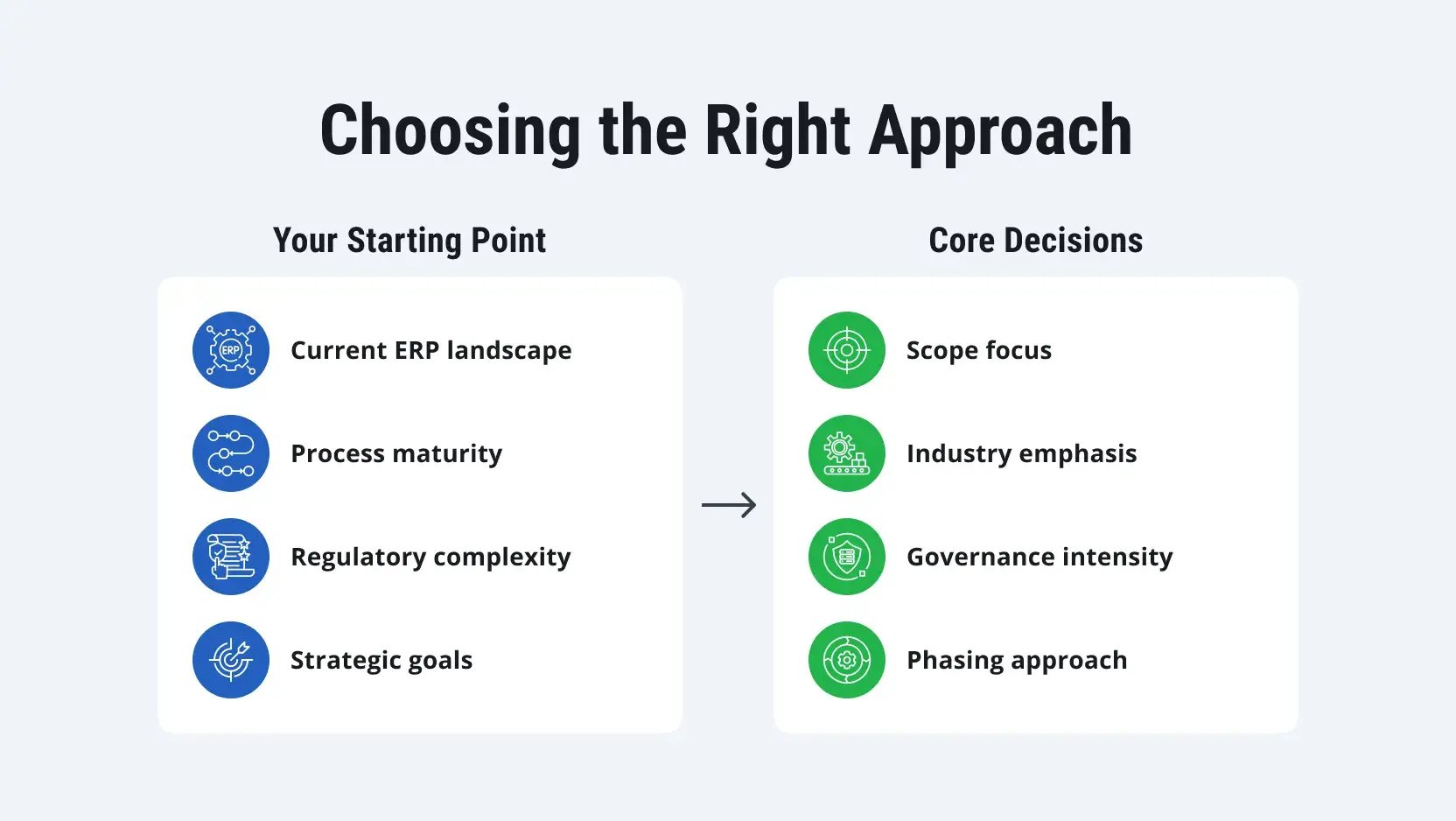
RISE with SAP is flexible by design, which is why the approach matters. Start with the basics, your current landscape, the processes you want to make consistent, and the areas where you need flexibility. If you sort that out early, the system is much less likely to get stuck in rework.
Key decision factors
Current ERP landscape
The current IT infrastructure defines the limitations. An environment largely based on SAP ERP Central Component (SAP ECC) represents a completely different path than the existing S/4HANA system, and both of these situations differ from a multi-instance or mixed environment involving SAP and third-party systems.
Process maturity
If processes vary widely by site or region, fit-to-standard typically reduces complexity faster. If processes are already consistent, you can focus on optimization and targeted industry capabilities.
Regulatory requirements
It is necessary to consider auditing capabilities, control mechanisms, data storage location, security requirements, and the specifics of reporting in different departments and regions.
Strategic goals
Be clear on what success looks like: cost reduction, faster innovation, a global template rollout, cleaner governance, or support for new business models. Priorities drive scope and sequencing.
RISE with SAP vs. traditional SAP S/4HANA migration
Anyone who has done an S/4HANA migration knows the pattern: build and cut over, then stabilize and operate. RISE with SAP does not treat it as two separate phases. The move to S/4HANA Cloud is tied to an ongoing operating setup, which is why ownership, cost model, and upgrade path look different.
|
Topic |
RISE with SAP |
Traditional migration |
|
Contract and cost model |
Subscription |
Separate costs and contracts |
|
Ownership |
SAP leads the RISE scope |
Distributed across multiple parties |
|
Customizations |
Clean core and SAP BTP extensions |
Often more in-core customization |
|
Long-term maintainability |
Designed for upgrades and change |
Depends heavily on governance and custom code |

Common Challenges in RISE with SAP
RISE with SAP can make the contract and cloud run model clearer, but the program still rises or falls on execution. The same four issues come up again and again, even in well-run transformations.
Organizational readiness
Teams often underestimate how many decisions need fast answers. Who signs off on process changes, who owns integrations, who approves exceptions, and who is accountable for outcomes. If that is not defined early, the project slows down, and work gets stuck between groups.
Standardization vs. customization
Most companies say they want fit-to-standard, then try to rebuild old exceptions because they feel familiar. The risk is carrying complexity into a new system. Clear rules help: what must be standard, what can be extended on SAP BTP, and what should be retired.
Data migration
Data issues do not wait until cutover; they show up in testing. Duplicates, missing fields, inconsistent master data, and different definitions across regions can derail timelines. The hard part is not moving data; it is deciding what is worth migrating and who cleans it.
Change management
Cloud ERP changes how people work and how often they see updates. Training, communications, and support matter, but so do basics like new roles, updated procedures, and realistic time for adoption. Without that, teams fall back to spreadsheets and workarounds, even after go-live.
Best Practices for Successful RISE with SAP Adoption
Most RISE with SAP programs get into trouble for the same reasons: teams try to do too much at once, they carry old customizations into the new system, or nobody can make a decision fast enough. The practices below help avoid that.
Start with fit-to-standard, then add industry detail
Agree early on what will be standard across the business, finance basics, procurement, master data rules, and common reporting. Use that to reduce variation between sites and regions. Then add industry needs where they actually change performance, compliance, or customer experience. If something is just “how we have always done it,” it usually does not belong in the new core.
Keep the core clean from day one
Decide up front that the ERP core stays stable. Put extensions, integrations, and automation on SAP BTP instead of pushing changes into the core. It keeps upgrades simpler and reduces the long-term support burden.
Deliver in phases
A big-bang approach creates risk and delays value. Most teams do better when they stabilize the core first, then expand. Get the essentials running, close, order-to-cash, procure-to-pay, then move into optimization, automation, and industry-specific capabilities.
Run with clear rules and measurable targets
Governance is not paperwork; it is how you avoid endless debates. Define who decides, what needs approval, and what counts as an exception. Track a small set of KPIs that reflect real progress, faster close, fewer manual reconciliations, improved forecast accuracy, fewer exceptions, better service performance, and stronger compliance evidence.
How LeverX Helps With RISE with SAP
LeverX helps teams plan and run RISE with SAP without guessing their way through scope, ownership, or sequencing. We cover the upfront decisions, the build and cutover work, and the follow-through after go-live.
Assessment and roadmap
First, we map your current landscape, what runs where, what talks to what, and where the data will cause problems. Then we turn that into a step-by-step plan to move to SAP S/4HANA Cloud. You get a roadmap with scope, phases, dependencies, and owners.
Industry-specific architecture
We define the core process baseline and the integration and extension approach that fits your industry. The ERP core stays clean, and industry-specific needs are handled through SAP BTP extensions and well-defined integration patterns.
Implementation and optimization
We run fit-to-standard workshops, build and test the solution, support cutover, and stay through stabilization. After go-live, we help teams tune processes, automate manual steps, and expand reporting and analytics based on agreed KPIs.
Global rollout support
For multi-country rollouts, we build a standard template and rollout playbook that teams can reuse. We also support localization, training, and governance so each rollout stays consistent without ignoring local requirements.
Conclusion
RISE with SAP is not a cloud badge, and it is not a lift-and-shift. It is a way to move to SAP S/4HANA Cloud without dragging old complexity along for the ride. The teams that get real value are the ones that treat it as a reset, tighten up core processes, keep the ERP core clean, and build what is unique on top of it instead of inside it.
The industry angle matters here. Automotive, manufacturing, retail, finance, energy, telecom, and fashion all face different pressures, but they run into the same problem when ERP becomes over-customized: every change takes too long and costs too much. RISE with SAP gives organizations a more stable base and a cleaner way to add what their industry requires, whether that is partner connectivity, traceability, real-time reporting, or new service models.
If you want RISE with SAP to be effective, the priorities are simple: define what will become the standard, strictly control key changes, plan data management from the early stages, and manage the system by assigning responsible individuals and setting measurable goals. With this approach, RISE with SAP will become a foundation on which you can continue to build, rather than just another transformation that will need to be redone in a few years.