

AI and ML are becoming part of the SAP S/4HANA digital core. This article explores how they work inside the system and how businesses use them to improve their operational resilience.
AI and machine learning in enterprise systems are delivering measurable operational impact. Research shows that successful AI/ML integration reduces planning cycles by 35% and improves forecast accuracy by 25%. In complex supply chain scenarios, machine learning models demonstrate up to 40% higher prediction accuracy compared to traditional statistical approaches. These results explain why AI is moving from pilot projects into core ERP environments.
SAP S/4HANA enables this shift by embedding AI/ML directly into transactional processes. Its in-memory architecture supports real-time execution of machine learning models. Instead of separating analytics from operations, SAP S/4HANA allows decisions to be generated where execution takes place.
This convergence of transactional processing and embedded intelligence signals the rise of intelligent ERP systems, where automation, predictive capabilities, and continuous optimization become integral to the digital core.
What is Intelligent ERP?
Traditional ERP systems were built for one primary task: recording transactions. They did a great job of structuring data across functions, but they were essentially reactive. Intelligent ERP changes this by making analytics and machine learning a native part of the system, not just an afterthought or an add-on.
This cloud-based approach allows companies to use the massive amounts of data they collect. Instead of just storing information, unified datasets allow machine learning models to catch performance deviations and update forecasts on the fly. It moves the system from a passive record-keeper to an active tool that helps organizations respond to market changes as they happen.
How SAP integrates AI and ML into its digital core
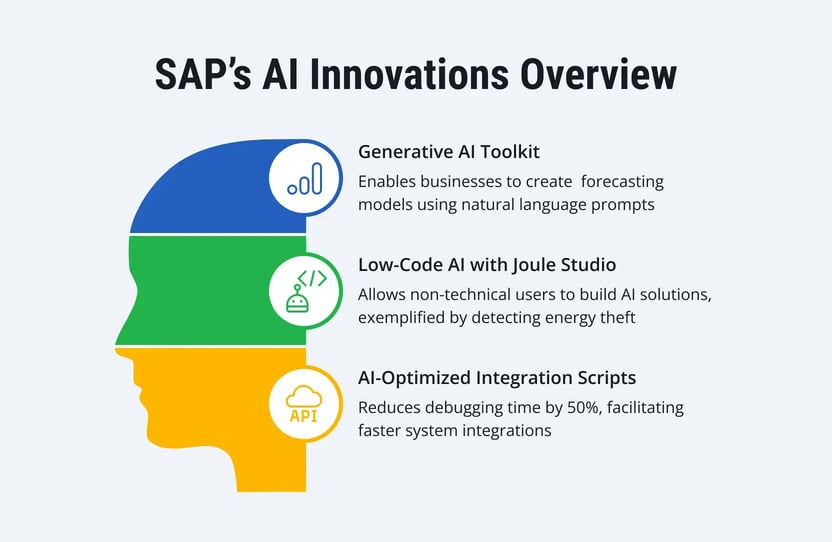
SAP isn't treating AI as a separate add-on anymore. Instead, they’re building machine learning directly into the core business processes. It’s a shift from just automating basic tasks to creating a system that handles predictive work across the whole company.
Initially, the goal was simple: stop wasting time on manual work. Tools like SAP Intelligent RPA took over the repetitive processes like invoice handling or supplier onboarding. Some teams saw their manual workload drop by 70%, which basically proved that you could scale automation even in complex transactional systems.
The next stage introduced predictive intelligence. With SAP AI Core and SAP Data Intelligence, organizations can develop, deploy, and manage custom machine learning models that operate within SAP environments. These models support use cases such as failure prediction, inventory optimization, and demand forecasting, running on live enterprise data rather than replicated datasets.
Integration is orchestrated through SAP Business Technology Platform (SAP BTP), which acts as the architectural backbone for AI deployment. BTP connects SAP S/4HANA with other SAP solutions and third-party systems, enabling AI services to function consistently across hybrid landscapes where legacy SAP ECC systems coexist with modern cloud environments. This layered integration ensures that AI capabilities are embedded into operational workflows, allowing automation and optimization to occur within the core system itself rather than at the periphery.
SAP S/4HANA AI and ML Capabilities
AI and ML in SAP S/4HANA are not separate modules. They are embedded into operational logic and exposed through concrete business capabilities.
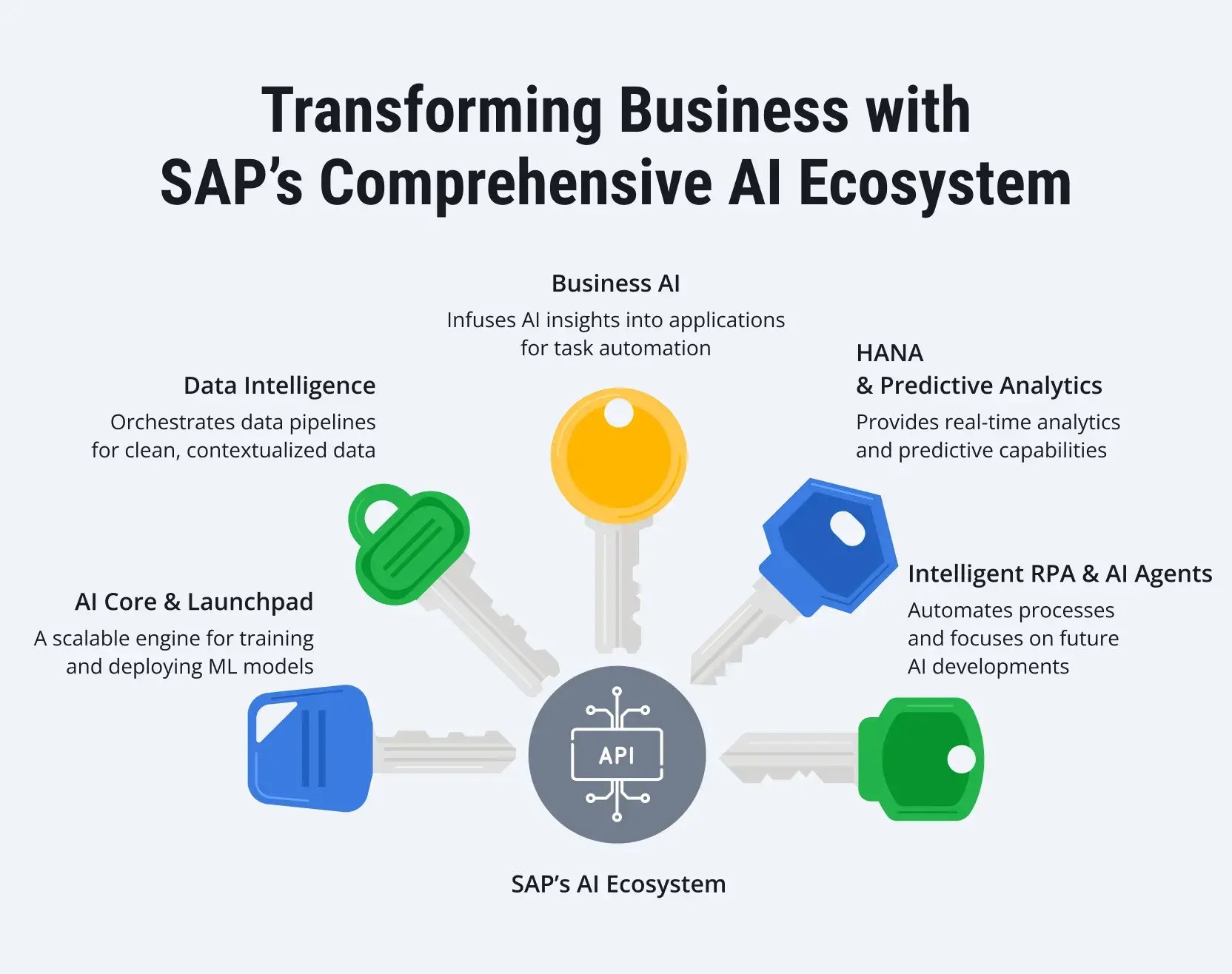
Real-time predictive processing (SAP HANA)
SAP HANA’s in-memory architecture is a big deal because it lets machine learning models work directly on live data. You don't have to worry about separate analytical replicas anymore. This allows things like forecasting, fraud monitoring, and predictive maintenance to run right inside your active business processes, rather than as a separate step.
Operational ML model deployment (SAP AI Core & AI Launchpad)
SAP gives you a controlled environment to move from the "experiment" phase into production. With full version control and performance monitoring built-in, your AI projects stay stable and measurable over time, which is usually where most enterprise initiatives struggle.
Intelligent process automation (SAP Intelligent RPA)
SAP intelligent automation is moving past simple analytics and into execution. With SAP Intelligent RPA, the focus is on taking over repetitive tasks like invoice validation or purchase order workflows. It cuts out the manual grunt work, but it’s done in a way that keeps the audit trail and compliance intact, which is usually the hardest part to get right.
Context-aware business recommendations (SAP Business AI)
This intelligence is also showing up exactly where people do their work. Instead of users having to switch to a different dashboard, S/4HANA embeds recommendations and alerts directly into the screens for finance, procurement, and supply chain. It’s about making decision support a natural part of the job.
Enterprise data orchestration for AI (SAP Data Intelligence)
SAP Data Intelligence handles the heavy lifting of connecting different systems, whether they are SAP or not. It makes sure your models are running on clean, contextualized information, even if your data is spread across a complex hybrid setup.
Benefits of Using AI and ML in SAP S/4HANA
Putting AI and machine learning into SAP S/4HANA isn't just a technical win — it changes how the business moves. It moves organizations away from reacting to old data and lets teams plan and adapt as things happen.
Higher productivity and process efficiency
The most immediate change is getting rid of the "keyboard time." When the system handles the boring stuff, like verifying data or checking documents, the entire team’s workday changes. Instead of being stuck in transactional loops, people can finally focus on the work that impacts the bottom line.
Improved decision accuracy and speed
But the real advantage is the speed of your decisions. When you have machine learning running on live data, you can spot a risk or an anomaly while it's still happening. Because these insights are part of the workflow, you don't have to wait for a month-end report to make a move; you just act on the data you see in front of you.
Enhanced customer experience
AI-enabled processes improve order accuracy, demand planning, service response times, and personalization. With better visibility across supply chain and finance processes, organizations can respond to customer needs with greater precision and consistency.
Operational resilience and agility
The biggest shift, though, is moving away from "firefighting." Instead of waiting for something to break, continuous monitoring and predictive tools let you see deviations in production or cash flow before they become a crisis. It gives the team a chance to be proactive, which is the only real way to handle the kind of volatility we see in the market today.
Innovation through data-driven insight
Beyond just fixing current processes, this level of intelligence helps you see what’s next. By spotting patterns in your operational data that aren't obvious to the naked eye, you can find new ways to optimize or even spin up new revenue models. It’s about more than just doing things faster — it’s about having a foundation to change how the business operates.
How Businesses Are Integrating SAP S/4HANA AI
Organizations are embedding SAP AI into their landscapes in different ways, depending on their transformation stage and system maturity.
|
New SAP S/4HANA implementation |
Modernizing legacy SAP landscapes |
Hybrid and multi-cloud environments |
|
When companies move to SAP S/4HANA, they aren’t just "flipping a switch" on a new system — they’re building AI directly into their core processes from day one. This is a massive shift from the old way of doing things, where automation and predictive tools were usually tacked on as afterthoughts or expensive extensions later. |
For those moving from SAP ECC, the migration is often the perfect time to leave behind old, static reporting. Rather than just recreating the same historical views in a new interface, teams are embedding machine learning models directly into their finance and supply chain workflows. It’s a chance to start using predictive data to handle inventory and cash flow in real time. |
In more complex setups, this intelligence also needs to reach beyond a single platform. SAP AI is now designed to act as a bridge across the entire ecosystem. It allows organizations to pull data from S/4HANA and connect it with other SAP tools or even third-party systems. The goal is to get a single, unified view of the business. |
Across these scenarios, AI is not introduced as a standalone initiative. It allows businesses to modernize processes while simultaneously elevating analytical maturity.
Challenges for AI and ML Adoption in SAP S/4HANA and Best Ways to Avoid Them
Strategic alignment with business objectives
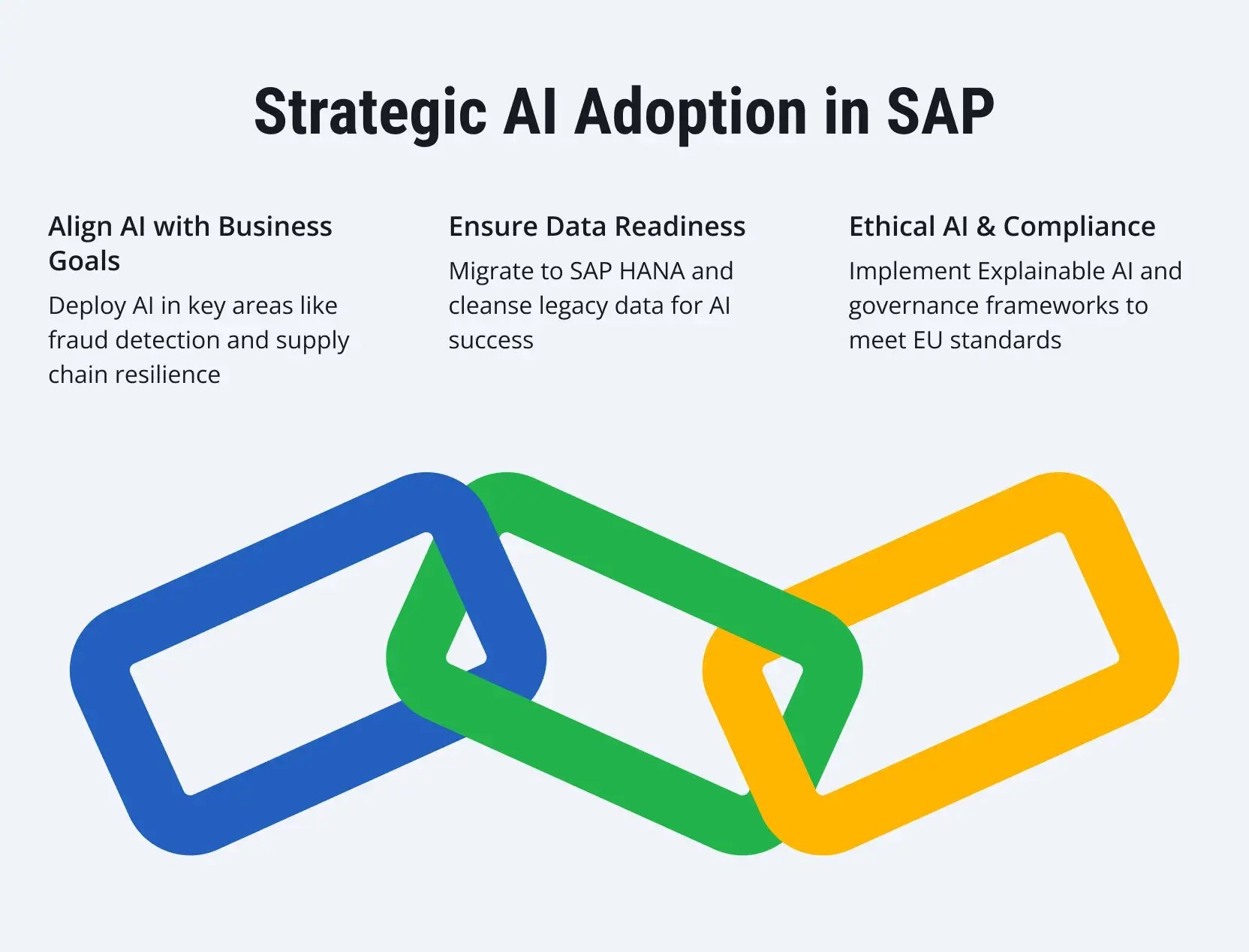
AI only really works when it’s aimed at a specific bottleneck. If you don't have a clear problem to solve, like a fraud gap or a massive maintenance backlog, you’ll probably end up with a "science project" that never goes live. It’s not just about the tech; you need someone in leadership who owns the result and clear KPIs to track it.
How to avoid it:
Start with the high-impact stuff and tie it directly to the money. Whether that's reducing working capital or cutting down on downtime, the financial goal has to be front and center. And honestly, don't even let the developers start until you have executive buy-in. Without that top-down support, these initiatives almost always get stuck in a corner and forgotten.
Data readiness and quality
Let’s be honest: machine learning is only as good as the data you feed it. The biggest headache with old SAP ECC environments is that they’re usually a mess of fragmented records and inconsistent entries. While moving to S/4HANA gives you more processing power, it doesn't magically fix your data quality. You still have to do the heavy lifting of cleansing your datasets and making sure the information makes sense across different departments before you even think about AI.
How to avoid it:
The best move is to set up a data governance plan before you start the rollout. Use the ECC-to-S/4HANA migration as your window to scrub those legacy datasets. You need to standardize your master data and figure out which variables matter before you waste time training a model. If the foundation is a mess, the AI is just going to automate your mistakes.
Model accuracy, drift, and continuous retraining
One of the biggest mistakes is assuming that once a machine learning model is live, the job is done. In reality, these models "decay" the moment business conditions shift whether it's a change in customer demand or a sudden swing in financial risk. If you aren't watching for "model drift" and setting up pipelines to retrain them, the accuracy will tank, and you’ll lose the trust of the people using the system.
How to avoid it:
The key is to treat ML models as living assets, not one-time software installations. You need continuous monitoring and automated retraining as part of the plan. Set clear thresholds for performance: the moment the output starts to slip, it should trigger a review. If you treat AI as a "set it and forget it" tool, it quickly becomes a liability rather than an asset.
Explainability and regulatory compliance
In a large ERP environment, a single AI decision can ripple through finance, HR, and your entire supply chain. This is why "black-box" predictions are a non-starter for most enterprises. You can’t have a system making high-stakes calls if no one can explain why it made them. To stay on the right side of things, especially with the EU AI Act breathing down everyone's neck, organizations need solid audit trails and a way to monitor for bias.
How to avoid it:
You have to be able to show exactly how a model reached its conclusion. This isn't just to keep the regulators happy; it's about making sure the AI fits into your company’s risk strategy. Treat governance as something that evolves alongside the law. If a decision is too complex to explain, it’s probably too risky to automate.
Integration across hybrid landscapes
Machine learning models must consume data from SAP and non-SAP systems and return outputs into transactional workflows. Ensuring low-latency integration and consistent data semantics across hybrid cloud environments remains a technical challenge.
How to avoid it:
Design integration architecture upfront. Use standardized APIs and unified data semantics. Test end-to-end data flows before production deployment.
Operationalization and MLOps maturity
Scaling AI requires more than data science capability. Enterprises need structured MLOps practices, including version control, model monitoring, automated deployment pipelines, and rollback procedures. Without this discipline, AI remains experimental rather than enterprise-grade.
How to avoid it:
Implement enterprise MLOps practices, including automated CI/CD pipelines, centralized monitoring, model versioning, and rollback procedures within governed environments such as SAP AI Core.
Organizational readiness and skill gaps
Successful AI and ML adoption requires collaboration between SAP architects, data engineers, and business stakeholders. Organizations must build internal competencies to interpret model outputs and incorporate them into operational decision-making.
How to avoid it:
Invest in cross-functional enablement. Involve business stakeholders early in use case design. Provide clear interpretation guidelines and embed AI outputs directly into familiar S/4HANA workflows.
Best Practices for Applying AI and ML Within the SAP Ecosystem
Finance: Intelligent reconciliation and predictive liquidity
In the finance department, the shift toward AI and ML is really about two things: killing the manual grunt work and getting a clearer view of cash flow. Traditionally, payment reconciliation was a massive time-sink, requiring teams to manually match remittances. Now, machine learning models can dig through historical patterns to handle that matching automatically, and usually with much better accuracy than a tired human eye.
The results aren't just theoretical. Look at Accenture, which handles a massive volume of entries for over 7,000 global clients. By bringing in SAP Cash Application, they managed to cut the manual handling of 250,000 entries and saw over half of their invoices clear automatically. That’s a huge amount of overhead gone.
But it’s not just about cleaning up the past; it’s about predicting the future. We’re now seeing ML used to flag customers who are likely to pay late by spotting subtle behavioral shifts in their payment history. Instead of being blindsided by a cash shortage, finance teams can get ahead of the problem, managing liquidity and timing their investments with a lot more confidence.
Human resources: Data-driven talent decisions
Inside SAP SuccessFactors, AI is starting to take over the more tedious parts of the hiring cycle. For one, Generative AI is being used to churn out job descriptions that are inclusive and structured, something that usually takes a lot of manual tweaking. But the real heavy lifting happens in candidate evaluation. Instead of a recruiter squinting at thousands of resumes, machine learning models can scan for skill patterns and experience that fit the role. It doesn't just save time; it helps find the "right" person who might have been missed in a traditional keyword search.
We’re seeing this play out in the real world with companies like Frit Ravich, who used SuccessFactors to clean up their recruitment matching process. Then there’s American Honda, which is using machine learning for something even more strategic: skill gap analysis. They aren't just hiring; they’re using the tech to see exactly where their workforce is falling short and aligning those capabilities with where the company is headed.
Customer experience: Behavioral intelligence and operational automation
In marketing and commerce, ML models analyze customer engagement patterns, browsing behavior, and purchase history to identify high-conversion leads. This allows targeted, timely campaigns based on predictive intent signals.
AI tools generate product descriptions from structured data such as specifications and pricing, ensuring consistency while supporting SEO alignment. In sales operations, AI automates order capture from emails and scanned documents, reducing manual entry errors. In customer service, ML models classify and route support tickets.
Bosch Power Tools uses AI to analyze millions of service tickets annually, directing them to appropriate teams and significantly reducing operational costs.
Supply chain: Predictive planning and risk monitoring
Supply chains benefit from continuous ML-driven forecasting and anomaly detection. Machine learning models monitor logistics, inventory, and operational data to detect disruptions early. Microsoft embedded AI into supply planning to reduce finished goods inventory and shift from reactive to predictive operations.
AI-assisted demand forecasting dynamically adjusts to market conditions, reducing shortages and overstock. AI tools also accelerate goods receipt processes by scanning and matching documentation automatically.
Looking Ahead: The Future of AI and ML in the SAP Ecosystem
AI and machine learning in SAP S/4HANA are moving from embedded optimization tools to core architectural drivers of enterprise behavior. The next phase is not about adding more predictive models. It is about systems that adapt, simulate, and self-correct in real time.
Self-optimizing workflows
The next big step for SAP isn't just better dashboards — it’s a system that can adjust itself. We’re moving toward a world where production schedules recalculate on their own because a supplier flagged a risk or a demand signal shifted in real-time. Instead of just following a set of rigid, pre-defined rules, Generative AI will be able to look at a disruption and propose a few different ways to fix it.
High-fidelity digital twins
We’re also getting closer to the digital twin becoming a standard tool rather than a luxury. By layering IoT data over machine learning, you can basically build a virtual replica of your production line or logistics network. It lets you "stress test" a decision, like a new energy consumption pattern or a route change, before you ever touch the physical assets. It’s a much safer way to plan, and it’s going to save a lot of wasted capital.
Domain-specific AI models
Expect AI to get much more "niche." SAP is moving away from generic models and toward templates that are built for your industry, whether that’s pharma, automotive, or retail. The goal is to stop building every predictive model from scratch. Instead, you'll take a proven industry template and just tune it to your specific data, which should significantly cut down the time it takes to see a return on the investment.
Greater interoperability and open integration
Looking ahead, SAP will not be a walled garden. AI is going to have to play well in a "mixed" environment. We’re moving toward a setup where you can take SAP’s native intelligence and plug it directly into third-party platforms or open-source frameworks. This kind of flexibility is a must for any company that wants a hybrid architecture that fits their specific needs, rather than just taking a one-size-fits-all approach.
Sustainability-driven intelligence
But perhaps the most important shift is how AI will handle sustainability. Currently, tracking emissions or resource consumption is mostly a report-and-file task. That’s changing. We’re moving toward a world where sustainability is an operational control. Imagine the system automatically adjusting a supply chain route not just for cost but for carbon footprint, right inside the ERP workflow. It turns environmental standards from a compliance headache into a core part of how the business runs.
Emerging technologies
The roadmap also points toward broader use of generative AI for workflow orchestration, more accessible AI tools for business users without technical backgrounds, and exploration of quantum computing for high-speed data processing in complex analytical scenarios.
As these capabilities mature, SAP systems will shift from reacting to historical data toward continuously anticipating operational change. The digital core will increasingly function as an adaptive decision engine, influencing sourcing strategies, production planning, workforce optimization, and financial risk management in near real time.
The Bottom Line
Integrating AI and machine learning into SAP S/4HANA represents a fundamental shift in enterprise architecture. We are moving away from a model where analytics is a retrospective, separate layer; instead, intelligence is becoming part of the operational core. This allows decisions to be generated exactly at the point of execution rather than being reconstructed from historical data after the fact.
However, moving toward an "intelligent ERP" is rarely a purely technical hurdle. Success usually hinges on the reality that data quality serves as a hard ceiling for any model. No amount of algorithmic sophistication can compensate for inconsistent historical records. Furthermore, the transition from an experimental pilot to a governed production asset requires a level of MLOps maturity that many organizations are still developing. Ultimately, the impact of these systems is decided at the design stage. Without in-depth involvement from business owners to solve specific, high-value bottlenecks, AI initiatives risk becoming "science projects" that demonstrate technical potential without delivering operational relief.
Organizations that build these conditions systematically gain a system capable of adapting to market changes, surfacing actionable scenarios before deviations escalate, and reducing the cost of delayed decisions. That is the practical value of intelligent ERP — the ability to manage operational complexity with foresight rather than in response to it.
How LeverX Can Help
LeverX supports organizations at every stage of building an intelligent digital core.
|
AI and ML integration within SAP S/4HANA |
Development of custom intelligent scenarios |
SAP predictive analytics and process automation setup |
|
We specialize in embedding AI directly into the transactional layer of SAP S/4HANA, ensuring that predictive models run on live business data. |
When standard SAP functionality isn't enough to solve a specific bottleneck, our team develops tailored machine learning models and intelligent process extensions. |
We configure everything from anomaly detection frameworks to complex forecasting models. The goal is to move beyond technical feasibility and link every prediction to a measurable business outcome. |
|
SAP BTP configuration for AI/ML extensions |
Data preparation and model optimization |
End-to-end implementation and post-go-live support |
|
The LeverX experts configure and extend SAP Business Technology Platform to support scalable AI deployments, hybrid integrations, and secure model lifecycle management. |
High-quality models depend on high-quality data. LeverX conducts data assessment, cleansing, harmonization, and feature engineering to improve model accuracy and long-term stability. |
From architecture design and deployment to performance monitoring and continuous optimization, we ensure AI and ML initiatives move from pilot stage to sustainable enterprise-scale execution. |


-min-Jul-12-2022-09-46-40-14-AM.jpg)
-min-1.jpg)