Understand how banks modernize with real-time finance, integrated risk, and SAP-enabled architecture to improve resilience, compliance, and operational efficiency.
Digital transformation in banking might look similar to other industries on the surface: we consider such concepts as cloud, data, AI, and automation. Underneath, it’s a different problem entirely.
Banks don’t operate in a flexible environment. Every system change affects regulated processes, financial reporting, and customer transactions at the same time. That creates a level of dependency most industries don’t deal with.
Three constraints define how the transformation actually happens.
Stability is non-negotiable
Payment systems, transaction processing, and account data must stay live. Even a minor disruption can trigger heavy financial loss or intense regulatory scrutiny. Reliability is the priority over almost any other metric.
Deeply embedded legacy systems
Many core banking platforms have been running for decades. Business processes and organizational habits are built entirely around these old systems. Replacing them is a major risk because they are so central to daily operations.
Market competition and speed
Many fintech companies move faster than traditional banks. Customers now expect instant services and seamless digital experiences as the standard. Balancing these legacy constraints with modern demands is the industry's primary challenge.
As a result, banks need to modernize, but they cannot afford uncontrolled change. Digital transformation in banking is shaped by constraints, where every step forward has to be controlled, validated, and aligned with risk and compliance.
In this blog post, we will trace the journey of banking innovation and explore the role of SAP in building a future-proof framework for financial institutions.
The Structural Limits of Legacy Core Banking Systems
Legacy core systems are misaligned with how modern banking operates. Most of these platforms were designed for stability in a much simpler environment. Products changed slowly, integrations were limited, and reporting cycles were periodic. That model no longer holds.
Banks now have to operate in real time. Transactions, risk exposure, and customer interactions all move continuously. When the underlying system still relies on older architectural principles, tension builds across the entire organization.
Instead of supporting change, the system starts resisting it. Adding a new product, updating regulatory logic, or integrating with external platforms often requires navigating layers of dependencies and custom code.
|
Limitation |
What it means in practice |
Business impact |
|
Batch processing |
Transactions are processed in cycles, not instantly |
Decisions rely on delayed data |
|
Data silos |
Finance, risk, and customer data are stored separately |
Conflicting reports and manual reconciliation |
|
Rigid product models |
New offerings require system-level changes |
Slower time-to-market |
|
High maintenance overhead |
Years of custom code and patches |
Increasing cost and reduced agility |
To work around these limits, banks usually add more systems around the core. Over time, this creates a fragmented landscape where data has to be constantly synchronized between platforms.
That fragmentation shows up in everyday operations:
- Reporting requires consolidation from multiple sources.
- Data inconsistencies introduce operational and compliance risk.
- Product changes take longer than the market allows.
What starts as a stable system gradually turns into a bottleneck for both operations and innovation.
SAP as a Digital Core for Financial Institutions
SAP S/4HANA, including SAP Cloud ERP, introduces a different way of organizing financial systems. It removes the separation between existing processes.
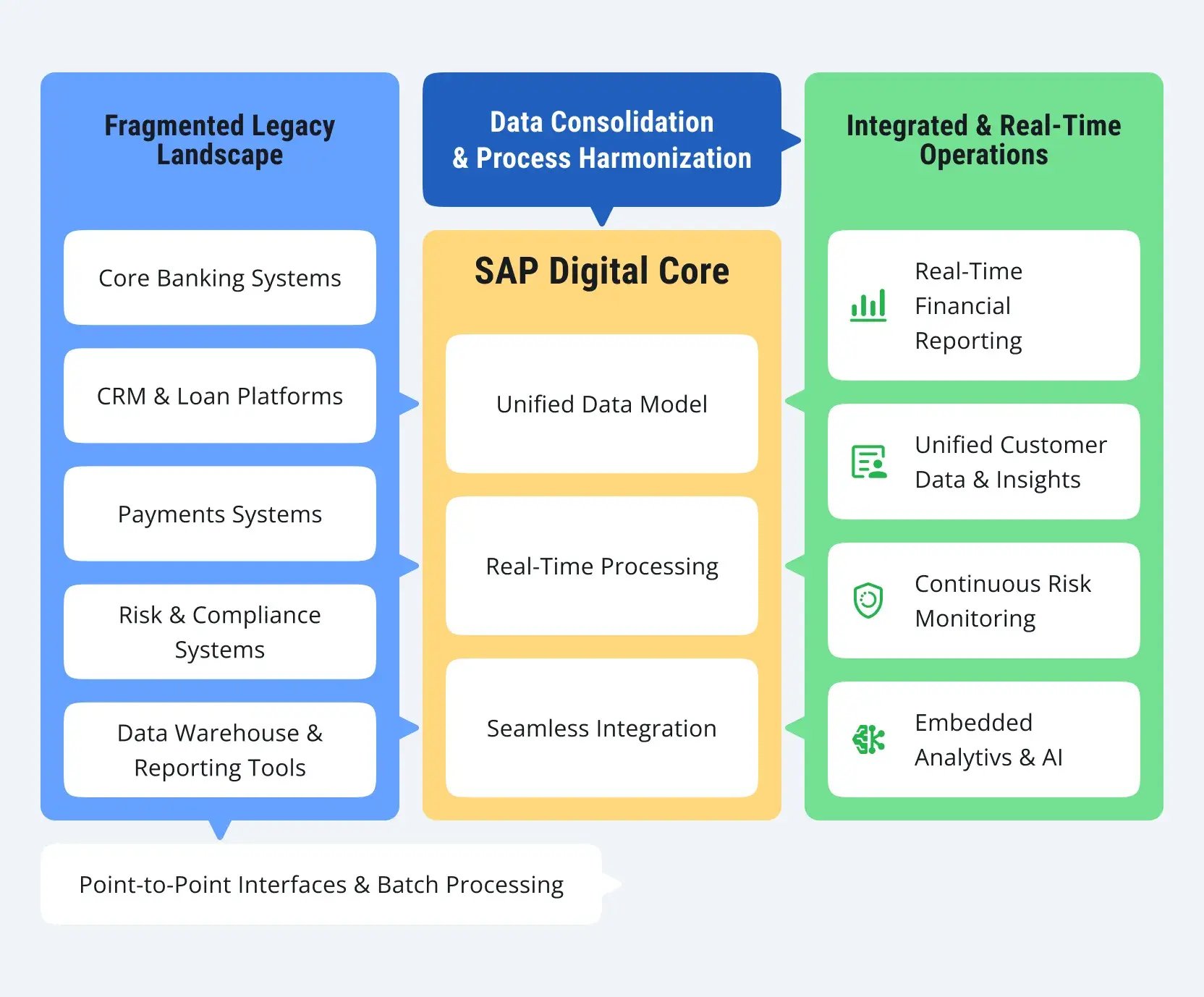
In most banks, financial data moves through multiple layers. A transaction is recorded, then transferred, aggregated, and finally reported. Each step adds delay and creates opportunities for inconsistency. By the time data reaches decision-makers, it often reflects a past state rather than the current situation.
SAP can significantly reduce this multi-step flow. At the core is a unified data model where transactions, financial records, and analytical data exist together. Once a transaction is posted, it can become available across finance, risk, and reporting functions without additional processing.
This changes several things at once:
- Financial data no longer needs to be replicated across multiple layers.
- Reporting can draw on current transactional data.
- Risk exposure can be evaluated more continuously.
The system also embeds analytics directly into operational workflows. Instead of generating reports separately, users can analyze financial positions, trends, or anomalies within the same environment where transactions occur.
Another important shift concerns how systems interact. In traditional landscapes, integration layers move data between platforms, and each interface introduces latency and complexity. Over time, this creates a fragile network of dependencies.
With SAP, much of that movement is no longer necessary. Instead of regenerating information for every department, data now flows from a single point of origin. This model does more than just cut technical clutter; it removes the lag that typically stalls operations.
The real shift, however, is in decision-making. Instead of reconstructing financial health from past records, leaders see liquidity and exposure as they actually happen. By closing the gap between an event and the response, the organization moves from a reactive posture to a predictive one — a necessity when market timing dictates the bottom line.
Modernizing Finance Operations
Finance is usually the first area where transformation stops being theoretical and starts showing a tangible impact. That’s because many inefficiencies in banking are concentrated in closing cycles, reconciliations, and reporting delays.
In legacy systems, finance moves in rigid phases. You record transactions, then wait until the end of the period to validate and reconcile everything. This approach creates a massive backlog and reduces visibility during the reporting period. You only see the full picture after the month is already over.
Modern SAP environments break that cycle. Finance stops being a periodic event and becomes a continuous process. Data is validated the moment a transaction occurs. This reduces the need for large end-of-period adjustments.
What changes in practice:
- Ongoing financial closing
Most adjustments happen during daily operations. You no longer have to compress a month of work into a few high-pressure days.
- Embedded reconciliation
Validation happens automatically within the process. This cuts the reliance on manual checks and disconnected spreadsheets.
- Live treasury data
Cash positions and liquidity are visible right now. You do not have to reconstruct your funding needs from multiple legacy sources.
- Direct reporting
Reports come straight from transactional data. There is no need to extract or reassemble files, which naturally shortens your cycles and hits higher accuracy levels.
This shift changes the actual day-to-day work for finance teams. You spend less time chasing missing data or fixing errors. Most of the energy goes into analyzing performance and supporting real business decisions. There is also a major control benefit. Discrepancies show up early, which reduces the risk of massive year-end adjustments. The real win is the removal of the bottlenecks that used to paralyze the reporting cycle.
Customer-Centric Banking Enabled by SAP
Banks have spent years investing in digital channels, but many still struggle to deliver a consistent experience. The issue is rarely the interface itself. The real problem is the underlying data. In most legacy landscapes, customer information is scattered across loans, payments, CRM, and risk systems. Each one holds only a partial view. Synchronizing them is slow and usually incomplete. This means different departments often operate with slightly different versions of the same customer.
That fragmentation creates constant friction. A client might receive conflicting offers or face delays during onboarding because the data is not aligned. SAP addresses this by pulling customer-related data into a unified structure. The bank stops stitching together information from separate systems and starts operating on a single, continuously updated profile.
Key capabilities:
- Complete customer view: a unified look at every product and interaction across the entire bank.
- Real-time analysis: instant tracking of behavior, transactions, and financial patterns.
- Accurate recommendations: product suggestions based on actual usage rather than old snapshots.
- Omnichannel consistency: the same level of service whether the client is on a mobile app or in a branch.
This shift moves a bank from reacting to customer activity toward anticipating it. Onboarding can become faster because more customer data is centralized. The information is already there and validated. There is also a major risk benefit: when data is consistent, credit decisions and fraud detection become much more reliable. The bank finally gains the ability to act on customer data without the typical hesitation or reconciliation delays.
Integrating Compliance Into the Core
In modern banking, compliance has moved from a "post-game" review to a real-time operational requirement. The traditional model, where data is captured, siloed, and eventually aggregated for regulators, is no longer sustainable. That approach doesn't just cause delays; it creates a dangerous daylight between what is actually happening and what is being reported.
By embedding regulatory logic directly into the transaction layer, the burden shifts from manual oversight to systemic design. In this environment, the reporting layer effectively disappears because the operational data is the regulatory data.
The operational reality looks the following way:
-
Live risk monitoring
We are moving away from the era of static snapshots. Instead, risk exposure functions as a live and breathing metric. It reflects market shifts as they happen rather than through a rearview mirror.
-
Native audit trails
Evidence is no longer gathered for auditors. Instead, it is generated as a natural byproduct of the transaction itself. This high-integrity data flow removes the need for those frantic forensic reconstructions that usually plague year-end reviews.
-
Unified fraud defense
By tethering detection tools to a single source of origin, we effectively seal the cracks that fragmented systems naturally leave open. This is not just about catching bad actors; it is about absolute data consistency.
-
Systemic integrity
This shift does more than just satisfy the authorities. It aggressively strips out the manual workarounds and offline adjustments that traditionally trigger both human error and regulatory scrutiny.
When a regulator demands to see the origin of a figure, the system provides a direct map back to the source. Ultimately, we move the complexity away from the reporting teams and into the architecture, turning compliance from an effort to clean everything up into a standard feature of the workflow.
Data, Analytics, and AI in Modern Financial Institutions
Banks generate large data volumes. The real issue is that most of it is fragmented, delayed, or inconsistent across systems. Analytics built on top of that foundation tends to be unreliable, which is why many AI initiatives fail to move beyond pilots.
The shift to SAP-based architectures changes this starting point. When transactional, financial, and operational data exist in a unified structure, analytics becomes part of the system rather than an external layer.
This has a direct impact on how data is used.
- Embedded analytics instead of separate reporting
Insights are available within operational workflows. A finance team does not need to extract data into another tool to understand performance or anomalies. The system reflects the current state as transactions occur. - Predictive forecasting based on live data
Liquidity forecasts, credit exposure, and financial projections are calculated using current positions rather than historical snapshots. This improves accuracy and reduces reliance on manual adjustments. - Anomaly detection across the full dataset
Pattern deviations, outlier transactions, and emerging operational risks can be identified earlier because the system has a broader analytical view across financial and customer data. - Automation of repeatable decisions
Routine processes such as reconciliation, validation, or basic risk checks can be automated when rules are clearly defined and supported by consistent data.
AI builds on top of these capabilities, but it is not the starting point. Its effectiveness depends entirely on the quality and structure of the underlying data.
In practical banking scenarios, this translates into:
- More reliable credit scoring models based on complete customer data
- Better liquidity and capital forecasting aligned with real-time transactions
- Faster identification of operational or compliance anomalies
- Reduced manual workload in financial operations
There is a common misconception that introducing AI automatically improves performance. In fragmented system landscapes, the opposite often happens. Models process inconsistent inputs and produce outputs that require additional validation.
A unified data environment changes that dynamic. It does not eliminate complexity, but it makes analytical results more trustworthy and easier to act on.
The real advantage is not that decisions are automated, but that they are based on a consistent and current view of the business.
Cloud, Security, and Sovereignty
Cloud adoption in banking involves constraints that go far beyond standard IT. Regulatory requirements for data location, access control, and operational resilience often dictate the architecture more than cost or scalability ever could. Most banks skip a single, sweeping approach and evaluate deployment models based on their specific limitations instead.
In 2026 and beyond, scalability is no longer a differentiator. The real constraint is data sovereignty. Banks must ensure that sensitive financial data remains protected from extraterritorial legal access, where regulations such as the US Cloud Act can conflict with EU data protection frameworks. This makes deployment decisions less about technical capability and more about jurisdiction, control, and legal exposure.
Common deployment models:
- Public clouds: This offers the most scalability and flexibility. It is usually the go-to choice for customer-facing services that need to adapt quickly.
- Private clouds: These setups provide much tighter control over sensitive data and the most critical back-end processes.
- Hybrid architectures: This allows a bank to keep certain workloads under tighter control while moving others to the cloud for better performance.
Depending on regulatory and operational requirements, banks may also retain selected workloads on-premises or in highly controlled hosted environments.
.webp)
Security remains the primary concern regardless of the model. It is not just about blocking external threats. You also have to ensure every internal access point is properly controlled and fully auditable. Disaster recovery is just as vital. Banking systems have to stay live during a crisis. This requires heavy redundancy and constant validation of your recovery procedures. Ultimately, a banking digital transformation strategy in the cloud is about aligning your tech with regulatory expectations, data sovereignty requirements, and your own risk tolerance. This also requires an SAP Clean Core approach, when we avoid excessive customization to adopt SAP updates, including regulatory changes, without disruption.
Measurable Business Outcomes
Digital transformation in banking is often discussed in abstract terms, but its impact is visible through a set of concrete operational and financial indicators. These outcomes are interconnected — improvements in one area usually reflect bigger changes in data consistency, process design, and system integration.
Finance and reporting efficiency
The first signal of a successful transformation appears in finance operations:
- Shorter financial closing cycles due to continuous accounting
- Reduced manual reconciliation and fewer spreadsheet dependencies
- More consistent group reporting across entities
- Faster access to accurate financial data during the reporting period
These changes indicate that financial data is no longer fragmented across systems and does not require reconstruction.
Liquidity and treasury visibility
Treasury functions benefit directly from real-time data availability:
- Immediate visibility into cash positions and liquidity exposure
- More accurate forecasting based on current transactional data
- Improved control over funding and capital allocation
When the treasury operates on live data, decision-making becomes more precise and less dependent on estimates.
Compliance and risk reduction
Regulatory processes become more predictable when data is aligned:
- Lower effort required to prepare regulatory reports
- Improved audit traceability from reported figures to source transactions
- Reduced risk of inconsistencies between operational and reported data
- Faster response to regulatory changes due to standardized data structures
This reflects a shift from reactive compliance to embedded control mechanisms.
Operational efficiency
Improvements in day-to-day operations are often the most immediate:
- Fewer manual interventions in financial and operational workflows
- Reduced duplication of data across systems
- Lower dependency on reconciliation processes
- More stable system behavior due to reduced customization complexity
These changes indicate that the system landscape is becoming more cohesive rather than layered with workarounds.
Speed of product and service innovation
A more flexible architecture directly affects how quickly banks can introduce new offerings:
- Faster rollout of new financial products
- Reduced effort to adjust pricing, terms, or regulatory logic
- Easier integration with external platforms and fintech services
This reflects a move away from rigid system dependencies toward configurable and scalable processes.
Cross-industry evidence from SAP transformations
While banking-specific benchmarks are often confidential, patterns from large-scale SAP transformations across industries show consistent results when data and processes are aligned:
- Reduction in process cycle times
- Decrease in manual workload and rework
- Elimination of redundant data silos
- Improved coordination between operational and financial functions
These outcomes reflect what happens when fragmented systems are replaced with a unified digital core.
Strategic Roadmap for Banking Digital Transformation
Banking transformation follows a recognizable structure. Each phase addresses a specific constraint, such as systems, data, or processes, while keeping the bank operational and compliant.
1. Establish data integrity and governance first
At this stage, banks must address master data quality and governance:
- Standardize customer, account, and product data
- Define ownership and validation rules
- Introduce governance
- Implement Customer Vendor Integration (CVI) where applicable
If this step is rushed, issues reappear later in more complex forms, affecting finance, risk, and reporting processes.
2. Start with the real system, not the diagram
Before defining any target state, banks need to understand how things actually run today.
- Map core and satellite systems
- Identify where the data breaks or gets duplicated
- Look at the custom code that quietly drives critical processes
This is where hidden complexity usually shows up, especially in manual workarounds.
3. Define a realistic target architecture
The goal is not to modernize everything, but to establish a stable digital core:
- SAP S/4HANA Finance becomes the operational backbone.
- A single data model replaces fragmented structures.
- Core logic is separated from extensions to avoid future lock-in.
This step sets direction. If it’s wrong, everything downstream becomes harder.
4. Anchor transformation in finance
Finance is typically the first domain to move because it connects the entire organization.
- Central Finance can unify data without a full system replacement
- Direct SAP S/4HANA finance implementations establish a new core faster
Either way, the objective is the same — to obtain one consistent financial view.
5. Align processes and integrations
Once the core and data are stable, systems need to start behaving consistently.
- Connect legacy systems to the SAP core
- Remove manual reconciliation steps
- Ensure finance, risk, and operations follow the same logic
This is where fragmentation starts to disappear in day-to-day work.
6. Transition gradually, not all at once
Full replacement is rarely practical. Most banks move in controlled steps.
- Migrate selected functions or entities first
- Run old and new systems in parallel where needed
- Retire legacy components over time
The system evolves without interrupting operations.
7. Expand once the foundation holds
Only after stabilization does it make sense to layer on advanced capabilities.
- Real-time analytics and reporting
- Generative AI and Joule-enabled financial insights
- Integration with fintech and external platforms
At this point, innovation becomes sustainable instead of fragile.
What separates working roadmaps from failed ones:
- Clear sequencing — data and finance come before everything else.
- Controlled scope — no attempt to replace everything at once.
- Continuous validation — each phase improves stability, not just features.
What ultimately matters is not just how quickly transformation starts, but how well it holds under pressure over time. Banks that take a structured, controlled approach build systems that remain stable as regulations evolve, markets shift, and customer expectations increase. That is what defines long-term competitiveness and resilience.
What SAP Offers for Banking Digital Transformation
Dedicated SAP solutions, tools, and platforms are focused on pulling finance, risk, and customer data into a single environment. This way, you move beyond simple transaction processing to creating a foundation for real-time analytics.
Core banking and financial processing
Solution: SAP S/4HANA Finance (SAP Cloud ERP)
This group of solutions serves as the bank's digital heart. It manages back-office operations, including Universal Journal, pulling every ledger entry into a single, centralized stream. Therefore, the system minimizes the need for manual, cross-department reconciliations. This ensures that every team is looking at the same real-time numbers at the same time.
Financial accounting and closing
Solutions: SAP S/4HANA Finance for Group Reporting, SAP Advanced Financial Closing
These tools drive a move toward continuous accounting. They automate the heavy lifting of intercompany settlements and consolidation. Shaking off the month-end rush leads to much faster cycles. It strips away the usual bottlenecks, finally letting teams focus on analysis instead of chasing data discrepancies.
Risk and compliance management
Solutions: SAP GRC Access Control, SAP Financial Compliance Management
This is an embedded control layer that monitors access risks and automates audit trails. It aligns daily operations with regulatory demands by default. Instead of a "cleanup" effort before an audit, compliance becomes a native, ongoing property of the system.
Treasury and liquidity management
Solution: SAP S/4HANA Cloud for Treasury and Risk Management
This setup centralizes cash flow forecasting and manages exposure to financial instruments. It gives a live look at the bank's actual financial standing. This transparency cuts out the guesswork, making capital usage much tighter even when markets get volatile. You achieve a new level of transparency that leads to better capital usage and reduces the guesswork in liquidity planning during volatile periods.
Customer data and experience
Solutions: SAP Customer Experience, SAP Customer Data Cloud
The solutions’ role is to build a unified view of the client across every channel. They consolidate behavioral insights for faster onboarding, more relevant services, and personalization.
Data management and governance
Solutions and tools: SAP Master Data Governance, SAP Customer-Vendor Integration
This layer standardizes master data across the entire landscape. It kills off inconsistencies before they hit your reporting, creating a clean foundation for everything from risk to finance.
Analytics, reporting, and AI
Solutions: SAP Analytics Cloud, SAP Datasphere, SAP Joule
Organizations can embed intelligent insights and real-time reporting directly into their workflow. Rather than performing manual analysis after the fact, leaders get AI-driven forecasting and instant reports. This speeds up the move from seeing the data to taking action.
Integration and extension layer
Integration and extension suite: SAP Business Technology Platform (SAP BTP)
This platform manages APIs and allows for custom extensions. It keeps the core clean and stable while giving the bank the flexibility to innovate. This reduces technical debt and makes the entire architecture more scalable as needs evolve.
Product and service innovation
Solutions: SAP Fioneer
SAP Fioneer supports the configuration and launch of new financial products. It provides industry-specific capabilities that reduce reliance on rigid legacy structures and simplify how products are defined and managed. So, by standardizing product logic and workflows, banks can introduce new offerings and adapt existing ones with less dependency on complex system changes.
IT architecture and cloud strategy
Solutions and service offerings: SAP S/4HANA Cloud, RISE with SAP
These provide the framework for cloud migration and infrastructure management. You align the bank's architecture with regional sovereignty and regulatory requirements. As a result, the system becomes more resilient and can scale without traditional on-premises limitations.

Our Experience in Financial Services Transformation
LeverX works across the SAP financial services industry, supporting banks in aligning finance, risk, and data within a unified SAP environment. That shapes how transformation programs are designed and executed.
Most banks don’t start from a clean slate. They operate across layered architectures with legacy cores, satellite systems, and years of accumulated custom logic. Replacing everything at once is rarely realistic. The focus is on introducing a stable digital core and gradually reducing fragmentation.
LeverX approaches this through several core areas:
- SAP S/4HANA finance implementations
Building a unified financial foundation where accounting, controlling, and reporting rely on the same data model. This removes reconciliation layers and enables continuous financial visibility. - Central finance programs
Creating a consolidated financial view across multiple systems without immediate full replacement. This allows banks to standardize reporting and gain control over data while the transformation continues in parallel. - Regulatory reporting optimization
Aligning financial data structures with regulatory requirements so that reporting reflects operational data directly. This reduces manual adjustments and improves audit traceability. - Treasury transformation
Providing real-time visibility into liquidity, cash flow, and financial exposure. Treasury functions shift from reactive reporting to ongoing monitoring and control. - Integration with fintech ecosystems
Connecting SAP systems for financial services with external platforms through controlled integration layers. This supports innovation without compromising data integrity or compliance. - Migration from legacy systems
Transitioning from fragmented environments while preserving historical data and maintaining business continuity. The emphasis is on controlled migration rather than disruptive replacement.
What defines these projects is not just technical delivery. It is the ability to align finance, risk, and data into a consistent operating model while the system landscape is still evolving.
In banking, transformation is successful if it remains invisible to customers and regulators while fundamentally changing how the institution operates underneath.