

Learn how banks use SAP to strengthen internal controls, manage access risk, improve audit readiness, and modernize regulatory compliance.
Regulation in banking has never been easy, but it has become far more intrusive and continuous. U.S. financial institutions operate under constant supervisory pressure, not periodic audits.
The scale of that burden is growing. Compliance costs continue to rise across the industry, with 85% of financial institutions reporting increased compliance spending in recent years, reflecting ongoing regulatory expansion and operational complexity.
At the same time, the operating model is inefficient. Banks often dedicate 10–15% of their workforce to KYC and AML activities alone, yet detection rates for financial crime remain around 2%, which is extremely low and highlights a gap between effort and actual outcomes.
This is not only a tooling issue. In many cases, it reflects fragmented data, inconsistent processes, and limited visibility across systems, which make effective detection significantly harder. Consolidating financial data within SAP S/4HANA Finance or Central Finance solves this by creating a consistent data foundation for better transparency. And tools like SAP Business Integrity Screening (SAP BIS) scan massive data volumes in real time to find patterns suggesting fraud or non-compliance.
Banking compliance management is no longer a reporting exercise done at quarter-end. It is an always-on operational capability that must be embedded into daily processes, but most institutions are still trying to manage it with fragmented systems and manual workflows.
Risks of Fragmented Banking Systems
Banks have to manage risk across several layers at once. Each one requires a different set of controls and constant monitoring to stay ahead of potential issues. Core risk categories include:
- Credit and market risks: Borrower defaults and loan portfolio exposure sit alongside volatility in interest rates, foreign exchange, and trading. These financial pressures are often the most visible.
- Operational and system risks: Process failures and human error can lead to sudden system breakdowns. This layer includes the constant threat of cyber risks, such as data breaches or system compromise.
- Liquidity and compliance risks: An inability to meet short-term obligations can trigger a crisis quickly. At the same time, failing to meet shifting regulatory requirements creates its own set of compliance risks.
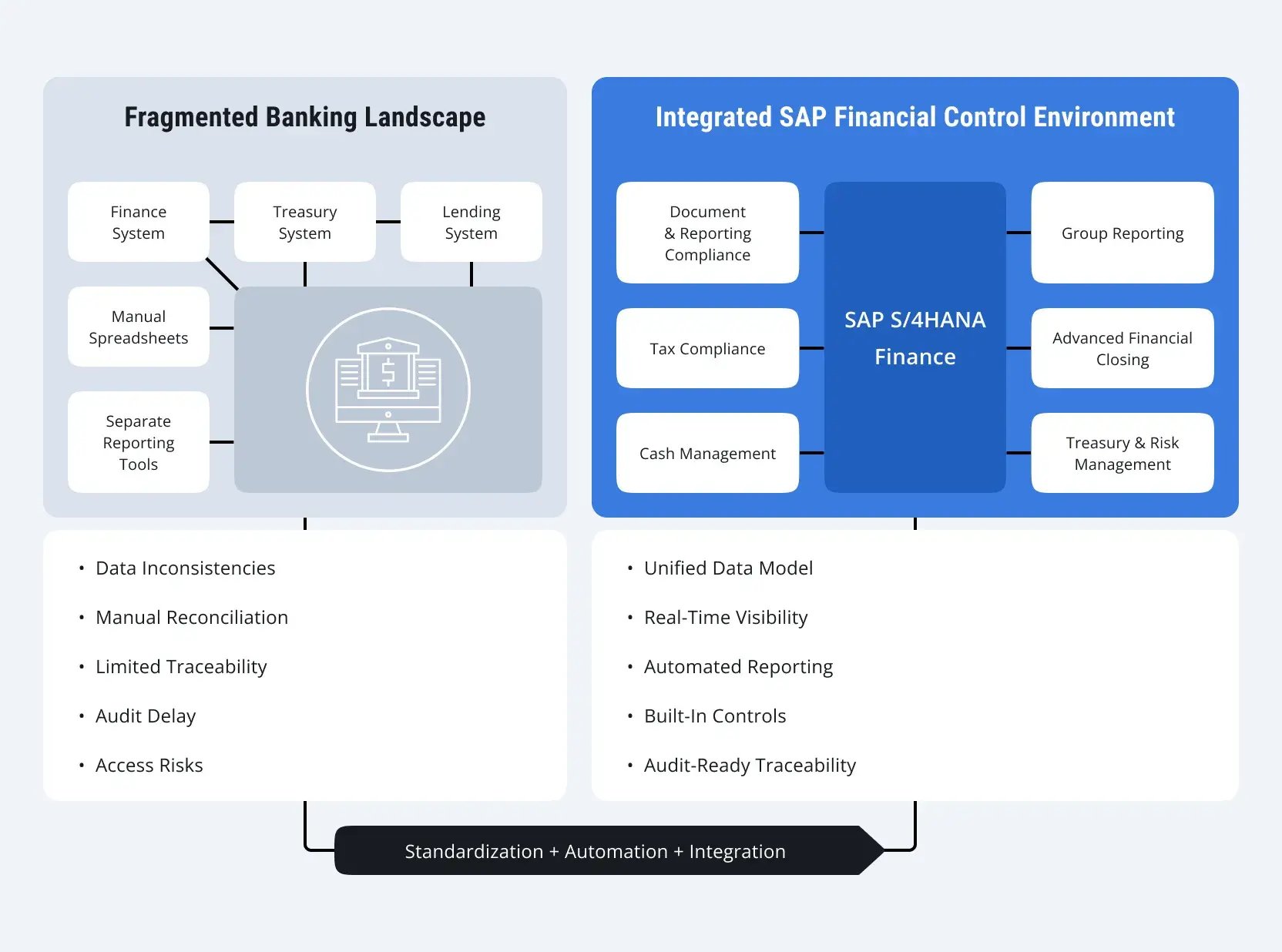
Risk management failures in banking rarely stem from one major breakdown. They grow from small inconsistencies that build up across disconnected systems. When functions like finance, treasury, and lending operate in silos, they each maintain separate data and control logic. This makes it difficult to get a clear view of the actual risk profile.
In many institutions, user access is managed apart from business processes. Control documentation and reconciliation often still depend on manual tools like spreadsheets. This creates structural blind spots. Evidence of a control might exist, but finding it quickly is a challenge. Access rights are often granted without being reviewed against current policy.
This fragmented landscape leads to duplicated data and inconsistent reporting. Preparing for an audit becomes a reactive scramble to reconstruct process histories manually. On the surface, the bank might seem compliant. Under real scrutiny, however, the organization can struggle to prove how controls were executed or enforced.
The disconnect between doing the work and proving the work increases operational risk. It also leaves the bank more exposed to regulatory penalties. Without a unified system, the sense of control often becomes difficult to validate.
SAP Support for Risk and Compliance in Banking
Risk management in a modern bank cannot rely on manual checks or isolated processes. SAP embeds controls directly into financial and operational workflows, creating a system where compliance is part of execution.
These capabilities are often traditionally grouped under the term SAP GRC (where “GRC” stands for “Governance, Risk, and Compliance”), but in practice, they are delivered through a set of specialized SAP solutions that operate within finance, reporting, and treasury processes.
While SAP S/4HANA Finance acts as the system of record for financial data, governance and control are reinforced through structured control frameworks and policy-driven processes that extend across systems and organizational layers.
Here are the core SAP solutions that support this approach.
Everything starts here. The solution acts as the backbone for your data, keeping it accurate and ready for an audit from day one. You get a clean foundation without the usual reconciliation headaches. For institutions operating in complex landscapes, S/4HANA for Central Finance enables the consolidation of financial data from multiple source systems into a single S/4HANA instance, which effectively minimizes the struggle of reporting across fragmented platforms.
SAP S/4HANA Finance for Group Reporting
This solution handles the heavy lifting of financial consolidation across various legal entities. It keeps your numbers aligned globally while cutting out the massive manual effort usually required.
SAP Document and Reporting Compliance
Compliance is a moving target, but this tool automates the response. SAP compliance solutions keep the bank aligned with local and international rules even as they shift.
SAP Advanced Financial Closing
Standardizing the month-end close is the goal here. Automating the routine steps, it removes the risk of human error and makes life much easier for the auditors.
SAP S/4HANA for Treasury and Risk Management
Liquidity and cash flow are tracked in real time. It gives you a clear look at market risks and funding needs so you can act before a gap becomes a crisis.
SAP S/4HANA Cloud for Cash Management
This solution provides an instant pulse check on your cash positions. You can forecast liquidity based on actual live data instead of relying on outdated data.
The solution handles the tax control framework automatically. The result is a consistent, auditable trail that can stand up to the most intense regulatory scrutiny.
SAP Business Integrity Screening
This tool targets suspicious activities across transactions, payments, and business partner data. It strengthens anti-money laundering and fraud detection by finding patterns or anomalies in massive data volumes. Working on top of a solid SAP S/4HANA financial foundation, it makes monitoring and investigation much more effective. Instead of manual, sampled checks, the system provides a more complete shield against financial crime. It allows teams to catch red flags earlier and act before a transaction causes lasting damage.
Building a Stronger Internal Control Environment With SAP
Internal controls are the foundation of regulatory compliance in banking, yet in many institutions, they remain static, document-based, and manually enforced. SAP transforms this model by operationalizing controls.
Through integrated control and compliance capabilities within SAP financial solutions, banks can establish a centralized control repository, map controls to specific risks and regulatory requirements, and embed them into business processes. Control testing can be automated where applicable, while remediation activities are tracked through structured workflows. This creates a dynamic control environment.
This approach helps maintain the three lines of defense model across the organization. Financial processes within SAP S/4HANA act as the execution layer where transactions and controls happen in real time. Monitoring activities then provides the necessary oversight to check if those controls are actually working as intended. Independent validation adds a final layer of security by testing these controls objectively and consistently. It moves the process away from self-reporting and toward a more reliable, verified system of checks and balances.
Organizations gain full visibility into whether controls exist, how they are executed, whether they are effective, and how issues are resolved. Control performance is continuously validated.
Such traceability aligns directly with regulatory expectations, where the ability to demonstrate control effectiveness is as important as the control itself.
Access Risk and Segregation of Duties
Access governance sits at the center of SAP risk management. This area is highly sensitive because uncontrolled permissions create a direct path to fraud, unauthorized transactions, and data manipulation. Leaving segregation of duties conflicts unaddressed will eventually undermine even the most robust control frameworks. You have to catch these overlaps early to prevent a complete breakdown in system integrity. Without tight oversight here, the rest of the security layer becomes much less effective.
SAP Access Control replaces manual guesswork with a structured, automated approach. It allows a bank to enforce least-privilege principles, block Segregation of Duties (SoD) conflicts before they happen, and monitor access to critical business transactions. User provisioning moves through governed workflows rather than informal requests. Access changes are monitored constantly, and periodic reviews make sure permissions stay aligned as roles shift.
This approach moves access governance away from a simple periodic check. It becomes a continuous control. Because access risk evolves with every new hire or system change, automation is the only way to stay ahead. Without it, these risks just accumulate quietly. They usually stay undetected until they trigger a major control failure or a bad audit finding.
Regulatory Reporting and Financial Traceability
U.S. banks handle several overlapping regulatory layers at once. Basel capital requirements and constant supervisory stress testing sit alongside strict anti-money-laundering rules. Added to this are the expanding standards for ESG reporting. None of these mandates exists in a vacuum. They create a constant pull on data quality and reporting accuracy. This environment demands flawless control execution. Without a unified system, meeting these combined expectations becomes an ongoing operational struggle.
In banking compliance, reporting is about much more than just accurate figures. You have to be able to prove exactly how those numbers were generated, validated, and controlled. This makes end-to-end traceability a core requirement. The SAP ecosystem handles this by pulling financial processes into a unified control and audit framework. Data lineage stays intact across the system, audit trails are recorded automatically, and the reporting logic remains consistent and easy to reproduce.
SAP also supports this process through audit-specific roles and read-only access profiles, allowing auditors and regulators to review financial data directly without affecting live processes. This reduces the need for manual data extraction and significantly limits the reactive effort typically required during audits.
Banks can use this to automate their reporting workflows and link every reported outcome directly back to a specific transaction. This shifts the focus from simple accuracy to reporting defensibility. Every single number can be traced and explained, which significantly cuts the risk during regulatory examinations or internal audits. It moves the process away from ad hoc preparation to a structured and defensible system.
Continuous Monitoring and Early Risk Detection
Periodic reviews are a lagging indicator. By the time you catch a mistake in a traditional model, it has already hit your liquidity or regulatory standing. SAP flips this. By embedding analytics directly into the financial and treasury workflows, the bank moves away from post-event cleanup to real-time awareness.
What to watch for in SAP S/4HANA Finance:
- Source system mismatches: When the central ledger does not match your source data, it is a red flag. Catching these inconsistencies immediately prevents a much larger mess during the final close.
- Posting patterns: Hidden risks often hide in unusual account activity. Identifying these shifts early prevents them from escalating into a major audit finding.
- Reconciliation breaks: You can see exactly where a process stops or hits a delay. This keeps the data moving without the typical weekend logjam.
- Closing variances: Unexplained differences are highlighted right when they happen. This preserves your data integrity before the final numbers are locked in.
In SAP Advanced Financial Closing, the focus is on keeping the team disciplined. You can track missed tasks or deviations from the standard workflow. This lets you fix a bottleneck before it paralyzes the entire cycle.
Treasury and cash visibility:
- Regional cash gaps: Mismatches across different accounts and regions show up in real time.
- Liquidity shifts: Unexpected shortages are flagged instantly, allowing for a faster response.
- Forecast drift: The system shows exactly how far you have wandered from your predicted cash flows.
- Market exposure: Shifts in interest rates or currency values are always on the radar.
These insights are vital for protecting your regulatory ratios. For reporting, SAP Document and Reporting Compliance tracks your submission status and flags any gaps. You catch validation errors at the source rather than discovering them during a high-pressure regulatory filing. It turns compliance into a steady, manageable process instead of a frantic scramble at the deadline.
Risk and Compliance in Hybrid SAP Landscapes
Banking IT setups are naturally messy. Most firms juggle a mix of legacy systems, on-premises SAP environments, cloud platforms, and third-party tools. This hybrid reality creates a headache for compliance. Maintaining data protection standards and hitting regional residency requirements needs a unified approach that fragmented systems cannot always provide. Cross-border operations only add another layer of complexity to these obligations.
Regulatory frameworks such as GDPR and U.S. supervisory requirements (e.g., OCC) further restrict where data can be stored and processed, making controlled deployment models like SAP Cloud ERP Private, essential for maintaining both data residency and consistent compliance policies across environments.
SAP offers deployment models designed to handle this variety. They allow a bank to apply the same set of policies across different environments while maintaining control over sensitive data. But technology by itself is never a total fix.
Real governance depends on clearly defined ownership. You need specific people responsible for risks and controls, plus a structured process for when things go wrong. Without consistent enforcement across the entire organization, even integrated systems can eventually slide back into siloed, fragmented operations. It is about the people and the process as much as the software.
Our Experience in Banking Risk and Compliance Programs
LeverX delivers end-to-end SAP compliance and risk management products tailored to banking environments.
Our capabilities include:
- Implementation of SAP financial and reporting solutions
- Financial data centralization and consolidation
- Regulatory reporting automation and compliance alignment
- Financial closing and reconciliation optimization
- Treasury and liquidity management transformation
- Integration of finance, treasury, and reporting processes
- Migration from fragmented legacy financial systems
Our approach focuses on building sustainable operating models rather than isolated technical implementations. We help banks establish environments where controls are embedded into processes, data remains consistent across systems, risks are continuously visible, and regulatory compliance in banking becomes a stable, repeatable capability.
Business Impact of Integrated Risk Management
Building risk and compliance into core operations creates measurable changes in how a bank functions. These improvements go beyond simple efficiency. They affect how consistently the business performs when things get difficult.
Core operational wins
Banks that integrate these processes often see a drop in regulatory findings and improved audit readiness. Reporting cycles move faster because the data is already aligned. This setup also lowers the overall exposure to fraud and operational errors. Manual workloads tend to decrease as automation and standardized workflows take over. This results in much higher transparency across the entire organization.
The resilience factor
The real value of an integrated environment is resilience. A bank can maintain a tight grip on its operations even under heavy regulatory pressure. Moving toward this model makes it easier to adapt to new rules and stay stable in shifting conditions. This shift changes compliance from a reactive scramble into a built-in part of the daily workflow. Instead of rushing to meet deadlines, the organization operates with constant, natural control.
A Practical Roadmap for Modernizing Banking Risk and Compliance With SAP
Modernizing risk management in banking is not a single initiative. It is a sequence of controlled steps that gradually replace fragmented processes with a consistent, traceable operating model.
1. Assess the current control and reporting landscape
Start with a realistic view of how things actually work - not how they are documented.
Focus areas:
- How financial data flows across systems (FI, treasury, legacy platforms)
- Where manual intervention is still required (reconciliation, reporting, closing)
- How controls are executed and evidenced today
- Where audit issues and delays typically occur
The goal is to identify:
- Data inconsistencies
- Control gaps
- Reporting bottlenecks
- Areas with the highest regulatory exposure
Master data consistency plays a critical role at this stage. Through integration with SAP Master Data Governance (SAP MDG) in a Central Finance setup, banks can harmonize key financial objects such as customers, vendors, and accounts across systems. This ensures that reporting, controls, and risk analysis are based on a consistent data foundation.
2. Define a financial control and compliance baseline
Before implementing anything, the bank needs a clear structure for how control should operate.
This includes:
- Standardized financial processes across entities
- Defined ownership for controls, data, and reporting
- Consistent closing and reconciliation procedures
- Unified policies for financial and regulatory reporting
At this stage, the organization moves from local practices to a shared model.
3. Establish a single source of financial truth
Fragmentation cannot be fixed without centralizing financial data.
Typical approach:
- Utilize SAP S/4HANA for Central Finance to replicate data from multiple ERP systems into a unified ledger
- Align postings, charts of accounts, and reporting structures
- Ensure that all reporting is based on the same dataset
This step is critical because:
- Compliance depends on data consistency
- Auditability depends on traceability
Without this, every downstream improvement will be limited.
4. Standardize and automate financial processes
Once the data foundation is stable, processes can be aligned and optimized.
Key actions:
- Implement SAP Advanced Financial Closing to structure and automate closing cycles
- Reduce manual reconciliation through system-driven matching and validation
- Enforce standardized workflows across entities
What changes in practice:
- Fewer last-minute corrections
- More predictable closing timelines
- Better control over execution
5. Strengthen regulatory reporting and compliance execution
With consistent data and processes in place, reporting becomes controllable.
This is where:
- SAP Document and Reporting Compliance automates regulatory submissions
- SAP S/4HANA Finance for Group Reporting ensures consistent consolidation across entities
- SAP Tax Compliance standardizes tax reporting and validation
The focus shifts from assembling reports to validating them.
6. Build real-time visibility into liquidity and financial risk
Risk cannot be managed if it is only visible after the fact.
Using:
- SAP S/4HANA for Treasury and Risk Management
- SAP Cash Management
Banks can monitor:
- Cash positions across accounts and regions
- Liquidity gaps and funding risks
- Deviations from cash flow forecasts
This introduces continuous visibility into financial risk exposure.
7. Introduce continuous monitoring and exception handling
At this stage, the bank moves away from periodic checks.
Instead, it establishes:
- Automated validation of financial data and postings
- Monitoring of closing execution and reporting completeness
- Early detection of anomalies in transactions and balances
Issues are no longer discovered during audits. They are identified during operations.
8. Embed governance and accountability
Technology alone does not stabilize compliance. The organization must define:
- Who owns financial data
- Who is responsible for the control execution
- How issues are escalated and resolved
- How compliance is enforced across entities
Without this layer, even well-designed systems drift back into inconsistency.
Following this approach leads to a system where:
- Financial data is consistent across all entities
- Reporting is reproducible and traceable
- Closing processes are controlled and predictable
- Liquidity and risk positions are visible in real time
- Compliance is part of operations, not a separate activity
The objective is not to simplify banking operations, which is unrealistic. The objective is to make complexity manageable. Banks that succeed do not eliminate risk; they build systems that:
- Detect issues early
- Adapt to regulatory change
- Maintain control under pressure
That is what operational resilience looks like in practice.





%20(1).webp)