

Learn how SAP S/4HANA supports core banking modernization by enabling real-time finance, flexible architecture, and integration with fintech ecosystems.
Banking is changing quickly, but many legacy systems aren’t built for that speed. Customers expect real-time services, regulators demand transparency, and fintechs keep raising the bar with flexible, API-based solutions. Older core systems — often decades old — are starting to show their limits.
Banks aren’t asking if they should modernize; they’re trying to figure out how to do it without affecting daily operations. A full core replacement is costly, risky, and takes time. That’s why many institutions are taking a more practical approach, evolving their architecture step by step and introducing a flexible digital core that works alongside existing transaction systems.
SAP S/4HANA is becoming a key element in this landscape. In many cases, it works alongside existing core banking systems as a central financial and operational layer that brings data and processes together. At the same time, SAP also offers industry-specific solutions where S/4HANA can take on core banking functions directly. The right approach depends on the bank’s architecture and transformation strategy.
Here, we’ll explore how this approach to modernizing core banking actually works, where SAP S/4HANA fits in, and how banks can move to a more flexible and resilient setup without putting stability or compliance at risk.
Why Core Banking Modernization Is Now a Strategic Imperative
Core banking modernization has become a pressing business need. Banks are dealing with pressure from several directions, and in many cases, their current systems just aren’t keeping up.
What’s driving the urgency?
Banks are being pushed from different sides at the same time.
- Legacy systems are part of the problem: A lot of them still work in batches and aren’t very flexible. Real-time processes are hard to support, and even small changes can take time.
- Customers don’t have much patience anymore: Instant payments, quick onboarding, 24/7 access — this is what people expect now. If something feels slow, they notice.
- Fintechs are moving quicker: They’re built differently, so it’s easier for them to roll out new features and connect with other platforms. That puts pressure on traditional banks.
- Regulation isn’t getting easier: There’s more focus on transparency and reporting, and in some cases, data is expected almost in real time. Older systems don’t handle that well.
- And it’s getting expensive: Keeping legacy systems running takes effort and money. Over time, that starts to affect how efficiently the bank operates.
Why legacy systems fall short
These challenges don’t exist on their own. As a result, banks are left with a system landscape with:
|
Challenge |
Business impact |
|
Batch-based processing |
Delayed visibility and slower decision-making |
|
Fragmented data |
Inconsistent reporting and reconciliation effort |
|
Rigid architecture |
Slow product launches and limited innovation |
|
High maintenance overhead |
Increased costs and reduced agility |
Put together, these factors are pushing banks to rethink modernization. It’s not just about replacing legacy systems anymore — it’s about building the ability to respond quickly to what’s happening in the market. In that sense, core banking modernization goes beyond IT. It’s a foundation for staying competitive.
The Limitations of Traditional Core Banking Systems
A lot of the pressure banks face today comes down to how their core systems are built. Many of them have been around for years — sometimes decades — and weren’t designed for the speed and flexibility that’s now expected.
Where the problems show up
Some of the issues are technical in nature, but they quickly become business problems:
- Batch-based processing: Many systems still process data in batches, so it’s not updated in real time. As a result, reporting, reconciliation, and decision-making all take longer.
- Fragmented data: Information is often spread across multiple systems. Getting a clear picture takes time, and inconsistencies are hard to avoid.
- Rigid product setup: Product logic is often fixed, so even small changes — like pricing updates or new offerings — require more effort than expected.
- Slow change cycles: Changes take time. Updates usually involve coordination, testing, and sometimes workarounds, which slow things down.
- Growing technical debt: Over time, fixes and patches pile up. Systems become harder to maintain, integrate, and evolve.
These issues show up in daily operations. Batch processing causes delays in reporting and decisions. Data is scattered, so getting a clear picture takes effort. And rigid systems make even simple product changes harder than they need to be. Long release cycles delay responses to market needs. And technical debt increases costs while reducing flexibility.
Why has it become a real issue?
On their own, these issues might seem manageable. But together, they start to affect how the bank operates.
Processes take longer, changes become harder, and responding to new demands — whether from customers, regulators, or the market — gets more difficult. Over time, that gap only grows.
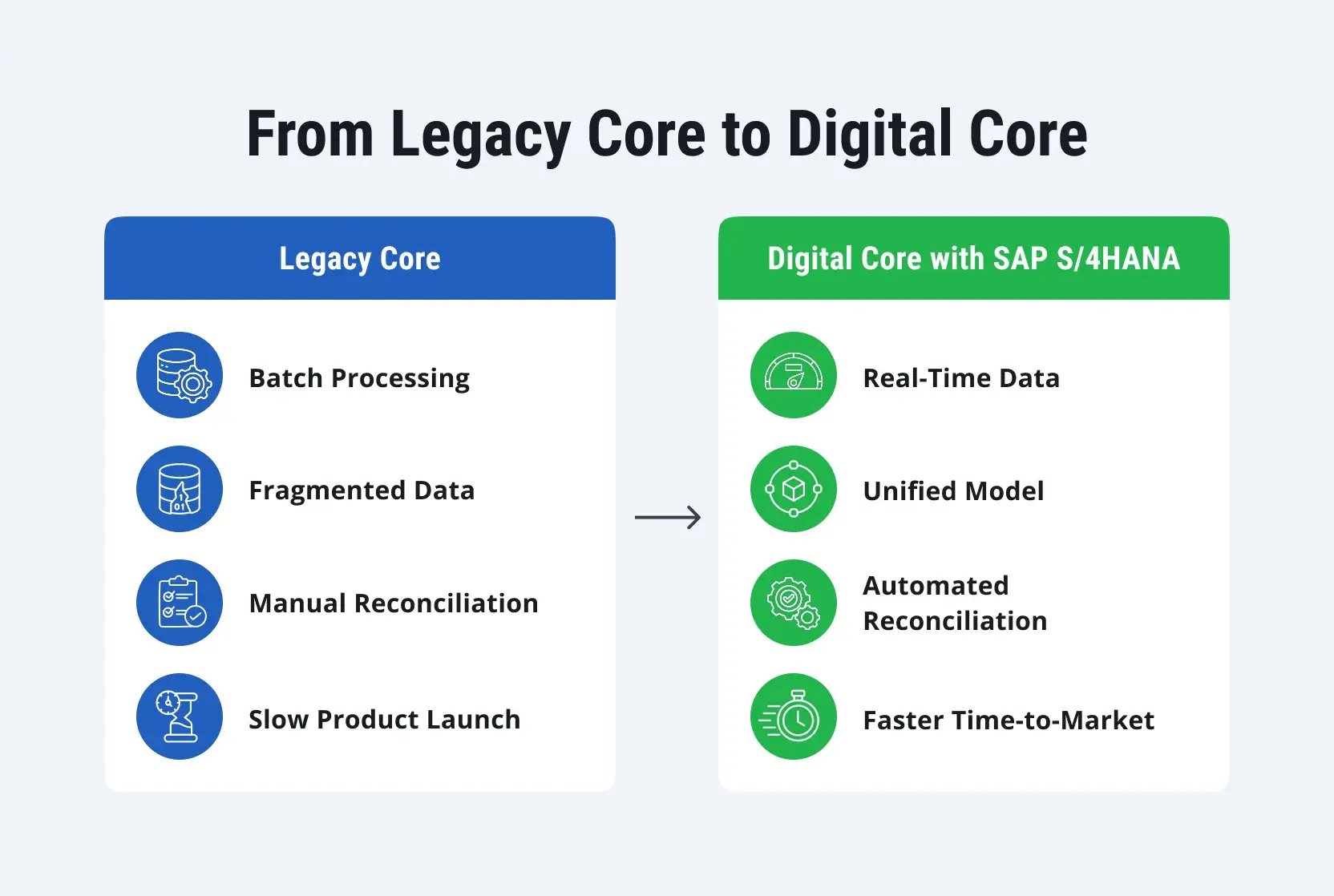
SAP S/4HANA as the Digital Core of Modern Banking
Banks aren’t trying to do everything in one system anymore. They use different systems for different tasks — core ones handle transactions, and SAP S/4HANA supports finance and operations.
This shift makes modernization more practical. Banks don’t need to rebuild everything — they can introduce a central layer that brings better visibility, more consistency, and faster financial processes.
What changes with S/4HANA
At the center of this approach is how data is handled. With in-memory processing, financial data is available as it is created, not hours or days later. Transactions, balances, and positions can be accessed in real time, which changes how finance teams operate on a daily basis.
At the same time, SAP S/4HANA provides a single financial data model across entities and systems. Instead of pulling data from multiple sources and reconciling it after the fact, banks can work from one consistent view. This reduces manual effort and improves the reliability of reporting.
Analytics are built into the system, so teams don’t wait for reports — they just use the data as it updates. That makes decisions faster and more relevant.
How it fits into the broader architecture
S/4HANA works alongside existing systems rather than replacing them. It connects core banking platforms, payment systems, and digital channels, bringing financial processes and control into one place.
This is especially important in environments where multiple systems are already in place. Instead of trying to unify everything at the transaction level, banks can integrate at the financial layer and still achieve consistency.
Integration is typically handled through APIs and platforms like SAP BTP, which allows banks to extend processes, connect external services, and adapt without changing the core setup. Tools like SAP Fiori and SAP Analytics Cloud complement this by improving user experience and enabling real-time insights.

Deployment flexibility for regulated environments
Deployment flexibility matters. S/4HANA supports cloud and hybrid models, helping banks meet requirements around data residency, security, and control.
Some banks choose to keep sensitive workloads on-premises while moving other parts to the cloud. Others adopt a phased approach. The key point is that the architecture allows banks to move at their own pace.
Why this matters
SAP S/4HANA becomes the layer that brings financial data, processes, and reporting together. It doesn’t replace core banking systems, but it changes how they are used, turning fragmented operations into a more consistent and responsive setup.
That’s what makes it a digital core: not another system, but the point where everything comes together.
Modern Financial Operations With S/4HANA
In traditional setups, financial work happens in cycles. Data comes in, gets processed later, and then teams spend time reconciling and fixing issues before they can trust the numbers. With S/4HANA, that pattern shifts.
Financial data is processed as it comes in, so closing activities don’t pile up at the end of the month. Instead of dealing with everything at once, teams are already working with data that’s largely in sync. The focus moves from fixing discrepancies to reviewing results.
A more centralized view of finance
With Central Finance, banks can bring data from different systems together without replacing everything at once. This makes it easier to standardize reporting and keep things under control, even if several systems are still running.
Better visibility where it matters
For treasury teams, the difference is especially noticeable. When data is delayed, visibility into cash and liquidity is always a step behind. With continuous updates, positions are visible as they change, which makes planning and short-term decisions more straightforward.
Reconciliation also becomes less of a manual process. A large part of the matching happens automatically, so teams spend less time chasing differences and more time focusing on exceptions.
Less effort around reporting
When the underlying data is already consistent, reporting becomes a lot simpler. There’s less need for adjustments before closing, and more confidence in the numbers both internally and for regulatory reporting.
The biggest shift is in how work flows day to day. Instead of catching up at the end of a period, teams stay on top of things as they go. There are fewer manual fixes, fewer surprises, and more time spent on analysis rather than corrections.
Integration With Core Banking and Fintech Ecosystems
S/4HANA doesn’t sit in isolation. Its role only makes sense as part of a broader system landscape, where different platforms handle different parts of the banking process.
Core banking systems continue to process transactions. Digital platforms handle customer interactions. Payment systems, risk tools, and compliance solutions all play their part. S/4HANA connects to this landscape and brings financial data and processes together.
How integration works in practice
In most setups, S/4HANA works alongside several key systems:
- Core transaction systems: These systems handle deposits, loans, and day-to-day transactions. S/4HANA receives financial data from them and ensures it is reflected consistently in accounting and reporting.
- Digital banking platforms: Customer-facing applications generate a constant flow of activity. This data feeds into S/4HANA, so financial processes stay aligned with what’s happening on the front end.
- Payment systems and gateways: Payments create an immediate financial impact. Integration ensures that transactions are captured and reflected without delay.
- Risk and compliance tools: Data from risk engines and compliance systems can be connected directly, making it easier to align financial reporting with regulatory requirements.
- Open banking APIs: APIs make it possible to exchange data with external partners and services. This supports new business models without changing the core setup.
Why flexibility matters
What matters here isn’t just connectivity — it’s flexibility. Banks rarely run on a single, clean system. Most have a mix of legacy platforms, newer tools, and external services. S/4HANA fits into that setup without forcing everything into one system.
The idea isn’t to replace what’s already there, but to connect it. This way, banks can gradually evolve their setup and add new capabilities without disrupting existing systems.
Data, Analytics, and Intelligent Automation
One of the biggest shifts isn’t just in how data is stored, but how it’s used. Instead of collecting data first and analyzing it later, banks can work with it as it comes in.
From reporting to real-time insight
Analytics are built into the system, so there’s no need to wait for separate reports. Finance, risk, and operations teams can see what’s happening as it happens. That changes how decisions are made — less based on past snapshots, more on current data.
Forecasting that reflects what’s actually happening
With AI-driven forecasting, planning becomes more dynamic, as financial systems begin to support decision-making directly rather than just record transactions. Instead of relying only on historical trends, models can take into account current activity and adjust expectations as conditions change. This is especially useful for liquidity planning and risk assessment.
Connecting fraud signals to financial processes
Fraud detection doesn’t sit in isolation. When it’s connected to financial systems, suspicious activity can be reflected immediately in reporting and controls. This makes it easier to react quickly, rather than investigate issues after the fact.
Automating routine decisions
A lot of day-to-day processes follow predictable patterns — approvals, checks, routing tasks. These can be handled automatically based on predefined rules and data inputs. Teams step in only when something falls outside the expected flow.
What changes in practice
The difference is less about tools and more about timing.
- Decisions are made earlier
- Fewer steps rely on manual input
- Less time is spent waiting for data
Overall, teams spend less time gathering and validating information and more time acting on it.

Cloud, Security, and Regulatory Considerations
Modernization, for banks, isn’t just a question of architecture. It’s about control. As soon as the setup changes, concerns around data, security, and compliance come into focus, and they can’t be treated as secondary.
Data residency and control
Banks often operate across multiple jurisdictions, each with its own requirements for where data can be stored and processed. That’s why deployment models matter.
S/4HANA gives banks flexibility in their infrastructure structure. Sensitive data can remain local or in specific regions, while other components can run in the cloud. This helps meet regulatory requirements without adding unnecessary complexity.
Security as part of the architecture
You can’t treat security as something separate. It needs to be part of the system from day one. In practice, this means:
- Strict access control and role management
- Continuous monitoring of system activity
- Protection of financial and customer data across integrations
Given how interconnected systems are, security needs to cover not just one platform, but the entire landscape.
Resilience and continuity
Downtime in banking is a risk. Modern setups are designed to handle this through:
- High availability configurations
- Backup and recovery mechanisms
- Failover strategies across environments
The goal is simple: keep systems running and recover quickly when something goes wrong.
Staying aligned with regulatory requirements
Compliance isn’t a one-and-done thing. Reporting, audits, and risk requirements keep changing over time. When data is consistent and processes are traceable, it becomes easier to:
- Produce accurate reports
- Respond to audits
- Adapt to new regulatory demands
What matters for decision-makers
The key question isn’t whether modernization introduces risk — it’s how well that risk is managed.
With the right setup, banks can modernize their systems while keeping control over data, maintaining security, and staying aligned with regulatory requirements.
Our Experience in Banking Modernization Programs
Modernizing financial systems in banking rarely follows a straight path. It usually means working across multiple systems, meeting regulatory requirements, and keeping core operations stable simultaneously.
This is where experience comes into play. It helps shape the right architecture and ensures the transition happens without interrupting the business.
What this looks like in practice
LeverX works with banks at different stages of modernization, depending on their starting point and constraints.
- S/4HANA finance implementations: Creating a central financial layer that brings everything — accounting, reporting, and control — into one consistent setup.
- Central Finance scenarios: Consolidating data from multiple systems into one place, so finance can be standardized without replacing everything at once.
- Regulatory and compliance process alignment: Adjusting financial processes and data flows to meet reporting and audit requirements across different jurisdictions.
- Legacy system transformation: Migrating or restructuring existing systems while keeping business processes stable.
- Hybrid architecture integration: Connecting on-premises systems, cloud platforms, and external services into a single working setup.
- Phased modernization approaches: Breaking transformation into manageable steps to reduce risk and avoid disruption.
How LeverX approaches these projects
In banking, the biggest risk isn’t the technology itself — it’s disrupting operations while trying to modernize. LeverX approaches this with a clear priority: keep the business running while the architecture evolves.
Instead of replacing everything, the work builds on what’s already there. Changes happen gradually, and the data stays consistent along the way. Each step is planned to keep risks low and avoid problems with reporting or compliance.
This matters most in complex setups, where multiple systems are already in place. Instead of trying to simplify everything at once, LeverX builds a stable foundation and improves it step by step.
What really matters here is how the transition is handled. A solid architecture is only part of the picture — things can still go wrong if the rollout isn’t managed properly. LeverX works closely with both technical and business teams to keep everything aligned throughout the process.
That helps banks move forward without disrupting critical processes, while improving how their systems operate.

Measurable Business Impact of Core Banking Modernization
The impact of modernization shows up in day-to-day operations and financial results. It’s not about abstract improvements but about how quickly banks can act, how efficiently they run, and how reliably they report.
Faster product rollout
When systems are more flexible, new products can be launched faster. Changes that once took long development cycles can now be introduced more quickly, helping banks respond to market demand in time.
Lower cost pressure
Legacy systems are expensive to maintain. As processes become more streamlined and manual work is reduced, operational costs go down.
This has a direct effect on the cost-to-income ratio, especially in areas like reconciliation, reporting, and system maintenance.
Clearer view of liquidity
With data updated continuously, treasury teams don’t have to rely on delayed information. Cash positions and liquidity are visible as they change, which supports better short-term planning and risk management.
Fewer operational risks
Automation and consistent data reduce the chances of manual mistakes. Problems are easier to spot early, and system dependencies are simpler to handle.
More reliable reporting
When financial data is aligned across systems, reporting becomes more predictable, with:
- Fewer adjustments before closing
- Less time spent reconciling differences
- Higher confidence in reported figures
Instead of constantly reacting to issues, teams work in a more stable environment where processes are easier to manage.
Over time, this translates into better cost control, faster response to change, and more stable operations.
A Practical Roadmap To Core Banking Transformation
Modernization begins with taking a close look at how things work today and identifying what needs to change.
Start with a clear baseline
Before making decisions, banks need a realistic view of their current setup, for example:
- Which systems are critical to daily operations
- Where the biggest bottlenecks hide
- How data flows across the landscape
This helps avoid unnecessary complexity later on.
Define the target approach
There’s no single path here. It really depends on the systems in place and how much change the organization can handle.
In practice, there are a few common S/4HANA migration approaches to consider:
- Phased migration, where systems are gradually modernized
- Parallel core setup, where a new core runs alongside the existing one
Each option comes with trade-offs in terms of risk, cost, and speed.
Move in controlled steps
Trying to change everything at once rarely works in banking. A phased approach makes it easier to manage risk and keep operations stable. This often includes:
- Introducing a financial layer first (for example, S/4HANA)
- Integrating systems step by step
- Validating data and processes along the way
Keep governance and risk in focus
Modernization affects not just systems, but also processes and controls. To avoid issues, banks need strong governance structures, especially in programs where multiple systems and teams are involved. They also require:
- Clear ownership of data and processes
- Visibility into changes as they happen
- Alignment with regulatory requirements at every stage
Looking ahead
When modernization is done in a structured way, banks can adapt more easily over time — launch new services faster, deal with regulatory changes, and keep things running smoothly. In the end, it’s about having a setup that can grow and change without constant disruption.
Conclusion
Banks don’t have the option to stand still. Expectations keep rising, systems are getting more complex, and the pressure to respond faster isn’t going away.
What works in practice isn’t a full reset, but a more balanced approach. Instead of replacing everything at once, banks can gradually reshape their architecture, connecting existing systems, improving financial processes, and gaining better visibility along the way. SAP S/4HANA plays a key role here by bringing financial data and operations into one consistent layer without disrupting the core.
In practice, this makes daily work easier to manage. There’s less time spent on fixing issues, data is available when it’s needed, and teams can focus more on decisions.
Over time, that’s where the real value shows. Systems don’t need constant workarounds, new capabilities can be added without major disruption, and the overall landscape becomes easier to manage.
For banks, that’s what makes the difference — a setup that can keep up with change instead of falling behind it.




%20(1).webp)