Learn about how AI operates inside SAP S/4HANA, from clean core and data quality to embedded use cases, real-time decisions, and secure, transparent execution.
If AI is not embedded in your ERP system, is it influencing daily operations or only generating reports?
The majority of structured enterprise data resides in SAP S/4HANA. This includes journal entries, inventory movements, sales orders, production confirmations, and supplier invoices. When AI capabilities are integrated directly into this system, predictions and recommendations are generated during transaction processing. The system can propose actions instead of only recording outcomes.
In this article, we will analyze the role of clean core in AI adoption, compare embedded and side-by-side AI architectures, review high-value use cases across finance, supply chain, and operations, and explain how SAP maintains data control and transparency. Keep reading to see how AI changes the function of the digital core.
Why Clean Core Determines AI Results in SAP S/4HANA
AI models do not operate in isolation. They rely on structured, consistent, and accessible data. In SAP S/4HANA, that data sits in standard tables, defined data models, and controlled business processes. When the core system is heavily modified, this structure becomes fragmented.
A clean core means keeping the standard SAP data model intact and limiting custom code in the core ERP layer. Extensions are built using approved mechanisms such as in-app extensibility or side-by-side services. Custom logic does not overwrite standard objects.
When organizations modify standard SAP tables, AI models can no longer interpret business processes directly. Data mappings must be rebuilt manually before algorithms can read operational patterns, which increases implementation effort and complexity.
This approach preserves compatibility with upgrades and keeps data definitions consistent across modules. It also reduces the effort required to activate AI capabilities. When organizations rely on standard data structures, SAP-delivered AI services can be deployed quickly because the algorithms already recognize the expected data model.
Why structure matters for AI
For AI scenarios, the structure is critical. Machine learning services require reliable access to master data and transactional data. Examples include journal entries, material documents, sales orders, and supplier invoices. If fields are redefined, tables are copied, or logic is embedded in custom Z-programs, AI services must be adapted for each system variant. This increases implementation time and reduces model portability.
Data quality is the second constraint. Duplicate business partners, inconsistent material master attributes, or incomplete cost center assignments directly affect prediction accuracy. AI does not correct structural data errors. It reflects them. A forecasting model trained on inconsistent historical data will reproduce those inconsistencies in its output.
The financial impact of technical debt
There is also a financial dimension to AI optimization. Systems with extensive modifications require additional regression testing during upgrades. Embedded AI capabilities delivered by SAP are optimized for standard objects and released APIs. A clean core reduces integration effort and lowers the cost of adopting new AI features delivered in future releases.
For executives evaluating AI investments, the implication is practical. The return on AI in SAP S/4HANA depends on two variables: structural integrity of the ERP core and measurable data quality. Without both, AI becomes a customization project. With both in place, AI becomes an extension of the existing transaction flow rather than a parallel system.
How AI Operates in SAP S/4HANA: Embedded or Side-by-Side?
AI in SAP S/4HANA is not delivered in a single format. It operates through two architectural models. The difference is structural. It affects governance, extensibility, maintenance effort, and long-term scalability.
Understanding this distinction is necessary before defining an AI roadmap.
Embedded AI inside SAP S/4HANA
Embedded AI refers to capabilities delivered as part of the standard S/4HANA code line. These functions are integrated into business transactions and Fiori applications. They use operational data directly within the system. This model works well for high-volume, standardized tasks where the business process already exists inside ERP workflows.
Examples include predictive features in finance, automated invoice matching, goods receipt anomaly detection, and situation handling. In finance, predictive accounting simulates expected financial postings based on incoming operational data. The logic runs within the ERP environment and follows the existing authorization model. Automated invoice matching is another example of applying embedded AI to repetitive operational tasks.
From a technical perspective, embedded AI uses SAP-delivered services and models. Data remains inside the ERP system, which removes the need for external replication for standard scenarios. This architecture simplifies compliance and auditing because operational data and AI logic operate within the same governed environment. Lifecycle management aligns with S/4HANA upgrades, and governance follows standard ERP controls.
This model is suitable when organizations require AI within standard processes and want minimal architectural expansion. More specialized or proprietary AI models can then be developed outside the core system using SAP Business Technology Platform in a side-by-side architecture.
Side-by-side AI on SAP BTP
Side-by-side AI refers to custom or extended AI services built outside the S/4HANA core. These solutions typically run on SAP Business Technology Platform and integrate with S/4HANA through APIs.
In this architecture, transactional or master data is exposed via secure interfaces. AI models are developed, trained, and deployed on SAP BTP using services such as machine learning frameworks, automation tools, or generative AI capabilities. The results are then written back to S/4HANA or presented in connected applications.
This model allows greater flexibility. Organizations can develop industry-specific prediction models, advanced optimization engines, or conversational assistants that go beyond standard ERP scope. It also enables integration of non-SAP data sources.
However, it introduces additional architectural components. Data replication, API governance, model lifecycle management, and security design must be planned explicitly.
Choosing the appropriate model
The decision is not binary. Many enterprises use both approaches.
Embedded AI is appropriate when standard SAP capabilities address the business requirement. It reduces integration effort and follows the clean core principle.
Side-by-side AI is appropriate when differentiation or complex modeling is required. It allows custom development without modifying the ERP core.
The key architectural rule remains consistent. The S/4HANA system should remain stable and upgradeable. Extensions, including AI-driven ones, should not introduce structural dependencies that complicate future releases.
For executive teams, the practical question is not whether to use AI inside or outside the ERP. The question is: where is standard functionality sufficient, and where do controlled extensions create measurable business value?

Where AI Delivers Measurable Impact in SAP S/4HANA
AI inside SAP S/4HANA produces measurable results when applied to well-defined operational processes. The most valuable scenarios are those where AI interacts directly with transactional data, master data, or planning processes.
Below are practical scenarios where AI affects daily operations.
Cash flow forecasting based on payment behavior
Liquidity planning often relies on static payment terms and manual adjustments. In finance, embedded machine learning models analyze historical payment patterns at the customer level. They calculate the probability of delay and expected payment dates.
Instead of assuming that all customers pay according to contract terms, the system evaluates how each customer has actually paid in the past. AI analyzes real payment behavior rather than relying only on contractual due dates. This helps identify potential liquidity gaps earlier and provides treasury teams with more reliable short-term cash flow projections.
The result is a forecast that reflects operational reality rather than theoretical payment schedules. Finance teams gain earlier visibility into possible delays and can adjust borrowing or liquidity planning accordingly.
Inventory planning beyond fixed min-max rules
Traditional replenishment models use fixed safety stock and reorder points. Often, these values are not reviewed regularly. AI-based forecasting in supply chain processes evaluates historical demand variability, seasonality, and recent consumption trends.
The system proposes buffer levels that adjust to changing demand patterns. In environments with supply instability, this reduces stock-outs without inflating inventory across all materials. The financial effect is visible in working capital and service level metrics.
Margin control through data-driven pricing
Pricing decisions are frequently based on static condition records and manual overrides. AI can analyze historical sales volumes, discount patterns, and customer behavior to recommend price adjustments within defined thresholds.
In practice, this means identifying products where discounts reduce margin without increasing volume, or detecting customers with high price sensitivity. The goal is not automated price volatility. The goal is structured price guidance supported by transaction data.
Predictive risk detection in financial postings
Machine learning models in finance can classify journal entries based on historical posting patterns. When a transaction deviates from normal behavior, the system flags it for review before the period closes.
This supports internal controls. It reduces the volume of manual sampling in audit preparation. It also helps identify posting errors earlier in the cycle, when correction effort is lower.
Maintenance planning based on equipment data
In manufacturing scenarios integrated with asset management, AI models can evaluate historical maintenance records, failure patterns, and operating hours. The system predicts the likelihood of equipment breakdown within a defined time window.
Maintenance orders can then be scheduled based on predicted risk rather than fixed intervals. This reduces unplanned downtime and prevents unnecessary preventive work. The financial effect is visible in production continuity and maintenance cost allocation.

How SAP S/4HANA Converts Unstructured Documents Into Structured ERP Data
A significant portion of operational data enters the company as documents, not as structured ERP records. These include supplier invoices in PDF format, sales orders received by email, scanned delivery notes, contract documents stored as attachments, etc.
In many organizations, employees manually transfer this data into SAP S/4HANA. This step creates delays and introduces input errors.
AI-based document extraction
SAP uses optical character recognition and machine learning models to extract structured information from documents. The system identifies and classifies fields such as:
- Supplier or customer name
- Invoice number and date
- Line items and quantities
- Net and tax amounts
- Payment terms
These values are mapped to the corresponding business objects in S/4HANA.
The goal is precise field extraction, not generic text recognition. The models are trained to detect business entities and document layouts commonly used in procurement and sales processes.
Validation against ERP data
Extracted data is not posted automatically without checks. It is validated against existing ERP records.
In accounts payable, the system compares invoice data with purchase orders, goods receipt documents, and master data records.
If quantities and prices fall within predefined tolerances, the invoice proceeds through the standard workflow. If discrepancies exist, the document is routed to a responsible user. This preserves internal controls and audit requirements.
Exception handling instead of data entry
The main operational change is a shift in user workload. Employees no longer retype document content. They review exceptions and validate edge cases.
For each field, the system logs the source document, extracted field values, and confidence scores. Corrections entered by users can be fed back into the model training process, depending on configuration. Over time, this improves recognition accuracy.
Beyond invoices: orders and contracts
The same mechanism applies to other document-driven processes. Sales orders received by email can be converted into structured sales documents. Contract files can be analyzed to extract key attributes, such as:
- Contract value
- Validity dates
- Payment conditions
- Penalty clauses
These attributes become searchable and can trigger automated reminders or compliance checks.
Maintaining accuracy and compliance
Data extracted by AI remains traceable and auditable. Each document can be linked to its source file, and all actions are logged. This supports regulatory compliance and provides visibility for internal audits while reducing the operational burden of manual record keeping.
Embedding document-processing AI in SAP S/4HANA reduces operational overhead, accelerates workflows, and ensures that the ERP system remains the authoritative record of enterprise activity.
FAQ: Key Questions About AI in SAP S/4HANA
At this stage, practical questions usually replace conceptual ones. The discussion shifts from “what is possible?” to “what does it require?” and “what are the risks?” Below are the questions most executives raise when evaluating AI in SAP S/4HANA.
How SAP S/4HANA Ensures Reliable and Controlled AI Decisions
In addition to architectural and operational questions, executives raise another set of concerns. They focus on reliability, data exposure, and legal accountability. These concerns are justified. AI in the digital core affects financial postings, forecasts, and compliance-sensitive processes.
Below are the most common concerns expressed in practical terms.
“I do not want decisions based on external or unreliable data.”
AI capabilities embedded in SAP S/4HANA operate on enterprise data stored within the system landscape. In embedded scenarios, models evaluate transactional history, master data, and configuration that belong to the company.
They do not retrieve information from the public internet. They do not generate responses based on unrelated external datasets. Predictions such as payment delay probability or anomaly detection are calculated using historical company records.
This reduces the risk of fabricated outputs often associated with open-domain generative tools. Results are tied to traceable ERP data.
“If the system makes a recommendation, I need to know why.”
Enterprise AI in SAP environments is designed to support, not replace, human decision-making. When a model classifies a journal entry as unusual or proposes a credit limit adjustment, the output is presented with contextual data.
Users can review the relevant transaction history, master data attributes, and applied thresholds. In many cases, confidence indicators or explanation features are available, depending on the specific application. The final action remains subject to approval workflows and authorization roles defined in the system.
The decision path is auditable. Logs record who reviewed and accepted or rejected a recommendation. This is essential for finance and compliance teams.
“Will our data be used to train external models?”
For embedded AI functions delivered by SAP, customer data is processed within the boundaries of the contracted system landscape. Data is not automatically used to train public or third-party models.
In side-by-side architectures running on SAP Business Technology Platform, data handling is defined during solution design. Training datasets, storage locations, and retention policies are explicitly configured. Organizations maintain control over which data is used for model training and for what purpose.
Data processing agreements and regional hosting options support compliance with data protection regulations.
“Are we exposed to regulatory risk?”
AI capabilities within SAP environments are subject to enterprise security standards where applicable, including role-based access control, encryption in transit, and encryption at rest.
Regulatory alignment depends on configuration and governance. For example, audit trails, access logs, and approval workflows remain active for AI-supported transactions. This supports compliance with financial reporting standards and data protection requirements.
Emerging regulations, such as the EU AI Act, introduce obligations related to transparency and risk classification. Companies remain responsible for assessing whether their specific AI use case falls under regulated categories. However, using AI embedded in a controlled ERP environment simplifies documentation and traceability compared to isolated experimental tools.
Let’s Compare: Legacy ERP vs. AI-Driven S/4HANA
To understand the operational impact of AI, it helps to look at how S/4HANA differs from classic ERP systems. The table below summarizes key areas where AI changes how business processes are executed:
|
Capability |
Legacy SAP (ECC / classic) |
AI-driven S/4HANA |
Business benefit |
|
Interactions |
Manual T-Codes & GUI |
Conversational interfaces (e.g., Joule AI) |
Faster execution with less training required |
|
Data processing |
Overnight batch jobs |
Real-time, in-memory processing |
Decisions are made instantly, reflecting current conditions |
|
Decision support |
Reactive reports |
Proactive recommendations |
Risks can be addressed before they impact the P&L |
|
Customization |
Hard-coded Z-programs |
Clean Core with standardized extensions |
Lower maintenance and simplified upgrades |
|
Exception handling |
Manual auditing |
Autonomous resolution |
Operational overhead is reduced significantly |
Why Execution Matters: LeverX Approach to SAP and AI
Technology alone does not produce results. Architecture decisions, data preparation, and process alignment determine whether AI functions operate as intended.
LeverX combines SAP implementation expertise with dedicated AI engineering capabilities. This includes internal development teams and research initiatives focused on applied machine learning in enterprise environments. Prototypes are validated before being introduced into production landscapes.
Our approach is structured:
- Assess system readiness, including release level and data quality
- Identify use cases with measurable financial or operational impact
- Define architecture, embedded or side-by-side
- Implement with clear ownership and monitoring procedures
The objective is controlled deployment. AI features must align with existing governance and compliance frameworks.
If you are evaluating AI in SAP S/4HANA, a structured assessment clarifies feasibility, cost, and expected impact. A focused discussion can determine whether embedded functions are sufficient or whether a side-by-side extension is required. Contact us to schedule a free consultation.
Before You Proceed: A Practical Readiness Checklist
Before deploying AI in S/4HANA, verify the following elements to maximize reliability, compliance, and business impact. This checklist reflects proven practices from SAP and AI implementations.
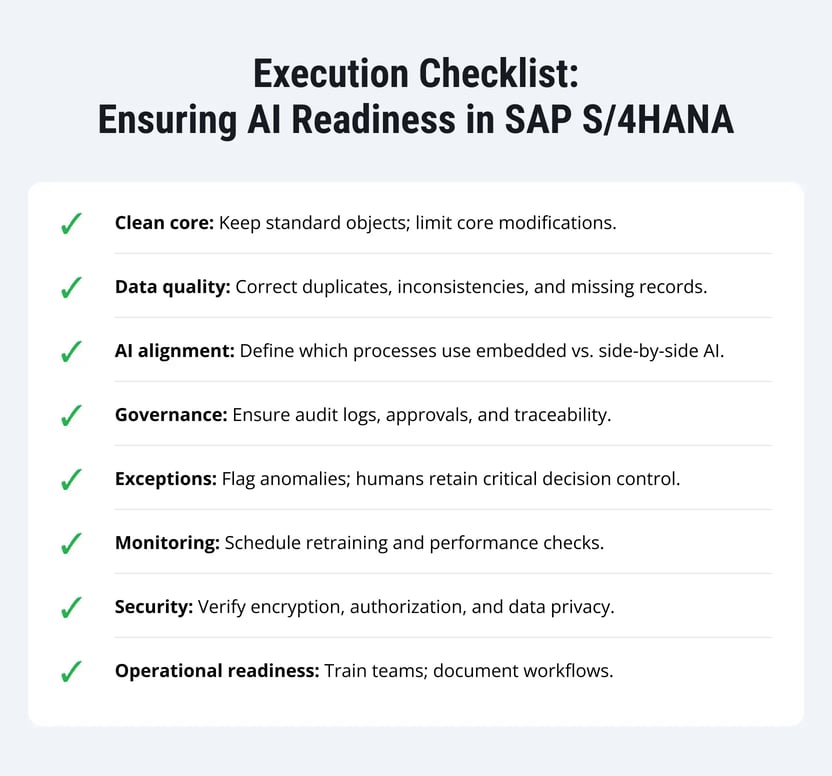
Use this checklist to confirm readiness. If you need guidance on applying these steps in your environment, LeverX can provide tailored assessment and support, leveraging our combined SAP and AI expertise.
.webp)