See how SAP connects supplier quality, shop-floor inspections, traceability, nonconformance, and analytics across automotive manufacturing.
A quality issue caught where it occurs is usually easier to contain than one discovered after additional assembly stages, shipment, or vehicle release. Automotive quality management, therefore, depends on connecting inspection, production, supplier, and traceability data early enough to support an effective response.
This is why quality management in the automotive industry is so demanding. Quality control teams require information from suppliers and incoming materials, production equipment, operators, inspection and testing systems, the manufacturing process, warehouse processes, and, ultimately, customer complaints and warranty claims. When these sources are disparate, tracing a defect to its source and identifying other potential impacts takes longer.
In the automotive industry, quality management shouldn't be limited to identifying deviations. It should include localization, tracking, corrective action, and verification that corrective actions are effective and reduce the risk of recurrence. This means monitoring quality throughout the entire production process, rather than waiting until the final inspection to identify defects at earlier stages.
SAP integrates these quality checks with purchasing, production, material status, manufacturing operations, supplier relations, traceability, and analytics. This integration can help manufacturers identify problems earlier, respond with better context, and use quality data for continuous improvement.
Why Automotive Quality Management Has Become More Complex
Automotive manufacturers are managing quality across more product configurations, technologies, suppliers, and production scenarios than a single inspection process can capture. A requirement that applies to one vehicle variant may change for another, while the source of a defect may sit several steps away from the operation where it is finally detected. Quality management, therefore, has to account for both greater product variation and a broader manufacturing network.
More product complexity creates more quality variables
The shift toward electrification has added new components and manufacturing processes to an industry that was already highly complex. Battery cells and modules, power electronics, sensors, electronic control systems, and high-voltage components introduce their own inspection and testing requirements. At the same time, manufacturers continue to produce conventional, hybrid, and electric vehicle platforms, sometimes across shared production environments.
Product variation adds another layer. A mixed-model line may handle vehicles or components with different configurations, materials, options, and process requirements. The relevant quality controls can change accordingly. Inspection characteristics, tolerances, test sequences, measurement requirements, or process limits may depend on the specific product being built.
Automation does not remove this complexity. It changes how quality has to be controlled. Automated assembly, inline measurement, robotic welding, fastening systems, and test equipment can generate large volumes of process and inspection data, but those results still need to be associated with the correct material, operation, product, and specification.
Automotive quality frameworks are evolving with these conditions as well. AIAG's APQP 3rd Edition adds guidance around areas such as sourcing, change management, risk mitigation, gated management, and part traceability. The standalone Control Plan 1st Edition also addresses Safe Launch and provides guidance for highly automated manufacturing applications.
Quality extends beyond the plant
A vehicle manufacturer controls only part of the conditions that ultimately affect product quality. Thousands of purchased parts, materials, and assemblies may depend on Tier 1 suppliers as well as multiple upstream tiers that contribute materials and subcomponents. Some arrive as relatively simple components; others already contain materials and subassemblies produced by several upstream companies.
That matters when a problem appears on the production line. Suppose an assembly fails a functional test because of a supplied component. Finding the defect is only the beginning. The quality team may need to establish the supplier and inspection history of the component and determine whether the same issue could affect other products.
The relationship also works in the opposite direction. A process problem inside the plant may initially look like a supplier defect, while an incoming component that passed inspection may later prove to be the source of failures during assembly. Supplier quality and manufacturing quality need enough shared context to distinguish between these situations and establish where corrective action belongs.
Quality teams need a faster path from detection to action
A measurement outside specification does not automatically tell a manufacturer what to do next. The response depends on what failed, how the affected product has moved through production, and whether the issue may extend beyond the unit where it was first detected.
Quality teams may need to establish:
- What failed and at which operation
- Which component, material, or batch was involved
- Where it came from
- Which assemblies or vehicles may contain the same material
- Whether related inventory should be placed on hold
- Whether production can continue under existing controls
- Whether the affected product can be reworked or requires another disposition
- Whether the issue should be escalated to a supplier or another internal function
These decisions become more difficult when inspection records, production history, material movements, and supplier information have to be reconstructed from separate systems. The practical requirement is not simply faster inspection. Manufacturers need enough connected information to determine the affected scope and choose an appropriate response while the issue is still manageable.
The Business Impact of Poor Quality in Automotive Manufacturing
The business impact of a quality problem depends heavily on when it is discovered. A defect found during the operation where it occurs may require a short stop, adjustment, or localized rework. If the same issue reaches finished goods, another plant, or vehicles already in the field, the response usually involves more products, more functions, and more organizations.
|
Where the issue is found |
Typical response |
Potential business impact |
|
At the operation |
Correction or localized rework |
Lost cycle time, rework labor |
|
Before final release |
Containment and additional inspection |
Throughput loss, scrap, and delayed completion |
|
After shipment to another facility |
Sorting, return, replacement, supplier/customer coordination |
Logistics costs, disruption, chargebacks |
|
After vehicles enter the field |
Investigation, warranty action, field containment |
Warranty costs, customer impact |
|
After a broader field pattern is identified |
Large-scale containment or recall |
Major financial, regulatory, and reputational exposure |
The direct costs are often the easiest to see. Scrap consumes material and production capacity without producing saleable output. Rework adds labor and may occupy stations or resources that were planned for normal production. Sorting campaigns pull employees into additional inspection, while blocked inventory can create shortages elsewhere in the plant. If replacement parts or materials are needed urgently, manufacturers may also incur premium freight and expediting costs.
Other costs are spread across functions and may be harder to isolate. A recurring defect can require hours of work from quality engineers, manufacturing engineers, purchasing teams, supplier quality specialists, logistics teams, and plant management. Production interruptions can affect scheduled output. Supplier-related issues may lead to disputed responsibility, additional inspections, returns, or chargebacks. If the problem escapes the plant, warranty claims, dealer work, customer complaints, and field investigations add another layer of cost.
The financial exposure grows further when the affected population cannot be narrowed quickly. A manufacturer may have to inspect, hold, or investigate far more material, assemblies, or vehicles than ultimately prove defective. In more serious cases, the issue may also create regulatory obligations or lead to a recall.
Cost does not necessarily increase at a fixed rate at every subsequent stage. A more practical rule is: the further a defect spreads, the more products and processes may require investigation, containment, and corrective action. This is why reducing the scale of a quality problem can be just as financially important as reducing the defect rate itself.

Building Quality Into Every Stage of Automotive Production
Automotive quality is shaped long before a finished vehicle reaches end-of-line testing. Requirements are defined during product and process planning, then carried into supplier quality, incoming inspections, manufacturing operations, final release, and post-production feedback.
AIAG's automotive Quality Core Tools reflect this lifecycle approach. AIAG identifies APQP, Control Plan, Production Part Approval Process (PPAP), Failure Mode and Effects Analysis (FMEA), Measurement System Analysis (MSA), and Statistical Process Control (SPC) as the automotive Quality Core Tools. Each supports a different part of planning, validating, controlling, or improving quality, and they are intended to work together rather than as isolated activities.
Quality planning before production begins
Before a quality requirement can be enforced on the line, it has to be translated into something production and quality teams can execute.
Depending on the product and process, that may include:
- Inspection characteristics and specifications
- Upper and lower tolerances
- Sampling requirements
- Measurement methods and equipment
- Control limits
- Inspection points
- Reaction plans
- Documentation requirements
- Quality gates
The connection between these requirements matters. FMEA can help teams identify potential failure modes and prioritize risks that require additional control. A Control Plan defines how selected characteristics will be monitored and what actions are expected when conditions move outside defined limits. MSA addresses the reliability of the measurement system itself, while SPC provides methods for evaluating process behavior over time. APQP and PPAP support the broader planning and validation work needed before regular production.
For manufacturing systems, the challenge is to carry those approved requirements into execution. An inspection characteristic has little operational value if the wrong specification appears for a product variant, the required measurement is missed, or the result cannot be tied to the product and operation where it was collected.
SAP Quality Management (SAP QM) can support parts of this execution and documentation process, but it should not be treated as a replacement for the automotive Core Tools methodology or for every specialized engineering and quality application. Its role is to help bring approved quality requirements into the manufacturing and supply chain processes where they need to be applied.
Supplier and incoming quality
For purchased material, one of the first operational decisions is whether a received component can be released for its intended use.
Consider machined housings, electronic control units, battery cells, wiring harnesses, braking components, or seat assemblies. Depending on the component, supplier history, and inspection strategy, the receipt may require dimensional checks, functional testing, document review, sampling, or another form of verification.
When the material arrives, predefined quality requirements determine whether an inspection is required and which characteristics need to be checked. The recorded results then support the decision to accept the material, reject it, or keep it under quality control until further action is determined.
That decision has an immediate operational effect. Accepted material may become available for production. Material that does not meet requirements may remain restricted, require additional inspection, be returned to the supplier, or follow another approved disposition.
SAP S/4HANA Quality Management can automatically create an inspection lot in configured goods-receipt scenarios. For stock-relevant inspections, material can remain in quality inspection stock while results are evaluated. The usage decision and configured follow-up processing can then determine how the stock is handled.
At this stage, the practical question is simple: does the available evidence support releasing the material for production?
In-process automotive quality control
Once production begins, quality control moves closer to the operation itself. Teams need to confirm not only that the resulting product meets specifications, but also that critical manufacturing steps are being performed within defined conditions.
Depending on the process, automotive quality control may include:
- Tightening torque and angle
- Weld parameters
- Dimensional measurements
- Adhesive volume or application conditions
- Press-fit force
- Leak-test results
- Electrical measurements
- Battery module parameters
- Component presence and orientation
- Surface or visual defects
- Functional test results
Some checks verify a product characteristic after the operation is complete. Others monitor the process while the characteristic is being created.
For example, a robotic welding operation may require current, voltage, or other process parameters to remain within defined ranges. If those values move outside the expected conditions, the issue can be investigated while the affected body or component is still close to the operation where the weld was created.
The same principle applies across automated equipment. Welding cells, presses, dispensing systems, test benches, and measurement devices can generate large volumes of production data. Those values become useful for quality control when they can be associated with the correct product, operation, and requirement.
Final inspection and product release
Building quality into production does not eliminate the need for final inspection. Some requirements can only be evaluated once several manufacturing steps and systems have come together.
Depending on the vehicle or component, final controls may cover:
- Functional performance
- Safety-related checks
- Assembly completeness
- Specified final inspection characteristics
- End-of-line diagnostic results
- Unresolved nonconformities
- Release status
A complete electrical or functional test, for example, may depend on systems that were installed and connected at different stages of assembly. The final check confirms how those systems perform together.
Final inspection, therefore, serves as another control point in the quality process. It should not be the main mechanism for discovering defects that could have been identified earlier in production.
If the same issue repeatedly appears only at the end of the line, that pattern may indicate that an upstream control, measurement, or process condition needs to be reviewed.
Nonconformity, containment, and corrective action
Detecting a defect starts a decision process. The organization still has to determine what should happen to the affected material or product and whether the issue points to a broader process problem.
The first step is usually to document the nonconformity and prevent the affected item from moving forward without a decision. Quality, manufacturing, engineering, or supplier teams then assess the condition and determine an appropriate disposition.
Possible outcomes include:
- Use as is, where formally authorized
- Rework
- Repair
- Scrap
- Return to supplier
- Additional inspection or sorting
Disposition addresses the immediate product. Corrective action addresses the reason the problem occurred.
A component may be successfully reworked and released, for example, while the underlying process condition that caused the defect remains unchanged. Corrective-action approaches such as 8D or CAPA help teams investigate causes, define actions, and verify whether those actions were effective.
That distinction is especially important for recurring problems. Repeatedly fixing individual units may restore acceptable output, but it does not prevent the same failure from appearing again.
Traceability determines how precisely containment can be targeted
Traceability becomes critical when a quality issue may involve more than the unit where it was first detected.
Suppose a supplier reports that a specific component batch may be defective. Some of those components may still be in inventory, while others may already have been issued to production, installed in assemblies, or incorporated into finished vehicles.
To determine the potentially affected population, the manufacturer may need to connect several levels of production history, including:
- Supplier batch
- Material or component
- Serial number
- Production order
- Operation
- Assembly
- Finished vehicle or VIN
- Inspection results
- Process parameters
- Production timestamps
The objective is not simply to maintain a detailed history. The records need to answer a practical question: which products could actually have been exposed to the condition under investigation?
If the affected batch can be linked reliably to the assemblies or vehicles that consumed it, the manufacturer can focus its investigation on that population. If the relationships are incomplete, more material or finished product may need to be reviewed because unaffected units cannot be excluded with confidence.
Customer and warranty feedback closes the loop
Some quality problems become visible only after the product has left manufacturing. Customer complaints, dealer findings, warranty claims, service records, and field investigations can reveal failure modes that were not detected in production or that develop only after use.
The value of that feedback increases when a field issue can be connected to the manufacturing history of the affected product. Teams can review how the vehicle or component was built, which materials were used, which operations were performed, and what inspection or process data were recorded.
Repeated warranty claims for the same component, for example, do not automatically establish that the supplier is responsible. Investigation may point to a material problem, an assembly condition, a process parameter, a design interaction, or another cause.
In this way, field and warranty data provide another source of evidence for determining where a quality problem originated and how broadly it may apply.
How SAP Supports End-to-End Automotive Quality Management
In an SAP landscape, automotive quality management is not handled by a single application. Different systems support different parts of the process and exchange the information needed to move from a quality requirement to an operational decision.
SAP S/4HANA Quality Management provides the core enterprise quality processes and connects them with procurement, manufacturing, inventory, and other transactional activities. SAP Digital Manufacturing (SAP DM) extends quality control into shop-floor execution, where production data and inspection results are captured in the context of the work being performed. SAP Business Network for Supply Chain can support selected quality interactions with suppliers.
Together, these capabilities connect quality records with the operational context around them. The following sections look more closely at how SAP supports enterprise quality processes, shop-floor execution, supplier collaboration, and material-related follow-up.
SAP S/4HANA Quality Management provides the enterprise quality backbone
SAP Quality Management supports the structured quality processes that sit around procurement, production, and material management. In SAP S/4HANA, these capabilities can cover:
- Inspection planning
- Inspection lots
- Inspection characteristics
- Results recording
- Defect recording
- Usage decisions
- Quality notifications
- Quality certificates
- Statistical process control
- Follow-up actions
The individual functions are connected. Defects can be recorded against an inspection lot, operation, or characteristic, depending on the inspection context. A usage decision records whether the inspected goods are accepted or rejected and can also update quality scores and quality levels or trigger configured follow-up actions. SAP QM also supports statistical process control through control charts for suitable inspection characteristics.
For an automotive manufacturer, the important point is what happens around those quality records. A usage decision may change whether material is available to production. A defect may lead to a quality notification. Supplier performance can be affected by inspection outcomes, while customer complaints may need to be connected with quality and production records.
This is why SAP QM works best as part of the broader S/4HANA process landscape rather than as an isolated quality database. Quality decisions can influence procurement, production, inventory status, supplier processes, customer-facing activities, and the financial consequences associated with scrap, rework, returns, or other follow-up actions.
SAP Digital Manufacturing brings quality controls to production execution
SAP S/4HANA Quality Management manages enterprise-level quality processes, while SAP Digital Manufacturing operates closer to the work being performed on the shop floor.
SAP DM can collect production-related values against the manufacturing context in which they occur. Its Data Collection functionality supports predefined parameters, required data, and validation against minimum and maximum limits. SAP DM can validate collected parameter values against configured limits and, when configured, automatically log a nonconformance when a value falls outside the permitted range.
Consider a safety-critical fastening operation during vehicle assembly. The production process may require a defined torque range. SAP DM can capture the measured value while the unit is being processed and evaluate it against the configured limits.
If the measurement is acceptable, production can continue according to the defined workflow. If the value falls outside the permitted range, the operator or system can record a nonconformance and manage the affected unit according to the configured disposition process. SAP DM provides services for logging and retrieving nonconformances and for dispositioning nonconformant SFCs through the appropriate manufacturing routing.
That shop-floor context is important. The measurement is associated with the production unit and operation rather than being stored as an isolated number. Depending on the manufacturing scenario, SAP DM can therefore support digital inspections, manual or automated data collection, process parameter capture, nonconformance handling, rework routing, and production genealogy.
SAP Business Network extends quality collaboration to suppliers
Some automotive quality processes require action outside the manufacturer's own SAP landscape. SAP Business Network for Supply Chain can provide a shared channel for selected quality interactions between buyers and suppliers.
In quality inspection collaboration, a buyer can request that a supplier perform an inspection against a specified inspection lot. The supplier can enter inspection results and attach a certificate of analysis, while the buyer can review the submitted results and return the relevant quality decision.
This can be useful when quality evidence needs to be exchanged before or alongside component delivery. Instead of relying on separate emails, spreadsheets, and document attachments, both parties can work with quality documents connected to the underlying business relationship.
Quality notification collaboration addresses a different scenario. When a buyer or supplier identifies a problem with goods or services, the notification can document the affected part or reference object, individual defects, causes, priorities, and corrective actions. This gives both sides a structured way to work on the same supplier-related quality issue.
For example, an OEM or Tier 1 manufacturer may identify a recurring defect associated with a supplied component. The manufacturer can document the problem and required action, while the supplier investigates the cause and records the corrective steps. The collaboration remains connected to the quality issue rather than being distributed across unrelated communication channels.
This capability should be positioned precisely. Quality collaboration is part of SAP Business Network for Supply Chain and requires the relevant quality collaboration entitlement. It is not automatically available with every SAP Business Network setup.

Quality decisions can control what happens to the material
One of the clearest examples of SAP integration is the link between an inspection result and the status of the material that was inspected.
Suppose a shipment of steering components arrives at an automotive plant and a dimensional inspection identifies a deviation. Recording the failed measurement is only part of the process. The manufacturer also needs to ensure that the affected components are not made available to production while their disposition remains unresolved.
In SAP S/4HANA Quality Management, the usage decision records the final evaluation of the inspection lot, including whether the inspected goods are accepted or rejected and which configured follow-up actions should apply. For inspection lots created from relevant goods movements, the usage decision can also be associated with a stock posting. Depending on the configured process, inspected material can be moved, for example, to unrestricted-use stock, blocked stock, or scrap.
This connection is where quality management becomes operational. An inspection result can affect material availability, and that material status can, in turn, influence what production or warehouse teams are allowed to do next.
The same principle applies more broadly across an integrated SAP landscape. Quality information becomes most useful when it changes the business process that depends on it, whether that means releasing material, restricting its use, initiating rework, escalating a supplier issue, or triggering another controlled follow-up action.
Quality Data as a Driver of Continuous Improvement
Quality data is most useful when it helps manufacturers find recurring patterns, test possible causes, and decide what to change in production.
Quality data reveals patterns that individual results cannot
A defect that looks isolated may become part of a clear pattern when analyzed across product, supplier, and production records. Teams may find that failures cluster around one supplier lot, tool, operation, product variant, shift, or range of process parameters. This analysis depends on combining quality results with the relevant production, supplier, equipment, and product context.
The goal is not to collect every available data point. It is to preserve enough relevant information to narrow the investigation and distinguish between plausible causes.
Standardized defect data makes root-cause analysis stronger
Analytics depend on consistent data. If plants use different terms for the same type of defect, enterprise reporting may treat comparable issues as separate categories and make recurring patterns harder to identify.
Standardization is therefore important across:
- Defect codes
- Cause codes
- Inspection characteristics
- Units of measure
- Supplier identifiers
- Material identifiers
- Disposition codes
The goal is not to eliminate every local distinction. Manufacturers need enough common structure to compare similar events across plants, suppliers, and product lines.
That consistency can change how a problem is interpreted. An issue that appears isolated at one site may become a broader pattern when comparable records from other facilities are analyzed together.
Use quality KPIs to answer specific operational questions
Quality metrics are most useful when each one supports a specific decision. No single KPI describes overall product quality, and different measures highlight different parts of the process.
|
Metric |
What it helps answer |
|
First-pass yield |
What proportion of output passes without rework or repair? |
|
Defect rate / PPM |
How frequently are defects occurring relative to production volume? |
|
Scrap rate |
What proportion of output is being scrapped? |
|
Rework rate |
What proportion of output requires rework? |
|
Supplier defect rate |
How frequently are defects occurring in received material relative to the relevant incoming volume? |
|
Process capability |
How well can a stable process produce output within specification limits? |
|
Complaint/warranty rate |
How frequently do complaints or warranty cases occur relative to the relevant vehicle or product population? |
|
Corrective-action closure time |
How long does it take to close corrective actions? |
|
Cost of poor quality |
How much financial impact is associated with quality failures? |
These measures may draw on inspection results, production data, supplier information, warranty records, and financial data. They do not have to come from a single SAP application.
The more important question is whether the metric leads to action. A rising rework rate, for example, should trigger an investigation into where the rework originates and what is driving it, rather than simply becoming another number in a monthly report.
Close the loop from analysis back to process control
Analysis creates value when the findings change how future production is managed. Depending on the root cause, that may mean:
- Changing inspection frequency
- Requesting supplier corrective action
- Adjusting process parameters
- Scheduling maintenance
- Revising work instructions
- Changing inspection characteristics
- Retraining operators
- Initiating an engineering change
- Updating the Control Plan
The appropriate response depends on the evidence. More inspection may be justified when risk increases, but it is not automatically the right response to every quality issue. If the underlying problem is equipment condition, supplier variation, or an unstable process parameter, the corrective action should address that source.
Continuous improvement depends on turning quality data into a better control decision for the next production run.
What Makes SAP-Based Quality Management Work in Practice
Technology alone does not make a quality process reliable. The system has to reflect how inspections, materials, production records, equipment data, and quality decisions are actually managed across the organization.
Quality master data must be trustworthy
Many quality processes rely on master data that defines what should be inspected, how it should be measured, and how the results should be interpreted. Inspection plans, master inspection characteristics (MICs), sampling logic, tolerances, defect catalogs, code groups, supplier and material records, work centers, and product identifiers all impact the system's operation.
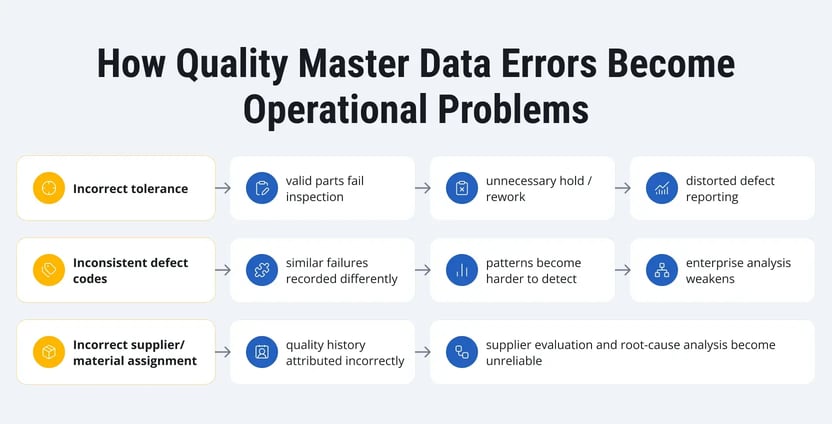
Problems in this data can quickly become operational problems. An outdated tolerance may generate unnecessary failures. Inconsistent defect codes can distort reporting. Incorrect material or supplier assignments can make quality history difficult to interpret.
For that reason, master data governance should be treated as part of quality management itself. Ownership, approval rules, naming conventions, and change processes need to be clear before quality processes are scaled across plants or systems.
Define which system owns each part of the quality process
Quality processes often span multiple systems, so it's essential to clearly define responsibility. Teams should determine where each type of information comes from, where it's used, and which system stores authoritative information.
An engineering specification may originate in PLM, while an inspection lot and usage decision may be managed in SAP S/4HANA Quality Management. A production measurement may be captured in SAP DM or another MES, while the raw value itself comes from a tester or machine. Enterprise reporting may then combine information from several sources.
Clear ownership reduces duplicate records, conflicting values, and unnecessary interfaces. It also makes integration decisions easier because each system has a defined role instead of competing to manage the same quality object.
Traceability must be designed before a quality incident happens
Traceability works only if the relationships between relevant objects are captured during normal operations.
For automotive manufacturing, the required traceability relationships must be defined and captured during normal production because missing links can be difficult to reconstruct after an incident. The required level of detail depends on the product, risk, regulatory requirements, and manufacturing model, but the design should address identifiers, serialization, genealogy, data retention, integration, and system ownership from the outset.
Automate quality decisions carefully
Automation works well where the rule is clear, and the required response is predictable. Examples include automatically creating inspection lots, validating measurements against defined limits, generating alerts, routing a known type of nonconformance, or executing an approved stock movement.
The same approach does not automatically apply to every quality decision. Safety-critical deviations, regulatory issues, engineering concessions, and unusual defect patterns may require controlled human review before material or product is released.
The practical goal is to automate repeatable processing while preserving appropriate approval and escalation points for decisions that depend on engineering judgment, risk assessment, or compliance requirements.

Emerging Directions in Automotive Quality Management
The next step in automotive quality is not simply collecting more inspection data. The bigger opportunity is to use manufacturing information earlier, bring new sources of evidence into the quality process, and connect production findings back to engineering decisions.
Predictive quality can provide earlier risk signals
Predictive quality looks for combinations of conditions that tend to appear before a defect is confirmed. Instead of waiting for a finished component to fail inspection, models can analyze process parameters, material characteristics, equipment condition, and historical quality outcomes to estimate when defect risk is increasing.
For example, a recurring dimensional issue may be associated with a particular combination of temperature, tool condition, and process pressure. If the same pattern begins to appear again, the model can flag the risk early enough for the manufacturer to review the process, increase inspection, or intervene before more units are affected.
This does not mean predictive models should replace established acceptance criteria. Their role is to add an earlier warning layer around controlled quality processes, while formal inspection and release decisions continue to follow defined engineering and quality requirements.
Computer vision can become another quality data source
Computer vision is increasingly relevant where defects or assembly conditions can be identified visually. Typical automotive applications include surface scratches, coating defects, missing components, incorrect orientation, incomplete assembly, and weld appearance.
The important architectural point is where the result goes next. A camera or external AI inspection system can classify an image, assign a defect category, or return a pass/fail result. That output can then be integrated into manufacturing or quality workflows, where it is associated with the relevant product and operation and handled according to the defined process.
This approach is more flexible than tying the strategy to one specific visual-inspection feature. SAP's release-specific documentation for SAP Digital Manufacturing 2605 states that the Visual Inspection capability and its associated apps, plugins, and APIs were removed. However, some current SAP Help pages still describe Visual Inspection and retain earlier deprecation language. Manufacturers planning computer-vision scenarios should therefore verify the current SAP roadmap and supported capabilities for their release and consider external or partner inspection technologies where appropriate
Digital threads can connect quality findings back to engineering
A recurring production problem does not always originate in manufacturing. It may point to supplier variation, tooling wear, process instability, a difficult tolerance, or a product characteristic that is particularly sensitive to production conditions.
A digital thread can link engineering definitions with production records and field data, allowing quality findings to be traced back to the product and process definitions that shaped them. Production results, inspection records, and field performance can then inform decisions about specifications, tolerances, materials, process requirements, or future product changes.
The value is in shortening the distance between what engineering intended and what production is actually seeing. When quality findings can move back into engineering and planning, manufacturers have a better basis for preventing the same issue from being designed or specified into the next production cycle.
LeverX Expertise in Automotive Quality Management
Quality projects in the automotive industry are rarely limited to a single function. A supplier issue can affect incoming inspection, material availability on the production line, production consistency, rework, traceability, and customer commitments. For OEMs and Tier 1 suppliers, the quality architecture must maintain the link between the component, its delivery lot, the operation in which it was used, and the vehicle or component into which it was incorporated.
LeverX supports manufacturers in designing and implementing the connected model across several areas:
- Quality processes in SAP S/4HANA: SAP QM configuration, inspection planning, quality master data, defect handling, and process optimization
- Shop-floor quality execution: SAP DM integration, in-process checks, nonconformance handling, connections with line-side and plant systems
- Supplier quality collaboration: Integration of supplier-facing quality processes, notifications, and supporting data
- Traceability and genealogy: Design and implementation of product genealogy and traceability across automotive manufacturing processes.
- Integration and extensions: Connections with test equipment, torque systems, external QMS platforms, and SAP Business Technology Platform (SAP BTP) services where needed
- Transformation and rollout: Migration from legacy SAP or third-party quality processes, template design, and multi-plant deployment
In automotive environments, this can mean making sure a failed incoming inspection keeps affected material out of production, capturing a critical torque or test result against the correct unit and operation, or determining the affected production scope when a quality issue occurs.
The focus is not simply to digitize existing quality checks. It is to make quality decisions usable across the processes that depend on them, from supplier receipt and mixed-model production to rework, release, and cross-plant analysis.
Conclusion
Automotive quality cannot be ensured solely by final inspection. It depends on how consistently manufacturers define requirements, control incoming materials, monitor production conditions, record defects, manage nonconformities, and implement corrective actions throughout the entire production cycle.
SAP can help connect quality decisions with the operational processes they affect, from material availability and production task execution to supplier actions and subsequent analysis. This connection is important, as a quality outcome is of limited value if the rest of the business cannot respond quickly and consistently.
The objective is to connect detection, containment, corrective action, and continuous improvement into one controlled quality process. SAP can support that process by making quality information available to the production, material, supplier, and engineering activities that need to act on it.