The biggest problem in manufacturing is not planning or execution, but the gap between them. This article explains how smart manufacturing closes it and what changes when it does.
“Smart manufacturing” is often positioned as a key pillar of digital transformation, but its practical meaning is sometimes diluted. In operational terms, it comes down to how factories integrate technology to improve decision-making, efficiency, and output.
According to a survey by Sapio Research and Rockwell Automation involving 1,350 manufacturers across 13 countries, adoption is no longer a distant goal. 97% of respondents are planning to implement smart manufacturing solutions within the next one to two years, including robotics, automation, IoT-enabled equipment, and real-time data solutions.
But high adoption intent doesn’t automatically translate into clarity. In many cases, smart manufacturing becomes an umbrella term for any digital initiative. And this is where the gap between ambition and execution starts to show. Investing in tools is relatively easy. Turning them into a cohesive, data-driven production environment is not.
To move past the hype, we need to break down what smart manufacturing really means in practice — and how it relates to the concept of a smart factory.
How the Concepts of Smart Manufacturing and Smart Factory Fit Together
There is no single system you can point to and call it smart manufacturing. It’s an operating model built on coordination — production, planning, quality, and maintenance linked through shared data and connected tools.
A smart factory is what this looks like in practice. Physical assets and digital systems are connected in a way that allows information to circulate across machines, applications, and teams without interruption.
How smart manufacturing differs from traditional automation
The difference between smart manufacturing and traditional automation comes down to interaction, data usage, and decision-making.
|
Aspect |
Traditional automation |
Smart manufacturing |
|
System architecture |
Automated but still can be fragmented across layers |
Unified, interconnected system landscape |
|
Data usage |
Collected and stored within individual systems |
Shared across systems in real time |
|
Decision-making |
Based on predefined rules within each system |
Coordinated across systems, data-driven |
|
Process flexibility |
Optimized for stability and repeatability |
Designed for adaptability and dynamic changes |
|
Optimization focus |
Line, cell, or function level |
End-to-end across production and supply chain |
|
Response to disruptions |
Requires cross-system coordination, often manual |
Coordinated response based on shared data |
Core capabilities of smart manufacturing
As this model develops, it leads to capabilities that extend beyond incremental efficiency improvements. These are not standalone features but the result of operations built on connected systems and consistent data.
|
Real-time production visibility |
Predictive and condition-based maintenance |
Dynamic and responsive planning |
|
Manufacturers can monitor operations across lines, plants, and regions with a consistent data layer. |
By analyzing equipment behavior in real time, you can anticipate failures, reduce unplanned downtime, and avoid unnecessary servicing. |
Production schedules can adapt to demand fluctuations, material constraints, and shop floor conditions. |
|
Proactive quality management |
End-to-end traceability |
Value chain integration |
|
Instead of detecting defects at the end of the process, systems identify deviations as they occur. |
It connects materials, components, and processes into a continuous lineage, making it possible to trace any item back to its origin. |
Integration with suppliers and customers ensures prompt responses to real demand signals. |
From Industry 4.0 to the Intelligent Enterprise
Smart manufacturing grows out of the Industry 4.0 shift, where connectivity, data, and automation are treated as parts of one operating setup rather than separate initiatives.
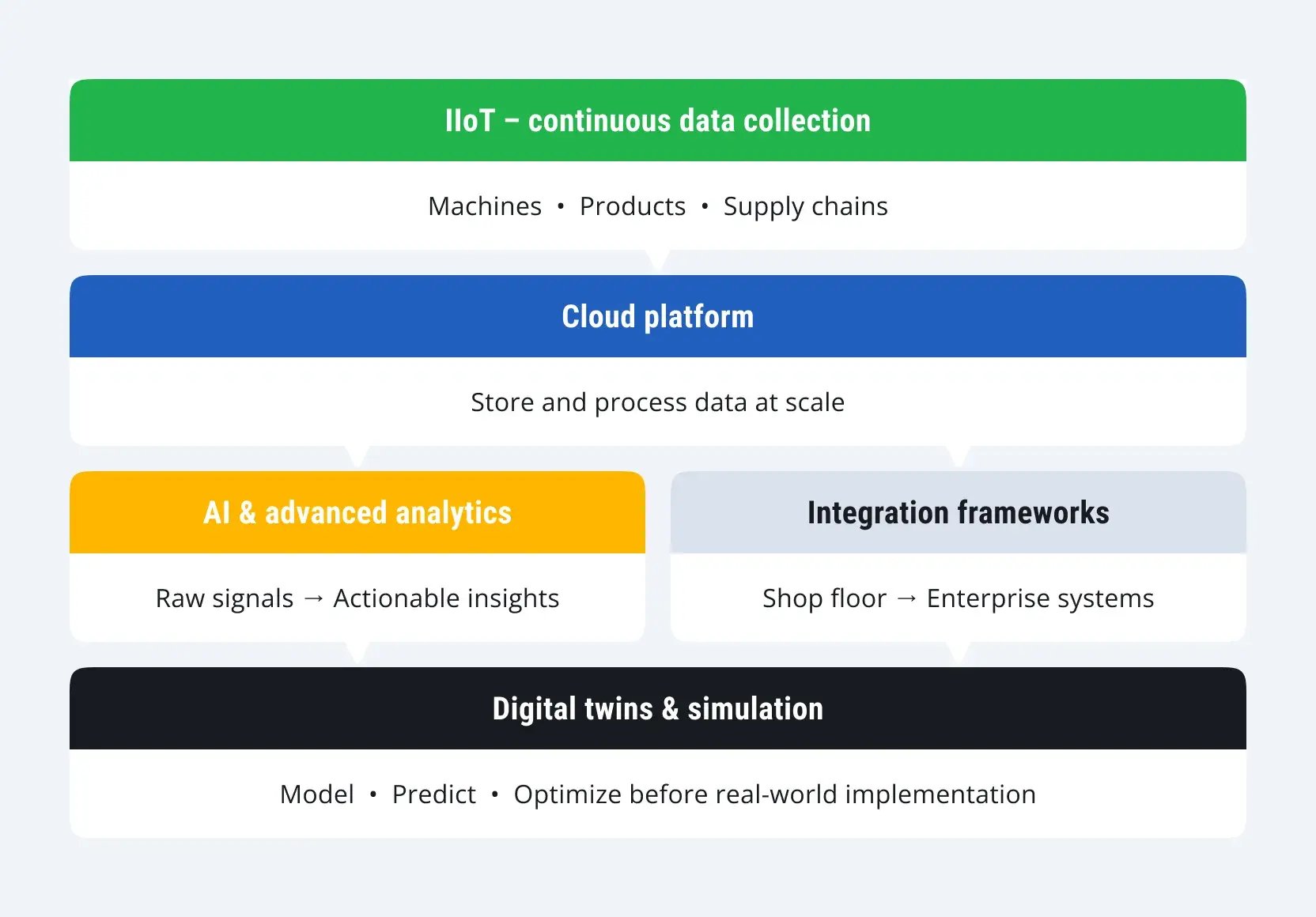
In practice, data is constantly captured from machines, products, and supply chains through IIoT. Cloud environments handle storage and large-scale processing, while AI helps interpret incoming data and highlight what requires attention. Integration keeps shop floor systems aligned with enterprise applications, reducing gaps between them. At the same time, digital twins and simulation tools make it possible to test scenarios and adjust decisions before applying them in real operations. This combination forms the basis of how smart manufacturing functions.
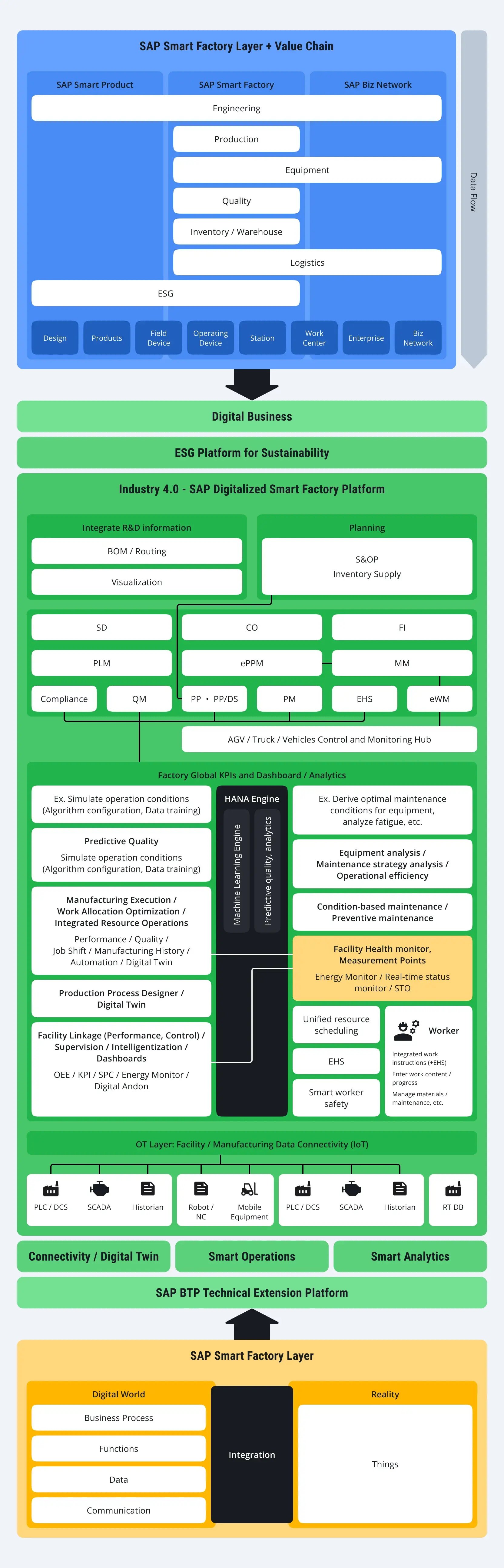
This is also the point where the intelligent enterprise concept becomes applicable. Industry 4.0 in SAP addresses transformation within manufacturing, while the intelligent enterprise extends these principles across the business as a whole. Production is integrated into broader workflows rather than treated separately. SAP reflects this by linking shop floor operations with enterprise processes.
Manufacturing data is transferred into SAP S/4HANA to support planning activities. Supply chain signals, including demand forecasts from SAP IBP and logistics data from SAP Transportation Management, are used to adjust production in near real time. SAP BTP provides the integration and data layer that supports consistent data exchange, analytics, and system extensions without disrupting the core landscape.
This approach reflects a key principle: manufacturing does not become “smart” in isolation. Its value emerges when it is synchronized with the rest of the enterprise.

How SAP Enables Real-Time Shop Floor Control
In many manufacturing environments, control still happens with a delay. A shift ends, data is collected, and reports are generated — and only then does it become clear where time or output was lost. By that point, nothing can be changed.
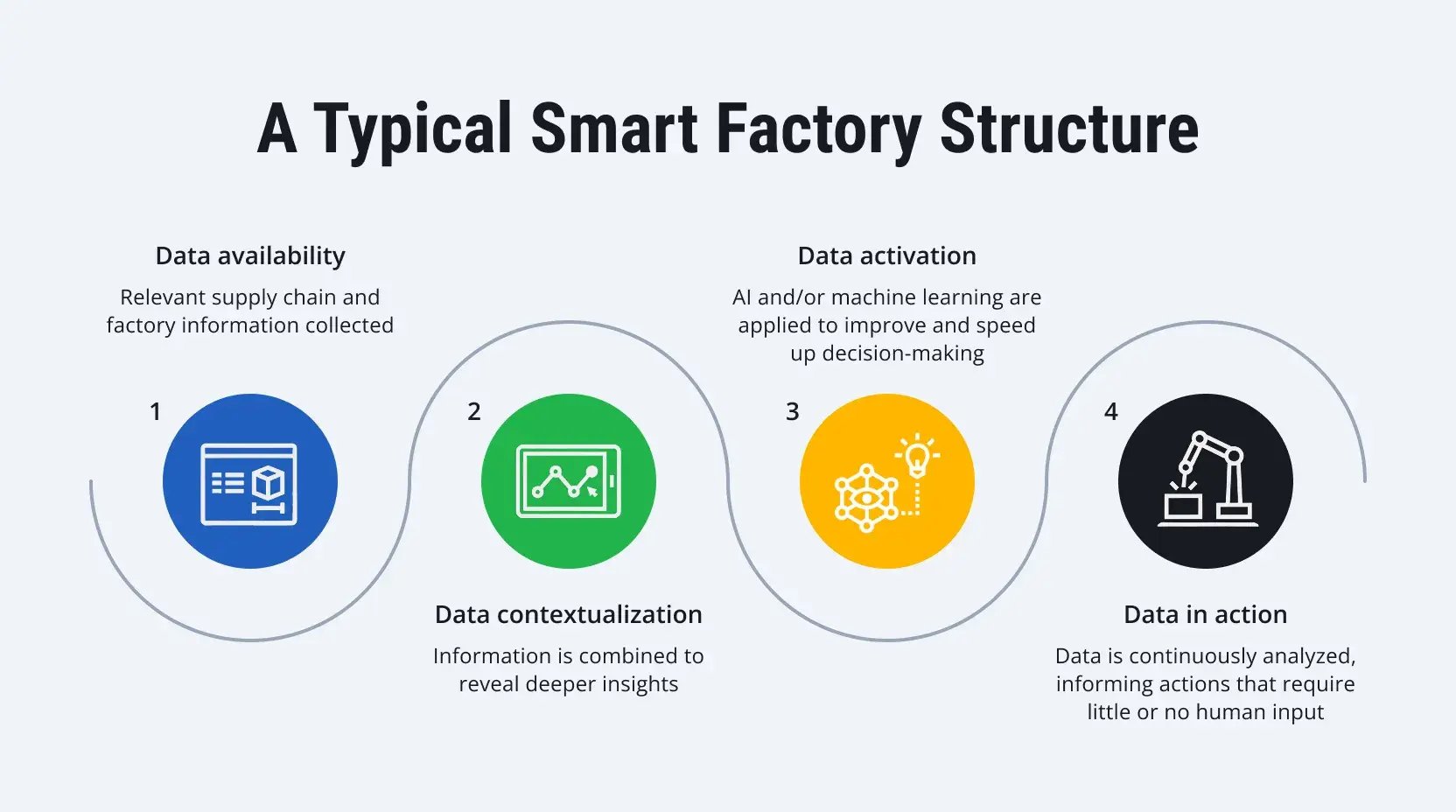
SAP moves control into the production process itself. Data from machines, operators, and production orders is captured and synchronized in real time, so everyone — from line operators to supervisors — works with the relevant view of what is happening.
Consider a situation where a production line starts slowing down mid-shift. The equipment is still running, but cycle times gradually increase. In a traditional setup, this would only show up in end-of-shift reports. With SAP, the deviation is visible immediately. The system highlights where the slowdown is occurring — not across the entire line, but within a specific operation. This allows the supervisor to intervene before the delay escalates.
The same applies to quality. If process parameters begin to drift outside acceptable thresholds, SAP links the deviation to a specific order, batch, and timestamp. Instead of stopping the entire line or discovering defects at final inspection, teams can isolate the affected output and take corrective action while production continues.
Operator execution is also brought into this loop. They receive task-specific guidance tied to the current order, including the correct process version, parameters, and steps required for that exact operation. When changes occur, they are reflected instantly in execution, without the need for manual updates or additional coordination.
Linking Demand, Planning, Execution, and Optimization
In most cases, manufacturing is not held back by missing capabilities in planning, execution, or analytics. The bigger problem is that these functions are not tightly linked. They run in parallel rather than in sync, which means feedback reaches decision-makers after the relevant moment has passed.
SAP is designed to close that gap. It connects these stages into an ongoing loop, where planning reacts to execution, execution reflects demand, and optimization is built on current signals rather than delayed reporting. The following section breaks this down step by step and shows how the process works across a real SAP landscape.
Stage 1: Demand planning
The loop begins with demand, but not as a static forecast. In SAP IBP, demand is continuously recalculated as new inputs appear — incoming orders, pipeline updates, and inventory shifts. When demand rises in a specific region, the system reflects it without delay and pushes that signal further along the process.
This is critical because every downstream decision depends on how current that signal is. If demand is outdated, the entire chain operates on incorrect assumptions.
Stage 2: Production planning
Once demand reaches SAP S/4HANA for production planning, it is evaluated against practical constraints such as capacity, material availability, and timing. Missing components force changes — orders are reprioritized, schedules are updated, or production is moved.
At this point, the plan can be executed, but it still reflects assumptions about how production will actually run.
Stage 3: Execution
At the moment production begins, assumptions built into the plan are tested against reality. SAP environments provide continuous visibility through SAP Digital Manufacturing (DM) and SAP Manufacturing Execution (ME), linking execution on the shop floor with SAP S/4HANA.
These systems capture real-time data — cycle times, order progression, equipment behavior, downtime — directly from operations. If a production line slows, SAP DM highlights the deviation by comparing actual results with planned values and ties it to a specific operation, work center, and order. Supervisors can quickly identify both the issue and its origin.
This is where the process starts to depart from traditional approaches.
Stage 4: Performance analytics
Once the gap is visible, the task becomes understanding why it occurs. In SAP, this is handled through analytics embedded in SAP S/4HANA, SAP Analytics Cloud (SAC), and SAP Datasphere for more complex data landscapes. Execution data from SAP DM is brought into these environments and combined with planning and demand data.
A deviation from a planned 60-second cycle time can be explored in SAC across different dimensions, including work centers, product variants, and shifts. Since the data is already aligned, analysis can begin immediately without manual preparation. This makes it possible to distinguish between capacity-related issues, product-driven delays, or situational factors.
With SAP Datasphere, analysis can go beyond production data. It becomes possible to connect performance issues with upstream conditions such as supplier reliability or material quality. Analytics shifts from describing what happened to explaining why it happened.
Stage 5: Continuous optimization
This is the point where the cycle completes, and the process stops behaving like a straight chain of steps. What happens during execution is fed back into planning and begins to reshape it. If a machine delivers below expected output, future plans take its actual capacity into account. If delays are linked to material shortages, procurement parameters are revised. If certain products disrupt flow, sequencing rules are updated.
What Keeps the Loop From Breaking
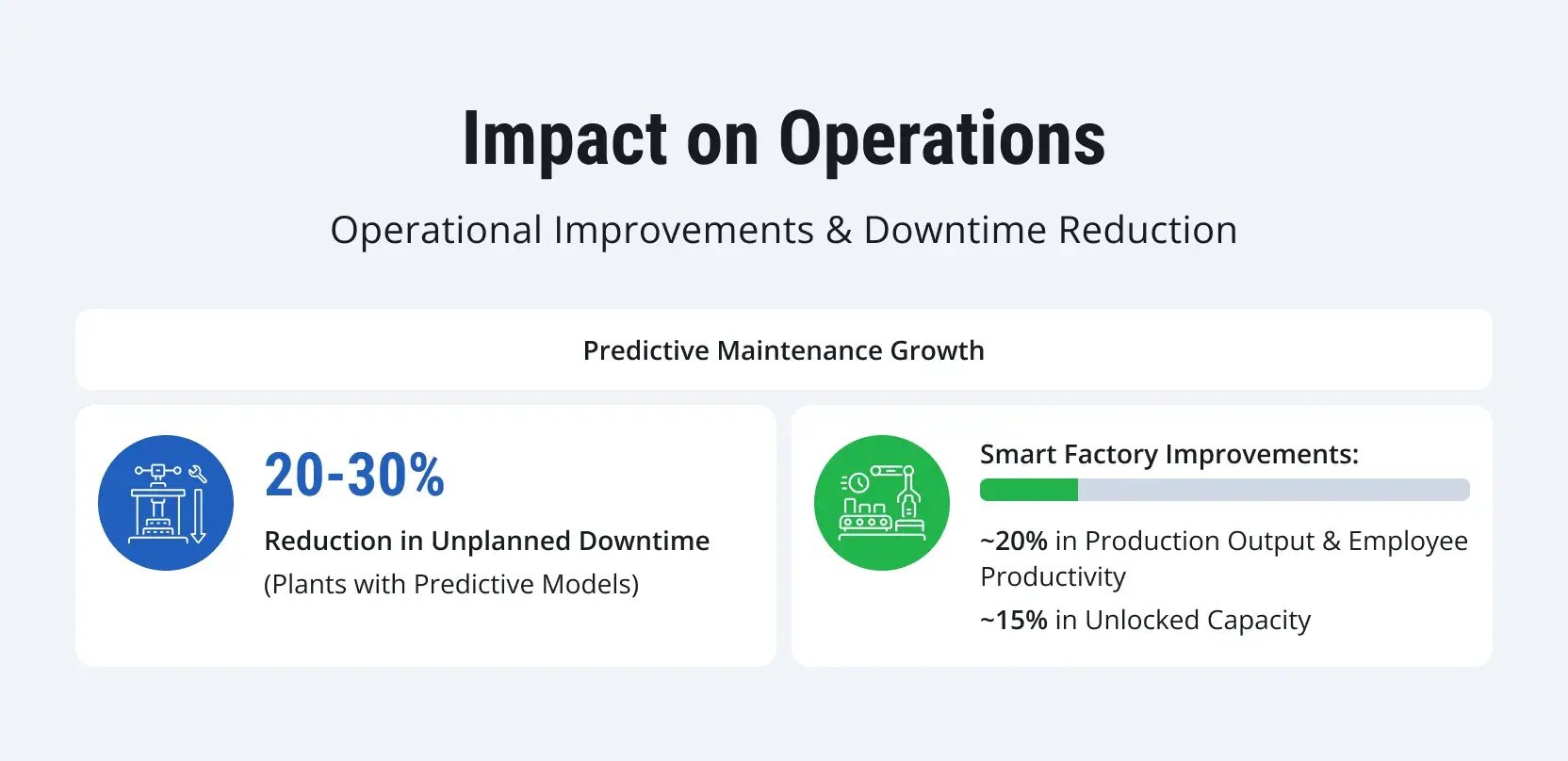
Even the most accurate plan will break if production cannot run consistently. In this context, predictive and autonomous maintenance is what keeps the loop intact. Without it, planning and execution remain vulnerable to the same issues: equipment failures and quality deviations.
SAP includes this layer in the loop by using data not only to react, but to anticipate and adjust. Predictive maintenance is the most direct example. Through SAP Asset Performance Management (APM), equipment data — vibration, temperature, load — is continuously analyzed to detect early signs of degradation. Maintenance is triggered based on actual condition.
 Source: Deloitte
Quality control follows the same logic. With AI-driven inspection embedded in SAP DM and powered by machine learning on SAP BTP, quality control moves into the production process itself. Visual inspection systems and process analytics detect defects or deviations as they occur. This reduces scrap and rework, but more importantly, it prevents defective output from moving further down the line where the cost of correction is significantly higher.
Underlying all of this is anomaly detection. Using machine learning models deployed on SAP BTP, the system continuously analyzes production patterns. It identifies deviations that do not match normal behavior even if they have not yet triggered a failure or quality issue.
For example, a subtle increase in cycle time variability or energy consumption can signal an emerging problem. Detecting these anomalies early allows teams to intervene before performance degradation becomes visible at the output level.
One System Across Many Plants
In distributed production environments, differences in systems and reporting approaches make it hard to assess performance across plants. Questions about underperformance, available capacity, or production balancing often require manual reconciliation. SAP addresses this with a structured approach.
Data is first brought into a consistent model. SAP S/4HANA, with SAP Datasphere as the data layer, ensures that orders, operations, materials, and performance metrics follow the same structure across plants. Even if execution differs locally, the data is aligned and comparable. This allows teams to work with a consistent view across all sites.
At the same time, KPIs are defined uniformly. Metrics such as OEE, throughput, scrap rate, and cycle time are calculated using shared logic. Performance differences therefore reflect actual operational gaps, not inconsistencies in measurement.
Governance is handled centrally, while execution remains flexible. Enterprise-level standards define how data, planning, and KPIs are managed, but plants adapt execution based on local constraints. This creates alignment without enforcing identical processes.
What Manufacturers Are Actually Getting: Outcomes Backed by Data
According to Deloitte’s study of 600 manufacturing executives, the shift from traditional automation to smart manufacturing has moved into the phase of measurable value with clear impact across core operational KPIs.
Output, capacity, and workforce productivity
The most consistent gains appear in core production metrics. Manufacturers report:
- 10–20% increase in production output
- 10–15% increase in unlocked capacity
- 7–20% improvement in employee productivity
These improvements are driven by better coordination across planning, execution, and analytics. When production is aligned with real constraints and continuously adjusted, existing assets and workforce deliver more without proportional increases in cost.
Operational and financial impact
Interestingly, the primary value is operational before it becomes financial.
- 49% of manufacturers cite operational improvements as the main outcome
- 44% identify financial impact as the next priority
This reflects how value is created: efficiency, throughput, and stability improve first and only then translate into cost savings and margin growth.
Agility and responsiveness
One of the less obvious but critical outcomes is agility. 85% of executives expect smart manufacturing solutions to improve agility and transform production processes. This shows up in the ability to:
- Adjust production faster to demand changes.
- Respond to disruptions with less delay.
- Reallocate resources across the network.
In volatile conditions, this becomes a competitive advantage.
Where Companies Are Still Catching Up
Despite measurable gains, Deloitte’s findings show that maturity across smart manufacturing is uneven. The gap is in the areas that enable the system to scale and sustain that progress.
The most notable gap is in human capital
While nearly half of manufacturers report having some form of training or adoption standards in place, workforce readiness remains the lowest-rated maturity area. This is not just about hiring but also about adapting existing teams to operate in a data-driven environment.
The pressure is significant:
- 48% of manufacturers report moderate to severe challenges in filling production and operations roles.
- 46% report the same for planning and scheduling roles.
- 35% identify adapting workers to the “Factory of the Future” as a top concern.
At the same time, demand for talent continues to grow. Deloitte estimates that up to 3.8 million new manufacturing employees will be needed by 2033. This creates a structural constraint: even if the technology is in place, the organization may not be ready to use it effectively. This is why companies are investing not only in hiring (68% report bringing in new talent) but also in upskilling:
- 53% use internal training programs for leadership
- 43% rely on external or vendor-led training
In parallel, many manufacturers are compensating for skill gaps by outsourcing critical capabilities, particularly in IT, data, and cybersecurity.
The second major gap is in maintenance maturity
While predictive maintenance is often highlighted as a key benefit of smart manufacturing solutions, Deloitte’s data shows that many organizations are still early in this transition. Maintenance functions lag behind areas like quality and operations, meaning that a significant portion of asset management is still reactive or schedule-based.
This creates a disconnect: production becomes more data-driven, but asset reliability does not fully keep pace. As a result, downtime and performance variability continue to limit the potential gains from smart manufacturing.
This explains why maintenance remains a priority area for future investment, not only in tools but also in integrating asset data into the broader operational loop.
The third gap is in material management
Even with improvements in production and planning, many companies still struggle to fully synchronize material flows with real production needs. Constraints such as delayed deliveries, inconsistent supply, and lack of real-time visibility into material status continue to disrupt operations.
This is particularly relevant in the context of increasing volatility. Without tight integration between supply chain and production, even well-optimized manufacturing processes remain exposed to external disruptions.

Strategic Roadmap to Becoming a Smart Factory
Becoming a smart factory with SAP is a structured progression. The companies that succeed are the ones that move through clear stages, aligning maturity, investment, and execution.
Phase 1: Establishing the baseline
The first step is to map the current state. Maturity is reviewed across production, systems, and data, usually on a 0–5 scale, with benchmarking used to understand how the organization compares to others in the same industry.
Governance and cybersecurity are defined early in the process. Governance clarifies ownership of decisions and standards. Cybersecurity focuses on risk identification ahead of increased connectivity.
Without this baseline, further investment may lead to scaling problems rather than solving them.
Phase 2: Defining the target state and investment focus
After understanding where they stand, companies move to shaping the next steps. The gap between current and target states is translated into a structured plan over the coming years, with shorter milestones.
This is where priorities are set. Core platforms, data layers, and integration come first, budgets are distributed, and workforce readiness is addressed.
The focus is on aligning initiatives so they develop as part of a single program.
Phase 3: Pilot, validate, and scale
The first stage of execution is carried out through pilots. Companies select focused scenarios where the effect can be measured, for example, bottleneck areas or processes with inconsistent output.
Early implementation includes essential systems, initial data collection, and visibility through dashboards and KPIs. Training is introduced alongside the rollout to support adoption.
The value of this phase comes from feedback. Pilots reveal where the approach fits and where it needs correction. These findings are recorded and used to adjust the rollout plan.
LeverX Experience in SAP Smart Manufacturing Programs
Smart manufacturing programs depend on alignment between planning, execution, and data, rather than improvements within systems. LeverX addresses this by linking core SAP platforms, shop floor systems, and data layers into a coherent operating model.
S/4HANA-driven production modernization
SAP S/4HANA is commonly positioned as the core planning and execution system. We focus on improving production planning logic, organizing master data, and aligning capacity, materials, and lead times with actual performance. The objective is to make production plans realistic and executable.
SAP Digital Manufacturing implementation
Implementation of SAP DM focuses on connecting production orders with shop floor activities and capturing execution data in real time. This includes production monitoring, digital work instructions, and traceability at the operation level. As a result, production execution becomes transparent and measurable within the same system landscape as planning.
MES-to-ERP integration
Many manufacturing environments operate with both MES and ERP systems that are only partially connected. Integration initiatives address data synchronization and process alignment between these layers. Production orders, confirmations, and performance data are structured and exchanged in a consistent format, which allows execution results to be reflected in planning without delays.
IoT architecture design
IoT architecture design focuses on structuring how equipment and sensor data is captured and used within SAP systems. This includes defining data flows from machines into asset management, production execution, and analytics environments. Properly designed architecture ensures that data can support use cases such as condition monitoring, predictive maintenance, and performance analysis.
Global rollout programs
Scaling smart manufacturing across multiple plants requires consistent data models, KPI definitions, and governance structures. Global rollout programs establish these standards at the enterprise level while accounting for local operational specifics. This approach enables comparability across sites and supports coordinated planning and decision-making at the network level.