Prepare for SAP ECC 2027 migration in the Nordics with a practical guide.
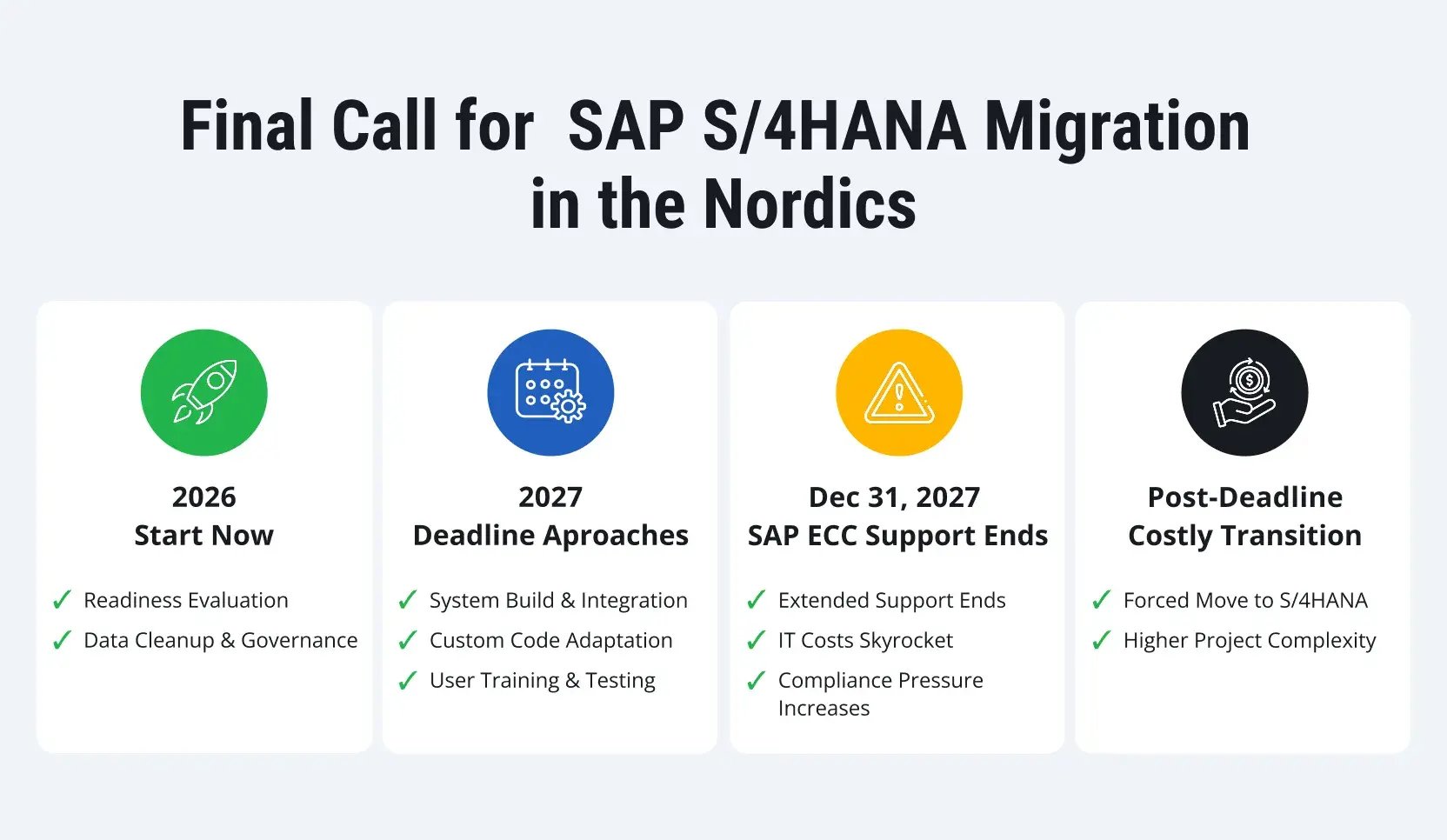
SAP will end mainstream maintenance for SAP Business Suite 7 core applications at the end of 2027, with extended maintenance available until 2030. For many organizations in the Nordics, this deadline is increasingly tied to broader transformation programs, where migration to SAP S/4HANA is usually combined with cloud adoption strategies such as RISE with SAP.
After 2027, companies are expected to face a different reality:
- Innovation is concentrated on SAP S/4HANA.
- Integration with newer platforms becomes less straightforward.
- Internal support effort increases.
- Long-term planning becomes less predictable.
At that point, the question is no longer about system stability. It becomes a question of how well the ERP core supports the business going forward.
The 2027 milestone is now a primary anchor for project timelines. It essentially forces organizations to choose a path. They must decide whether they will continue to maintain a legacy core or finally commit to a modern architecture. This deadline makes long-term indecision a significant operational risk.

The Real Constraint: Time and Execution Capacity
ERP transformation programs take time, especially in organizations operating across multiple countries and entities. A realistic timeline often includes:
- Several months for assessment and business case development
- Over a year for implementation and testing
- Additional time for stabilization
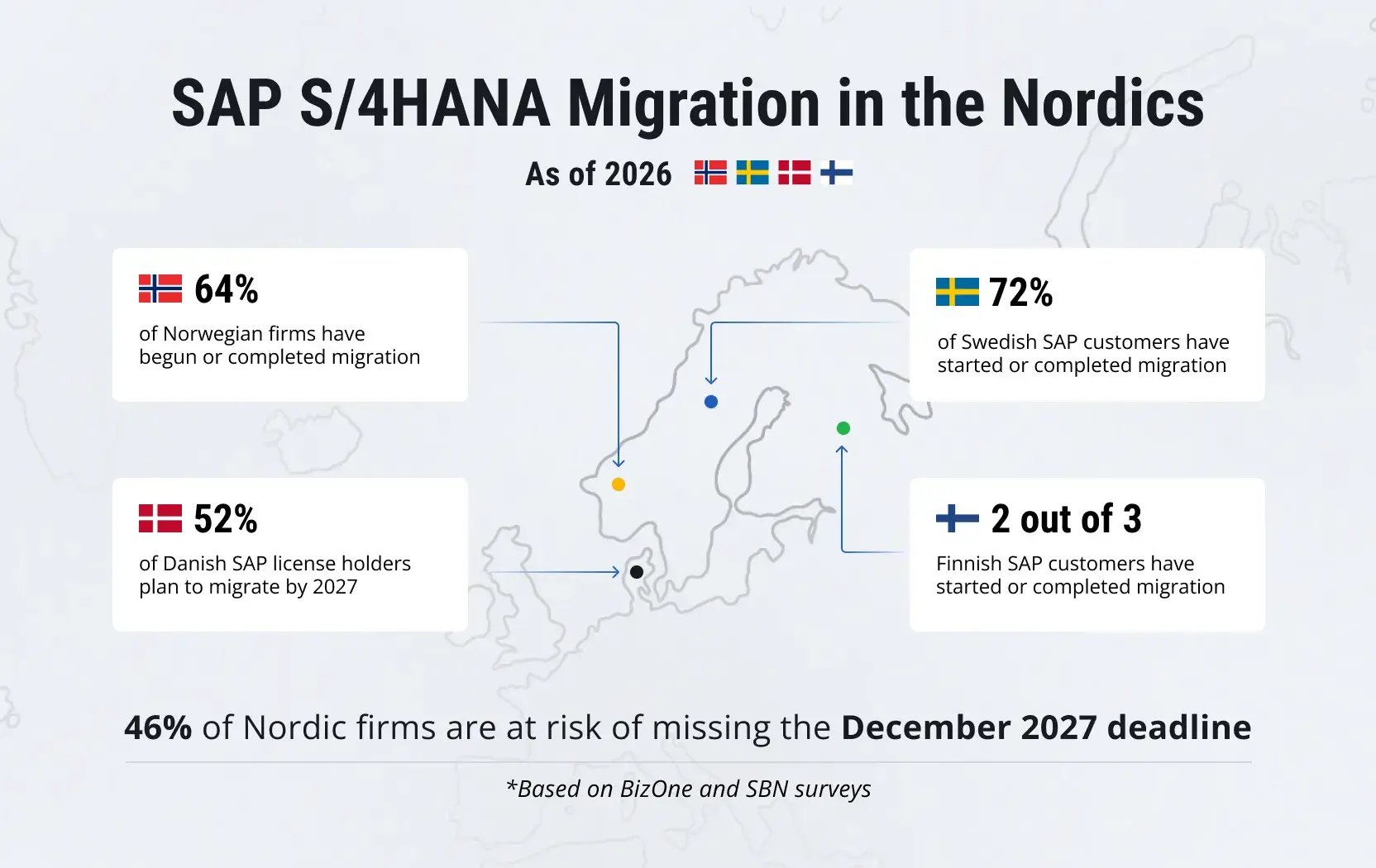
That timeline already overlaps with the 2027 horizon. At the same time, the broader market is moving forward. According to Eurostat, 53% of EU enterprises used paid cloud services in 2025, with Finland reaching nearly 80% — the highest rate in the Nordics.
This matters because ERP does not exist in isolation. The more the surrounding landscape modernizes, the more visible the limitations of older systems become. Delaying the decision does not freeze the environment. It just narrows the window for a controlled transition.
Why the Nordics Require a Different Perspective
The SAP ECC migration Nordics discussion is usually broader than a system upgrade; it involves a number of factors, such as:
- High digital maturity of the region
- Strong reliance on cloud services
- Cross-border structures
- Strict governance and reporting expectations
There is also a regulatory shift underway. The Corporate Sustainability Reporting Directive (CSRD) requires large companies to disclose sustainability reporting, starting with financial year 2024 reports published in 2025.
Consequently, the pressure on data consistency and reporting capabilities is growing. ERP systems are now expected to support:
- Financial and operational transparency
- ESG data tracking
- Consistent reporting across entities
- Integrated planning and analytics
Expanded requirements create broader goals for SAP S/4HANA Nordics migration initiatives.
The Reality of SAP ECC Assessments
Nordic firms usually start an assessment by thinking about technical compatibility or code size. They quickly realize the problem is actually strategic. Most legacy setups are a pile of small decisions made over decades. Every change fixed a local problem, but the bigger picture was ignored. You end up with a system full of overlapping logic where data ownership is unclear or fragmented.
The weight of dead code
We often find massive amounts of custom code with no clear purpose. It was built for a specific need years ago, and the people who understood it are long gone. Because nobody knows what will break if it is deleted, the code just stays there. It becomes a permanent layer of risk that everyone is too afraid to touch.
Drift between entities
Companies across the Nordics tend to let their regional offices tweak their own workflows. Procurement and finance processes start to drift apart until the business is no longer running on a single standard. This fragmentation makes any attempt at a global rollout complicated without a massive upfront cleanup.
Data that does not match
Material and supplier records are rarely the same across different systems. One site uses one naming convention while another uses something totally different. Without strong governance, new errors pop up every day. You cannot have a digital transformation when your basic building blocks are inconsistent.
The reporting struggle
When KPIs are pulled from a mix of ERP data and manual spreadsheets, trust in the numbers disappears. You often find three different departments reporting three different versions of the same metric. This makes every board meeting a debate about whose spreadsheet is right rather than how to move the business forward.
Hidden integration risks
Systems are often held together by old interfaces that have zero documentation. They still run, but nobody knows how they will react to a modern workload or a major system change. These shadow integrations are a significant risk for any migration project.
Separately, these problems are just nuisances. Together, they act as a total brake on innovation. The assessment phase is the first time the business has to look at how the ERP actually functions today, rather than how it was designed ten years ago.
Migration as an Operating Model Reset
Once the assessment ends, the conversation shifts. It is no longer about the technical move but about what kind of business you are building. Legacy SAP ECC setups reflect decades of local patches and exceptions. Moving to SAP S/4HANA forces you to decide which parts of that history are still useful and which are just baggage.
The shift in system logic
SAP S/4HANA works differently from the old core. Processes are tied more tightly together, and the data model is far less tolerant of messy records. Analytics are baked into the transactions instead of being a separate layer. These changes make fragmentation impossible to hide. Issues that used to be buried in manual spreadsheets now become visible roadblocks.
Concrete design choices
This is where you make real-world decisions at the intersection of tech and business. You have to decide how much standardization you can actually enforce across different countries. You need to pin down exactly who owns the data and how much of your current complexity you are willing to drag into the future. These choices dictate your long-term maintenance costs.
The Nordic balance
In the Nordics, many firms operate across different borders while trying to keep a unified model. The ERP has to balance this need for global standards with local requirements. That balance never happens by accident. It has to be a deliberate choice made by leadership.
Stakeholder friction
Different leaders bring different pressures to the table. The CFO wants financial consistency and perfect compliance. Operations wants the flexibility to get the job done without being slowed down by the system. The CIO is looking at long-term scalability. If these groups do not align early, the project usually defaults to the safest and worst path: copying old, broken processes into the new environment.
The controlled reset
You have to use the migration as a chance to simplify. Standardize the parts of the business where consistency improves control. Only keep local variations if they are absolutely necessary for the business to function. Done right, this stage sets your foundation for the next decade. Done wrong, you just move your old problems into a faster system with the same structural limits.
Functional Changes Across the Core
Finance and accounting
Finance is often the most complex area in an older environment. Years of local adjustments and extra ledgers create a heavy reconciliation burden. Moving to a unified model cuts the number of steps needed to close the books and makes transaction history easier to trace. For firms in the Nordics, this simplifies global consolidation. However, the shift is rarely automatic. You still have to audit your account structures and controlling logic to make sure they work in a modern, integrated setup.
Procurement and sourcing
Purchasing in legacy systems often depends on local habits and historical workarounds. This creates a messy variety in how things are bought across the company. A transition is the best time to audit supplier records and approval flows. The real aim is visibility over spend rather than just enforcing a standard. Having clean data now is the only way to make advanced sourcing platforms actually usable for the team later.
Operations and supply chain
Operations usually house the most custom code. Manufacturing and logistics are often full of local patches, like custom planning routines or manual inventory tweaks. During a move, you have to decide which of these workarounds still add value and which are just baggage. Redesigning these areas leads to better alignment between your planning and what actually happens on the shop floor. This reduces the constant need for reactive adjustments.
Analytics and reporting
Many teams underestimate the work needed for analytics. In older landscapes, reporting usually lives in a separate world of extracts and spreadsheets. This leads to different departments arguing over their own versions of the same metric. Moving to a new core forces you to rebuild this logic. You have to decide which metrics matter and where the calculation should live. Modern tools are powerful, but they cannot fix a broken data model or a lack of governance.
The SAP Ecosystem Behind the Transformation
When teams start planning an SAP ECC-to-SAP S/4HANA migration, the conversation usually begins with the core system. That makes sense — it’s the center of everything. But pretty quickly, it becomes obvious that the real challenge is around it.
What actually changes during migration is not just the ERP itself, but the way the whole landscape is put together. How systems talk to each other. Where logic lives. How data moves and sometimes, how it gets stuck along the way.
Most SAP ECC environments were not designed in one go. They grew. A new interface here, a reporting tool there, a custom fix when something didn’t quite work. Nothing unusual. But after a few years, you end up with something that works, yet resists change.
Migration is usually the first time someone steps back and asks: Does this structure still make sense?
From “It Works” to “It Makes Sense”
There’s a difference between systems that are connected and systems that are actually structured. In many SAP ECC landscapes, integration looks like a web of point-to-point connections. It does the job, but it’s hard to follow and even harder to change without breaking something unexpected.
With SAP S/4HANA, companies usually try to clean that up. Not for the sake of architecture diagrams, but because day-to-day operations depend on it. Fewer surprises, clearer ownership, better control. That’s where the wider SAP ecosystem starts to matter.
SAP S/4HANA — The Core, but Not the Whole Story
SAP S/4HANA becomes the central system. That part is straightforward. What changes is how much you expect from it. In SAP ECC, it often carried everything — transactions, logic, extensions, and workarounds. In SAP S/4HANA, the idea is to be a bit more disciplined.
The core should:
- Handle transactions
- Keep data consistent
- Support end-to-end processes
The moment you start pushing too much custom logic back into the core, you’re slowly recreating the same situation you were trying to move away from.
SAP BTP — Where the “Extra Stuff” Goes
This is where SAP BTP comes into play, though “platform” doesn’t really capture how it’s used in practice. Think of it as a place where everything that doesn’t belong in the core can live:
- Custom apps
- Extensions
- Integrations
- Automation scenarios
In SAP ECC, those things often ended up inside the ERP itself. That made sense at the time, but it also made upgrades painful and changes risky. Separating them out gives you more room to move. You can adjust one part without shaking the whole system. For companies in the Nordics, where digital initiatives keep evolving, that flexibility tends to pay off fairly quickly.
SAP Integration Suite — Cleaning Up the Mess Nobody Wants to Touch
Integration is usually the part everyone knows is messy but avoids discussing too early. In older landscapes, it’s common to see:
- Direct connections between systems
- Custom-built interfaces with limited documentation
- Unclear ownership when something breaks
It works, until it doesn’t. SAP Integration Suite is basically an attempt to bring order into that. Not by adding more layers, but by making connections more predictable:
- Centralizing how integrations are managed
- Standardizing communication patterns
- Improving monitoring so issues don’t stay hidden
This becomes especially important when cloud systems enter the mix. Hybrid landscapes are less forgiving when integration is fragile.
SAP Signavio — Making Process Reality Visible
One thing that often surprises teams is how little visibility they have into their own processes. Everyone knows how things should work. Fewer people can explain how they actually work across the whole organization.
That’s where SAP Signavio tends to help by putting the processes on the table:
- Mapping what really happens
- Identifying where things slow down or break
- Comparing that with standard approaches
It sounds basic, but it changes the conversation. Once you see the full picture, it becomes harder to justify keeping inefficient steps just because you’ve always done it like this.
SAP Analytics Cloud — Fixing Reporting That Grew Sideways
Reporting in SAP ECC environments rarely stays clean. Over time, it spreads:
- Part in ERP
- Part in Business Warehouse
- Part in Excel
- Part in someone’s private files no one wants to touch
The result is usually multiple versions of the same number. SAP Analytics Cloud helps bring that back together. It connects more directly to operational data and reduces the need for manual consolidation.
But there’s a catch. The tool doesn’t fix bad logic. If KPIs are inconsistent or poorly defined, that problem just becomes more visible. So migration often forces a cleanup not just of tools, but of how the business defines its numbers.
SAP MDG — The Unpopular but Necessary Part
Master data governance is rarely the exciting part of a transformation. It’s also the one that quietly causes the most problems if ignored. Inconsistent master data affects everything:
- Reporting accuracy
- Automation
- Integration stability
SAP MDG introduces structure:
- Clear definitions
- Approval workflows
- Ownership of data
It’s one of the few areas where small improvements have a large ripple effect across the system.
Extending into Business Areas
Once the core and supporting layers are in place, companies often look at specific domains:
- SAP Ariba for procurement
- SAP Extended Warehouse Management for warehouse operations
- SAP Transportation Management for transportation
- SAP Integrated Business Planning for Supply Chain for planning
These are usually not part of the initial migration scope, but they come into play when companies start asking what they can improve, not just what they need to replace.
Why This Setup Either Works — or Doesn’t
Individually, all these components make sense. The problem starts when they are introduced without a clear structure. That’s how complexity builds up again. Just newer, cleaner-looking complexity.
What tends to work better is keeping a few principles in mind:
- Don’t overload the core.
- Keep integrations structured.
- Treat data as something that needs ownership.
- Align processes before automating them.
Nothing groundbreaking there. But in practice, this is exactly where projects either stay manageable or drift back into the same patterns they started with.
Choosing the Migration Path
The choice between Greenfield, Brownfield, or Bluefield is rarely just a technical one. It actually shows how much change your organization is willing to handle at once:
- Greenfield: This is for when your current setup is too broken to fix. It gives you a clean start, but it only works if you have strong leadership and a team ready for a total process shift.
- Brownfield: If your system is stable and you need to move fast, this is the way to go. It keeps the disruption to a minimum, but you have to accept that most of your old structures will stay exactly as they are.
- Bluefield: This is the middle ground. It lets you rebuild the parts of the business that need it most while leaving stable areas alone. It is the right move when neither a total reset nor a simple technical swap fits your goals.
-min-1.jpg)
Side note: if you aren’t sure about the right SAP S/4HANA migration strategy for your case, we explored the available options in our guide on SAP S/4HANA migration vs. conversion vs. transition. You will not only find the correct definitions there but also gain insights into their impact on your global ERP strategy.
Risks of Delaying Migration
Delaying migration often feels reasonable. The system still runs, business processes hold up, and there is no immediate disruption forcing action.
The problem is that the landscape keeps evolving in the background. Operational complexity and system dependencies tend to intensify over time, which steadily reduces the window for a structured transition. When a migration finally becomes an absolute necessity, the organization often finds itself working under much less favorable conditions. This delay limits the ability to execute a deliberate strategy, forcing the project into a more reactive, constrained environment.
Less Time for Proper Preparation
A solid migration starts with assessment and design. That includes understanding custom code, processes, and integrations.
When timelines tighten, this phase is compressed. Teams spend less time analyzing and more time reacting. As a result:
- Process redesign is limited.
- Inefficient structures are carried forward.
- Decisions are made under pressure rather than by design.
More Dependence on Legacy Customizations
Over time, SAP ECC systems accumulate custom logic. Some of it is still relevant, some of it isn’t.
The longer the migration is delayed, the harder it becomes to understand dependencies. Besides, the risk of removing outdated logic increases, and you have to keep more custom elements just in case. This reduces the overall benefit of moving to SAP S/4HANA.
Integration Complexity Keeps Growing
Integration landscapes rarely stay simple. New systems are added, interfaces evolve, and data flows become harder to track. Delaying migration means:
- More connections to manage during transition
- Less transparency in how systems interact
- Higher risk during testing and cutover
Increased Pressure During Execution
Migration depends heavily on business users for testing, validation, and adoption. When timelines are tight:
- Testing cycles are shortened.
- Training is rushed.
- Issues surface later, often after go-live.
This shifts effort into the post-migration phase, where changes are more difficult.
Trade-offs Become Inevitable
As deadlines approach, priorities shift from improvement to completion. Typical compromises include:
- Postponing process changes
- Reducing data cleanup
- Accepting technical shortcuts
The system goes live, but many existing issues remain in place.
Why Timing Matters
These risks build on each other. Less preparation leads to more complexity, which increases pressure, which leads to compromises. Starting earlier does not remove these challenges, but it gives companies more control over how they handle them.
Benefits of the Shift
For most Nordic firms, the real value of the transition is not a single big event. It shows up in the daily flow of the business. Operations become more consistent and less dependent on the manual workarounds that usually slow things down.
Process alignment
Legacy environments often have different countries handling the same task in different ways. This creates friction in finance and procurement. The new core allows you to bring these activities together. The goal is not to force everyone into the exact same mold, but to cut out the variations that serve no real purpose.
Data transparency
The difference in data quality is immediate. When your structures are aligned, teams stop wasting time arguing over which report is right. This is especially vital in the Nordics, where accuracy and transparency are often strict regulatory requirements rather than just internal goals.
Decision speed
There is a massive shift in how fast you can act. Direct access to data means you no longer have to wait for batch processing or manual consolidation. It does not guarantee a better choice, but it removes the technical lag that often prevents a timely response to market changes.
Architectural stability
From a technical view, the landscape becomes easier to handle. By separating core processes from your custom extensions, future updates become less of a disaster. This stability might not seem like much during go-live, but it becomes a major advantage a few years down the road.
Future readiness
The move aligns the business with current market trends. Whether you are looking at sustainability reporting or deeper automation, you need a foundation that is not held back by old structural limits. It provides a base that supports modern cloud tools instead of fighting against them.
How Nordic Companies Can Prepare
The quality of preparation work determines if the rest of the project is a smooth transition or a constant crisis. You have to start by digging into the current landscape to see how the business actually uses the system. You need to know which processes are vital and exactly where custom code is propping up daily operations.
Mapping the dependencies
Understanding how systems interact is the next hurdle. You have to map out every integration and data flow. This is often the first time a company actually sees the full picture of its own technical debt. It reveals exactly where complexity has piled up over the years, making it easier to see what needs to be cut.
The data cleanup trap
Standardizing master data always takes more effort than teams expect. This is not just a technical job. It requires a real agreement on who owns the data and how it is defined. If you do not settle these governance issues now, your old inconsistencies will simply move into the new system and cause the same problems.
Structuring the future architecture
You need to decide exactly how the future landscape will look. This means picking what stays in the core and what moves to the extension layers. These choices dictate how flexible your system will be five years from now. It is about building an environment that can evolve without breaking every time you make a change.
Selecting the path and alignment
The choice between a fresh start and a conversion changes everything from your timeline to your total budget. This decision requires early buy-in from finance, operations, and IT. If you wait until implementation to get these leaders on the same page, you are almost guaranteed to run into major conflicts that will stall the project.
Testing and change as a foundation
User adoption and testing should not be saved for the end. These factors should influence how you design your processes from day one. If you treat change management as an afterthought, you risk building a system that is technically perfect but completely rejected by the people who actually have to use it.
Where External Expertise Changes the Outcome
Even the best internal teams hit limits during a transition. This is not about a lack of skill but rather the fact that migration introduces hurdles that are not part of daily operations. Having an outside view often prevents common errors that are hard to spot from the inside.
Objectivity in readiness assessments
External specialists bring a neutral perspective to the early evaluation phases. It is difficult for internal teams to question processes they have used for a decade. An outside expert helps identify risks and structural flaws that those close to the system might overlook. They provide the objective data needed to make hard decisions about what to keep and what to retire.
Navigating strategy pitfalls
Choosing the right migration path is about balancing risk against business impact. Experience from other projects helps avoid the traps that typically derail a transition. Outside input ensures that the chosen strategy is based on proven results rather than just technical theories.
Taming custom code complexity
Analyzing years of custom developments is usually more difficult than expected. External teams help pin down which code is still vital and which is just legacy noise. This prevents unnecessary complexity from being dragged into the new system, keeping the final architecture much cleaner.
Architectural integration
Rebuilding the integration layer requires a specific type of architectural foresight. It is not just about making two systems talk. It is about setting up a structure that remains easy to manage as the business grows. External support provides the technical depth needed to build a hub that stays stable under pressure.
Data governance and rules
Setting up consistent data rules across multiple business units is a major challenge. External experts help establish the governance needed to settle arguments between stakeholders. This ensures that everyone agrees on definitions and ownership before the data move begins.
The precision of cutover planning
Testing and the final cutover are the most high-stakes phases of the project. A small mistake here can paralyze the whole business. Having people on the team who have survived dozens of these transitions reduces the risk of a go-live disaster.
The goal is to reinforce the project in specific areas where experience makes a measurable difference. It is about making the transition predictable instead of a gamble.
The LeverX Approach to Nordic Migrations
Most firms know they need to leave the old core. The struggle is organizing the move without stopping the business. We focus on the entire lifecycle, making sure the final system is actually sustainable for the long term.
SAP ECC Discovery and Mapping
We start by finding out what actually exists. Often, the internal view of the system is incomplete. We look at how units use the software and where processes have drifted apart over the years. This usually exposes the gap between how things are supposed to work and how they actually run on the ground.
Readiness and strategy
Once the state of the system is clear, we measure how ready the team is for the move. We look at data quality and the sheer volume of custom code to build a realistic baseline. This leads to picking a path. We weigh the trade-offs between a clean start and a technical conversion, focusing on what is practical for your specific business priorities.
The roadmap and business case
A strategy only works if it is tied to a structured plan. We develop the business case and roadmap by defining clear phases and milestones. This stage is vital for getting finance, operations, and IT leaders to agree on the expected impact before the real work begins.
Data and integration cleanup
These are almost always the most underestimated parts of a project. We map out every data flow and find the inconsistencies in your master records early. Solving these integration hurdles before the move starts significantly lowers the risk of failure during implementation.
Managing custom developments
Custom code is a massive source of uncertainty. We analyze your developments to find what is actually being used and what is just dead weight. This allows us to decide how to handle vital functions in the new system while stripping away the complexity that no longer serves the business.
Process redesign and analytics
Migration is the best time to fix broken workflows. We use tools like SAP Signavio to map current steps and find where the friction is. We also rebuild the reporting logic. In older environments, reports are often a mess of different definitions. We align your KPIs so that every department is finally looking at the same numbers.
Implementation and stability
During the move, we handle everything from configuration to cutover planning. The goal is to keep the project controlled even when real-world challenges pop up. After going live, we stay through the stabilization phase. We resolve operational glitches and fine-tune the system until it is fully reliable for daily use.
Working in practice
The best results happen when your internal team and our experts work as a single unit. Your team provides the business context while we bring the experience from dozens of similar transformations. This partnership is what keeps the project on track and prevents the typical pitfalls of a large-scale migration.
Bottom Line
By the time companies move into migration planning, it usually becomes clear that the SAP ECC landscape reflects years of accumulated decisions. Some of those decisions still make sense. Others simply stayed in place because changing them was difficult.
Migration brings these issues into focus. It forces companies to decide how they want their processes, data, and systems to work going forward.
For Nordic organizations, this decision carries additional weight. High digital maturity, regulatory requirements, and multi-entity structures all increase the importance of having a stable and transparent ERP core.
Starting earlier gives companies the space to address these challenges properly. It allows time for analysis, alignment, and design. Delaying the decision does not remove the need for migration. It only reduces the number of options available when the transition finally begins.