

A late scrap shipment can disrupt a melt plan. An unexpected rolling mill outage can render a feasible production schedule impossible. A quality restriction on one heat can affect available inventory, customer commitments, transportation plans, and margin.
For U.S. steel manufacturers, these events are connected because the underlying operations are linked. Procurement decisions influence chemistry and yield. Equipment availability constrains production. Quality determines which material can be allocated. Warehouse and transportation execution affect whether a customer receives the promised product on time.
The production model makes this coordination especially difficult. Steelmaking can combine continuous, batch-oriented, repetitive, and discrete processes. One production run may generate several grades, dimensions, coils, slabs, billets, bars, co-products, reusable scrap, or off-spec material. Characteristics such as width, thickness, weight, chemistry, surface condition, and mechanical properties can determine how the material is planned, produced, inspected, stored, allocated, and shipped.
The scale of the U.S. industry raises the cost of getting these connections wrong. According to the American Iron and Steel Institute's 2025 Annual Statistical Report, U.S. raw steel production reached approximately 90 million net tons in 2025.
The practical challenge is therefore broader than implementing individual systems for production, maintenance, quality, logistics, or finance. Manufacturers need those processes to work from a consistent operational picture.
SAP can provide much of that foundation. SAP Mill Products capabilities address industries where product characteristics, variants, production constraints, and customer-specific requirements directly influence planning, manufacturing, fulfillment, quality, and logistics. Other SAP solutions can extend the model into detailed scheduling, manufacturing execution, asset management, warehousing, transportation, analytics, and network planning.
The exact landscape will differ by producer. Some companies may run most enterprise and manufacturing processes in SAP. Others may retain specialized MES, mill scheduling, laboratory, automation, warehouse, or transportation systems and integrate them with SAP.
This article explains where the main SAP capabilities fit, how they can work together in U.S. steel operations, and which architecture, data, and transformation decisions matter when moving from disconnected processes toward a more integrated operating model.
For U.S. steel manufacturers planning a broader ERP transformation, SAP S/4HANA consulting services from LeverX can help connect architecture decisions with implementation priorities.
At a glance: SAP can help steel manufacturers integrate raw materials, production planning, mill operations, quality, product characteristics, inventory, logistics, sales, maintenance, and supply chain planning. Important use cases include characteristics-based planning, make-to-stock and make-to-order production, order promising, quality management, heat and batch traceability, co-product management, warehouse execution, asset management, and supply-chain resilience.

Why Steel Manufacturing Requires a Specialized ERP Approach
The main difficulty in steel manufacturing is not the number of business functions involved. It is how quickly a decision in one function changes what is possible elsewhere. A heat or batch moves through capacity-constrained equipment. Material changes form several times. Actual yield can differ from the production plan. One process may create finished material, reusable scrap, co-products, off-spec output, and losses.
Commercial requirements add another layer. Grade, chemistry, dimensions, surface condition, coating, tolerances, mechanical properties, weight, and customer specifications can determine both which material is suitable for an order and which production route can make it.
Consider what happens when these processes work from different information. A scheduler may plan production against a rolling line that maintenance has already taken out of service. Sales may promise inventory that quality has restricted. Procurement may choose a lower-cost scrap mix without visibility into its effect on feasible grades or yield.
Each local decision may make sense on its own. The problem appears when the operation is viewed end-to-end. A steel-oriented ERP model, therefore, needs to connect product characteristics, production constraints, equipment availability, actual yield, inventory status, customer requirements, and financial outcomes. Technology enables those connections, but the operating model has to define what information matters, where decisions belong, and which system owns them.
That is the context for choosing the SAP capabilities that follow.
What SAP Solutions Are Relevant to U.S. Steel Manufacturers?
There is no universal SAP stack for steel. An integrated producer with primary steelmaking, casting, rolling, and finishing has different requirements from an EAF minimill, a downstream processor, or a network of finishing plants and service centers. Existing MES, APS, warehouse, laboratory, and automation systems also influence what should move into SAP and what should remain outside it.
SAP Cloud ERP, SAP Cloud ERP Private, or SAP S/4HANA on-premises can provide the enterprise core. Other SAP capabilities can address network planning, detailed scheduling, manufacturing execution, quality, warehousing, transportation, asset management, integration, analytics, and sustainability.
Before assigning those capabilities to individual processes, however, one architectural assumption needs to be clear.
Architecture baseline
The detailed examples in this article primarily assume SAP Cloud ERP Private or SAP S/4HANA on-premises. Within this baseline, SAP S/4HANA PP/DS is embedded in SAP Cloud ERP Private or SAP S/4HANA on-premises rather than operating as a separate PP/DS system. SAP describes current PP/DS as fully integrated into the SAP S/4HANA environment.
Use of embedded SAP S/4HANA PP/DS is subject to the applicable SAP Advanced Planning/PP/DS licensing or entitlement and activation requirements.
SAP EWM can use embedded or decentralized architectures within SAP Cloud ERP Private and SAP S/4HANA on-premises landscapes. SAP TM can operate within the ERP stack or through a separate landscape.
These patterns should not automatically be applied to SAP Cloud ERP. SAP Cloud ERP provides its own Warehouse Management and Transportation Management capabilities and supports specific integration scenarios with decentralized EWM and external or decentralized transportation management.
Accordingly, later references to embedded PP/DS, embedded or decentralized EWM, and in-stack or separate TM use the SAP Cloud ERP Private / SAP S/4HANA on-premises baseline unless stated otherwise. If SAP Cloud ERP becomes the ERP core, planning, warehousing, transportation, and integration requirements need to be mapped to the capabilities and deployment options available in that environment.
|
SAP capability |
Primary role in steel manufacturing |
|
SAP Cloud ERP / SAP Cloud ERP Private / SAP S/4HANA on-premises |
Finance, procurement, production, inventory, sales, costing, and core ERP processes |
|
Industry-specific support for mill-product planning, manufacturing, fulfillment, quality, and logistics |
|
|
Demand, supply, inventory, response, and network planning |
|
|
Detailed production planning, finite scheduling, sequencing, and bottleneck-resource planning within the baseline architecture |
|
|
Manufacturing execution and shop-floor integration, where appropriate |
|
|
Inspections, quality results, defects, and material-quality processes |
|
|
Maintenance planning and execution |
|
|
Condition monitoring and predictive or prescriptive maintenance scenarios |
|
|
Warehouse execution, production staging, inventory movements, and loading |
|
|
Transportation planning and execution |
|
|
SAP BTP, including SAP Integration Suite |
Integration, APIs, extensions, workflows, and automation |
|
SAP Business Data Cloud and analytics |
Cross-functional operational and management analytics |
|
Corporate and product footprint calculation where relevant |
A steel manufacturer rarely needs every component in this table. The more useful starting point is to assess what existing MES, automation, laboratory, specialized mill scheduling or advanced planning and scheduling applications, warehouse systems, and transportation systems already do well. That exercise shows where SAP should serve as the system of record, where another application should retain responsibility, and where integration may create more value than a replacement.
With those boundaries established, the next step is to model the product itself.
SAP Mill Products for Steel Manufacturing
Steel products often cannot be represented effectively as generic materials moving through a standard production process. Two coils may belong to the same broad product family and still differ in grade, dimensions, coating, surface properties, mechanical characteristics, or customer-specific requirements. Those differences can change how they are planned, produced, inspected, allocated, priced, or shipped.
SAP Mill Products capabilities support this characteristics-driven operating model. Configurable products, material variants, characteristics, and related product data allow manufacturers to represent the attributes that actually influence business decisions rather than creating an unrelated material record for every possible commercial or technical variation.
The production strategy can then follow the product-market model. Standard grades or high-volume products may suit make-to-stock. Products driven by specific customer requirements may need make-to-order. Configure-to-order scenarios may also be relevant for some portfolios.
Make-to-stock production for configurable materials has specific prerequisites. SAP documents applicable configuration and planning requirements. The material must be batch-managed, and when SAP S/4HANA PP/DS is used, the configurable material or material variant must be defined as an Advanced Planning material. Other planning environments have their own required settings.
Product characteristics can also continue into network planning. SAP IBP characteristics-based planning can represent relevant characteristics as planning attributes and help match demand with supply that meets those requirements. Relevant characteristics, batch, or segmentation information can be integrated from SAP Cloud ERP Private or SAP S/4HANA on-premises into SAP IBP.
The business value comes from continuity. Sales, planning, production, quality, inventory, and fulfillment can work from the same product logic instead of rebuilding the meaning of a grade or specification at every process boundary.
Once the product model is stable, planners can address the harder question: can the required material actually be produced when the customer needs it?
SAP for Steel Production Planning
A demand plan becomes useful only when it can be converted into an executable production plan. Steel planners may need to consider raw material and scrap availability, grade requirements, furnace and caster capacities, rolling restrictions, campaign logic, sequence dependencies, changeovers, maintenance windows, and delivery commitments simultaneously.
Within the architecture baseline defined earlier, SAP Cloud ERP Private or SAP S/4HANA on-premises provides the operational production-planning foundation, while SAP S/4HANA PP/DS can add detailed planning and scheduling.
PP/DS can support finite resource planning, sequencing, detailed scheduling, and bottleneck-resource planning. This matters when a plan appears feasible in aggregate but fails once actual equipment capacity, components, or sequencing constraints are taken into account.
Not every mill will move detailed scheduling into SAP. Some plants need specialized logic for furnace campaigns, caster sequences, rolling restrictions, setup optimization, or other mill-specific constraints. In those cases, a dedicated APS or mill scheduling application can serve as the detailed scheduling layer while exchanging the required information with SAP and MES.
SAP IBP operates at a different level. It supports demand, supply, inventory, response, and scenario planning across plants and distribution networks. Network planning can decide how the broader supply chain should respond. Detailed scheduling then determines how an individual mill should execute its part of that response.
SAP Digital Manufacturing or an existing MES can take the next step by supporting production execution. Keeping these planning levels distinct becomes especially important for manufacturers operating several U.S. mills or finishing sites. A decision about which plant should meet demand is not the same as a decision about how the selected plant should sequence its furnace, caster, or rolling resources.
That production plan also depends on whether the required raw materials are actually available.
Raw Material and Scrap Procurement
A detailed schedule cannot compensate for missing or unsuitable inputs. Depending on the production route, steel manufacturing may require iron ore, scrap, alloys, coke, refractory materials, consumables, and other production materials. Availability matters, but so do source, quality, chemistry, and delivered cost.
Scrap is particularly important in the U.S. steel model. The U.S. Geological Survey estimates U.S. apparent consumption of iron and steel scrap at 57 million metric tons in 2025.
For an EAF producer, the available scrap mix can influence feasible grades, chemistry, yield, cost, and ultimately the production plan. A purchasing decision based only on unit price can therefore create costs elsewhere in the process.
The SAP ERP core can connect purchasing contracts and orders with goods receipt, inspection, inventory, consumption, and financial information. Companies sourcing both domestically and internationally may also need reliable supplier, origin, material, contract, and inbound logistics data.
The result is a traceable flow from supplier purchasing and receipt through quality checks, inventory, and eventual consumption in production. Procurement and production teams can compare what was ordered and received with what the plant actually used and how those materials affected output. Once those inputs enter the process, however, the manufacturer also needs to preserve their history.
Heat, Batch, and Material Traceability
A steel producer should be able to reconstruct how material moved from the input to the customer. That means identifying which raw materials entered the heat, which equipment and process steps handled the material, which semi-finished and finished products resulted, and where those outputs were ultimately shipped.
The genealogy can span raw materials, heats or batches, cast products, rolling or other processing, finished material, shipment, and customer delivery. Splits, merges, transformations, rework, and other changes need to preserve the relevant relationships.
In practice, this information may cross several applications. Heat data may originate in a plant system. Laboratory results may come from a LIMS. Production confirmations may be recorded in MES. Inventory and shipment events may sit in SAP.
Traceability, therefore, depends on more than storing history in each system. Identifiers, timestamps, process relationships, product characteristics, and links among physical outputs need to survive as data crosses system boundaries.
The difference becomes visible when something goes wrong. If a customer reports a quality problem, teams should be able to identify the potentially affected material without rebuilding the production history manually from spreadsheets and disconnected records. The same genealogy can support containment, certification, root-cause analysis, inventory control, and customer inquiries.
Traceability explains where the material came from and where it went. Quality management determines whether that material can continue moving through the process.
SAP Quality Management for Steel
A complete production history is not enough if the business cannot act on the resulting quality. Steel quality processes may include incoming, in-process, and final inspections for chemistry, dimensions, mechanical properties, surface condition, coatings, defects, and other defined characteristics.
SAP Quality Management can connect specifications, inspections, recorded results, quality decisions, and resulting material status with production and inventory processes. Depending on the configured workflow, material may be released, restricted, blocked, reworked, or otherwise dispositioned.
The important mechanism is the connection to downstream operations. If a batch fails an inspection, that decision should affect whether it can be allocated to a customer, staged in the warehouse, included in production, or shipped. When quality status remains isolated inside the quality function, the rest of the operation can continue making decisions based on inventory that is physically present but not actually usable.
Traceability and quality, therefore, answer complementary questions. Genealogy explains the material's history. Quality determines whether the material meets the requirements for its next use. Both depend on a product and specification model detailed enough to describe what "acceptable" actually means.
Steel Grade and Product Specification Management
A material number alone may not tell a steel manufacturer whether a particular physical item is suitable for a customer order. Grade, dimensions, tolerances, chemistry, coating, mechanical properties, product form, and customer-specific specifications may all influence that decision.
The portfolio itself can also be diverse. Depending on the producer and production route, it may include slabs, billets, blooms, coils, sheets, bars, wire rod, tubes, and downstream products with different manufacturing and inspection requirements.
SAP can represent these differences through product characteristics, configurable materials, variants, and batch information. The same specification model can then inform production, quality, inventory allocation, order fulfillment, and customer documentation.
The design challenge is deciding what belongs in that model. A useful rule is to capture characteristics because they drive a business process or decision. An attribute that influences planning, quality, pricing, allocation, or fulfillment should be treated differently from information stored only for reference.
This keeps the product model detailed enough to support operations without turning every available data point into a planning or configuration dependency. With the product and quality logic in place, attention shifts to the plant floor.
SAP for Steel Manufacturing and Production Execution
Planning describes what should happen. Execution records what the plant actually does. The difference matters in steel because manufacturing routes vary significantly. An integrated mill may span primary ironmaking, steelmaking, casting, and rolling. An EAF operation centers on scrap- or metal-based melting. A rolling or finishing facility may receive semi-finished material rather than produce primary steel.
Relevant stages can include melting, ladle metallurgy, casting, reheating, rolling, coating, cutting, finishing, and packaging. The execution layer needs to connect production requirements with actual material consumption, confirmations, output, scrap, inventory movements, and quality events.
SAP Digital Manufacturing can support manufacturing-execution and shop-floor integration scenarios. An existing MES can also remain in place when it already handles specialized mill processes effectively.
The more important architectural question is not whether every plant uses the same execution application. It is whether planned production, actual production, quality, inventory, and financial processes exchange the information required for consistent decisions.
Plant use case: EAF production
Consider a U.S. EAF mill that suddenly has less of a preferred scrap grade available at the same time that planned maintenance reduces downstream rolling capacity.
Procurement and inventory data first establish which scrap mix is actually available. Production planning determines which grades and customer requirements remain feasible. The detailed-scheduling layer then evaluates resource, sequence, and capacity constraints using SAP S/4HANA PP/DS or a specialized mill APS, depending on the architecture.
Maintenance information identifies when downstream resources will be unavailable. Production execution records the material actually consumed and the resulting output. Quality processes determine whether that output meets the required specification.
If the manufacturer operates several U.S. mills or service centers, the business can also check whether available inventory elsewhere in the network can protect customer commitments without forcing an inefficient production change at the constrained site.
Finance then has the information needed to assess how the changed scrap mix, actual yield, energy consumption, and production route affected cost. No single application needs to own every part of this scenario. What matters is that procurement, planning, scheduling, execution, maintenance, quality, inventory, and finance share the information needed to make connected decisions.
The same principle applies to the physical outputs of production.
Scrap, Yield, and Co-Product Management
Steelmaking rarely converts a fixed quantity of input into one predictable finished output. Production may create finished material, reusable scrap, off-spec product, co-products, by-products, residues, and losses. The quantities can also differ from the plan.
SAP production, inventory, and costing processes can capture these flows and compare actual consumption and output with planned quantities. Operationally, the company needs to understand how much input became finished output, how much became reusable scrap, what co-products or by-products were created, and where losses occurred. The same information should show which outputs can be reused, reprocessed, sold, or written off.
This becomes financially significant at scale. A relatively small shift in yield across a high-volume operation can materially change raw-material consumption and unit cost. Yield, however, is only one major driver of production economics.
Energy Management and Production Economics
Steel production consumes substantial energy across melting, reheating, rolling, finishing, and supporting processes. Looking at the energy bill alone tells the business very little about operational performance. Consumption needs to be understood alongside production volume, product mix, equipment utilization, and yield.
Geography can also change the economics for U.S. mills. The U.S. Energy Information Administration reports an average industrial retail electricity price of 8.62 cents per kWh in 2025, while actual prices vary by locality.
Much of the underlying data may originate outside SAP. Meters, utility systems, plant energy platforms, automation environments, and other applications can provide the measurements. When that data is linked to production output, manufacturers can analyze consumption and energy costs per ton, per product, per process stage, or other useful operational dimensions.
This distinction matters because a higher energy bill does not automatically indicate worse plant performance. The change may come from higher electricity prices, increased production, a different product mix, lower yield, or different asset utilization.
Energy should therefore be treated as part of the production-economics model. Carbon accounting and product-footprint calculations can use the same source data, but they answer different questions. Before addressing sustainability, however, another constraint must be considered in production planning: asset availability.
SAP Asset Management for Steel Plants
A production plan can use only the capacity that is actually available. Steel plants depend on furnaces, casters, rolling mills, cranes, conveyors, pumps, compressors, drives, electrical systems, and other capital-intensive assets. When one of those resources is unavailable, the effect can propagate from production sequencing to customer delivery.
SAP Enterprise Asset Management can support equipment records, preventive and corrective maintenance, work orders, spare parts, maintenance history, inspections, and planned shutdowns.
The operational value increases when maintenance information feeds production decisions. If a rolling line has a planned maintenance window, detailed scheduling should see the corresponding capacity restriction before the production sequence is finalized. Conversely, production priorities may influence when a maintenance activity can reasonably be scheduled.
Connecting the two processes reduces the number of plans that are technically correct in the planning system but impossible to execute on the plant floor. Condition-based information can take that model one step further.
Predictive Maintenance in Steel Manufacturing
Preventive maintenance follows predefined schedules or maintenance strategies. Predictive maintenance uses asset conditions to help determine whether intervention may be needed sooner, later, or differently.
SAP Asset Performance Management can support condition monitoring and predictive or prescriptive maintenance for assets such as motors, pumps, bearings, conveyors, furnaces, and rolling equipment.
The technology only helps when the underlying data is trustworthy. Sensor readings, equipment history, asset master data, analytical models, and maintenance records need enough quality and context to distinguish meaningful deterioration from normal process variation.
An alert also needs somewhere to go. If abnormal behavior is identified, the organization needs a defined response for inspection, maintenance planning, spare parts preparation, or escalation. Without that process, predictive insight remains disconnected from maintenance execution.
Predictive maintenance should therefore build on a mature asset-management foundation rather than substitute for one. After production is complete, the operating constraint changes again: the material has to be stored, moved, staged, and loaded safely and accurately.
SAP EWM for Steel Warehouses and Yard Operations
Steel warehouse execution has physical requirements that differ from those of many conventional distribution environments. Inventory may include coils, slabs, billets, bars, raw materials, and finished products with unusual dimensions, high weights, special handling requirements, or quality restrictions. Producers may spread this inventory across mill warehouses, service centers, external storage facilities, processing locations, and distribution sites.
SAP EWM can support inventory visibility, warehouse tasks, production staging, loading, handling units, and related execution processes. The physical deployment depends on the SAP ERP environment and the target architecture established earlier.
The software does not need to replace every technology involved in physical movement. Cranes, yard systems, automation, identification technologies, and specialist applications may continue controlling equipment or plant-specific handling processes. The important design question is which system owns the inventory and movement events that the wider business needs.
With that ownership defined, SAP EWM can coordinate warehouse execution and inventory status, while specialized systems continue to do what they do best. Once material is ready to leave the site, transportation becomes the next constraint.
SAP TM for Steel Transportation
Steel logistics in the United States can involve truck, rail, barge, ocean, and intermodal transportation. Long distances among mills, processors, service centers, ports, warehouses, and customers mean freight influences both customer service and delivered cost. Cross-border movements with Canada and Mexico add routing, capacity, documentation, and lead-time considerations.
Outbound execution needs to connect the customer order with warehouse or yard staging, loading, the selected transportation mode, shipment monitoring, and delivery.
SAP TM can support transportation planning, carrier selection, freight bookings, tendering, execution monitoring, and transportation-charge processes. As with SAP EWM, the applicable deployment pattern depends on the ERP environment and target architecture.
Successful transportation execution also depends on handoffs. Warehouse teams need to know which material should be staged and loaded. Transportation planners need reliable shipment demand, weights, dimensions, and constraints. Carriers need the information required to perform the movement. Commercial teams need visibility into delivery status. SAP TM addresses this transportation process.
A different decision remains upstream: which plant, supplier, or inventory location should serve the demand in the first place? That belongs to broader supply-chain planning.
SAP Supply Chain Planning for Steel
A mill scheduler decides how to run a plant. Supply-chain planning decides how the wider network should respond. For a U.S. steel producer, that may mean comparing domestic and imported supply, reallocating production among plants, responding to a rail or port disruption, adjusting safety stock, or positioning material closer to regional demand.
SAP IBP can support demand, supply, inventory, response, and scenario-planning processes. Characteristics-based planning can add product-specific detail where attributes need to influence supply decisions.
Suppose demand for a certain product increases in one region, and two mills can potentially supply it. Network planning can compare available inventory, plant capacity, sourcing options, and distribution requirements before deciding where that demand should be served. Detailed scheduling can then convert the network decision into a feasible plant sequence. Execution systems take over from there.
Keeping these layers separate helps prevent local optimization from working against the enterprise. The most efficient production sequence at one mill may not be the best business decision once inventory, freight, customer commitments, and capacity elsewhere in the network are considered. Those network decisions eventually have to support a specific customer promise.
SAP for Steel Customer and Order Management
Steel customer orders can carry more than a material number and quantity. They may include customer-specific specifications, dimensions, delivery schedules, documentation requirements, commercial terms, and other constraints. The order should reference the approved product and specification model rather than recreate technical requirements independently.
SAP can connect customer requirements and approved specifications with availability, production needs, quality status, inventory allocation, transportation, shipment, and billing.
For commercial teams, the benefit is practical: a promise date can be based on current information about supply, production, quality, and logistics rather than a disconnected estimate.
The same integration becomes useful when conditions change. If production deviates from plan or quality blocks material, teams can identify which customer commitments are affected and evaluate alternatives using current operational data.
Each of those decisions eventually appears in financial performance.
SAP Costing and Profitability for Steel
Steel margin reflects a combination of raw materials, energy, conversion, yield, scrap, maintenance, downstream processing, transportation, and revenue. Analyzing those drivers separately can hide the actual economics of a product or customer order.
The SAP ERP core can connect production and financial information so the business can analyze cost and profitability at the relevant product, order, plant, customer, or other management level. Product-cost and margin analysis can therefore incorporate material consumption, energy, conversion, yield effects, maintenance, freight, revenue, and other relevant drivers within a single financial view.
For a manufacturer with several plants, this becomes especially important. The same grade may have different delivered economics depending on where it is produced, which production route is used, plant yield, energy performance, required downstream processing, freight, and customer location.
At this point, integration is no longer only an IT design concern. It gives management a way to understand the financial consequences of operational decisions. The model also has to cope with external conditions that the manufacturer cannot control.
U.S.-Specific Steel Manufacturing Considerations
U.S. steel companies operate across domestic, cross-border, and international supply chains. Imported material, domestic capacity, energy markets, customer geography, trade rules, and manufacturing investment can all change sourcing and logistics decisions.
Based on August 2026 SIMA permit data, AISI estimated finished steel import market share at 16% year-to-date through August. The August estimate itself was 18%. AISI notes that permit data represent tonnage requested in import-license applications rather than finalized import volumes, while the first-eight-month figures combine August SIMA permits with final imports through July.
Cross-border operations may also need to consider the U.S.-Mexico-Canada Agreement (USMCA) where applicable. At the July 1, 2026, joint review, the United States did not agree to renew USMCA in its current form. The agreement nevertheless remains in force for the remainder of its current term, which runs through July 1, 2036, unless terminated earlier. Under Article 34.7 of the USMCA, because the parties did not all confirm an extension at the six-year review, the USMCA Free Trade Commission is required to conduct annual joint reviews for the remainder of the term unless the parties subsequently agree to extend it.
Trade measures and rules of origin can make material classification, country of origin, supplier, sourcing, and purchasing information important inputs to landed-cost and sourcing analysis. Applicable treatment should be evaluated for the specific product and transaction in accordance with current official guidance.
Domestic manufacturing investment and reshoring initiatives can also shift where steel demand emerges and, therefore, where suppliers, inventory, customers, and production capacity need to be positioned.
SAP architecture cannot remove this uncertainty. What an integrated operating model can provide is reliable master data, sourcing, costing, planning, and logistics information, enabling the organization to respond without hard-coding temporary assumptions about trade or market conditions into core processes.
That adaptability becomes most valuable when the normal plan stops working.
SAP for Steel Supply Chain Resilience
Disruptions rarely affect only one variable. A supplier problem may create a material shortage, but replacing that supplier can introduce a different quality profile, longer lead times, higher freight costs, or production constraints. A transportation interruption may make another mill more attractive, but only if that plant has available capacity and suitable inventory.
A U.S. steel producer may therefore need to compare alternative suppliers, substitute raw materials, produce at another mill, additional inventory, a different production sequence, or another rail, truck, port, or cross-border route. Integrated information allows teams to compare alternatives by cost, lead time, production impact, inventory impact, working capital, and customer impact.
The practical objective of resilience planning is not simply to maintain a list of alternatives. It is to evaluate those alternatives quickly enough to protect production or customer commitments while understanding the operational and financial consequences of the choice.
Environmental decisions introduce another connected data problem.
Sustainability and Carbon Management for Steel
Operational energy management, corporate emissions reporting, and product-level carbon calculations use related data, but they are not the same process. Steel sustainability information can span all three. SAP sustainability solutions can support broader environmental and sustainability requirements across the enterprise. SAP Sustainability Footprint Management can support corporate and product footprint calculations using relevant operational and supplier information.
For a steel producer, inputs may include energy use, raw materials, recycled scrap, production quantities, yield, and transportation. Companies operating plants in several U.S. regions may also need to account for differences in energy sources, production routes, recycled content, and logistics.
Reliable calculations depend on the methodology as much as the software. Allocation rules, organizational boundaries, product boundaries, source data quality, and calculation assumptions need explicit governance. Methodology changes also need to be controlled if historical figures must remain reproducible.
Operational energy-cost analysis, therefore, answers a different question from carbon accounting. Connecting the underlying data makes both processes stronger, but one should not substitute one for the other. By this stage, the broader architectural implication is clear: the steel operating model will probably span several systems.
SAP Integration Architecture for Steel Manufacturing
A modern steel landscape can include enterprise applications, network planning, detailed scheduling, manufacturing execution, warehouse and transportation capabilities, laboratory systems, specialist applications, and operational technology.
The integration challenge is not to connect everything to everything. It is to decide which information has to cross a system boundary, which application owns it, and where an actual interface is required.
|
Integration relationship |
Information exchanged |
Integration responsibility |
|
SAP IBP ↔ SAP ERP core |
Demand, supply, inventory, master, and planning information |
Connect network planning with enterprise and operational planning |
|
SAP ERP planning / SAP S/4HANA PP/DS ↔ SAP Digital Manufacturing or MES |
Production requirements, schedules, orders, confirmations, output, yield, scrap, and status |
Connect enterprise planning and scheduling with plant execution |
|
Specialized mill APS ↔ SAP ERP core / MES |
Finite schedules, sequences, capacity constraints, and planning updates |
Required where a separate specialized scheduling application is retained |
|
Warehouse-management flows |
Staging requirements, deliveries, inventory status, handling, and loading information |
Determine whether the flow remains within one system or crosses an interface based on the deployment model |
|
Transportation-management flows |
Transportation demand, planning, execution status, and freight information |
Determine the physical integration boundary based on the deployment model |
|
Asset Management → planning and scheduling |
Maintenance windows, equipment availability, and capacity restrictions |
Prevent schedules from assuming unavailable resources |
|
LIMS / quality applications ↔ SAP / MES |
Laboratory, inspection, test, and quality results |
Define ownership of detailed laboratory and quality data |
|
PLC / SCADA / automation ↔ MES or integration layer |
Machine states, process values, events, and production information |
Bring required OT information into execution and enterprise processes through controlled interfaces |
These are logical information flows rather than a second target-system architecture. Depending on the deployment model, some flows may remain within a single SAP environment, while others cross a physical system boundary.
SAP BTP can provide a broader platform for integration and extension across the landscape. SAP Integration Suite, as part of SAP BTP, can support integration flows, APIs, events, and connectivity between SAP and third-party environments where required.
The objective is not to maximize interface count. Every new connection introduces design, testing, monitoring, security, and support requirements. A stronger architecture starts with ownership and moves only the information that the connected process actually needs.
That principle becomes even more important when the source data itself is inconsistent.
SAP Data Management for Steel
Integration does not correct inconsistent data. It often distributes the inconsistency faster. A steel transformation depends on information that crosses functional and system boundaries. Important domains can include materials, grades, characteristics, specifications, heats and batches, suppliers, customers, routings, work centers, resources, assets, and locations.
Governance should define required attributes, naming and classification rules, approval processes, ownership, and relationships among enterprise and plant systems. For U.S. operations, sourcing, origin, plant, logistics, and customer-related attributes may also become important depending on the process and reporting requirements.
Migration provides an opportunity to simplify this foundation. Instead of moving every legacy structure into the target environment, the program can identify which data the future operating model actually requires, which duplicate or obsolete objects can be retired, and which local variations need to remain.
Traceability, quality, planning, detailed scheduling, and multi-plant reporting all depend on that common foundation. The consequences become even more apparent when several facilities need to operate as a single network.
SAP for Multi-Plant Steel Manufacturers
Large U.S. steel businesses may include mills, finishing facilities, service centers, warehouses, distribution centers, and acquired companies across several states. The difficult question is rarely whether everything should be standardized. It is what needs to be common across the enterprise, and which differences are justified by the actual plant operation.
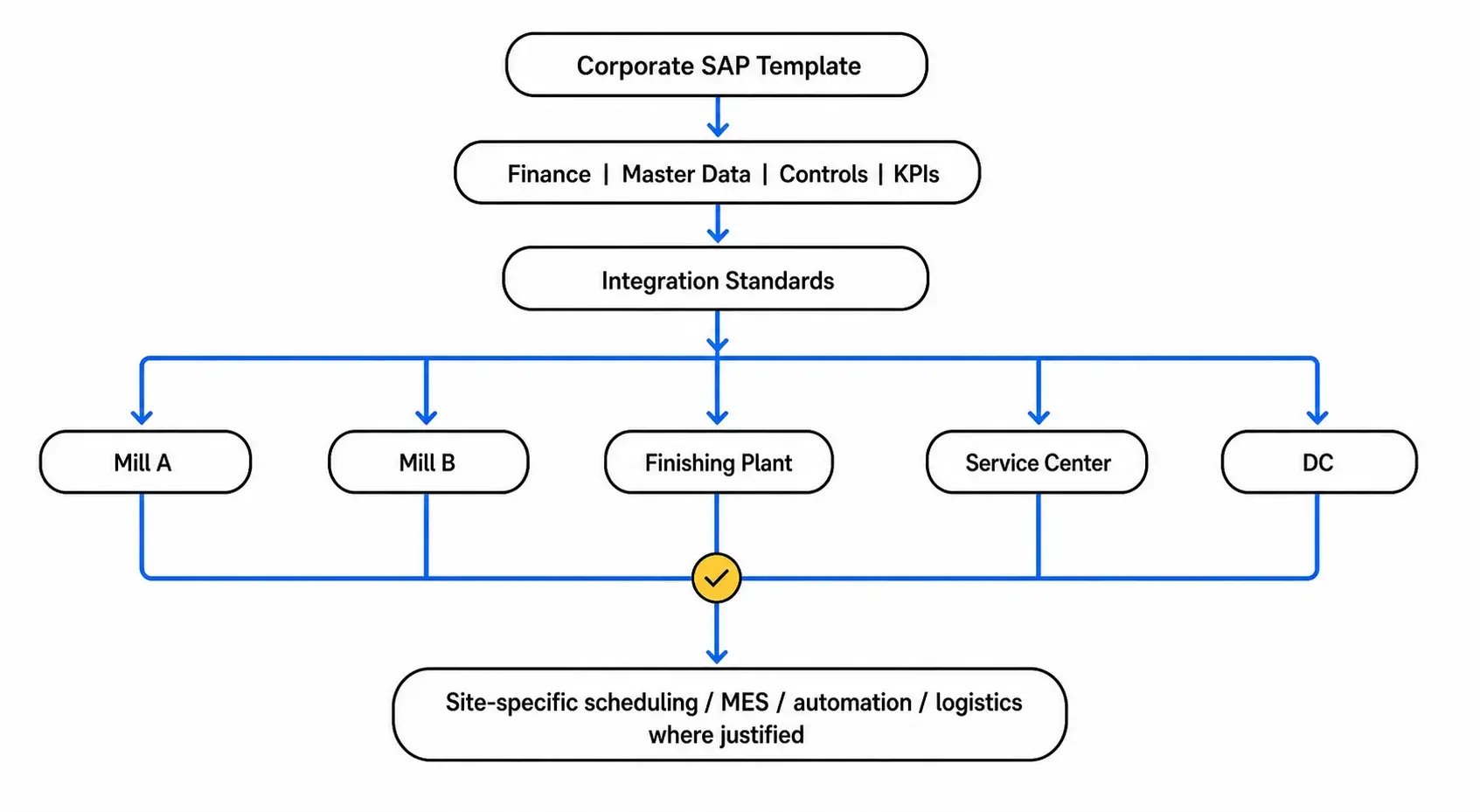
A corporate template can standardize finance, master data, enterprise controls, common KPI definitions, and integration principles. Plants can retain legitimate differences where production routes, equipment, scheduling constraints, automation, or logistics materially differ.
This creates a useful rule for multi-site design: local variation should have a documented operational reason. The objective is not an identical technical implementation at every facility. It is a common operating model in which differences are intentional rather than inherited simply because each plant evolved independently.
That distinction also helps explain why steel transformations often become difficult even when the selected software supports the required processes.
Common SAP Transformation Challenges in Steel Manufacturing
Most transformation problems do not begin with a missing software function. They emerge at the boundaries between systems, from inconsistent data, from legacy decisions that no longer match the operating model, or from processes that rely too heavily on individual knowledge.
Fragmented plant systems
ERP, MES, laboratory, warehouse, quality, scheduling, and automation applications may all maintain different versions of production information. Adding interfaces is not enough if ownership remains ambiguous.
Before integration design begins, the program needs to decide which application owns each critical object, event, status, and decision. Otherwise, integration can create several synchronized versions of the same uncertainty.
Poor heat and batch traceability
Production, quality, inventory, and shipment records may exist in different systems even when each application preserves its own history correctly. The practical test is whether the company can reconstruct the complete relevant genealogy when a customer inquiry, investigation, or containment action occurs.
If the answer requires multiple teams to manually reconcile records, traceability remains fragmented.
Inconsistent product data
Plants may use different definitions of grade, characteristics, dimensions, or materials for equivalent products. Those differences undermine planning, quality, allocation, and reporting because information cannot be reliably compared or combined across sites. Governance should distinguish genuine product or process differences from different names for the same business concept.
Weak maintenance integration
Production planning can assume a resource will be available even when maintenance has already scheduled downtime. Connecting maintenance windows and asset availability with detailed scheduling makes the capacity impact visible before the plan reaches execution. That prevents a known outage from becoming a last-minute production exception.
Manual planning
Spreadsheet-based scheduling and planner expertise may work well in a relatively stable environment. The limitation appears as product variety, resource constraints, network complexity, or disruption volume increases. At some point, planners may no longer be able to consistently evaluate all relevant material, sequence, resource, and capacity constraints.
The question is therefore not whether spreadsheets are inherently unsuitable. It is whether the current planning approach can evaluate the required constraints and replan quickly enough when conditions change.
Energy data fragmentation
Energy information may remain disconnected from production quantities, product mix, yield, utilization, and financial results. Teams can then see that energy costs have increased without being able to determine whether the cause was consumption efficiency, production volume, utility prices, product mix, asset utilization, or another factor. Connecting operational and energy data turns a cost variance into something the plant can investigate.
Legacy customization
Many historical SAP customizations were created for valid business reasons. That does not mean those reasons still exist. A transformation should test each customization against the target process. The program should determine whether the requirement remains valid and whether current standard capabilities can now address it differently before reproducing the legacy design.
Acquisition complexity
Acquired facilities may bring their own ERP, APS, MES, warehouse, transportation, product, asset, and process models. The transformation needs to separate true operating differences from inherited inconsistency.
Without that distinction, the organization can make either of two costly mistakes: standardize processes that genuinely need to remain different or preserve fragmentation that no longer creates business value.
These challenges point back to the same architectural principle: standardize the elements that create enterprise value while keeping specialization where the plant genuinely requires it.
Recommended SAP Architecture for U.S. Steel Manufacturers
The following model applies the architecture baseline established earlier. It illustrates how relevant capabilities can interact within a complex steel-manufacturing environment, rather than prescribing the same set of components for every producer or plant.
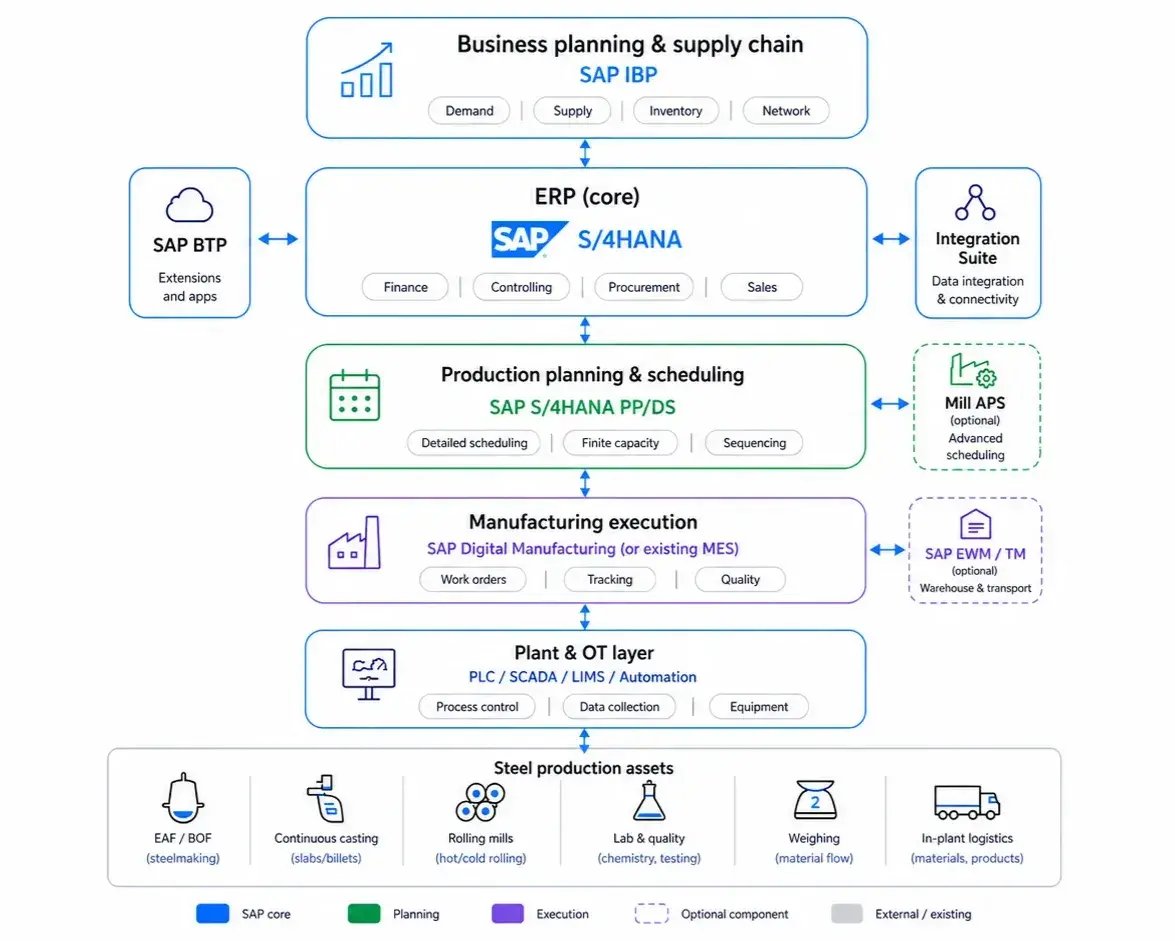
The model separates several kinds of decisions.
- Network planning: SAP IBP can help balance demand, supply, inventory, production capacity, and distribution requirements across plants and regions.
- Enterprise planning and execution: The ERP core provides the enterprise foundation for procurement, production, inventory, quality, asset management, sales, finance, and costing. Detailed scheduling turns operational requirements into executable mill plans, while SAP Digital Manufacturing or an existing MES can support plant execution.
- Warehouse and transportation: Warehouse and transportation capabilities connect finished and semi-finished inventory with staging, loading, shipment planning, freight execution, and customer delivery.
- Plant and OT systems: PLC, SCADA, laboratory, automation, and specialist applications can continue handling functions that require plant-level technology while exchanging relevant information with execution and enterprise systems.
- Integration and extensibility: SAP BTP can support integrations, extensions, workflows, and automation across the landscape, with SAP Integration Suite providing integration-specific capabilities where required.
A U.S. multi-plant manufacturer does not need to reproduce this model identically at every site. One facility may use more SAP capabilities. Another may retain specialized scheduling, MES, warehouse, or automation systems because of its equipment, production route, or existing environment.
The design decision is where consistency creates enterprise value and where local specialization remains justified. Standardizing data, controls, integration principles, and core processes while preserving legitimate plant differences is usually more realistic than forcing every facility into the same technical pattern.
Once that target is defined, the transformation can be sequenced around the dependencies that matter to the operation.
SAP Transformation Roadmap for U.S. Steel Manufacturers
A target architecture describes the destination. The roadmap determines how the business gets there without disrupting production. That means technology, data, process, and plant changes should be sequenced around operational dependencies rather than implemented as isolated modules.
Phase 1 — assess
Start with the current operation rather than the future software. Map plants, production processes, assets, the SAP ERP environment, scheduling, MES applications, warehouses, transportation flows, data, interfaces, and major operational pain points.
The assessment should show where fragmentation currently affects planning, scheduling, traceability, quality, maintenance, inventory, logistics, or financial visibility.
Phase 2 — define
Translate the assessment into a target operating model. Define the target SAP ERP environment, architecture principles, system ownership, data responsibilities, deployment models, scheduling approach, and the intended balance between enterprise standards and plant-specific processes. Major architecture boundaries should be settled here before configuration and integration development begin.
Phase 3 — prioritize
Not every gap needs to be addressed in the first release. Sequence the program around business value, operational risk, and dependency. Priorities may include production, traceability, maintenance, procurement, planning, detailed scheduling, warehouse execution, transportation, or quality.
For multi-site programs, plant criticality, legacy complexity, geographic dependencies, and rollout capacity should also influence sequencing.
Phase 4 — build
Configure the selected SAP capabilities, prepare data, develop required extensions, and establish integrations with systems that remain in the target landscape. Those retained systems may include specialized APS, MES, laboratory applications, automation, warehouse and transportation environments, and other specialist tools.
Integration development should follow the system-ownership decisions established during design rather than informally redefining those responsibilities during the build.
Phase 5 — test
Steel processes need to be tested as complete operational scenarios. Testing should follow the process from customer requirements and specifications through network planning, materials, finite scheduling, production, quality, inventory, and shipment.
The exception scenarios are equally important. Tests should cover material shortages, failed inspections, equipment downtime, scheduling conflicts, production deviations, warehouse exceptions, transportation changes, order changes, and traceability investigations. These scenarios reveal whether information continues to move correctly when the operation deviates from the ideal path.
Phase 6 — deploy
Roll out by site, process, or business unit based on operational risk and dependencies. Readiness should cover data, integrations, training, cutover, support, and production-continuity planning.
In multi-plant programs, sequencing also needs to account for shared processes and interfaces. A transition at one site should not disrupt the plants or functions that still depend on the previous environment.
Phase 7 — optimize
Go-live establishes the new operating model. It does not complete the improvement cycle. Production, scheduling, asset, quality, energy, supply-chain, logistics, and financial data can then show where further improvements are available. The strongest candidates often appear where actual results consistently differ from the plan or where teams continue performing manual work despite the new process.
A roadmap also needs measurable outcomes. Otherwise, the business can complete the implementation without knowing whether operational performance actually improved.
KPIs for SAP in Steel Manufacturing
A successful SAP deployment should change how the operation performs, not simply which software it uses. KPIs, therefore, need clear pre-transformation baselines and definitions tied to the business case.
|
Area |
Example KPI |
|
Production |
Production schedule adherence |
|
Production |
Yield / scrap rate |
|
Quality |
First-pass yield / non-conformance rate |
|
Traceability |
Heat and batch genealogy completeness |
|
Assets |
Equipment availability |
|
Maintenance |
Unplanned downtime / MTBF |
|
Inventory |
Inventory accuracy |
|
Supply chain |
Supplier on-time delivery |
|
Logistics |
On-time customer delivery |
|
Energy |
Energy consumption per ton |
|
Finance |
Cost per ton |
|
Commercial performance |
Product or customer margin |
For a multi-plant U.S. business, definitions should be standardized enough to make comparisons meaningful.
Targets do not necessarily need to be identical. A minimill, integrated operation, finishing plant, and service center can have different production routes, product mixes, constraints, and performance baselines. The useful comparison is therefore a consistent measurement interpreted in the appropriate operational context.
LeverX Recommendation
For U.S. steel manufacturers, many of the most important SAP design decisions sit between functions rather than inside individual modules.
Raw material availability changes what can be produced. Detailed scheduling determines whether the plan is executable. Equipment availability changes capacity. Quality controls on which inventory can be used or shipped. Warehouse and transportation processes determine whether material reaches the customer as promised. Yield, energy, and freight influence the economics of every decision.
The choice among SAP Cloud ERP, SAP Cloud ERP Private, and SAP S/4HANA on-premises is part of that design. Planning, manufacturing, warehouse, transportation, and integration requirements should be mapped to the selected ERP environment before the target landscape is finalized.
LeverX can help connect SAP Cloud ERP, SAP Cloud ERP Private, SAP S/4HANA on-premises, SAP Mill Products capabilities, SAP IBP, SAP Digital Manufacturing, SAP Quality Management, SAP Asset Management, SAP EWM, SAP TM, SAP BTP, sustainability, and data capabilities with specialized APS, MES, automation, and other plant systems that remain in the environment.
The objective should not be maximum SAP coverage. A stronger target is an operating model with clear system responsibilities, justified deployment boundaries, governed data, and the information flows needed to make better production, scheduling, sourcing, maintenance, logistics, and commercial decisions across the U.S. network.
FAQ
What is SAP for steel manufacturing?
SAP for steel manufacturing combines enterprise and plant capabilities around processes such as planning, production, quality, logistics, maintenance, and finance. A useful scope test is whether a process needs enterprise-level consistency or depends on plant-specific, time-critical execution that should remain in a specialized system.
What role does SAP Mill Products play in steel manufacturing?
SAP Mill Products supports characteristics-driven products and processes common in steel. It can reduce unnecessary material-master proliferation by representing meaningful variations through characteristics and configuration, provided governance defines which attributes are reusable, who owns them, and when obsolete variants should be retired.
Which SAP ERP environment does this architecture assume?
The architecture primarily assumes SAP Cloud ERP Private or SAP S/4HANA on-premises. If SAP Cloud ERP is the ERP core, environment-dependent planning, warehousing, transportation, and integration decisions should be documented explicitly to ensure that later scope changes remain compatible with the selected architecture.
How can SAP support steel production?
SAP can connect planned and actual production quantities, timing, resource use, material consumption, output, and reasons for deviations. A consistent deviation model helps teams identify recurring problems in capacity, yield, materials, and execution across products and plants.
Can SAP manage heat and batch traceability?
Yes. The implementation should define the required genealogy granularity, including how splits, merges, rework, and transformations between heats, batches, semi-finished material, and finished products must be preserved.
How does SAP support steel quality management?
SAP can connect inspections, results, disposition, and material status with production and inventory processes. Governance should also define who may override a quality decision, under which conditions, and how the exception must be recorded.
Can SAP manage steel grades and product specifications?
Yes. A strong model separates customer-facing specifications from internal production and inspection attributes while maintaining clear relationships between them.
How does SAP support scrap and yield management?
SAP can capture production inputs, outputs, scrap, co-products, off-spec material, and losses. Standard variance reasons can make recurring yield problems easier to compare across products, shifts, lines, and plants.
Can SAP help steel manufacturers manage energy costs?
Yes. The design should define how energy measurements are assigned to production orders, equipment, products, or process stages so cost changes can be traced to the activities that caused them.
How does SAP Asset Management support steel mills?
SAP Asset Management supports maintenance planning and execution, equipment records, work history, inspections, and spare parts processes. Asset criticality can also help prioritize maintenance efforts, inspection strategies, and spare parts coverage.
Can SAP support EAF and other steel-production environments?
Yes. Manufacturers can define plant archetypes such as EAF, integrated, or finishing operations with common data and control requirements, plus clearly documented site-specific execution rules. This can reduce unnecessary one-off designs while preserving legitimate production differences.
How does SAP EWM support steel warehouses?
SAP EWM can support inventory visibility, staging, movement, loading, and other warehouse-execution processes. The design should define the physical-unit granularity required to reliably locate, move, stage, load, and trace coils, slabs, bundles, and other inventory.
How does SAP TM support steel transportation?
SAP TM can support steel transportation planning and execution. Equipment requirements, weight and dimension limits, loading dependencies, carrier constraints, and multimodal handoffs should be identified early because they can change which shipment plans are feasible.
Can SAP IBP support steel supply-chain planning?
Yes. SAP IBP can support demand, supply, inventory, response, and scenario planning across the network. Organizations should also define decision rights and thresholds for when a network-level change requires mill-level replanning or escalation.
Where does SAP S/4HANA PP/DS fit in steel production planning?
SAP S/4HANA PP/DS can serve as the detailed-scheduling layer when SAP owns finite scheduling. If a specialized APS remains, define which system owns the executable schedule, the replanning horizon, and how schedule changes are synchronized so planners do not work with competing plans.
How can SAP help U.S. steel manufacturers manage supply-chain disruption?
SAP can provide the data needed to compare supply, production, inventory, and logistics alternatives by factors such as capacity, lead time, cost, and customer impact. Predefined disruption scenarios and decision criteria can make the response more consistent.
Can SAP support sustainability and product-carbon management for steel?
Yes. For auditable calculations, retain the methodology version, emission-factor source, and effective date, allocation basis, and recalculation rules with the reported result. This helps reproduce historical figures when methodologies or source data change.
Does SAP replace MES, APS, or plant automation systems?
Not necessarily. For systems that remain, define a source-of-truth matrix covering schedules, production confirmations, quality results, inventory events, equipment states, and required data latency. This makes clear what belongs in SAP, what remains at the plant level, and what needs to be synchronized.
Disclaimer: The information in this article is provided for general informational and planning purposes only. SAP products, capabilities, deployment options, product names, licensing, and technical approaches may change over time. Industry, production, trade, energy, and other statistics are based on the cited sources and periods and may subsequently be revised.
The actual solution design depends on the organization's production model, selected SAP ERP environment, SAP landscape, plant systems, data, integrations, security requirements, licensing and entitlements, and implementation scope.
Trade, tariff, environmental, regulatory, quality, cybersecurity, contractual, tax, and other compliance requirements should be evaluated by qualified professionals for the organization's specific circumstances. Current tariff classifications, rates, exclusions, country treatment, and effective dates should be verified against applicable official U.S. government guidance before making sourcing, customs, or commercial decisions. SAP capabilities should not be interpreted as a guarantee of regulatory compliance, certification, product quality, or business results.