See how SAP Business AI supports transportation, warehousing, forecasting, logistics planning, and exception management across the supply chain.
Transportation and logistics operations generate an enormous number of decisions every day. Which carrier should take a shipment? Can two loads be consolidated? Will a delivery reach the customer on time? Does a warehouse need to reprioritize picking tasks in the context of supply chain management? Will tomorrow's demand exceed available inventory or transportation capacity?
Historically, logistics managers addressed complex routing and allocation decisions using static rules engines, standard optimization solvers, historical reports, and manual oversight. While this operational framework remains relevant, its effectiveness degrades as supply networks grow and operational variables multiply across regions.
AI can help organizations manage some of these scaling pressures by analyzing larger volumes of operational data and supporting decisions that are difficult to handle through fixed rules alone. Depending on the use case, machine learning models can analyze historical and current operational data to generate forecasts, identify unusual patterns, or prioritize exceptions. When embedded directly into enterprise resource planning and transportation execution software, artificial intelligence functions less as an isolated platform and more as an integrated decision-support layer within daily logistics workflows.
For SAP customers, this shift is particularly important. SAP is embedding AI into business applications and workflows through SAP Business AI and Joule while connecting AI capabilities with the enterprise data and process context already managed across its application landscape.
The Role of Artificial Intelligence in Modern Logistics
Logistics has always depended on optimization. Recent shifts stem primarily from the expanding volume of variables that impact daily dispatch decisions.
A transportation manager evaluates spot rates, trailer payload capacity, carrier rejection rates, physical transit limits, and sudden order surges during a single operational window, leveraging AI to optimize these factors. Facility supervisors face parallel pressures across dock door assignments, shift labor availability, rack space utilization, picking order sequences, and carrier pickup deadlines.
Systemic disruptions complicate these routines further. A six-hour port delay can affect production schedules, receiving capacity, and subsequent outbound movements, potentially putting customer service commitments at risk. When the required data is connected, predictive models can analyze relationships between these events and help planners identify downstream delay risks earlier.
Several pressures make conventional planning increasingly difficult:
- Volatile demand and shorter planning cycles
- Rising transportation, fuel, labor, and warehousing costs
- Complex multimodal and international transportation networks
- Higher customer expectations for delivery speed and shipment visibility
- Persistent capacity and labor constraints
- Large volumes of operational data distributed across SAP and non-SAP systems
- More frequent supply, weather, geopolitical, and infrastructure disruptions
The value of AI in transportation, therefore, does not come simply from automating individual activities. Its larger role is helping companies move from delayed recognition of problems toward earlier prediction and more targeted intervention.
Consider a delayed shipment. Traditional monitoring may tell a planner that the truck is late. An AI-supported process can potentially go further: evaluate current and historical data, estimate the expected arrival time, determine which customer commitments are at risk, and help the planner focus on the exceptions with the greatest operational impact.
That difference — between reporting what happened and helping determine what is likely to happen next — is central to predictive logistics.
Where AI Generates the Highest ROI in Logistics
Logistics processes do not benefit equally from artificial intelligence. For stable, rules-based tasks, standard automation and traditional optimization software remain entirely sufficient. AI proves useful primarily when decisions rely on large datasets, shifting variables, unpredictable outcomes, or unstructured information that fixed logic cannot easily capture.
Value from AI isn't spread evenly across supply chain functions. The strongest case for it exists where teams have to adjust to sudden shifts or manage tradeoffs that ripple through connected operations. In practice, this points to a few specific areas: scheduling transit, directing warehouse workflows, estimating demand, placing inventory, tracking delayed shipments, and managing customer communications.
The return on investment depends on the exact decision involved. One operational bottleneck is rarely identical to the next. A transportation coordinator may simply require earlier notice regarding a potential transit delay. A warehouse supervisor, by contrast, needs to identify which specific order fulfillment tasks threaten an upcoming departure window. Supply planners address yet another problem: translating demand fluctuations into clear requirements for inventory, labor, and space.
SAP Business AI for Transportation and Logistics
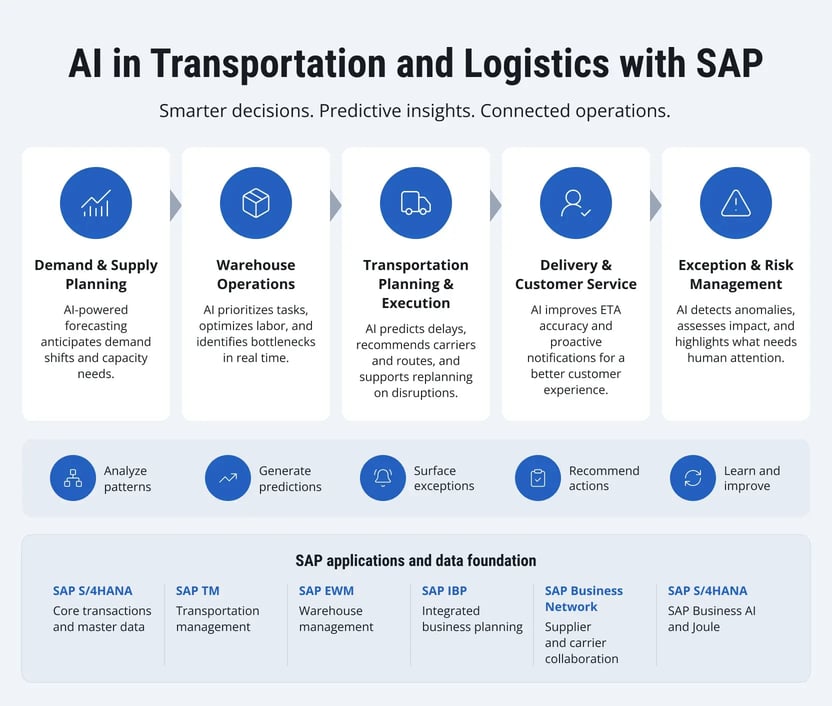
SAP Business AI is not a standalone logistics application. It is SAP's approach to embedding AI into the applications, data, and processes companies already use. For logistics organizations, the relevant architecture can span several systems.
SAP S/4HANA
SAP S/4HANA provides core transactional and master data context for processes such as sales, procurement, inventory, manufacturing, and finance. Depending on the architecture, transportation, and warehouse, execution may be handled through embedded or separately deployed SAP Transportation Management and SAP Extended Warehouse Management environments.
AI capabilities connected to this core can work with business context that would otherwise have to be assembled from separate sources.
SAP Transportation Management
SAP TM supports transportation planning, execution, freight agreement management, charge calculation, and settlement. AI capabilities can complement these processes by adding predictive signals or decision support where the required SAP services, external data, or custom models are available. Conversational interfaces like SAP Joule provide supported natural-language capabilities in SAP Transportation Management, including searching freight agreements and rate tables.
SAP Extended Warehouse Management
SAP EWM manages warehouse execution across receiving, put-away, replenishment, picking, packing, and shipping. Data generated by these processes can support AI scenarios for task prioritization, workload analysis, and the identification of operational bottlenecks, depending on the available SAP capabilities and system architecture.
SAP Integrated Business Planning
SAP IBP connects demand, supply, inventory, and response planning, making it a natural environment for AI-supported forecasting and scenario analysis. Planners can use these capabilities to identify supply-demand imbalances and investigate emerging constraints. The core planning logic remains unchanged. AI helps users interpret the results and focus on issues that need attention.
SAP Business Network
Logistics decisions frequently depend on parties outside the enterprise. SAP Business Network can provide a collaboration layer across suppliers, logistics service providers, carriers, and other trading partners. Connecting external network information with internal business processes gives AI-supported workflows a broader context than ERP data alone can provide.
SAP Joule
Joule provides a conversational and AI-assisted interaction layer across SAP's broader application environment. For transportation and logistics users, this changes how certain business information and supported functions can be accessed. Instead of requiring users to locate every transaction, report, or dataset manually, Joule can provide natural-language interaction with available business context.
The underlying SAP applications remain responsible for transportation, warehouse, planning, and transactional processes. Joule acts as an intelligent conversational copilot, helping users surface current insights, investigate business information, and access supported functions without overriding the core logic of those applications.
Standard SAP releases do not include every AI tool described below. Out-of-the-box availability depends heavily on the specific product edition, deployment setup, license tier, and system setup. Deploying certain features may require additional software services, third-party data feeds, or custom engineering.
Top 9 SAP AI Use Cases in Logistics
The business case for AI becomes clearer when it is tied to specific operational decisions. The following use cases show where AI can support transportation, warehouse, planning, inventory, asset management, and employee workflows across an SAP-centered logistics landscape.
|
Use case |
How AI contributes |
SAP applications and data involved |
Business impact |
|
Predictive ETA |
Uses execution and contextual data to estimate arrival times and identify likely delays |
SAP TM with connected execution, event, and external data sources |
Earlier intervention and more reliable customer commitments |
|
Transportation planning |
Adds predictive signals and execution patterns to established planning and optimization processes |
SAP TM |
Better asset and capacity utilization |
|
Carrier decision support |
Evaluates historical performance, cost, service, and operational data |
SAP TM, SAP Business Network |
Better cost-service tradeoffs |
|
Demand forecasting |
Detects patterns in historical and contextual demand data |
SAP IBP |
Earlier inventory, warehouse labor, and transportation capacity adjustments |
|
Warehouse prioritization |
Helps identify tasks, replenishment needs, or exceptions requiring attention |
SAP EWM |
Higher operational productivity and better deadline adherence |
|
Inventory risk detection |
Identifies potential shortages, excess inventory, and emerging imbalances |
SAP IBP, SAP S/4HANA |
Improved inventory positioning |
|
Exception management |
Helps classify disruptions according to their likely operational impact |
SAP TM, SAP EWM, and connected systems |
Faster response to critical problems |
|
Predictive maintenance |
Uses equipment and maintenance history to identify developing asset risks |
SAP Enterprise Asset Management and applicable asset-performance solutions |
Lower risk of unplanned downtime |
|
Conversational logistics support |
Provides natural-language access to supported business information and workflows |
SAP Joule and supported SAP applications |
Less manual searching and faster information retrieval |
How SAP AI Use Cases Work in Practice
Logistics systems depend on interconnected data. ETA updates, carrier evaluations, and disruption alerts all feed into the same freight choice, just as demand forecasts direct inventory levels and warehouse labor schedules. The following sections detail how these related software features function together across SAP applications.
Transportation planning and disruption management with SAP TM
Arranging freight moves requires balancing pickup locations, fleet size, transit regulations, delivery slots, and freight rates. SAP Transportation Management applies built-in algorithms to handle these routine constraints, while machine learning introduces predictive updates when live transit data becomes available.
Arrival time forecasts illustrate this dynamic. Scheduled deliveries fall behind when weather fronts, road blockages, port backlogs, or driver delays hit active routes. Evaluation models process current GPS positions alongside historical lane records to flag late arrivals hours before a delivery window shuts.
These models also provide actionable context for route adjustments. Recurring transit delays or sudden carrier drops signal that original routing assumptions no longer hold. Dispatchers review these flags to adjust load allocations or switch transit modes.
Carrier assignments offer another practical application. SAP TM ranks carriers using defined cost rules, while predictive routines evaluate historical acceptance rates, past damage claims, and lane familiarity. Dispatchers gain objective performance records without overriding standard tender workflows.
Additionally, system alerts score transit delays based on direct business impact. Instead of treating every hold-up as an emergency, freight managers focus on shipments tied to line-down risks or key client contracts.
Statistical forecasts supplement optimization algorithms without replacing them. SAP TM solves routing matrices against hard operational limits; predictive tools simply refine those calculations with real-world variables.
Business impact: Early disruption alerts, accurate arrival estimates, data-backed carrier choices, and structured delay management.
Warehouse execution and task prioritization with SAP EWM
Executing daily warehouse work generates vast amounts of event logs across receiving lanes, storage racks, packing stations, and outbound docks. Supervisors must constantly evaluate which tasks require immediate intervention, such as forklift trucks, pickers, and dock doors reach capacity limits.
SAP Extended Warehouse Management controls physical inventory movements. The operational records generated by these routines feed analytical tools to highlight labor bottlenecks, adjust stock replenishment, and update picking queues.
Consider an uncompleted replenishment job that threatens to delay a high-priority customer order. Analytical checks flag this dependency early, prompting supervisors to redirect pickers before the carrier departure window closes. Similar checks identify labor shortages across specific warehouse zones.
Business impact: Smarter task ordering, prompt bottleneck resolution, consistent departure compliance, and balanced labor usage.
Demand forecasting and supply planning with SAP IBP
Uncertain consumer demand creates operational issues beyond warehouse walls. Volume changes shift labor schedules, storage needs, truckload requirements, and carrier commitments.
Machine learning enhances standard statistical models by detecting subtle trends within order books and external economic signals. These tools cannot eliminate market volatility, but they give planners a faster method to update baseline models when purchasing habits shift.
Within SAP Integrated Business Planning, revised projections flow into replenishment and distribution calculations. A projected order surge increases expected outbound volumes in SAP IBP, giving downstream teams time to respond. SAP EWM and SAP TM can use the resulting planning context to support warehouse labor and transportation capacity decisions before the additional volume reaches execution.
System alerts also highlight locations where projected sales and actual inventory levels diverge. Planners investigate prospective stock shortages or overstock risks early, targeting balanced inventory positioning rather than blind stock reduction.
Integrated conversational interfaces further assist team members in pulling planning records and investigating system recommendations.
Business impact: Proactive capacity planning, tight alignment between sales and logistics resources, and accurate restock timing.
AI-assisted logistics interaction with SAP Joule
Supply chain managers frequently gather facts from multiple transaction screens, freight tables, and order logs to troubleshoot an operational delay. Where integrated, SAP Joule offers natural-language prompts to query underlying records directly.
This interface reduces screen navigation and manual data searches without bypassing primary execution applications. User access remains governed by existing SAP role authorizations.
Business impact: Faster data searches, reduced software navigation, and rapid resolution of operational questions.
Predictive maintenance for logistics assets
Equipment breakdowns disrupt warehouse and transport schedules regardless of how well a master plan is built. Asset telemetry and maintenance logs stored in SAP supply the necessary context for machine health checks.
Predictive models analyze past mechanical strain, equipment age, and service logs to identify component wear patterns. Technicians use these alerts to schedule repairs during planned downtime, preventing sudden equipment failures on active lines.
Analytical scoring alerts teams to rising equipment risks without changing standard maintenance workflows.
Business impact: Reduced equipment downtime, maximum fleet availability, and reliable operational schedules.
From Fragmented Logistics Data to Generative AI: Our Expertise
Deploying artificial intelligence becomes exceptionally difficult when transport telemetry sits trapped inside isolated spreadsheets, local fleet management databases, and disconnected third-party software.
A project completed by LeverX for a global manufacturing client demonstrates this operational reality. The company managed five production facilities across Asia and North America alongside roughly 200 distribution nodes worldwide. Because daily transportation data remained scattered across offline Excel workbooks, disparate regional systems, and external vendor platforms, routine route optimization, demand forecasting, and executive reporting suffered from severe lag.
To resolve these integration bottlenecks, our team deployed a custom logistics application built on SAP Business Technology Platform (SAP BTP) combined with generative AI tools. Project records indicate the deployment yielded a 15–20% reduction in operational expenditures while improving overall on-time delivery rates. These performance gains reflect the specific system architecture and scope of this implementation rather than a guaranteed baseline for generative AI deployments.
The core takeaway is not that generative language models automatically lower transport costs by a set percentage. Rather, the project illustrates what becomes possible when fragmented operational records are consolidated into a unified data architecture.
Another transport integration project completed by LeverX reinforces this exact architectural principle. Facing a disconnected software footprint while managing 3,500 active fleet vehicles and moving over 10 million tons of freight annually, a major logistics provider engaged LeverX to deploy SAP BTP. The implementation successfully linked separate Warehouse Management Systems (WMS), Transportation Management Systems (TMS), SAP S/4HANA instances, and legacy third-party applications into a consolidated operational view — delivering a reported 20% reduction in operational expenditures.
Taken together, these two enterprise deployments emphasize a technical requirement often missing from discussions around logistics automation: scaling AI across logistics depends in part on reliable data flows between planning, execution, and external systems, alongside sound governance and process design.
Business Benefits of AI in Transportation Management
The strongest AI business cases in the logistics industry are tied to operational KPIs rather than the number of models deployed.
Lower transportation costs
Transportation costs often climb when teams have to react late. A missed capacity signal can mean premium freight; an emerging delay can trigger expensive replanning that might have been avoided with earlier notice. Better forecasts and predictive execution signals give planners more time to weigh cost against service requirements before those options narrow.
Improved delivery performance
A predicted delay is useful only while there is still time to do something about it. Earlier ETA updates and exception detection can give logistics teams that window, whether the appropriate response is replanning a shipment, adjusting capacity, or simply giving the customer a more realistic delivery commitment.
Higher warehouse productivity
Warehouse productivity is not just a question of completing more tasks per hour. During a busy shift, supervisors also have to decide which work cannot wait.
AI-supported prioritization can draw attention to tasks that put outbound deadlines, replenishment dependencies, or other downstream commitments at risk. That helps teams use available labor and equipment where delays would matter most.
Better forecasting and planning
Forecast changes rarely stay inside the planning function. They influence purchasing decisions, inventory positions, warehouse workloads, production requirements, and transportation capacity. A more reliable planning baseline can therefore improve decisions across several parts of the network, although the actual impact depends on how quickly those forecasts reach the teams responsible for execution.
More focused exception management
For many logistics teams, the problem is not a shortage of alerts. It is figuring out which alerts deserve attention first. AI can help separate routine deviations from events with a greater potential impact on production, customer commitments, or transportation schedules.
The practical gain is straightforward: planners spend less time working through low-value noise and more time investigating exceptions where human judgment can change the outcome.
Better customer experience
Customers evaluate freight services based on precise arrival estimates and predictable delivery schedules rather than the complexity of an underlying AI system. Catching transit bottlenecks early, updating arrival times continuously, and clearing customs or terminal exceptions quickly keeps communication clear — even during unavoidable severe weather or port closures.
Greater operational resilience
True resilience requires active risk visibility. Dispatchers must detect transit interruptions, model downstream effects on factory production lines, and redirect shipments before small delays compromise entire delivery schedules. Pairing real-time predictive analytics directly with execution software shrinks the time gap between an initial delay alert and the corrective rerouting decision.

Challenges of Implementing AI in Logistics
Purchasing a machine learning license represents just the beginning of a deployment cycle. Establishing the data pipelines, integration points, and operating protocols required to trust these algorithms demands significantly more effort.
Poor data quality
AI outputs depend heavily on the quality and relevance of the data available to the model. Missing freight milestones, inconsistent location data, outdated lead times, and duplicate records can materially reduce the reliability of predictions and recommendations.
Project teams must integrate data architecture planning directly into the software deployment schedule to avoid isolated IT database cleanups.
Fragmented systems
Generating an accurate forecast from isolated warehouse metrics may have limited operational value for outbound dispatchers. Critical operational metrics — spanning active orders, pallet inventory, routing schedules, and external weather delays — frequently live across disconnected platforms. Connecting these data sources and applications determines whether an algorithm gathers sufficient context to recommend an actual route change.
Weak process design
AI cannot compensate for unclear process ownership or poorly defined decision logic. These weaknesses should be addressed as part of the implementation of custom AI solutions. Implementation teams must define several strict parameters before going live:
- The specific dispatch or allocation decision targeted for improvement
- The exact telemetry needed to support that specific workflow
- The designated platform serving as the authoritative system of record
- The physical workflow triggered by an algorithmic recommendation integrates AI to improve efficiency
- The precise conditions permitting fully automated execution are essential for effective AI systems
- The scenarios demanding manual planner intervention
- The protocol for managing algorithmic failures and edge-case exceptions
Governance and accountability
Algorithmic routing suggestions directly impact safety stock volumes, delivery SLA compliance, and weekly carrier spending.
Supply chain leaders must establish strict controls — spanning user permissions, data encryption, continuous performance monitoring, and clear frameworks — to manage these automated outputs securely.
Management frameworks must dictate exactly how dispatchers respond when algorithmic outputs clash with established business rules or physical reality. Lacking explicit override procedures leaves operational accountability entirely ambiguous during severe network disruptions.
Organizational readiness and change management
An engineered predictive tool can fail on the warehouse floor if supervisors doubt its accuracy or lack instructions for applying its insights to daily load planning.
Dispatchers must comprehend the logic behind a suggested route, the specific metrics driving that recommendation, the thresholds for manual intervention, and the exact shift in liability when relying on software guidance.
Successful deployment demands targeted role-based training, updated standard operating procedures, rigid escalation matrices, and explicit ownership over algorithmic errors. Rolling out machine learning can force an entire operational restructuring alongside the software installation.
A Practical Roadmap for AI Adoption in SAP Logistics
A company does not need to redesign its entire logistics landscape to begin using AI. A controlled rollout is usually more defensible.
1. Start with the business problem
Define the operational issue before discussing technology. It might be persistent delivery delays on specific lanes, too much planner time spent sorting transportation exceptions, weak forecast accuracy, or recurring warehouse bottlenecks. Starting with “we need AI” reverses that logic. The use case should determine whether AI is actually necessary and what type of capability makes sense.
2. Establish the KPI baseline
Before changing the process, document how it performs today. Otherwise, there is nothing credible to compare the pilot against. The metrics will depend on the problem being addressed. Useful baselines may include:
- Transportation cost per shipment
- On-time delivery
- Forecast accuracy
- Warehouse task cycle time
- Inventory turns
- Premium freight expenditure
- Planner time spent on exceptions
A transportation project, for example, may track both cost per shipment and on-time performance so that an apparent efficiency gain does not hide deteriorating service.
3. Assess process and data readiness
Next, trace the decision from source data to operational action. Which systems supply the information? Who owns it? How quickly does it become available, and what happens after a prediction or recommendation reaches the user?
This review should cover relevant SAP and non-SAP sources, master data consistency, historical transaction quality, event completeness, integration latency, and ownership. It can expose a less glamorous problem before the AI work begins: sometimes the real constraint is fragmented data or a poorly defined process rather than the model itself.
4. Match the SAP capability to the use case
Only at this point does technology selection become useful. Transportation scenarios may center on SAP TM, while warehouse execution points toward SAP EWM. Forecasting and supply planning typically involve SAP IBP.
Cross-system scenarios can require a broader architecture, including SAP BTP and relevant SAP Business AI capabilities. The exact combination should follow the process and data requirements identified earlier rather than a predetermined product list.
5. Keep the first pilot narrow
There is little reason to expose an entire logistics network to an unproven use case. A single transportation lane, warehouse, distribution center, product category, or planning process can provide a controlled environment for testing whether the approach works under real operating conditions.
The scope still needs enough transaction volume and variation to produce meaningful evidence. “Small” should mean manageable, not statistically useless.
6. Measure what changed in operations
Return to the baseline established at the beginning. Did the pilot reduce transportation costs, improve delivery performance, shorten warehouse cycle times, or reduce the amount of manual exception handling?
A better analytical score is not automatically a business result. If model performance improves while the operational KPI barely moves, the constraint may sit elsewhere — in integration latency, workflow design, data quality, user adoption, or the team's ability to act on the recommendation.
7. Scale the operating model
A successful model is only one part of a scalable AI process. Before extending the use case to additional sites or business units, standardize the data flows, ownership, governance, monitoring, and exception-handling procedures around it.
Expansion can then follow the operating pattern proven during the pilot, with local adjustments where processes, data, or business requirements genuinely differ.
AI-Driven Supply Chain Transformation With LeverX
AI projects in logistics sit at the intersection of process design, SAP architecture, integration, data engineering, and operational execution.
LeverX supports this transformation across:
- SAP Business AI implementation and AI use-case development
- SAP Digital Supply Chain projects
- SAP Transportation Management implementation and optimization
- SAP Extended Warehouse Management implementation and optimization
- SAP Integrated Business Planning consulting
- SAP S/4HANA transformation
- SAP BTP integration and extension scenarios
- AI strategy and process optimization
- SAP Application Management Services
Organizations dealing with disparate software platforms often see better outcomes by standardizing workflows, cleaning up master records, and establishing stable API connections prior to rolling out machine learning applications.
Establishing this operational groundwork prevents advanced analytics tools from functioning as isolated software tests that fail to integrate into real-world dispatch routines.
AI Is Becoming Part of the Logistics Operating Model
AI is not replacing transportation management, warehouse management, planning systems, or experienced logistics professionals. It is changing how information moves between these elements and how quickly people can act on it, as AI enhances the speed of communication.
Transportation planners can receive earlier warnings of execution risks. Warehouse teams can focus attention on work that threatens downstream commitments. Supply planners can investigate complex results more efficiently. Customer service teams can respond with better shipment context before a service issue escalates.
For SAP customers, SAP Business AI, Joule, SAP TM, SAP EWM, SAP IBP, SAP S/4HANA, SAP Business Network, and SAP BTP can contribute different pieces of this operating model.
The long-term shift is therefore not simply toward more AI models. It is toward logistics processes in which prediction, optimization, transactional execution, and human judgment operate within the same decision cycle.
Combining the right SAP architecture with logistics expertise, governance, and process discipline is what turns that capability into operational value.
The Future Outlook for AI in Transportation and Logistics
The next phase of logistics AI will be less about adding another prediction tool and more about putting intelligence closer to everyday operational decisions. Several shifts are already pointing in that direction:
- Prediction will increasingly lead to action. Knowing that a shipment is likely to arrive late is useful; knowing which response makes sense under current cost, capacity, and service constraints is considerably more valuable. Expect more AI scenarios to bridge that gap.
- Planning boundaries will become less rigid. A transportation disruption rarely stays a transportation problem. Its effects can reach warehouse schedules, inventory availability, production, and customer commitments. AI has the potential to connect these signals earlier instead of leaving each function to interpret them separately.
- AI copilots and agents will take on more operational work. Conversational tools such as SAP Joule are moving enterprise AI closer to the user. Over time, their role is likely to expand from finding information and explaining results toward supporting multi-step tasks, with business rules, authorizations, and critical decisions remaining under appropriate controls.
- Planning cycles will get shorter. Faster access to execution data gives companies more opportunities to revisit forecasts and capacity assumptions as conditions change, rather than waiting for the next scheduled planning cycle.
- Governance will have to keep pace. Once AI starts influencing operational decisions at scale, questions around data lineage, access rights, model behavior, accountability, and human review become part of the architecture — not paperwork to deal with after deployment.
- The business case will become harder to fake. A more accurate model means little if freight costs stay flat, warehouse bottlenecks persist, or planners spend just as much time resolving exceptions. Logistics teams will increasingly judge AI by what changes on the ground: cost, service, productivity, inventory exposure, and the amount of manual work required to keep the network running.
Ready to Transform Your Logistics Operations With AI?
Deploying artificial intelligence inside live supply chain workflows involves technical preparation beyond software selection. LeverX assists organizations in identifying specific operational points where predictive analytics yield measurable financial returns, auditing current SAP databases for model readiness, and structuring deployment phases around established transport, inventory, and fulfillment routines.