Learn how boutique SAP specialists and large integrators differ in project delivery, team structure, costs, and governance, and what to evaluate before choosing a partner.
Choosing an SAP implementation partner involves more than comparing company size, credentials, and project portfolios. A specialized SAP firm and a global consulting organization may offer similar services, yet assign different teams, distribute responsibilities differently, and use different approaches to managing project changes.
The differences become particularly relevant when a project requires specialized technical expertise, coordination across business functions, or delivery across multiple countries.
Quick answer: Boutique SAP partners typically focus on SAP technologies or specific industries, while Big Four firms and global system integrators offer broader consulting and technology services. Specialized partners may be better suited to projects requiring deep SAP expertise, Big Four firms to transformations involving extensive business consulting and risk management, and global integrators to large-scale, multi-platform programs. These are typical strengths, not fixed boundaries.
Boutique SAP Partners vs. Big Four and Global System Integrators
SAP implementation providers generally fall into three overlapping categories, distinguished by their primary service focus and delivery capabilities.
Boutique and specialized SAP partners concentrate on SAP technologies, business processes, or specific industries. Boutique firms are typically smaller, while the broader specialist category also includes international providers capable of delivering complex enterprise programs.
The Big Four — Deloitte, PwC, EY, and KPMG — combine SAP implementation services with business consulting, risk advisory, regulatory expertise, and organizational transformation. Their multidisciplinary capabilities can be particularly relevant when an ERP initiative is part of a wider business transformation.
Auditor independence requirements may also restrict the SAP implementation services a Big Four firm can provide to its audit clients. For example, certain financial information system design and implementation activities may be prohibited if they could compromise audit independence. The restrictions depend on the jurisdiction, the nature of the services, and the firm's relationship with the client.
Global system integrators (GSIs), such as Accenture and Capgemini, typically have extensive capabilities in enterprise technology implementation, systems integration, and managed services across multiple platforms. They can coordinate SAP delivery alongside other enterprise applications and technology modernization initiatives.
These categories are not mutually exclusive. Some SAP-focused providers also operate as international system integrators, while Big Four firms and GSIs may offer many of the same consulting and implementation services.
Key differences in SAP partner operating models
|
Evaluation area |
Boutique or specialized SAP partner |
Big Four firm |
Global system integrator |
|
Core focus |
SAP technologies, business processes, and selected industries |
Business transformation, advisory, risk, and SAP consulting |
Enterprise technology transformation, systems integration, and SAP delivery |
|
Breadth of services |
SAP-focused services, often complemented by related technologies |
SAP services combined with strategic, financial, regulatory, and organizational consulting |
SAP and other enterprise platforms, cloud, data, integration, and managed services |
|
Delivery organization |
SAP-focused teams, with structure and capacity varying by provider |
Multidisciplinary teams combining SAP specialists with relevant advisory practices |
Technology delivery teams across platforms, regions, and service lines |
|
Geographic reach |
Regional or international, depending on delivery capabilities |
Typically multinational, with access to international advisory and delivery networks |
Typically multinational, with cross-border technology delivery capabilities |
|
Program coverage |
Focused SAP projects through complex international implementations |
SAP-enabled business transformation and enterprise-wide change programs |
Large SAP implementations and multi-platform technology transformations |
|
Team composition and availability |
May provide direct access to SAP specialists; capacity depends on commitments |
May combine SAP delivery specialists with business and risk advisors |
May draw on larger technical resource pools across delivery locations |
|
Decision-making and change control |
May use compact escalation structures for focused engagements |
May involve broader advisory and program governance functions |
May coordinate decisions across multiple technology teams and delivery units |
|
Cost structure and commercial terms |
Pricing reflects specialization, staffing, scope, and delivery location |
Pricing may include advisory, transformation, and implementation workstreams |
Pricing may cover multiple delivery locations, technology workstreams, and managed services |
|
Flexibility for smaller engagements |
Some providers focus on targeted implementations or specialist assignments |
Depends on practice, service offering, and commercial requirements |
Depends on business unit, offering, and engagement model |
|
Auditor independence restrictions |
Generally not subject to audit-firm independence restrictions unless the provider has a relevant audit relationship |
Certain SAP implementation or advisory services may be restricted for audit clients, depending on the jurisdiction and nature of the work |
Generally not subject to audit-firm independence restrictions unless the provider has a relevant audit relationship |
Note: These are typical operating-model characteristics, not guaranteed attributes of individual providers. Actual staffing, pricing, governance, and minimum engagement requirements must be confirmed with each firm.
Project Staffing, SAP Expertise, and Team Continuity
The capabilities of an SAP consulting firm matter only when they translate into qualified people working on the project. A partner may demonstrate extensive experience during selection, but the assigned consultants, their availability, and their responsibilities determine how that expertise is applied.
Seniority and hands-on experience
Specialized SAP partners may involve senior consultants directly in solution design and implementation. Larger integrators can assemble multidisciplinary teams from different practices and delivery locations. In both cases, the relevant question is whether the proposed staffing model matches the work.
For example, an SAP S/4HANA implementation involving complex manufacturing processes may require expertise in production planning, warehouse operations, financial integration, and custom developments. A partner's overall number of SAP-certified consultants does not establish whether those skills are available within the assigned team.
Staffing commitments should therefore distinguish between:
- Named specialists: Consultants assigned to key roles, with relevant project experience and defined responsibilities.
- Resource allocation: The expected availability of each specialist during critical implementation phases.
- Delivery dependencies: Activities assigned to subcontractors, external specialists, or the customer's internal team.
- Replacement arrangements: The process for introducing qualified substitutes if key personnel become unavailable.
These commitments are particularly relevant when a project depends on scarce expertise or consultants who hold substantial knowledge of the existing SAP landscape.
Resource continuity and knowledge transfer
A smaller delivery team may retain direct knowledge of technical decisions and project history, but losing a key specialist can create a staffing gap. A larger integrator may have more resources available for replacement, although those consultants still need time to understand the solution and its dependencies.
Resource availability alone does not resolve this risk. Design decisions, configuration details, integration specifications, and unresolved issues need to remain accessible beyond the individuals who originally worked on them.
For either delivery model, continuity depends on maintaining usable project documentation and arranging knowledge transfer when responsibilities change. Contracts can also establish conditions for replacing key personnel, including qualification requirements and customer approval where appropriate.
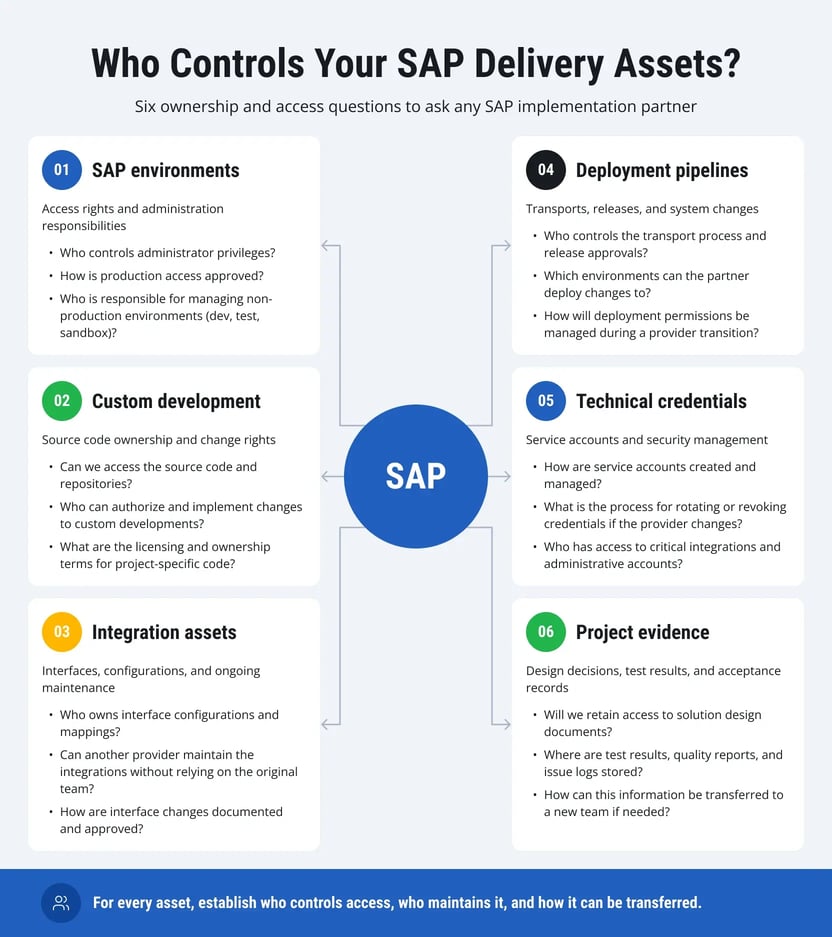
Regardless of whether a company works with a specialized SAP partner, a Big Four firm, or a global system integrator, it should clarify access rights, responsibility for technical assets, and handover arrangements before implementation begins. The following six checkpoints highlight what customers should establish to maintain control over their SAP landscape and prepare for a potential provider transition.
Example: joint SAP delivery at Eurasia Group
During the SAP S/4HANA migration for Eurasia Group Kazakhstan, LeverX assembled a team of 13 experts who worked alongside 25 specialists from the customer's organization. The joint team began the project in April 2022 and completed the migration in December 2022, after approximately 8.5 months.
The engagement illustrates how a specialized SAP team can work alongside customer specialists within a shared delivery organization.
Implementation Methodology, Governance, and Decision-Making
Both specialized SAP partners and global integrators can use SAP Activate, SAP's implementation methodology with roadmaps, activities, and deliverables tailored to different solutions and implementation scenarios. Following the same methodology, however, does not mean that partners organize project decisions in the same way.
The difference lies in their governance arrangements: who has decision-making authority, how issues move between teams, and when a decision requires escalation.
How delivery models affect governance
A specialized SAP partner may coordinate technical and project decisions through a relatively small group of delivery leads and customer representatives. A large integrator may use additional program management layers to coordinate multiple workstreams, regions, and suppliers.
More management layers do not necessarily mean stronger controls or slower decisions. A complex international rollout may need formal approval structures to manage dependencies, while a focused implementation may work effectively with fewer escalation levels.
The customer's governance also matters. Even when the implementation partner has authority to resolve a technical issue, changes affecting business processes, budgets, or project scope may require customer approval.
Decision-making in practice
Consider a request to change the approval workflow for purchase orders during an SAP implementation. The delivery team can assess the configuration effort, but the proposed change may affect purchasing controls, authorization responsibilities, and the agreed project scope.
In this situation, the relevant distinction between partners is how they coordinate the decision. A specialist team may involve the responsible functional consultants and procurement process owners directly. A larger delivery organization may route the issue through designated workstream leads or program management functions.
Either model can work if decision rights, escalation thresholds, and response expectations are clear. Problems arise when an issue crosses organizational boundaries without an agreed-upon owner or requires approval from stakeholders who are unavailable.

Cost Structure and Commercial Terms: Comparing SAP Partner Proposals
A specialized SAP partner may have a different overhead structure from a global integrator, but lower organizational overhead does not guarantee a lower project price. Both can use onshore, nearshore, or offshore delivery models, and their rates depend on expertise, location, resource availability, and contractual terms.
What makes SAP partner proposals financially different?
Three areas deserve particular attention:
- Resource pricing and utilization. Compare the estimated effort and cost of the entire delivery team, including project management, specialist support, and shared resources. A lower hourly rate may not reduce costs if the proposed approach requires substantially more billable hours.
- Contract structure and risk allocation. Fixed-price contracts establish pricing for defined deliverables, subject to agreed assumptions and change provisions. Time-and-materials arrangements charge for actual effort, making expenditure dependent on resource utilization and project duration. Hybrid arrangements can combine these models for different work packages.
- Scope boundaries and additional charges. Proposals may differ in how they price subcontractors, travel, specialist resources, testing cycles, change requests, and post-go-live support. These differences can affect the final amount even when the headline scope appears identical.
Comparing the financial impact of delivery models
Consider two providers bidding for the same SAP S/4HANA implementation. The specialized partner proposes a compact delivery team with senior specialists directly involved in configuration and integration. The global integrator proposes a larger team with separate technical, functional, and program management roles.
The two proposals may distribute effort differently across consulting, development, and project management activities. Comparing their total estimated hours, role-specific rates, and included deliverables provides a more reliable basis for assessing cost than comparing headline prices. Neither proposal is necessarily more economical. For example, if one bid excludes integration testing support or limits hypercare to two weeks while the other includes broader coverage, their initial prices are not directly comparable. The customer must account for the excluded work and determine who will pay for it.
Internal costs also matter. Business process owners, IT teams, and key users contribute time to workshops, testing, data preparation, and approvals, regardless of which provider delivers the implementation.
When to Choose a Specialized SAP Partner, Big Four Firm, or Global Integrator
The right delivery model depends on the capabilities a particular transformation requires. Four scenarios illustrate when specialized SAP expertise, international delivery capacity, multidisciplinary business advisory, or broader technology integration may be most relevant.
Scenario 1: a technically demanding SAP migration
A manufacturer plans to migrate a heavily customized SAP ERP environment to SAP S/4HANA. The project covers one primary business organization but involves complex production processes, custom code, and integrations with shop-floor systems.
A specialized SAP partner with proven experience in similar manufacturing environments may be a strong fit. The critical requirement is deep knowledge of the existing landscape and the technical dependencies involved in the transition.
However, a narrow organizational scope does not necessarily mean a small delivery effort. Extensive customization or complex integration requirements may still demand several specialist teams.
Scenario 2: a multinational SAP rollout
An enterprise is introducing SAP S/4HANA across 20 countries, with shared business processes and local requirements for finance, taxation, and reporting.
The program requires coordinated deployment waves, consistent global processes, and sufficient regional expertise. A global integrator may be well-positioned to support these demands through its international delivery organization.
An established SAP specialist may be equally suitable if they have demonstrated experience with comparable international deployments, including the required country-specific processes and localizations. For either provider type, the rollout plan should account for when regional specialists will be needed and how their availability will be secured before each deployment wave.
Example: scaling an SAP program at Girteka
LeverX's SAP SuccessFactors implementation for Girteka demonstrates how a specialized SAP provider can support an expanding international program.
The first phase covered approximately 3,000 employees in Lithuania and was completed in February 2023. The project roadmap also included expanding SAP SuccessFactors to Girteka's operations in Poland, Georgia, Spain, the Netherlands, and the Nordic countries.
As the program expanded, LeverX increased its delivery team from five to 20 specialists, including consultants, integration developers, and project management personnel.

Scenario 3: SAP within a broader technology transformation
A company is implementing SAP S/4HANA while replacing its CRM platform, modernizing enterprise data management, and redesigning integrations across several business applications.
A global integrator may be suitable when the organization wants one provider to coordinate these technology domains.
Alternatively, the company can engage a specialized SAP partner alongside other technology providers. This arrangement allows each supplier to focus on its area of expertise but requires clearly assigned responsibility for cross-system architecture, dependencies, and end-to-end outcomes.
The choice depends on whether the customer has the internal capabilities to coordinate multiple vendors or needs a partner to assume broader integration responsibility.
Scenario 4: an SAP-led finance and controls transformation
A publicly listed company is implementing SAP S/4HANA while redesigning financial reporting, internal controls, and compliance processes across its business units.
The program requires more than ERP configuration. Finance leaders must align accounting policies, redesign control activities, establish reporting responsibilities, and evaluate how process changes affect regulatory obligations.
A Big Four firm may be a strong candidate when the company needs SAP implementation expertise alongside finance transformation, risk advisory, and internal controls consulting. Combining these capabilities within one engagement can simplify coordination between technology and business advisory teams.
However, the company must first assess auditor independence restrictions. If the prospective provider is also its statutory auditor, certain implementation or advisory services may be restricted or prohibited, depending on the jurisdiction and scope of work.
How to Compare SAP Delivery Models Before Signing
A practical delivery scenario can reveal how a prospective SAP partner coordinates work across teams and systems. Before signing, companies should also verify that the provider's staffing, commercial, and capacity commitments support the proposed delivery model.
Test cross-team accountability
Consider an SAP S/4HANA implementation where an integration with an external warehouse management system fails during end-to-end testing, preventing goods movements from posting correctly.
Present the scenario to each shortlisted provider and ask them to identify the responsible teams, escalation points, and steps required to restore the affected business process.
The response should clarify three points:
- Ownership: Who takes responsibility for investigating the defect when SAP and non-SAP components are involved?
- Coordination: How are technical teams, business process owners, and third-party vendors brought together to resolve it?
- Resolution: Who confirms that the corrective action is complete and that the affected business process can resume testing?
Compare how each provider distributes these responsibilities, where handoffs occur, and whether the proposed arrangement creates dependencies on other suppliers or the customer's internal team.
Compare the responses against the proposed responsibility matrix and delivery plan. Differences between the scenario response and contractual commitments can reveal unresolved dependencies before implementation begins.
Verify delivery commitments
Beyond the integration scenario, four areas help establish whether the proposed delivery model can be executed as presented:
- Staffing: Confirm that named specialists, their availability, and replacement conditions are reflected in the agreement.
- Governance: Check that decision-making authority, escalation responsibilities, and approval thresholds are documented.
- Commercial terms: Verify that pricing assumptions, scope exclusions, and change-order provisions align with the proposed delivery responsibilities.
- Delivery capacity: Confirm how additional specialists or regional resources will be made available during later project phases.
Any material differences between the proposal and contractual commitments should be resolved before signing.

How LeverX Combines SAP Specialization With Global Delivery
LeverX combines focused SAP expertise with the resources of an international system integrator. As an SAP Gold Partner and SAP Global Strategic Supplier, we have more than 20 years of experience, 500+ SAP-certified experts, and a portfolio of over 1,500 projects delivered for more than 900 clients.
We support SAP projects of varying scope, from targeted technical initiatives to enterprise-wide transformations. Our capabilities include:
- SAP implementation and migration: Solution architecture, configuration, system transitions, and deployment.
- Integration and development: Connecting SAP with enterprise applications and addressing custom development requirements.
- International rollouts: Coordinating SAP deployments across business units and geographic locations.
- Application management: Supporting, maintaining, and optimizing SAP landscapes after go-live.
We work with customers to establish project responsibilities, determine resource requirements, and select a delivery approach that reflects their technical landscape and organizational needs.
Conclusion
The right SAP partner is one whose delivery capabilities match the project's technical, organizational, and geographic requirements. Before making a final decision, companies should confirm that the proposed team, contractual commitments, and scope of responsibility reflect what the implementation will actually demand.