Compare SAP Datasphere and SAP Business Data Cloud, understand how they fit together, and determine which platform best supports your data strategy.
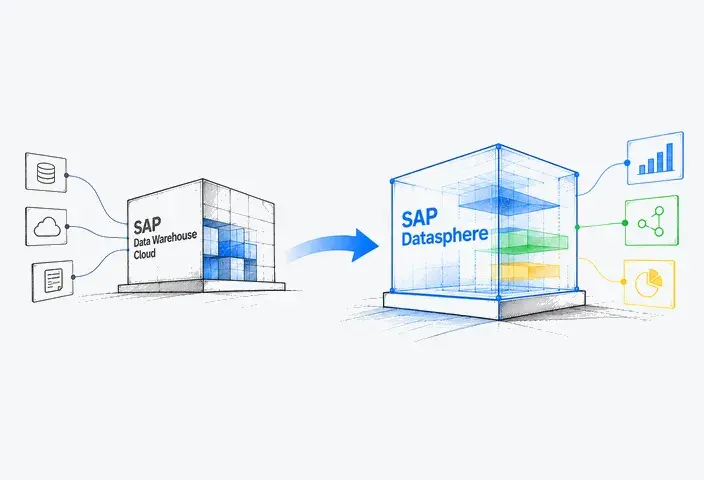
SAP's data platform strategy has undergone significant changes over the past few years. What began with SAP Data Warehouse Cloud has evolved into SAP Datasphere, and its portfolio now encompasses SAP Business Data Cloud. As the portfolio has grown, so has the uncertainty surrounding how these solutions interact with each other.
A common misconception is that SAP Business Data Cloud replaces SAP Datasphere. In reality, these two tools are designed to work together, although they serve different roles within the enterprise data architecture.
SAP Datasphere provides the foundation for integrating, modeling, and managing enterprise data. SAP Business Data Cloud extends these capabilities with business-ready data products, SAP Databricks, AI-powered analytics, planning, and additional data services.
This article compares the two platforms from an architectural perspective, explains where each fits within SAP's data strategy, and provides practical guidance on when to choose one, the other, or both.
Why SAP's Data Platform Strategy Has Evolved
For years, enterprise data platforms had a clear job: collect data from business systems and make it available for reporting. That approach worked when most organizations relied on a limited number of applications and analytics teams were the primary consumers of data.
Large enterprises often use dozens, sometimes hundreds, of cloud and on-premises systems. Many business processes increasingly rely on near-real-time data. AI initiatives depend on reliable, governed datasets. Finance, supply chain management, sales, and operations all want access to the same information, but each team views this information from its own business perspective.
SAP's data strategy has evolved to address this shift. Rather than building another data repository, SAP expanded the role of the platform itself.
The focus has gradually shifted from data storage to preserving business context, then to connecting distributed data without unnecessary duplication, and now to delivering business-ready data that can serve as the basis for analytics, planning, and artificial intelligence.
This evolution can be seen across SAP's data portfolio:
|
Platform |
Why SAP introduced it |
|
SAP BW |
To centralize enterprise reporting and consolidate SAP business data |
|
SAP BW/4HANA |
To modernize data warehousing with SAP HANA and improve performance, scalability, and simpler data models |
|
SAP Data Warehouse Cloud |
To move enterprise data warehousing to the cloud while supporting data integration and virtualization |
|
SAP Datasphere |
To preserve business semantics, unify SAP and non-SAP data, and provide a trusted foundation for enterprise analytics |
|
SAP Business Data Cloud |
To extend that foundation with business-ready data products, AI capabilities, SAP Databricks, planning, and managed business data services |
The reality is that each platform was built for a completely different set of business and architectural needs. SAP introduced Business Data Cloud to broaden its data and analytics portfolio rather than replace Datasphere. It was introduced because modern enterprises need more than just a managed data platform. They need a full ecosystem that ties together analytics, AI, and intelligent applications on a single, trusted foundation.

SAP Datasphere vs. SAP Business Data Cloud at a Glance
Although closely related, SAP Datasphere and SAP Business Data Cloud are designed to address different needs. SAP Datasphere provides a robust data foundation that organizations use to integrate, model, and manage enterprise data. SAP Business Data Cloud builds on this foundation by combining trusted business data with analytics, planning, artificial intelligence, and business-ready data products.
The table below highlights the key differences.
|
Category |
SAP Datasphere |
SAP Business Data Cloud |
|
Primary purpose |
Build a trusted, governed enterprise data foundation |
Deliver a unified business data ecosystem for analytics, planning, and AI |
|
Primary users |
Data engineers, data architects, BI teams |
Business leaders, analysts, planners, data teams, AI practitioners |
|
Core role |
Data integration, modeling, virtualization, and governance |
Business-ready data, AI, planning, analytics, and intelligent applications |
|
Typical deployment |
Enterprise data platform |
Enterprise business data platform |
|
Business focus |
Trusted enterprise data |
Business outcomes and intelligent decision-making |
|
Semantic modeling |
Comprehensive business semantic layer |
Built on SAP Datasphere's semantic capabilities |
|
Data governance |
Centralized governance and data quality |
Enterprise governance with business-ready data products |
|
Business data products |
Custom models created by customers |
SAP-managed business data products plus customer data |
|
SAP Databricks |
Not included |
Included as an integrated capability |
|
Planning capabilities |
Integrates with SAP Analytics Cloud |
Native integration with planning and analytics services |
|
AI readiness |
Provides trusted data for AI workloads |
Adds AI services and business-ready AI scenarios on top of trusted data |
At a high level, SAP Datasphere focuses on creating a trusted and governed data foundation, while SAP Business Data Cloud expands that foundation into a broader business data ecosystem that supports analytics, planning, AI, and intelligent business applications.
Understanding the Architecture Behind SAP Datasphere and SAP Business Data Cloud
Although SAP Datasphere and SAP Business Data Cloud share common technologies and work closely together, they play different roles in the enterprise data architecture. One provides the trusted data foundation. The other extends that foundation with business intelligence, planning, AI, and business-ready data products.
Understanding this distinction is essential when designing a modern SAP data landscape.
SAP Datasphere: building the enterprise data foundation
SAP Datasphere provides the data foundation for modern SAP analytics architectures. It connects data from SAP and non-SAP systems, preserves business context through its semantic layer, and makes governed enterprise data available for reporting, analytics, planning, and AI workloads.
Its architectural responsibilities include:
- Integrating data from SAP and third-party sources
- Virtualizing data to reduce unnecessary replication
- Preserving business semantics across datasets
- Creating reusable business models for analytics
- Applying consistent governance, security, and access controls
- Delivering trusted data to downstream applications and analytics tools
As a result, reports and analytics are based on the same business definitions, regardless of which team or tool is involved.
SAP Business Data Cloud: turning trusted data into business value
SAP Business Data Cloud extends the capabilities of SAP Datasphere by adding services designed for business users. Along with governed enterprise data, it brings together business data products, planning, analytics, SAP Databricks, and AI capabilities in a single environment.
Its architectural role includes:
- Delivering business-ready data products with preserved business context
- Supporting cross-line-of-business analytics
- Integrating SAP Databricks for advanced analytics and data science
- Enabling planning and simulation scenarios
- Providing a foundation for SAP Joule and other AI-powered services
- Accelerating business decision-making through prebuilt business content
Rather than replacing the enterprise data platform, Business Data Cloud extends it into a broader business data ecosystem.
How the platforms work together
SAP Datasphere and SAP Business Data Cloud are designed to work together, with each platform serving a different purpose within the overall architecture.
SAP Datasphere acts strictly as the management layer, handling the integration, modeling, and consistency of your data. Business Data Cloud then takes that foundation and converts it into actual business tools, adding pre-built data products, planning features, and AI applications.
In a typical SAP architecture, information flows through the following layers:
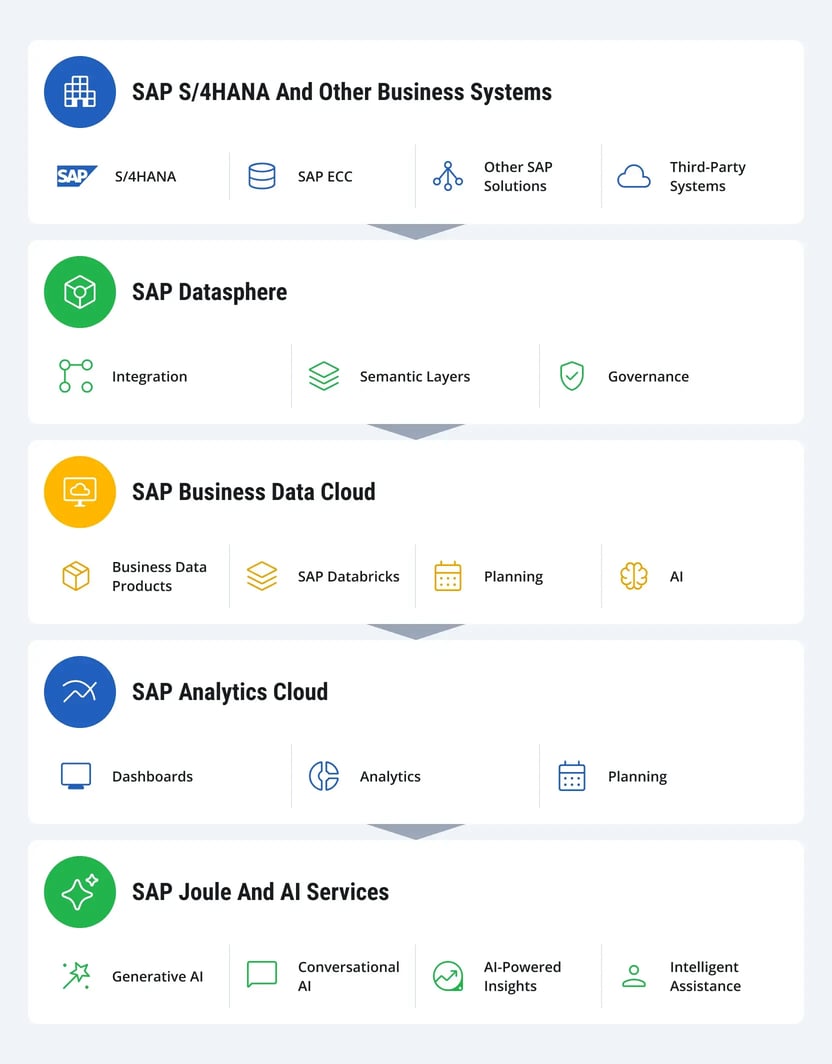
This layered architecture allows organizations to separate technical responsibilities from business capabilities. Datasphere provides trusted, governed enterprise data. Business Data Cloud transforms that data into business intelligence, planning, AI-driven insights, and reusable business data products.
For most companies, it’s not a competition between SAP Datasphere and SAP Business Data Cloud. The real win comes from understanding how these two platforms complement each other to build a single, cohesive data and analytics strategy.
Does SAP Business Data Cloud Replace SAP Datasphere?
Existing SAP Datasphere deployments remain fully supported and continue to play the same role in SAP's data architecture. For most organizations, the decision isn't whether to replace Datasphere, but whether additional Business Data Cloud capabilities fit their roadmap.
The simplest way to look at it is this: SAP Datasphere manages the data foundation, while SAP Business Data Cloud adds business-ready services on top of that foundation.
For existing SAP Datasphere customers, this distinction matters. Investments in Datasphere aren't made obsolete by Business Data Cloud. Companies can continue to use Datasphere for data integration, semantic modeling, virtualization, and data management. Business Data Cloud becomes relevant when organizations want to expand this foundation with SAP-managed data products, such as SAP Databricks, planning, artificial intelligence, and intelligent applications.
There is no one-size-fits-all migration path from SAP Datasphere to SAP Business Data Cloud. The right move depends entirely on your current setup and where it’s heading. Most companies need to audit their existing data models, reporting setups, and planning workflows first, then map out their long-term AI strategy to see if they actually need those extra capabilities.
|
Myth |
Fact |
|
SAP Business Data Cloud replaces SAP Datasphere. |
SAP Business Data Cloud builds on SAP Datasphere capabilities. Datasphere remains important for data integration, modeling, and governance. |
|
Existing Datasphere customers need to migrate immediately. |
There is no universal need for an immediate move. The right timing depends on the current architecture, business goals, and planned analytics or AI scenarios. |
|
SAP Datasphere is only useful for reporting. |
Datasphere supports a broader data foundation, including integration, virtualization, semantic modeling, governance, and data access across SAP and non-SAP sources. |
|
Business Data Cloud is only another analytics tool. |
Business Data Cloud is broader than analytics. It includes business data products, SAP Databricks, planning, AI capabilities, and intelligent applications. |
|
Companies must choose one or the other. |
Many enterprises can use both. Datasphere can support the governed data layer, while Business Data Cloud extends that layer for analytics, planning, and AI-driven business use cases. |
Existing SAP Datasphere deployments remain fully relevant. The real consideration is whether the current environment covers the capabilities your business plans to adopt over the next few years. For organizations investing in AI, business data products, or enterprise planning, SAP Business Data Cloud adds capabilities that go beyond a traditional data platform.
SAP Datasphere vs. SAP Business Data Cloud: Capability Comparison
Looking only at feature lists can make SAP Datasphere and SAP Business Data Cloud appear very similar. The difference is that many capabilities available in Business Data Cloud originate in SAP Datasphere, while additional services, including SAP-managed business data products, SAP Databricks, and Insight Apps, are exclusive to Business Data Cloud.
The comparison below highlights where the platforms overlap and where they differ.
|
Capability |
SAP Datasphere |
SAP Business Data Cloud |
|
Primary role |
Enterprise data integration, modeling, and governance |
Business data platform for analytics, planning, AI, and business data products |
|
Data integration |
Connects SAP and non-SAP data through native connectors and federation |
Uses Datasphere capabilities while adding SAP-managed business data products |
|
Data virtualization |
Native support for data federation and virtualization |
Available through Datasphere |
|
Semantic modeling |
Shared semantic layer with reusable business definitions |
Uses Datasphere semantic models and extends them with SAP business data products |
|
Data catalog |
Metadata management and data discovery |
Includes metadata from Datasphere along with SAP-managed business content |
|
Data governance |
Centralized governance, security, and access control |
Relies on Datasphere governance while extending it with managed business data products |
|
SAP application integration |
Native integration with SAP S/4HANA, SuccessFactors, Ariba, IBP, and other SAP applications |
Native integration with SAP applications and SAP-managed business content |
|
Non-SAP integration |
Supports databases, cloud platforms, and third-party applications |
Supports SAP and non-SAP data through the underlying Datasphere layer |
|
SAP Databricks |
Not included |
Included |
|
AI capabilities |
Provides governed enterprise data for AI models |
Adds SAP Joule, AI services, and AI-ready business data products |
|
Insight Apps |
Not available |
Included |
|
Planning |
Integrates with SAP Analytics Cloud |
Native planning capabilities through SAP Analytics Cloud and Business Data Cloud |
|
Business data products |
Customer-defined data models |
SAP-managed business data products with customer extensions |
|
SAP Analytics Cloud integration |
Native integration for reporting and planning |
Native integration with additional prebuilt business content |
|
Extensibility |
Open APIs, SQL, and SAP BTP integration |
Extends Datasphere with SAP-managed services, AI capabilities, and business content |
|
Typical users |
Data engineers, data architects, BI developers, and governance teams |
Business analysts, planners, executives, AI teams, data scientists, and data engineers |
The comparison shows that the two platforms overlap in several areas, but Business Data Cloud introduces capabilities, such as SAP-managed business data products, SAP Databricks, Insight Apps, and AI services, that aren't available in a standalone SAP Datasphere deployment.
Integration With SAP S/4HANA and Other Enterprise Systems
Almost nobody runs on just SAP S/4HANA. The reality is a mixed bag of SAP cloud apps, third-party software, different operating systems, and old legacy databases. If a data platform can’t handle that entire mix, it’s not going to work for a modern enterprise.
Supported integration scenarios
SAP Datasphere supports connectivity to a wide range of enterprise systems, including:
- SAP S/4HANA, SAP ECC, SAP BW, and SAP BW/4HANA
- SAP SuccessFactors, SAP Ariba, SAP Integrated Business Planning (IBP), SAP Concur, and SAP Customer Experience
- Microsoft Dynamics 365, Oracle ERP, Salesforce, ServiceNow, and other third-party business applications
- SAP HANA, Oracle Database, Microsoft SQL Server, Snowflake, Google BigQuery, Amazon Redshift, and other databases
- External sources through APIs, SQL, SAP Integration Suite, and SAP Business Technology Platform (SAP BTP)
What Changes with SAP Business Data Cloud?
Organizations already using SAP Datasphere don't need to redesign their integration architecture to implement SAP Business Data Cloud. Existing connections, semantic models, and managed data remain in place.
Business Data Cloud builds on that foundation by introducing capabilities such as:
- SAP-managed business data products
- SAP Databricks
- SAP Insight Apps
- Planning through SAP Analytics Cloud
- SAP Joule and AI services
Because these services leverage the same managed enterprise data, organizations can expand their capabilities in planning, advanced analytics, and artificial intelligence without creating an additional integration layer or rebuilding existing data pipelines.
Which Platform Is the Better Fit?
For many organizations, the answer is not one platform or the other. The table below shows which solution usually takes priority based on the business need.
|
Priority |
Recommended approach |
|
Modernize SAP BW or SAP BW/4HANA while preserving business semantics |
SAP Datasphere |
|
Create a governed data foundation for SAP and non-SAP systems |
SAP Datasphere |
|
Standardize reporting across business units |
SAP Datasphere |
|
Introduce enterprise planning alongside analytics |
SAP Business Data Cloud |
|
Support AI initiatives with SAP-managed business data |
SAP Business Data Cloud |
|
Use SAP Databricks and Insight Apps |
SAP Business Data Cloud |
|
Build a long-term enterprise data architecture |
SAP Datasphere + SAP Business Data Cloud |
How LeverX Can Help
Choosing between SAP Datasphere and SAP Business Data Cloud is only one part of the decision. The bigger challenge is determining how either platform fits into your existing SAP landscape and long-term data strategy.
LeverX helps organizations assess their current environment, define the right target architecture, and implement SAP data platforms that support reporting, analytics, planning, and AI initiatives. Our services include:
- Data platform assessments to evaluate your current landscape and define the right modernization strategy
- SAP BW and SAP BW/4HANA modernization for organizations moving toward cloud-based data platforms
- SAP Datasphere implementation and semantic model design
- SAP Business Data Cloud adoption and implementation planning
- Enterprise data architecture for SAP and non-SAP landscapes
- SAP Analytics Cloud integration for reporting and planning
- AI-ready data strategy built on governed enterprise data
- Migration roadmaps for SAP BW, SAP Datasphere, and SAP Business Data Cloud
Whether you need to modernize an old SAP BW system, look into SAP Business Data Cloud, or scope out a wider data overhaul, LeverX can jump in. We’ll help you pin down the exact architecture and rollout strategy that makes sense for your setup.
Conclusion
SAP Datasphere and SAP Business Data Cloud are closely connected, which is exactly why they're so often confused. They share part of the same architecture and, in some cases, similar capabilities. Even so, they solve different problems.
The decision is not so much about choosing one platform over the other, but rather about understanding the role each should play in your architecture. Some organizations require a managed data platform. Others are ready to expand into planning, AI, and business data products. Many will eventually move through both phases.
The best place to start isn't a feature checklist. It's your current environment. Understanding how data flows through the business today, where the gaps are, and what new capabilities you're planning to introduce will usually make the decision much easier.