Accelerate your US enterprise upgrade. Learn strategies, data pipelines, ITAR compliance, and risk frameworks for moving from Infor to SAP S/4HANA.
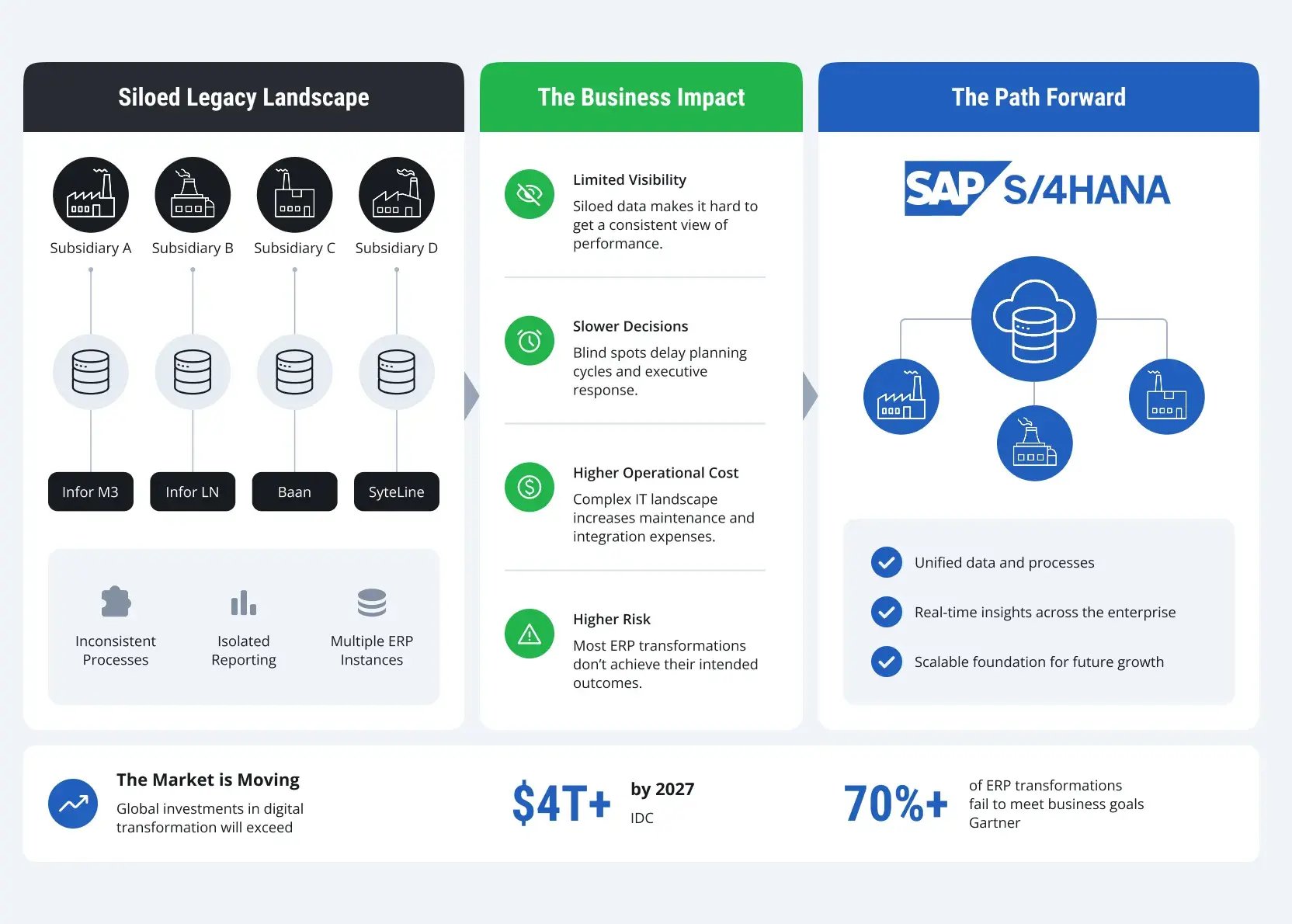
Many major US manufacturers, distributors, and industrial brands installed Infor M3, Infor LN, Baan, or SyteLine long before their current operating model took shape. Years of buyouts, new factory builds, and corporate reshuffling turned basic workflows into highly complex webs. Today, it is incredibly common to see a single enterprise running a messy mix of different ERP instances, inconsistent business processes, and completely isolated reporting setups from one subsidiary to the next.
This kind of structural split hurts far more than just your IT budget. When your numbers live in completely separate silos, gaining a consistent view of business performance becomes increasingly difficult. The moment this blind spot begins stalling your weekly planning and slowing down executive decisions, unifying the whole operation becomes an urgent priority. The broader market is already moving this way, too. IDC numbers indicate that global investments into digital transformation will soar past $4 trillion by 2027.
That pressure is exactly why SAP S/4HANA enters the corporate boardroom conversation. For leadership teams trying to force clean master data control or align messy operational workflows across every site, this platform offers a concrete way to build a unified foundation.
The challenge is that these legacy Infor setups hold decades of deeply rooted business logic. It is locked tight inside BODs (Business Object Documents), custom Infor ION integrations, homegrown ETL pipelines, and specialized factory-floor apps. Because these daily dependencies keep your plants running, planning a transition involves way more than just shifting rows from an old database to a new one. The stakes are incredibly high here: Gartner reports that over 70% of recent ERP overhauls fall short of their promised business goals.
This guide examines the architectural, operational, and data-management considerations that shape migration to SAP S/4HANA from Infor. We also explore the frameworks large US enterprises use to reduce migration risk, maintain business continuity, and establish a scalable digital core for future growth.

Architectural Evolution: Infor's Middleware vs. SAP's Digital Core
An architecture assessment is usually the very first milestone you have to clear in an Infor-to-SAP migration program. The scope here goes way beyond basic data mapping or workflow updates. The entire underlying tech stack is undergoing a massive shift, transforming how your business links applications, builds reports, governs master data, and handles long-term system maintenance.
A standard Infor setup relies heavily on Infor ION (Intelligent Open Network) to bridge the gap between different business applications. Transactions pass through BOD definitions, allowing core ERP modules and outside software to communicate without point-to-point connections. Over time, large organizations naturally expand this footprint, plugging in specialized manufacturing execution software, warehouse tracking tools, transportation modules, and custom internal applications.
But as this integration web spreads out, your data has to go through multiple transformation and validation steps before hitting downstream systems. Corporate reporting often depends on syncing up massive datasets harvested from completely different origins. This creates a fragmented corporate landscape where daily logistics data, financial figures, and analytical insights live in separate, isolated repositories.
SAP S/4HANA eliminates this fragmentation by using a completely unified database architecture. The system processes and stores both transactional entries and analytical data inside the SAP High-Performance Analytic Appliance (HANA) engine, reducing dependence on standalone reporting warehouses and heavy overnight batch jobs. Finance follows a similarly streamlined path: the SAP Universal Journal centralizes corporate accounting, controlling, asset tracking, and profitability metrics within a single data structure.
These architectural contrasts dictate your entire migration strategy. Existing Infor ION pathways, BOD structures, and custom extract-transform-load (ETL) pipelines cannot simply be migrated into SAP S/4HANA. Project teams must audit the entire landscape to decide which integrations to keep, which to simplify, and which to replace entirely with native SAP capabilities.
|
Architecture component |
Infor ERP environment |
SAP S/4HANA environment |
|
Core architecture |
Applications connected through Infor ION and BOD messaging |
Unified platform running on SAP HANA |
|
Primary data movement |
Message-based integration between systems |
Unified transactional and analytical data model |
|
Financial data structure |
General Ledger and supporting financial tables |
SAP Universal Journal |
|
Reporting model |
Data consolidated from multiple repositories |
Reporting generated from operational data stored in SAP HANA |
|
Analytics availability |
Dependent on synchronization and integration cycles |
Near real-time access to transactional and analytical data |
|
Integration management |
Multiple interfaces maintained across connected systems |
Greater use of platform-native services and APIs |
US Migration Paths: Why Greenfield Often Becomes the Preferred Approach
LeverX recommends a Greenfield deployment model for Infor M3 and Infor LN migration programs involving multiple facilities, extensive customization, and large integration landscapes.
A typical manufacturing environment may contain ERP customizations developed over ten or fifteen years, hundreds of interfaces connected through Infor ION (Intelligent Open Network), plant-specific planning rules, and reporting logic built around local operational requirements. During migration assessments, LeverX architects often find that the same business process is executed differently across facilities because individual sites introduced their own workflows, data structures, and integration patterns.
These differences create practical challenges during migration. Production planning rules, inventory management processes, financial controls, and procurement workflows frequently depend on custom configurations that have no equivalent representation inside SAP S/4HANA. Rebuilding every legacy configuration increases implementation effort, expands testing scope, and adds support requirements after go-live.
For this reason, Greenfield projects begin with process analysis rather than system replication. LeverX teams evaluate existing customizations, identify redundant integrations, compare business processes across facilities, and determine which configurations will continue supporting current operational requirements. The results help organizations reduce migration scope before development activities begin.
The same assessment applies to data. Manufacturing companies often maintain duplicate suppliers, inactive materials, obsolete inventory records, and historical transactions accumulated through acquisitions, divestitures, and system changes. Migrating these records increases data validation effort and expands testing activities without improving operational performance after deployment.
Greenfield programs allow organizations to establish data ownership, standardize master data, and define retention rules before information enters SAP S/4HANA. This approach simplifies reconciliation activities, reduces data transformation effort, and supports more consistent reporting after go-live.
LeverX advice
When executing a migration from Infor M3 or LN to SAP S/4HANA, avoid building custom point-to-point database integrations. Infor's object-centric middleware model and SAP HANA's column-oriented in-memory architecture process transactions through fundamentally different structures. A Greenfield deployment supported by a mature extract-transform-load (ETL) data pipeline provides a controlled method for validating, transforming, and loading business data while preserving data integrity across production, procurement, inventory, and financial operations.
Managing US Regulatory Compliance and Core Integrations
Once the migration strategy has been defined, project teams typically focus on three areas that have a direct impact on deployment success:
- Integration architecture.
- Regulatory compliance.
- Master data governance.
Each introduces its own set of technical requirements and can significantly influence project timelines, infrastructure decisions, and testing activities.
Deconstructing existing Infor ION integrations
In large manufacturing environments, Infor ION (Intelligent Open Network) often serves as the integration layer between ERP, manufacturing execution systems (MES), product lifecycle management (PLM) platforms, warehouse management solutions, transportation systems, supplier portals, and internally developed applications. Business transactions move between these systems using BODs (Business Object Documents), creating an integration landscape that often reflects years of operational requirements.
During migration, these integrations require detailed analysis, not direct replication, since SAP S/4HANA does not process transactions through Infor BOD structures. This means existing interfaces must be redesigned around SAP integration patterns. In most projects, organizations evaluate whether integrations should be rebuilt using SAP Integration Suite, exposed through application programming interfaces (APIs), or consolidated. If integrations no longer serve a business purpose but continue to increase maintenance effort and testing complexity, it may be necessary to retire the integration altogether. Identifying these dependencies early reduces project risk and helps define a more sustainable target architecture.
Addressing US regulatory requirements
Compliance frameworks heavily alter database and infrastructure layout designs throughout major ERP overhauls. United States corporate entities must resolve strict statutory criteria regarding audit trail requirements, information security protocols, user access controls, and historical record archiving. These parameters directly control user account creation paths, system audit logging, segregation-of-duties controls, disaster recovery intervals, and master data governance architectures. The architectural selections finalized during early system mapping dictate the success of subsequent Sarbanes-Oxley Act (SOX) and Generally Accepted Accounting Principles (GAAP) verification reviews.
Separate regulatory requirements govern industrial enterprises active in defense, aviation, and federal manufacturing procurement lines. Companies answering to International Traffic in Arms Regulations (ITAR), Aerospace Standard 9100 (AS9100), or federal procurement clauses must guarantee the storage of restricted design data, manufacturing routing lists, and customer information within server hardware hosted within the United States. Access to these software networks must remain blocked from foreign nationals, allowing entry only to authenticated personnel holding verified citizenship status. These mandates elevate data center placement to an essential component of overall corporate legal compliance.
Consequently, implementation teams assess government-compliant cloud environments, including AWS GovCloud or Azure Government, during early system discovery. These environments deliver pre-configured hardware and software controls built to isolate federal data assets, easing the management of storage residency restrictions, perimeter security audits, and identification reviews. Postponing the integration of these compliance parameters until the final installation window causes immediate architectural overhauls, additional system performance verification steps, and project schedule extensions.
Establishing master data governance
Infor and SAP organize core business entities differently, particularly in customer and supplier management. Infor environments often maintain separate customer and vendor records, while SAP S/4HANA uses the SAP Business Partner framework as a unified model for these entities.
During Infor-to-SAP migration assessments, LeverX teams often identify duplicate suppliers, conflicting customer records, inconsistent naming conventions, and different classification structures across business units. These issues become especially common in organizations that have expanded through acquisitions or operate multiple ERP instances. Before migration begins, organizations must define how existing records will be consolidated, mapped, and validated within the SAP Business Partner model.
Master data governance also supports Sarbanes-Oxley Act (SOX) and Generally Accepted Accounting Principles (GAAP) requirements. LeverX helps organizations establish ownership rules, standardize critical master data objects, and prepare governance controls before data enters SAP S/4HANA. These activities improve auditability and help maintain reporting accuracy after go-live.
-min-Jul-12-2022-09-46-40-14-AM.jpg)
Technical Risk Mitigation and TCO Optimization
Cutover planning for production environments
In manufacturing companies, SAP go-live affects inventory management, production planning, procurement, shipping, and financial reporting simultaneously. A data inconsistency discovered after cutover can prevent production orders from processing materials correctly or cause inventory discrepancies between plants and distribution centers.
For this reason, migration teams typically conduct several full-scale cutover simulation migrations before production deployment. Each simulation validates data conversion results, integration behavior, reporting outputs, user access controls, and rollback procedures. The objective is to measure the actual duration of migration activities and identify issues while the legacy Infor environment remains available.
LeverX advice:
- Many organizations focus their testing on data migration and application functionality, while leaving external integrations until the final stages of the project. Include MES, WMS, supplier portals, EDI transactions, barcode scanners, and reporting systems in every cutover simulation.
- Define cutover exit criteria before testing begins. For example, inventory balances, open production orders, purchase orders, and financial postings should reconcile within predefined tolerances before the project receives approval for production deployment.
- Assign ownership for every cutover activity. During go-live, project teams often discover that migration tasks, validation procedures, and business sign-offs belong to different departments. Clear ownership reduces delays during the deployment window.
Scope expansion and budget growth
Scope expansion often begins when organizations treat ERP migration as an opportunity to solve unrelated business problems. A project originally approved to replace Infor may gradually absorb requests for process redesign, supplier portals, advanced analytics, mobile applications, or custom manufacturing workflows.
Each additional workstream introduces new design sessions, testing cycles, training requirements, and deployment dependencies. What started as an ERP migration can evolve into a multi-year transformation program with a significantly different budget and timeline.
To prevent this scenario, successful organizations define which capabilities are required for go-live and which initiatives can be delivered after stabilization. This distinction helps maintain deployment schedules and reduces the risk of extending the migration far beyond its original objectives.
LeverX advice:
- Define go-live requirements before the design phase begins and evaluate all additional requests against those objectives. Capabilities that are not required for production readiness should be planned as separate post-deployment initiatives.
Historical data retention and infrastructure costs
Manufacturing companies that have used Infor for many years may store millions of completed production orders, closed purchase orders, inactive customer records, obsolete materials, and archived financial transactions.
Migrating all historical records increases database size, extends data validation cycles, and creates additional work during testing. It also increases infrastructure requirements after go-live because larger datasets consume additional computing and storage resources.
LeverX advice:
- Do not load unfiltered historical data from legacy Infor environments directly into SAP HANA. Define retention rules before migration begins and classify records according to operational, regulatory, and audit requirements.
- Active business data should move into SAP S/4HANA. Historical information required for compliance purposes can remain accessible through archival repositories or lower-cost storage tiers. This approach reduces database growth, shortens migration timelines, and lowers long-term infrastructure costs.
Data quality and long-term support costs
Data quality issues rarely disappear during migration. Duplicate suppliers, inconsistent material definitions, inactive customers, and conflicting master records continue generating problems after go-live.
Every duplicate business partner requires additional validation. Every inconsistent material definition affects reporting accuracy and planning processes. Resolving these issues before migration reduces testing effort and decreases the volume of support tickets after deployment.
For organizations operating multiple facilities, data cleansing often delivers measurable benefits long before the SAP S/4HANA environment enters production.
LeverX advice:
- Start with data profiling before beginning data cleansing activities. Quantify duplicate suppliers, inactive materials, incomplete customer records, and conflicting master data definitions across business units.
- Assign business ownership for customer, supplier, material, and inventory master data. Technical teams can identify inconsistencies, but business stakeholders should determine which records remain authoritative.
- Standardize naming conventions, material classifications, and numbering schemes before migration begins. Waiting until user acceptance testing to resolve these issues frequently delays deployment schedules.
Conclusion
Infor M3, Infor LN, Baan, and SyteLine environments often contain hundreds of integrations, years of accumulated master data, plant-specific workflows, and industry-specific compliance requirements. Each of these elements influences migration scope, implementation timelines, infrastructure design, testing effort, and long-term operating costs.
Before selecting a migration strategy, organizations should understand:
- Which integrations remain necessary.
- Which historical data must be retained.
- How regulatory requirements affect deployment architecture.
- What level of process standardization is required across business units.
These questions cannot be answered through software evaluation alone; they require a detailed assessment of the current environment.
Book an Enterprise SAP Readiness Assessment with LeverX. Our senior SAP architects will review your Infor landscape, analyze integration dependencies, evaluate data quality, identify compliance constraints, and provide a migration roadmap based on your existing systems, business processes, and operational requirements.