Don’t just change systems. Discover strategies, timelines, and financial benefits of migrating from legacy Microsoft Dynamics GP to SAP S/4HANA.
For decades, Microsoft Dynamics GP (formerly Great Plains) has been a reliable financial hub for US businesses. Finance teams know the workflows, controllers rely on the reports, and IT teams have built years of integrations around it.
However, Microsoft’s support roadmap changes everything: product support, tax updates, and security patches for Dynamics GP will officially end on December 31, 2029. It sounds far off, but enterprise ERP migrations take years to finish.
The issue isn't just deadlines — GP was designed for an earlier era of enterprise technology, while the current ERP market is rapidly moving to the cloud.
By 2025, cloud solutions held 70.4% of all ERP deployments, and 79% of new projects launched in the cloud. The cloud ERP market reached roughly $42.7 billion in 2026, driven by companies looking for AI, automation, easier scaling, and lower maintenance costs.
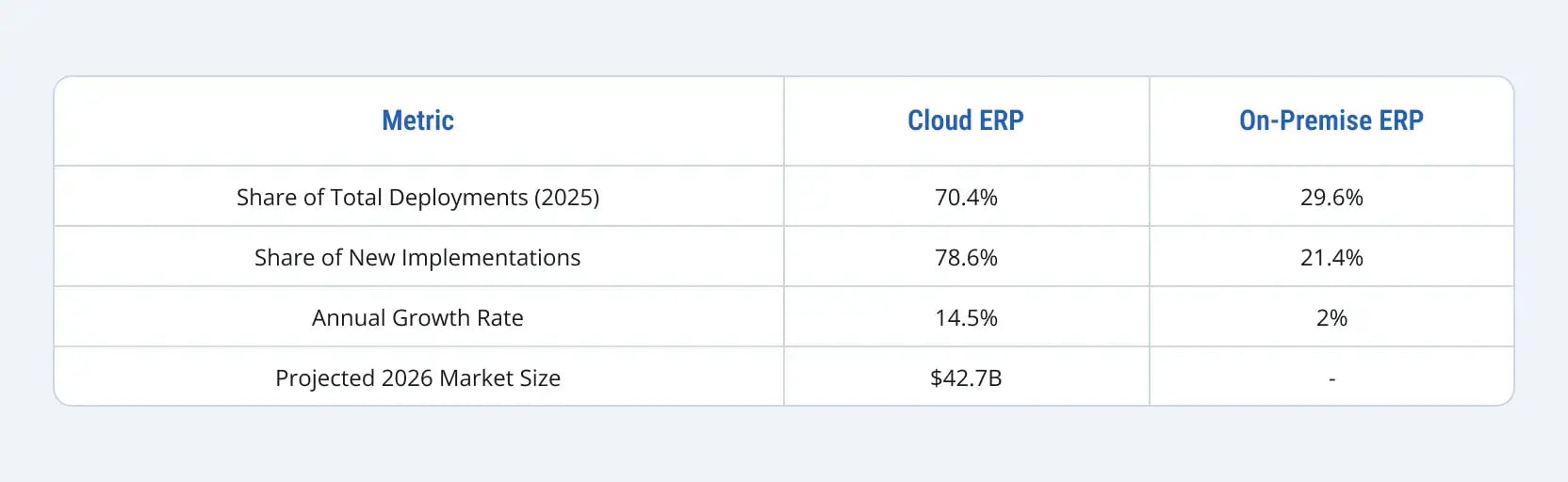 Source: Anchor Group, Global Growth Insights, Cargoson/HG Insights
Many GP users are moving to the cloud, but they aren't always sticking with Microsoft. Growing firms are using this deadline to modernize broader business operations on enterprise platforms featuring real-time data processing, unified financials, built-in analytics, and connected workflows.
If you have outgrown Great Plains’ legacy data structures, complex account segments, and messy reporting, SAP S/4HANA offers a scalable foundation for future growth.
This guide covers why companies are moving from Dynamics GP to SAP S/4HANA, how they compare, your migration choices, and what finance and IT leaders should check before starting.
Legacy Batch Accounting vs. Real-Time Digital Core: Structural Comparison Matrix
The core difference between Dynamics GP and SAP S/4HANA comes down to how they handle data.
Microsoft Dynamics GP
Dynamics GP was built at a time when data entry and reporting were separate workflows. Financial data is distributed across individual modules and sub-ledgers, meaning the GL, accounts payable, accounts receivable, and fixed assets live in different silos. Keeping these records aligned often requires batch posting and manual reconciliation. Because of this limitation, finance teams frequently have to rely on data exports or overnight processing cycles just to see a unified view of company performance.
This architecture worked well for companies with fewer legal entities and lower transaction volumes.
SAP S/4HANA
S/4HANA relies on a modern in-memory database that processes live operations and reporting together in real time. It unifies financial and controlling data inside a single ledger — the Universal Journal — which reduces the need for traditional sub-ledger reconciliation.
For growing organizations, this means immediate access to metrics, simpler reporting structures, faster closing cycles, and seamless consolidation across multiple subsidiaries and global regions.
|
Capability |
Microsoft Dynamics GP |
SAP S/4HANA |
|
Financial architecture |
Separate sub-ledgers and segmented account structures |
SAP Universal Journal architecture with a unified financial data model |
|
Data storage model |
Multiple financial data repositories |
Single source of truth across finance and controlling |
|
Database technology |
Microsoft SQL Server with batch-oriented processing |
SAP High-Performance Analytic Appliance (HANA) in-memory database |
|
Reporting availability |
Often dependent on scheduled processing and data refreshes |
Near real-time reporting and analytics |
|
Period-end close |
Significant reconciliation effort across modules |
Automated closing cycles and integrated financial controls |
|
Multi-entity consolidation |
Frequently requires additional tools and manual consolidation |
Native support for complex organizational structures and group reporting |
|
Analytics |
Separate reporting environments are common |
Embedded analytics within operational processes |
|
Scalability |
Often supported through customizations and add-ons |
Designed for enterprise-scale operations and growth |
Why Is Greenfield Implementation the Preferred Path?
The choice of migration methodology from Microsoft Dynamics GP to SAP S/4HANA has a direct impact on project duration and system performance. While alternative methods are reviewed during discovery, most enterprises deploy SAP S/4HANA via a Greenfield implementation.
The typical Dynamics GP environment features significant customization. Over multiple fiscal years, organizations add new subsidiaries, ad-hoc reporting tools, and custom workflow configurations. This incremental layering of modifications builds technical debt and creates an unstable foundation for direct data conversion.
Discovery phases often reveal significant data and process fragmentation, such as inconsistent reporting definitions across business units, duplicate data records, and active customizations that still exist, even though the operations they supported have been discontinued.
Re-engineering these legacy structures inside the SAP S/4HANA framework provides little operational value. Direct replication of legacy workflows limits the capabilities of the modern database and extends implementation timelines. A Greenfield methodology eliminates these legacy constraints by deploying a clean system architecture. This method reduces custom development, optimizes data structures, and facilitates faster user adoption.
LeverX advice
Conduct a data and workflow audit before defining the migration blueprint. Legacy GP databases often contain extensive historical data and inactive integrations that do not align with modern business processes. When these assets are included in the migration, scope increases project budgets and extends the testing phase. Instead, define the minimum viable financial history and master data required for operational continuity on day one, and build the migration plan around those explicit requirements.
Overcoming Financial and Operational Pitfalls in the US Market
A Greenfield deployment provides a clean operational foundation, but the technical migration process requires managing deep structural dependencies. Leadership teams should focus on three critical transformation pillars:
#1 Restructuring the financial data model
The segmented account architecture in Dynamics GP often carries information that would be better managed through separate analytical dimensions that embed entity, location, and department codes directly into the general ledger string. This structural layout inevitably leads to an unmanageable volume of account combinations, as business requirements evolve over time.
SAP S/4HANA introduces a unified data architecture where the general ledger tracks purely financial classifications, while operational metadata is managed through separate objects like profit centers and business partners. Migrating to this model makes a simple database conversion unrealistic. Finance executives must actively redesign the corporate data model, shifting operational tracking out of the general ledger structure and into SAP’s standardized analytical layers.
#2 Balancing data quality with statutory compliance
Historical ledger data creates a major challenge during an enterprise resource planning (ERP) transition. Loading low-quality or redundant historical data degrades modern database performance, yet statutory compliance requires historical records to remain accessible for audit purposes.
To mitigate this risk, organizations must establish structured data transformation protocols. The migration framework must include comprehensive validation steps to verify that data pulled from Dynamics GP aligns exactly with the financial inputs loaded into SAP S/4HANA. Maintaining these clear data transformation records is an absolute necessity for meeting Generally Accepted Accounting Principles (GAAP) and Sarbanes-Oxley Act (SOX) compliance requirements.
#3 Decoupling sub-ledger ecosystems and add-ons
Dynamics GP instances typically depend on an array of third-party external applications to support core business processes. These integration tools often manage vital operations, creating a complex web of integrations outside the primary ERP platform.
The migration to SAP S/4HANA offers a strategic opportunity to evaluate these external dependencies. A significant portion of these legacy applications duplicate functionalities that are natively integrated into the SAP S/4HANA core or supported by the SAP Integration Suite. Early identification of these overlapping systems enables IT leaders to streamline the enterprise architecture, simplify system support, and avoid the cost of rebuilding unnecessary interfaces.
Possible Technical Risks and Ways to Mitigate Them
Three areas usually shape executive planning during a Dynamics GP to SAP S/4HANA migration:
- Data protection.
- Operational downtime during cutover.
- Long-term operating costs.
Managing these variables requires a defined strategy for security, business continuity, and total cost of ownership (TCO) before the project begins.
Data security and compliance
The migration process involves extracting and transforming sensitive payroll, banking, tax, and customer records. Data vulnerability increases significantly during temporary storage, test environment replication, and user access configuration.
LeverX advice
Establish strict end-to-end encryption protocols across the entire migration architecture. Enforce role-based access controls on all staging databases and utilize data masking in testing environments to safeguard sensitive financial information.
Cutover planning and business continuity
SAP S/4HANA cutover usually requires freezing legacy Dynamics GP transactions. System cutover demands rapid data extraction, validation, loading, and final reconciliation before the production system becomes available to business users. Unplanned delays in this sequence risk halting corporate reporting and core accounting functions.
LeverX advice
Measure the actual duration of every data migration task during test cycles. Data from mock cutovers provides a reliable foundation for scheduling go-live windows and minimizing operational disruption.
Total cost of ownership (TCO) optimization
Long-term platform costs extend far beyond software licensing. Infrastructure hosting, custom code maintenance, system integrations, and third-party dependencies represent the majority of five- to ten-year operating expenses.
LeverX advice
Audit the entire legacy Dynamics GP software ecosystem before finalizing your future TCO projections. Define the operational necessity, ownership structure, and support costs for every active report and interface to avoid unexpected post-implementation expenses.
Conclusion
The upcoming end of support is pushing companies toward an enterprise architecture capable of sustained transaction volumes, advanced analytics, and multi-subsidiary expansion. SAP S/4HANA handles these operational demands directly. The platform unifies the corporate financial data model, automates multi-entity consolidations, and provides real-time access to operational data across all business units.
Determining the transition path requires a precise Enterprise SAP Readiness Assessment. A technical discovery workshop with LeverX allows companies to audit the existing Dynamics GP environment, identify configuration risks, and establish an optimized migration roadmap to SAP S/4HANA.