Migrating dozens of SAP systems doesn’t have to take years. Learn how the SAP Migration Factory approach helps structure and accelerate large-scale S/4HANA migrations.
Imagine a situation that is quite common in large SAP landscapes. A company has been operating internationally for many years. Over time, its IT architecture has expanded alongside the business. New subsidiaries launched their own systems, acquisitions brought inherited landscapes, and individual business units implemented solutions tailored to their local processes.
As a result, the infrastructure may eventually include 20–40 SAP systems, each with its own configuration, integrations, and historical data. The challenge becomes clear once the organization starts planning its transition to SAP S/4HANA. Migrating one system is a well-understood task. Migrating dozens of systems across a complex SAP landscape is an entirely different undertaking.
Even if the technical migration of a single system takes only a few weeks, the surrounding activities significantly extend the timeline:
- Analysis of the current landscape and data may take 6–10 weeks.
- Preparing tools and environments requires several additional weeks.
- Testing, adjustments, and repeated runs add multiple iterations.
When this process must be repeated across dozens of systems, SAP digital transformation initiatives can easily stretch over many years. At the same time, a large share of the work is repeated again and again. Teams configure the same tools, perform similar data checks, and recreate comparable test scenarios for each migration.
This challenge of scaling large migration programs is exactly what led to the emergence of the SAP Migration Factory approach — a model designed to standardize and industrialize the migration of SAP systems.
What is SAP Migration Factory?
The SAP Migration Factory is a specialized operating model built for the structured, repeatable transition of large-scale system landscapes. It replaces the "one-off project" mindset with a standardized ecosystem of tools and governance, allowing for the concurrent migration of multiple systems within a single framework.
Operationally, this functions as a migration assembly line. With the methodology and roles predefined, every system follows a strict five-stage lifecycle:
- Assessment
- Preparation
- Migration
- Validation
- Stabilization
Standardizing these activities removes the overhead of process-building for every system. This approach is particularly critical for enterprises facing aggressive timelines for SAP S/4HANA adoption across complex, multi-system environments.
Why Companies Choose the SAP Migration Factory Approach
It provides a rigorous framework for moving complex environments while insulating the business from potential disruption. By standardizing the move, companies achieve a modernized SAP footprint without the operational friction or go-live shocks associated with unmanaged migration strategies.
Structured migration management
The SAP Migration Factory replaces traditional, disjointed project management with a methodical blueprint for large-scale transitions. This model governs the complete scope under a unified governance layer. Such standardization ensures that critical technical elements remain front and center, preventing the kind of omissions that typically plague unstandardized, system-by-system migrations.
Automation and specialized tools that accelerate migration
The SAP Migration Factory utilizes a built-in automation framework that increases process throughput and reduces the human error factor. Instead of manual code rework, the model leverages solutions such as ABAP Test Cockpit and SAP Readiness Check that perform automated simplification item analysis and remediate incompatibilities in custom developments (Z-code).
Access to expertise and proven practices
High-stakes SAP digital transformation services are rarely without technical friction or intricate dependencies. To navigate this, the Migration Factory model leans heavily on a center of excellence approach, leveraging specialists whose best practices have been battle-tested across dozens of global initiatives.
Flexibility for different migration scenarios
The true strength of the SAP Migration Factory lies in its inherent modularity. Because landscapes vary wildly in complexity, the model supports a high degree of strategic tailoring, allowing organizations to choose between a staged migration or a more holistic, time-bound transformation. This flexibility ensures that the migration strategy remains subservient to the company's actual priorities and the technical realities of their legacy environment.
-min-Jul-12-2022-09-46-40-14-AM.jpg)
Business Results Companies Can Expect
|
Higher system performance and scalability |
Lower total cost of ownership |
Improved data management |
|
After migration, companies experience faster system response times and improved overall stability. |
Systems migrated using the SAP Migration Factory require fewer resources for maintenance and infrastructure management. |
With technologies such as SAP HANA and its in-memory architecture, data can be processed and analyzed in near real time. |
|
More efficient operations |
Lower migration risk |
Foundation for continuous innovation |
|
The standardized processes and automation used in the Migration Factory model reduce manual work and simplify operational tasks. |
By detecting risks during planning and preparation stages, companies can address them proactively. |
Once the migration is complete, organizations are better positioned to adopt new SAP capabilities, updates, and innovations. |
The Building Blocks of an SAP Migration Factory
At its heart, the SAP Migration Factory concept revolves around an industrialized ecosystem designed for scale. By consolidating technical tools and operational governance into a single engine, organizations can orchestrate multiple migrations in tandem. This setup removes the volatility of moving complex SAP environments, ensuring that predictability remains constant regardless of how many systems are being transitioned at once.
- Landscape readiness tools — tools such as Maintenance Planner and SAP Readiness Check are deployed early to de-risk the transition. They identify the "must-fix" system incompatibilities before the migration begins, transforming a massive list of technical unknowns into a prioritized task list for the S/4HANA move.
- Data migration tooling — for the data layer, the SAP S/4HANA Migration Cockpit provides a governed environment for moving information. It’s not just about the transfer itself; it’s about the built-in validation mechanisms that prevent corrupted or incomplete data from reaching the target system.
- Custom code adaptation frameworks — custom code often represents the biggest hurdle, which is why the ABAP Test Cockpit is essential for detecting and remediating incompatible developments. To close the loop, automated testing solutions are integrated across migration cycles to stress-test business processes and integration points, ensuring the new landscape is production-ready.
- Automation frameworks — automation tools coordinate repetitive migration tasks and help teams manage multiple migration waves simultaneously.
- Testing platforms — automated testing solutions validate business processes, integrations, and data integrity across migration cycles.
- Infrastructure and cloud readiness solutions — the move is completed through infrastructure frameworks like RISE with SAP, which streamline the transition to cloud-based operations. These platforms handle the heavy lifting of environment preparation, aligning the infrastructure with S/4HANA’s specific technical requirements.
SAP Migration Factory Timeline
Landscape assessment
2–4 weeks
This initial window is dedicated to validating migration readiness across all technical layers. By evaluating custom developments and integration complexity, teams can effectively de-risk the project before it begins.
Migration strategy
1–2 weeks
This involves prioritizing the migration scope and aligning the SAP system conversion approach with the organization’s long-term transformation goals.
Migration planning
1–2 weeks
A detailed migration roadmap is prepared, covering timelines, resources, testing procedures, and the sequence of migration waves.
Cutover and implementation
3–6 weeks
During execution, the technical team handles the environment build and data migration. We run end-to-end testing cycles to confirm that integrations remain stable and that the data transfer meets all compliance and performance benchmarks.
Go-live and stabilization
1–2 weeks
The team shifts into a stabilization phase, closely monitoring the environment to iron out any performance bottlenecks and ensure the system is fully optimized for live business operations.
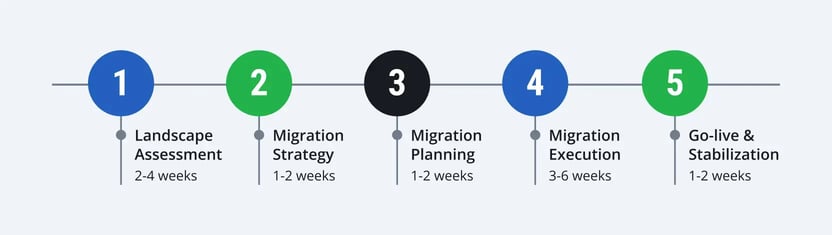
*Timelines are provided for a single system (one wave) within the migration pipeline.
Migration Approaches Supported
Flexibility is perhaps the most significant strategic advantage of the SAP Migration Factory approach. It accommodates the full spectrum of migration paths, giving companies the latitude to align their technical move with broader transformation goals. By avoiding a standardized "locked-in" methodology, the model ensures the migration remains subservient to the organization’s specific risk appetite and timeline.
|
New implementation (Greenfield) |
SAP system conversion (Brownfield) |
Selective data transition (Landscape transformation) |
|
It involves standing up an entirely new SAP S/4HANA environment while fundamentally re-engineering business processes. This is the path of choice for organizations looking to shed years of technical debt and legacy complexity in favor of modern SAP best practices. |
For organizations prioritizing continuity, the Brownfield path converts the existing SAP ERP system directly to SAP S/4HANA while keeping current process configurations intact. It’s a "lift-and-shift" philosophy at its core, favored by enterprises that want to modernize their underlying platform without the shock of a total process overhaul. |
Selective data transition serves as a strategic pivot between a new build and a direct conversion. It allows organizations to surgically migrate specific datasets and critical processes while simultaneously re-engineering their SAP landscape. |
What Can Go Wrong During Migration and How to Prevent It
Hidden dependencies in the system landscape
One of the biggest risks in any migration is the undocumented reality of the legacy system. Between local implementations and historical acquisitions, many SAP landscapes are riddled with dependencies that simply aren't on the map. These gaps usually surface only when a system is in mid-transition, unless early discovery is prioritized.
How to avoid it:
By front-loading the project with SAP Readiness Check and dedicated architecture deep-dives, organizations can map the actual integration footprint, ensuring that hidden flows are accounted for in the migration blueprint rather than being discovered during a go-live.
Custom code surprises
Years of development often leave SAP systems cluttered with massive amounts of custom code, half of which is typically obsolete or breaks entirely upon reaching SAP S/4HANA. Realizing this too late in the cycle can stall a migration for weeks.
How to avoid it:
Front-load your technical debt analysis with tools like the ABAP Test Cockpit. This makes it possible to prune dead developments and pinpoint necessary optimizations well before the migration sequence even begins.
Poor data quality
Legacy systems tend to accumulate outdated or inconsistent data. Migrating this data “as is” can lead to reporting issues, process errors, and unnecessary complexity in the new environment.
How to avoid it:
Clean and validate data before migration. Data profiling and governance processes help ensure that only relevant and accurate data moves to the new system.
Integration overload
Most SAP systems interact with dozens of other applications — internal platforms, partner systems, analytics tools, and more. If these integrations are not carefully mapped and tested, even a successful migration can break critical processes.
How to avoid it:
Map all integrations early and include them in testing cycles. End-to-end testing across systems is essential before go-live.
Unexpected business disruption
Even technically successful migrations can cause operational issues if cutover planning is weak. Downtime, incomplete testing, or rushed go-live phases may impact daily business operations.
How to avoid it:
Plan migration waves carefully, define clear cutover scenarios, and run multiple testing cycles before the final go-live.
A Smarter Way to Handle Large SAP Migrations
Today’s SAP digital transformation services have moved far beyond the era of isolated, one-off technical projects. Given the sheer sprawl of modern landscapes and the high stakes of digital change, organizations are pivoting toward structured models, essentially "industrializing" the move to handle complexity without stalling day-to-day operations.
The SAP Migration Factory is the direct result of this shift. By moving toward a coordinated, repeatable engine, enterprises can transition multiple systems under a single governance layer. This ensures the move to SAP S/4HANA remains a managed evolution, rather than a disruptive event that puts business continuity at risk.
How LeverX Can Help
-
Migration strategy and landscape assessment
LeverX experts perform a deep-dive into your current SAP environment to map out technical dependencies and lock in the most effective migration scenario.
-
System conversion and selective data transition
Our team handles the full spectrum of S/4HANA moves, from direct system conversions to more surgical selective data transitions.
-
Custom code remediation and optimization
Our specialists pinpoint specific S/4HANA incompatibilities and rework custom developments to bridge the technical gap, ensuring the transition doesn't stall due to legacy friction.
-
Automated migration toolkits and accelerators
To compress migration timelines and neutralize project risks, LeverX leans on a dedicated stack of automated frameworks and accelerators to standardize technical workflows and keep quality consistent across every wave.
-
Data cleansing and governance setup
We help organizations clean, validate, and structure their data before migration while also implementing governance frameworks to maintain data accuracy in the new environment.
-
Post-migration support and continuous improvement
LeverX provides ongoing support, system optimization, and guidance on adopting new SAP capabilities to help organizations get the most value from their modernized SAP landscape.

-min-1.jpg)