Still running SAP R/3 in 2026? Discover why U.S. enterprises must accelerate their SAP R/3 to S/4HANA migration to avoid the 2027 support discontinuation.
|
Disclaimer! SAP R/3 evolved over time into SAP ERP 6.0, also known as SAP ECC (ERP Central Component). SAP ECC is the direct technological predecessor of SAP S/4HANA. Migration to SAP S/4HANA is possible from both classic SAP R/3 systems and later SAP ECC releases. Regardless of the current system version, LeverX supports the secure transfer of data and business processes as part of S/4HANA migration projects. |
For years, migration to SAP S/4HANA was treated as a future project. It appeared on roadmaps and showed up in conference agendas. But many organizations viewed it as a long-term modernization effort rather than an operational requirement.
That framing no longer holds. SAP ECC and SAP R/3 are not conservative choices. The environments are now operating in a shrinking support and security window. Custom code ages. Integration points rely on outdated interfaces. The system still runs, but the technical safety margin is narrowing every year.
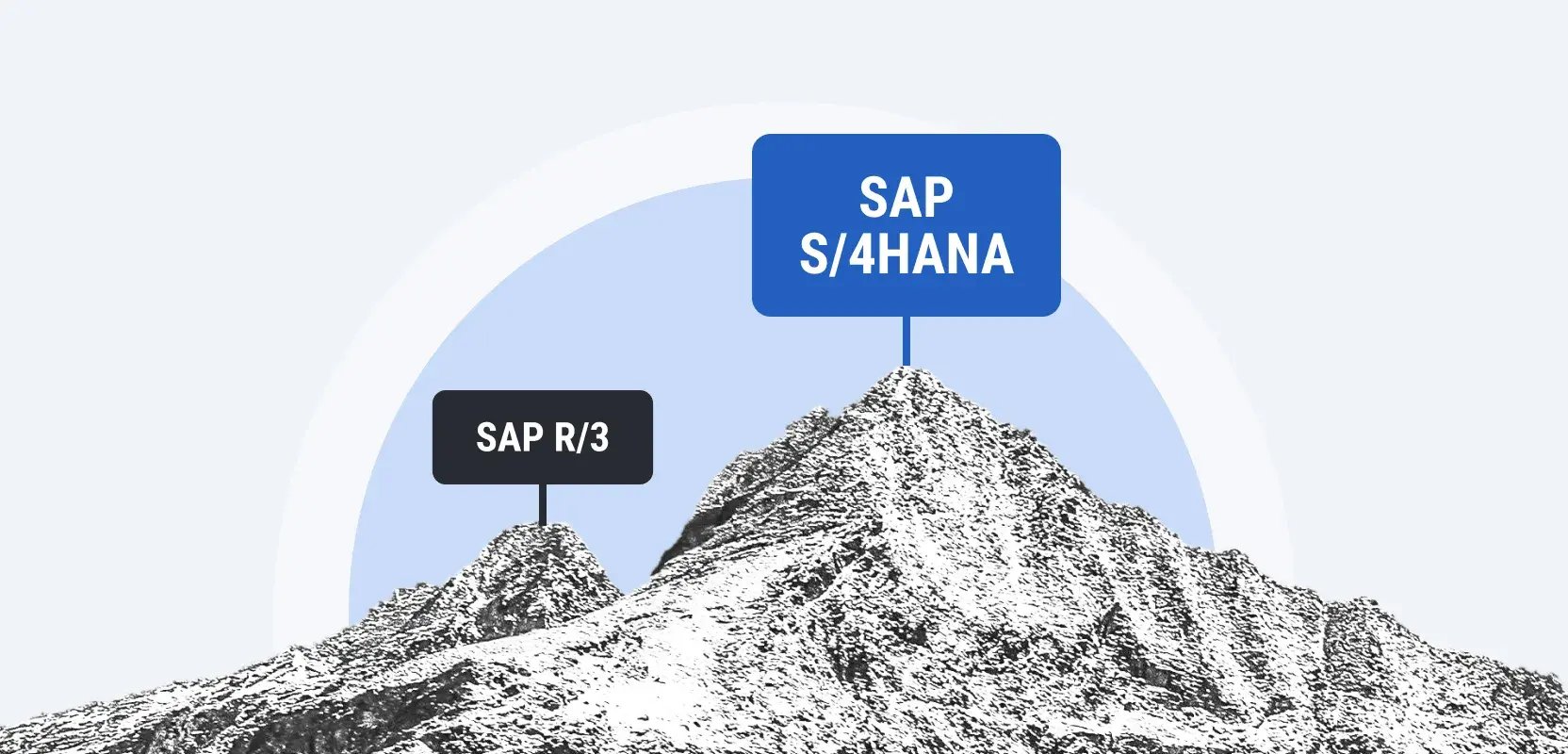
This article examines what staying on SAP R/3 in 2026 actually means for U.S. enterprises. It also outlines what options exist to protect data, maintain system reliability, and prepare the ERP foundation for analytics and AI workloads that R/3 was never designed to support.
When SAP R/3 Becomes a Business Constraint
SAP R/3 is often described as a stable core system that “still runs.” In 2026, that description misses the real issue. The platform no longer evolves with the business it supports. Its technical limits now define what the enterprise can and cannot do.
SAP R/3 was the first real-time ERP system, but it was designed for a different scale and operating model. To avoid database locking and performance degradation, it relies heavily on asynchronous updates, batch processing, and pre-aggregated tables. Financial close activities depend on scheduled jobs. Reporting often requires replicated data or external warehouses. Changes to core logic move through transport-heavy release cycles. These design characteristics slow response when pricing models change, supply chains shift, or regulatory requirements tighten.
This creates a management problem. When core finance and logistics cannot adapt quickly, strategic decisions are either delayed or made using obsolete data. Mergers require extended system harmonization. New digital products demand parallel systems. Each workaround increases operational complexity and audit exposure.
The approaching end of SAP R/3 support turns this situation into a fiduciary issue. After 2027, enterprises running SAP R/3 will depend on custom fixes, extended maintenance contracts, or unsupported components. These choices introduce measurable risks: higher outage probability, limited security patching, and growing dependence on scarce R/3 specialists. For U.S. public companies, these are not abstract concerns. They affect internal controls, SOX compliance, and disclosure obligations.
From an investor perspective, prolonged reliance on SAP R/3 signals constrained execution capability. It raises questions about data reliability, scalability, and the cost of future transformation. Stability under these conditions is not a strength. It is an operational liability that directly impacts enterprise valuation.
SAP Activate methodology structure
This component provides a modular implementation structure to support cloud, on-premises, and hybrid deployment models. In any scenario, all stakeholders get a validated sequence of steps and tasks that result in the global ERP transformation. The peculiarity lies in the combination of Waterfall planning and Agile sprints, allowing for prompt system refinements in small cycles, well-defined timelines, and a clear budget structure.
The Architectural Reason SAP R/3 Slows the Business
These business constraints come from the system’s architecture. SAP R/3 was built for a different operating model, and its technical design now limits how quickly the enterprise can act.
A system built for recording, not reaction
SAP R/3 was designed as a system of record. Its database layer stores transactions efficiently, but it assumes that analysis happens later. Data is written first, processed later, and reviewed after batch jobs complete. In 2026, this delay is no longer acceptable for finance, supply chain, or pricing decisions that depend on current data — not yesterday’s snapshot.
The end of waiting cycles
The move from AnyDB to SAP HANA is often described as a performance upgrade. That description is incomplete. The real change is the removal of waiting periods.
In S/4HANA, transactions and analytics run on the same in-memory dataset. Financial close activities no longer depend on overnight aggregation. Inventory positions can be evaluated while postings are still in progress. Planning cycles shorten because the system no longer separates operational data from analytical views.
No chance for AI adoption
SAP R/3 also creates a hard barrier for AI adoption. Modern AI tools require structured business objects, consistent data definitions, and documented relationships between entities. R/3 does not provide this semantic layer in a form that AI systems can reliably use.
SAP Joule and other generative AI services depend on components that exist only in modern SAP environments. These include the SAP HANA Cloud Vector Engine and the RESTful ABAP Programming Model (RAP). Legacy SAP R/3 and SAP ECC systems do not support these technologies. As a result, Joule cannot be mapped, replicated, or attached to R/3 through integration or data extraction. The limitation is architectural, not contractual.
For U.S. enterprises, this distinction matters. S/4HANA is not an enhancement that improves access to AI capabilities. It is the only SAP ERP platform that can support them in production scenarios.
Decision speed and user interaction
The same gap appears at the user level. SAP GUI remains functional, but it is optimized for data entry, not decision-making. SAP Fiori applications, embedded analytics, and conversational interfaces in S/4HANA reduce the steps between a question and an answer. Managers act on live figures instead of exported reports.
This change affects adoption, speed, and talent retention. It also changes how quickly the organization can respond when conditions shift.
The Silver Tsunami and the Talent Gap SAP R/3 Creates
The Silver Tsunami is another reason SAP R/3 has become a business risk. Many SAP R/3 systems in U.S. enterprises were implemented and customized decades ago. The specialists who designed these environments understand the logic behind custom programs, interfaces, and data structures. A significant portion of this knowledge exists only in experience, not in documentation.
As these specialists retire, maintaining SAP R/3 becomes slower and more difficult. Change requests require extended analysis. Defects take longer to resolve. Risk assessments rely on assumptions rather than system understanding. When internal R/3 expertise declines, the system becomes resistant to change, even when business requirements are clear.
This skills gap also affects hiring. SAP R/3 development and SAP GUI-based work attract fewer candidates each year. Younger professionals focus on platforms that use modern data models, APIs, and user interfaces. SAP S/4HANA aligns with these expectations through standardized business objects, modern development frameworks, and browser-based access. Migration reduces dependence on shrinking skill pools and restores long-term maintainability of the ERP landscape.
The Cost of Waiting: Financial Impacts of Delaying S/4HANA
For finance leaders, the question is no longer whether migration delivers value. The more immediate question is what the delay costs.
In 2026, demand for S/4HANA migration services is already tightening the market. Skilled consultants are booked earlier, project timelines stretch, and rates increase as enterprises rush to avoid unsupported systems. Waiting until 2027 shifts the same work into a more expensive and less predictable environment.
Estimates also indicate that waiting until next year could increase implementation expenses by 30–50% due to higher hourly rates and limited project capacity.
There are also financial mechanisms that change the economics of acting now. In the U.S., software modernization work often falls under Section 174, which requires capitalization and amortization of development costs. This creates a different cash flow profile than large, one-time upgrade projects of the past. SAP programs such as RISE with SAP also include commercial incentives that can offset transition costs when contracts are structured early rather than under deadline pressure.
Finally, S/4HANA affects working capital in measurable ways. Real-time access to receivables, credit exposure, and dispute status shortens the time between billing and cash collection. Finance teams no longer wait for batch reports to identify blocked invoices or overdue accounts. Improved visibility directly impacts Day Sales Outstanding and liquidity. From a CFO perspective, migration shifts from a future return discussion to a present cost control decision.
Why 20 Years of Custom Code Makes Migration Critical
The challenges of SAP R/3 are not only architectural, operational, or financial. They are also deeply technical.
Decades of custom ABAP code, which was built to patch, extend, or bypass limitations in the original system, have created a layer of complexity that slows every change. These modifications were important in their time, but today they make upgrades riskier and more costly. Each new request or integration risks unexpected consequences: the system works, but its logic is fragile.
This “spaghetti ABAP” problem highlights why S/4HANA adoption is more than a performance upgrade. Modern migration approaches do not simply copy old code into the new system. Instead, essential processes are re-platformed, while unnecessary or obsolete customizations are retired. The result is a clean S/4HANA core that maintains critical business functions without carrying over decades of hidden technical debt.
A clean core improves predictability. Updates and enhancements take less time. Analytics, reporting, and AI can access operational data directly. Handling legacy code systematically removes one of the main technical limits of R/3.
SAP R/3 vs. S/4HANA: Key Differences at a Glance
We have just examined how decades of custom ABAP create hidden complexity and slow change. Beyond custom code, the platforms differ in foundational capabilities that affect performance, reporting, and intelligence. Understanding these differences helps clarify why migration to S/4HANA should be a top priority for R/3 users right now.
The table below shows the key architectural and functional distinctions between SAP R/3 (legacy) and SAP S/4HANA (modern core) across four critical areas: database, reporting, custom code, and intelligence.
| SAP R/3 (Legacy) | SAP S/4HANA | |
| Database | Relational databases (AnyDB); transactional and analytical data are separated; batch processing is required for reports | In-memory HANA database; transactional and analytical data combined; real-time processing without batch delays |
| Reporting | Depends on replicated or external data warehouses; limited live insights | Embedded analytics and live reporting; managers access operational data as it is posted |
| Custom Code | Heavy legacy ABAP; fragile and hard to maintain; many obsolete routines | Critical processes re-platformed on S/4HANA or BTP; obsolete code retired; clean core maintained |
| Intelligence | No native AI or machine learning; external ETL and mapping required | Native AI and machine learning access structured business objects; supports predictive analytics and real-time insights |
Ready for 2027? Planning Your S/4HANA Transformation
SAP R/3 limits speed, increases risk, and makes change harder each year. S/4HANA removes those limits, but only if the move is planned and controlled. Migration is not a single event. It is a sequence of technical and organizational steps that reduce risk before the system is switched.
The roadmap below reflects a common structure used by U.S. enterprises. Exact timing depends on system size, custom code volume, and business scope. The phases are shown to illustrate order and intent, not fixed deadlines.
Phase 1: Discovery & audit (4–6 weeks)
Analyze the current R/3 landscape. Identify custom ABAP, unused functions, interfaces, and data quality issues. The outcome is a COI and technical debt report that shows what must move, what should be changed, and what can be removed.
Phase 2: Clean core preparation (2–3 months)
Separate essential business logic from legacy custom code. Retire obsolete programs and clean master and transactional data. A side-by-side BTP setup is used to test new designs without touching production. This step reduces migration risk before execution begins.
Phase 3: Execution (6–12 months)
Convert to S/4HANA in controlled stages. Central Finance or selective module go-lives allow finance and logistics to continue operating during the transition. Reporting and interfaces are validated at each step to avoid downtime and data gaps.
Phase 4: AI and advanced analytics (ongoing)
After migration, S/4HANA provides the data structure required for predictive analytics and SAP Joule. Finance, supply chain, and operations teams can work with current data instead of batch-based reports.
Secure Your 2027 Window
Support timelines are fixed, but consulting capacity is not. In 2026, experienced S/4HANA teams are already booking projects well in advance. Beginning now allows for realistic planning, stable teams, and controlled costs. Delaying increases the chance of compressed timelines, higher rates, and operational pressure.
The right partner matters. A strong migration vendor brings proven methods, clear governance, and teams that understand U.S. compliance and enterprise complexity. LeverX supports businesses through each migration phase, from audit to go-live, with a focus on control, transparency, and predictable outcomes.