AI has entered everyday HR work faster than many organizations have formalized its use. SAP Business AI can help close the gap across the employee lifecycle.
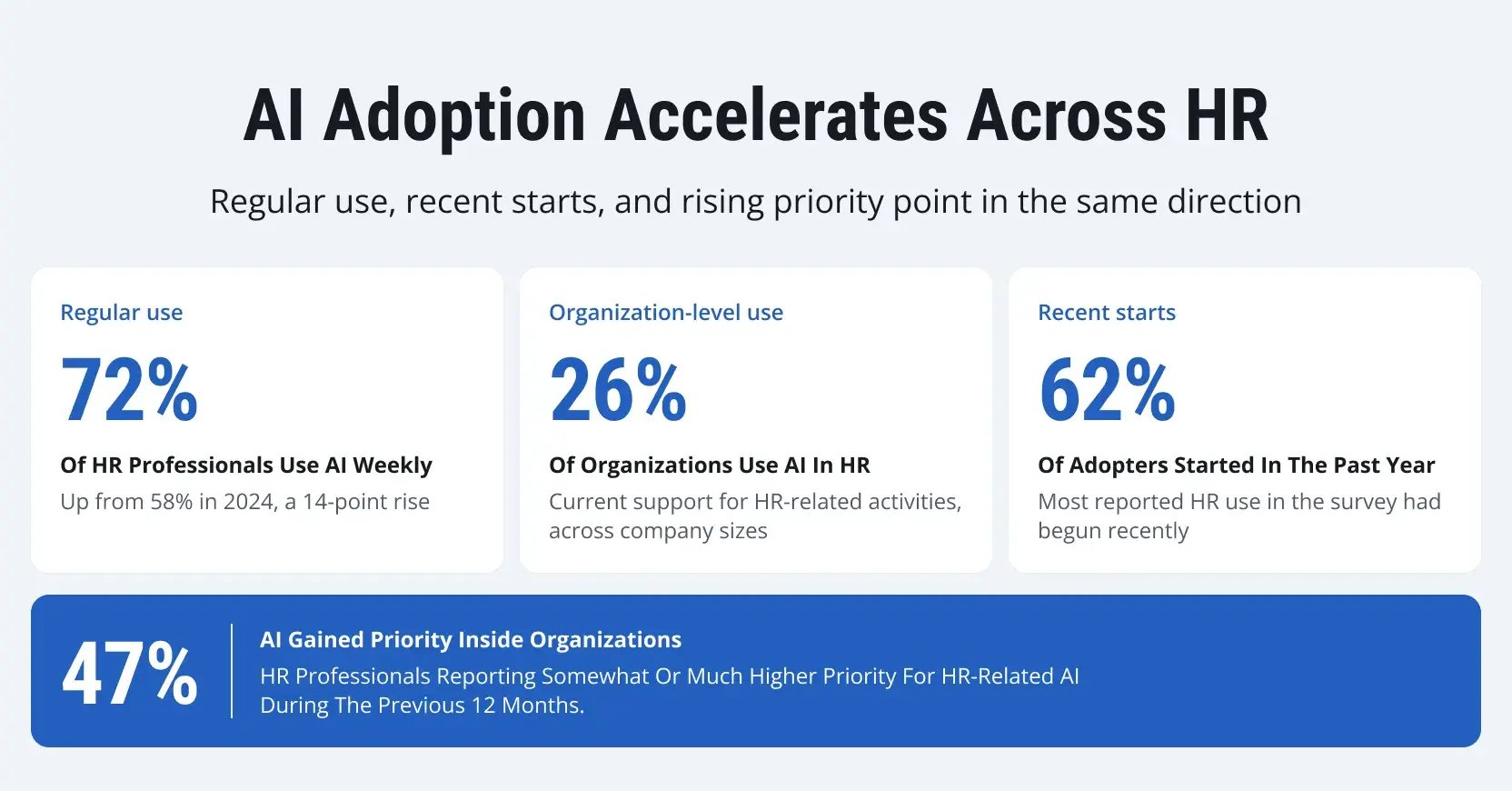
By 2025, nearly three-quarters of HR practitioners (72%) were using AI tools on a weekly basis, compared to just 58% a year earlier, according to HireVue’s survey of 4,000+ industry employees and professionals. Climbing 14 percentage points in twelve months illustrates just how fast automated platforms moved into core operational roles.
Organizational metrics paint a similar picture. In a SHRM study of 2,366 US HR professionals, 26% reported active AI usage for talent and HR tasks. Crucially, 62% of those active users had introduced the technology within the past year alone, while 47% confirmed that AI initiatives gained explicit priority during that window. Even with distinct sampling methodologies, both reports point to the same outcome: rapid and widespread institutional adoption.
 Sources: HireVue, SHRM
Why Businesses are Accelerating AI Adoption in HR
Workload, costs, and productivity
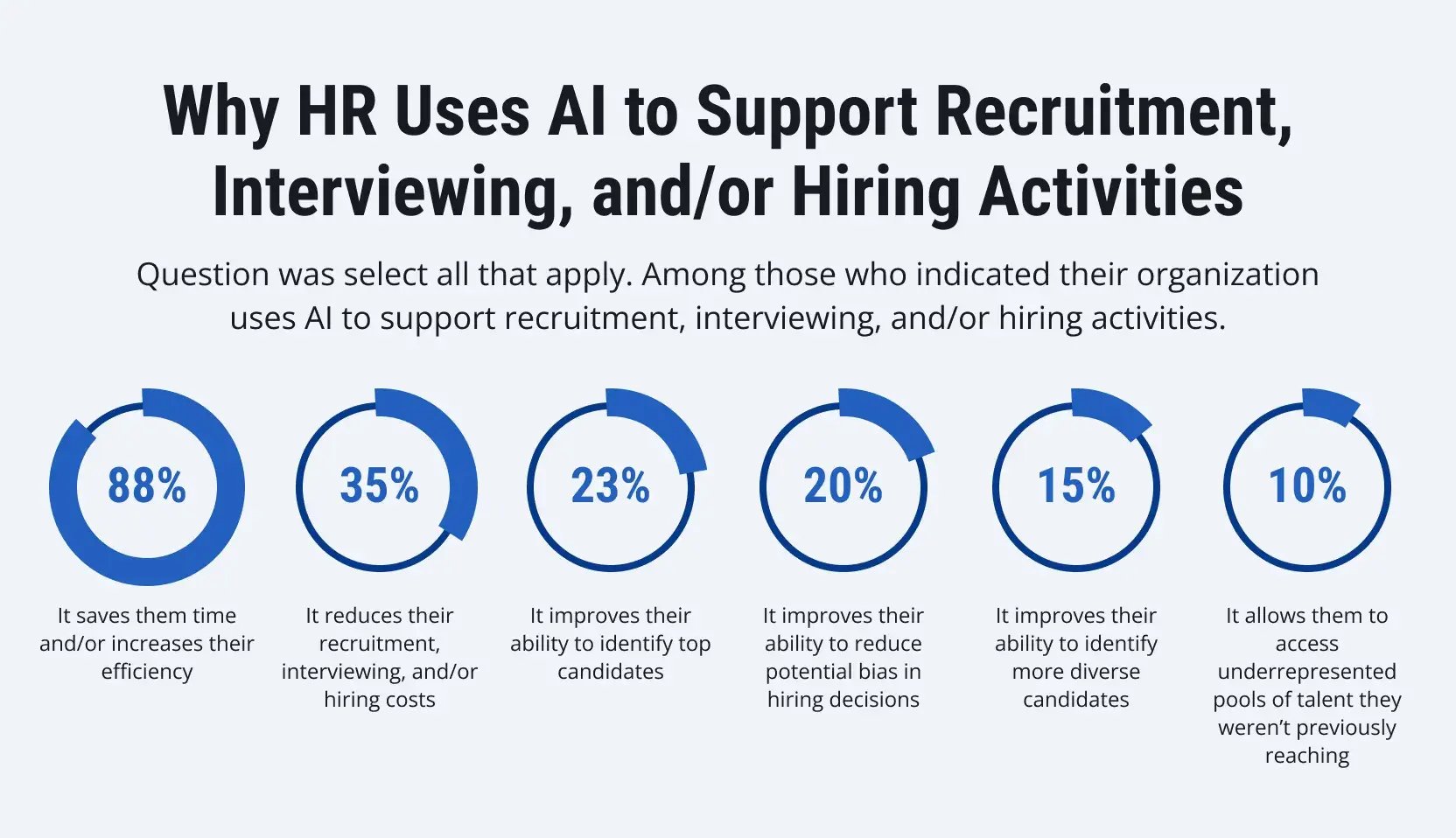
Workload provides the clearest documented driver. HR teams handle high volumes of data and recurring work before specialists reach decisions requiring human judgment. In the SHRM survey, 88% of organizations using AI in recruitment cited time savings or higher efficiency; 35% also cited lower recruitment, interviewing, or hiring costs. HireVue’s global study reinforces the economic case, with HR leaders reporting 63% greater productivity.
Reported results help sustain investment. Among SHRM respondents using AI in recruitment, 52% said the time required to fill open positions had improved, and 49% reported improvement in the volume of applications that required manual review. Those outcomes connect the efficiency claim to measures companies can track during hiring.
Stronger talent outcomes
Organizations also evaluate the quality of HR outcomes. Among recruitment users, 23% cited a stronger ability to identify top candidates, while 20% cited a stronger ability to reduce potential bias in hiring decisions. The same focus appears in learning and development. Among organizations using AI in this manner, 51% reported more effective programs and 44% reported higher employee engagement. These measures give leaders evidence for continued investment after the initial productivity gains.
Human intelligence and role transformation
Three in four HR professionals expect advances in AI to increase the importance of human intelligence in the workplace over the next five years. Among organizations already using AI, 32% reported transformed jobs or roles, while 2% reported worker displacement. The 16-to-1 difference supports investment aimed at reallocating routine work, while keeping people accountable for decisions that affect employees.
How HR Teams Use SAP Business AI Across the Employee Lifecycle
AI adoption in HR currently concentrates on three areas that involve substantial amounts of text, employee data, and recurring preparation.
Recruiting, interviewing, and hiring
Recruiting records the broadest AI adoption within HR. Among organizations using AI in this area:
- 65% generate job descriptions.
- 42% customize postings for specific candidate groups.
- 34% apply AI to resume review.
- 33% use it to communicate with applicants or automate candidate searches.
Usage drops closer to candidate evaluation. 10% use AI to pre-select applicants for interviews, 7% conduct AI-powered pre-screening interviews, and 3% analyze interview performance. Current adoption, therefore, concentrates on drafting, search, communication, and initial review; recruiters retain control over assessments that directly affect candidates.
This approach provides measurable outcomes.
 Source: SHRM, 2024 Talent Trends
SAP Business AI for recruiting
SAP SuccessFactors Recruiting places AI assistance at several stages of the hiring process. AI assistance can help businesses:
- Generate or refine job descriptions.
- Improve clarity.
- Flag language that may introduce bias or exclude qualified applicants.
- Identify relevant capabilities in job requisitions and resumes.
- Ask role-specific questions based on the requirements of the vacancy.
Consider a recruiter preparing a vacancy notice for a data analyst. After the recruiter enters the responsibilities and required skills, the writing capability in SAP SuccessFactors Recruiting produces a job-description draft. Text analysis highlights wording that could restrict the applicant pool and suggests a clearer alternative. When applications arrive, skills matching shows how each resume aligns with the role. Before the interviews, the system generates questions connected to the required competencies. The recruiter reviews every suggestion and remains responsible for shortlisting and selection.
Customer results demonstrate the potential effect at scale. Darussalam Assets reported a 75% reduction in recruitment time after introducing automated resume screening and AI-driven candidate scoring with SAP SuccessFactors.
Learning and development
Learning and development ranks second among HR utilization of AI. Personalization accounts for the most common use:
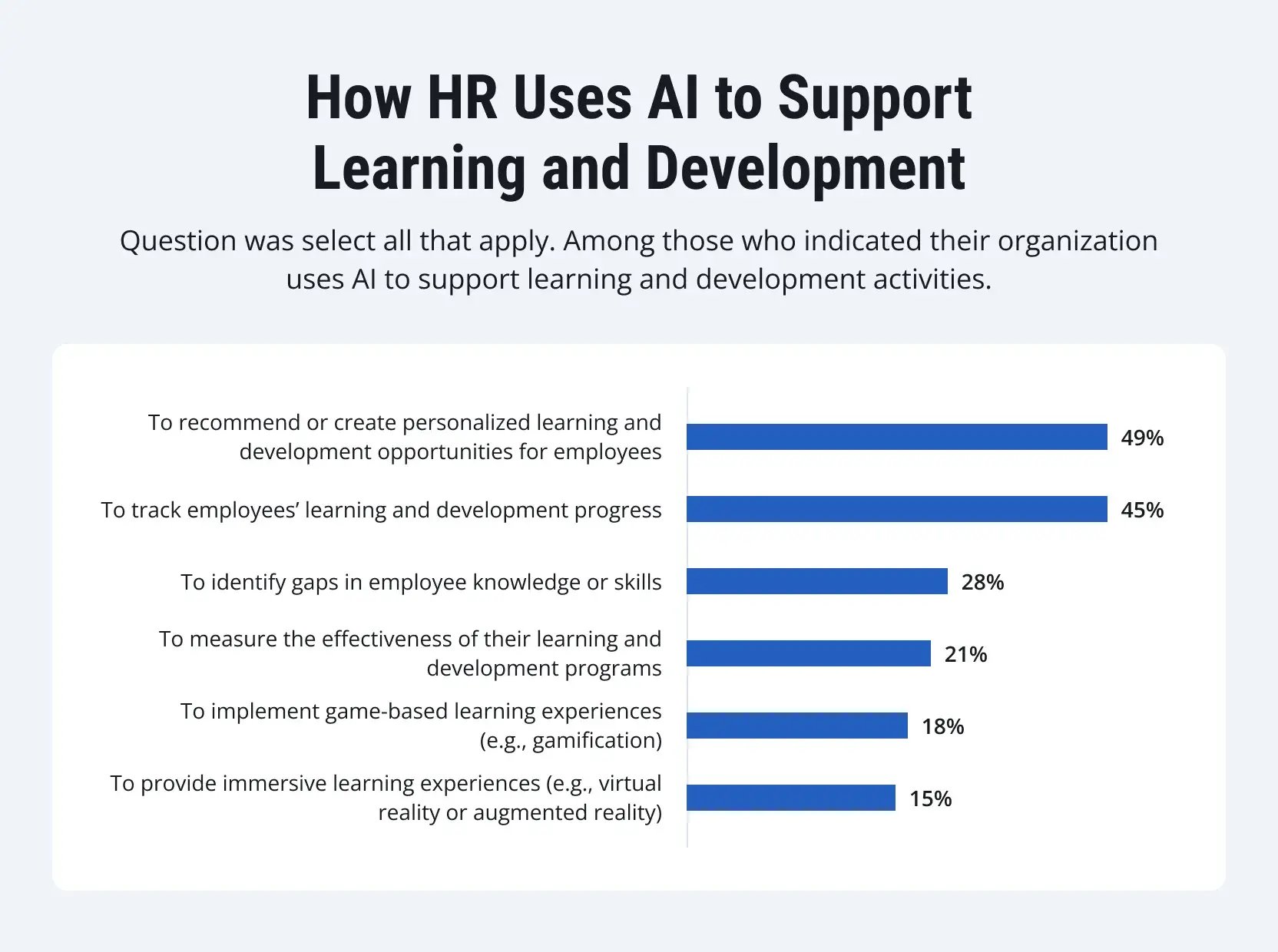 Source: SHRM, 2024 Talent Trends
These activities connect learning decisions with employee data and changing skill requirements. Among AI users in L&D:
- 51% reported more effective programs.
- 44% recorded higher employee engagement.
- 36% gained stronger data support for decisions about their learning portfolio.
- 33% reduced L&D-related costs.
SAP Business AI for learning and development
Embedded AI in SAP SuccessFactors can infer the skills associated with learning content, add relevant tags to courses, and recommend opportunities aligned with an employee’s current role or prospects. SAP SuccessFactors Talent Intelligence Hub organizes skills and related attributes across SuccessFactors, allowing learning recommendations and talent processes to use a shared skills foundation. Joule provides a conversational interface through which employees can request guidance and proceed to relevant development activities.
For example, an employee considering a move from customer support into service operations can record their capabilities in a Growth Portfolio and explore the requirements of the target role. SAP SuccessFactors can help them identify missing skills and recommend suitable learning content. HR can review aggregated skill needs when deciding which programs require additional investment, helping connect individual development choices with anticipated workforce demand.
Delta Air Lines provides a practical example. The company uses Talent Intelligence Hub to support personalized growth portfolios and connect employee skills with tailored learning opportunities.
Performance management
Organizations primarily use AI in performance management to prepare goals, feedback, and review materials. Among companies applying AI in this area:
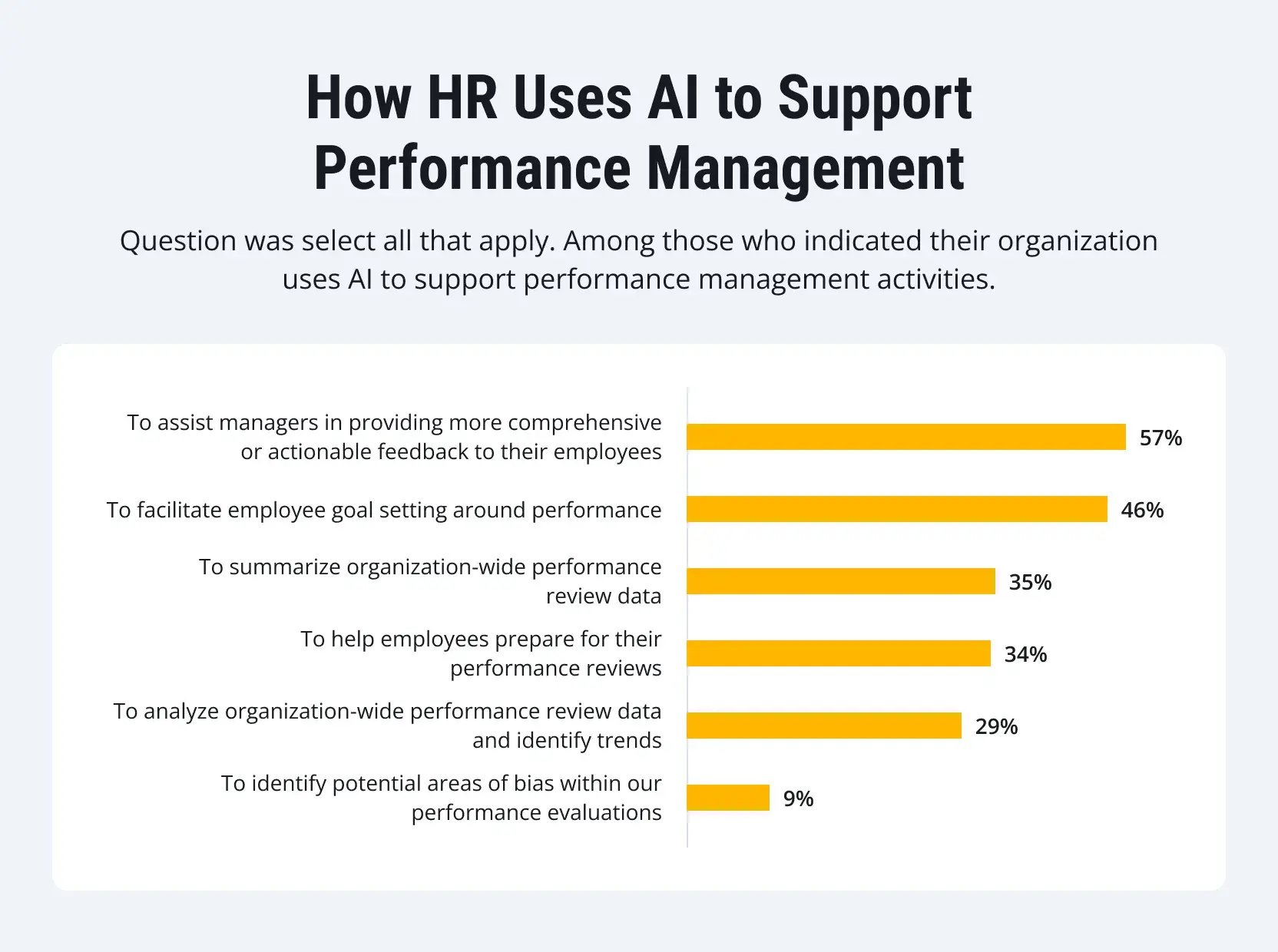 Source: SHRM, 2024 Talent Trends
SAP Business AI for performance management
SAP SuccessFactors Performance & Goals can create draft performance or development goals from a description supplied by an employee or manager. The generated content may include the goal name, detailed expectations, and measures of success. AI-assisted writing can refine review comments and feedback, while embedded capabilities summarize feedback and identify patterns in performance data. Through Joule, a user can enter a request, such as “Help me set goals for my new role,” and continue within the relevant SuccessFactors process.
Or a manager can provide the employee’s role, current priorities, and expected result for a six-month project. The system proposes a measurable goal with success criteria. The manager and employee then review its scope and wording before saving it. When the review cycle approaches, AI summarization brings together existing feedback and recorded achievements, giving the manager focused material for the discussion. The manager verifies the underlying information and retains responsibility for the final evaluation.
Prepare Your Organization for AI-Enabled HR with LeverX
70% of organizations using AI for HR-related activities have encountered at least one challenge. Security and privacy concerns lead at 40%, followed by employee resistance or lack of trust at 21%. Another 17% lack the time, budget, or staff needed to audit and correct algorithms, while 15% report resistance among executives.
The remaining findings connect data quality and oversight with direct employee impact. 13% cite insufficient data, and the same share report limited transparency into AI decisions. 12% struggle to keep models aligned with changing HR needs. In some organizations, AI has overlooked qualified candidates or employees at 9%, while 5% have seen it reproduce patterns of bias from historical data.
These risks can reinforce one another. That's why preparation for implementing AI into the corporate HR processes should cover the full period from use-case selection to post-launch monitoring.
Start with a focused use case and define success criteria
Risk signal:
56% of HR functions do not formally measure AI success, and only 16% use ROI.
Action:
- Select one process with a measurable workload.
- Record its baseline, target result, responsible owner, human approval points, and expected cost.
- Compare available Base and Premium AI capabilities before considering custom development.
LeverX role:
Our SAP SuccessFactors readiness assessment can map the current process and system landscape. LeverX can also evaluate technical feasibility, select an appropriate SAP capability, and estimate licensing, integration, AI Units, and support requirements.
Prepare your HR data and integrations
Risk signal:
Security and privacy concern 40% of organizations using AI in HR, while 13% report insufficient data.
Action:
- Identify the authoritative source for every required field.
- Correct duplicate records, outdated profiles, inconsistent skill names, and missing values.
- Restrict access to the data required by each use case and check whether records adequately represent different roles, locations, and career paths.
LeverX role:
LeverX data consulting covers data readiness, quality controls, migration, and SAP or third-party integrations. Our SAP security services can add role-based authorization, data masking, encryption, and secure transfer controls.
Establish governance, trust, and responsible AI in HR
Risk signal:
Employee distrust affects 21% of AI users, executive distrust affects 15%, and 13% report limited transparency. Among organizations purchasing AI tools, only one in three considers its vendors very transparent about safeguards against discrimination or bias.
Action:
- Maintain a register for every HR AI use case that records its purpose, data sources, owner, human-review rule, and audit schedule.
- Inform users when AI contributes to an output and provide a procedure for reporting errors.
- Hiring, compensation, promotion, performance, and termination decisions should always remain subject to authorized human approval.
|
SAP’s responsible AI framework covers fairness, privacy, human oversight, transparency, and accountability. SAP also applies an ethics impact assessment to its AI use cases. |
LeverX role:
Our team can convert governance policies into role permissions, approval steps, system logs, and audit procedures. LeverX’s security assessments and GRC services can identify control gaps before the use case reaches employees or candidates.
Test AI under human review
Risk signal:
17% of organizations lack the resources to audit or correct algorithms. 9% report overlooked qualified people, while 5% have encountered repeated bias.
Action:
- Test the use case with representative historical records and edge cases.
- Compare AI output with structured human review, then measure errors, missed candidates, overrides, processing time, and outcomes across relevant groups.
- Set thresholds for correction, suspension, and rollback.
LeverX role:
LeverX can configure the pilot, connect its data sources, and conduct functional, integration, regression, security, and user acceptance testing. Our team can activate a standard SuccessFactors capability or implement a specialized use case through SAP BTP and SAP AI Core.
Train users and monitor AI performance
Risk signal:
Employee and executive trust problems continue after deployment, while 12% of organizations struggle to keep AI aligned with changing HR requirements.
Action:
- Explain where AI participates in each process, which data it uses, who reviews its output, and how users can report a problem.
- After launch, monitor errors, overrides, complaints, data quality, group-level outcomes, and AI Units consumption.
- Repeat testing after material changes to HR policies, source data, job architecture, AI models, or SAP releases.
- Scale the rollout only after each use case has a named owner, documented data scope, approval rule, performance baseline, user guidance, and scheduled review.
LeverX role:
We can provide communication planning, role-specific training, post-launch monitoring, troubleshooting, and application optimization as part of a SuccessFactors rollout.
Turn SAP Business AI into HR Efficiency
The 72% weekly-use rate among HR professionals and the 26% organization-level adoption rate come from different respondent groups, yet together they point to the same transition: AI has entered routine HR work faster than organizations have formalized its use. That uneven pace helps explain why 70% of adopters have encountered challenges.
Organizations therefore need to bring the AI activity already occurring in HR into defined processes. SAP Business AI supports that shift within SAP SuccessFactors, where each use case can rely on approved data and process-level measurement.
LeverX can configure the required workflows and controls around your existing SuccessFactors landscape and the HR outcome you want to improve. Contact our team to identify the use case with the strongest measurable potential and establish the conditions required for wider adoption.


.webp)