Most oil and gas companies invest in digital technologies, yet many initiatives stay at the pilot stage. This article explores what changes when SAP becomes part of their landscape.
Digital transformation in oil and gas didn’t happen overnight. Around 2017, companies started introducing digital tools across different parts of the value chain — from upstream operations to refining and distribution.
The drivers were fairly clear: operations were getting more complex, markets less predictable, and events like the COVID-19 pandemic added pressure. Over time, these tools stopped being separate initiatives and became part of daily work, influencing how maintenance, assets, and processes are handled.
At the same time, the industry still runs on heavy capital investment. Small inefficiencies don’t stay minor for long, which makes structured asset management and better visibility across systems a practical necessity.
SAP is often used as that foundation. In the article, we’ll look at how SAP supports digital transformation in oil and gas and where it delivers the most practical impact.
The State of Digital Transformation in Oil & Gas
Digital transformation efforts in oil and gas are ongoing but uneven. Companies keep investing in new technologies, yet scaling them across operations is still not straightforward. According to McKinsey & Company, around 70% of organizations remain in the pilot phase of digital transformation.
The industry continues to invest more in digital transformation. In 2023, spending reached $30.2 billion, with further growth expected. Most of it goes into AI, machine learning, cloud platforms, and IoT, especially where operations need clearer visibility and less manual coordination.
COVID-19 forced a faster rollout. Adoption increased by around 40%, and remote monitoring became a necessity rather than a roadmap item. The shift showed that digital tools can operate at scale but also made it clear that many systems weren’t designed to work together that way.
The pace and focus of adoption differ across regions. North America is leading in execution, especially in shale operations where efficiency improvements quickly affect production. In the Middle East, investment is concentrated on large-scale smart oilfield projects, while European companies emphasize sustainability-led digital initiatives within broader energy transition programs.
Core Pillars of Digital Transformation in Oil & Gas
Digital transformation in oil and gas is starting to reshape day-to-day operations, decision-making, and the way assets are actually used across the value chain. Most of the tangible impact comes from changes in these areas.
Production monitoring and optimization
Production teams now work with data as it comes in, not after shifts or reports are closed. Sensors across facilities pick up pressure, temperature, and flow, and this stream is used directly in operations. If something starts to drift, it’s usually caught early enough to correct without major impact. Over time, that helps keep output steady and avoids underused equipment.
Predictive maintenance and asset performance
Maintenance is no longer tied as strictly to fixed schedules. In many cases, decisions are based on how equipment is actually performing. By looking at condition data and recurring patterns, teams can spot early signs of failure and act before something breaks. This helps avoid unexpected downtime and makes better use of maintenance resources, which matters when every hour offline is expensive.
Reservoir management and field development
Work with subsurface assets is increasingly tied to digital models rather than static assumptions. Engineers run simulations, check different scenarios, and adjust well placement before committing in the field. This doesn’t remove uncertainty, but it reduces it enough to plan more confidently and improve recovery over time.
Safety and risk management
Even with digital tools in place, safety stays at the center, especially in more hazardous environments. What changes is how exposure is managed. Remote monitoring and automated inspections reduce the need for manual intervention, and data gives earlier signals when something starts to deviate from normal conditions.
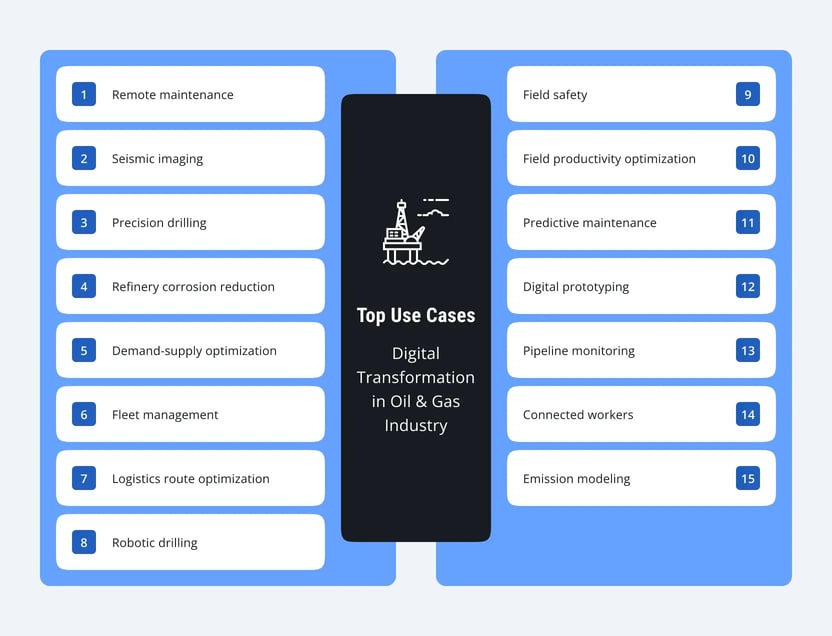
Technologies Behind Digital Transformation
Artificial intelligence and machine learning
AI and ML are now used across multiple stages of oil and gas operations, from maintenance to forecasting. The market is projected to reach $4.01 billion, which reflects growing reliance on these technologies.
In maintenance, models can identify failure patterns several weeks in advance, helping reduce unplanned downtime by up to 35%. In drilling, AI improves efficiency by 15–20% by analyzing real-time and historical data together.
In seismic interpretation, AI accelerates data processing significantly — up to 100 times faster in some cases — reducing analysis time. In production planning, forecasting models achieve accuracy above 90%, which supports more stable planning and better financial visibility.
IoT and sensor technologies
IoT is already embedded in how oil and gas operations run. Devices collect data continuously across assets and infrastructure, and the market is expected to reach $39.4 billion. This reflects how widely these systems are being deployed.
In practice, IoT underpins real-time monitoring. Large pipeline networks may operate with tens of thousands of connected sensors, tracking leaks, pressure, and flow. At the wellhead, wireless systems monitor key parameters with uptime close to 99.9%, which reduces the need for manual checks and shortens response time.
Monitoring has also become more detailed. Sensors now capture vibration, temperature patterns, and acoustic signals, not just basic readings. These inputs help identify early signs of failure — in many cases preventing serious equipment issues. The same networks are used for emissions tracking, which makes it easier to stay within regulatory limits and react faster when conditions change.
Data analytics and visualization
Operational data on its own doesn’t do much. The shift happens when it’s processed and interpreted in a way teams can actually use. Analytics platforms help with that — they reduce the time between “data captured” and “decision made” and make coordination less dependent on manual updates.
In oil and gas, this usually means pulling together inputs from different places — sensors, maintenance tools, production records, logs — and presenting them in one view. With visualization, teams can follow what’s happening as it unfolds, not hours later, and react with fewer assumptions.
Robotics and autonomous systems
Access has always been a constraint in certain oil and gas environments. Now, it’s handled differently. Drones and autonomous systems are used where sending people would be risky or inefficient.
These tools are part of pipeline inspections, offshore maintenance, and facility monitoring. They reduce the amount of manual work involved and make inspections more predictable. Operations can continue in parallel instead of being stopped for checks.
Cloud computing
Cloud solutions are becoming the default foundation for data in oil and gas. The market is expected to grow at about 9.2% annually through 2028, which reflects how quickly companies are moving away from purely on-prem setups.
The reason is mostly practical. Data volumes are too large and too variable to manage efficiently in traditional environments. Cloud infrastructure handles seismic data, production data, and sensor inputs without the same constraints, and it makes advanced tools — simulation, modeling, optimization — more broadly available.
At the same time, edge computing is used where delays are not acceptable. In remote locations, processing data locally can reduce latency by 60–80%, which directly affects control over drilling and production processes. Most companies combine both approaches. Hybrid models allow them to scale when needed while keeping sensitive data under tighter control, and in many cases reduce infrastructure costs by 30–40%.
Blockchain
Blockchain is being explored for supply chain transparency and secure data exchange, particularly in multi-party environments. It enables traceability of transactions, improves trust between partners, and supports more efficient coordination across complex supply chains.
Big data technologies
Big data analytics supports processing of large and complex datasets. The market is projected to grow at a CAGR of 10.8%, driven by the need for better operational insights and faster analytical processing.
This is especially relevant in oil and gas, where data volumes are high, data formats vary, and decisions often depend on combining engineering, operational, and commercial inputs within the same analytical environment.
Digital twins and simulation
Digital twins create virtual representations of physical assets such as offshore platforms, refineries, and pipeline systems. These models combine real-time sensor inputs, historical performance data, and engineering specifications to simulate asset behavior under changing conditions.
Their value is especially high in oil and gas because physical testing is often costly, time-consuming, and operationally risky. Digital twins allow operators to test scenarios, optimize maintenance schedules, evaluate process changes, and assess operational risks before making changes in the field.
In subsurface operations, reservoir digital twins support well placement decisions, recovery strategy optimization, and what-if analysis for field development. They can also reduce physical testing costs by 50% to 70%, while enabling faster optimization cycles and broader scenario analysis.

How SAP Oil & Gas Solutions Enable Digital Transformation
Managing operations in oil and gas usually means dealing with multiple systems and data sources. SAP helps reduce that fragmentation by connecting core domains within one landscape, so processes rely on the same data rather than parallel versions of it.
Core operations and process integration
SAP S/4HANA Oil and Gas supports end-to-end processes across finance, logistics, and asset management. Because operational and financial data are aligned, teams don’t have to reconcile differences later, and coordination across production and supply activities becomes more predictable.
Hydrocarbon supply and distribution
In hydrocarbon networks, planning only works if data stays consistent across systems. SAP oil & gas solutions are often used to bring demand planning, scheduling, and inventory into one flow. With SAP IBP and SAP S/4HANA, teams don’t have to reconcile separate versions of data as often, which makes day-to-day coordination less fragmented.
Field logistics and inventory management
Tracking assets in the field is less about counting and more about knowing where things actually are. Integrated logistics processes make that easier by connecting movements across sites. When fewer manual updates are involved, traceability improves, and inventory issues are usually caught earlier.
Asset performance and maintenance
Maintenance decisions are increasingly linked to equipment condition rather than schedules. SAP APM and SAP EAM connect planning with real asset data, which helps identify risks earlier and focus effort where it’s actually needed. This reduces downtime without overloading maintenance teams.
Sustainability and carbon data management
Managing carbon data requires consistency across multiple sources. SAP Sustainability Control Tower is used to consolidate that data and keep reporting aligned. With analytics on top, companies can track emission drivers and refine their approach instead of relying on static targets.
External services and contractor management
SAP oil & gas solutions provide a centralized environment for managing external services, including workflows, approvals, and performance tracking. This improves transparency, supports contract-based billing, and reduces risks associated with third-party providers.
Workforce management
Through SAP SuccessFactors, companies can manage workforce planning, payroll, compliance, and employee data within a single system. This helps standardize HR processes and maintain consistency across locations and teams.
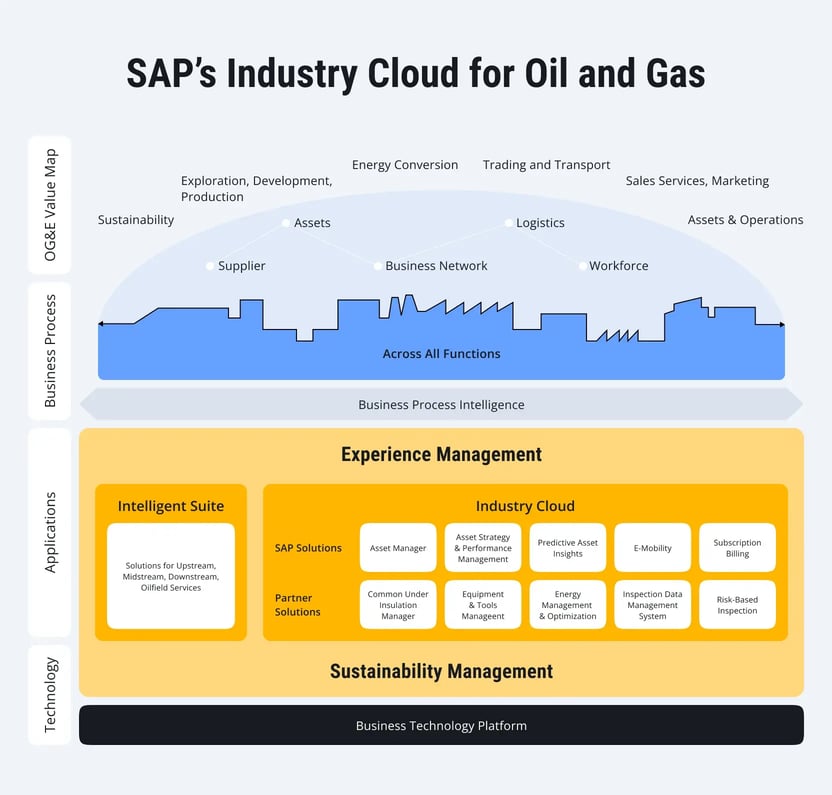
Upstream, Midstream, and Downstream Transformation Scenarios
Oil and gas digitalization doesn’t follow a single pattern. What it looks like depends on where it’s applied — in the field, in logistics, or closer to planning and processing. SAP is typically used as a common layer across these areas, so operations don’t run on disconnected data and separate workflows.
Upstream: Real-time production optimization and predictive operations
In upstream operations, digital initiatives often begin with a basic requirement — understanding what is happening in production and with equipment in real time. Data is collected from wells and assets through IoT integrations and brought into SAP S/4HANA and SAP BTP, where it can be accessed without switching between systems.
From there, the same data is used in analytics tools like SAP Analytics Cloud and linked with asset management in SAP APM. This creates a working environment where production data and equipment conditions are not reviewed separately but seen together.
In practice, this changes how teams react. Production can be adjusted while operations are running, maintenance is planned based on actual signals, and drilling decisions rely less on static assumptions. The main difference is timing — responses happen earlier, and downtime is less likely to build up.
Midstream: Network visibility and coordinated logistics
Midstream operations are less about extraction and more about coordination. Pipelines, terminals, and storage need to work as one system, even though they are physically distributed. SAP S/4HANA is often used to create that shared view, with SAP IBP supporting planning across the network.
Data from different sources flows through SAP BTP, which helps bring volumes, movements, and capacity constraints into one place. Analytics tools then make it easier to monitor performance and react when something starts to deviate.
This allows operators to adjust shipment schedules more dynamically, keep supply and demand better aligned, and track movements with fewer gaps. Over time, it leads to more stable operations and better control over how infrastructure is used.
Downstream: Refining optimization and integrated planning
In downstream, the focus shifts to refining performance and how closely production follows demand. A typical setup brings plant data, control systems, and planning into SAP S/4HANA, with SAP Analytics Cloud used on top to work with that data.
Process data is not just stored — it’s used while operations are running. Parameters can be adjusted in real time to stabilize yield and keep product quality within range. At the same time, planning tools like SAP IBP help align production with demand signals and supply constraints.
On the asset side, SAP EAM supports maintenance based on actual equipment behavior. This helps avoid unexpected shutdowns and keeps refining processes more stable over time.
Upstream, Midstream, and Downstream Transformation Overview
|
Pointers |
Upstream |
Midstream |
Downstream |
|
Business need |
Improve visibility into asset condition and production performance. Support stable operations in asset-intensive environments. |
Ensure transparency across transportation networks and coordinate flows between supply and demand. |
Increase operational efficiency and align production with market demand and planning cycles. |
|
Use case |
Asset performance monitoring, predictive maintenance, drilling and production optimization. |
Pipeline monitoring, inventory tracking, network scheduling, and logistics coordination. |
Refinery process optimization, demand-aligned production planning, and maintenance planning. |
|
SAP technologies |
|||
|
Technology layer |
Upstream |
Midstream |
Downstream |
|
Core system |
SAP S/4HANA for asset management and production coordination. |
SAP S/4HANA for logistics and transportation processes. |
SAP S/4HANA for production and financial integration. |
|
Integration and IoT |
SAP Business Technology Platform for sensor data integration and real-time monitoring. |
SAP Business Technology Platform for pipeline and storage system integration. |
SAP Business Technology Platform for plant data integration. |
|
AI and machine learning |
Predictive maintenance models, drilling optimization, anomaly detection in equipment behavior |
Flow optimization, demand forecasting, anomaly detection in pipeline operations |
Process optimization, yield improvement, predictive maintenance for refining assets |
|
Analytics and visualization |
SAP Analytics Cloud for production insights and performance tracking |
SAP Analytics Cloud for network visibility and scheduling analysis |
SAP Analytics Cloud for process and planning analytics |
|
Asset management |
SAP Asset Performance Management and SAP EAM for predictive and risk-based maintenance |
SAP EAM for infrastructure reliability |
SAP EAM for plant maintenance and shutdown planning |
|
Planning |
Integration of operational data with maintenance and production planning |
SAP Integrated Business Planning for supply-demand coordination |
SAP Integrated Business Planning for demand-driven production |
Challenges in Oil and Gas Digitalization Projects
Legacy systems and infrastructure constraints
A lot of core processes still run on systems that were put in place years ago. They weren’t built to connect with newer tools, and that shows up quickly once integration starts. Updating them is possible, but it tends to take time and budget. Replacing them entirely is even more complicated, because operations can’t just stop. In most cases, companies move in smaller steps, adding new layers around what already works instead of trying to rebuild everything at once.
Data integration and data quality
Even when data is available, using it is another matter. It comes from different places — sensors, control systems, older databases — and doesn’t line up automatically. Formats differ, parts of the data are incomplete, and quality varies. Without a clear way to bring this together, it’s hard to rely on analytics or automate anything beyond isolated cases.
Cybersecurity and data protection
When systems are connected, security becomes less static. New integrations, new data flows — all of this expands the attack surface in ways that aren’t always predictable. Protecting operations means monitoring continuously and revisiting assumptions about where risks might come from.
Regulatory compliance and data governance
Regulation is part of how the industry operates, not an external constraint. Any digital system has to account for safety standards, environmental requirements, and data protection rules. This usually introduces additional steps, especially around reporting and verification, which need to be managed alongside core operations.
Talent gap and workforce readiness
Digital work depends on capabilities that are not always available inside the organization. Finding people with the right background in data or development is one part of the problem. The other is helping current teams work differently. Without that, new tools remain underused, even if they are technically in place.
Change management and organizational alignment
Technology can be introduced relatively quickly. Changing habits takes longer. Teams need to understand not only what is changing, but why it matters in their daily work. Where that link is missing, adoption slows down. Alignment across functions becomes critical; otherwise, each unit moves in its own direction.
Scalability and investment justification
Digital initiatives often start as pilot projects, but scaling them across the organization introduces additional challenges. Companies need to ensure that solutions are flexible enough to adapt to changing business needs while also delivering measurable value. High initial investment costs increase the importance of clear ROI, which must be demonstrated before expanding initiatives further.
Key Benefits of SAP-Driven Digital Transformation
The effect of digital transformation becomes noticeable when systems are no longer fragmented. SAP energy industry solutions help create that connection, linking operational processes with financial results instead of treating them as separate layers.
Improved operational efficiency and asset utilization
With data from operations, maintenance, and planning combined in SAP S/4HANA and SAP Analytics Cloud, teams don’t have to rely on delayed reports. They see changes as they happen and adjust accordingly. This reduces process gaps and improves coordination across functions. Over time, companies typically see efficiency improvements of up to 20%.
Reduced downtime and maintenance costs
Maintenance starts to look different when it’s based on how equipment actually behaves. With SAP Asset Performance Management and SAP EAM, teams don’t have to rely only on fixed schedules — they act on early signals instead. That helps avoid unexpected outages and makes maintenance timing more precise. In practice, companies often see costs drop by up to 30%, along with more stable equipment performance.
Lower operating costs and improved margins
Cost reduction usually comes from small changes adding up. Fewer manual steps, cleaner data, and better visibility across processes all play a role. When workflows are automated and decisions are based on consistent data, and operations run with less friction. This can reduce operating costs by 15–25%, with a noticeable effect on margins in asset-heavy environments.
Increased production and better planning accuracy
Production becomes easier to manage when plans can adapt to changing conditions. Analytics allows teams to revisit assumptions as conditions change, rather than sticking to outdated forecasts. This reduces mismatches and helps keep output within a more stable range.
Enhanced safety and risk management
Safety improves when attention moves from response to observation. Real-time data and predictive models highlight where something is starting to go wrong. Automated inspections support this by reducing manual checks, especially where access is limited. Organizations investing in digital safety technologies have reported up to a 50% reduction in safety incidents, reflecting the impact of better visibility and early intervention.
Environmental sustainability and compliance
Managing environmental impact increasingly depends on how well companies work with their own data. Digital tools provide the structure needed to monitor resource usage, connect it with emissions, and adjust processes where needed. This improves both reporting consistency and compliance with regulatory requirements.
Data-driven decision-making across the value chain
SAP supports a more grounded use of data by combining inputs from across operations. This allows teams to rely less on assumptions and more on actual performance indicators when making decisions related to maintenance, costs, or planning.
Our Expertise in Oil & Gas Digital Transformation
Digital transformation in oil and gas is usually a sequence of decisions, adjustments, and trade-offs, where new systems have to fit into already complex operations. LeverX works within this reality, focusing on solutions that can be applied without disrupting core processes.
We implement SAP S/4HANA as a foundation, but the main task is not the system itself. It is how well it reflects production flows, maintenance cycles, and supply chain dependencies across different segments of the business.
Industry configuration, including SAP IS-Oil, is handled with attention to operational detail. Hydrocarbon logistics, inventory specifics, and compliance requirements are rarely standard, so configurations are adjusted to match how materials and data actually move through the organization.
When it comes to IoT and predictive maintenance, the value is not in the models alone. It comes from how data is embedded into daily maintenance decisions. We focus on connecting sensor inputs, monitoring logic, and work execution so that insights lead to action rather than staying isolated in dashboards.
In supply chain and trading, improvements tend to emerge from better alignment between functions. Planning, transportation, and commercial operations are often optimized separately, which creates gaps. Connecting these layers helps improve visibility and reduces operational friction.
Migration from legacy systems is approached as a gradual transition. Instead of replacing everything at once, we work with existing structures, preserving what is still effective and rethinking what no longer supports the business. This reduces risk and makes the change more manageable for operational teams.
After implementation, the system does not remain static. New constraints appear, volumes change, and processes evolve. Ongoing optimization focuses on keeping the system aligned with these shifts, without overcomplicating the landscape or introducing unnecessary layers.
Conclusion
Many oil and gas companies have already tested digital solutions. The next challenge is making them work consistently across the business. This requires systems that can support ongoing operations while adapting to new requirements.
SAP provides a structured environment where processes and data are aligned. This helps reduce fragmentation, improves coordination across the value chain, and allows teams to keep track of performance in a more reliable way.
Turning this into practical results requires the right approach to implementation. If you are planning your next phase of transformation, contact us to discuss how SAP and LeverX can support it.
.jpg)