A practical guide to SAP solutions for oil and gas companies. Learn how to optimize upstream, midstream, and downstream operations with S/4HANA and industry tools.
The oil and gas industry doesn’t operate like most businesses. It deals with volatile prices, complex logistics, strict regulations, and assets that cost millions to maintain. From exploration and production to refining and distribution, every step depends on precise coordination and reliable data.
That’s where standard ERP systems often fall short. Oil and gas companies need solutions that understand industry-specific processes — from hydrocarbon accounting and production planning to pipeline transportation and regulatory reporting.
To manage this complexity, companies use SAP to connect operations across the value chain. Exploration, transportation, processing, and distribution don’t sit in separate systems anymore. Everything is linked, so teams can see what’s happening and adjust when something shifts.
In this guide, we’ll look at how SAP supports oil and gas companies at every stage and what that means in practice for operations, assets, and decision-making.
Industry Challenges in Oil and Gas
Oil and gas isn’t an easy industry to manage. There’s always a lot going on, and much of it is hard to predict. Plans change, conditions shift, and even small issues can become expensive very quickly.
Volatility that affects every decision
The market moves quickly. Prices don’t just fluctuate — they can swing enough to force immediate decisions. Companies adjust production, revisit budgets, delay or accelerate investments. Long-term planning is still there, but a lot of attention goes to what’s happening right now.
Expensive assets and costly downtime
Operations rely on assets that are both complex and expensive — platforms, pipelines, refineries, and drilling equipment. They need constant attention. When something stops working, it’s rarely isolated. Production is affected, costs go up, and in some situations, safety becomes a concern.
Constant pressure from regulations
Regulation is part of day-to-day operations. Environmental standards, safety requirements, reporting — all of it has to be managed continuously. The rules vary by region and change over time, so teams deal with a steady flow of data and regular audits.
A supply chain that’s hard to keep in sync
Operations are distributed. Production happens in one place, storage in another, transportation and distribution somewhere else. These parts depend on each other, but they don’t always stay aligned. Delays or breakdowns in one area tend to ripple through the rest.
Growing expectations around sustainability
Sustainability is no longer a separate initiative. It’s built into how companies operate. Emissions tracking, environmental reporting, operational adjustments — all of this is now expected, alongside everything else the business already has to handle.
How SAP Supports Oil and Gas Operations Across the Value Chain
Oil and gas operations are usually divided into three parts: upstream, midstream, and downstream. In practice, though, they’re closely connected. What happens in one area tends to affect the others, which is where things start to get complicated: different teams, different systems, and not always a clear view of the full picture.
SAP is used to bring these parts together. Instead of running each stage separately, it connects them into a single environment where data stays consistent, and processes don’t fall out of sync.
How the value chain is structured
In simple terms, the industry is split into three areas:
- Upstream — exploration and production
- Midstream — transportation and storage
- Downstream — refining, trading, and distribution
Each has its own processes, but they don’t operate in isolation.
Upstream: exploration and production
Upstream is about finding and extracting resources. It covers exploration, drilling, production planning, and field operations. A lot of the complexity here comes from uncertainty — both in terms of geology and day-to-day operations — while costs still need to stay under control.
SAP helps teams keep track of production, manage field activities, and understand what’s happening with volumes and costs. This is also where industry-specific functionality like SAP IS-Oil is used, especially for hydrocarbon accounting and production data.
Midstream: transportation and storage
After extraction, resources need to be moved and stored. This is where pipelines, transportation networks, and storage facilities come in.
Coordination matters here. If something is delayed, out of balance, or simply not visible in the system, it can affect everything that follows. SAP helps by providing a clearer view of volumes, movements, and infrastructure, so teams can keep things aligned.
Downstream: refining and distribution
Downstream covers refining, trading, and getting products to end customers.
At this stage, operations rely heavily on data coming from upstream and midstream. If that data isn’t accurate or up to date, problems show up quickly. SAP connects these processes, making it easier to plan supply, react to demand changes, and keep distribution running without unnecessary disruption.
Where SAP fits across the value chain
|
Value chain stage |
Key focus areas |
How SAP supports operations |
|
Upstream |
Exploration, production, field operations |
Production tracking, hydrocarbon accounting, cost visibility |
|
Midstream |
Transportation, pipelines, storage |
Volume tracking, logistics coordination, and infrastructure visibility |
|
Downstream |
Refining, trading, distribution |
Supply planning, demand response, distribution management |
What really matters is how well these parts work together. SAP acts as a shared foundation across the value chain, helping teams stay aligned and work with the same data instead of piecing information together from different systems.
For many companies, this foundation is built around SAP S/4HANA as a digital core for integrated operations, with industry extensions like SAP IS-Oil (Industry Specific – Oil & Gas) and additional capabilities on SAP Business Technology Platform (SAP BTP) to support integration and analytics.
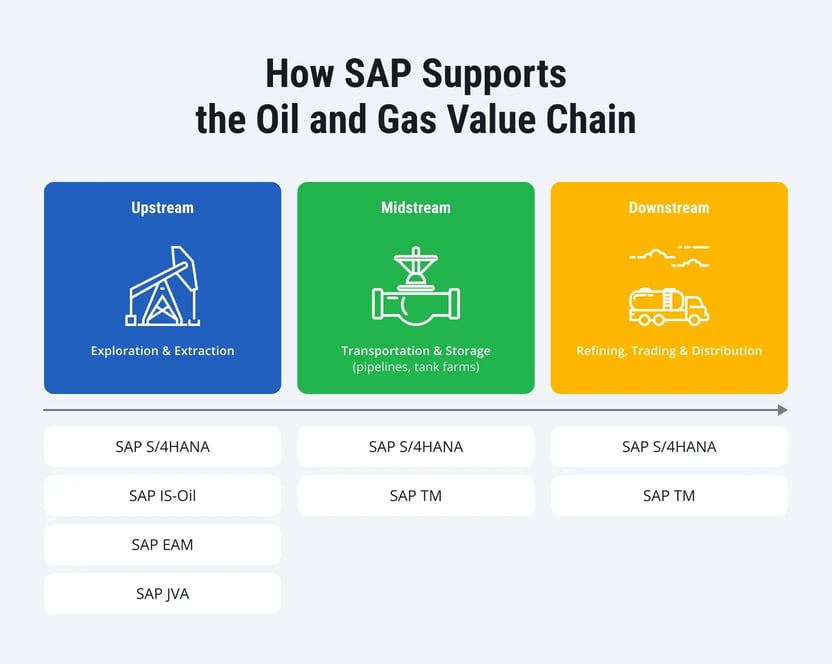
SAP Solutions for Upstream Operations
Upstream is where uncertainty shows up the most. Exploration doesn’t always turn into production, and production itself rarely follows the plan exactly. Field conditions change, and costs can move with them. Even so, companies still need to keep operations steady and predictable.
SAP supports upstream operations by giving teams better visibility into what’s happening on the ground and helping them keep production, assets, and costs aligned. In most cases, this is built around SAP S/4HANA as a core system, with industry-specific capabilities like SAP IS-Oil and tools such as SAP Enterprise Asset Management (SAP EAM) layered on top.
Exploration and production planning
Planning in the upstream is never static. Conditions change, new data comes in, and assumptions need to be revisited.
SAP gives teams a clearer, more up-to-date picture when planning exploration and production. With SAP S/4HANA and IS-Oil capabilities, they can track reserves, test different production scenarios, and adjust plans as conditions change. Instead of piecing data together from different sources, decisions are based on a more consistent view of what’s actually happening.
Field operations
Field operations are where plans meet reality. This is where delays, equipment issues, or unexpected conditions show up first.
SAP allows teams to keep things under control. Work orders, inspections, and maintenance don’t get lost — everything is tracked and easier to coordinate across sites. That matters a lot when equipment reliability directly affects production, which is where SAP EAM usually comes in.
Hydrocarbon accounting
Hydrocarbon accounting is one of those areas that’s very specific to oil and gas. Companies need to track how much is produced, moved, stored, and sold, and make sure the numbers line up across the entire chain.
SAP IS-Oil is typically used here to manage production volumes, allocations, and imbalances. This reduces discrepancies and makes sure reporting is based on data they can actually rely on, which matters for both operations and compliance.
Cost tracking and operational transparency
Upstream costs are not always easy to control. They depend on many variables — from equipment performance to external conditions.
SAP makes it easier to see where the money is actually going. By connecting operational and financial data, teams can understand what’s driving costs, how they change over time, and how they relate to production. This helps spot inefficiencies early and adjust operations when needed.
Joint venture and expenditure tracking
Upstream operations are often run as joint ventures. Multiple partners share ownership in assets, production, and costs, which makes financial tracking more complex than in most other industries.
Each partner needs a clear and accurate view of how costs are allocated and how revenue is distributed. This includes capital expenditures, operating costs, and production-based allocations.
SAP supports this through SAP Joint Venture Accounting (SAP JVA), which is used alongside SAP S/4HANA and IS-Oil. It helps track partner shares, allocate costs, and manage billing and settlements in line with joint operating agreements.
In reality, this reduces manual reconciliation, keeps partner reporting consistent, and makes it easier to handle audits and financial transparency across stakeholders.

SAP for Midstream and Downstream Operations
After extraction, it’s about moving, processing, and delivering. That’s midstream and downstream, and this is where coordination matters just as much as production.
In practice, midstream and downstream operations depend on how well transportation, storage, refining, and distribution are coordinated. If one part is out of sync, it creates issues elsewhere — from planning to delivery.
SAP helps bring these processes together in one system. Teams can track movements, manage storage, and coordinate distribution based on the same data. SAP S/4HANA typically sits at the center, with logistics and supply chain capabilities supporting these activities.
Transportation and storage
Midstream covers how resources are moved and stored: pipelines, shipping, rail, and tank farms. It depends on coordination. Volumes, routes, and infrastructure all need to stay under control.
SAP is used for transportation planning and execution across complex logistics networks, helping teams manage movements and respond to changes. SAP Transportation Management (SAP TM) supports planning, routing, and execution across transport modes.
Storage is a big part of the process. Teams need to track what’s in storage, where it is, and how it moves. In oil and gas, this is usually handled through industry-specific tools like SAP Trader's and Scheduler's Workbench (SAP TSW) and terminal management capabilities, which are designed for bulk storage and movements rather than discrete warehouse operations.
Refining and processing
Downstream starts with refining — processing raw materials into products. Refining relies on steady input. If supply is delayed or inconsistent, plans change quickly. SAP helps keep supply and processing in sync. In SAP S/4HANA, production planning is linked with supply and logistics data, so teams see the same numbers across the process.
Trading and distribution
At this stage, products move to market through trading, distribution, and delivery. Demand shifts quickly, so companies need to respond without breaking supply or building up excess stock.
SAP ties supply data into distribution, so teams can react to changes and keep deliveries moving. SAP S/4HANA supports this through supply chain and order management, aligning demand, inventory, and delivery.
How SAP supports midstream and downstream processes
|
Area |
What needs to be managed |
How SAP helps |
|
Transportation |
Pipelines, fleets, routing, scheduling |
Visibility into movements and coordination across logistics networks (SAP TM) |
|
Storage |
Tank farms, inventory levels, material flows |
Tracking stock levels and improving storage and distribution operations (SAP TSW) |
|
Refining |
Processing inputs and outputs |
Aligning supply with production plans (SAP S/4HANA) |
|
Distribution |
Deliveries, demand changes, customer supply |
Connecting supply data with distribution and improving responsiveness (SAP S/4HANA) |
In midstream and downstream, everything comes down to flow — how efficiently materials move, get stored, processed, and delivered. SAP connects these stages, giving teams a consistent view of operations and helping them catch issues early.
Asset Management and Predictive Maintenance in Oil and Gas
In oil and gas, risk mostly comes down to the assets. Pipelines stretch for miles, offshore platforms deal with tough conditions, and refinery equipment runs nonstop. When something fails, it hits right away — production is affected, costs go up, and safety risks increase.
This makes asset management a core part of operations, not a support function.
Managing complex and distributed assets
Assets in oil and gas are not only expensive — they are spread across locations and often difficult to access. Pipelines, drilling equipment, compressors, and processing units all need regular maintenance, but not all issues are visible in advance.
The challenge is not just maintaining individual assets, but managing them as part of a system. A failure in one segment of a pipeline or a single unit in a refinery can affect the entire operation.
This is where companies rely on advanced asset management strategies with SAP EAM to keep maintenance processes structured and aligned with operational priorities.
From reactive to predictive maintenance
Traditional maintenance approaches don’t work well in this environment. Waiting for equipment to fail or relying only on scheduled maintenance leads to either unplanned downtime or unnecessary work.
What’s changing is the shift toward predictive maintenance. Instead of reacting to failures, teams use data to identify early signs of wear or performance issues.
Sensors and IoT data make it possible to see asset condition in real time. Maintenance is then planned based on actual usage and performance, not guesswork.
Monitoring assets in real time
Continuous monitoring is especially important for linear assets like pipelines and for equipment operating in remote locations.
Pressure or temperature changes, or unusual flow patterns, can be early warning signs. With that data, teams can act before something breaks.
In practice, this means fewer unexpected shutdowns and better control over maintenance schedules.
What companies monitor in practice:
- Equipment condition (pressure, temperature, vibration)
- Pipeline integrity and flow stability
- Asset performance under load
- Early signs of wear or failure
- Maintenance history and usage patterns
Reducing downtime and improving performance
Downtime in oil and gas is expensive. Even short interruptions can affect production targets and contractual obligations.
Better asset management changes the way downtime is handled. Instead of fixing things after they break, teams plan ahead, reduce disruptions, and extend how long assets stay in use.
Companies that focus on maximizing ROI from asset-intensive operations usually see better uptime, tighter cost control, and more consistent asset performance.

Digital Transformation With SAP S/4HANA in Oil and Gas
In oil and gas, it often comes down to how data is handled across operations. When production, logistics, finance, and asset management sit in different systems, it’s hard to see what’s really happening or react in time. SAP S/4HANA is usually brought in as the core system, with SAP IS-Oil and SAP BTP used alongside it where needed.
Working with data in real time
In oil and gas, timing matters. Delays in data — even small ones — can affect planning, production decisions, or supply coordination.
SAP S/4HANA lets teams see data as it comes in, not after a delay. Production, asset status, logistics, and financials are all visible in real time, so decisions are based on what’s going on right now.
One data model across the business
In oil and gas, data is usually spread across multiple systems. Different teams work with different tools, which means inconsistencies show up and have to be sorted out manually.
SAP S/4HANA uses a single data model across business units. This means production, logistics, finance, and maintenance all work with the same data. There’s less need for manual reconciliation, and fewer situations where teams are looking at different versions of the same numbers.
Connecting operations across the value chain
Oil and gas operations don’t stop at functional boundaries. Decisions in one area affect others — production impacts logistics, logistics affects refining, and everything ties back to financial results.
SAP S/4HANA links these processes. Teams don’t work separately anymore — they can see how changes in one area affect others, which helps avoid delays.
Choosing how the system is deployed
For many companies, transformation also includes deciding how SAP S/4HANA is deployed, whether in the cloud, on-premise, or in a hybrid setup.
Each option comes with trade-offs in terms of flexibility, control, scalability, and cost. Understanding modern deployment models for SAP S/4HANA is an important part of planning the transformation.
At the same time, no one starts from scratch. Choosing the right S/4HANA deployment strategy depends on existing systems, regulatory requirements, and long-term goals.

Sustainability and Regulatory Compliance
In oil and gas, sustainability and compliance are not separate initiatives — they’re part of daily operations. Companies track emissions, report environmental impact, and deal with regulatory requirements across multiple regions.
This adds another layer of complexity to operations that are already hard to manage.
Emissions tracking in real conditions
Tracking emissions is not just about reporting numbers. Methane leaks, flaring, and carbon output have to be monitored across assets, often in remote locations.
Data usually comes from different sources — equipment, sensors, systems — and it doesn’t always match. Teams have to reconcile it and make sure it reflects real conditions.
Companies typically track:
- Methane emissions and leak detection
- Flaring volumes
- Carbon output across assets
- Emissions by location and facility
- Deviations from expected thresholds
Reporting and audit requirements
Reporting is ongoing. Companies need to document emissions, operational impact, and safety metrics, and be ready to provide this data during audits.
The difficulty is not collecting the data, but keeping it consistent. What’s reported externally has to match internal records, and any gaps or inconsistencies quickly become a problem.
Dealing with different regulatory frameworks
In the US, requirements come from multiple regulators, including federal and state-level authorities. What needs to be reported can vary depending on location and type of operation.
That makes reporting processes harder to standardize — they need to be flexible enough to adapt, but structured enough to stay compliant.
How sustainability and compliance are managed in practice
|
Area |
What teams deal with |
Where issues usually appear |
|
Emissions |
Tracking methane, carbon, flaring across assets |
Gaps between field data and reported numbers |
|
Reporting |
Preparing environmental and operational reports |
Inconsistent data across systems |
|
Compliance |
Meeting federal and state requirements |
Different rules across locations |
|
Audits |
Providing traceable historical data |
Missing links between source data and reports |
Making data reliable enough to report
Sustainability reporting depends on data quality. If data is incomplete or inconsistent, reporting becomes unreliable, and compliance risks increase.
That’s why companies focus on traceability, where the data comes from, how it’s processed, and how it ends up in reports. This makes audits easier and reduces the risk of discrepancies.
Key Benefits of Implementing SAP in Oil and Gas
In oil and gas, SAP is not just another system on top of existing ones. It changes how operations are run, how data is used, and how decisions are made day to day.
The effect is usually seen in a few areas that directly impact operations.
Better cost control
In this industry, costs are closely tied to what’s happening in operations — equipment performance, production, logistics, and maintenance. When data is split across systems, it’s hard to see where the money is actually going.
When operational and financial data are connected, teams can track costs in context and notice changes earlier. This makes it easier to react before issues grow.
Reduced downtime
Unplanned downtime is expensive and often hard to predict. When systems don’t talk to each other, early warning signs are easy to miss, and maintenance becomes harder to coordinate.
With better visibility into assets and operations, teams can plan maintenance more effectively, respond faster, and reduce the impact of failures.
More transparency across operations
When different parts of the business work in separate systems, it’s difficult to understand how everything fits together.
Bringing data into one environment gives teams a clearer view of production, logistics, and financials. It also reduces the amount of time spent aligning numbers across systems.
Stronger compliance and reporting
Compliance is part of everyday work, and reporting depends on reliable data.
When data stays consistent across systems, reporting becomes more straightforward. It’s easier to prepare reports, reduce discrepancies, and deal with audits.
More reliable forecasting
Planning in oil and gas depends on many moving parts — production, demand, pricing, and supply chain conditions.
When data is up to date and consistent, forecasts become more reliable. Teams can adjust plans faster and make decisions with more confidence.
Where the impact shows up
|
Area |
What changes in practice |
|
Costs |
Clearer view of cost drivers and earlier response to changes |
|
Downtime |
Fewer unexpected disruptions and more predictable maintenance |
|
Transparency |
One view across production, logistics, and financials |
|
Compliance |
More consistent reporting and easier audits |
|
Forecasting |
More accurate planning based on current data |
LeverX Expertise in SAP for Oil and Gas
SAP projects in oil and gas rarely follow the same path. Every company has its own systems, regulatory constraints, and way of working. Implementation is not just about rolling out software — it has to fit how the business actually operates.
LeverX works with oil and gas companies across different types of projects — from system implementations to landscape transformation and integration.
S/4HANA implementations
S/4HANA projects in oil and gas are usually more than a technical upgrade. They involve changes in how processes are set up, how data moves across systems, and how teams work together.
LeverX supports these projects end-to-end — from system design and process alignment to data migration and go-live.
IS-Oil configuration
Industry-specific processes play a key role in oil and gas operations. This includes hydrocarbon accounting, production tracking, and logistics specific to the industry.
LeverX works with SAP IS-Oil to configure these processes so they reflect how operations run in practice, not just how they are defined in the system.
Integration across systems
Most companies don’t run on a single system. They have a mix of legacy platforms, third-party tools, and SAP solutions. LeverX helps connect these, so data doesn’t get stuck between systems. This includes tying together upstream, midstream, and downstream processes, as well as operational and financial data.
Migration and transformation programs
Migration to S/4HANA is usually part of a broader transformation. LeverX works with different approaches — system conversion, landscape transformation, and selective data migration — with a focus on keeping disruption low and data consistent.
Conclusion
Oil and gas operations are not simple. They run across different locations, rely on expensive assets, and are constantly affected by market changes and regulations. When systems don’t connect, it becomes difficult to keep things stable and predictable.
SAP is typically used to bring these parts together. It connects processes across the value chain, aligns data, and gives teams a clearer view of what’s happening — from production and logistics to finance and compliance. In practice, this changes how decisions are made. Teams don’t have to rely on delayed or inconsistent data. They can respond faster, plan more accurately, and keep operations under control, even when conditions change.