Learn why SAP modernization in Qatar is becoming more than an ERP upgrade. Explore integration strategy, cloud readiness, analytics modernization, SAP BTP, and scalable digital transformation approaches for connected business operations.
A lot of SAP systems were modernized only when companies felt they had no other choice. The software was outdated, integrations were unstable, or teams were spending too much time working around system limitations. That approach is becoming harder to justify in Qatar’s current business environment.
Businesses today are operating in a very different environment than they were even five or seven years ago. The country’s push toward digital transformation is changing expectations across almost every industry. Faster services, connected platforms, better reporting, and more transparent operations are no longer seen as optional improvements. They are becoming part of normal business requirements.
A lot of companies in Qatar are reaching the point where older enterprise systems are becoming difficult to work around. As digital services expand and business processes become more connected, many organizations are starting to rethink how their SAP environments are structured.
And this is where many organizations discover the same issue: the ERP itself is often not the only problem.
In many SAP environments, complexity has been building quietly for years. One integration was added for procurement. Another interface for reporting. A local customization that solved a short-term operational issue. Separate analytics tools were created because business users could not get the data they needed fast enough. Over time, these decisions create fragmented landscapes that are difficult to manage, scale, or fully connect.
That is why SAP modernization in Qatar is increasingly turning into a broader architecture discussion rather than a simple ERP upgrade project. Companies are looking not only at the core system, but also at integrations, reporting structures, data quality, process consistency, and cloud readiness.
Instead of maintaining isolated systems connected by temporary solutions, companies are looking to create environments where core business functions and external platforms interact in a more stable and manageable manner.
The companies seeing the most value from modernization are usually the ones treating SAP as the foundation for long-term digital operations — not just as software that needs to be updated from time to time.
Why Companies in Qatar Are Rethinking SAP Modernization
Businesses in Qatar are operating in a much more connected digital environment today. As operations expand across platforms and services, companies need enterprise systems that are easier to integrate, scale, and manage.
In many organizations, SAP complexity did not appear all at once. It built up gradually through years of additional integrations, local fixes, and separate reporting solutions that eventually became difficult to manage efficiently.
For years, companies could keep adding fixes and integrations to existing systems and still make things work. Now that processes, data, and digital services are far more connected, that approach is starting to break down.
In many cases, the ERP system itself is not the only issue. Complexity has often been building quietly for years. One integration was added for procurement, another interface for reporting, and separate analytics tools appeared because business users could not access information quickly enough. Over time, these decisions created fragmented environments that became harder to maintain, scale, and modernize efficiently.
As a result, SAP modernization in Qatar is increasingly becoming a broader business and architecture discussion rather than simply an ERP upgrade initiative.
What is driving SAP modernization today
|
Business challenge |
How it affects SAP environments |
|
Years of ERP customizations |
Makes systems harder to maintain, upgrade, and extend over time |
|
Fragmented enterprise applications |
Creates disconnected workflows and inconsistent data exchange |
|
Reporting and analytics complexity |
Slows decision-making and reduces visibility across operations |
|
Growing cloud adoption |
Increases demand for API-ready and hybrid architectures |
|
Expansion of digital services |
Requires more scalable and connected platforms |
|
Increasing operational complexity |
Creates pressure to standardize processes and reduce manual work |
|
Higher expectations for visibility |
Requires cleaner analytics and more reliable data foundations |
|
Business growth and expansion |
Older environments may no longer support larger or multi-entity operations |
Today, organizations increasingly look for:
- Transparency across business processes and reporting
- Scalability that supports business growth without adding operational complexity
- Integration readiness for cloud services, external platforms, and analytics tools
- Operational agility that allows teams to react faster to changing business needs
This shift is also being accelerated by Qatar’s broader digital transformation initiatives. Through Digital Agenda 2030 and investments in local hyperscaler infrastructure, connected services, and regional platforms such as Microsoft Azure Qatar regions, the Google Cloud Doha region, and Qatar Cloud initiatives, modernization is becoming more practical and strategically important for enterprise environments.
As cloud capabilities continue to grow, businesses are increasingly evaluating how SAP environments should support:
- API-driven integrations
- Advanced analytics
- Automation initiatives
- Platform extensibility
- Hybrid and cloud-native architectures
At the same time, some companies — especially in regulated industries — still need hybrid or private environments to meet compliance, security, data residency, or operational control requirements.
SAP modernization is becoming a strategic decision
SAP transformation is no longer viewed only as a technical upgrade or infrastructure refresh. For many organizations, the bigger issue is whether the business can continue scaling and adapting in an environment that has become increasingly difficult to connect, manage, and extend.
That is why modernization initiatives in Qatar increasingly include:
- Integration redesign
- Analytics modernization
- Process harmonization
- Cloud readiness
- Platform simplification
For many organizations, modernization becomes necessary not because the ERP system stops functioning, but because the surrounding business environment evolves faster than the existing architecture can comfortably support.
When companies look at modernization from a business perspective — not just a technical one — they often end up with systems that are easier to manage, integrate, and adapt as the business evolves.

Modernization Is More Than an ERP Upgrade
A lot of companies still think SAP modernization is mainly about upgrading to a newer ERP version. But once these projects begin, businesses usually realize that the bigger issues often sit outside the core system itself.
In many organizations, complexity has been building around the core SAP environment for years. New integrations were added one by one, custom developments accumulated over time, and reporting processes expanded across multiple systems and spreadsheets. While these decisions often solved immediate operational issues, they also created landscapes that became harder to maintain and scale.
As a result, modernization projects in Qatar are increasingly turning into broader architecture initiatives rather than standard software upgrades.
Legacy complexity often sits outside the ERP core
For many businesses, the main operational difficulties are no longer tied to the ERP version itself. The bigger problem is that everything is built around it over time.
Common issues include:
- Heavily customized workflows
- Disconnected reporting environments
- Duplicate or inconsistent data
- Difficult-to-maintain integrations
- Manual workarounds between systems
- Fragmented business processes
In many cases, companies discover that replacing the ERP alone does not automatically solve these problems.
Modernization usually includes more than system migration
Because of this, SAP modernization efforts now typically include a wider set of transformation activities aimed at simplifying the overall enterprise environment.
These initiatives often involve:
- Integration rationalization to reduce unnecessary interfaces and simplify system connectivity
- Reduction of historical customizations that create long-term maintenance challenges and complicate future upgrades, making a SAP Clean Core approach increasingly important for sustainable modernization initiatives
- Business process redesign to eliminate fragmented workflows and manual dependencies
- Reporting architecture cleanup to improve consistency across analytics and KPIs
- API-based architecture preparation for more flexible integrations and future scalability
- Cloud readiness improvements to support modern deployment and extension models
- Master data governance enhancements to improve data quality and consistency
- Interface simplification across ERP, analytics, procurement, and external platforms
For many organizations, these areas create more operational friction than the ERP platform itself.
_11zon.webp?width=832&height=555&name=832x555_Picture_1%20(1)_11zon.webp)
Connected operations require a different SAP architecture
The shift is especially visible in Qatar, where digital transformation is accelerating across industries. As organizations expand cloud usage and introduce more digital services, the limitations of fragmented enterprise systems become much harder to ignore. That changes the role of SAP inside the organization.
Instead of functioning only as a transactional system, SAP increasingly becomes the digital core connecting finance, procurement, analytics, supply chain operations, and external platforms within a broader business ecosystem.
Modernization is about building a scalable operating environment
The companies seeing the most value from SAP modernization are usually not the ones focused only on replacing outdated systems. They are the ones using modernization to simplify architecture, standardize processes, improve data consistency, and reduce operational complexity.
In practice, companies are no longer modernizing SAP just because the software is outdated. The bigger goal is to create an environment that is easier to scale, integrate, and adapt as the business continues to evolve.
Why Integration Becomes Central in SAP Transformation
When companies start discussing SAP modernization, attention usually goes straight to the ERP core. But in many cases, the bigger operational problems are caused by the way systems are connected — or not connected — across the business.
A lot of SAP landscapes became complex little by little. Teams added interfaces whenever a business need appeared, temporary fixes stayed in place longer than expected, and different systems were connected one at a time. Eventually, the environment became difficult to maintain and even harder to scale.
This is why SAP integration in Qatar is becoming a much bigger part of modernization discussions.
What fragmented SAP landscapes usually look like
In many legacy environments, companies deal with a mix of:
- Point-to-point integrations created over different stages of growth
- Undocumented or poorly documented interfaces
- Manual workarounds between disconnected systems
- Isolated operational or procurement platforms
- Fragmented analytics environments
- Duplicated or inconsistent data flows
A single disconnected integration or manual workaround may not look like a major problem. But when these issues accumulate across the business, they often create operational friction that becomes difficult to ignore.
In some organizations, teams spend more time maintaining integrations and fixing data inconsistencies than improving business processes themselves.
Modern ERP alone does not solve fragmentation
One of the common mistakes in SAP transformation projects is assuming that a new ERP core automatically fixes integration problems.
In reality, companies can still end up with disconnected systems, inconsistent reporting, and complicated workflows even after moving to modern SAP platforms if the integration architecture remains unchanged.
A newer ERP version alone often does not fully solve:
- Fragmented interfaces
- Inconsistent data exchanges
- Disconnected analytics layers
- Unstable integrations between cloud and on-premises systems
- Operational silos across departments
That is why SAP integration architecture in Qatar is becoming a central modernization concern rather than a secondary technical topic.
Qatar’s digital transformation requires connected ecosystems
This shift is especially important in Qatar, where digital transformation initiatives increasingly focus on connected services and interoperable platforms rather than isolated applications.
As businesses continue expanding digital operations, enterprise environments are expected to support:
- Connected business processes
- Reliable data exchange
- Scalable integrations
- API-driven services
- Cloud-based collaboration across platforms
This naturally changes how companies approach SAP transformation in Qatar. Organizations are no longer looking only at ERP functionality. They are also evaluating whether systems can integrate efficiently with analytics platforms, procurement solutions, operational technologies, external services, and cloud environments.
Why API-based integration is becoming more important
A lot of businesses are discovering that traditional one-to-one integrations become difficult to maintain as the environment grows. Many are now shifting toward more flexible integration approaches built around APIs and centralized management, while also focusing on choosing the right SAP integration platform for long-term scalability and governance.
This is one reason why SAP API integration in Qatar is becoming increasingly relevant, especially for companies planning:
- Cloud expansion
- Platform modernization
- Analytics transformation
- External partner integrations
- Multi-system business environments
API-driven architectures usually provide better flexibility, easier scalability, and more manageable integration governance compared to heavily customized legacy interfaces.
Integration architecture is now part of business strategy
Businesses are starting to realize that integration problems affect far more than technical systems. Poor connections between platforms often lead to reporting issues, manual work, operational delays, and unnecessary complexity across the organization.
Companies that simplify and modernize integration early in their transformation projects often find themselves in a much better position to support future growth, cloud adoption, and connected digital operations.
What Changes in Finance, Procurement, Operations, and Analytics
Most modernization projects begin with conversations about systems and infrastructure. But over time, companies usually realize that the biggest improvements — and challenges — affect the way teams actually work every day.
Most companies are not modernizing SAP simply to replace old technology. They want to reduce manual work, improve visibility across the business, and prevent systems from becoming even more complicated as operations grow.
Finance
A lot of finance teams are still working around limitations inside older ERP environments. It is common to see reporting handled partly in SAP, partly in spreadsheets, and partly through manual checks between disconnected systems.
Eventually, finance teams spend more time checking numbers, fixing inconsistencies, and dealing with reporting delays, especially during financial close cycles.
As part of SAP modernization, companies usually focus on:
- Unified financial processes across departments and business units
- Fewer manual reconciliations caused by disconnected data sources
- Improved controls through standardized workflows and approvals
- Faster reporting with more centralized and accessible financial data
- Stronger compliance support through better traceability and governance
- Better transaction visibility across financial operations
For finance leaders, modernization is often less about changing interfaces and more about reducing complexity behind the reporting process itself.
Procurement
Many procurement teams still deal with disconnected processes behind the scenes. Supplier management may happen in one system, approvals in another, and purchasing data somewhere else entirely.
This often creates visibility gaps and slows decision-making around purchasing and supplier management.
Modernization initiatives usually focus on:
- Supplier process integration across procurement and finance environments
- Spend visibility with more centralized procurement data
- Connected procurement workflows that reduce manual coordination between teams
- Reduced process fragmentation across purchasing activities
- Integration between ERP and external procurement platforms for smoother data exchange
For companies using solutions like SAP Ariba, modernization can also help create a more connected procurement environment with better supplier collaboration and clearer visibility across purchasing processes.
Operations
Many operational environments were not built for the level of visibility businesses now expect. As manufacturing, logistics, warehouse systems, and back-office applications evolved separately, companies often ended up with disconnected processes and delayed information flows.
In many organizations, operational processes still depend on local developments, disconnected applications, or manual coordination between teams.
Modernization efforts typically focus on:
- Real-time or near-real-time visibility across operational processes
- Integration between operational and back-office systems for smoother process execution
- Reduced dependence on legacy local developments that are difficult to maintain
- Cleaner process orchestration across multiple systems and workflows
The goal is usually to simplify operations and improve coordination between systems without adding additional layers of complexity.
Analytics
Analytics environments often become fragmented gradually. One department creates its own reports, another introduces a different BI platform, and teams start tracking the same KPIs in different ways. Over time, reporting becomes harder to standardize and trust.
As businesses continue investing in digital transformation, these fragmented analytics environments become harder to scale and maintain.
Modernization projects often include:
- Modernization of reporting architecture to simplify analytics environments
- Consolidation of fragmented BI systems across departments
- KPI consistency improvements through cleaner data structures and governance
- Readiness for modern analytics platforms and cloud-based reporting environments
Many organizations in Qatar are also preparing their environments for platforms such as SAP Analytics Cloud (SAC) and SAP BW/4HANA to support more centralized analytics, planning, and reporting capabilities.
Modernization impacts more than IT teams
One important shift is that SAP modernization discussions are no longer limited to IT departments.
Today, transformation initiatives directly affect:
- Finance leaders responsible for reporting and compliance
- Procurement teams managing supplier processes
- Operations managers focused on process efficiency
- BI and analytics stakeholders responsible for data consistency and decision-making
As a result, modernization projects now involve much more than IT teams alone. Finance, operations, analytics, and business stakeholders increasingly need to work together throughout the transformation process.
.webp)
What SAP Solutions Are Relevant to Modernization in Qatar
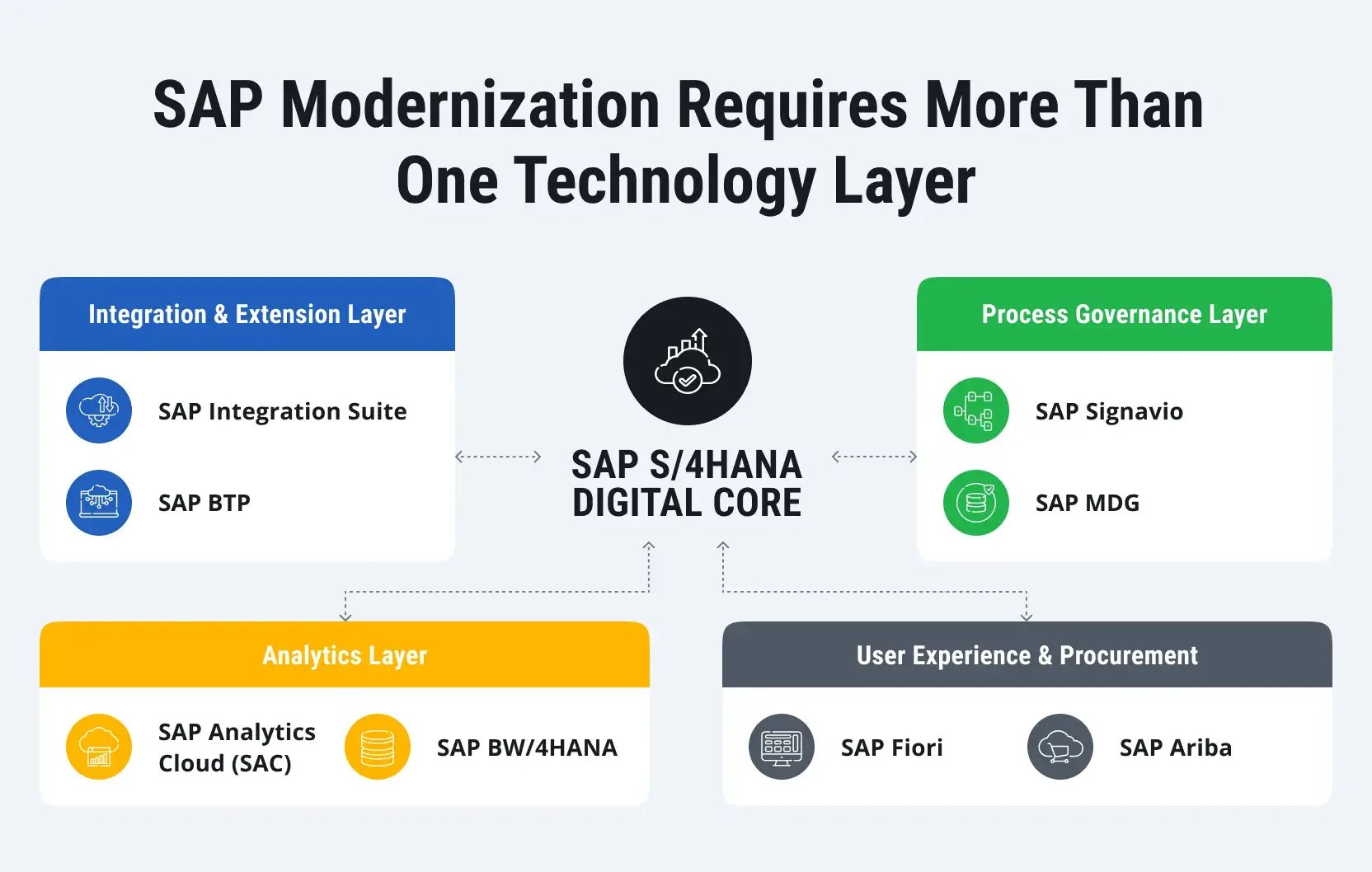
Once modernization discussions begin, many companies quickly realize the ERP system is only part of the challenge. Integrations, reporting, workflows, and cloud strategy often end up requiring just as much attention.
For many organizations, modernization quickly becomes bigger than the ERP platform itself because too many business processes and systems depend on each other.
ERP Core
SAP S/4HANA
As companies grew, their SAP environments usually grew with them. More systems were connected, additional customizations appeared, and reporting structures became more difficult to manage over time.
Companies in Qatar are increasingly evaluating SAP S/4HANA not only as a replacement for legacy ERP systems, but also as a platform that can support:
- Cleaner business processes
- Faster reporting
- Better operational visibility
- Cloud-ready architectures
- More scalable integrations
SAP ECC / SAP ERP
Many customizations were necessary at the time to support specific operational requirements. The complexity usually appeared gradually as businesses expanded, connected more systems, and adjusted processes over time.
This is one reason why RISE with SAP is becoming an important modernization driver for many organizations. Businesses are not only looking to move away from legacy ERP environments, but also trying to simplify infrastructure, reduce operational complexity, and create more scalable, cloud-ready SAP landscapes.
Because of this, modernization projects usually begin with assessing:
- Existing integrations
- Custom code complexity
- Reporting dependencies
- Process fragmentation
- Readiness for future transformation
For many companies, the goal is not simply to replace SAP ECC, but to simplify the broader enterprise environment built around it.
Integration and extension layer
SAP Business Technology Platform (SAP BTP)
As businesses modernize SAP environments, they increasingly need more flexible ways to extend functionality without creating additional ERP complexity. This is where SAP BTP becomes important. Companies use SAP BTP to support:
- API-based integrations
- Workflow automation
- Application extensions
- Innovation initiatives
- Clean-core-friendly development approaches
In many modernization projects, SAP BTP also helps organizations reduce dependence on heavy ERP customizations by moving extensions into more scalable platform environments.
SAP Integration Suite
As companies connect more systems, cloud services, and business platforms, integration architecture becomes much more important during SAP transformation projects. SAP Integration Suite is frequently used to:
- Redesign fragmented integration landscapes
- Improve interface governance
- Simplify API management
- Support cloud and hybrid integrations
- Reduce dependence on unstable point-to-point interfaces
For companies in Qatar focusing on connected digital operations, integration modernization is often just as important as ERP modernization itself.
Process governance layer
SAP Signavio
Many organizations start modernization projects without fully understanding how fragmented their business processes have become over time. SAP Signavio helps companies analyze how processes actually work across departments and systems before major transformation decisions are made. Businesses often use SAP Signavio for:
- Process discovery
- Fit-gap analysis
- Workflow harmonization
- Identifying operational bottlenecks
- Preparing for standardized transformation initiatives
This is especially helpful in companies where different teams adjusted processes in their own way over the years, gradually creating inconsistencies across the business.
SAP Master Data Governance (SAP MDG)
As companies modernize ERP and analytics environments, data quality becomes a much bigger issue than many initially expect. Inconsistent master data often creates reporting problems, integration issues, and operational inefficiencies across departments. SAP MDG helps organizations improve:
- Master data consistency
- Governance processes
- Data quality controls
- Centralized data management across systems
For businesses working toward more connected digital operations, stronger master data governance becomes an important part of long-term platform stability.
SAP Governance, Risk, and Compliance (SAP GRC)
A few years ago, many companies could treat security and compliance as something handled separately from modernization. Now, as SAP environments become more connected and cloud usage grows, those topics are becoming part of the core transformation discussion.
SAP GRC helps companies strengthen governance and reduce operational risk through:
- Access control and segregation of duties management
- Compliance monitoring and audit support
- Identity and authorization governance
- Risk analysis across business processes and systems
- Policy enforcement across SAP environments
As companies in Qatar modernize SAP environments, governance and compliance are becoming a bigger part of the conversation — especially in industries working with regulated or sensitive data. Many organizations are looking for better control over user access, security policies, and compliance processes across hybrid and cloud environments.
Analytics layer
SAP Analytics Cloud (SAC)
Many businesses in Qatar are also modernizing analytics environments alongside ERP transformation initiatives. SAP Analytics Cloud is increasingly used to create more centralized reporting, dashboarding, and planning environments. Organizations often adopt SAC to support:
- Real-time dashboards
- Executive reporting
- Planning and forecasting
- KPI standardization
- Analytics modernization across departments
For companies dealing with fragmented reporting environments, SAC can help simplify analytics landscapes and improve visibility across the business.
SAP BW/4HANA
For larger organizations with complex reporting requirements, SAP BW/4HANA often remains an important part of enterprise analytics architecture. Companies typically use SAP BW/4HANA for:
- Enterprise reporting
- Centralized data warehousing
- Large-scale analytics consolidation
- Historical data management
- Integration between operational and analytical systems
Modernization projects frequently include reviewing how BW environments fit into future analytics and cloud strategies.
User experience modernization
SAP Fiori
User experience is another area that many companies reconsider during modernization projects. Older ERP environments often rely on interfaces that can become difficult to navigate and inefficient for everyday operational tasks, especially as processes grow more complex over time.
SAP Fiori helps modernize the user experience through:
- More intuitive workflows
- Simplified navigation
- Role-based applications
- Improved accessibility across devices
SAP Joule
Tools like SAP Joule are changing how business users interact with SAP environments. Instead of relying heavily on transaction codes or manually searching through reports, teams can ask questions directly and retrieve operational, procurement, or financial insights in a much more intuitive way.
For many organizations, better usability and AI-assisted access to information help improve adoption, reduce manual effort, and support faster decision-making across departments.
Procurement
SAP Ariba
A lot of businesses are looking for ways to make procurement operations easier to manage and less fragmented. SAP Ariba is often introduced to support:
- Supplier collaboration
- Procurement workflow integration
- Spend visibility
- Sourcing and purchasing standardization
- Better connectivity between procurement and ERP systems
In many organizations, SAP Ariba becomes part of a broader attempt to make procurement processes easier to manage and less fragmented across departments and systems.
Modernization requires more than one technology layer
One of the biggest shifts in SAP modernization projects is that companies are no longer focusing only on the ERP core itself. Businesses increasingly need environments that support:
- Scalable integrations
- Cleaner analytics architectures
- Stronger governance
- Cloud readiness
- Connected digital operations
Most modernization initiatives now extend across multiple SAP environments, including ERP systems, integrations, analytics platforms, reporting structures, and operational workflows.
Why Cloud and Platform Readiness Are Part of Modernization
A few years ago, companies might have approached SAP modernization primarily as an ERP system upgrade. Today, however, it's much more difficult to separate it from cloud strategy, integration architecture, and long-term platform planning.
As businesses in Qatar expand digital operations, enterprise systems are expected to support more connected services, faster integrations, and greater flexibility across departments and platforms. That changes what companies expect from SAP environments.
Modernization is no longer only about running a newer ERP version. Businesses also need environments that are easier to extend, integrate, and adapt as operational requirements continue to change.
Why platform readiness matters
Many older SAP environments were built around tightly connected customizations and point-to-point integrations. Those approaches often solved immediate business needs, but they also created environments that became increasingly difficult to scale later.
Today, companies are paying much closer attention to how future SAP environments will support cloud services, APIs, integrations, and long-term operational flexibility.
|
What companies need today |
Why it matters |
|
Flexible integration models |
Businesses need systems that can connect more easily across departments, cloud services, and external platforms. |
|
API-driven architectures |
Modern integrations are expected to be easier to scale and maintain than traditional point-to-point interfaces. |
|
Scalable extension approaches |
Companies want to add new functionality without overloading the ERP core with customizations. |
|
Cloud and hybrid readiness |
Enterprise environments increasingly operate across both cloud and on-premises systems. |
|
Resilience and flexibility |
Businesses need environments that can adapt more easily as operational requirements change. |
This is one reason SAP platform modernization in Qatar is becoming a broader architecture discussion rather than only a technical migration effort.
Cloud strategy is becoming part of SAP planning
Businesses in Qatar are also evaluating SAP environments in the context of growing regional and local cloud capabilities. As the country continues investing in digital infrastructure, cloud adoption is becoming more practical for enterprise environments than it was several years ago.
This includes:
- Qatar Cloud initiatives
- Expanding cloud ecosystems
- Growing regional cloud capacity
- Microsoft Azure Qatar region and infrastructure developments
- Broader support for connected digital services
As a result, many organizations are reviewing how future SAP environments will support hybrid architectures, cloud-native integrations, and more connected digital operations while evaluating different SAP S/4HANA cloud deployment options for long-term scalability and flexibility.
At the same time, organizations in highly regulated sectors — particularly government, energy, and critical infrastructure — are increasingly prioritizing deployment models that provide stronger control over data residency, operational management, and compliance requirements. In some cases, this includes sovereign or locally managed cloud approaches designed to align with Qatar’s evolving regulatory and cybersecurity frameworks while still supporting modernization and innovation initiatives.
Why SAP BTP becomes important in cloud-aware architectures
As organizations modernize environments, many are also trying to avoid rebuilding the same ERP complexity inside newer platforms.
This is where SAP BTP Qatar discussions often become relevant. Businesses use SAP BTP to support:
- Cleaner extension models
- API-based integrations
- Workflow automation
- Cloud-native application development
- More flexible innovation initiatives outside the ERP core
For many companies, this approach creates a more manageable environment than continuing to place every customization directly inside the ERP system.
Modernization without platform strategy often recreates old problems
One of the common mistakes in modernization projects is focusing only on the ERP migration itself while leaving the surrounding architecture mostly unchanged.
In practice, companies can still end up with:
- Fragmented integrations
- Difficult reporting environments
- Excessive customizations
- Unstable interfaces
- Operational complexity hidden behind a newer ERP platform
That is why SAP cloud readiness in Qatar increasingly depends not only on infrastructure decisions, but also on how companies redesign integrations, extensions, analytics, and operational workflows around the ERP core.
A lot of organizations are trying to avoid repeating the same cycle where a new platform gradually becomes just as complicated as the old one.
%20(1).webp)
Common Risks of Delaying SAP Modernization
Most organizations do not start modernization projects because the system has stopped working. They start because every day changes, and new business requirements gradually become harder to support inside the existing environment.
Over time, this can reduce operational flexibility, slow transformation initiatives, and increase the amount of effort required to maintain everyday processes.
|
What happens over time |
Business impact |
|
Technical debt continues growing |
Additional customizations, local fixes, and temporary workarounds make the environment harder to maintain and change later. |
|
Integrations become more fragile |
Older interfaces often require more manual support and become less reliable as more systems are connected. |
|
Manual work increases |
Teams spend more time reconciling data, fixing process gaps, and coordinating disconnected workflows. |
|
Analytics evolution slows down |
Fragmented reporting environments make it harder to introduce modern analytics, planning, and real-time visibility. |
|
Scalability becomes limited |
Existing architectures may struggle to support business expansion, cloud initiatives, or new digital services efficiently. |
|
Transformation costs rise later |
The longer complexity accumulates, the larger and more expensive modernization projects often become in the future. |
In many companies, these issues build up slowly over time. The systems may still function normally, but everyday operations often become less flexible as integrations, reporting processes, and system dependencies grow more complicated.
Business Benefits of SAP Modernization for Companies in Qatar
For many companies in Qatar, SAP modernization is becoming more about improving how the business operates overall than simply replacing older software.
Companies today expect much more from enterprise systems than they did a few years ago. Systems are now expected to support connected operations, easier integrations, and faster access to information across departments.
|
Modernization area |
Business benefit |
Operational impact |
|
Processes |
Stronger process standardization |
Reduces inconsistencies between departments and simplifies workflows across the business. |
|
Architecture |
Cleaner system landscape |
Makes the SAP environment easier to manage, extend, and support over time. |
|
Data and reporting |
Improved visibility through modern SAP data and analytics environments |
Gives teams quicker access to more reliable business information. |
|
Operations |
Lower operational complexity |
Reduces manual coordination, duplicated processes, and disconnected workflows. |
|
Integrations |
Stronger integration governance |
Improves control over APIs, interfaces, and system connectivity. |
|
Digital transformation |
Better support for digital initiatives |
Helps companies introduce automation, analytics, and cloud services more efficiently. |
|
Scalability |
Stronger foundation for growth |
Makes it easier to support expansion, new business models, and connected operations. |
For many organizations in Qatar, these benefits are becoming more important as the country continues developing connected digital infrastructure, smart services, and innovation-led transformation initiatives.
How Companies in Qatar Should Approach Modernization
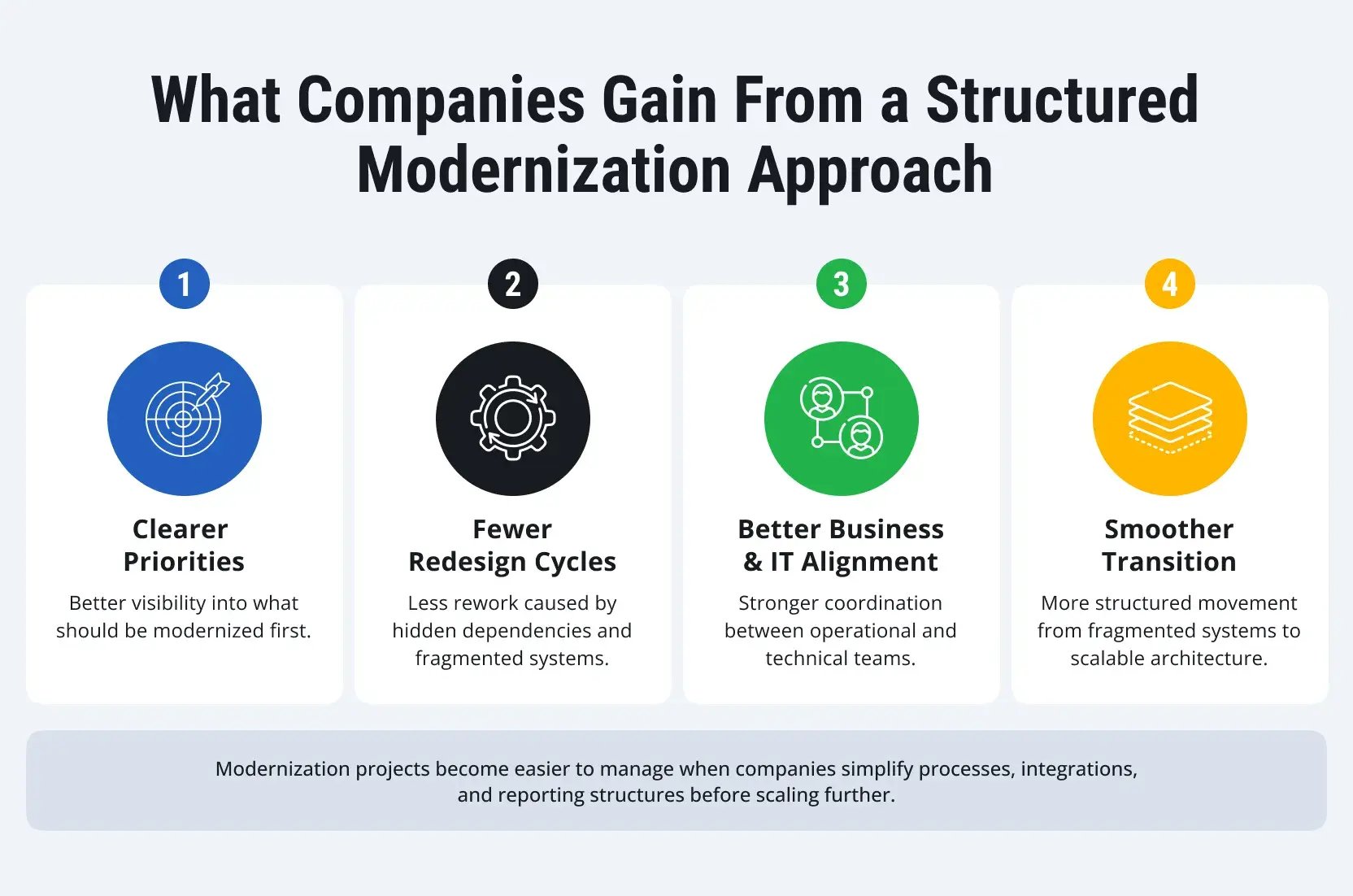
For many businesses, SAP modernization becomes much easier when it is approached as a structured transformation program rather than a standalone technical upgrade.
In many projects, the biggest complications appear after implementation work has already started. Teams suddenly find undocumented integrations, fragmented workflows, or reporting issues that were not fully visible during early planning.
A more practical approach is to evaluate the broader environment first and then prioritize modernization step by step.
|
Step |
What companies usually focus on |
Why it matters |
|
1. Assess the current SAP landscape |
Review existing ERP environments, connected systems, custom developments, and operational dependencies |
Helps identify where complexity, risk, or inefficiencies already exist |
|
2. Map integrations and system dependencies |
Analyze interfaces between ERP, analytics, procurement, operational systems, and external platforms |
Makes it easier to understand which integrations may create transformation risks later |
|
3. Identify fragmented processes and legacy custom code |
Review local workflows, manual workarounds, and heavily customized processes |
Helps reduce unnecessary complexity before modernization moves forward |
|
4. Review analytics and reporting architecture |
Evaluate reporting environments, KPI consistency, BI tools, and data dependencies |
Prevents reporting fragmentation from being carried into the new environment |
|
5. Define the future integration and platform model |
Decide how APIs, cloud services, integrations, and extensions will work moving forward |
Creates a more scalable and manageable architecture in the long term |
|
6. Prioritize business-critical areas |
Focus first on the processes and systems that create the biggest operational impact |
Helps organizations manage transformation in more practical phases |
|
7. Align business and technology stakeholders |
Bring together IT, finance, operations, analytics, and data teams early in the process |
Reduces disconnects between technical implementation and business expectations |
|
8. Build a phased modernization roadmap |
Plan modernization in manageable stages instead of trying to modernize everything at once |
Helps reduce operational disruption and transformation risk |
For many companies in Qatar, modernization projects tend to deliver better results when they are approached as broader business transformation efforts rather than just ERP migrations. Businesses that simplify processes, integrations, and reporting early usually avoid carrying the same complexity into the new environment.
Where External Expertise Becomes Important
Many companies have experienced internal IT and operational teams, but large modernization projects often benefit from SAP modernization services — especially when it comes to evaluating complex dependencies, architecture decisions, and long-term platform direction.
External expertise is usually most valuable in areas such as:
- Modernization readiness assessments
- Integration architecture reviews
- Target-state environment design
- SAP BTP and platform strategy
- Process harmonization workshops
- Analytics and reporting redesign
- Phased rollout planning
- Post-go-live stabilization support
In many cases, experienced SAP consulting services help companies identify hidden complexity earlier, reduce transformation risks, and create a more realistic modernization roadmap before large-scale implementation begins.
How We Support SAP Modernization and Integration in Qatar
A lot of companies start modernization projects expecting the biggest challenge to be the ERP migration itself. In reality, the harder part is usually everything around it — integrations that grew over the years, reporting dependencies nobody fully documented, custom workflows, and systems that became tightly connected over time. That is where we typically help.
Our team supports companies in Qatar with:
- SAP landscape assessments: We review how existing ERP systems, integrations, reporting processes, and operational workflows are connected across the business.
- Modernization roadmap development: LeverX helps companies define realistic transformation priorities and phased implementation plans.
- SAP S/4HANA readiness analysis: Our experts evaluate current systems, custom code, and business processes before migration planning begins.
- Integration architecture redesign: We simplify fragmented interfaces and improve connectivity across systems and platforms.
- SAP BTP and API strategy: Our team supports scalable extension models, workflow automation, and API-driven architectures.
- Process harmonization support: We identify inconsistent workflows and help standardize business processes across departments.
- Analytics and reporting readiness: Our experts review reporting environments, KPI structures, and analytics dependencies.
- Phased rollout and implementation support: LeverX helps businesses modernize environments in manageable stages with lower operational risk.
- Post-go-live stabilization assistance: We support system performance, integrations, and operational continuity after deployment.
We work with companies to make SAP environments easier to scale, integrate, and adapt as business needs continue changing.
Conclusion
In Qatar, SAP modernization is becoming part of a much bigger business conversation than a standard ERP upgrade. As companies expand digital operations and connect more systems and services, enterprise environments are expected to be easier to integrate, scale, and adjust over time.
Businesses that approach modernization strategically usually end up with cleaner architectures, stronger analytics foundations, and more manageable environments for future growth. Companies focused only on technical upgrades often carry the same complexity into newer systems.
The biggest value of modernization today is not simply newer technology. It is creating an SAP environment that can support long-term business change without becoming harder to manage every few years.