A warehouse can record the receipt, storage, and shipment of a product. Cold chain operations require additional control over the conditions in which that product moves through the supply chain. Storage temperatures, remaining shelf life, batch information, delivery windows, and transportation conditions can all affect whether an order reaches the customer in an acceptable condition.
These requirements create dependencies between warehouse processes, inventory records, quality controls, and transportation execution. SAP provides capabilities for managing these processes and connecting them with specialized warehouse equipment, refrigerated carriers, and temperature-monitoring systems.
In this guide, we will examine the role of SAP in cold chain logistics in the USA, including SAP EWM, FEFO and shelf-life management, temperature monitoring, batch traceability, refrigerated transportation, and the integration of internal and external logistics processes.
Understanding Cold Chain Logistics
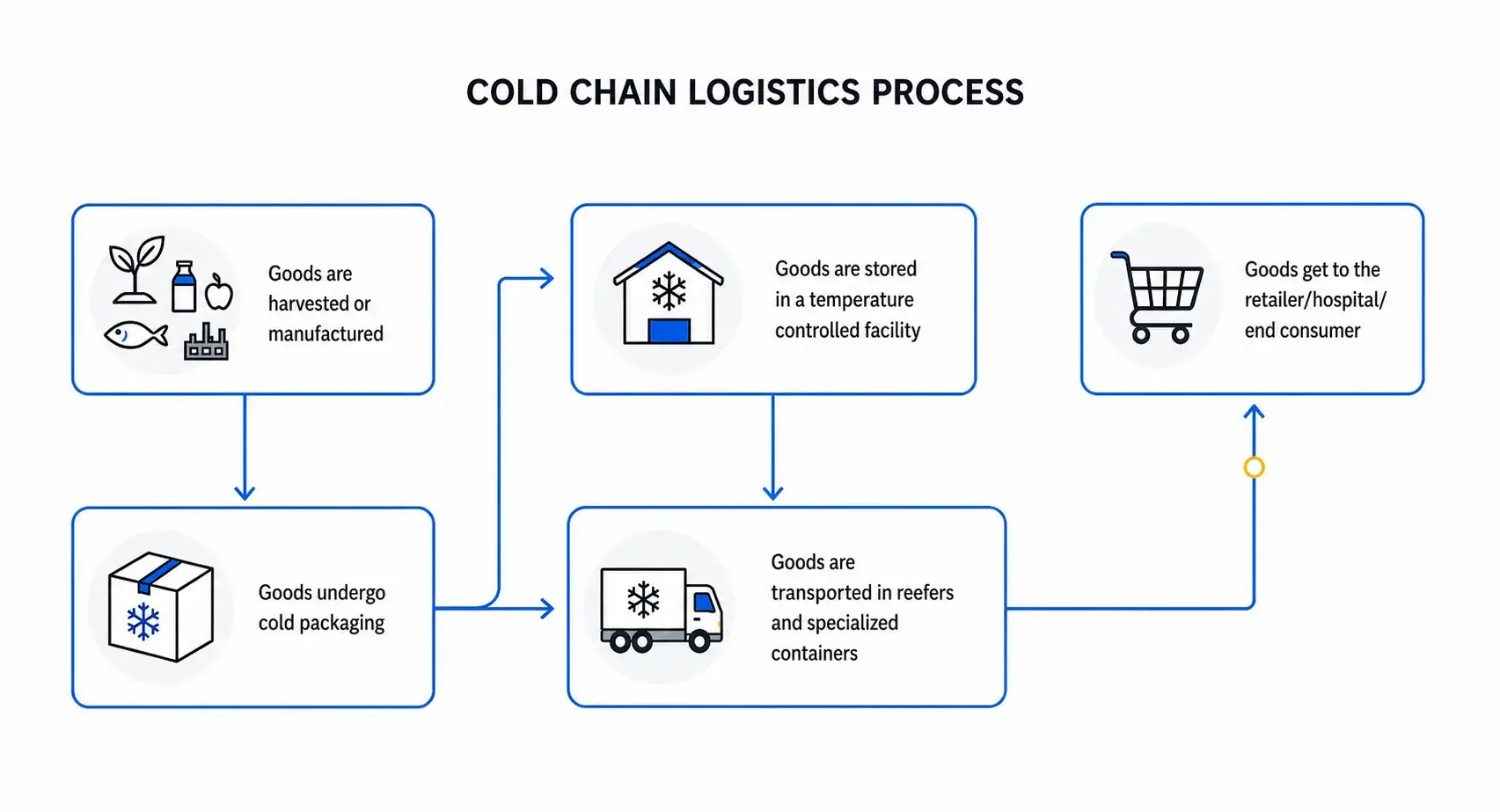
Cold-chain logistics is the storage, handling and transportation of products under certain temperature conditions. The process ensures these conditions are maintained throughout the supply chain and records of product movement, handling and quality are kept.
Products that are typically transported using cold chain logistics are pharmaceutical products, vaccines, biologics, dairy, meat, seafood, fresh food and frozen food. Different categories may have different temperature ranges, storage requirements and shelf life restrictions.
Key cold chain requirements include:
- Controlled temperature ranges for storage and transportation
- Refrigerated or frozen warehouses and vehicles
- Continuous or event-based temperature monitoring
- Shelf-life and batch or lot management
- Quality checks, traceability, and procedures for handling temperature excursions.
For example, a pharmaceutical product may require storage within a defined refrigerated range. Frozen food may require continuous freezing during storage and transportation. The relevant controls depend on the product's specifications and applicable handling requirements.
Why cold chain logistics requires more control
Conventional logistics typically tracks where inventory is, how much is available, and when a shipment will arrive. Cold chain logistics adds the conditions surrounding the product to these requirements.
A shipment can reach its destination on time and still require investigation if its temperature exceeded the approved range. The organization needs to establish when the excursion occurred, which products it affected, and whether the products remain suitable for use or sale.
A temperature excursion can lead to:
- Product quarantine while quality teams investigate
- Potential spoilage, product rejection, or disposal
- Additional testing, replacement shipments, and inventory losses
- Regulatory or contractual consequences, depending on the product and the circumstances.
Traceability supports the investigation. Teams need to connect affected batches or lots with storage locations, warehouse movements, transport records, temperature data, and quality decisions. This information helps identify the affected inventory and determine the appropriate response.
Cold chain operations also involve multiple parties. A manufacturer may rely on specialized warehouses, refrigerated carriers, distributors, and monitoring systems. Coordination between inventory, warehouse, quality, transportation, and external logistics processes helps maintain product controls across each handoff.
SAP can support these processes through relevant capabilities in warehouse management, inventory and batch management, quality management, transportation, and system integration. The specific solution depends on the company's products, SAP landscape, and monitoring requirements.
Which SAP Solutions Support Cold Chain Logistics?
Cold chain logistics generally requires numerous SAP capabilities in planning, inventory, warehouse, transportation, quality and analytics. The exact mix depends on the company’s products, supply chain structure, existing SAP landscape and external logistics systems.
SAP does not replace refrigerated warehouses, vehicles, sensors, telematics, or carrier platforms. These technologies perform physical operations and collect operational data. SAP links the relevant business processes and records the data necessary to track inventory, shipments, quality, and exceptions.
What role does each SAP solution play?
The cold chain is broken down into different components:
- SAP S/4HANA supports core processes such as sales orders, procurement, inventory, batch management, and financial transactions.
- SAP Extended Warehouse Management (EWM) manages warehouse execution, including receiving, putaway, storage, picking, packing, and inventory movements. It can also exchange transportation information with SAP Transportation Management.
- SAP Transportation Management (TM) supports transportation planning and execution, including freight orders, carrier processes, and transportation events.
- SAP Quality Management (QM) supports inspections, quality decisions, and quality-related inventory processes.
- SAP Integrated Business Planning (IBP) supports demand, supply, and inventory planning. It can help planners account for supply constraints, demand changes, and inventory requirements.
- SAP Business Network can connect shippers with carriers and logistics providers for processes such as freight tendering, shipment execution, document exchange, and status updates.
- SAP Business Technology Platform (BTP) provides integration and application development capabilities for connecting SAP with external systems.
- SAP Analytics Cloud and SAP Business Data Cloud can bring together relevant supply chain data for reporting and analysis.
- SAP Digital Manufacturing can support production processes when cold chain requirements extend into temperature-sensitive manufacturing environments.
A company may use only some of these capabilities. For example, a food distributor with complex refrigerated warehousing may have a different SAP architecture from a pharmaceutical manufacturer managing production, quality controls, and specialized transportation.
How does SAP fit with cold chain technology?
Temperature sensors, refrigeration equipment, vehicle telematics, warehouse automation, and carrier systems remain part of the physical logistics environment. SAP can receive relevant data from these systems and connect it with business transactions.
For example, a carrier platform may provide shipment status while a monitoring system records temperature data. An integrated SAP environment can associate relevant information with the shipment, inventory, or batch record and make it available to the appropriate business process.
Temperature monitoring and the handling of temperature excursions require their own integration and process design. We will examine SAP integration with monitoring systems and temperature excursion management in detail later in the guide.

Warehouse and Inventory Operations
A cold storage warehouse has to control where products are stored, which inventory can be picked, and how orders move through the facility. SAP EWM provides the warehouse execution layer for these processes, while shelf-life rules and automation determine how inventory moves through the facility.
SAP EWM for cold storage warehouses
SAP Extended Warehouse Management (EWM) manages warehouse activities at a more detailed level than the core inventory processes in SAP S/4HANA. In a cold storage environment, EWM can organize inventory by storage type and location, manage handling units and warehouse tasks, and control movements from receiving through shipment staging.
The connection between S/4HANA and EWM allows business documents and inventory information to flow into warehouse execution. EWM then manages the physical warehouse activities required to fulfill those documents. After picking and staging, transportation processes can take over for shipment execution.
Relevant EWM processes include:
- Assigning products to appropriate storage locations and storage types
- Managing batches, handling units, and inventory status
- Creating and confirming warehouse tasks for putaway, picking, replenishment, and internal movements
- Applying shelf-life and batch selection rules during picking
- Managing staging and loading activities before shipment
- Maintaining warehouse-level inventory visibility.
This setup can support processes such as quarantining a batch after a quality issue, restricting inventory with an unsuitable status, or directing warehouse workers toward specific batches during order fulfillment.
How FEFO and shelf-life management affect picking
First Expired, First Out (FEFO) selects inventory based on expiration dates or remaining shelf life. The approach matters when products have a limited usable period and older inventory needs to move before inventory with a later expiration date.
The warehouse may also need to meet a customer's minimum remaining shelf-life requirement. For example, an order could require a product to have at least 60 days of remaining shelf life at delivery. Inventory that expires sooner may remain available for other orders while the warehouse allocates a suitable batch to this shipment.
FEFO can influence several connected processes:
- Batch selection during order allocation and warehouse picking
- Minimum remaining shelf-life checks against customer requirements
- Inventory positioning and replenishment decisions
- Identification of inventory approaching expiration
- Disposal or other disposition processes for expired stock.
The rule also affects planning outside the warehouse. Procurement teams may need to account for supplier shelf life, while planners need to consider how long products will remain available after receiving. Transportation planning can also become relevant when remaining shelf life leaves less time for delivery.
How automation works with SAP EWM
Cold storage facilities often use automation to reduce manual handling inside refrigerated or frozen areas. Depending on the facility, this can include automated storage and retrieval systems, conveyors, robotic picking, autonomous mobile robots, and other material-handling equipment.
SAP EWM can coordinate warehouse execution with automation through components such as the Material Flow System (MFS) or through integration with a Warehouse Execution System (WES) or Warehouse Control System (WCS). A simplified architecture can follow the pattern:
SAP EWM → MFS / WES / WCS → Warehouse automation
The appropriate design depends on the equipment, warehouse processes, throughput requirements, and existing control systems. EWM can determine the warehouse task, while the automation layer handles the physical movement through the relevant equipment.
For complex cold storage facilities, this separation helps define which system controls inventory and warehouse processes and which system controls individual machines. The integration between them determines how confirmed physical movements become updated warehouse inventory.
Temperature Monitoring and Exception Management
Temperature data becomes useful to cold chain operations when it can be associated with a specific shipment, batch, handling unit, storage location, or other business object. That connection allows teams to move from a temperature reading to a business decision.
How temperature monitoring connects to SAP
Temperature information can come from sensors in warehouses, refrigerated trucks, containers, data loggers, telematics systems, or external carrier platforms. An integration layer can transmit relevant readings and events to SAP or an application running on SAP Business Technology Platform (BTP).
A typical architecture can connect these components:
Sensor or telematics → integration layer → SAP or BTP → business rule or alert → operational or quality action
The integration needs enough context to identify what the measurement relates to. A reading of 9°C has limited meaning on its own. The business process needs to know which product was exposed, which shipment carried it, what temperature range applies, and how long the exposure lasted.
SAP IoT and related event capabilities can support event creation and rule-based processing. SAP documentation also provides examples of temperature-related events and configurable rules triggered by incoming measurements.
The resulting event can then connect with logistics or quality processes. For example, a temperature event associated with a shipment may trigger an investigation of the affected batch or handling unit.
What happens after a temperature excursion?
A temperature excursion requires a defined response based on the product's requirements and the company's quality procedures. The response may involve operational and quality teams rather than a single automated action.
For example, an excursion during transportation could lead to an alert, identification of the affected shipment and batch, and a temporary restriction on the associated inventory. A quality team can then review the temperature history, exposure duration, product requirements, and other relevant information before deciding how to proceed.
Possible responses include:
- Placing affected inventory into quarantine or inspection stock
- Holding a shipment while the excursion is investigated
- Creating or updating a quality record
- Reviewing the temperature history and identifying the affected batches or handling units.
- Releasing, rejecting, or otherwise disposing of the affected product according to the applicable quality decision
- Documenting the event and its resolution for traceability and further analysis.
SAP supports several related quality and inventory processes. For example, Quality Management can work with EWM to inspect warehouse stock, and quality processes can result in follow-up stock actions.
The exact workflow depends on the company's products, thresholds, monitoring technology, and quality procedures. An implementation may combine SAP functionality with IoT platforms, integration services, business rules, and custom workflows. A temperature alert alone does not determine whether a product must be discarded. The system needs the relevant product and quality rules, exposure data, and decision process to support that determination.
Transportation and Carrier Integration
Refrigerated transportation adds constraints that transportation planning has to account for before a shipment leaves the warehouse. The available vehicle, required equipment, delivery window, route duration, and shipment requirements can all affect how and when a load moves.
SAP Transportation Management (TM) can connect these transportation requirements with warehouse readiness and carrier execution. The process can run from shipment planning through loading, transportation, and delivery, with carrier updates returning to the transportation system.
How SAP TM supports refrigerated transportation
SAP TM can plan and execute transportation based on freight requirements, locations, dates, and transportation resources. For cold chain shipments, the planning model can also reflect requirements such as refrigerated or frozen equipment and specific delivery windows.
The timing between warehouse and transportation operations matters. A refrigerated truck arriving before a shipment is ready can create waiting time and dock congestion. A late loading operation can reduce the time available for delivery. Longer routes can also affect transportation requirements for temperature-sensitive products.
SAP TM can support activities such as:
- Planning freight and selecting suitable transportation resources.
- Coordinating pickup and delivery dates and time windows.
- Managing freight orders and carrier assignments.
- Tracking transportation milestones and delays.
- Supporting freight cost calculation and settlement.
- Coordinating transportation with warehouse and loading activities.
Cross-docking can add another dependency. Products may move between inbound and outbound transportation with limited storage time, so transportation schedules and warehouse execution need to remain synchronized.
How SAP connects with cold chain carriers
Many cold chain shipments involve external carriers with their own transportation management, telematics, GPS, reefer monitoring, and tracking systems. Exchanging transportation data manually between these systems creates opportunities for inconsistent shipment status, missing milestones, and reconciliation work.
SAP Business Network Freight Collaboration provides connectivity between SAP transportation processes and participating carriers. Carriers can receive freight requests and orders, provide confirmations and milestone updates, and exchange documents through supported network capabilities. SAP documents integration options that include APIs and EDI, as well as connectivity between Freight Collaboration and SAP TM.
A typical information flow can include shipment requirements and pickup instructions moving from the shipper's transportation system to the carrier. The carrier can return acceptance, planning information, status updates, pickup and delivery milestones, and other execution data. Carrier integrations can also exchange tracking information from external systems.
For a US cold chain operation, carrier integration may involve EDI, APIs, or a combination of both, depending on the carrier's technology and the integration architecture. SAP Business Network documentation specifically covers ANSI X12 and API-based carrier integration.
The result gives transportation teams a shared view of planned and actual execution data. A shipment can remain connected to its carrier status instead of requiring teams to reconcile updates across separate systems. Temperature events can also enter the broader shipment process when the carrier or monitoring platform provides that data, with the detailed temperature-excursion process handled through the monitoring and quality architecture described earlier.
Traceability and Quality Management
Cold chain traceability connects a product's identity with its movement and quality history. For a batch-controlled product, that history can extend from the supplier and goods receipt through storage, shipment, and delivery to the customer.
How SAP supports cold chain traceability
Batch management provides the data needed to identify and follow specific quantities of a product. SAP can record information such as the supplier batch number, expiration date, production date, and batch status. With integrated EWM, the same batch can also be associated with warehouse locations and movements.
Depending on the product and process, traceability can connect:
- Supplier and supplier batch
- Material batch or lot
- Production and expiration dates
- Warehouse, storage location, and inventory status
- Shipment and delivery information
- Customer or receiving location.
This information supports practical investigations. If a quality issue affects a specific batch, teams can identify where that batch was received, where it moved, which inventory remains available, and which customers received it. SAP Global Batch Traceability can also combine batch genealogy data from SAP and non-SAP systems when a broader supply chain view is required.
The same records support inventory control. SAP can distinguish unrestricted and restricted batches, and configuration can prevent warehouse tasks or goods movements for restricted batches.
How SAP Quality Management handles cold chain quality
Quality Management connects inspections and quality decisions with inventory and logistics processes. For example, an inbound delivery can trigger an inspection process, with the resulting stock status affecting whether inventory can proceed into normal warehouse operations. EWM supports integration with Quality Management for inbound inspections and related stock handling.
A cold chain process may involve an inspection after receipt, a quality decision, and release of the product for storage or further processing. If a defect or temperature-related issue affects inventory later in the process, the affected stock can be linked to a quality notification and moved to quality inspection or blocked stock while the issue is investigated. SAP provides standard follow-up actions for these EWM quality scenarios, including posting to quality inspection stock, blocked stock, unrestricted stock, return to supplier, or scrap.
The exact inspection criteria depend on the product, customer requirements, company procedures, and applicable regulatory requirements. For pharmaceuticals, biologics, and food products, those requirements can differ significantly. SAP provides the process framework and records the resulting decisions; the company defines the quality rules and acceptance criteria that govern each product.
How SAP Solutions Support Different Cold Chain Models
Cold chain requirements are very different across products and operating models. A pharmaceutical manufacturer might require stringent batch traceability and documented quality decisions. A food distributor may focus on shelf life, FEFO, recalls and high volume warehouse execution. For a 3PL, the same facility might need to house several customers, each with their own storage conditions and service demands.
These differences can be reflected in SAP architecture with a combination of S/4HANA, EWM, TM, Quality Management, integration services and external monitoring systems.
How SAP supports pharmaceutical cold chain
Pharmaceuticals, vaccines, and biologics can have defined storage and transportation conditions tied to product specifications and labeling. FDA guidance also recognizes that biological products can be sensitive to temperature and that storage conditions can affect their safety, purity, or potency.
A pharmaceutical cold chain may connect S/4HANA with EWM, TM, Quality Management, and external temperature-monitoring systems. Batch and expiration data can follow the product through receiving, storage, picking, transportation, and delivery. Quality processes can control inventory that requires investigation or release before distribution.
The exact controls depend on the product and applicable requirements. FDA requirements and guidance differ across drugs, biologics, and other regulated products, so the SAP design should follow the company's validated processes and regulatory obligations.
SAP can provide the systems and process integration needed to record and manage these activities. Compliance depends on the complete operating model, including procedures, equipment, monitoring, validation, and quality controls.
How SAP supports food and beverage cold chain
Food and beverage operations typically handle high inventory volumes and frequent movements across warehouses, distribution centers, stores, restaurants, or other customers. Dairy, meat, seafood, fresh produce, frozen food, and beverages can also have different storage and transportation requirements.
Shelf life and batch traceability often have a direct effect on warehouse execution. FEFO can guide batch selection, while traceability data can help identify affected inventory during a recall or quality investigation. Transportation processes also need to account for temperature-control requirements.
For food transported in the United States, the FDA's Sanitary Transportation rule establishes requirements covering transportation equipment, operations, training, and records. It also requires adequate temperature control for food that requires temperature control for safety.
SAP can connect these requirements with warehouse, inventory, quality, and transportation processes. The specific controls still depend on the product, the company's procedures, and the applicable federal, state, or contractual requirements.
How SAP supports 3PL cold chain operations
A 3PL can manage cold chain inventory for multiple customers, each with different temperature ranges, shelf-life requirements, service levels, reporting needs, and billing arrangements. The warehouse system consequently needs to keep customer inventory and operating rules separated while supporting shared warehouse resources.
SAP EWM can manage warehouse execution and inventory at the required level of detail, while S/4HANA can support commercial and financial processes. Integration with customer systems, carriers, transportation platforms, and temperature-monitoring systems can connect external data with warehouse and shipment records.
A 3PL architecture links customer systems through an integration layer to SAP EWM and S/4HANA, and then to transportation, carrier and monitoring platforms. The integration design should describe the flow of orders, inventory updates, shipment information, temperature events, billing data and value added services between the systems.
For a 3PL, the challenge often lies in handling different customer rules within a common operating environment. SAP configuration and integration can support those variations while maintaining a consistent record of inventory, warehouse activity, and transportation execution.

See how LSG Sky Chefs, the world’s leading airline catering provider, worked with LeverX to establish a centralized procurement framework across 46 US locations.
Explore the case to learn how the project improved visibility across a complex, distributed supply network.
Planning and Capacity Management
Cold chain planning has to account for two connected constraints: how much inventory the network needs and how much temperature-controlled capacity it can handle. A demand forecast can support higher inventory targets during a seasonal peak, for example, while available freezer space, pallet positions, dock capacity, and refrigerated transportation may limit how much stock a facility can actually hold and move.
How SAP IBP supports cold chain planning
SAP Integrated Business Planning (IBP) can link demand forecasts to inventory targets, supply plans, and network constraints. Features of demand planning include statistical forecasting and machine learning-based forecasting. Inventory optimization can help set inventory targets based on expected demand and service requirements. Response and supply planning can then evaluate how the supply network can meet that demand within modeled constraints.
Cold chain planning adds another variable: product expiration. Holding more stock can protect service levels, yet the additional inventory may have less time available for sale or use. SAP IBP supports shelf-life planning, allowing supply and demand matching to consider expiration dates and minimum required shelf life when the relevant planning setup and integration are in place.
This changes how planners evaluate inventory decisions. A plan for an additional 10,000 cases, for example, needs to account for expected demand, available shelf life, storage capacity, replenishment timing, and the ability of downstream facilities to receive and process the volume. Scenario planning can help compare these conditions before the company commits to a supply or inventory decision.
What SAP can do for cold storage capacity planning
Cold storage capacity has several dimensions. A warehouse may have separate frozen, chilled, ambient, and controlled-temperature areas, each with different physical and operational constraints. Available pallet positions alone cannot describe the capacity available to the business.
SAP EWM can map the physical warehouse down to storage-bin level and maintain attributes such as total capacity and maximum weight. Its capacity checks can evaluate factors such as weight, volume, product, and handling unit when determining whether a storage bin can accept additional stock.
For planning purposes, companies can connect this operational warehouse data with broader supply and demand plans. The analysis can cover:
- Available pallet and cubic capacity by temperature zone
- Expected inventory levels and peak stock requirements
- Receiving, picking, staging, and loading throughput
- Dock and appointment capacity
- Capacity available across internal and external cold-storage facilities.
This connection helps expose a common planning gap: the forecast may fit the supply plan while exceeding the physical capacity of a particular cold-storage location. A company can then evaluate options such as shifting inventory between facilities, changing replenishment timing, using an external warehouse, or adjusting the supply plan.
SAP EWM also provides capacity information for loading points when integrated with SAP Dock Appointment Scheduling, supporting the planning of transportation-unit arrival and departure times.
The practical architecture depends on the planning horizon. SAP IBP handles network-level demand, supply, and inventory decisions, while SAP EWM provides detailed warehouse capacity and execution data. Connecting the two gives planners a clearer view of whether planned inventory can fit the physical network and where capacity constraints could affect service levels or spoilage risk.
Data, Analytics, and Integration Architecture
Cold chain data becomes useful when events from different parts of the operation can be interpreted together. A temperature excursion, for example, carries very different implications when the system also knows the shipment, product batch, current location, expected arrival time, and inventory or quality status.
A cold chain architecture therefore needs more than connections between SAP applications. It needs a way to collect data from warehouses, transportation providers, sensors, customers, suppliers, and other external systems, associate that data with business objects, and make the resulting information available to the processes and people that need it.
What cold chain analytics should show
A cold chain dashboard should connect operational events with the business context behind them. Looking at temperature data alone can show that a threshold was exceeded. Linking the same event to a shipment and batch can show which inventory may require review and where that inventory currently sits.
Depending on the operation, useful analytics can cover temperature excursions, delivery performance, inventory age, expiration exposure, spoilage, warehouse dwell time, carrier performance, shipment status, and cold-storage utilization.
For example, a shipment view could bring together its current temperature status, location, ETA, product and batch information, and quality status. A planner or logistics manager can then investigate an exception without switching between separate transportation, warehouse, monitoring, and quality systems.
SAP Analytics Cloud can consume analytical data from SAP environments, while SAP Datasphere and other data services can support broader data integration and modeling scenarios. The appropriate design depends on the existing SAP landscape, external data sources, reporting requirements, and the required latency.
The key architectural decision concerns the level of detail that needs to reach SAP business processes. A high-frequency sensor stream does not necessarily belong in an ERP transaction. A temperature event that indicates a potential product-quality issue may need to reach the relevant shipment, batch, inventory, or quality process quickly.
How SAP BTP connects the cold chain landscape
A typical cold chain landscape contains systems that were designed for different purposes. SAP S/4HANA handles core business transactions. SAP EWM manages warehouse execution. SAP TM supports transportation processes. IBP supports planning. Carriers may operate their own transportation and telematics platforms, while refrigeration equipment and sensors generate environmental data.
SAP BTP provides integration and extension capabilities between these systems. APIs can be used to expose or consume business data and SAP Integration Suite facilitates connections between SAP and non-SAP applications. Event-based communication is useful when downstream applications need to react to something happening, such as a shipment milestone or other business event. SAP Event Mesh supports asynchronous communication between applications and can propagate events from both SAP and non-SAP sources.
This distinction matters for cold chain operations. An integration flow can exchange shipment or delivery information between systems. An event-driven process can notify another application when a relevant event occurs. A workflow or extension can then apply additional business logic or guide a user through a required action. SAP BTP supports these extension patterns alongside integration capabilities.
External participants can connect through APIs, EDI, files, or other supported interfaces, depending on their capabilities. A 3PL, for example, may exchange order and inventory information with SAP while providing shipment milestones through its own platform. Sensor and telematics platforms can provide temperature and location events through their available interfaces.
What a reference SAP architecture for cold chain can look like
There is no single SAP product stack that fits every cold chain operation. The target architecture should follow the company's processes, existing systems, product requirements, and integration landscape.
A common reference model places SAP S/4HANA at the center of core commercial and supply chain transactions, with SAP EWM and SAP QM supporting warehouse and quality processes and SAP TM supporting transportation. SAP IBP operates at the planning level. External carriers, 3PLs, customers, suppliers, telematics platforms, and sensor systems connect through the appropriate integration layer.
A simplified view looks like this:
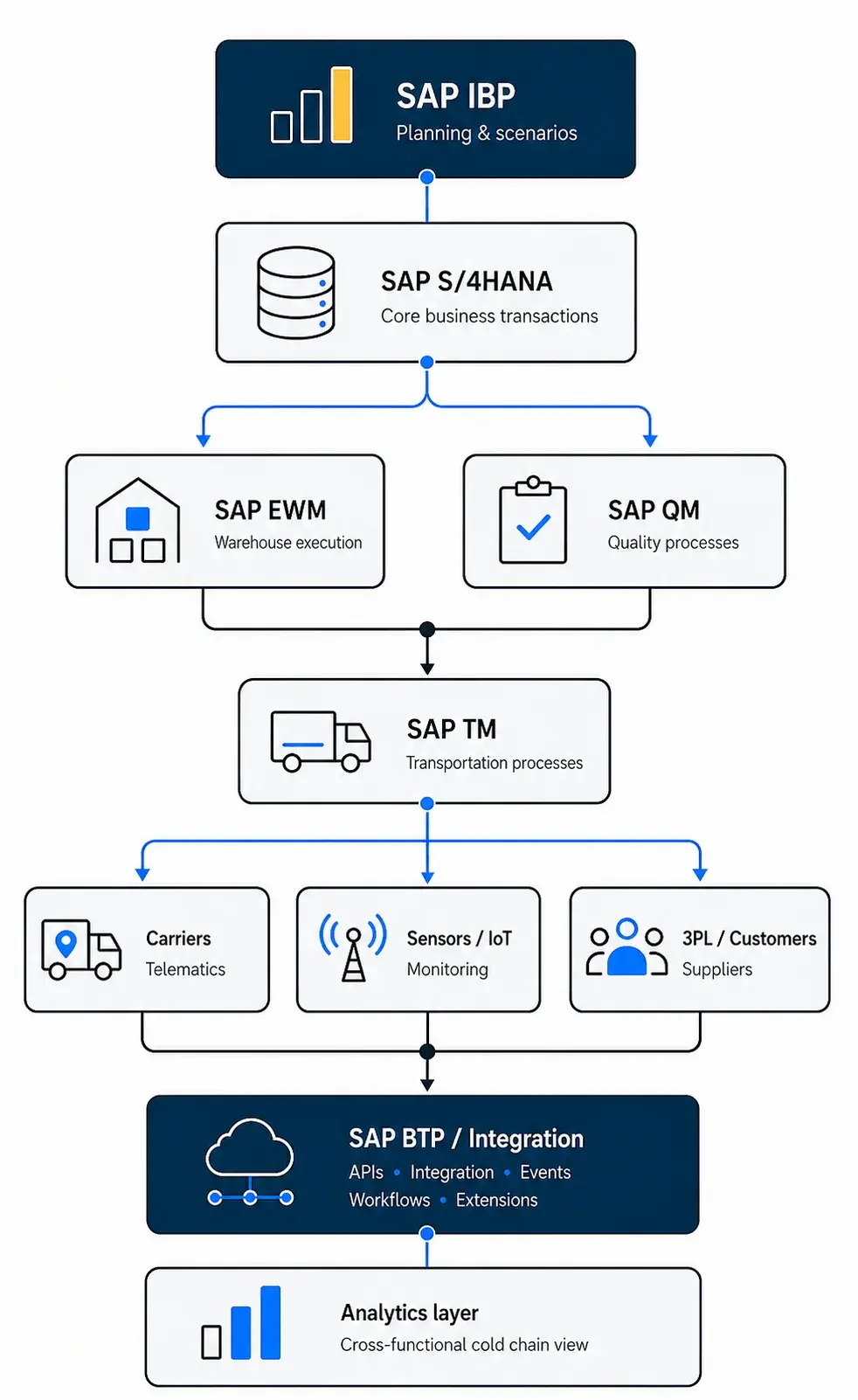
The diagram represents a reference architecture rather than a mandatory implementation. Some companies may already have a separate TMS, data platform, warehouse system, or IoT platform. Others may require additional applications for specialized monitoring or customer collaboration.
The architectural goal remains consistent: keep transactional responsibilities in the systems designed to manage them, connect external events and data through controlled interfaces, and provide analytics across the resulting landscape. SAP BTP can also support extensions where a cold chain process requires functionality beyond the standard SAP applications, while keeping those extensions separate from the digital core where appropriate.
US Market Considerations and Supply Chain Resilience
Cold chain operations in the United States often span long distances, multiple distribution regions, refrigerated trucking networks, and different climate conditions. These factors affect inventory positioning, transportation planning, storage capacity, and response times when a disruption occurs.
What US cold chain operations need to account for
A US network may connect manufacturers, regional distribution centers, cold-storage facilities, retailers, hospitals, pharmacies, and 3PLs. Products can cross several states before reaching customers, while international flows may add border crossings with Canada or Mexico.
Planning and execution can be affected by:
- Long transportation distances and regional distribution patterns
- Refrigerated truck and trailer availability
- Seasonal weather, including extreme heat, winter storms, and hurricanes
- Border delays and additional handoffs on Canada and Mexico routes
- High-volume food and pharmaceutical distribution.
Regulatory requirements also depend on the product category. For food requiring temperature control for safety, the FDA's FSMA Sanitary Transportation rule covers areas such as transportation equipment, operations, training, records, and adequate temperature control.
Pharmaceutical distribution follows different requirements, including the Drug Supply Chain Security Act (DSCSA), which covers tracing certain prescription drugs through the US distribution chain and establishes requirements for authorized trading partners.
SAP can support the operational records and processes behind these requirements. Compliance also depends on company procedures, equipment, contracts, quality controls, and the specific regulations that apply to the products.
How SAP supports cold chain resilience
A disruption becomes easier to manage when the company can quickly connect the event with affected inventory, shipments, customers, and delivery commitments. A refrigeration failure can affect several batches, while a carrier cancellation may put multiple orders at risk.
A practical response model follows the flow event → visibility → impact assessment → exception → action. SAP data can help connect external events with warehouse, transportation, inventory, batch, and planning information.
Depending on the situation, teams may need to:
- Reroute a shipment or change the carrier
- Move inventory to another facility
- Adjust replenishment or delivery priorities
- Expedite an order where capacity allows
- Place potentially affected inventory into a controlled status for quality review.
External weather, telematics, carrier, and border data can provide the initial event, while SAP processes can help identify the related business objects and actions. Where temperature control may have failed, the response can also require a documented safety or quality determination before distribution. FDA guidance for sanitary transportation addresses such temperature-control failures for food covered by the rule.
The architecture developed earlier in the article supports this response by connecting planning, warehouse, transportation, quality, and external data. The result depends on how those systems are configured and how the company defines its exception and quality procedures.
What It Takes to Improve a Cold Chain With SAP
SAP can support many cold chain processes, yet the technology alone does not resolve disconnected data, inconsistent processes, or unclear ownership. Companies usually encounter these issues when warehouse, transportation, monitoring, quality, and partner systems have developed separately over time.
What challenges can affect an SAP cold chain landscape?
The most common problems appear where operational data crosses system boundaries. Temperature readings may remain in a monitoring platform, while shipment information sits in a TMS and batch status in SAP. A carrier may provide milestones through a separate portal, leaving warehouse teams to reconcile delivery information manually.
Other issues include:
- Incomplete batch and shelf-life information
- Manual handling of temperature excursions and quality decisions
- Gaps between carrier, 3PL, warehouse, and inventory data
- Inconsistent master data for storage conditions, products, and batches
- Automation introduced before warehouse processes and data are standardized.
These gaps can affect decisions beyond the original process. For example, missing shelf-life information can influence inventory allocation, while incomplete carrier data can make it harder to assess the impact of a delayed refrigerated shipment.
How should an SAP cold chain transformation start?
A practical roadmap starts with the existing operation rather than a predefined SAP product stack. The company first maps its warehouses, transportation processes, monitoring systems, products, batches, quality controls, and external partners. The assessment should also identify where data originates, who owns it, and where manual reconciliation occurs.
The next stage defines the target processes and integration model. Teams can then prioritize areas where better system support can reduce operational risk, such as batch traceability, FEFO, temperature-event handling, or shipment visibility.
Implementation can follow a controlled sequence:
- Assess: document processes, systems, data, and dependencies.
- Design: define target processes, data ownership, integrations, and exception handling.
- Prioritize: select high-impact use cases and sites.
- Integrate and test: connect SAP applications with monitoring, carriers, and external systems, including failure and exception scenarios.
- Deploy and improve: roll out by site or region, then use operational data to refine processes and planning.
Testing should cover realistic disruptions alongside standard transactions. A refrigerated shipment arriving late, a sensor becoming unavailable, a warehouse losing connectivity, or inventory entering quality hold can expose integration and process gaps that a standard happy-path test will miss.
KPIs for Cold Chain Logistics
Cold chain KPIs should connect product conditions with warehouse, transportation, inventory, and service performance. Tracking temperature excursions alone can miss the operational impact of a delayed shipment, aging inventory, or limited storage capacity.
|
Area |
KPI |
|
Temperature |
Temperature excursion rate |
|
Quality |
Product quarantine rate |
|
Inventory |
Inventory accuracy |
|
Inventory |
Expired or spoiled inventory |
|
Warehouse |
FEFO compliance |
|
Warehouse |
Storage utilization |
|
Transportation |
On-time delivery |
|
Transportation |
Shipment visibility |
|
Carrier |
Temperature-compliant deliveries |
|
Service |
Perfect-order rate |
|
Operations |
Warehouse or shipment dwell time |
|
Finance |
Cost per shipment |
Definitions and calculation rules should remain consistent across sites and systems. Regulated operations may also need KPI definitions that align with internal quality procedures, customer requirements, and applicable compliance controls.
Conclusion: Building a Stronger SAP Foundation for Cold Chain Operations
A cold chain transformation needs to follow the product journey across planning, inventory, warehouse execution, quality, transportation, and temperature monitoring. Connecting these processes helps teams relate temperature events to the inventory, shipments, batches, and quality decisions they affect.
How LeverX supports SAP cold chain projects
LeverX brings together SAP S/4HANA, EWM, TM, Quality Management, IBP, BTP and integration services, data and analytics, and other SAP supply chain capabilities according to the company's processes and existing landscape. The right combination depends on the products, facilities, systems, and operating model.
This approach starts with the current landscape and identifies gaps in process execution, data, integration, and visibility. From there, teams can define a target architecture and prioritize changes around the areas with the greatest operational impact.
For companies assessing their cold chain processes or planning an SAP initiative, we suggest booking a strategy session with the LeverX team. They will provide an expert review of the current landscape and help define practical next steps.
FAQ
Can SAP track temperature excursions?
SAP can receive and process temperature-excursion events when the monitoring solution connects to the SAP landscape. A business rule can trigger an alert or workflow and identify the related shipment, batch, or inventory.
Product disposition requires a defined quality process. A temperature reading alone does not determine whether goods can be released, tested, returned, or discarded.
Does SAP support FEFO and shelf-life management?
SAP can use expiration dates and shelf-life information when planning and executing inventory processes. FEFO rules can guide batch selection toward stock with the earliest expiration date, subject to the company's configuration and process requirements.
Shelf-life requirements can also affect procurement, inventory allocation, replenishment, and customer deliveries.
How does SAP TM support refrigerated transportation?
SAP Transportation Management can support freight planning and execution, carrier assignment, transportation milestones, delivery windows, and freight cost processes. Cold chain requirements can form part of shipment planning where the relevant product and transportation data are available.
Refrigeration equipment and vehicle conditions remain the responsibility of the specialized systems that monitor or control them.
Can SAP integrate with temperature sensors and telematics?
Yes. SAP can exchange data with sensors, data loggers, refrigerated vehicles, containers, and telematics platforms through APIs, integration services, events, or other supported interfaces.
The integration design should connect an incoming event with its business context. For example, a temperature event may need links to a vehicle, shipment, handling unit, batch, or storage location before an SAP process can act on it.
How does SAP support food and beverage cold chain?
SAP can support inventory, batch management, shelf-life, warehouse, transportation, quality, and traceability processes used for temperature-sensitive food and beverages. FEFO and batch-level information can help manage products with limited shelf life.
Temperature monitoring, refrigeration control, and vehicle conditions typically remain within specialized equipment and monitoring platforms. Integration can connect relevant events with SAP business processes.
Does SAP replace IoT temperature-monitoring systems?
SAP does not replace specialized temperature sensors, refrigeration controllers, data loggers, or telematics platforms. Those systems collect measurements and, where applicable, control or monitor refrigeration equipment.
SAP can use selected data and events from these systems within warehouse, transportation, inventory, and quality processes. The architecture should define which system owns monitoring, which system manages business decisions, and how the two exchange information.
Can SAP manage batch and lot traceability?
SAP supports batch management and can connect batch information with inventory, warehouse movements, deliveries, and other relevant transactions. This provides a basis for tracing products through different stages of the supply chain.
For more complex landscapes, additional traceability capabilities or integrations may be required to combine genealogy data from SAP and external systems.
How does SAP support cold chain recalls?
SAP can help identify affected batches, inventory, deliveries, and customers when recall criteria are available in the relevant systems. Quality and inventory processes can then support actions such as placing stock on hold, documenting decisions, coordinating returns, or removing affected goods from distribution.
The recall process depends on the company's quality procedures, product requirements, and external partner systems.