Discover how SAP combines logistics execution, carbon tracking, and ESG reporting to build more sustainable and efficient supply chains.
How much delivery risk comes from SAP, and how much comes from the partner implementing it?
For many enterprises, the answer becomes clear only after budgets expand, or once project timelines are missed, or when support tickets begin to accumulate. By then, the organization has already invested years into processes, custom code, and working relationships that make changing partners more difficult.
In this article, we will describe the warning signs that separate temporary project challenges from long-term delivery problems, the cost of keeping the wrong SAP partner, and how US enterprises can evaluate when a partner replacement should become part of their SAP strategy.
Your SAP Partner Has More Influence Than You Think
Many organizations view an SAP partner as the entity responsible for implementing new functionality, completing upgrades, or providing application support. In practice, the partner influences decisions that remain part of the SAP landscape for years. Those decisions affect future project costs, upgrade complexity, system stability, and the amount of custom development an organization must maintain.
An experienced SAP partner should deliver more than completed project milestones. Every architectural decision, configuration choice, integration approach and customisation should be made with long-term maintainability in mind. For those organisations migrating to SAP S/4HANA or adopting RISE with SAP, those decisions also determine how closely aligned the system is to Clean Core Values and SAP’s recommended implementation practices.
Technical debt compounds quietly
Most SAP partner problems do not appear as a single failure. They accumulate as small compromises: a custom enhancement built to patch a gap instead of using standard SAP Activate configuration; a workaround left in place because fixing it properly would have delayed a sprint; a data migration script that works for go-live, but breaks the next time a country is added to the rollout.
Each compromise is a reasonable decision under deadline pressure. Together, they raise the cost of every future change, because more of the system now depends on code that only the original team fully understands.
This is why SAP implementation risk rarely surfaces as a dramatic outage. Instead, it shows up as a total cost of ownership that grows year-over,year, without a corresponding increase in business value.
Small delivery decisions can create long-term costs
An SAP delivery problem does not stay contained to the project plan. A delayed financial consolidation module pushes back month-end close. A supply chain module that goes live with unresolved integration issues creates inventory visibility gaps that procurement and logistics teams work around manually. A compliance-relevant configuration(e.g., tax determination logic or SOX-relevant approval workflows) that gets deprioritized under schedule pressure will be identified in an audit months later.
The timing pressure on these decisions has increased. SAP has confirmed that mainstream maintenance for SAP ECC 6.0 (Enhancement Packages 6 through 8) ends December 31, 2027, with extended maintenance available only through 2030 at an additional cost. Optional extended maintenance runs until the end of 2030 at a premium, and only a narrow set of complex customers on a RISE with SAP agreement can arrange support beyond that.
Enterprises still running SAP ECC no longer have an open-ended timeline to absorb a partner's delivery gaps. Every quarter lost to rework or scope disputes is a quarter subtracted from an already fixed migration window.
The signals worth tracking
A handful of measurable indicators tend to distinguish SAP partners who are managing risk from partners who are creating it:
-
Custom code ratio and Clean Core alignment: how much of the solution relies on non-standard code that will need remediation before or during an S/4HANA conversion.
-
Defect trends after go-live: whether critical and high-priority tickets decline over the weeks following deployment or stay flat.
-
Milestone accuracy under SAP Activate: how often planned phase dates hold versus get revised, and whether revisions come with a documented root cause.
-
Support ticket aging: the average time a ticket sits without a substantive update, not just the time to first response.
These indicators are already available in most SAP partner contracts through status reports and support SLAs. The problem is rarely a lack of data. Rather, the data does not get reviewed as a pattern until a larger failure forces the question.
10 Warning Signs Your SAP Partner Is No Longer the Right Fit
Of course, one delayed milestone or an isolated production issue does not automatically indicate that an SAP partner should be replaced. Large SAP programs involve changing business requirements, evolving priorities, and unexpected technical challenges.
The concern starts when the same delivery patterns appear across multiple projects, support activities, and release cycles. Those patterns usually point to process, governance, or architectural problems that become more expensive to correct over time.
Warning sign #1: Project deadlines continue to slip
Every SAP project experiences occasional schedule changes. However, consistently missing delivery milestones points to a deeper issue. Common causes include unrealistic effort estimates, weak project governance, slow decision-making, or limited understanding of business processes.
Repeated delays create a chain reaction across the organization. Business teams postpone process changes, integration projects wait for dependent functionality, and planned SAP releases become harder to coordinate. When schedules move several times without a clear technical reason, project management practices deserve closer attention.
Warning sign #2: Nearly every new requirement becomes a change request
Change requests are part of every SAP implementation. Their volume should decrease as the project scope becomes more stable. When new change requests appear for routine business requirements, the original solution design may have missed important processes or underestimated implementation effort.
Enterprise leaders should review why change requests are increasing. The underlying cause often falls into one or more of these areas:
-
Incomplete discovery and business process analysis
-
Inaccurate project estimation
-
Solution design that does not reflect operational requirements
-
Limited collaboration between functional consultants and business stakeholders
A growing backlog of change requests usually affects both budget predictability and delivery timelines.
Warning sign #3: Delivery status is difficult to understand
Project reporting should help executives make decisions. Status reports that rely on technical terminology, inconsistent metrics, or optimistic progress updates make that difficult.
Leadership teams should have clear visibility into completed work, unresolved risks, upcoming milestones, budget status, and delivery dependencies. When that information requires constant clarification, governance has already become less effective.
Warning sign #4: Critical knowledge resides with a small number of consultants
Many SAP projects rely on experienced specialists. Problems begin when only one or two consultants understand key integrations, custom developments, or business processes.
Knowledge concentration increases operational risk. Vacation, staff turnover, or resource reallocation can slow issue resolution and delay project work. Strong SAP delivery includes documentation, structured knowledge transfer, and cross-functional teams that reduce dependence on individual experts.
Warning sign #5: Every release introduces new production issues
Application changes should become predictable as delivery processes mature. Frequent regressions after transports or releases often point to gaps in quality assurance.
Typical causes include incomplete regression testing, limited automation, insufficient integration testing, or compressed release schedules. These issues increase support effort and reduce confidence in future deployments.
Warning sign #6: Custom code continues to expand
Every SAP landscape contains some level of custom development. The question is whether each customization solves a business requirement that standard SAP functionality cannot address.
When custom code grows without clear governance, future upgrades require additional effort. Organizations moving to SAP S/4HANA may also face longer migration projects because custom developments require analysis, remediation, or replacement. Partners who follow Clean Core principles regularly review existing extensions and recommend standard capabilities where they meet business requirements.
Warning sign #7: Integration problems never fully disappear
Enterprise SAP environments exchange data with finance platforms, CRM systems, manufacturing applications, warehouse solutions, procurement platforms, and external services. Stable integrations require consistent architecture, monitoring, and testing.
If you see multiple interface failures, duplicate transactions, delays in synchronisation, or manual corrections of data, these are usually not defects. Instead, they are symptoms of an architectural problem. Repeated fixes for the same integration deserve a broader technical review.
Warning sign #8: Support issues remain open too long
Support quality depends on more than response times defined in a service agreement. Resolution speed, root-cause analysis, communication, and permanent corrective actions all influence business operations.
Recurring incidents with temporary fixes usually increase the number of future support tickets. Enterprise support teams should document root causes, eliminate recurring issues, and share recommendations that reduce operational risk.
Warning sign #9: The engagement ends with the current project
An SAP landscape continues to evolve after implementation. Regulatory requirements change. SAP releases new functionality. Business priorities shift. Infrastructure and integration requirements also change over time.
An experienced partner should help organizations plan those changes through architecture reviews, upgrade planning, technical assessments, and lifecycle recommendations. Delivery focused only on the current project often leaves internal teams without a clear direction for future investments.
Warning sign #10: Business teams no longer trust SAP delivery
The strongest warning sign usually appears outside the IT organization. Business teams begin creating manual workarounds because planned functionality arrives late. Departments hesitate to approve new SAP initiatives after previous delivery problems. Executive sponsors ask for additional oversight before approving the next project phase.
Once confidence drops, it becomes more difficult to execute any future SAP initiatives. Restoring that trust often means changing delivery governance, communication practices, technical leadership and, in some cases, the implementation partner.
What Does Keeping the Wrong SAP Partner Actually Cost?
Recognizing one or several warning signs does not always mean an immediate partner replacement. Some delivery issues can be corrected through stronger governance, revised project management, or changes within the delivery team.
The situation changes when the same problems continue across multiple projects or release cycles. At that point, the discussion moves beyond project performance. Enterprise leaders need to evaluate the financial and operational impact of staying with the current partner and compare it with the effort required to transition to a new one.
The largest costs rarely appear in the project budget
An SAP project may still finish within its approved budget, while creating expenses that surface months later. Teams spend additional time correcting design decisions, rewriting custom developments, repeating testing cycles, or resolving production issues that could have been prevented earlier.
These costs rarely appear under a single budget line. Instead, they spread across IT operations, business teams, and future SAP initiatives. As a result, the total cost of ownership continues to grow long after the original implementation ends.
Delayed transformation creates business consequences
Many US enterprises are preparing for SAP S/4HANA adoption, extending SAP Business AI capabilities, modernising integrations, or planning a move to RISE with SAP. “These initiatives rely on a stable SAP landscape and predictable delivery.”
\When implementation problems remain unresolved, organizations often postpone strategic programs in order to stabilize existing operations first.
That increases SAP transformation risk, because future projects inherit unresolved technical issues, outdated custom developments, and incomplete documentation. Each delay also reduces the time available to prepare for upcoming business priorities and SAP roadmap milestones.
Operational risk continues to increase
Delivery issues rarely remain isolated within a single project. Over time, they begin affecting budgets, operational planning, and future investments. Organizations frequently experience:
-
SAP project overruns caused by repeated rework and extended implementation phases.
-
Higher support and maintenance costs as recurring issues require ongoing attention.
-
Longer testing and upgrade cycles before each release.
-
Delayed SAP S/4HANA and RISE with SAP programs, because the existing landscape requires additional remediation.
-
Increased pressure on internal SAP teams that spend more time maintaining existing solutions than delivering new capabilities.
For many organizations, these costs eventually exceed the effort required to conduct an SAP partner evaluation and plan a structured transition.
How Can You Replace an SAP Partner Without Disrupting the Business?
Recognizing the signs is the easier part. The harder question is what to do next, without disrupting a system that still runs your finance, supply chain, and operations every day. A structured approach exists for this, and it starts before any RFP goes out.
Run an internal SAP health assessment first
Before evaluating a new partner, evaluate the current state of your own environment. This means auditing custom code volume and its alignment with Clean Core principles, reviewing open and aged support tickets by root cause rather than by ticket count, and checking integration stability across CRM, finance, and logistics interfaces. Additionally, it means confirming whether your SAP Activate documentation, technical specs, configuration decisions, and test scripts, actually reflect what's running in production.
This assessment does two things. It gives you a factual baseline to compare against any new partner's proposal, and it identifies which problems are the incumbent partner's responsibility versus which ones originated internally from unclear requirements or delayed decisions on your side.
Conduct a structured vendor performance audit
A vendor audit differs from a health assessment in that it looks specifically at the partner's contractual and delivery performance: SLA adherence over the past 12 to 24 months, change order frequency and cause, staffing turnover on the account, and whether reported status has historically matched what the underlying ticket and testing data show.
Where possible, this audit should draw on the same metrics referenced earlier, custom code ratio trend, defect rates after release, milestone accuracy, so the evaluation is based on a documented pattern rather than a handful of recent frustrations.
This audit forms the factual core of any SAP vendor transition strategy, since a transition planned around vague dissatisfaction is harder to defend internally than one built on a documented performance record.
Prepare the RFP around what actually failed
A generic SAP RFP process — one covering standard implementation and support scope without reference to what actually went wrong — tends to attract proposals that look similar to what the incumbent already offered. An RFP built around the specific failure patterns identified in the health assessment and vendor audit forces prospective partners to respond to your actual risk profile.
If custom code growth was the core problem, ask each bidder for their Clean Core governance process and how they measure adherence.
If support ticket aging was the issue, ask for their ticket lifecycle model and escalation ownership structure, not just their stated SLA.
If RISE with SAP or Clean Core-aligned S/4HANA migration is the next milestone, ask each bidder to walk through how they'd handle the technical debt your health assessment identified, not just how they'd handle a clean-slate implementation.
Plan the transition before you sign anything
An ERP partner replacement carries its own risk, if the handover isn't planned deliberately. Before finalizing a new partner, confirm knowledge transfer requirements from the incumbent, including access to configuration documentation, custom code repositories, and open ticket history.
Define a parallel support period rather than a hard cutover, so the incoming partner has time to build context on your specific environment before taking full ownership. And set a shared understanding, internally, of which decisions require executive sign-off during the transition versus which ones the new partner can make independently once onboarded.
The overall sequence matters. An enterprise that skips the internal health assessment and moves straight into an RFP process often ends up evaluating new partners against a poorly documented baseline. This makes it hard to know afterward whether the ERP partner replacement actually solved the original problem.
What You Should Expect From an SAP Partner Today
A health assessment, a vendor audit, and a structured SAP RFP process identify which partner deserves a seat at the table. None of that tells you what to look for once you're evaluating what they'll actually do differently.
The steps already covered protect you from repeating a bad decision. What follows describes what a good one looks like in practice.
Clean Core governance is built into the delivery model, not bolted on afterward
A partner serious about Clean Core treats it as a standing constraint on every design decision, not a compliance checkbox reviewed at the end of a phase.
That means every proposed custom development goes through a documented evaluation of standard SAP alternatives first, extensibility options through the SAP BTP layer get considered before a core modification, and the partner tracks a custom code ratio as an ongoing metric rather than a one-time audit finding.
The difference shows up in the numbers over time. A Clean Core-first partner's custom code footprint stays flat or shrinks across releases. A partner treating Clean Core as a marketing term shows the opposite trend.
Governance runs on milestones with defined exit criteria
SAP Activate provides the framework 一 Prepare, Explore, Realize, Deploy 一 but the framework alone doesn't guarantee discipline. A partner applying it well defines specific, testable exit criteria for each phase before that phase begins: which processes must be configured and validated, which integrations must pass testing, which data objects must be migrated and reconciled.
Moving to the next phase requires meeting those criteria, not just reaching a date on the plan. This is what separates milestone-based governance from a project plan that looks structured on paper, but slips one sprint at a time without anyone formally acknowledging it.
Reporting directly reflects the underlying ticket and test data
Transparent reporting means a steering committee can trace every status indicator back to a specific, verifiable source. A partner operating this way ties percentage-complete figures to a list of named deliverables, links defect counts directly to the ticketing system rather than to a manually curated summary, and flags emerging risks (e.g., a slipping integration test, a growing custom code request queue) before they become the following month's excuse.
If your team has to independently reconcile a partner's report against raw ticket data to trust it, the reporting model has already failed, regardless of how polished the deck looks.
Architecture ownership sits with named individuals, not a staffing roster
A partner's org chart matters less than who is accountable for specific architectural decisions and why those decisions were made. Strong architecture ownership means a lead architect can explain the reasoning behind a given integration pattern or data model choice months after it was implemented, and that reasoning is documented somewhere beyond that person's memory.
A staffing-model approach, where consultants rotate through the account and architecture decisions get made by whoever is available that sprint, produces a system nobody fully understands within eighteen months. This matters directly for SAP implementation risk, since undocumented architecture is the single hardest thing for an incoming partner to inherit during a transition.
SAP Activate alignment means consistency, not just familiarity
Knowing the SAP Activate methodology and applying it consistently across every phase and every workstream are different things.
A partner aligned with it in practice uses the same governance cadence, the same testing gates, and the same documentation standards, whether the workstream is finance, logistics, or a custom integration. Inconsistent application, tight governance on the visible finance workstream and loose governance on a smaller logistics interface, is often where the failure signs described earlier in this article first take root.
These five behaviors reinforce each other. A partner with strong architecture ownership tends to also produce more reliable milestone tracking, because someone senior enough to understand the whole system is accountable for saying honestly whether a phase is actually complete.

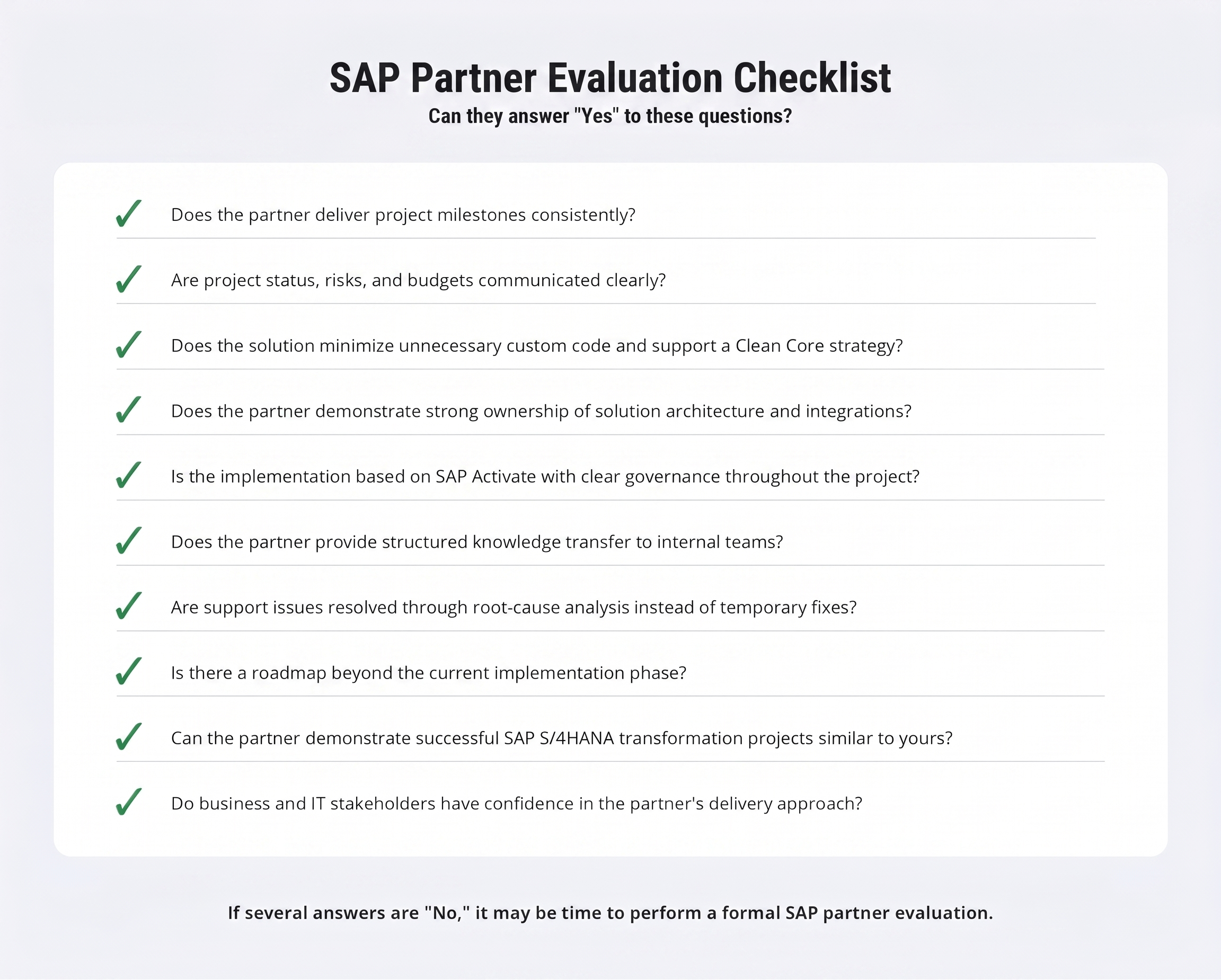
SAP Partner Evaluation Checklist for CIOs and CFOs
Even after a structured selection process, comparing SAP partners side by side can be difficult. Proposals use different language, emphasize different strengths, and rarely reveal how a partner actually performs once a contract is signed.
We've built the following checklist to turn that comparison into five direct questions, each scored against verifiable evidence rather than a general impression.
Does this partner's track record match their stated timelines?
Ask for milestone accuracy over the past 12 to 24 months, the number and cause of change orders, and whether missed deadlines came with a documented root cause. A partner with a strong record here can produce specific data. A partner without it offers reassurance instead.
Can every status report be verified against underlying data?
Check whether status updates tie to named deliverables and the actual ticket or test log, not a summary written after the fact. A transparent partner flags emerging risks before they affect a milestone. If your team has to reconcile the report against raw data to trust it, the reporting has already failed.
Is the architecture documented and the custom code trend improving?
Review the custom code ratio and its direction over the last several release cycles, along with whether the partner evaluates standard SAP or BTP extensibility options before proposing custom development. Architecture decisions should be documented well enough for someone outside the original team to understand them, without asking the architect directly.
How quickly and permanently does support resolve issues?
Look at average resolution time by ticket severity and whether the same incident reopens repeatedly under a new ticket number. Recurring reopens usually mean a symptom was patched instead of a root cause fixed.
Do business stakeholders confirm the system actually works for them?
Ask finance, supply chain, and operations teams directly whether the system supports their process, rather than relying only on IT's assessment. Manual workarounds built outside SAP are a reliable sign that alignment has broken down, regardless of what the project status report says.
A partner scoring well across all five questions represents low continuation risk. Weak answers on two or more, particularly architecture and transparency together, are the strongest signal that an RFP process is worth initiating.
Partner Quality Is a Business Continuity Issue
The ten warning signs, the cost data, and the evaluation checklist all point to the same conclusion. An SAP partner relationship affects whether financial close happens on time, whether supply chain data stays accurate, and whether a compliance control holds up under audit.
None of that sits within the scope of a typical vendor decision. Replacing an underperforming partner is a risk mitigation step for the stability of systems the business depends on daily, evaluated with the same rigor as any other continuity plan.
What this means in practice
Treating partner quality as a continuity issue changes what gets tracked and how often. Custom code ratio, ticket resolution time, and milestone accuracy are no longer reporting metrics reviewed once a quarter; they become indicators that are monitored the way an enterprise oversees system uptime or data integrity.
A pattern across two or more of the ten warning signs covered earlier in this article is worth the same internal escalation as any other operational risk, not a conversation deferred until the next contract renewal.
Where LeverX Fits
If your organization recognizes several of the warning signs discussed in this article, an independent assessment can help clarify the next steps. In many cases, the outcome confirms that the current engagement can be strengthened. In others, it identifies delivery risks that justify a structured SAP partner evaluation or a planned transition.
LeverX has 20+ years of SAP experience and supports organizations across the United States and globally. Our teams have completed 1,500+ SAP projects across industries: manufacturing, retail, automotive, utilities, life sciences, consumer products, and others. We help organisations evaluate their current SAP landscapes, review their delivery practices, plan SAP transformations, and offer SAP S/4HANA implementation, migration and application support services.
If you would like an independent review of your current SAP program, schedule a confidential assessment with our SAP experts. We will review your delivery approach, discuss the challenges your team is facing, and help you determine the most practical path forward.