How do you replace an SAP partner without disrupting business operations? Our guide explains the risks, governance model, and transition framework for enterprise SAP environments.
Replacing an SAP partner rarely creates a problem because of the contract itself. The concern comes from everything connected to that partner — custom developments. integration knowledge, support procedures, security roles, financial processes, compliance controls — in large SAP environments, years of operational knowledge often exist outside the system documentation.
Many US enterprises reach a point where replacing their SAP partner becomes the right business decision. The larger challenge comes afterward. A poorly managed transition can interrupt critical business processes, delay SAP programs, weaken governance, and introduce compliance risks that extend far beyond the IT organization. Enterprise leaders need a structured transition plan that protects operations while transferring technical ownership in a controlled manner.
In this article, we’ll discuss why enterprises replace SAP partners, where transition risks typically arise, and how to implement a phased partner transition that ensures business continuity, governance, and compliance across SAP landscapes.
Why Enterprises Outgrow Their SAP Delivery Partner
Enterprise SAP landscapes rarely remain the same over several years. An ERP environment that initially supported core business processes can later include SAP S/4HANA, SAP Business Technology Platform (BTP), cloud integrations, custom developments, automation initiatives, and additional compliance requirements. As these elements expand, enterprises require broader SAP expertise and stronger delivery control from their strategic partner.
Many SAP partnerships start with a defined engagement, such as an implementation project, migration, or Application Management Services (AMS) contract. Over time, the partner may take ownership of additional areas, including production support, integration management, custom development, maintenance, release planning, and technical architecture decisions.
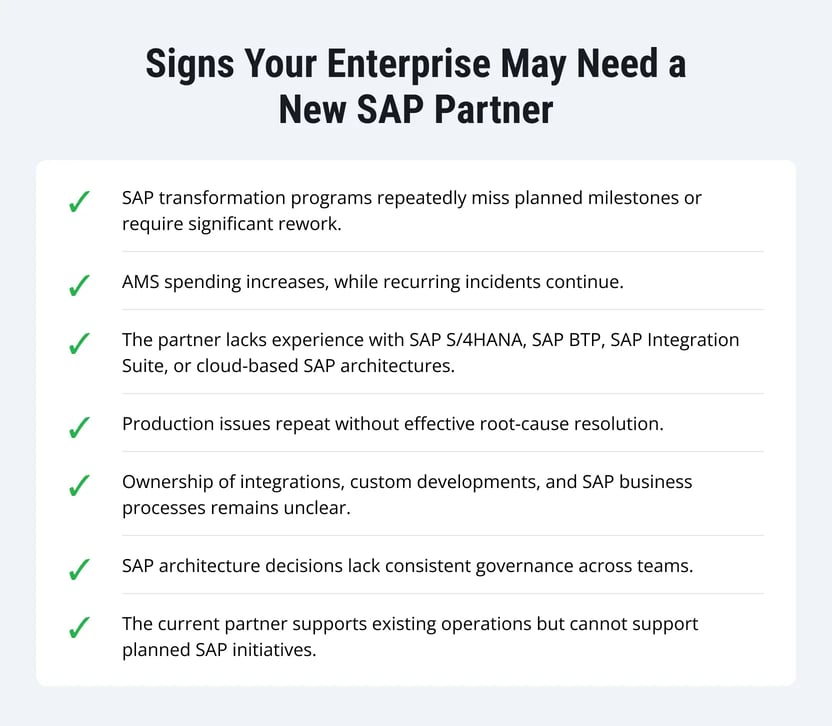
Partner replacement usually follows a longer period of delivery challenges. Transformation programs may experience repeated delays. Support costs may continue to grow. Technical decisions may become harder to coordinate across teams. These patterns often indicate that the current delivery model no longer matches the enterprise’s SAP roadmap.
Common reasons enterprises replace an SAP partner
Several factors commonly lead organizations to evaluate a new SAP delivery partner:
- SAP transformation programs lose predictability. S/4HANA migrations, business process improvements, or cloud initiatives face missed milestones, unclear ownership, or repeated rework when project governance and SAP expertise do not match program requirements.
- AMS costs increase while recurring problems persist. Support contracts expand while unresolved incidents, manual workarounds, and repeated fixes continue to affect business teams.
- SAP modernization initiatives decrease. Enterprises adopting SAP BTP, SAP Integration Suite, API-based integrations, automation, or cloud services require specialists with experience in these areas. Limited capabilities can restrict architecture decisions and delivery options.
- Production support remains reactive. Critical incidents receive attention after business impact occurs. Preventive monitoring, root-cause analysis, and technical improvements receive less focus than immediate issue resolution.
- SAP ownership becomes difficult to manage. Different teams may control integrations, custom code, finance processes, and reporting components. Without clear responsibility, changes require more coordination and create additional delivery risks.
- Critical SAP knowledge remains concentrated among a small group of consultants. Limited knowledge transfer around custom developments, interfaces, and business processes can create dependency on specific individuals.
When business requirements move beyond the existing delivery model
Enterprise SAP requirements continue to expand as organizations adopt new technologies, adjust business processes, and introduce additional compliance controls. A strategic SAP partner needs to support production stability while also contributing expertise across architecture, integration, security, and transformation initiatives.
When an existing partner cannot support these changing requirements, enterprises begin searching for a new delivery model. The transition decision usually follows a review of SAP capabilities, governance processes, technical expertise, and the partner’s ability to support future programs.
What Makes SAP Partner Transitions Risky for Enterprises?
Changing an SAP delivery partner requires transferring responsibility for a complex business system. The challenge comes from the amount of technical and process knowledge connected to the existing SAP environment. Some of this knowledge exists in documentation. Other knowledge exists in custom developments, configuration decisions, integration designs, and the experience of consultants who have supported the system for years.
A successful transition requires more than access to SAP systems and project documents. The incoming partner needs a clear understanding of how business processes run, how integrations exchange data, how custom developments support operations, and how controls are maintained. Gaps in this information can affect system stability, compliance activities, and future SAP initiatives.
Knowledge transfer risk across SAP systems
Enterprise SAP environments often contain years of accumulated changes. Custom ABAP developments, enhancements, interfaces, and configuration adjustments may support processes that are critical to daily operations.
During a partner transition, incomplete knowledge transfer can create several challenges:
- Custom developments may lack updated technical documentation, making future changes dependent on reverse engineering
- Business process knowledge may remain with individual consultants instead of being captured in formal documentation
- Functional decisions behind SAP configuration may be unclear, especially in areas such as Finance, Controlling, procurement, and supply chain processes
- The incoming team may spend additional time identifying dependencies before making system changes.
A structured transition requires reviewing existing developments, integrations, business processes, and support procedures before operational ownership changes.
Production stability and business process risk
Enterprise SAP systems support processes that directly affect financial operations, supply chains, sales activities, and reporting. Changes in support responsibility can introduce risks, if system behavior and dependencies are not fully understood.
The highest risks usually appear around areas with frequent data exchange or strict process controls:
- FI/CO processes that support financial close, reporting, and management accounting
- Interfaces connecting SAP with external applications through SAP Integration Suite, SAP CPI, APIs, or middleware platforms
- Custom programs and scheduled jobs that support daily operations
- Existing modifications that may behave differently after technical changes or upgrades.
A transition plan should include system assessment, interface validation, regression testing, and clear ownership of production support activities.
Compliance and audit risks in SOX-controlled environments
For US enterprises subject to Sarbanes-Oxley (SOX) requirements, SAP partner transitions require additional attention. Financial systems depend on documented controls, controlled access, traceable changes, and reliable reporting processes.
A partner change can affect compliance activities when responsibilities, documentation, or control procedures are transferred without proper governance.
Key areas that require review include:
- Change management records for SAP configuration and custom code updates
- Documentation of financial process controls and system dependencies
- Access management procedures and authorization ownership
- Audit evidence collection processes across SAP and connected systems.
Maintaining control visibility during the transition helps avoid gaps during internal audits or external reviews.
Integration ownership and architecture risk
Modern SAP landscapes rarely operate as isolated ERP systems. They connect with applications across finance, customer management, supply chain, analytics, identity management, and external platforms.
When multiple vendors and internal teams manage different parts of the landscape, ownership boundaries can become unclear. This creates additional SAP transition risk because resolving integration issues requires coordination across several parties.
Before changing partners, enterprises should establish clear ownership for:
- SAP interfaces and integration flows
- Middleware platforms such as SAP Integration Suite or SAP CPI
- API management and external system connections
- Monitoring, incident management, and technical documentation.
A controlled transition depends on clear accountability for the complete SAP landscape, including the systems connected to it.
SAP Partner Replacement Is a Governance Transformation, Not a Vendor Swap
Procurement teams typically lead an SAP partner transition, since RFPs, contract terms, and statements of work fall under their function. While this process selects a vendor; it does not assign who owns a control during the transition window, who has authority to pause a cutover step, or who signs off when a test fails. Those questions sit outside procurement, and a transition plan that leaves them unanswered inherits every risk described above — without a mechanism to resolve it.
Independent research on SAP S/4HANA programs points to a consistent pattern. Projects rarely fail from a lack of technical skill. They fail when no one has been designated to make decisions, responsibility for those decisions is unclear, and there is no defined process for what happens after a decision is made.
A partner transition raises the stakes on this pattern because, for a period of time, two organizations, the outgoing partner and the incoming one, both hold partial knowledge of the landscape and neither holds full authority over it.
A governance model closes that gap by assigning clear ownership before the transition begins, not after an incident forces the question. This differs from the vendor contract, which sets commercial terms: pricing, SLA targets, support scope. None of these terms determines who is accountable if a control breaks mid-transition or who approves an emergency change while both partners are still active in the system.
A governance structure built for the transition period typically defines:
- Who holds accountable ownership for each control and the integration point identified during the risk assessment
- Who has authority to pause or roll back a step in the cutover if a test fails
- How knowledge transfer gets documented and verified, separate from the general project plan
- How decision rights split between the enterprise, the outgoing partner, and the incoming partner during the overlap period
- How audit evidence collection continues without a gap through the transition, rather than resuming after it.
Once this structure exists, procurement executes its part: selecting and contracting the incoming partner. Governance carries the part that determines whether the transition protects the business. Enterprises building an SAP governance model around this distinction treat the vendor contract as one component inside a larger transition program, not as the program itself.
What Does a Structured SAP Partner Transition Look Like?
A successful SAP partner transition follows a defined sequence of activities. Each phase reduces uncertainty before operational responsibility moves to the new partner. Advancing too quickly can leave gaps in documentation, integration knowledge, or production support.
Delaying the transition without clear objectives can increase costs and extend dependency on the incumbent partner.
Phase 1: Discovery and risk mapping
The incoming partner cannot govern what it has not yet inventoried. This phase produces a factual baseline of the SAP landscape, rather than a summary of what the outgoing partner reportedly manages. A complete discovery covers:
- Full landscape scope across ECC and S/4HANA, including versions, add-ons, and support pack levels
- Custom code inventory: ABAP developments, user exits, enhancements, and their last modification dates
- Integration mapping across SAP CPI, custom APIs, and third-party connections, cross-referenced against the ownership gaps identified earlier in this article
- Business-critical process dependencies in FI/CO, order-to-cash, and procure-to-pay, flagged by transaction volume and audit relevance.
This phase provides the evidence needed to guide each phase that follows. Skipping or rushing it is the single most common reason transitions stall in later stages.
Phase 2: Governance alignment
With the landscape mapped, the enterprise defines who is accountable for what during the overlap period.
This means finalizing the dual-vendor RACI model referenced in the governance section, standing up a transition governance board with representatives from IT, finance, and the incoming and outgoing partners, and aligning SLA commitments across both vendors so incident response does not have a gap between one partner's contract ending and the other's beginning.
Phase 3: Controlled knowledge transfer
Knowledge transfer works best as a verification exercise, not a document handoff. The incoming partner reviews existing system documentation against the actual configuration, validates integration dependencies against the map built in Phase 1, and reconstructs support runbooks where none exist.
Functional decisions behind FI/CO configuration and other compliance-relevant processes get documented at this stage, closing the gap between what the system does and what anyone can currently explain about why.
Phase 4: Parallel support or shadow mode
The incoming partner begins operating alongside the incumbent, rather than replacing them outright. In shadow support, the incoming team observes and resolves tickets under supervision. In reverse shadow support, the incoming partner takes primary responsibility, while the outgoing team remains available for escalation.
Either model gives the enterprise a way to benchmark the new partner's incident handling and system performance against the incumbent's baseline before removing that baseline entirely.
Phase 5: Controlled cutover and stabilization
The incumbent partner's access and responsibilities wind down on a defined schedule rather than a single cutoff date. Full operational ownership transfers to the incoming partner, followed by a hypercare period with elevated monitoring and faster escalation paths.
Hypercare ends once incident volume and resolution times stabilize at, or below, the benchmarks set during Phase 4, not on a fixed calendar date regardless of system behavior.
What Should US Enterprises Look for in a Replacement SAP Partner?
A qualified SAP partner brings proven S/4HANA delivery experience, FI/CO depth, BTP and integration architecture capability, SOX-aware governance, and a structured ITIL-based support model. Any credible SAP systems integrator will present these on a capability slide.
What separates a partner ready for a US enterprise transition, from one that only looks ready, shows up in areas most RFPs never directly consider.
SOC 1 matters more than SOC 2 for financial systems
Most SAP AMS providers can produce an SOC 2 report covering security, availability, and confidentiality controls. Enterprises evaluating a partner to support FI/CO and other financially relevant processes need something more specific: an SOC 1 Type II report, which attests to controls over financial reporting rather than general security posture.
An SOX-controlled enterprise relying on an outsourced partner for financial process support needs that partner's SOC 1 to map cleanly onto its own ICFR documentation, since external auditors will test the enterprise's reliance on that report during the annual audit cycle.
A partner without a current SOC 1 Type II, offering only SOC 2 as a substitute, creates a compliance gap that surfaces during the first audit cycle after go-live, rather than during vendor selection.
Delivery location may affect data access, not just cost
Enterprises often evaluate offshore delivery purely on hourly rate and time zone coverage. For SAP environments processing US financial data, the delivery location also determines who has access to that data and under what legal framework. State privacy statutes, industry-specific data handling requirements, and internal data residency policies increasingly restrict which delivery locations can touch production financial or customer data without additional contractual controls.
A partner with a clear, documented delivery model, specifying which locations handle which data classes and under what access controls, avoids a renegotiation of the support model after the enterprise's own legal or compliance team reviews the staffing plan.
US GAAP fluency is not the same as general finance expertise
FI/CO expertise gets listed on every SAP partner's capability statement, but US enterprises need fluency in specific American accounting requirements: ASC 606 revenue recognition logic embedded in SD and FI configuration, multi-state sales and use tax determination, and payroll tax complexity across jurisdictions with different withholding rules.
A partner whose FI/CO experience comes primarily from IFRS-reporting markets may configure or troubleshoot these processes correctly on the surface, while missing the specific US regulatory logic behind them, a gap that often does not surface until a state tax audit or a revenue recognition restatement forces the question.
Litigation hold and eDiscovery continuity
US enterprises face litigation and regulatory inquiries that place specific SAP records under legal hold, a requirement with no direct equivalent in many other markets.
A partner transition that changes who manages archiving, retention schedules, or audit log access can inadvertently break a hold already in place. An evaluation of a replacement partner should confirm the partner's experience maintaining eDiscovery-compliant data retention through a system transition, not only their technical archiving capability in general.
None of these four areas will appear on a standard capability comparison. They tend to appear during the first compliance review, tax filing, or legal request after the new partner has already taken over, which is exactly why they belong in the evaluation criteria and not in the post-transition troubleshooting list.
Where SAP Partner Transition Programs Often Go Wrong
Cutting the parallel support phase
Some enterprises move straight from knowledge transfer to full cutover, skipping shadow or reverse-shadow support. This removes the only checkpoint that catches an incoming team's gaps before they reach production.
Without a validated parallel-run period, the incoming partner's first real test of an integration, a batch job, or a period-end process happens live, with no benchmark to compare against and no incumbent still available to confirm what normal behavior looks like.
Treating knowledge transfer as a document handoff
Weak knowledge transfer rarely looks weak on paper. A folder of documentation gets delivered on schedule, reviewed by no one who can confirm it still matches the live system. The gaps this creates surface first in a few specific places:
- Integration logic behind CPI flows and custom APIs, documented in a diagram that predates the last several changes
- Custom ABAP code with no current owner who can explain the business rule behind it
- FI/CO configuration decisions that made sense at build time, but were never recorded
A knowledge transfer phase built around a document review, rather than a verified walkthrough against the live system, passes these gaps to the incoming partner's first production incident.
Deprioritizing SOX and audit continuity
SOX gaps rarely stop a transition outright. They let a transition pass on schedule while breaking audit continuity underneath it. The break shows up later, when auditors test the control environment across the transition period and cannot find continuous evidence.
A transition plan that treats compliance as a final checklist item, instead of a requirement carried through every phase, tends to break traceability at the exact point auditors are likely to sample.
Underestimating integration ownership
Enterprises often scope a transition around the applications they already know are critical, yet they miss how many integrations touch those applications indirectly. A CPI flow or API connection built for one project can outlive that project and the person who built it. Ownership confusion surfaces when one of these integrations fails and neither the outgoing nor incoming partner can confirm who owns the fix. The discovery phase in the framework above exists to catch this before cutover, not after.
Each of these four mistakes shares one pattern. None came from a lack of technical skill on the incoming partner's side. Each came from a framework step that got shortened under schedule pressure.
Choosing a Second SAP Partner That Enterprises Won't Need to Replace
A partner transition solves a problem in the near term and creates a new question for the enterprise: will the incoming partner end up in the same review cycle within three years?
That question depends less on technical certification and more on whether the incoming partner has actually run this kind of transition\before, under the same compliance pressure a US enterprise carries.
How LeverX supports enterprise SAP transitions
LeverX has more than 20 years of SAP delivery experience and is an SAP Gold Partner. We support enterprise organizations throughout the SAP lifecycle, including SAP ECC and SAP S/4HANA implementations, Application Management Services, SAP Business Technology Platform (BTP), SAP Integration Suite, enterprise integrations, and finance solutions built around SAP FI/CO.
For US enterprises, our transition approach focuses on governance, operational continuity, and controlled knowledge transfer. Every engagement begins with an assessment of the existing SAP landscape, followed by transition planning, documentation validation, knowledge transfer, and phased operational handover. This approach supports ongoing business operations, while responsibilities move to the new delivery team.
A successful transition should leave the organization with clear ownership, documented processes, and a delivery model that supports future SAP programs, as well as day-to-day operations.
Request an SAP partner transition assessment with LeverX to evaluate your current SAP support model, identify transition risks, and develop a structured roadmap for transferring operational ownership with minimal disruption to business-critical processes.

-min-Jul-12-2022-02-13-36-09-PM.jpg)