Explore how SAP improves oil and gas supply chain efficiency, from logistics and inventory to predictive planning and real-time visibility.
Supply chain performance is now a primary bottleneck for many companies in the oil and gas sector. Operators are currently balancing a volatile mix of shifting demand, climbing overhead, and a tightening net of global oversight. These networks are rarely straightforward; most stretch across multiple borders and rely on a fragmented web of regional vendors and specialized logistics firms.
In this landscape, optimization is less about chasing incremental gains and more about basic operational stability. The goal is to prevent minor logistical gaps from cascading into stalled production. Whether it is a delayed equipment shipment or a simple inventory discrepancy, the result is the same. When a site’s critical component is missing, the financial impact is immediate.
Many companies are now dismantling their siloed legacy workflows. By moving toward connected, real-time architectures like SAP supply chain management solutions, they can finally maintain a single view of the entire value chain. This alignment helps long-term planning stay synchronized with the daily movement of materials, allowing logistics to actually support the pace of production.
Supply Chain Pressures
Supply chain friction in oil and gas is rarely a series of isolated events. The danger lies in how these issues stack. Long lead times, volatile demand, and tight operational dependencies often hit at the same time. This overlap creates a fragility where one local failure can trigger a downward cascade.
Inventory and lead time issues
Inventory management involves a high-stakes trade-off between tying up working capital and risking an operational shutdown. That balance is becoming harder to maintain. Although supply chain conditions have stabilized since 2022, lead times for critical spares still remain above pre-pandemic levels, limiting flexibility when field conditions shift.
The result: Procurement must happen months earlier.
The risk: There is little room to pivot when field conditions shift.
The forecasting and logistics gap
Demand in this sector does not follow standard retail logic. It is often dictated by geopolitical friction and sudden price swings. A single export terminal disruption can ripple through global markets in hours. Combined with specialized, high-risk transport routes where delays can extend delivery timelines by 10 days or more due to rerouting and congestion, relying on historical data is often a liability.
Cost inflation
Operating and supply chain costs remain above pre-pandemic levels. Energy prices and labor gaps are the primary drivers. This is a direct hit to thin margins. There is often no remaining buffer for logistical inefficiency.
The visibility bottleneck
The primary problem is internal data silos. Gartner notes that 29% of supply chain organizations have the integration or agility needed for future operations. Without real-time connectivity, planning stays reactive. Decisions can remain behind the curve.
External constraints only make this situation harder. Oil and gas supply chains now operate within a messy landscape of international regulations, sanctions, and shifting carbon reporting rules. Minor gaps in your documentation or failures in partner validation will quickly delay shipments and halt operations. You need automated compliance checks to stay ahead. Otherwise, even a small oversight becomes a massive disruption.
What SAP Has for Supply Chain Optimization
Sometimes logistics in the oil and gas sector look like everything falls apart at the handoffs. Planning isn’t always aligned with execution, field data might stay outdated, and finance might see the fallout when it is too late to react. SAP fixes this by pulling the fragmented pieces into one live environment.
The digital core
Everything runs through SAP S/4HANA. The system handles financials and field operations simultaneously. This approach cuts out the need for batch updates or constant manual reconciliation. Any shift in supply, inventory levels, or local demand hits the system the moment it happens. You get a live view of the entire chain instead of waiting for a report at the end of the day. It turns your data into a real-time tool for making decisions.
SAP Integrated Business Planning handles demand forecasting and scenario modeling, which is a necessity in a volatile market. It allows for quick adjustments to the plan, rather than waiting for a quarterly review that is already obsolete.
Logistics execution solutions
SAP Extended Warehouse Management and SAP Transportation Management bring a stricter structure to warehouse and transit planning. These tools coordinate material flows and cut down on handling delays. They allow you to adapt to disruptions without the entire process breaking down.
SAP Advanced Shipping and Receiving goes a step further by linking the warehouse to transportation. It syncs up loading activities with transport schedules. This level of timing is vital in oil and gas environments. When you are dealing with specialized equipment and hazardous materials, even a small scheduling gap becomes a major safety or logistical risk.
Adding SAP Global Trade Services into the mix handles the pressure of customs regulations, sanctions screening, and trade requirements. Automating these specific checks prevents shipments from getting stuck due to missing documents or sudden regulatory changes.
The integrated result
The real value is the connectivity between these SAP applications. A logistics delay in SAP Transportation Management shows up in the SAP Integrated Business Planning model instantly, and every operational tweak is visible in the SAP S/4HANA Finance module the moment it happens. This keeps the physical movement of goods more synced with the balance sheet.
SAP Supply Chain Architecture for Oil and Gas
In oil and gas, supply chain systems don’t usually work as a single block. They tend to evolve in layers, with each one solving a different operational problem. SAP follows a similar structure. Instead of one tool doing everything, the landscape is split into several parts that connect over time.
Core operations and data foundation
At the center sits SAP S/4HANA (SAP Cloud ERP). It handles core processes like finance, procurement, asset management, and inventory. The key point here is not just consolidation, but consistency. When data updates in one place, it carries through the rest of the system without delay, which reduces the usual gaps between departments.
Planning and forecasting
Planning is handled through SAP Integrated Business Planning. It’s used for forecasting demand, balancing supply, and testing different scenarios. In practice, teams don’t rely on a single forecast anymore. They work with several versions at once and adjust as conditions shift.
There’s also an AI layer now. SAP Joule processes signals from across the supply chain and highlights changes earlier than traditional models would. It doesn’t replace planning, but it changes how quickly plans can be updated when something starts to move.
Logistics and execution
On the execution side, SAP Extended Warehouse Management focuses on warehouse activity. Storage, picking, internal transfers — all the physical movement stays structured there. The improvements are usually incremental, but they add up over time in how materials flow.
SAP Transportation Management handles the movement outside the warehouse. It supports planning routes, tracking shipments, and coordinating transport across regions. In more complex setups, that visibility becomes critical.
SAP Advanced Shipping and Receiving sits somewhere in between. It links warehouse tasks with transport timing. That connection helps avoid situations where goods are ready, but transport isn’t, or the other way around.
External collaboration and compliance
Not everything happens inside the company’s systems. SAP Business Network connects suppliers and logistics partners into the same process. Instead of chasing updates through emails or calls, teams can see what’s happening with orders and deliveries more directly.
Compliance runs in parallel with all of this. SAP Global Trade Services handles customs checks, sanctions screening, and regulatory requirements. It’s mostly invisible when things work, but when it’s missing, delays tend to show up quickly.
SAP Across the Oil and Gas Value Chain — Three Scenarios
Upstream: Spare parts and rig uptime
Upstream success hinges on material availability, supported by the synchronization of SAP S/4HANA Asset Management with supply chain processes. A missing valve or a delayed drill bit doesn't just slow things down; it can stall production entirely. SAP S/4HANA manages this by tethering maintenance schedules directly to inventory and procurement.
The SAP impact
Critical spares are tracked across every remote site, with replenishment increasingly tied to maintenance requirements. In SAP S/4HANA, maintenance work orders can trigger procurement signals, linking asset management with inventory and supply chain processes. This reduces the gap between field needs and warehouse stock, ensuring that components are staged before failures occur.
Midstream: Flow and storage synchronization
In the midstream, the core struggle is coordination. Any mismatch between pipeline flow and storage capacity creates an immediate bottleneck. SAP Transportation Management and SAP S/4HANA provide the necessary oversight into shipments, transit inventory, and current tank levels.
The SAP impact
Logistics teams adjust transport routes as field conditions change. Storage assets are used with more precision to avoid overcapacity. This prevents idle infrastructure from draining the budget. A more synchronized flow helps contain local issues before they spread through the wider network.
Downstream: Refining and retail alignment
Downstream operations sit on the front lines of market volatility. Refining output must stay synchronized with shifting demand signals. SAP Integrated Business Planning links these layers by connecting retail data directly to production and distribution.
The SAP impact
Companies can adjust refining volumes based on actual consumption rather than outdated forecasts. By tracking product availability across regional hubs, it becomes much easier to pivot during market shifts. This prevents the twin risks of overproduction and regional shortages.
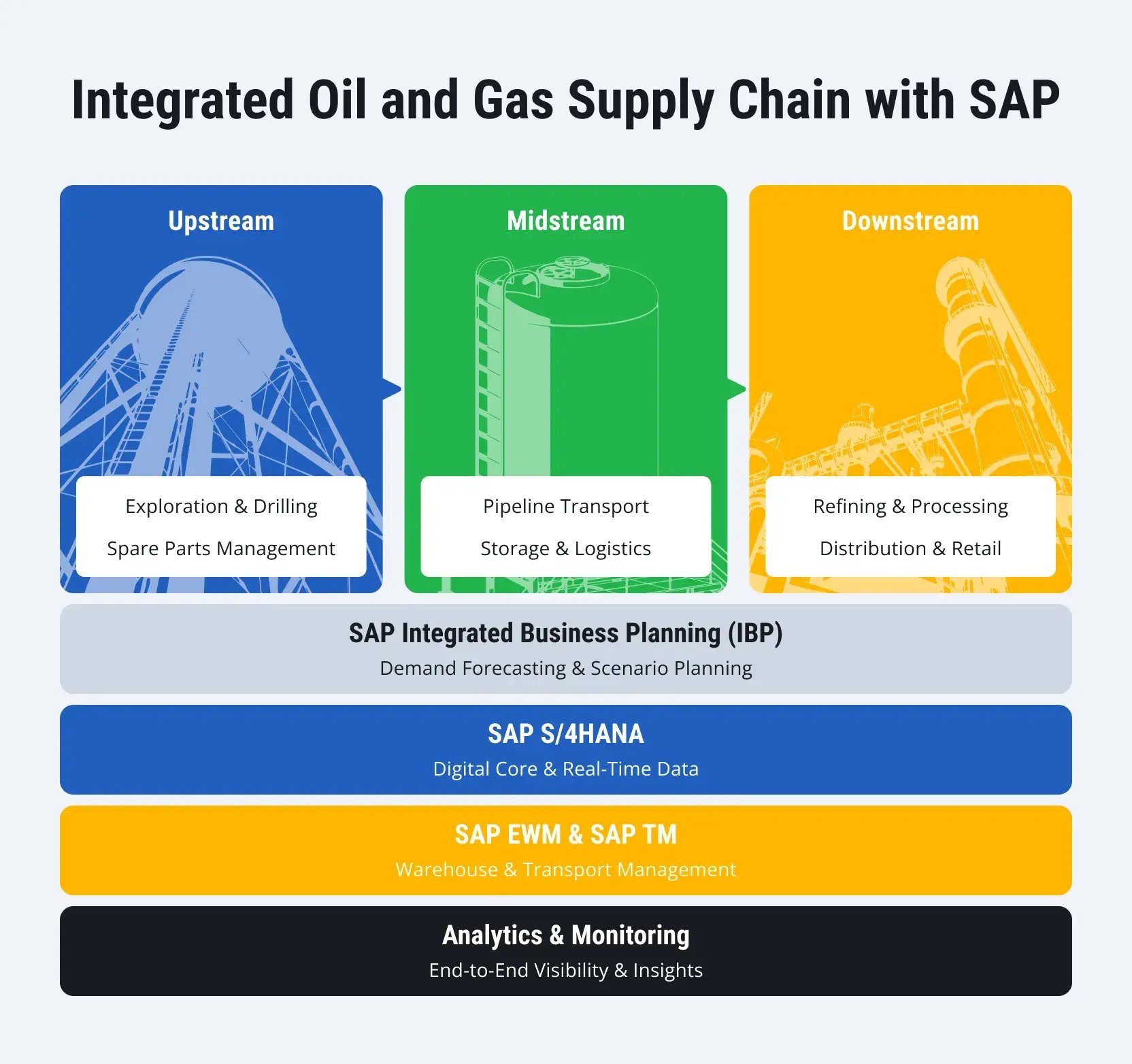
Inventory and Materials Control
Inventory management in this sector balances operational uptime against capital tie-up. The goal is to keep critical parts available for field use.
Categorization and visibility
SAP S/4HANA provides the oversight needed to fix regional blind spots. Teams categorize materials by how critical they are to the operation. This lets them prioritize high-risk components while they optimize non-essential stock for cost. A tiered approach like this helps prevent over-investment in low-impact inventory.
Procurement via demand signals
Procurement moves away from static reorder points by using live demand signals. This shift helps reduce the manual guesswork that often leads to surplus or shortages. Automating these workflows brings a level of consistency that manual tracking rarely achieves.
Warehouse operations
On the ground, SAP EWM manages the physical movement of goods. This includes picking, storage, and internal transfers. The result is better space utilization and faster material handling. By using SAP Advanced Shipping and Receiving, you can also sync your warehouse activities with transportation. Loading, staging, and dispatch all align with actual transport schedules. This cuts down on idle time and prevents those typical delays at loading points.
Together, these tools stop the logistical lag that often stalls maintenance or production. It keeps the flow moving so that a lack of parts never becomes the reason a project stops.
Planning and Predictive Analytics
Rigid planning creates risk in the oil and gas sector. Forecasts based on fixed assumptions often fail when conditions shift. SAP IBP replaces these methods with a scenario-based architecture.
Planners use this tool to stress-test various outcomes at the same time. The framework models how sudden demand spikes or supply gaps move through the broader operation. Finding these vulnerabilities early lets the team build out multiple contingencies. This helps the organization move into a proactive stance where responses are ready before a crisis hits.
Predictive analytics introduces technical accuracy that traditional models often lack. The system pulls from a wider range of data sources to flag subtle patterns. These might include seasonal variations or logistical friction that can go unnoticed in manual systems.
A newer layer is starting to reshape how forecasting works on the ground. AI-driven demand sensing, supported by tools like SAP Joule, moves the focus away from periodic forecasting and toward continuous signal analysis. The system no longer relies primarily on historical patterns. It interprets live inputs such as market movements, supply disruptions, and operational data from across the entire network.
This shifts the planning models so they can adjust much earlier. Often, these changes happen before they even fully materialize in a traditional report. In volatile sectors like oil and gas, detecting those signals early makes a measurable difference. It determines how quickly the organization can actually respond to a crisis or a sudden market shift. It turns forecasting into a real-time defensive tool.
LeverX: Oil and Gas Supply Chain Expertise
Supply chain shifts in the oil and gas sector are almost always dictated by existing infrastructure and daily operational realities. Most projects aren't about starting from a blank slate; they focus on making high-pressure, complex environments more consistent and manageable.
Practical execution and design
LeverX works with companies by focusing on how planning, logistics, and execution actually collide in the field, rather than just how they look on a blueprint.
Core process integration
End-to-end SAP supply chain implementation starts by tethering core functions across procurement, inventory, logistics, and finance. This usually means digging into how data moves between teams. Most inefficiencies stem from functional gaps rather than the software itself.
SAP S/4HANA and SAP IBP connectivity
Connecting SAP S/4HANA (Cloud ERP) with SAP Integrated Business Planning remains a priority. Planning models have to reflect actual floor-level constraints, while execution needs to absorb changes without stalling. Once this link is solid, companies can ditch rigid planning cycles in favor of continuous, live adjustments.
Logistics and warehouse operations
We approach warehouse and logistics from a purely practical angle. This involves sharpening material tracking across remote sites, cutting down handling times, or retooling transportation plans to match actual field conditions.
Warehouse efficiency often depends on the quality of incoming data. By connecting logistics processes to the SAP Business Network, we help organizations receive advanced shipping notices before materials arrive. This level of visibility can help you prepare receiving and staging areas in advance, reduce delays, and help avoid congestion at loading and unloading points. Instead of just reacting to arrivals at the gate, the warehouse can plan for them in advance.
Targeted inventory strategy
Inventory rules shouldn't be one-size-fits-all. We segment stock based on criticality, real demand patterns, and supply risk. This keeps essential parts available without tying up excessive working capital in low-impact inventory.
Data integrity
Fragmented or stale data kills the value of any planning effort. Building a more reliable data foundation makes it easier to coordinate big decisions and fixes the "guesswork" often found in forecasts.
Extended ecosystem connectivity
Supply chain performance in oil and gas often depends on how well internal systems connect with external partners. The SAP Business Network can help link SAP S/4HANA to the broader vendor ecosystem by digitizing procurement and logistics.
This setup provides a clearer view of purchase orders, shipping updates, and service confirmations. Instead of relying on fragmented communication, teams can track supplier commitments and material flows with more consistency. Improving this level of coordination can reduce uncertainty around incoming materials and provide better visibility into supplier-driven risks.
Continuous modernization
System updates and support are treated as a rolling process. As the supply chain moves, SAP environments have to adapt without breaking operations. This involves managing version updates, refining custom extensions, and keeping a close eye on performance.
The goal isn't to layer on more complexity. It’s about making the current setup more stable, transparent, and ready to pivot when market conditions shift.
Business Outcomes
When supply chain processes align within a single system, the impact shows up in daily operations. These improvements go beyond simple efficiency. They affect how consistently the business performs under pressure.
Cost control
Better coordination between planning, procurement, and logistics helps manage unnecessary spending. It can limit the need for emergency shipments and reduce excess inventory. This leads to more predictable operating costs over time.
Inventory efficiency
Real-time visibility supports the shift toward leaner inventory levels. Companies can often reduce surplus stock while keeping critical materials ready. This helps improve working capital without necessarily increasing operational risk.
Unified demand visibility
Teams move away from fragmented data and toward a shared view of demand and supply. A unified perspective helps align production, transportation, and distribution more naturally. This shifts the focus from managing departmental friction to maintaining a steady operational flow. Instead of different teams working from separate spreadsheets, the entire organization can coordinate based on a single set of numbers.
Operational responsiveness
Connecting planning with execution allows for a faster reaction to disruptions. You can often make adjustments earlier, sometimes before a small issue escalates into a larger operational problem.
Regulatory compliance
Standardized processes and better data traceability can simplify reporting. This reduces the likelihood of errors or penalties during a routine audit.
Automated trade compliance
Moving away from manual checks toward solutions like SAP Global Trade Services helps manage the risk of shipment delays. Automated checks for documentation and compliance allow customs processes to run alongside logistics planning. This helps avoid some of the typical delays at the border.
Implementation Challenges and Risk Mitigation
Even the most calculated supply chain initiatives hit the same walls. In the oil and gas sector, these obstacles are magnified by massive operational scales and a dense web of legacy systems.
Integration and technical debt
Connecting modern SAP environments to aging ERP platforms or custom-built logistics tools is rarely a clean process. Many of these isolated applications were never built for external connectivity. Mismatched data structures and conflicting processes often create friction that can stall an implementation if not mapped out from day one.
The data fragmentation trap
Information is frequently scattered across the organization in inconsistent formats. This fragmentation is a major risk; without addressing data quality early, even the most advanced planning tools will yield unreliable results. Success depends on consolidating these sources into a single, verified stream.
Operational change management
Supply chain workflows are deeply woven into daily field life. Any shift in the system hits everyone from procurement to rig operators. Without a heavy focus on communication and hands-on training, even a perfectly designed solution risks being bypassed by teams falling back on old habits.
Structured mitigation recommendations
Prioritize data alignment
Clean and standardize master data before flipping the switch on new systems. This provides the stable ground needed for both planning and execution.
Map the integration early
Decide which legacy tools stay, which go, and which get phased out. Trying to link everything simultaneously without a priority list usually leads to a bottleneck.
Phase the rollout
Break the implementation into digestible stages. This lets teams adapt to the new reality gradually and keeps the risk of a total operational shutdown low.
Focus on adoption
User buy-in determines the actual ROI. Involve key users during the build phase and provide practical, field-relevant training.
Keep the core clean
Avoid heavy customization within the core system. Moving specific requirements into extensions makes future SAP updates much easier to swallow.

Conclusion
Supply chain performance now serves as a long-term differentiator in oil and gas. It is no longer just a back-office concern. With market conditions remaining volatile, the pressure to maintain continuity while pivoting quickly has become a baseline requirement.
Between 2026 and 2030, the industry shift moves from isolated fixes toward fully connected supply chain models. The goal is an environment where planning, logistics, and execution stay aligned in real time. Periodic reconciliation is being replaced by continuous synchronization.
SAP provides the technical ground for this level of coordination. By tethering data and workflows across the entire value chain, the platform allows for earlier disruption response and lower friction during plan adjustments. This creates a supply chain capable of absorbing shocks without compromising core operational performance.