Downtime in oil & gas can cost $200,000 per hour. See how SAP EAM helps prevent it before it starts.
Operations in the oil and gas sector rarely pause. Facilities run under constant load, frequently in locations where conditions are demanding and risks are higher than average. In this context, even minor equipment problems can quickly turn into major disruptions.
The cost of unplanned downtime isn’t limited to lost output. It can compromise safety, create environmental exposure, and disrupt contractual performance. One failure is often enough to impact the entire supply chain and increase pressure on maintenance teams already working within tight constraints.
Unplanned downtime can cost up to $200,000 per hour in the oil and gas sector. |
Effective operations in these conditions depend on a unified view of assets where equipment data, maintenance activities, and compliance requirements are connected and managed together. SAP EAM helps oil & gas organizations achieve this by improving lifecycle visibility, enabling earlier detection of issues, and supporting consistent control over maintenance and compliance processes.
In this article, we explore how SAP EAM supports asset management in oil and gas, what capabilities it brings beyond traditional maintenance systems, and why it plays a critical role in reducing operational risk and improving asset performance.
Where Asset Management Breaks Down in Oil & Gas
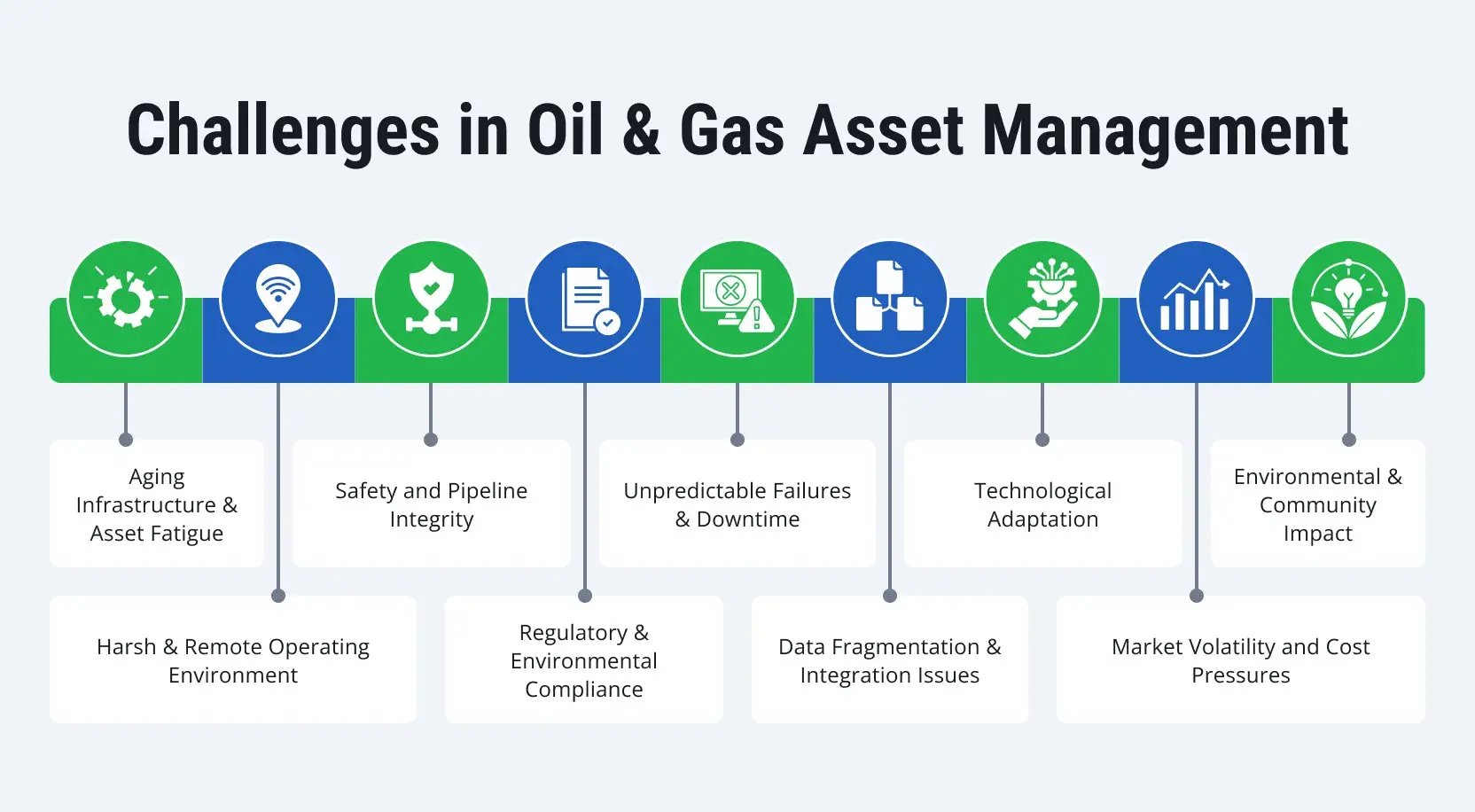
Distributed and high-complexity asset landscapes
Oil and gas assets are spread across wide, often hard-to-access locations — from offshore platforms and subsea systems to long pipelines and large processing plants. Maintaining consistent visibility across this landscape depends on stable connectivity and reliable data capture, which can be difficult to ensure in remote or harsh environments.
Unplanned and expensive downtime
Unexpected breakdowns remain a constant pressure point. One failure can be enough to interrupt production, delay supply commitments, and create immediate financial impact. When there’s no system to detect issues early, maintenance becomes reactive by default. Over time, this results in more downtime and higher costs to restore operations.
Inconsistent and unstructured asset data
In practice, asset data is scattered. Different systems, different teams, different formats. There’s no single, consistent view, which makes it difficult to understand asset condition, track maintenance, or rely on performance data. This lack of clarity affects planning, and decisions are made without a complete or current picture.
Limited adoption across field operations
An EAM system only works if it’s consistently used in daily operations. But in reality, field teams tend to rely on familiar workflows, particularly when tools feel disconnected from how they work or when training hasn’t been thorough.
As a result, data is entered inconsistently, work orders stay open longer than they should, and system records drift away from real asset conditions. This reduces the reliability of the overall process.
Safety, compliance, and ESG pressure
The combination of regulatory pressure and operational risk defines oil and gas environments. Asset management must support both safety and compliance, as even small equipment issues can lead to incidents with environmental and reputational impact.
At the same time, ESG requirements are becoming more demanding. Companies are expected to reduce emissions, manage waste, and use resources responsibly, all of which depend on reliable assets and trustworthy data.
Market volatility and continuous cost pressure
Ongoing price volatility and global uncertainty require companies to operate with tighter cost control while sustaining performance. Asset management is a critical part of this equation, since both reactive maintenance and unexpected failures directly affect financial outcomes. The goal is to maximize asset value and avoid spending that doesn’t contribute to performance.
What Is SAP EAM for Oil & Gas and How It Works
SAP Enterprise Asset Management enables companies to manage assets from installation through ongoing operation and maintenance. By combining asset data, maintenance tasks, and operational workflows, it creates a consistent and controlled environment.
Standard maintenance management focuses on planning and execution. SAP EAM expands this scope by incorporating real-time data and system integration, allowing maintenance to function as part of a connected operational landscape.
How SAP EAM fits into the SAP landscape
In SAP S/4HANA, SAP Enterprise Asset Management is part of a broader operational flow. Maintenance activities are linked with finance, procurement, and logistics, so decisions around assets don’t happen separately from cost and planning considerations. At the same time, it works with SCADA systems, IoT platforms, and mobile applications, allowing data to pass directly from equipment and field teams into central systems.
Core components of SAP EAM
- SAP S/4HANA Asset Management is responsible for maintenance planning, work order management, and tracking execution.
- SAP Asset Performance Management extends this with predictive maintenance based on live data and analytics.
- SAP Business Network Asset Collaboration enables coordination with external vendors and service providers.
- SAP Linear Asset Management is designed for distributed assets like pipelines and transport networks.
- SAP Service and Asset Manager allows technicians to work in the field, even offline.
How it works in practice
In SAP EAM, asset data, maintenance, and business processes are not handled separately. Information from equipment is used in maintenance planning and execution, and then returned to the system as updated insights. As this cycle continues, companies can reduce reliance on reactive maintenance and move toward a more controlled model.

How SAP EAM Supports Daily Operations in Oil & Gas
In oil and gas, asset management is closely tied to field inspections, shutdown planning, spare parts availability, and how quickly teams respond across distributed sites. With SAP EAM, these activities are connected, so day-to-day operations stay coordinated rather than fragmented.
Preventive and corrective maintenance
SAP EAM allows teams to plan maintenance based on schedules, asset usage, or real-time condition data from sensors and IoT systems. Preventive tasks reduce the likelihood of failures, while corrective maintenance is structured and traceable when issues occur. In refinery or offshore environments, this helps stabilize operations and avoid unplanned shutdowns.
Work order management
Work orders in SAP EAM act as a single reference point for maintenance. They bring together the scope of work, required resources, safety notes, and timing. In day-to-day operations, this helps avoid confusion between teams. During turnarounds or urgent work, it makes coordination faster and more straightforward.
Asset lifecycle management
With SAP EAM, each asset builds its own history over time — from the moment it is introduced into operations to the point it is taken out of service. For oil and gas companies, this means all inspections, repairs, failures, and performance changes are recorded in one place.
This makes decisions less speculative. Teams can see how equipment has actually behaved and decide whether it still makes sense to maintain it or if replacement is the better option, especially for assets like compressors or pipelines.
Spare parts and inventory integration
SAP EAM gives teams a clear view of spare parts across different locations and links this information to maintenance planning. Work can be scheduled with a realistic understanding of what is actually available. This matters even more at remote sites, where waiting for parts can keep equipment offline far longer than expected.
Mobile maintenance applications
SAP Service and Asset Manager allows field teams to work with tasks and asset data on-site, without depending on constant connectivity. Work can be completed offline and synchronized later.
This improves data quality and keeps maintenance records accurate. In the bigger picture, maintenance, inventory, and field operations are coordinated within one model.
Integration with SAP S/4HANA and Other Systems
In oil and gas operations, SAP EAM is embedded into SAP S/4HANA and connects maintenance activities with finance, procurement, supply chain, and production processes.
Maintenance → materials and procurement
When a work order is created in SAP EAM, the system instantly checks spare parts through SAP Materials Management. If something is missing, a purchase requisition is generated automatically and linked to that work order. Procurement processes it, and the delivery status stays visible to maintenance. This removes delays that usually come from manual coordination.
Maintenance → real costs, not estimates
Each job in SAP S/4HANA is directly linked to finance through FI/CO, so costs are captured as work is performed. Labor, materials, and contractor expenses are recorded against the asset in real time. This makes it possible to see what a specific unit actually costs to maintain — not just what was planned.
Maintenance → production planning
In SAP EAM, planned work is shared with production through SAP Production Planning and Detailed Scheduling. When equipment needs to be taken out of service, production can respond in advance. That way, processing flows remain predictable rather than disrupted at the last moment.
Equipment data → maintenance actions
Integration with SCADA, DCS, and IoT brings real equipment data into SAP EAM. Notifications and work orders can be triggered based on actual conditions. With SAP Asset Performance Management, this data is used to predict failures and plan maintenance earlier.
Suppliers and contractors in the same loop
SAP Business Network Asset Collaboration gives vendors direct access to asset data, documentation, and work scope. This helps avoid misalignment between internal teams and external contractors. In turnaround scenarios, where several contractors are involved, having a shared source of information keeps work coordinated.

Benefits of SAP EAM for Oil & Gas Companies
|
10% boost in mechanical efficiency |
20% increase in asset availability |
15–20% reduction in maintenance costs |
|
SAP EAM improves how maintenance is planned and executed on the ground. Crews spend less time coordinating and more time performing actual work, schedules become more predictable, and equipment operates closer to optimal conditions. This leads to more stable performance and higher output. |
With better planning and condition-based maintenance, equipment stays operational longer. Fewer interruptions and more controlled maintenance cycles translate into additional production time without expanding capacity. |
Costs decrease through better workforce utilization and tighter control over spare parts. Inventory levels are optimized instead of being overstocked across remote sites, while maintenance teams work more efficiently within structured workflows. |
|
Up to 20% fewer equipment failures |
Shorter shutdowns and faster recovery |
Long-term operational gains |
|
Improved visibility into asset condition allows teams to act earlier and prevent breakdowns. Fewer unexpected failures reduce emergency repairs and help avoid production losses. |
Turnarounds and planned maintenance events are executed with better coordination of tasks, materials, and contractors. This reduces downtime and brings assets back online faster. |
Over time, companies also benefit from longer asset lifecycles, lower energy consumption, and fewer defects. These improvements accumulate and support both cost control and operational stability. |
What Makes SAP EAM Projects Work in Oil & Gas
Start with clean and structured data
How the system behaves depends on the quality of asset data. Inconsistent naming, gaps in attributes, or duplicate entries quickly affect planning and reporting. It’s worth standardizing naming conventions, equipment classifications, and historical data upfront so the system mirrors actual operations rather than a fragmented view.
Design the asset hierarchy around operations, not theory
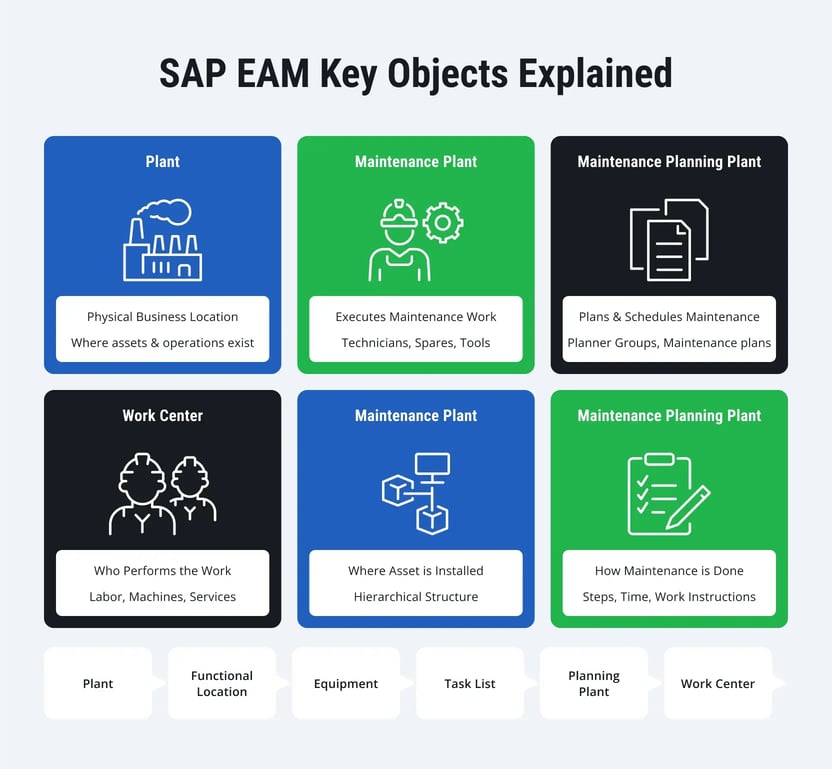
Asset structures need to reflect how work is actually done in the field. Functional locations, equipment breakdown, and hierarchy levels should support maintenance planning, failure analysis, and reporting without adding friction. If the structure is too complex, it slows teams down. If it’s too simple, it limits what you can see and analyze.
Treat change management as part of the implementation
The value of SAP EAM depends on consistent use in the field. That requires straightforward processes, practical training, and tools that don’t get in the way. When teams bypass the system or don’t close work orders, gaps appear in the data, and the system loses credibility.
Plan integrations early, not after go-live
Data from SCADA systems, IoT platforms, and related SAP modules feeds directly into SAP EAM. That’s why integration design needs to be set upfront, including data scope, update frequency, and how it supports maintenance workflows. When this is postponed, inconsistencies show up, manual fixes become common, and the overall picture is no longer complete.
Focus on rollout discipline
Trying to launch across all sites at once often leads to confusion. A staged rollout keeps things more controlled, especially when responsibility is clearly assigned and progress is measured. Pilots give teams a chance to see how processes behave in real work and adjust before expanding.
How LeverX Can Help
LeverX works with oil and gas companies to design, implement, and evolve asset management processes within SAP EAM, aligning system capabilities with operational realities across upstream, midstream, and downstream environments.
We offer:
Implementation and system optimization
A typical starting point is bringing SAP EAM in line with current maintenance practices and operational realities. Work order logic, maintenance approaches, and resource planning are reviewed and adjusted. Where systems already exist but underperform, the effort is usually about refining and fixing rather than replacing.
Asset lifecycle management design
LeverX works on structuring asset hierarchies, defining maintenance approaches, and setting up lifecycle tracking. The goal is to make sure asset data and history are usable in day-to-day work, not just stored for reporting. At the same time, this creates a base for decisions that go beyond immediate operations.
Predictive maintenance enablement
By combining SAP EAM with SAP Asset Performance Management and IoT data, our team helps companies shift toward condition-based and predictive maintenance. This involves defining what data actually matters, setting up how it is monitored, and making sure insights are used in real maintenance work.
Integration with SAP S/4HANA and operational systems
Our SAP team focuses on making sure maintenance doesn’t run separately from procurement, finance, and production. Processes are connected so that decisions are made with full context, not in isolation. At the same time, equipment data is set up to flow into decision-making, not just sit in the system.
Migration from legacy maintenance systems
For organizations moving from standalone CMMS or custom-built tools, LeverX manages data migration, process alignment, and system transition. This includes cleaning and structuring historical data to ensure continuity and usability in the new environment.
Ongoing support and continuous improvement
After go-live, the LeverX team continues to support system evolution through performance monitoring, process adjustments, and incremental improvement to ensure that SAP EAM remains aligned with changing operational needs and delivers consistent value over time.
Conclusion
For oil and gas companies, effective asset management determines how long existing infrastructure can continue to deliver value. An industry survey showed that 97% of oil and gas producers consider field life extension a key driver for reassessing their assets. Companies achieve this through engineering upgrades, detailed analysis, and structured maintenance programs.
Extending asset life, however, is only one dimension of this shift. The same practices that support longer asset operation also reshape how assets are managed daily.
This is where SAP EAM plays a central role. It provides a structured environment where asset data, maintenance activities, and operational processes are connected, allowing companies to manage reliability, costs, and compliance within a single system. Maintenance becomes more predictable, decisions are based on actual asset conditions, and operations gain better control over performance across distributed sites.
As a result, SAP asset management evolves from a support function into a core capability that directly influences operational stability and financial outcomes.