A practical look at how organizations in the Nordics modernize SAP data platforms to support analytics, compliance, and AI.
For many Nordic organizations, data discussions used to start with reporting. The focus was on improving dashboards, speeding up data refresh cycles, or replacing legacy business intelligence tools with more modern platforms. But this approach no longer reflects reality.
Today, the question is no longer just about reporting — it’s whether the underlying data foundation can support how the business runs and grows. Across Sweden, Denmark, Norway, Finland, and Iceland, expectations around data have shifted significantly. Business teams need fast, reliable access to up-to-date information, while leadership is placing increasing focus on governance, compliance, and readiness for AI-driven use cases.
As expectations grow, the gaps in many SAP data environments are becoming harder to ignore. Over time, layers of reporting tools, separate pipelines, and duplicated logic have created situations where the same KPI can mean different things across teams or systems. By the time data reaches the business, it has often been transformed multiple times, and not always in a transparent way. The issue is no longer just slow reporting — it’s a growing lack of trust, consistency, and scalability.
This is becoming even more important as data is no longer used only for retrospective analysis. It now plays a central role in planning and operational decision-making, and is increasingly embedded in how businesses run. These use cases require data that is manageable, traceable, and consistent in its business value.
This is why Nordic companies are moving beyond traditional BI modernization. Tool changes alone don’t solve the problem. Without a unified, governed data foundation, scaling analytics, meeting compliance requirements, and using data consistently become difficult.
Data platform modernization is not just a BI upgrade. It is the foundation for trusted data access, governance, and Agentic AI readiness (including SAP Business AI and SAP Joule, in particular), and a prerequisite for how modern Nordic enterprises operate.
One of the architectural shifts supporting this approach is SAP’s move toward a Clean Core. In practice, this means keeping SAP S/4HANA close to standard and moving data processing, integration, and analytics into the platform layer. This not only reduces complexity in the core system but also reinforces the role of the data platform as the central place for managing and using data across the organization.
At the same time, this shift isn’t happening in isolation. It’s shaped by a set of regional factors that increasingly influence how Nordic organizations approach data platform modernization.
Understanding these drivers is the first step to building the right data platform strategy.
.webp)
Why Data Platform Modernization Is a Strategic Priority in the Nordics
Across the Nordics, the push to modernize data platforms isn’t really about tools. It’s about the fact that existing data setups no longer match how businesses run today. In Sweden, Denmark, Norway, Finland, and Iceland, several underlying shifts are behind this change.
Digital maturity and expectations for real-time insights
In the Nordics, companies operate in highly digital environments where data is expected to be available, reliable, and usable without delay.
- Decision-making cycles are shorter.
- Business teams rely on up-to-date operational data.
- Static or delayed reporting is no longer sufficient.
In practice, data platforms need to deliver timely, reliable data — not just rely on scheduled reporting cycles.
Growth of AI and responsible AI initiatives
AI is no longer just an experiment in the Nordics — it’s becoming part of how businesses actually operate. But it’s not only about adopting AI; there’s just as much focus on using it in a controlled and responsible way.
Organizations are increasingly asking:
- Is the data behind AI models reliable?
- Can results be explained and audited?
- Who is accountable for data and model outputs?
This shifts the data platform's role. It must not only deliver data but also ensure it is governed, traceable, and consistent.
Governance, traceability, and auditability requirements
Data governance is becoming a bigger priority. In the Nordics, companies are focusing more on:
- Clear data ownership
- Transparent data lineage
- Controlled access and usage policies
- Reproducibility of reports and analytics
This shift is also shaped by new European regulations. For example, CSRD is raising expectations around how companies collect, track, and report ESG data, making transparency and traceability essential. At the same time, the EU AI Act is putting more focus on explainability, data quality, and accountability in AI use cases. Together, these changes are pushing organizations to build stronger governance directly into their data platforms, not just into reporting.
Hybrid and multicloud operating models
Most Nordic enterprises are already operating in hybrid and multicloud environments.
- SAP systems coexist with non-SAP platforms.
- Cloud services integrate with legacy systems.
- Data is distributed across multiple environments.
This makes interoperability critical. A modern data platform must provide a unified and governed view across all sources, not just within SAP.
What this means in practice
The shift in expectations can be summarized as follows:
|
Traditional BI focus |
Nordic data platform expectations today |
|
Historical reporting |
Real-time and operational insights |
|
Tool-centric approach |
Data foundation–centric approach |
|
Isolated data layers |
Unified, cross-platform data access |
|
Limited governance |
Strong governance and traceability |
|
Analytics only |
Analytics, compliance, and AI readiness |
Across the Nordics, companies need data platforms that can handle analytics and compliance side by side. That’s why modernization is no longer just a technical upgrade — it’s a business decision that shapes how data is used, managed, and scaled.
The Real Problem: What’s Broken in Legacy SAP Data Landscapes
Most organizations don’t run into problems because their tools are outdated. The real issue is how data is structured, managed, and used across the landscape.
Over time, many SAP environments have grown into complex setups with multiple layers, disconnected pipelines, and overlapping logic. What once worked for reporting now gets in the way of analytics, management, and scaling further.
Fragmentation and data silos
In many organizations, data is spread across multiple systems and flows through different pipelines depending on the team or tool. Finance, supply chain, and sales often rely on their own versions of the same data. Different countries or business units build their own reporting logic. As a result, there is no single, consistent view of the business. Instead of enabling insights, the landscape creates friction.
Inconsistent semantics and KPI logic
When data is spread across systems, definitions don’t stay consistent. The same KPI is calculated differently depending on the report, tool, or team. Over time, the logic gets duplicated and modified to the point where consistency is lost. This makes it difficult to support operational decisions, provide real-time visibility, or provide more complex use cases.
Slow and untrusted data delivery
Even when data is available, it often arrives too late or requires too much effort to use. Reports take time to prepare. Data moves through multiple transformations before reaching the business. By the time insights are ready, the underlying situation may have already changed. This makes it difficult to support operational decisions, real-time visibility, or more advanced use cases.
Weak governance and high maintenance costs
In many legacy systems, it’s unclear who is responsible for the data, how it’s governed, or how it moves from one place to another. Access rules are inconsistent. Lineage is difficult to trace. It’s often difficult to recreate results or track how data was used, particularly in regulated environments.
At the same time, maintaining the landscape becomes increasingly expensive. Every change requires manual effort. Technical debt accumulates. Complexity grows faster than value.
What this really means
The issue isn’t tooling. The real gap is a unified, governed data foundation. Without shared definitions, trusted access, and clear rules, scaling analytics, ensuring compliance, and trusting data becomes much harder.
Why the Nordic Context Changes the Modernization Agenda
In the Nordics, data platform modernization is part of a bigger picture shaped by how organizations approach governance, technology, and long-term architectural choices.
Compared to other markets, Nordic companies tend to view data not simply as an operational asset, but as something that needs to be controlled, explained, and that must comply with broader business and regulatory requirements.
Governance-first data strategy
In the Nordics, companies tend to start their data strategy with governance rather than tools. Who owns the data, who is responsible for it, and how transparent it is all matter from the beginning. Access alone isn’t enough — teams need to understand its origin, meaning, and how it’s used in practice.
This becomes especially important as companies move beyond reporting into more advanced use cases. When data is used in automated decisions or embedded into business processes, explainability and control are no longer optional. This is one of the reasons why governance is moving closer to the core of data platform design.
Hybrid and multicloud by design
Most Nordic enterprises don’t operate within a single data stack. SAP systems don’t operate in isolation — they coexist with non-SAP platforms, cloud services, and various operational tools. Over time, this creates a hybrid environment where data spans multiple systems and technologies. In practice, modernization isn’t about replacing platforms — it’s about enabling seamless data movement, integration, and consistent use across SAP and non-SAP environments.
In practice, this comes down to a data platform that can support:
- Integration across different systems
- Consistent semantics
- Governed access regardless of where the data originates
Data sovereignty and compliant modernization
Questions about data location, processing, and access are moving to the forefront. In the Nordic region, organizations are increasingly incorporating data sovereignty and compliance into their architecture decisions, especially in the context of cloud adoption. Today, scalability and flexibility are only part of the equation. A data platform should also provide:
- Control over data location
- Clear governance of data usage
- The ability to meet regulatory requirements across different jurisdictions
As a result, modernization becomes as much about designing a compliant architecture as it is about technical transformation.
Responsible AI and ethical data use
As AI adoption grows, Nordic organizations are placing strong emphasis on how it is used, not just how fast it is deployed.
There is a clear shift toward responsible and controlled AI usage, where governance is embedded directly into the data and AI strategy. This includes:
- Ensuring data quality and traceability
- Maintaining transparency in how models use data
- Aligning AI initiatives with internal policies and external regulations
This becomes increasingly important as organizations look to scale AI initiatives, including SAP Business AI, which rely on consistent, well-governed data foundations.
Analyst perspectives reflect this direction. EY highlights the region’s strong focus on responsible AI leadership and governance, while ISG points to growing investments in comprehensive data strategies and hybrid multicloud architectures, as well as compliant, sovereign cloud operating models across the Nordics.
In this context, data platform modernization is no longer separate from AI strategy — it becomes its foundation.
Data location, processing, and access are no longer technical details — they’re business concerns. In the Nordics, companies are building data sovereignty and compliance into their architecture, especially as they move to the cloud.
CSRD and the EU AI Act are driving this shift, setting higher expectations for data transparency, consistency, and accountability. It’s no longer enough for data to be available — it also needs to be traceable, explainable, and governed end to end.
This shift also reflects the direction of the EU AI Act, which puts more focus on transparency, risk, and accountability in AI systems. For organizations, that means the data behind AI models needs to be properly managed, documented, and easy to audit, making a solid data platform foundation essential.
What Data Platform Modernization Actually Means (Not Just Migration)
Many companies still treat data platform modernization as a migration project — move reports, replace tools, optimize a few pipelines, and consider it done. But this approach doesn’t address the real problem.
In most cases, the problem isn't where the data is stored. It's how it's structured, defined, and used within the business. If these factors don't change, the same problems — confusion, duplication, and lack of trust — are simply carried over to the new system. Modernization only delivers value when it changes how data flows end-to-end.
In many cases, this foundation is built within SAP Business Technology Platform (SAP BTP), which provides the services needed to integrate, manage, and govern data across SAP and non-SAP environments.
Unified access to SAP and non-SAP data
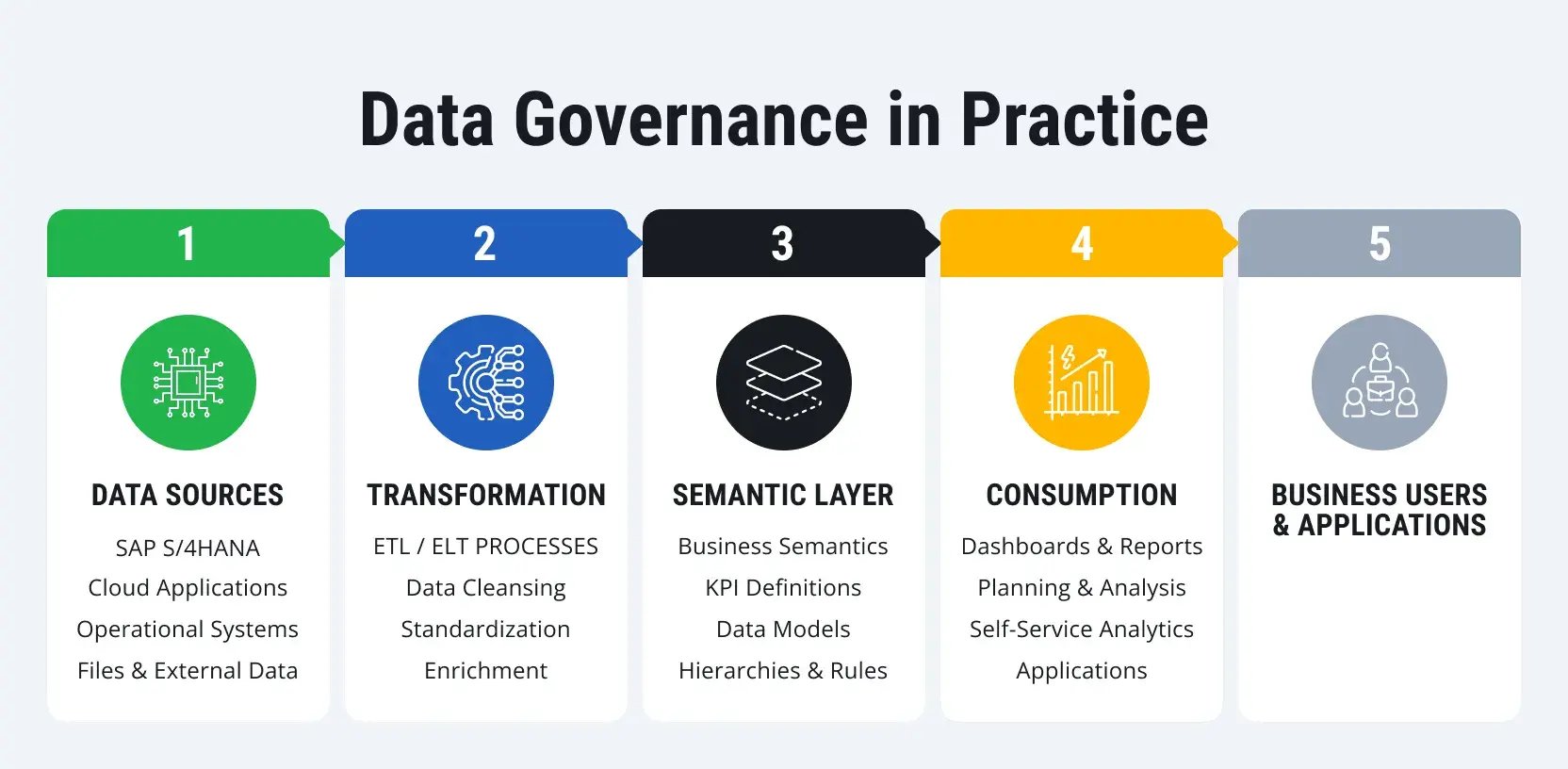
In reality, data is spread across SAP systems, cloud platforms, and operational tools. Business users shouldn’t have to think about where data lives or how to combine it. A modern platform brings this together into a single, governed access layer, so teams work with the same data, not their own extracts.
Shared definitions and business context
One of the biggest problems in legacy landscapes is that the same KPI means different things in different reports. Fixing this isn’t about tooling — it’s about agreeing on definitions and making them reusable. A proper semantic layer helps keep that logic consistent across the business.
Governance that actually works
In many environments, governance exists on paper but not in practice. Ownership is unclear, access rules are inconsistent, and lineage is hard to trace. Modernization should address this directly by making ownership visible, access controlled, and data usage traceable.
Data that’s available when it’s needed
Batch reporting was enough when decisions moved more slowly. That’s no longer the case. Whether it’s operations, finance, or supply chain, teams increasingly expect data to reflect what’s happening now or close to it.
A foundation that can support future use cases
Many organizations talk about advanced analytics or AI, but struggle to move beyond pilots. The reason is usually the same: the underlying data isn’t consistent or trusted. Modernization should fix that first; new initiatives will hit the same limitations.
Modernization is not about moving data to a new platform. It’s about fixing how data is structured, governed, and used across the business.
From data movement to data federation
In many Nordic organizations, the approach to data is also shifting away from traditional warehousing models. Instead of relying on heavy ETL pipelines and copying data between systems, there is a growing focus on making data accessible where it already exists.
This is reflected in SAP’s Business Data Cloud (BDC) approach, which shifts the focus toward data federation and zero-copy data sharing. In practice, data can be accessed and shared across systems — including platforms like Snowflake, Google BigQuery, or Databricks — without needing to create additional copies.
For organizations, this changes the modernization approach. Rather than centralizing data, the focus is on connecting it and making it consistently accessible. This reduces data movement, limits latency, and ensures teams rely on the same, up-to-date information across the organization.
The Role of SAP Datasphere in Modern Data Architectures
SAP Datasphere is often viewed as the next evolution of data warehousing. But treating it as a direct replacement for SAP BW/4HANA oversimplifies how it’s actually used in modern architectures.
In practice, its role is different. SAP Datasphere isn’t just a storage and reporting layer, as it sits closer to the business, connecting data across systems, keeping its meaning intact, and making it available in a controlled way.
What makes Datasphere different
- It focuses on business data, not just data models.
- It keeps semantics and context intact, instead of rebuilding logic downstream.
- It supports virtual access, reducing unnecessary data movement.
- It works across SAP and non-SAP landscapes.
- It embeds governance into how data is accessed and used.
How it compares to SAP BW/4HANA (in practice)
|
Aspect |
BW/4HANA |
SAP Datasphere |
|
Core role |
Centralized data warehouse |
Business data layer across systems |
|
Data approach |
Primarily persisted |
Mix of persisted + virtualized |
|
Semantics |
Modeled inside BW |
Preserved and shared across the landscape |
|
Integration |
Strong SAP focus |
SAP + non-SAP + open ecosystem |
|
Typical use |
Structured reporting, core models |
Cross-system access, data sharing, hybrid scenarios |
This doesn’t make one better than the other, as they solve different problems.
SAP BW/4HANA remains a solid foundation for structured, high-performance data warehousing, especially where organizations have already invested heavily in it. SAP Datasphere builds on that foundation, making it easier to access, combine, and reuse data across a broader landscape.
Datasphere enables governed access to business data while preserving business context across SAP and non-SAP environments.
In practice, modernization isn’t about choosing between SAP BW/4HANA and SAP Datasphere. It’s about understanding how they work together and how to build a more flexible architecture without losing the value of existing investments.

Where SAP BW/4HANA Fits: From Legacy to Modernization Path
For many Nordic organizations, SAP BW/4HANA is not something “to move away from” — it’s something they’ve spent years building, refining, and relying on. And in many cases, it still works well.
The challenge is not that SAP BW/4HANA has no value anymore. The challenge is that the surrounding data landscape has changed. New data sources, new tools, and new expectations require more flexibility than traditional architectures were designed to handle. That’s why modernization is rarely about replacement. It’s about evolution.
BW still plays a role
SAP BW/4HANA remains a strong foundation for structured, high-quality data models and core reporting. Many business-critical processes — especially in finance, supply chain, and operations — still depend on it. Replacing it entirely is often unnecessary and, in some cases, counterproductive.
Reuse what already works
Most BW landscapes contain valuable assets:
- Well-defined data models
- Established business logic
- Trusted reporting layers
Modernization should build on these, not discard them. Reusing existing models where they still create value helps reduce risk, shorten timelines, and avoid rebuilding what already works.
From centralized warehouse to hybrid architecture
Instead of keeping everything inside one system, organizations are gradually extending their architecture. SAP BW/4HANA continues to handle stable, structured workloads, while platforms like SAP Datasphere enable more flexible access, integration, and cross-system scenarios.
This creates a more balanced setup:
- Stability where it’s needed
- Flexibility where it’s required
Transition is a path, not a jump
Moving from SAP BW/4HANA to a more modern architecture doesn’t happen in one step. It typically involves:
- Assessing the current BW footprint
- Identifying reusable objects and models
- Gradually extending capabilities into new platforms
- Shifting use cases over time, based on business value
Often, tools and accelerators allow a significant portion of existing BW artifacts to be reused or transferred, making the transition more practical than it might seem.
Typical Modernization Scenarios in the Nordics
Data platform modernization rarely starts from scratch. Most organizations are working with landscapes that have evolved over years — sometimes decades — layer by layer, tool by tool.
Even though Nordic organizations come from different starting points, the problems tend to repeat. In some cases, it’s about simplifying a heavily customized SAP BW/4HANA setup. In others, it’s fragmented data across multiple systems. And almost everywhere, there’s growing pressure to make data work for more than just reporting.
For this reason, modernization doesn’t follow a single scenario. It tends to take shape around a handful of recurring situations, each with its own focus and trade-offs.
The table below outlines the most common ones.
|
Scenario |
What it looks like today |
What organizations are trying to fix |
What modernization focuses on |
|
BW-centric landscape optimization |
Mature SAP BW/4HANA environment with multiple reporting layers and growing complexity |
Heavy maintenance, duplicated logic, limited flexibility for new use cases |
Simplifying models, reducing duplication, improving governed access, and extending usage beyond traditional reporting |
|
Hybrid SAP/non-SAP data platform |
SAP systems coexist with cloud platforms, external tools, and operational systems |
Fragmented data, inconsistent definitions, and constant data movement between systems |
Connecting SAP and non-SAP data, introducing a unified semantic layer, enabling governed access across the landscape |
|
Data foundation for advanced analytics |
Businesses want advanced analytics, but data is inconsistent and hard to trust |
Poor data quality, unclear definitions, and a lack of governance |
Establishing trusted data models, improving data quality, and enabling faster and more reliable access to business data |
|
Multi-country analytics standardization |
Different Nordic entities use their own KPIs, tools, and reporting logic |
Inconsistent reporting across countries, a lack of alignment at the management level |
Standardizing definitions, introducing shared governance, and balancing central control with local flexibility |
No matter the scenario, the end goal doesn’t really change. It’s about leaving behind fragmented, tool-based reporting and building a data foundation that’s consistent, governed, and usable across the whole organization.
What to Assess Before Starting
Before jumping into tools or migration plans, it helps to take an honest look at the current setup — not just what’s documented, but how things actually work in practice. More often than not, the complexity isn’t only in the technology, but in how systems, data, and logic have evolved over time. In reality, this assessment usually comes down to four key areas.
1. Architecture and source systems
Start with a realistic view of the current landscape:
- Which core systems are in place (SAP ECC, SAP S/4HANA, SAP BW/4HANA, non-SAP platforms)?
- How does data move between them (batch, real-time, manual extracts)?
- Where is the data stored, and where is it used?
- How many reporting levels and data processing pipelines are there?
In many Nordic organizations, this already reveals a hybrid setup that is often more complex than expected.
2. Business-critical use cases
Not all data is equally important. The focus should be on what the business actually relies on:
- Executive and management reporting
- Finance and controlling
- Supply chain visibility
- Sales and profitability analytics
- Cross-entity reporting across countries
This helps avoid a common mistake: modernizing everything instead of prioritizing what creates real value.
3. Governance maturity
Technology can be replaced relatively quickly. Governance cannot.
Key questions to answer:
- Who owns the data and is accountable for it?
- Are KPI definitions aligned across teams and countries?
- Is there visibility into data lineage and transformations?
- How are access and usage controlled?
- Is metadata maintained and usable?
In many cases, this is where the biggest gaps appear.
4. Cloud and sovereignty constraints
In the Nordics, architecture decisions are closely tied to compliance and control. In many cases, this goes beyond GDPR — organizations often require local data residency to meet national security and privacy regulations.
- Where is data stored and processed?
- Are there regulatory or industry-specific restrictions?
- How does the current setup align with the cloud strategy?
- What level of control is required over data access and movement?
- How do regulatory requirements such as CSRD and the EU AI Act impact data storage, processing, and access models?
These factors affect how modernization is approached in practice — both from a technical and an operational standpoint. They shape not only where data lives, but also how it’s structured, managed, and made available across the business.
A clear view across these areas shifts modernization from a purely technical task to something much more aligned with real business needs.
Common Mistakes in Data Modernization Programs
Data platform modernization is rarely straightforward, and strong budgets don’t guarantee results. Without changes in governance, structure, and data usage, modernization brings little value.
A few patterns keep coming up.
Treating modernization as a tool upgrade
Many organizations fall into the trap of viewing modernization as nothing more than a tool change.
- Moving from legacy BI to a new platform
- Migrating reports without rethinking structure
- Keeping the same logic in a different system
It may improve performance or usability, but the core issues remain. Fragmentation and inconsistencies don’t go away.
Ignoring semantics and business definitions
Data integration alone is not enough. When KPI definitions are not aligned:
- The same metric is calculated differently across teams.
- Reports contradict each other.
- Trust in data drops over time.
Without a shared semantic layer, even the most modern platform will produce inconsistent results.
Underestimating governance
Governance is frequently seen as a secondary concern when it’s actually fundamental.
- Unclear ownership leads to uncontrolled changes.
- Lack of lineage makes data hard to trust.
- Weak access control creates compliance risks.
Without governance, complexity grows back quickly, even in a new environment.
“Lift-and-shift” thinking
Simply moving existing data models and pipelines to a new platform rarely delivers value.
- Outdated logic is carried forward,
- Unnecessary layers are preserved,
- Technical debt is replicated instead of reduced.
Modernization should be a chance to simplify, not just relocate.
Starting with advanced analytics or AI too early
There’s often pressure to move quickly into advanced use cases. But when the data foundation is not ready:
- Models rely on inconsistent data.
- The results are difficult to explain.
- Scaling becomes impossible.
In practice, this leads to stalled initiatives and wasted effort.
Expected Business Outcomes
Data platform modernization is often discussed in terms of architecture, tools, or migration paths. But for most organizations, the real question is simpler: what actually changes in the way the business works?
The value doesn’t come from new technology alone. It comes from how data becomes easier to trust, faster to access, and more consistent across the organization.
|
Outcome |
What changes in practice |
Why it matters |
|
Predictive readiness |
Data is consistent, timely, and structured for forward-looking analysis |
Organizations can anticipate trends, identify risks earlier, and make more proactive decisions |
|
Trusted access to data |
Teams work with consistent definitions and reliable data sources |
Decisions are based on numbers that everyone agrees on |
|
Faster decision-making |
Data is available when it’s needed, not hours or days later |
Businesses can react to changes in near real time |
|
Consistency across the organization |
KPIs and reports are aligned across teams, functions, and countries |
Management gets a single, clear view of performance |
|
Stronger foundation for advanced analytics |
Data is structured, governed, and reusable |
New analytical use cases can be developed without rebuilding everything from scratch |
|
Reduced landscape complexity |
Fewer duplicated pipelines, models, and reporting layers |
Lower maintenance effort and more predictable operations |
Taken together, these changes fundamentally shift how teams work with data. Instead of reconciling numbers or rebuilding reports, they can focus on making decisions based on reliable data.
Over time, this also changes how organizations scale. New use cases — whether in analytics, planning, or automation — can be built on top of an existing foundation, rather than starting from scratch each time.
Modernization delivers value when data becomes reliable and usable, not just reportable. It also changes how users interact with data, with tools like SAP Analytics Cloud providing direct access to consistent models and trusted data for analysis and planning.
.webp)
Recommended Delivery Approach
Modernization isn’t something you do all at once. It works better as a step-by-step process, with clear priorities and steady progress along the way.
In the Nordics, this matters even more. Data platform decisions don’t exist in isolation — they’re tied to governance, compliance, and hybrid environments. As a result, a phased, structured rollout tends to be far more effective than a one-time transformation.
In practice, this tends to follow a few key steps.
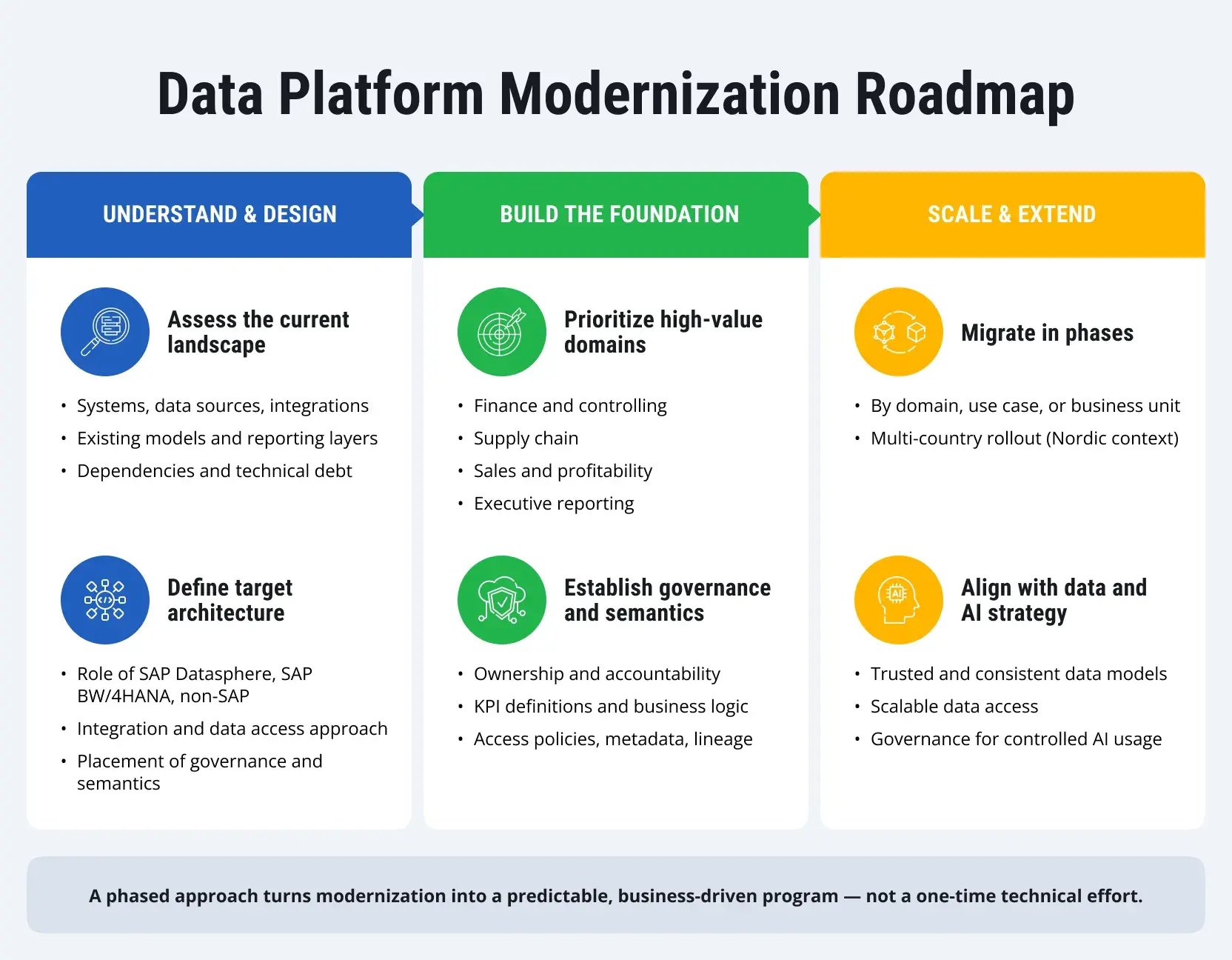
1. Assess the current landscape
Start with a clear understanding of what’s already in place:
- Systems, data sources, and integrations
- Existing data models and reporting layers
- Dependencies between tools and teams
- Areas of complexity and technical debt
This step often reveals more duplication and fragmentation than expected.
2. Define the target architecture
Once the current state is clear, the next step is to define how data should be accessed and managed going forward. This includes:
- The role of SAP Datasphere, SAP BW/4HANA, and non-SAP platforms
- How data will be integrated and consumed
- Where semantics and governance will sit
The focus should be on simplicity, scalability, and clarity, not just technology choices. This is particularly relevant in Nordic environments, where SAP and non-SAP systems typically coexist within hybrid and multicloud setups.
3. Prioritize high-value domains
Modernization shouldn’t start everywhere at once. Instead, focus on areas where impact is highest:
- Finance and controlling
- Supply chain
- Sales and profitability
- Executive reporting
This helps deliver visible results early and builds momentum.
4. Establish governance and semantics first
Before scaling data access, it’s critical to define:
- Ownership and accountability
- KPI definitions and business logic
- Access rules and policies
- Metadata and lineage
Without this, complexity quickly returns even in a new architecture.
5. Migrate in phases
Rather than a full migration, most organizations move gradually:
- By business domain
- By use case
- By country or business unit, which is especially relevant for organizations operating across multiple Nordic markets
This reduces risk and allows the architecture to evolve based on real usage.
6. Align with broader data and AI strategy
Modernization shouldn’t happen in isolation. If there are plans for advanced analytics or AI, the data platform needs to be designed with that in mind from the start:
- Consistent and trusted data models
- Scalable access to data
- Governance that supports controlled data use
A phased, business-driven approach keeps modernization predictable and focused on real outcomes, not just technical progress. In the Nordics, this matters even more, as AI initiatives are closely tied to governance and controlled data usage.
LeverX Services for SAP Data Platform Modernization in the Nordics
LeverX supports organizations across the Nordics in modernizing SAP-centric data landscapes — from initial strategy to full-scale rollout.
What we deliver
- Strategy and assessment: Clear view of current architecture, use cases, and modernization priorities.
- Target architecture and roadmap: Definition of SAP Datasphere, SAP BW/4HANA, and non-SAP roles within a unified data platform.
- Implementation and integration: Data integration, semantic modeling, and platform setup across SAP and non-SAP systems
- Governance and data foundation design: Ownership, KPI definitions, access models, and data policies.
- Phased rollout and scaling: Domain-based and multi-country implementation aligned with business priorities.
LeverX works with SAP every day and understands how real data landscapes actually look in practice. We help companies move away from scattered reporting setups toward data platforms that are easier to manage and scale.
In the Nordics, this means finding the right balance between analytics, compliance, and keeping the architecture under control long term.
Conclusion
Data platform modernization has moved beyond simply improving reporting or replacing tools. It is becoming a broader shift in how organizations build and manage their data platforms.
In the Nordic countries, expectations around data have changed. It’s not just about analysis anymore — data needs to be reliable, clearly managed, and able to support new use cases, including AI, while meeting higher standards for transparency and control.
This is why modernization decisions are increasingly focused on architecture and governance. The real challenge is not implementing new platforms, but creating a system where data remains consistent, understandable, and usable across systems and teams.
Solutions like SAP Datasphere help with this by connecting data across environments and preserving its business context, rather than adding another layer of complexity.
Organizations that approach modernization this way not only improve their reporting but also create a foundation upon which to build as requirements evolve. Companies that modernize their data platforms today determine how effectively they can scale analytics and AI tomorrow.