

Discover how SAP Business AI Platform connects SAP BTP, Joule Studio, SAP Knowledge Graph, and orchestration capabilities to support connected enterprise operations and cross-system workflows.
SAP Sapphire 2026 highlighted SAP’s broader shift toward connected operational environments where systems, workflows, and business data can work together across the enterprise landscape.
Instead of just slapping AI features into separate products, SAP is building a big-picture platform where smart systems can actually work together across different apps, workflows, and company data. The focus is shifting away from people just playing around with isolated tools toward letting AI handle the background work, understand the bigger business context, and actually get things done across different systems and networks.
This change reflects how modern enterprise environments actually operate. Business processes rarely stay inside a single application. Modern enterprise landscapes typically combine SAP solutions with non-SAP applications, data warehouses, cloud platforms, and business networks, making it difficult to scale and govern AI tools consistently. Companies increasingly need technologies that can work with business context, operational policies, and interconnected workflows rather than separate interfaces and standalone tasks. SAP Business AI Platform is designed to support this transition.
Built on SAP Business Technology Platform (SAP BTP), the platform brings together orchestration capabilities, governance frameworks, business context technologies, and intelligent agents inside one operational environment. Solutions such as Joule Studio, SAP Knowledge Graph, and Generative AI Hub are becoming part of a larger architecture focused on enterprise-wide coordination and execution.
For SAP customers, this also changes the broader technology strategy. Clean Core approaches, process standardization, and modern SAP BTP environments are becoming increasingly important as companies prepare their systems and data landscapes for the next stage of enterprise transformation.
Business Data Cloud
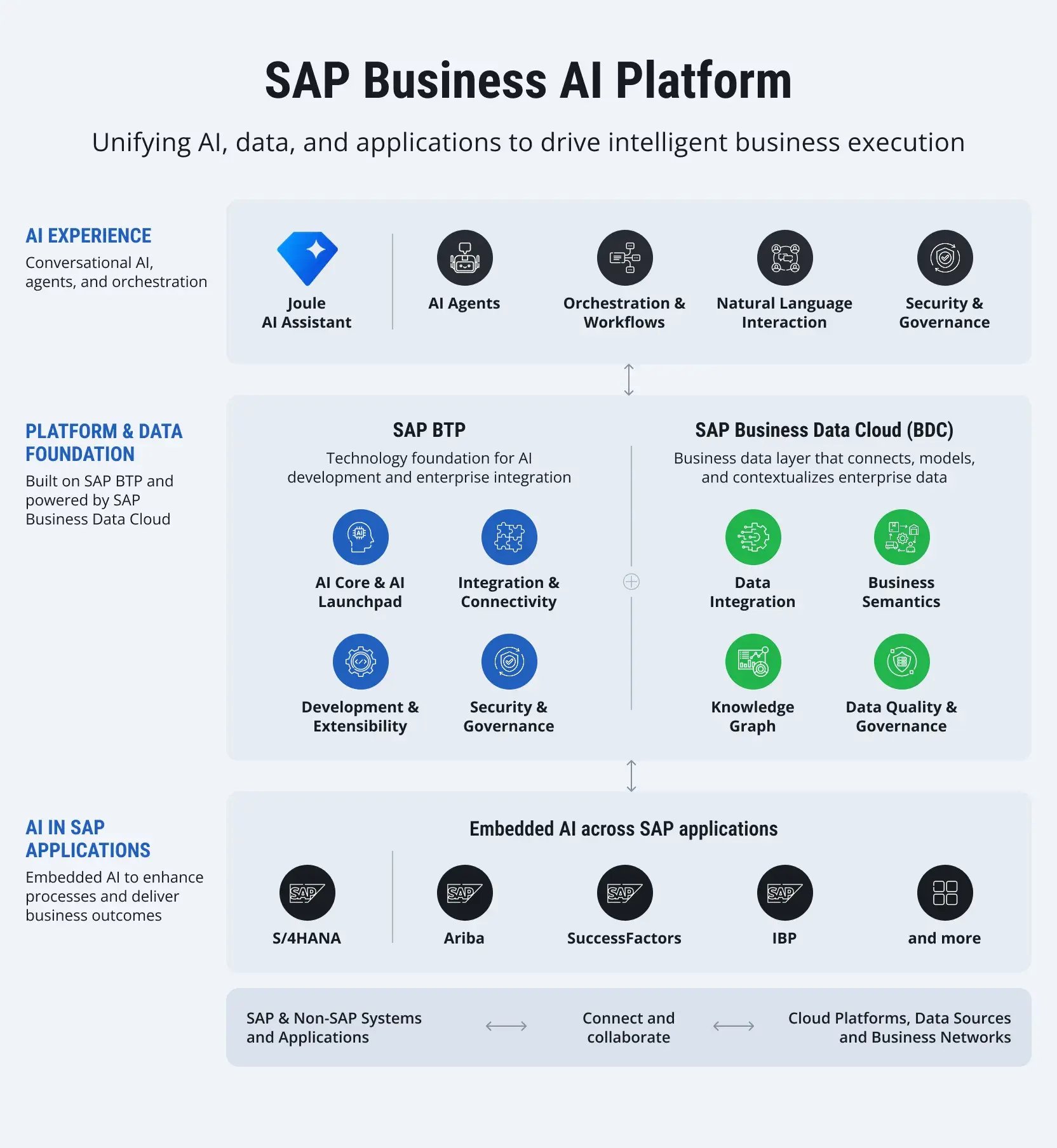
SAP Business AI Platform combines three foundational elements: SAP BTP, SAP Business Data Cloud (BDC), and SAP Business AI capabilities.
SAP BTP provides the underlying technology foundation for application development, integration, automation, security, and AI operations. SAP Business Data Cloud serves as the business data layer, connecting SAP and non-SAP data sources while preserving business context and governance. On top of these foundations, SAP Business AI delivers capabilities such as Joule, embedded AI scenarios, intelligent agents, orchestration services, and enterprise automation.
Together, these pieces bring data, processes, and AI into one place, making it way easier for companies to run things more smoothly and smartly.
What Is SAP Business AI Platform in 2026?
SAP is no longer adding AI capabilities separately to individual applications. Building on SAP BTP and SAP Business Data Cloud, SAP Business AI Platform provides a common layer that connects enterprise systems, business processes, data, and AI-powered automation inside a unified environment.
This architecture also supports SAP’s broader Autonomous Enterprise vision and the development of SAP Autonomous Suite, where connected systems can coordinate workflows and operational processes across the SAP ecosystem with greater automation and centralized control.
Why SAP is changing its approach
Modern SAP environments rarely operate inside a single application or workflow. Procurement, finance, HR, supply chain, and planning processes constantly move across multiple SAP systems, external platforms, and business networks.
Modern SAP landscapes include:
- SAP S/4HANA
- SAP Ariba
- SAP SuccessFactors
- SAP Business Network
- SAP Integrated Business Planning
- Third-party applications
- Industry platforms and external data sources
Business processes constantly move between systems and often involve multiple departments, approval stages, integrations, and external partners at the same time.
This is where SAP Business AI Platform comes in.
A centralized orchestration layer on SAP BTP
At its core, SAP Business AI Platform is designed to connect all the moving parts inside modern enterprise environments. Many of these capabilities are still evolving, but they reflect SAP’s broader architectural direction for connected enterprise operations. It brings together language models, business data, solutions, extensibility approaches, workflows, integrations, governance systems, and intelligent agents inside one shared operating environment.
Instead of giving intelligent agents unrestricted access to enterprise systems, the platform applies centralized controls that define which data can be accessed, which systems can be used, what actions are allowed, and how activities are monitored throughout the process.
Open-by-principle: cross-vendor agent interoperability (A2A)
The orchestration capabilities of SAP Business AI Platform are not limited to native SAP environments. Since most enterprises operate across multi-vendor cloud ecosystems, SAP's architecture increasingly supports open-by-principle Agent-to-Agent (A2A) interoperability, allowing workflows and intelligent agents to operate across SAP and non-SAP applications.
This approach enables bidirectional communication between SAP’s orchestration environment and external enterprise platforms while keeping governance, operational controls, and workflow visibility centralized inside SAP BTP.
Microsoft ecosystem integration
SAP is expanding interoperability between Joule and Microsoft 365 Copilot through secure A2A integrations. This allows users to coordinate workflows across Microsoft environments and SAP systems more directly inside their daily operational processes.
For example, activities initiated inside Microsoft Teams, Outlook, or Microsoft 365 workflows can interact with SAP business processes, ERP operations, and orchestration layers without requiring separate manual coordination between systems.
Google Cloud integration
SAP is also extending interoperability through its partnership with Google Cloud. Joule agents are increasingly designed to support bidirectional integration with Google Gemini Enterprise environments, allowing external agents to interact with SAP workflows and business context while remaining inside SAP BTP governance boundaries.
This architecture allows organizations to maintain centralized oversight, security controls, compliance requirements, and operational visibility even as orchestration workflows expand across multiple enterprise platforms and cloud ecosystems.
This structure becomes especially important in large enterprise environments where security, compliance, governance, and operational transparency are critical requirements.
.webp)
Joule Work: the operational workspace for the autonomous enterprise
SAP is also positioning Joule Work as a unified desktop and mobile workspace designed to simplify how users interact with increasingly complex enterprise environments.
Instead of forcing employees to move between multiple applications, dashboards, and workflow interfaces, Joule Work acts as an intent-driven engagement layer across the SAP ecosystem. Users can describe goals or operational tasks in natural language while the platform coordinates the underlying workflows, enterprise data, and orchestration logic behind the scenes.
Joule Work is designed to surface business insights, aggregate information from connected systems, and coordinate operational activities across SAP Autonomous Suite environments while maintaining operational transparency and human oversight throughout the process.
This model allows organizations to simplify interactions across procurement, finance, HR, supply chain, and other enterprise workflows without removing governance structures, approval logic, or centralized operational controls.
How the architecture works
|
Layer |
Role in the platform |
|
Large Language Models (LLMs) |
Provide reasoning, language understanding, and generative capabilities |
|
SAP-RPT-1.5 |
SAP’s proprietary tabular AI model is designed to analyze ERP tables, transactional records, and structured operational datasets while supporting large-scale “what-if” simulations and business scenario evaluation. |
|
AI Foundation |
Manages model access, integrations, orchestration, and lifecycle control |
|
Generative AI Hub |
Provides centralized tooling for prompt management, model governance, version control, evaluation, testing, and fine-tuning. |
|
SAP Knowledge Graph & Company Memory |
Adds business context by mapping relationships between enterprise data, processes, and metadata |
|
Joule Studio |
Supports orchestration, workflow design, multi-agent coordination, and development of enterprise operational scenarios across SAP BTP. |
|
SAP Autonomous Suite |
Coordinates workflows across interconnected enterprise environments while executing tasks directly inside core SAP applications such as SAP S/4HANA and SAP Ariba. |
|
Joule Work |
Acts as the unified engagement layer where users interact with workflows, operational insights, enterprise data, and orchestration processes through natural language interactions. |
|
AI Agents |
Coordinate workflows, execute tasks, and interact with enterprise systems |
SAP is also introducing a dual-model architecture designed to support different enterprise workload types more effectively. Traditional large language models continue to support conversational interfaces, reasoning, and unstructured workflows, while SAP-RPT-1.5 is optimized specifically for structured ERP datasets and large-scale transactional analysis across enterprise environments.
What makes the platform different
What makes the platform different is its understanding of business context. Most standalone AI tools work without a clear view of how enterprise processes, approval structures, and operational rules actually function. SAP Business AI Platform is designed to work inside those environments rather than outside them.
This allows intelligent systems to:
- Coordinate workflows across applications
- Validate actions against governance policies
- Trigger business processes automatically
- Work with structured enterprise data
- Support operational execution instead of isolated user interactions
For example, if a supply chain disruption occurs, the platform can detect inventory risks in SAP S/4HANA, analyze alternative suppliers in SAP Ariba, validate procurement rules and approvals, notify logistics teams, and launch mitigation workflows automatically across connected systems.
Lifecycle management and governance
The wider AI spreads across enterprise operations, the harder it becomes to manage everything around it. Companies now have to deal with model management, usage monitoring, compliance requirements, cost control, and visibility into automated processes across multiple departments and platforms.
SAP Business AI Platform addresses these challenges through centralized lifecycle management and control mechanisms. The platform is designed to give organizations greater visibility and control over how intelligent systems operate across the enterprise.
Key capabilities include:
- Prompt and model management
- Orchestration and workflow configuration
- Monitoring and version control
- Governance and auditability
- Usage tracking and compliance oversight
- Security and access management
SAP is positioning the platform around enterprise-grade requirements for transparency, compliance, security, and responsible AI operations.
To reduce the risks associated with fragmented shadow AI environments and unmonitored agent activity, SAP is consolidating orchestration and oversight capabilities inside SAP AI Agent Hub. Built on SAP LeanIX enterprise architecture insights, SAP AI Agent Hub functions as a vendor-agnostic control layer for managing agents, workflows, and orchestration activities across enterprise systems.
Instead of operating only as a monitoring dashboard, the platform is designed to map active agents directly to the applications, business processes, and enterprise data they interact with. This allows organizations to maintain stronger operational visibility, apply runtime boundaries, manage permissions more consistently, and retain centralized control across increasingly complex orchestration environments.
The Architecture Behind the Platform
The SAP Business AI Platform is built as a layered architecture where orchestration, business context, model management, and enterprise execution work together inside a single environment. Instead of relying on isolated assistants or disconnected automation tools, SAP is creating an ecosystem where intelligent systems can operate across applications, workflows, and data landscapes with centralized governance and operational control.
Several core components form the foundation of this architecture.
Joule Studio: the AI-first development environment
Joule Studio is becoming one of the central development layers inside SAP’s AI strategy. Rather than functioning as a traditional chatbot builder, it is designed as an environment for creating, orchestrating, and managing intelligent agents and multi-step enterprise workflows.
Its development and orchestration capabilities are closely integrated with SAP Build Code and Generative AI Hub, allowing organizations to combine workflow automation, application development, prompt management, model access, and orchestration inside a unified SAP BTP environment.
The platform is built around several core capabilities that support enterprise-wide orchestration and execution.
|
Capability |
Role in enterprise workflows |
|
Multi-agent orchestration |
Allows different agents to handle separate tasks within the same business process |
|
Workflow chaining |
Connects actions, approvals, integrations, and system responses into coordinated execution flows |
|
Low-code tooling |
Enables business users to configure workflows and orchestrations visually |
|
Pro-code extensibility |
Allows development teams to extend functionality through APIs, custom logic, and integrations |
|
Lifecycle management |
Supports governance and operational management of agents, prompts, workflows, and orchestration logic |
Multi-agent orchestration
One of the platform’s key capabilities is multi-agent orchestration. Different agents can operate inside the same workflow while handling separate responsibilities. One agent may retrieve operational data, another may validate business rules, while a third can trigger workflows or generate recommendations based on enterprise context.
This orchestration model becomes especially important in large SAP environments where processes regularly move across multiple systems, departments, and approval layers.
Workflow chaining and process coordination
Joule Studio also supports workflow chaining, which allows organizations to build coordinated execution flows instead of isolated prompts and responses. Actions, approvals, integrations, and system events can be connected into structured operational scenarios that combine automation, reasoning, and business logic.
Low-code and pro-code development
Another important aspect is the combination of low-code and pro-code development approaches.
Business users can configure workflows and orchestrations through visual tooling, while development teams can extend functionality using APIs, integrations, and custom logic. This gives organizations more flexibility when scaling AI initiatives across teams with different technical requirements.
AI-first development lifecycle
SAP is also positioning Joule Studio as part of a broader AI-first development lifecycle. Intelligent agents, prompts, workflows, orchestration logic, and governance controls are increasingly managed as long-term operational assets rather than standalone experimental tools.
.webp)
SAP Knowledge Graph and business context
One of the most important architectural components inside SAP Business AI Platform is SAP Knowledge Graph.
Why enterprise context matters
Most language models work primarily with statistical relationships between words and documents. Enterprise environments require a much deeper understanding of operational context. Business processes involve structured relationships between customers, suppliers, approvals, transactions, materials, employees, contracts, and organizational rules.
SAP Knowledge Graph is designed to provide this contextual layer.
Mapping relationships across enterprise systems
The technology maps semantic relationships between enterprise entities, metadata, workflows, and operational processes across SAP environments. Instead of processing information as isolated records, intelligent systems can interpret how data objects relate to one another in real business operations.
This improves process awareness across enterprise workflows and helps intelligent systems operate with a stronger understanding of dependencies, hierarchies, and business logic.
For example, a procurement request is not treated as a standalone transaction. The platform can associate it with supplier contracts, approval structures, inventory data, financial rules, purchasing policies, and historical operational patterns across connected systems.
Metadata intelligence and process awareness
Metadata intelligence also plays an important role here. Enterprise systems generate large volumes of structured operational metadata that describe relationships between applications, users, workflows, permissions, and business objects.
SAP Knowledge Graph uses these relationships to improve contextual reasoning across enterprise environments.
Reducing hallucinations in enterprise workflows
Another key benefit is stronger contextual accuracy. Since the platform operates with enterprise relationships, metadata, and business rules, it can provide more consistent outputs across operational scenarios.
This architectural approach becomes increasingly important as organizations scale enterprise AI across highly interconnected SAP landscapes.
AI Foundation and Generative AI Hub
AI Foundation and Generative AI Hub provide the underlying infrastructure layer for model management, orchestration, and AI operations inside SAP BTP.
One of SAP’s main architectural decisions is maintaining a vendor-neutral approach to model access. Instead of depending on a single model provider, organizations can work with multiple external and proprietary models depending on business requirements, governance policies, cost considerations, and operational scenarios.
The platform supports integrations with providers such as:
- Anthropic / Claude
- OpenAI
- Mistral
- SAP-developed models
SAP recently expanded this ecosystem with Anthropic’s Claude models, which are expected to play an important role in supporting advanced reasoning capabilities across SAP Autonomous Suite scenarios and multi-step enterprise orchestration workflows.
This flexibility allows organizations to select different models for different workloads while maintaining centralized governance and orchestration.
AI Foundation acts as the operational control layer for these environments. It manages model access, authentication, orchestration logic, integration services, and lifecycle operations across enterprise AI scenarios.
Generative AI Hub extends these capabilities with centralized tooling for:
- Prompt management
- Version control
- Model evaluation
- Fine-tuning
- Testing
- Deployment governance
As AI adoption grows, prompt governance and model versioning are becoming operational requirements rather than development conveniences. Organizations increasingly need visibility into which prompts are used, how models behave across environments, and how orchestration logic changes over time.
This becomes especially important in regulated industries where transparency, repeatability, and auditability are mandatory.
Together, AI Foundation and Generative AI Hub provide the infrastructure layer that allows organizations to scale AI operations with greater flexibility, governance, and operational consistency.
From Copilots To Autonomous Agents
One of the most important shifts in SAP’s AI strategy is changing the role connected systems play in enterprise operations. Earlier AI initiatives were mostly centered around user assistance and productivity improvements. The next stage is focused on operational execution across interconnected business environments.
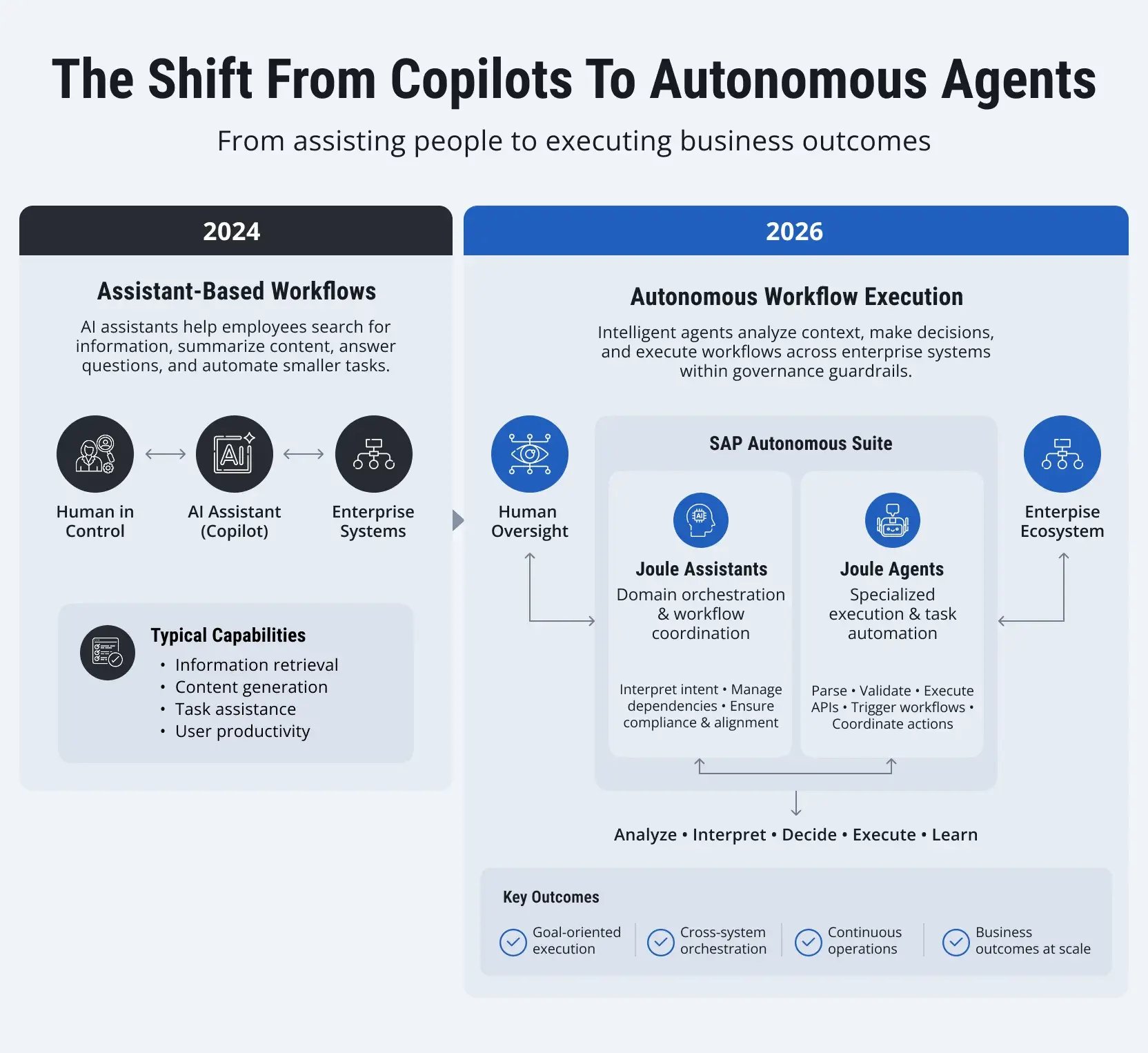
In 2024, enterprise AI primarily focused on assisting users with individual tasks, while by 2026, intelligent agents are increasingly expected to coordinate and execute workflows across enterprise systems within defined governance boundaries.
This transition is pushing AI beyond isolated interactions and into end-to-end process coordination. Intelligent agents are increasingly expected to work across applications, interpret business context, trigger actions automatically, and support execution inside complex operational environments rather than simply respond to user prompts.
SAP Autonomous Suite represents one of the clearest examples of this transition. Instead of treating assistants as standalone interfaces, SAP is building a layered orchestration model that combines workflow coordination, reasoning, and operational execution across enterprise systems.
At the center of this architecture is Joule Work, which acts as the coordination layer between users, enterprise workflows, SAP applications, and operational processes across the SAP ecosystem.
SAP Autonomous Suite itself is structured around two core orchestration layers: Joule Assistants and Joule Agents.
This shift changes the role of enterprise AI entirely.
From user prompts to goal-oriented execution
Traditional assistants mainly respond to direct user requests. Autonomous agents work differently.
Instead of waiting for prompts, agents can operate around business goals, operational events, and process conditions. Their role is not limited to generating responses. They can retrieve data, evaluate business rules, trigger workflows, validate approvals, and coordinate actions across connected enterprise systems.
This creates a move from isolated interactions toward continuous operational execution.
Agent collaboration across enterprise systems
Another major difference is the collaboration between agents. Inside large SAP environments, a single workflow may involve procurement systems, financial applications, inventory platforms, logistics tools, approval structures, and external supplier networks at the same time. Instead of relying on one centralized assistant, different agents can handle separate responsibilities within the same operational process.
For example:
- One agent may monitor operational risks.
- Another may validate compliance rules.
- A third coordinates supplier communication or workflow execution.
This orchestration model allows enterprise processes to operate more dynamically across interconnected SAP landscapes.
Inside SAP Autonomous Suite, Joule Assistants function as domain-specific orchestration layers focused on broader business functions such as finance, procurement, or spend management. Their role is to interpret user intent, coordinate workflows across systems, manage dependencies between operational processes, and ensure activities remain aligned with enterprise policies and compliance requirements.
Joule Agents operate differently. They function as specialized execution components inside larger operational workflows. Once triggered through orchestration logic or assistant coordination, agents can autonomously process unstructured data, validate business rules, execute API calls, trigger workflows, and coordinate operational tasks across connected systems.
For example, a Cash Management Agent may automatically reconcile daily bank statements, validate transaction data, and trigger follow-up financial workflows without requiring manual coordination for every operational step.
Process-aware AI and autonomous orchestration
Autonomous orchestration depends heavily on business context.
Enterprise workflows involve dependencies, approval chains, governance policies, and operational constraints that connected systems must understand before taking action. SAP’s architecture is designed around process-aware execution rather than standalone automation.
This means intelligent agents can:
- Operate inside predefined operational structures
- Follow approval logic
- Work with enterprise master data
- Coordinate actions across systems while maintaining operational visibility
The goal is not uncontrolled automation. The goal is controlled operational execution inside enterprise-defined guardrails.
Human oversight still matters
Even as enterprise AI becomes more autonomous, human oversight remains a critical part of the architecture.
Organizations still need:
- Approval structures
- Auditability
- Compliance controls
- Monitoring
- Clear visibility into automated decisions
SAP’s platform strategy is built around the idea that intelligent agents should operate inside governance frameworks rather than independently from them. This becomes especially important in industries with strict regulatory, financial, or operational requirements.
Example: autonomous supply chain response
A supply chain disruption illustrates how this orchestration model works in practice.
Instead of requiring multiple teams to manually coordinate every step, intelligent agents can handle large parts of the process automatically:
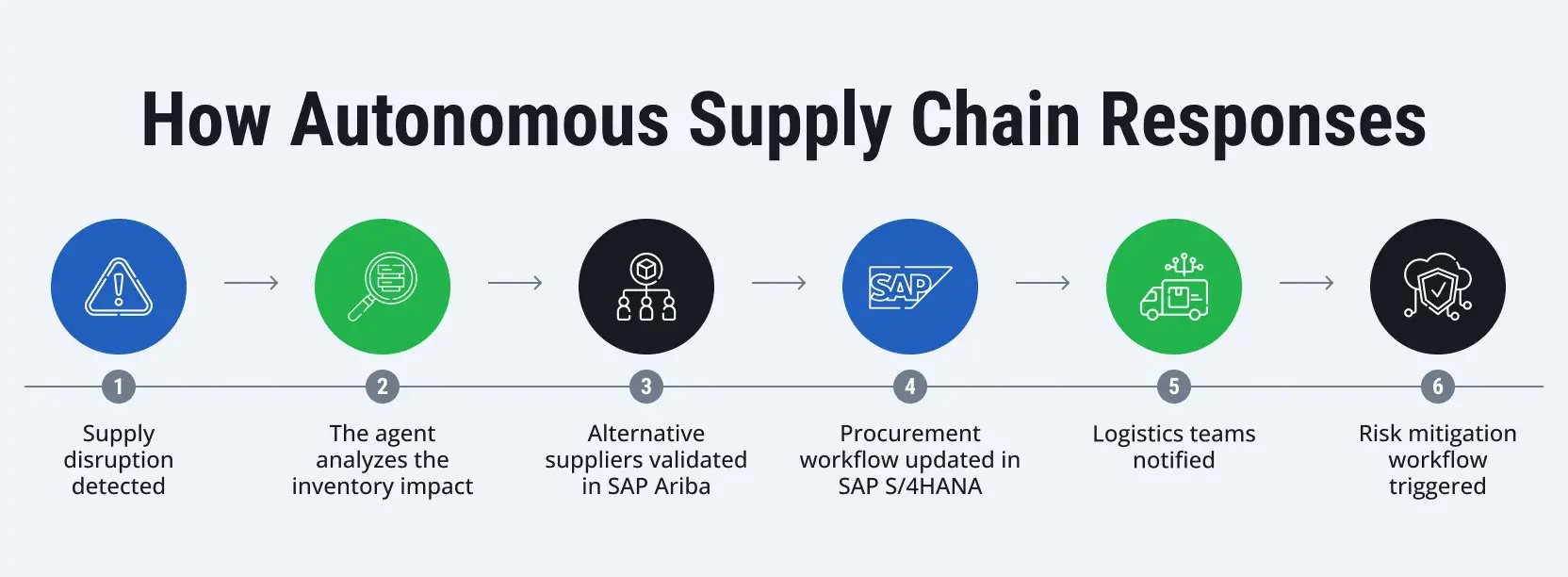
In this scenario, intelligent systems are not simply generating recommendations. They are coordinating operational execution across multiple enterprise platforms while remaining inside predefined business rules and control structures.
This is one of the clearest examples of how SAP is moving from assistant-based productivity tools toward autonomous enterprise operations.
The Economic Model: Understanding AI Units
As AI adoption grows, cost management is becoming one of the biggest concerns for CIOs and enterprise architects. Running intelligent agents across multiple systems, workflows, and business processes introduces a completely different operational model compared to traditional software licensing.
This is one of the reasons SAP is moving toward consumption-based AI economics through AI Units.
Instead of paying only for software access, organizations increasingly pay based on how intelligent services are used across the enterprise landscape. This includes factors such as model consumption, orchestration complexity, workflow execution, agent activity, and integration workloads.
For CIOs, the challenge is not simply enabling AI capabilities. The real challenge is scaling them without losing visibility into operational costs, governance, and system behavior.
Why consumption management matters
Enterprise AI environments can grow very quickly.
A single intelligent agent may:
- Retrieve enterprise data
- Trigger workflows
- Interact with multiple systems
- Generate responses
- Validate business rules
- Coordinate operational actions across departments
When dozens or hundreds of agents operate simultaneously, usage levels can increase rapidly across the organization.
Without centralized governance, companies risk:
- Uncontrolled model consumption
- Duplicated orchestration logic
- Unnecessary workflow execution
- Unpredictable infrastructure costs
This is why observability and governance are becoming critical parts of SAP’s AI platform strategy.
AI observability and governance dashboards
SAP is positioning AI observability as an operational requirement rather than a technical add-on.
Organizations increasingly need visibility into:
- Which models are being used
- Where AI Units are consumed
- How agents behave across workflows
- Which departments generate the highest usage
- Whether automated execution remains aligned with governance policies
Governance dashboards are expected to play a major role in helping enterprises monitor:
- Consumption trends
- Workflow execution volumes
- Orchestration activity
- Compliance controls
- Operational performance
This becomes especially important in large SAP landscapes where intelligent agents operate across finance, procurement, HR, supply chain, and external business networks simultaneously.
Preventing uncontrolled agent execution
Another major concern for enterprise leaders is preventing uncontrolled execution.
Autonomous agents can coordinate workflows, trigger actions, and interact with enterprise systems at scale. Without proper oversight mechanisms, this can create operational, financial, and compliance risks.
SAP’s architecture is designed around controlled execution models where organizations can define:
- Access permissions
- Orchestration boundaries
- Approval requirements
- Usage policies
- Monitoring rules
This allows companies to scale AI initiatives while maintaining operational transparency and governance oversight.
Enterprise cost optimization
Consumption-based AI economics also changes how organizations approach optimization.
Companies are starting to evaluate:
- Which workloads require premium models
- Where lightweight orchestration is sufficient
- Which workflows generate the highest operational value
- How intelligent agents should be prioritized across departments
This turns AI governance into both a financial and operational discipline. Organizations that manage orchestration efficiently will be able to scale enterprise AI more sustainably while avoiding unnecessary consumption growth.
AI unit consumption scenarios
|
AI tier |
Typical usage |
Business impact |
|
Foundation tier |
Internal assistants, summaries, lightweight automation |
Improves employee productivity and reduces manual work |
|
Operational tier |
Workflow orchestration, cross-system execution, business rule validation |
Increases process efficiency and operational coordination |
|
Advanced autonomous tier |
Multi-agent execution across enterprise systems and external networks |
Supports scalable autonomous operations and enterprise-wide automation |
For many SAP customers, AI economics is quickly becoming as important as AI functionality itself. The companies that scale successfully will not necessarily be the ones using the most intelligent agents, but the ones that manage orchestration, governance, and consumption most effectively.
Enterprise Use Cases in 2026
As enterprise AI moves beyond copilots and isolated automation scenarios, the focus shifts toward operational execution across entire business environments. The most valuable use cases are no longer limited to employee productivity. Companies are starting to apply intelligent orchestration to supply chains, financial operations, workforce management, and cross-system decision-making.
The following scenarios illustrate how SAP Business AI Platform could operate inside real enterprise environments in 2026.
Autonomous supply chain control towers
Even minor supply chain issues can have a ripple effect across procurement, logistics, inventory management, and supplier operations. Coordinating responses manually often requires multiple teams to work across disconnected systems and processes.
Autonomous control towers are designed to continuously monitor operational conditions across the supply chain landscape and coordinate responses automatically when risks appear. These disruptions may include:
- Inventory shortages
- Transportation delays
- Supplier disruptions
- Geopolitical risks
- Unexpected demand fluctuations
This operational model closely aligns with broader Industry 4.0 initiatives, where connected systems, real-time visibility, and integrated business processes become critical for large-scale enterprise operations.
Instead of coordinating supply chain responses manually across multiple departments, companies can streamline the process by connecting operational analysis, supplier validation, procurement updates, planning adjustments, and team notifications inside one workflow.
Operational decisions are not made in isolation. The platform can evaluate supplier agreements, procurement policies, inventory thresholds, logistics limitations, and financial governance requirements before workflows are executed across systems.
This allows organizations to respond faster to operational disruptions while maintaining visibility, compliance, and governance across the broader SAP landscape.

Self-reconciling finance operations
Finance teams spend significant time validating transactions, reconciling records, reviewing exceptions, and coordinating approvals across systems.
In 2026, AI platforms are increasingly expected to automate parts of these operational processes instead of only assisting with reporting or analytics.
Financial operations often involve transactions moving across multiple systems and business networks. The platform helps monitor these activities continuously, identify inconsistencies, validate transaction data, and support reconciliation processes when issues appear.
For example, the platform may:
- Detect mismatched invoices
- Compare transaction records across systems
- Validate supplier agreements
- Identify policy violations
- Initiate approval or correction workflows without requiring manual coordination for every step
This creates a more continuous operational model for finance management where reconciliation processes become faster, more traceable, and less dependent on fragmented manual activities.
The combination of governance controls, auditability, and operational context is especially important here because financial workflows require strict compliance and visibility into automated actions.
AI-driven workforce orchestration
Today’s HR operations involve much more than administrative processes. Companies need to coordinate workforce planning, employee development, compliance, and staffing needs across distributed teams and multiple regions.
Traditional HR automation typically focused on isolated administrative tasks. Enterprise AI orchestration introduces a much broader operational model.
Organizations can coordinate workforce data, project requirements, employee development plans, and learning initiatives across connected HR systems and business environments.
This allows organizations to:
- Identify skill gaps
- Recommend internal mobility opportunities
- Automate onboarding workflows
- Coordinate learning assignments
- Support workforce planning
- Personalize employee development journeys
When companies need to staff new initiatives quickly, coordinating workforce availability, onboarding activities, and training requirements can become difficult across departments and regions. The platform helps organize these activities inside a single environment.
Since these activities remain integrated with organizational policies and operational structures, companies can maintain consistency across departments and regions.
Governance, Security, and Compliance
As enterprise operations become more automated and interconnected, governance is no longer treated as a secondary consideration. Organizations need stronger oversight, compliance controls, and transparency across the systems and workflows that support procurement, finance, HR, and supply chain operations.
This is one of the areas where SAP is positioning its platform strategy differently from many consumer-oriented AI environments.
SAP Business AI Platform is designed to support enterprise-grade governance, with a strong focus on compliance controls, auditability, operational transparency, and secure data environments. For organizations in regulated industries, these requirements are often just as important as the technology itself.
Governance as an architectural layer
For enterprise systems, governance works best when it is part of the architecture itself rather than an additional layer applied after deployment. This includes workflows, data access, orchestration logic, and operational processes.
Organizations increasingly need visibility into:
- How decisions are made
- Which models are being used
- What data is accessed
- Who approved automated actions
- How workflows move across systems
SAP’s governance approach is designed around centralized policy management, operational transparency, and controlled execution across enterprise environments.
This allows companies to define:
- Access permissions
- Workflow boundaries
- Approval requirements
- Orchestration rules
- Compliance policies across departments and systems
Explainability and auditability
As intelligent technologies become more involved in operational processes, explainability becomes critical for enterprise adoption.
Organizations need to understand:
- Why was a recommendation generated?
- How was a workflow decision made?
- What data influenced the outcome?
- Which systems participated in the execution?
This is particularly important in regulated environments where operational decisions may need to be reviewed by auditors, compliance teams, regulators, or internal governance boards.
The platform is designed around operational transparency and traceability instead of closed execution models. This helps organizations maintain visibility into workflows, orchestration mechanisms, and interactions between connected enterprise systems.
AI Act readiness and regulatory compliance
Regulatory pressure around enterprise AI is increasing rapidly, especially in Europe and highly regulated industries.
Organizations are expected to maintain:
- Transparency around automated decisions
- Oversight of operational AI systems
- Governance documentation
- Risk management processes
- Compliance controls for enterprise data usage
SAP is positioning its architecture around these enterprise requirements by embedding control and compliance capabilities directly into the platform environment rather than treating them as external controls.
This becomes increasingly important as companies scale intelligent workflows across procurement, finance, HR, and supply chain operations.
Private enterprise data protection
Data protection remains one of the biggest concerns for AI adoption.
Organizations need clear boundaries around:
- Where enterprise data is stored
- How models access information
- Which systems process operational data
- Whether sensitive business information is exposed to external environments
SAP’s platform strategy emphasizes protected enterprise data environments and controlled orchestration across SAP ecosystems.
Many companies see this as a key requirement rather than an optional capability. They need environments where operational data and business processes remain protected while still supporting large-scale orchestration across enterprise systems.
Trust architecture for enterprise operations
As enterprise AI environments become more autonomous, trust architecture becomes just as important as model performance.
Companies need systems that are:
- Secure
- Auditable
- Explainable
- Compliant
- Operationally transparent
SAP is positioning its Business AI Platform around these enterprise-grade requirements rather than purely experimental or consumer-focused AI experiences.
For CIOs and enterprise architects, governance readiness is becoming one of the main factors that determines whether intelligent technologies can scale safely across the organization.
Conclusion
SAP Business AI Platform reflects a bigger shift in how enterprise systems are evolving. Companies are no longer focused only on separate automation scenarios or productivity features inside individual applications. The focus is moving toward connected environments where systems, processes, and business data can work together with less manual coordination between teams.
For many organizations, this also exposes long-standing problems inside existing SAP landscapes.
Heavily customized ERP systems, fragmented data, disconnected workflows, and inconsistent control become much harder to manage as environments grow more connected. What once looked manageable inside separate systems can quickly turn into a limitation when companies try to scale operations across the business.
That is why initiatives such as Clean Core, process standardization, SAP BTP modernization, and stronger data governance are becoming much more important. More companies now treat these projects as necessary preparation for future growth rather than optional improvements that can wait.
For enterprise leaders, the challenge goes beyond technology adoption. Companies also need SAP environments that can continue supporting connected and reliable operations as business needs evolve over time.

.webp)
-min-Jul-12-2022-11-01-30-92-AM.jpg)