Compare RISE with SAP and traditional S/4HANA services: contracting, accountability, OpEx or CapEx, customization, innovation speed, and control.
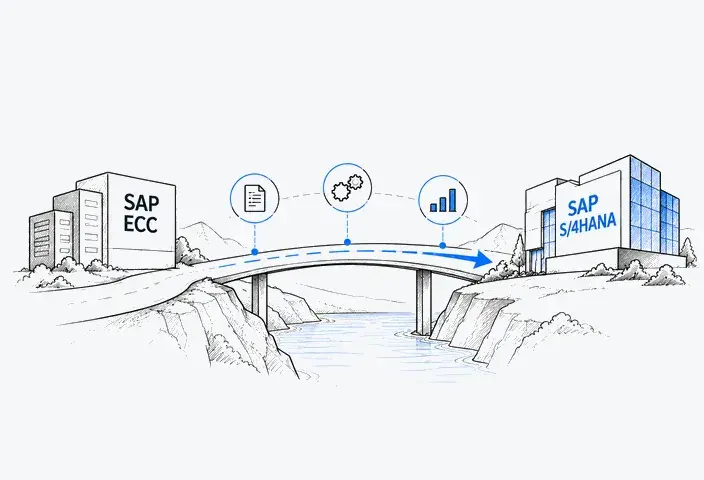
SAP S/4HANA is becoming standard for many SAP customers, whether the business loves the timing or not. With SAP Business Suite 7, including SAP ECC 6.0, moving toward the end of mainstream maintenance in 2027 and optional extended maintenance through 2030, the timeline is tightening for many landscapes. At the same time, expectations keep rising, and teams need better reporting, automation, and planning without piling on more tools and manual fixes.
What’s open for discussion is the transformation model. Some organizations opt for RISE with SAP, a subscription package that combines software, cloud infrastructure, and a defined set of managed services under a single contract. Others follow the traditional approach, where licenses, infrastructure, implementation, and ongoing support sit in separate agreements and are managed as a vendor ecosystem. That traditional model can still be cloud-based, for example, a BYOL setup on a hyperscaler, where S/4HANA runs on cloud infrastructure, but licensing, hosting, implementation, and support remain split across multiple vendors and contracts.
The choice is a strategic preference, often mistaken for a technical one. It is a governance and financial decision that determines what you own, what you outsource, how risk is shared, and how accountability works when priorities conflict or something breaks. The key difference isn’t the S/4HANA core; it’s who manages the layers around it and how responsibility and costs are structured.
How RISE and Traditional Models Differ
Before looking at speed, customization, or innovation, it is important to understand how each model is constructed. The commercial structure defines who is responsible for what, how problems are resolved, and how predictable the operating model is over time.
Contracting model and accountability
RISE with SAP is built around a single commercial agreement. SAP provides SAP Cloud ERP Private in an SAP-coordinated cloud environment, including hyperscalers, along with a predefined scope of managed technical services. The operational result is centralized accountability: SAP is the primary point of contact, coordinates service levels across the in-scope stack, and runs a single escalation path for incidents that cross infrastructure, platform, and technical operations.
The traditional non-RISE S/4HANA model separates those layers. You typically buy licenses from SAP, source infrastructure independently on a hyperscaler or on-premises, engage an integrator for implementation, and often use a different partner for ongoing support. Each provider owns its slice, so cross-layer issues require orchestration. In practice, the customer usually coordinates triage and escalation, which increases governance load and spreads accountability across multiple parties.
RISE simplifies accountability for the technical stack, but it does not replace program governance. Process ownership, integration architecture, testing discipline, and change management still sit with the customer and delivery partners.

Licensing and financial model
From a financial perspective, the two models follow very different logics.
With RISE with SAP, costs are bundled into a subscription and treated primarily as an operating expense. Licensing, infrastructure, and defined services are combined into a recurring fee. This makes cost planning more predictable year over year, but it also ties the customer to a contract term and commercial structure that needs to be evaluated carefully. For CFOs, the shift is not only accounting. It changes budget ownership, approval cycles, and how tightly costs can be tied to usage, scope, and renewal terms.
In the traditional model, S/4HANA licenses are often purchased upfront and capitalized. Infrastructure, hosting, and support are paid separately as operating costs. This approach offers more flexibility in vendor selection and contract design, but financial forecasting depends heavily on how the landscape is run and how many parties are involved. Traditional programs can be more controllable in the long run because you can renegotiate each layer separately. The trade-off is variability: infrastructure consumption, support scope, and change volume can move the baseline.
Cost visibility over time
RISE with SAP: One subscription line covering software, infrastructure, and core technical services; costs scale based on contract terms and system size. In many organizations, this also means fewer separate invoices and a simpler internal chargeback model, with renewal terms becoming the main commercial lever. The trade-off is reduced commercial granularity: infrastructure and software are negotiated together, which limits the ability to optimize or renegotiate individual layers independently.
Traditional S/4HANA: Initial investment in licenses; ongoing infrastructure, support, and upgrade costs vary depending on usage, vendor pricing, and operational maturity. You get more levers to optimize individual layers, but cost variance increases if change requests, incidents, or consumption are not tightly governed.
Cost structure summary
|
Dimension |
RISE with SAP |
Traditional non-RISE S/4HANA |
|
Budget shape |
One recurring subscription line covering major layers |
Upfront license investment plus multiple operating cost lines |
|
Invoicing and chargeback |
Fewer invoices, simpler internal chargeback in many organizations |
More invoices and cost centers, depending on the vendor model |
|
Main commercial lever over time |
Renewal terms and contract structure |
Separate renegotiation levers per layer and vendor |
|
Ability to optimize one layer independently |
Lower, package components move together |
Higher, each layer can be optimized separately |
|
Cost variability drivers |
Changes in contracted scope and renewal structure |
Consumption, incidents, change volume, and vendor rates |
|
Governance requirement |
Lower vendor orchestration effort, but governance is still needed |
Higher orchestration effort, strong governance required to control variance |
The total cost of ownership cannot be assessed in isolation. A fair OpEx vs CapEx comparison depends on contract terms, landscape size, integration complexity, and how much you standardize versus rebuild the current design. Without those assumptions, any TCO number is marketing, not analysis.
Three Structural Differences That Drive Project Outcomes
Implementation success is rarely about one feature or one architecture choice. It usually comes down to how the model is built and who owns the moving parts. When SAP bundles key layers under one agreement, you get a tighter operating setup with fewer handoffs. When you assemble the stack yourself, you gain control and choice, but you also take on more coordination. That trade-off shows up in three practical areas.
Speed and continuous innovation
With RISE, SAP manages updates across the components included in the package. In practice, you do not have to stitch together separate upgrade plans for the platform, the environment, and the capabilities that sit around S/4HANA. The intent is continuity: new functionality, including selected innovation features and process tooling aligned to the package scope, moves forward on a coordinated cadence, and SAP owns integration across that scope.
RISE also pushes a more standardized implementation path. You are not starting from a blank sheet because the operational model, service boundaries, and baseline methodology are defined earlier. That can shorten time-to-value, especially for organizations that want a clear route to a stable first go-live.
In the traditional model, speed is achievable, but it is earned through hard work. Your team and partners plan updates, align dependencies, and decide how aggressively to adopt innovation without disrupting business operations. That gives you more say in timing and sequencing, and it requires stronger governance to avoid slowdowns.
Customization and standardization
Traditional delivery is the control-heavy option. Because the customer selects and manages infrastructure and consulting partners, there is more freedom in how the system is designed and operated. This includes deep ABAP customization, highly tailored integrations, and architectural choices that reflect unique process requirements. In traditional landscapes, customers technically have the option to modify SAP source code, even though this is rarely recommended. For some industries and business models, that level of control is not nice to have; it is how differentiation is preserved.
RISE leans into standardization, most visibly in public cloud deployments. In practice, however, most RISE programs for ECC migrations use the private cloud option, which supports conversion-driven scenarios and allows existing custom code to be carried forward. Deep ABAP development is still possible in RISE Private Cloud, but the model enforces stricter boundaries: SAP does not allow source code modifications, even though enhancements and custom developments are supported.
This is where the Clean Core strategy becomes central. Clean Core focuses on keeping the S/4HANA core as standard as possible and placing differentiation in extensions, integrations, and side-by-side applications instead of modifying the core itself. In a RISE context, this approach matters because it reduces upgrade effort, lowers regression risk, and makes it easier to stay aligned with SAP’s release cadence. SAP Business Technology Platform (SAP BTP) becomes the primary path for building what is specific to your business while keeping the core stable. The constraint is real, but so is the benefit: fewer custom elements inside the core typically means less rework during upgrades and a more predictable lifecycle over time.
Built-in intelligence and manageability
A practical advantage of RISE is that process intelligence tooling is typically part of the package. SAP Signavio’s capabilities support process analysis, benchmarking, and continuous improvement. This adds a management layer on top of the implementation: you can validate where process friction lives, prioritize changes with clearer evidence, and track whether improvements stick after go-live. In some RISE contracts, access to these tools is provided as a time-limited trial or for a defined term, so it’s worth confirming what’s included, for how long, and what happens after the trial period ends.
RISE can also simplify access to SAP’s network ecosystem through SAP Business Network capabilities. That matters when the S/4HANA program includes supplier collaboration, logistics visibility, or broader supply chain digitization. Traditional programs can deliver the same outcomes, but they often require separate contracting, separate licensing decisions, and more integration effort across multiple parties.
The Strategic Choice That Actually Matters
By this point, one thing should be clear. The decision between RISE with SAP and a traditional S/4HANA program is not about the application itself. The S/4HANA core is the same. What changes is who runs the surrounding layers, how responsibility is assigned when things go wrong or need to change, and how costs are structured over time.
At its core, this is a choice about operating model and financial logic, not technology preference.
Three pillars of the decision
You can reduce the comparison to three questions that cut through most debates:
- Single package or separate contracts
One bundled agreement with SAP, or a landscape assembled and governed by the customer. - Convenience and single accountability or full control with shared responsibility
Fewer handoffs and a clearer escalation path, or maximum freedom in vendor and architecture choices with more coordination effort. - OpEx subscription or CapEx license purchase
Predictable recurring costs, or upfront investment, with more flexibility in how operating costs are shaped.
These pillars tend to move together. You rarely get single accountability without giving up some control, and you rarely get full flexibility without taking on more operational responsibility.
How to choose in practice
Choose the traditional approach if
- Deep customization is non-negotiable and must live inside the S/4HANA core.
- You want to select and manage infrastructure, implementation, and run partners independently.
- Your organization has the governance maturity to coordinate multiple vendors without losing momentum.
- You prefer capital investment in licenses and are comfortable managing variable operating costs over time.
Choose RISE with SAP if
- You want a simpler operating model with clearer accountability across the stack.
- Predictable subscription-based costs are a priority for finance planning.
- You are willing to standardize the core and build differentiation through extensions.
- Reducing vendor coordination effort matters as much as technical flexibility.
To ground the decision, most organizations end up answering a short set of practical questions:
- How much customization is truly non-negotiable?
- Do we want to own and operate infrastructure assets, or transfer that responsibility?
- Do we have the internal maturity to manage multiple vendors long-term?
- Do we value cost predictability more than structural flexibility?
- How aggressively do we want to adopt new functionality without disrupting operations?
Answer those honestly, and the right model usually becomes obvious.
Conclusion
RISE with SAP and the traditional S/4HANA approach can both deliver a successful transformation. The difference is the operating model you choose to live with after go-live. RISE concentrates responsibility under one contract and pushes a more standardized, SAP-managed path for running, updating, and evolving the environment. The traditional model keeps control with the customer, along with the freedom to select vendors, shape infrastructure strategy, and customize more deeply where the business truly needs it.
For most leadership teams, the decision becomes straightforward once you name what you are optimizing for. If you want fewer handoffs, clearer accountability, and a subscription model that simplifies budgeting, RISE is often the cleaner fit. If you need maximum flexibility, expect heavier customization, or prefer to retain ownership of key assets and vendor choices, the traditional route may be the better long-term trade.